Two Kinds of Cats

Today’s post is a call back to “Pet Words of Wisdom” from March 2024, posted just after we had to say goodbye to our beloved cat, Mittens, who was nearly eighteen when he passed. He was the last of the six cats in the many years my wife and I have lived in our little house. All of them brought great joy and liveliness to our home. After he died, we decided we needed a break.

That break ended last Saturday when we adopted Maeve and Moxie, pair of nine-month old kittens, who were part of the last litter born to an outdoor colony. The two were very underweight when they went into foster care, but now are glowing with life, love and energy.
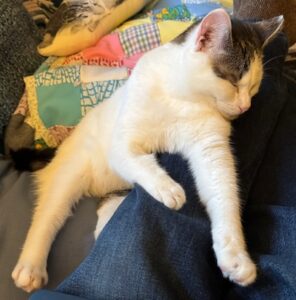
Maeve in a rare moment of rest.
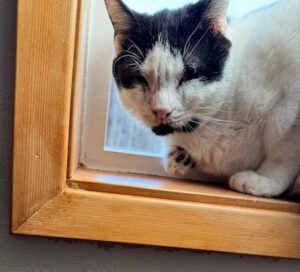
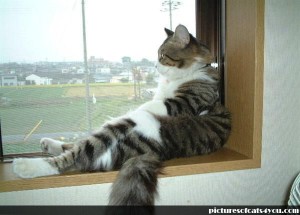
Moxie imitating a work of art, with the window frame serving as a faux picture frame.

Suddenly our quiet house has returned to an earlier time, with cat toys strewn about and the thundering of small paws down the hallway at 2AM when the wee furry ones have zoomies in the wee hours.

Now, despite being a lifelong “servant to cats” as well as a friend to dogs, I hadn’t included a pet in any of my books until my second Meg Booker mystery, Book Drop Dead, which sees Meg adopt a stray kitten she finds outside the library. However, little Honorius does not help solve any murders.

Writing a cozy featuring pets that are involved in solving a mystery is enticing, but of course there are already many such mysteries out there. Not that that’s ever stopped me before when an idea takes hold, but, just as I did with cozies in general, I’d want to read a stack of pet mysteries.

I’m already huge fan of Jeffrey Poole’s Corgi Casefiles series which give much inspiration for a potential pet-centered mystery, with his clue-detecting corgis Sherlock and Watson.

Now if I were to write a “pet helps solve mystery” novel it would of course have to star a cat or cats.

With that in mind I have Rita Mae Brown’s Mrs. Murphy cat mysteries, Shirley Rosseau Murphy’s Joe Grey series, Lillian Jackson Brown’s Cat Who books, and Miranda James’ Cat in the Stacks series on my to-be-read list of cat mysteries.

In honor of cats in mystery fiction, today we have an excerpt a from 2024 post by Elaine Vets on including pets in mysteries, as well as a 2016 post by James Scott Bell, on herding very different kinds of “CATS.”

Both post are well worth reading in full.

We all know that getting a reader inside a lead character’s head is one of the keys to compelling fiction. But it has to be done seamlessly so it doesn’t jerk us out of the narrative and put a crimp in the fictive dream.

Which means we have to learn to handle what I call “Character Alone Thinking Scenes” (CATS) in a deft manner.

The first issue is whether to begin the book with a CATS. As last Wednesday’s first-page critique demonstrated (in my view, at least) the answer should almost always be No. 

Why? Because we have to have a little personal investment in someone before we can care deeply about their feelings.

Imagine going to a party and you’re introduced to a fellow with a drink in his hand. You say, “How are you?” and the guy says, “I’m really depressed, man, I wake up every day and the room looks dark and the sun never shines, even though it’s out there, and I don’t see it because of the dark dankness in my soul, and life has lost its meaning, its luster, whatever it was it once had for me when I was young and ready to take on the world. Ya know?”

AHHHH!!!!

Well, the beginning of a book is like walking into a party. The reader wants to meet interesting people. And interest is aroused by what people do. The way you catch readers from the start is through action and disturbance, not feeling and expounding. 

I can’t tell you the number of manuscripts I’ve read over the years that did not begin with a real scene, but instead opted for the inside of a character’s head. What I usually do in such cases is flip the pages until I get to some dialogue, because that automatically means we’re in a scene. And 98% of the time that is the best place to start. (Sure, an argument can be made that a great style might be enough to carry the opening pages. But it better be truly great and truly brief.)

So, re: the opening—save your CATS for later.

Once you’re into the novel there are two types of CATS to herd—active and reactive.

In an active scene, the character is alone but with a major scene objective (something that materially relates to the plot), and thinks while trying to overcome whatever scene obstacles are in her way.

In a reactive scene, the character is alone with a chance to reflect. She may be thinking about what’s already happened in the story, or her current psychological state, or the other characters. When done well, reactive scenes strengthen our emotional bond with the character.

James Scott Bell—October 1, 2017


I’m writing a new mystery series set in South Florida. Here’s one of the hairiest problems I considered: did I want my protagonist to have a pet?

I like pets, and they’re popular with mystery readers. Especially cat and dog mysteries.

Many cozy readers are familiar with Laurie Cass’s Bookmobile Cat series. And that’s just the start of the good felines. There are series with Cat Cafes, Klepto Cats, Magical Cats, witches’ cats, library cats, bookstore cats and more.

Cats who talk and solve mysteries aren’t my cup of tea – my cats can’t even open a can of food for dinner. But what do I know? Readers love felines who can perform semi-human feats.

I could also give my new protagonist a dog. Dog mysteries are definite people pleasers. There’s a pack of them, including David Rosenfelt’s series, featuring work-avoiding, dog loving lawyer Andy Carpenter and his golden retriever, Tara.

Tara is a lovable companion. Other mystery series feature working dogs, such as FBI special agent Sara Driscoll and her search and rescue Labrador, Hawk.

Here are more good reasons to have pets in mysteries:

Walking a dog is a good way to meet people.

Animals are good judges of character. Dogs (and some cats) can rescue or defend you, warn you with a timely bark or hiss, even uncover a clue.

A pet in your mystery can be plus. Readers identify with pets. “Your cat reminds me of my orange tabby, Ginger. She loves to . . .”

But there are major downsides to consider. Pets need care. Your detective can’t be on the track of a killer and suddenly stop the investigation to make a phone call. (“Psst! Mark. I’m staking out the killer’s house. Will you walk my corgi? I just got a new living room rug.”)

Dogs also have to be fed and groomed. Cats are a little more easy care. Your detective can open a big bag of dry food and leave out a bowl of water, but sooner or later the litter box has to be cleaned.

Janet Evanovich’s Stephanie Plum series has a unique, easy-care animal, a hamster named Rex. Rex lives in a cage on her kitchen counter. Rex sleeps in a soup can and runs on his hamster wheel. Stephanie occasionally tosses him a grape for a treat.

But she’s such a good writer, Rex seems real. Once, some thugs held Rex for ransom, and I genuinely hoped the little critter would survive.

For this new series, I decided to go pet-free.

Elaine Viets—August 8, 2024

***

  1. Do you enjoy reading mysteries about pets? Any favorites?
  2. Have you included pets in your fiction? If so, what sort and in what fashion?
  3. How do you herd JSB’s “CATS” when you write?
Pet Words of Wisdom

Tuesday my wife and I said goodbye to our beloved cat Mittens, who we’d adopted along with his brother Simba when they were ten-week-old kittens. He finally succumbed to multiple health challenges after being our constant companion for over seventeen years. He and Simba were also my writing buddies, barely fitting together on the cat bed mounted to the window sill in my writing office, spending many hours there over the years while I wrote. If I put a printed outline or manuscript on the writing desk below their cat bed, one of them would often decide to offer editorial input by laying on it.

After Simba passed in 2019, Mittens continued as my writing pal. He lost his hearing as he became elderly and meowed loudly when hungry or craving my attention, which sometimes interrupted my flow and other times reminded me that I’d gone down a distraction rabbit hole away from my writing. He would often watch me from the patio window when I was outside stargazing at night. I’m very grateful he was a part of our lives, and a wonderful writing companion, especially for so long.

Pets have a special place in the heart of many writers and readers. While I’m a “cat person” I also love dogs, and enjoy greeting them and their owners on walks, as well as visiting those that live with family and friends. I also love encountering pets in fiction.

Today’s Words of Wisdom looks at pets in fiction, with excerpts by Elaine Vets, Sue Coletta and Terry O’Dell. The full posts are well worthy reading, and are linked from the dates below their respective excerpts.

I like most cat mysteries, too. But some are so cutesy they make my teeth ache. Cats are not sweet. They’re funny, they’re beautiful, they’re elegant. But I never forget that under a cat’s soft fur beats the heart of a killer. So I persuaded my editor that I should write my 13th Dead-End Job mystery about another subject. I sent her the outline. She was underwhelmed. “You really should write about cats,” she said.

“But they’re so girlie,” I said.

“They don’t have to be,” she said. “Write the Elaine Viets take on cats.”

That’s when it dawned on me. Cats are the new vampires. They’re a subject that’s eminently portable and ever changing. Cats are whatever you want them to be: cuddly, ruthless, aloof, loveable – or all four.

Each generation reworks the vampire myth. The classic Bram Stoker vampire was the rich preying on the poor. The ’70s Frank Langella vampire was sex without responsibility – or pregnancy. Charlaine Harris brilliantly reworked the vampire myth, and I’m not saying that just because I know her.

Charlaine was already a successful New York Times mystery writer with several series when she got the idea for her Sookie Stackhouse  Southern Vampire series.
Charlaine added a fresh twist. Her vampires, like gay people, lived unrecognized among us. Then the Japanese blood substitute let the vamps come out and northern Louisiana was overrun with the undead.

When other writers tell me they’re going to write a vampire mystery, I congratulate them. But I wonder if they’ll write a different vampire mystery, or simply another variation on one of the timeworn themes.

I wrote a vampire story called “Vampire Hours,” about a woman who becomes a vampire to escape the trials of middle age – an unfaithful husband, constant dieting, fading beauty. People asked me if I was going to make that story into a novel. No. My idea was different, but not universal.
But cats are universal. So I agreed to do the cat book. I’m owned by a defrocked show cat, Columbleu’s Unsolved Mysterie. She bit a judge at her first show. I would write my new Dead-End Job mystery about the world of show cats and the people who love and care for them. I’d report on a culture.

And so Catnapped! was born. Helen Hawthorne and Phil Sagemont, my husband and wife PI team, are the in-house lawyers for a Fort Lauderdale attorney. The lawyer’s client, Trish Barrymore, is divorcing her husband, financier Smart Mort,  and the only thing the couple can agree on is custody of their show cat, Justine.

When Mort fails to return the cat on time, Helen and Phil are sent to collect the cat. They find Mort dead and Justine kidnapped and held for half a million dollars. Helen goes undercover to work for a show cat breeder.

Judge Tracy Petty, Cat Fanciers’ Association southern region director, helped with the cat show details.

Did you know that long-haired show cats have to be bathed – and they learn to like it? Their fur is so thick they are slathered in Goop, the mechanic’s hand cleaner, and then the cats get two shampoos, a conditioner and more. Their fur is dried with a special blow dryer. There’s more.

Much more. But you’ll have to read the book to find it out.

Elaine Vets—May 8, 2014


A few things to keep in mind when writing pets into fiction…

If you kill the pet, you better have a damn good reason for it, a reason readers will understand.

For example, not long ago my husband and I watched John Wick. [SPOILER ALERT] I fell in love with the Beagle puppy his dead wife sent from the grave. When the bad guys murdered the dog I almost shut off the movie. If my husband hadn’t begged me to keep watching, that would’ve been it for me. Turns out, this moment kicked off the quest (First Plot Point in story structure). Not only is it an important scene, but if it didn’t happen there’d be no story. See? Understandable reason why he had to die. John Wick would not have gone ballistic over a stolen car. The puppy was the only thing left he cared about. It had to happen.

The safer option is to not harm the pets.

Why Does the Character Have That Specific Pet?

As I mentioned earlier, you need to know why the character chose that pet. Is he lonely? Does a couple use their pets to fill a maternal/paternal need? Are you using that pet as a way to show the character’s soft side? Does the pet become the only one who’ll listen to their fears, sorrow, or hidden secrets? In other words, for an introverted character, pets can assume a larger role in the story so your character isn’t talking to him/herself.

As the writer, you need to know why that dog, cat, bird, lizard, or bear is in the story and what role they play. Does a K9 cop track criminals? Did your criminal character train a horse to be the getaway driver? Does the killer feed his pet hogs or gators human flesh? Knowing why that fictional pet exists is crucial.

What’s the Pet’s Personality?

Animal lovers know each pet has his/her own personality. If you’ve never owned the pets you’re writing about, then I suggest doing a ton of research till you feel like you have. For example, while writing Blessed Mayhem I needed to know how crows communicated and how people could interpret their calls. What separated a crow from a raven, what they felt like, what they smelled like, what foods they enjoyed most. In order to make the characters real I spent countless hours of research into the life of crows. I even went so far as to befriend a crow of my mine. Turns out, Poe was female. It didn’t take long for her to bring her mate, Edgar. When they had chicks, they brought them too. It’s turned into a very special experience (story for another time).

What Does the Pet Look Like and How Does S/he Act?

First, you must know the basics … their markings, voice, breed, habitat, diet, etc. Then delve deeper into the expressions they make when they’re happy, content, sleeping, aggravated, and downright pissed off. Every animal has their own unique personality, mannerisms, and traits. Evoke the reader’s five senses. Don’t just concentrate on sight. By tapping into deeper areas, our fictional pets come alive on the page. A scene where the hero or villain cuddles with a pet can add a nice break from the tension, a chance to give the reader a moment to catch their breath before plunging them back into the suspense.

Plus, pets are fun to write.

Does the Basset Hound snore so loudly he keeps the rest of the family awake? Is he now banished to the garage at night? Does the German Shepherd’s feet twitch when he’s dreaming? Does the Mastiff throw his owner the stink-eye when he can’t reach his favorite toy?

Let’s talk dogs. They do more than bark. Use their full range of grunts, moans, groans, happy chirps, and playful growls when your character plays tug-of-war. For cats, nothing is more soothing than a purr rattling in their throat as your character drifts asleep. Soft claws can massage their back after a brutal day.

Years ago, I had a pet turkey who used to love to slide his beak down each strand of my hair. This was one of the ways Lou showed affection. I’d sit in a lounge chair with a second lounge Papa Bear lounge chair behind me, and Lou would work his magic till I became putty in his beak. He knew it, too. After all that hard work, I couldn’t deny him his favorite treats.

Sue Coletta—January 8, 2018

[B]ecause saying “No” has always been a monumental task for me, I agreed to go along with my editor’s request.

I was reading along, some hiccups due to my internal editor refusing to shut up, but overall, the writing was clean and easy to read. It was a little slow-moving for my taste, as the suspense element wasn’t brought in until later than I would have expected, but then … about ¾ of the way through the book …

The protagonist, who by now had received threatening emails and phone calls, came home to find a box on her doorstep. Upon opening it, she discovered the mutilated body of a cat. Not just any cat, but a stray she’d semi-adopted.

Mind you, this was not a serial killer, dark mystery/thriller type book. This was, overall, a romance with some suspense elements. And a mutilated cat.

Very early in my writing career (2004 according to my files), I attended my first writer’s conference. At a workshop given by the late Barbara Parker, she said she’d made the unforgivable mistake of having a mutilated cat show up in a box on the doorstep at the protagonist’s house. And, even worse, the protagonist had a young daughter. Parker said readers sent hate mail, and warned that killing a pet was an absolute no-no. Her book was a legal mystery, so her audience wasn’t romance-oriented, yet they still screamed.

I told her my manuscript for the as of then unpublished Finding Sarah included a character with 2 cats, and I had poisoned them (you’ll never know the delight you can light up in someone’s eyes until you holler between your office and the Hubster’s and say, “I need a way to poison a cat.”) My plan was to have one survive. The incident would 1) force my character to deal with emotions he’d denied; and 2) provide a critical clue for solving the overall mystery.

She gave me an emphatic “NO.” — Spoiler Alert— So, in the final version, both cats survived.

I passed this information on to my editor, who said she was warned against harming children or dogs, but nobody’d ever mentioned cats, and that she would bring it up with the author. Whether there are any changes remains to be seen.

Terry O’Dell—August 4, 2021

***

  1. Do you have a pet as a writing companion?
  2. Have you written about pets in your fiction? If so, how do you balance a unique take with a universal appeal?
  3. What do you think of Sue’s advice on writing about pets?
  4. How do you feel about depicting harm to pets in fiction?

***

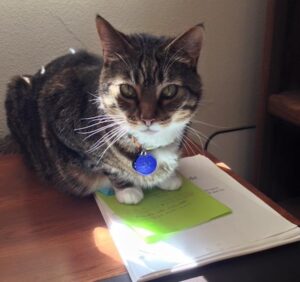
Mittens, having claimed a manuscript for editorial review, with appropriate super-villain under lighting.

What My Cat Has Taught Me About Writing

By Jordan Dane
@JordanDane


I’m convinced cats are noble beings reincarnated into a beautiful and graceful creature with four legs and plenty of attitude. No one owns a cat. They allow you to live with them. They tolerate you. Their fierce independence is one of my favorite qualities of theirs. At the mere drop of a string, they are ready to play. And when they are happy, their purr sounds like a fine-tuned engine.
 
Here are TEN things I learned from my cat(s) about writing:


    1.) Be suspicious of every character you meet, even the ones you live with. That keeps the tension going and readers won’t know who they can trust either.       

    2.) Suspense is all about anticipation of something bad about to happen, like when my cat stares behind me and makes me turn around. Without even a word, my cat can make me think a serial killer is creeping up on me. How do they do that? I’m still working on adapting that technique for my writing.

    3.) If a scene gags you, think what it will do to the next guy. Cough it up and get rid of it. Some things are meant for the trash. When it’s a pile in front of you, you’ll know it when you see it. Then just walk away. This works in the litter box too.

    4.) A cat knows pace. If there is a back story path that meanders across the top of a sofa or winds around legs in a prodding fashion, that is all well and good, but why not walk OVER people to get where you need to go and take the most direct route?

    5.) Take naps. If you’re prone to writer’s block, a nap can’t hurt. There is nothing like a nap or basking in the sun to rejuvenate your perspective. Cats are specialists in looking out for numero uno. Learn from a master and take heed. Getting stressed out over things you can’t control is a waste of time and a distraction from your writing.

    6.) Be a good observer of your surroundings. Narrow your eyes and really take a look around. Don’t take anything for granted. Everything is interesting when you narrow your eyes. Try it. (People who Botox should avoid this.)

    7.) Look before you leap. If you pay attention, you’ll land on your feet with style and grace.

    8.) Be flexible. It feels good to S-T-R-E-T-C-H yourself.

    9.) Curiosity never killed anything.

    10.) Climb your way to the top. Be fearless and maybe even cop an attitude. You can’t reach your dream if you think small and stay safe. Dare to take risks and have an adventure.  

    I’d love to hear your cat stories. I have two rescue cats – Pinot Grigio (yes, we named him when we were looking at a wine menu) and Foochie Focker (don’t ask).

    What has your cat taught you?

    Indigo Awakening by Jordan Dane voted the winner of “Best of 2012” Paranormal Category by BookTwirps