Today’s post is a call back to “Pet Words of Wisdom” from March 2024, posted just after we had to say goodbye to our beloved cat, Mittens, who was nearly eighteen when he passed. He was the last of the six cats in the many years my wife and I have lived in our little house. All of them brought great joy and liveliness to our home. After he died, we decided we needed a break.
That break ended last Saturday when we adopted Maeve and Moxie, pair of nine-month old kittens, who were part of the last litter born to an outdoor colony. The two were very underweight when they went into foster care, but now are glowing with life, love and energy.
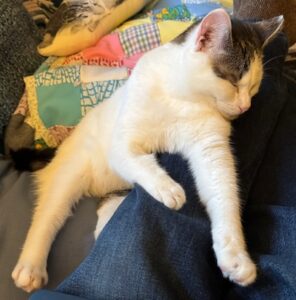
Maeve in a rare moment of rest.
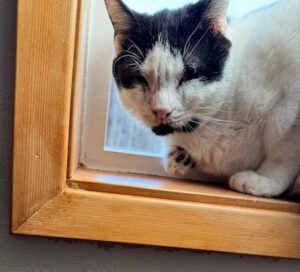
Moxie imitating a work of art, with the window frame serving as a faux picture frame.
Suddenly our quiet house has returned to an earlier time, with cat toys strewn about and the thundering of small paws down the hallway at 2AM when the wee furry ones have zoomies in the wee hours.
Now, despite being a lifelong “servant to cats” as well as a friend to dogs, I hadn’t included a pet in any of my books until my second Meg Booker mystery, Book Drop Dead, which sees Meg adopt a stray kitten she finds outside the library. However, little Honorius does not help solve any murders.
Writing a cozy featuring pets that are involved in solving a mystery is enticing, but of course there are already many such mysteries out there. Not that that’s ever stopped me before when an idea takes hold, but, just as I did with cozies in general, I’d want to read a stack of pet mysteries.
I’m already huge fan of Jeffrey Poole’s Corgi Casefiles series which give much inspiration for a potential pet-centered mystery, with his clue-detecting corgis Sherlock and Watson.
Now if I were to write a “pet helps solve mystery” novel it would of course have to star a cat or cats.
With that in mind I have Rita Mae Brown’s Mrs. Murphy cat mysteries, Shirley Rosseau Murphy’s Joe Grey series, Lillian Jackson Brown’s Cat Who books, and Miranda James’ Cat in the Stacks series on my to-be-read list of cat mysteries.
In honor of cats in mystery fiction, today we have an excerpt a from 2024 post by Elaine Vets on including pets in mysteries, as well as a 2016 post by James Scott Bell, on herding very different kinds of “CATS.”
Both post are well worth reading in full.

We all know that getting a reader inside a lead character’s head is one of the keys to compelling fiction. But it has to be done seamlessly so it doesn’t jerk us out of the narrative and put a crimp in the fictive dream.
Which means we have to learn to handle what I call “Character Alone Thinking Scenes” (CATS) in a deft manner.
The first issue is whether to begin the book with a CATS. As last Wednesday’s first-page critique demonstrated (in my view, at least) the answer should almost always be No.
Why? Because we have to have a little personal investment in someone before we can care deeply about their feelings.
Imagine going to a party and you’re introduced to a fellow with a drink in his hand. You say, “How are you?” and the guy says, “I’m really depressed, man, I wake up every day and the room looks dark and the sun never shines, even though it’s out there, and I don’t see it because of the dark dankness in my soul, and life has lost its meaning, its luster, whatever it was it once had for me when I was young and ready to take on the world. Ya know?”
AHHHH!!!!
Well, the beginning of a book is like walking into a party. The reader wants to meet interesting people. And interest is aroused by what people do. The way you catch readers from the start is through action and disturbance, not feeling and expounding.
I can’t tell you the number of manuscripts I’ve read over the years that did not begin with a real scene, but instead opted for the inside of a character’s head. What I usually do in such cases is flip the pages until I get to some dialogue, because that automatically means we’re in a scene. And 98% of the time that is the best place to start. (Sure, an argument can be made that a great style might be enough to carry the opening pages. But it better be truly great and truly brief.)
So, re: the opening—save your CATS for later.
Once you’re into the novel there are two types of CATS to herd—active and reactive.
In an active scene, the character is alone but with a major scene objective (something that materially relates to the plot), and thinks while trying to overcome whatever scene obstacles are in her way.
In a reactive scene, the character is alone with a chance to reflect. She may be thinking about what’s already happened in the story, or her current psychological state, or the other characters. When done well, reactive scenes strengthen our emotional bond with the character.
James Scott Bell—October 1, 2017
I’m writing a new mystery series set in South Florida. Here’s one of the hairiest problems I considered: did I want my protagonist to have a pet?
I like pets, and they’re popular with mystery readers. Especially cat and dog mysteries.
Many cozy readers are familiar with Laurie Cass’s Bookmobile Cat series. And that’s just the start of the good felines. There are series with Cat Cafes, Klepto Cats, Magical Cats, witches’ cats, library cats, bookstore cats and more.
Cats who talk and solve mysteries aren’t my cup of tea – my cats can’t even open a can of food for dinner. But what do I know? Readers love felines who can perform semi-human feats.
I could also give my new protagonist a dog. Dog mysteries are definite people pleasers. There’s a pack of them, including David Rosenfelt’s series, featuring work-avoiding, dog loving lawyer Andy Carpenter and his golden retriever, Tara.
Tara is a lovable companion. Other mystery series feature working dogs, such as FBI special agent Sara Driscoll and her search and rescue Labrador, Hawk.
Here are more good reasons to have pets in mysteries:
Walking a dog is a good way to meet people.
Animals are good judges of character. Dogs (and some cats) can rescue or defend you, warn you with a timely bark or hiss, even uncover a clue.
A pet in your mystery can be plus. Readers identify with pets. “Your cat reminds me of my orange tabby, Ginger. She loves to . . .”
But there are major downsides to consider. Pets need care. Your detective can’t be on the track of a killer and suddenly stop the investigation to make a phone call. (“Psst! Mark. I’m staking out the killer’s house. Will you walk my corgi? I just got a new living room rug.”)
Dogs also have to be fed and groomed. Cats are a little more easy care. Your detective can open a big bag of dry food and leave out a bowl of water, but sooner or later the litter box has to be cleaned.
Janet Evanovich’s Stephanie Plum series has a unique, easy-care animal, a hamster named Rex. Rex lives in a cage on her kitchen counter. Rex sleeps in a soup can and runs on his hamster wheel. Stephanie occasionally tosses him a grape for a treat.
But she’s such a good writer, Rex seems real. Once, some thugs held Rex for ransom, and I genuinely hoped the little critter would survive.
For this new series, I decided to go pet-free.
Elaine Viets—August 8, 2024
***
- Do you enjoy reading mysteries about pets? Any favorites?
- Have you included pets in your fiction? If so, what sort and in what fashion?
- How do you herd JSB’s “CATS” when you write?