About Kathryn Lilley

A crime writer, former journalist, and author of IMBA-bestselling mystery series, The Fat City Mysteries. She lives in Los Angeles with her husband and two neurotic cats. http://www.kathrynlilley.com/

First-Page Critique: The Art of Stage Setting

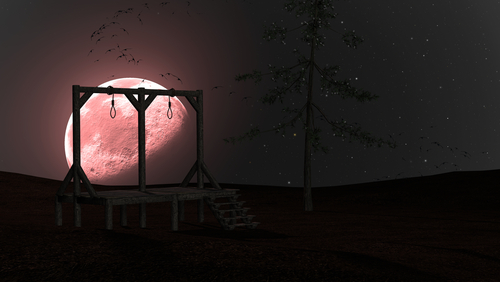
1gallows_shutterstock_239830486

Today we’ll be critiquing the first page of a story called THE GHOST AT BEAVERHEAD ROCK. I’ll add my comments at the end. Please add your notes and suggestions in the Comments.

THE GHOST AT BEAVERHEAD ROCK

Darkness still hid the night’s work when Daniel Stark and Timothy McDowell stepped out of the restaurant. It would not be hidden for long, Dan said to himself. A faint glow separated the outline of the easterly mountain ranges from the star-filled sky. The boy must not see it. They must be gone before anyone saw it.

The coach from Bannack to Virginia City stood in front of the Overland stage office. Restless, wanting to move and get warm, the horses stamped their feet, rocked the coach forward, then back. Their breath steamed in the lamplight spilling from the windows.

“It’s ready to leave. Hurry.” Dan slung his rifle across his back.

“Sun ain’t up yet.” Timothy yawned. “Sure is a nice morning. Crisp.”

The boy’s deep voice still could startle Dan, who thought of him as the boy he had left in the spring. “Let’s get our bags.” He set a fast pace toward the rooming house.

Boy-like, Timothy scuffed his toe at clods of frozen horse manure. “We’ll be in that dratted box all day. I want to enjoy the air.”

“You can enjoy the air in Virginia City.”

“Not if the smoke settles there. Gets so bad sometimes you can hardly breathe.” He took a deep breath, let it out. ”Nothing like mountain air.”

Dan looked over his shoulder. Timothy grinned at him, teasing, but took longer steps. Dan cuffed the boy’s shoulder, not much below his own. “That’s better.”

As he spoke, the stars lost brilliance, and the mountains around Bannack stood out from the sky.

The stage driver came out of the office, holding a coiled blacksnake whip in one hand. He arched his back, circled his arms, rolled his shoulders. Two passengers, a man and a stout woman walked out of the stage office.

Timothy lagged behind again. Dan called over his shoulder, “Hurry. They’re loading.”

“What in hell—?” Breaking into a run, Timothy veered off the boardwalk, broke into a run uphill.

Damn! He had seen it. Pivoting, Dan sprinted after him. He leaped the sluice ditch, dashed between the one-man cabins on Bachelor’s Row. His boots crushed frozen bunch grass. His breath rasped in his throat. The rifle bounced against his back.

He caught Timothy amid the sagebrush several yards from the gallows and tackled him around the waist. They tumbled together onto the ground. “No, Tim, don’t look – ” What he meant to say was lost as the corpse turned on its rope; its frozen eyeballs stared into his soul.

My comments: I think this first page shows that the writer has a nice ear for dialogue. The conversation between the man and boy flowed easily. There are some other craft-related issues that need to addressed, in order to make this scene stronger.

Get important information across early

I sense that this writer has a strong vision of the story’s characters and setting, but the first paragraph needs to provide more information to convey that vision to the reader. In the absence of clues, readers start making their own assumptions. It’s easy for them to wander off track. For example, I didn’t realize until the second paragraph that the story is set in the western past. By then, I had already formed a vision of a much more modern setting. It’s jarring to the reader to have to backtrack after making a wrong assumption.

Don’t over-withhold information in an effort to build suspense

The first paragraph in this story makes a reference to “the night’s work,” followed up by several more deliberately vague references to “it”. We don’t learn what “it” is until the very end of the page, however. Too much information is withheld for too long, potentially frustrating the reader or causing him to lose interest. The first paragraph might be stronger if it contained a hint or reference to the gallows. For example, instead of repeating the use of a vague pronoun in the following sentence:

It would not be hidden for long…”

It might be more dramatic if Dan spotted the silhouette of the dark, swinging mass (the corpse) emerging against the night sky. Just a hint, enough to give the reader some sense of the terrible sight that he’s trying to keep the boy from seeing.

Avoid confusing transitions between dialogue and action

By the time I encountered the following paragraph:

“What in hell—?” Breaking into a run, Timothy veered off the boardwalk, broke into a run uphill.

I still didn’t know what it was that Timothy had seen and was reacting to. By the time I got to the payoff at the very end of the scene–the sight of the gallows and hanging corpse–I was feeling confused and somewhat frustrated as a reader. This confusion can be avoided by providing the reader with enough information earlier in the scene, to keep him oriented and engaged in the story.

Your thoughts?

Please add your notes and suggestions in the Comments. And thanks to our brave writer for submitting this first page!


What’s Your Self-Editing Score?

imageHow good are your self-editing skills?  Take the following  test, and see how well you score! (The quiz is brought to you courtesy of today’s guest, writer and editor Debbie Burke.)

Self-Editing Pop Quiz

This morning, let’s imagine we’re back in school and the teacher announces a pop quiz to test your self-editing skills. Did you do your homework?

1. Scan your WIP and highlight every form of the verb “to be.” How many times per page did you use:
is ​

are​

am ​

was/were​

had

been

Tally your score:

Fewer than 5 per page:​ Excellent

Between 5 and 10 per page: ​Very good, but could use more active verbs

More than 20 per page: ​Work on how to “de-was” with strong, active, specific verbs.

Many years ago, I took a workshop from the late, great Montana mystery author James Crumley. He shared with me how to “de-was” and I’ve never forgotten. This single skill goes a long way to transform your writing into active, muscular prose.

2. Read the first few paragraphs of each new scene or chapter. Can a reader quickly determine:

WHO is present?

WHERE they are?

WHEN is the scene taking place?

If you can answer these questions, you’ve done a good job of orienting your reader immediately in the story world. Give yourself a point each time you effectively set the scene.

3. Do a global search for what I call “junk” words that add little information and dilute the power of your prose. Score a point every time you delete one of the below “junk” or “stammer” words.

There is (was)

​​it is (was)​

that

​just​

very ​

nearly​

quite​

rather​

sort of

turned to​

started to​

began to​

commenced to

Editor Jessi Rita Hoffman calls the last four examples “stammer verbs” that weaken the verb that follows, i.e. Barbara began to race to escape the zombie.

Stronger version: Barbara raced to escape the zombie.

Stammer verb exception: when an action is interrupted or changed, i.e. Robert started to run, but tripped over the corpse.

4. How many of your characters’ names start with the same letter?

Deduct a point if you’ve christened more than two characters with the same first letter, i.e. Michael, Mallory, Millie, Moscowitz, Melendez.

Deduct a point for rhyming or similar-sounding names: Billy, Lily, Julie.

Extra credit: if none of your characters’ names ends with “S,” give yourself a point for avoiding the unnecessary complication of figuring out whether it should be “Miles’s machine gun,” or “Miles’ machine gun.”

5. Do you exploit all five senses? Writers most often use sight and hearing, and ignore the other senses that can add texture and richness to the reader’s immersion in the story world.

Give yourself a point each time you employ one of the under-used senses of taste, touch, and smell.

Extra credit: for dramatic effect, deprive your characters of normal sensory input, i.e.

A blindfolded kidnap victim who cannot see where captors are taking her.

An explosion-deafened soldier who cannot hear the enemy stalking him.

6. The English language constantly challenges even experienced authors. In the eyes of editors and agents, improper usage of common words marks a writer as an amateur. Choose the correct word for each of the following:

(a) It’s [or] its a beautiful day in the neighborhood.

(b) The bear retreated to its [or] it’s den as winter closed in.

(c) Hurricane Katrina effected [or] affected every home in New Orleans.

(d) The affect [or] effect of Hurricane Katrina continued long after the rains ended.

(e) After the lobotomy, McMurphy possessed a flat affect [or] effect.

(f) The farther [or] further the boat drifted from the shore, the harder Joe paddled.

(g) The further [or] farther you pursue this tangent, the more you lose credibility.

(h) The magician made an allusion [or] illusion to Houdini’s famous “vanishing elephant”illusion [or] allusion.

(i) Robert implied [or] inferred that Janet was a tramp.

(j) Since Janet had been convicted of prostitution, Robert inferred [or] implied she was a tramp.

(k) The witness that [or] who saw the assault ran away.

(l) Winston tastes good like [or] as a cigarette should. (Trick question for those of a certain age.)

Answers at the end. Score 1 for each correct answer.

The Elements of Style by Strunk and White is my go-to reference whenever I’m not sure of correct word usage. I find answers to 98% of my questions in Strunk and White.

7. Scan an entire chapter. How many times is the first word of a new paragraph the name of your character or a pronoun referring to that character (he or she)?

8+ out of 10 times – Normal for the first draft, but try varying sentence structure to begin paragraphs in different ways.

5 out of 10 times​​ – Better, but still needs work.

2 out of 10 times​ – ​You display good variability in paragraph structure.

8. Point of View—do you stay consistently in the same character’s head for the entire scene? Doyou switch point of view only when a scene changes or when a new chapter begins?

How many POV changes can you find in the following passage?

Silky sheets caressed Teresa’s naked skin, as her heartbeat quickened. She watched Zack, framed in the doorway, as he unbuttoned his shirt. Secret fantasies he’d harbored for months were about to come true. Teresa’s heavy-lidded eyes promised a welcome worth waiting for. She quivered inside with trepidation. Would he be disappointed or thrilled? With a sweep of his sinewy arm, Zack whipped back the sheet, stunned to discover Teresa was really Terrance.

Answer: Four. The paragraph starts in Teresa’ POV because she feels the sheets and her heartbeat. Then POV switches to Zack and his secret fantasies, which she might guess, but can’t know about since they’re inside his head. Then back to Teresa, quivering inside. Then back to Zack being stunned.

If you struggle with POV, lock yourself inside the head and body of the POV character.Everything that goes on in that scene must be within the eyesight, earshot, or touch of that character. That means the character might be able to look at his own feet, but he can’t see the broccoli stuck in his teeth. Only another character can do that…and I certainly hope she tells him about it soon!

9. Is the action described in chronological order? Does cause lead to effect? Does action trigger reaction? Is the choreography clear to the reader? Who is where doing what to whom?

If you understand the last sentence, give yourself 10 points and deduct 10 points from my score!

How would you rewrite the following confusing sentence?

George slashed Roger’s throat with the knife as he grabbed him from behind after he sneaked into the warehouse.

How about: ​Knife in hand, George sneaked into the warehouse, grabbed Roger from behind, and slashed his throat.

Just as messy, but much clearer to the reader because events unfold in the order they happened.

10. Do you read your work out loud? If so, give yourself an automatic 10 points.

When you read out loud, you catch repeated or missing words, awkward phrasing, and sentences that are too long. “Glide” is the term used by author/editor Jim Thomsen to describe smooth, effortless, clear writing. Glide is like riding in a chauffeur-driven Rolls Royce as opposed to bucking and shuddering in a 1973 Pinto with bad spark plugs and a flat tire.

For extra credit, have someone else read your work out loud. If he or she can read without stumbling, you’ve achieved glide. Award yourself 25 bonus points.

Answers to 6 (a) it’s, (b) its, (c) affected, (d) effect, (e) affect, (f) farther, (g) further, (h) allusion, illusion, (i) implied, (j) inferred, (k) who, (l) Despite the catchy slogan from the 1950s, correct use would be as. Back then, liquor couldn’t advertise on TV, but cigarettes could. Now liquor ads are common, but few people even remember commercials for cigarettes. How times change!

How did you do? Tell us in the Comments! 

Fewer errors equal less distractions and a more engaged reader. A more engaged reader equals more sales.

And that equals an A+.

image

Debbie Burke lives in Montana, where she greets every morning with coffee and TKZ. Her articles (under the name A. Burke) appear in regional, national, and international periodicals. She has edited numerous published books and enjoys mentoring young writers. Her suspense thriller Instrument of the Devil will be published next summer.

Putting Backstory in its Place: First Page Critique

Shutterstock image via TKZ

Shutterstock image via TKZ

Today we are critiquing the first page of a reader-submitted story, titled THE BANK BAR. I’ll add my comments at the end, and then please add yours in the Comments.

THE BANK BAR

The young man had been stalking Sadie for over a month. He sat in his car and watched as Sadie walked home from the store. She didn’t know him. He wanted to make contact with her, but it was too soon. He just wasn’t ready. The only connection he had to Sadie was that he had gone to high school with her older brother. But, they weren’t friends, they didn’t really know each other. He had seen Sadie in a store one day, and knew she was special. Well, special to him. He had no problem attracting girls. He was good looking, smart, in good shape, and was charming. He didn’t have a role model growing up, although if his friends had known his father they would probably disagree.
Sadie was 20 years old, and he was surprised that Sadie was still single. It was 1938, and it wasn’t uncommon for girls younger than Sadie to quit school, marry, and get pregnant; or the other way around. The depression had forced a lot of students to leave school to look for work to help their family. Nor was it unusual for girls to marry someone older. His father was six years older than his mother when they married, and she was 16. But his father was gone now. Good riddance. The bastard had mistreated his mother, and often beat him in a drunken rage. For a long time, there wasn’t much he could do. Things change. A boy grows up. A boy gets bigger, stronger. Eventually, a boy becomes a man. That day came when he finally was able to face his father, and it was no contest. His father would never abuse his mother or beat him again. The neighbors heard that his father left to look for work, and would return for his family. A lot of men had gone off to try to find work. Lord knows there wasn’t much work in Greenville, Alabama. Only he and his mother knew the truth. It was something they could live with, and in fact, preferred to the violence they lived with before his father disappeared. He would not be returning. Ever.

My comments

I like the way this first page sets up a level of tension and expectation in the reader. At first, I wondered why the narrator describes “stalking” Sadie. Once it was revealed that the boy had previously killed his father, I immediately thought, “Uh oh, poor Sadie is next. We have an attractive, charming, serial killer on our hands.” If that’s where this story is headed, I’m interested!

Avoid getting bogged down in backstory and tell-itis 

Unfortunately, this scene suffers from a malady I call “the backstory blues.” The very first line of the story, “The young man had been stalking Sadie for over a month” sets the reader’s focus in the past. And there we stay–mired  in backstory details–for the rest of the page. This problem can be fixed by refocusing the scene to show what’s happening now. Let us see through the young man’s eyes as he’s watching Sadie. Is she a farm girl? Pretty? Vulnerable looking?

Use specific language and details

The language, “Walked home from the store”, is too brief and nonspecific to convey dramatic tension. Is Sadie walking a dusty back road or village sidewalk? Perspiring as she struggles with a heavy bag? Is she walking with a friend, and is her stalker waiting until she’s alone to make his approach? The more specific and “in the moment” this stalking scene can be written, the stronger and creepier it will be. Weave in the backstory elements without losing focus on the here and now.

Avoid weak words

Certain words are inherently weak, in conversation as well as writing. “He ‘just’ wasn’t ready.” “They didn’t ‘really’ know each other.” Edit those out.

Title note

I was a bit confused by the title. Having read the first page, I still have no idea what THE BANK BAR refers to. (A spot for dumping bodies, perhaps?) In this title, both words–bank and bar–can have multiple meanings. This title can be interpreted in different ways, and therefore, it lacks clarity. The title is a writer’s first opportunity to grab the reader’s interest. Make it as strong and compelling as possible. At the very least, the title should give a hint about the type of story that is to come.

Your thoughts?

How did you like THE BANK BAR, TKZ’ers? Please add your notes and suggestions in the Comments. And thank you to our brave reader for submitting this first page!


First Page Critique: INDELIBLE

Shuttertstock photo purchased by TKZ

Shutterstock photo purchased by TKZ

We’re critiquing a first page submission today, called INDELIBLE. I’ll add my comments at the end, and then please add your feedback for the writer.

INDELIBLE

“I would rather die a thousand deaths.”

​A short silence followed as Theny’s words fell between them.

Hard.

Like an ice-skating buffalo.

​“Good.” A pause . “I hope you realize I can make that happen.”

​Through squinted eyes, Theny Carlisle slid a sullen sideways glance over at the woman threatening her from the driver’s seat of the Caravan. And for the briefest of moments, Theny mentally ticked through the list of all the things she really didn’t know about her mother’s life before she’d been domesticated. Susannah Carlisle’s meek appearance could fool most anyone, making her the next-to-last person one might expect to make such threats. Petite with large doe-eyes and flowing brown hair, Theny thought her mom looked faintly…Amish.

Minus the bonnet.

Or the dress.

But with make-up.

Oh—and a tattoo.

On her neck.

Of a skull.

Driving a minivan.

Okay…Maybe not so much Amish.

​“You don’t know what it’s like, Mom,” Theny huffed and took to her iPhone.

​“Oh, don’t I? I think you’ve forgotten that I, too, was in high school once.”

​“Mom—seriously. You’re such a f…” Theny managed to catch the word ‘fossil’ right before it slid off the end of her tongue. She was in deep enough doo-doo as it was.

​“I’m such a what?”

​Theny swallowed, paused. “You’re such a…a…f-fine public speaker. So you wouldn’t understand.”

​With her thumbs poised over the phone’s screen, Theny gasped as her mother reached over from the driver’s seat and grabbed the phone from her death grip. Where had she honed such cat-like reflexes? The woman was quick. Impressive. Like a greased cheetah.

“PLEASE text me…so bored…riding shotgun with…the Fossil…,” Susannah read with the device propped on the steering wheel, seemingly unfazed by the F-word.

​“Hey—no texting and driving, Mom. Remember…‘It can wait.’”

“You are giving that speech, Betheny Jane Carlisle. And that’s final.”

“Speech? We could have died just then,” Theny scowled out the windshield.

​“Well then,” Susannah said with an evil grin, tucking the confiscated device into her shirt pocket. “I guess that’d be one down, nine-hundred-ninety-nine to go.”​

“Wha—?”

​“And I quote—‘I’d rather die a thousand deaths’—End quote.”

Theny sighed and let her head fall back against the headrest. It rolled to the right and smacked the rider-side-window. “Admit it, Mom,” she mumbled with her cheek pressed to the glass. “You were Mafioso before you met Dad.”

My comments:

This first page has some notable strengths–I like the strong sense of the young girl’s voice, and the equally strong opposing voice of the mother’s character. Other aspects of the scene had me a bit confused.

Where the heck are we?

The unusual name “Theny,” plus the reference to the mother’s character as having been “domesticated” made me think we’re reading a scene from a dystopian story set in  the future. But then, other references, “iPhone,” “Amish,” “(Dodge) Caravan,” undid that first assumption, leaving me feeling confused. Where (and when) are we, exactly, in this scene?

Keep every stimulus with its corresponding reaction

This scene starts off with the phrase, “I’d rather die a thousand deaths.” We have no idea what that dialogue refers to until much later, when the mother finally says, “You are giving that speech…” And even then, we have to surmise the implied association. Overall, this is a confusing setup. By the time the reader figures out what these characters are talking about, she may have lost interest. Keep every stimulus in your story closely associated with its corresponding reaction (you can also think in terms of keeping every cause with its associated effect). In this scene, we wander all over the place (the lengthy descriptions of the mother, tattoo, dress, makeup, etc.) before we learn what the heck these two characters are arguing about.

Don’t let readers make wrong assumptions

What kind of speech are the characters discussing in this scene? We need to get that information as early as possible, as well as a sense of why Theny is resisting the idea of giving the speech. Readers tend to “fill in” missing information by making their own assumptions. (For example, I assumed Theny is supposed to give a valedictorian address, but that assumption may be wrong.)  Don’t let readers wander down a wrong path by withholding specific information that they need to know. (Another example of this is when a writer introduces a character without physical specifics, and later refers to her as a brunette. That would be jarring to readers who had “filled in” the specifics by visualizing her with blonde hair.)

Use appropriate language for each character

I liked the way the daughter’so dialogue is written–it seems appropriate for a character in her teens. But then, when the daughter’s thoughts describe her mother, the language seems to belong to a much older speaker. “Honed..cat-like reflexes.” “Greased cheetah.” (“Greased cheetah” didn’t work for me, in general, btw. Nor did “ice skating buffalo”.)

Avoid confusing interruptions and transitions

I got lost during the back and forth about the iPhone and texting. For example, when I first read “Theny took to her iPhone”, I didn’t understand until rereading that she had started writing a text message. Then we have an interjection of dialogue from Susannah, “PLEASE text me..” without establishing a sense that it is now Susannah who is speaking. When you shift gears from one character to another, you need to make sure the reader stays with you.

A minor note: I also got thrown by the “F” word discussion. “Fossil” seems a very tame “F” word for Theny to be worried about using.

Overall

I sense the development of strong characters and an interesting story in this first page. Avoid unnecessary distractions, and keep going! And thanks to our brave writer for submitting this page for review!

Do you have feedback for today’s writer? Please add your thoughts in the Comments.

First Page Critique: SMACKDOWN!

image

Today we’re critiquing a first page submission, UNTITLED. My comments follow.

***

Locked up. That’s how it felt, with Liam’s one arm wrapped around my body and the other around my neck. I flexed my arms. His grip tightened. His sweat was dripping onto me, creating a puddle between my shoulder blades. He was way bigger – no way I could use brute force against him.

“How’s that for revenge, huh?” He snickered into my ear.

I chuckled lightly. He grounded his teeth in annoyance. The class was staring at us, so was our coach, Mr. Randall. Cedric grinned at me from the back. I grinned. “Not good enough.” I wrapped a leg around his, pulling upwards at the same time. His arms flailed as he attempted to regain his balance, failed, and crashed to the floor, dragging me down with him.

I got to my feet immediately and took the Jod Muay stance again. Head bent, arms up, protecting my face, left foot forward. I motioned with my finger, taunting him.

Liam scrambled to his feet. There was an ugly looking bruise on the side of his head. “You little shit-“

“We all know who that is.”

Liam swore and lunged towards me with a punch. I sidestepped and grabbed hold of his wrist. I watched as his eyes widened with surprise. I grinned. Then delivered two punches straight to his kidneys. Liam crumpled to the floor, gasping for breath.

“Ryan! Get off him!”

I turned to face my coach. “Mr. Randall-!”

“That’s enough Muay Thai for today! Your class is over!”

I swore. “Come on, sir! Just a few more minutes!” Hell, I was having fun. And we had barely started.

Before he could reply, Liam’s elbow slashed across the side of my head. Blinding white pain – then anger.

I tackled Liam to the floor, pummeling every inch of his body I could find. Once, twice, a third time. Liam was already half unconcious, barely fighting back.

I felt someone grab my arms and I was dragged away. I kicked backwards.

“That bloody-“

Cedric stepped in front of me, still holding down my arms. “Take it easy, buddy.”

I was still shaking. My face felt hot. “That – That bloody – hurt – “

Cedric put a hand on my shoulder. “Look, fight in the dorm, you know Mr. Randall doesn’t like you-“

“Yeah.” I cut him off, trying to focus on breathing calmly. Half the school teachers hated me. And it wasn’t my fault.

My comments:

This page does a nice job of conveying the tension of physical combat between the two characters in the scene. I sense an interesting main character and story here, but there are a few craft-related issues getting in the way. Some points to consider for revision:

Why do we care?

The first paragraphs in this scene convey the physical aspects of a boxing match, but little more. We get a hint of emotional tension at the end (the illegal punch, the reference to being disliked), but we could use some of that tension earlier. A boxing match without any context isn’t particularly compelling.

Keep the reader’s attention focused

The first paragraph combines a series of rapid-fire actions that shift the reader’s focus from the narrator to his opponent, then back again. That’s okay, but when dialogue is suddenly interjected, (“How’s that for revenge, huh?”), it’s unclear at first which character is speaking, and what he’s referring to. One way to fix that would be to start the second paragraph with an action establishing Liam, followed by his dialogue. For example, you could move the line about Liam tightening his grip around the narrator’s neck, and use it  as the intro to the second paragraph dialogue.

Avoid repeating similar elements

The word “snickered” is followed immediately by a similar synonym, “chuckled.” “Grinned” is also used three times on the same page. Overall, there’s too much grinning and chuckling going on–try to pare that back some.

Watch the word choice

It should be “He ground” his teeth in annoyance, not grounded.

Avoid action whiplash

The focus of the action shifts so rapidly in some places that the reader can become disoriented. For example, one paragraph contains all of the following: (“I chuckled…He ground(ed)…The class was staring…Cedric grinned…I wrapped…”). Too many shifts in focus happen too quickly here. In general, try to limit each paragraph to a single focus of action. It’s possible for a  paragraph to contain actions by multiple characters, but it’s hard to pull off.

Your thoughts?

TKZ’ers, can you add your thoughts and suggestions for our brave Writer today?

Ripping Stories from the Headlines

image


Jordan’s excellent post last week, about basing characters on friends or family, reminded me of another writer’s hack–ripping plots from newspaper headlines. The following headline inspired a subplot for one of my books:

 “Nurse Killed Patient Over Grudge”

According to the news story, a nurse in a plastic surgery office had murdered a patient during a plastic surgery procedure. And the motivation?  It turned out that the victim had “stolen” the nurse’s boyfriend 30 years earlier, when both women were in high school. So this murder 30 years later was the nurse’s way of getting some long-overdue payback.

Talk about revenge being a dish that’s best served cold!

That headline spawned an idea that stayed with me, and eventually emerged as a subplot in one of my mysteries.

image

I was particularly struck by this particular news story, because it underscored how powerful the emotions of rage and jealousy can be. Who would have thought that a jilted girlfriend would actually murder the “other woman” who happened to turn up in her medical care, thirty years later? In addition to fueling a subplot for my story, the article also made me start reflecting on what was to become one of the themes in my books: jealousy and revenge.

What about you? Have you ever based a story on a real-life event, or something you read about in the news?

Reader Friday: Happy 7th, TKZ!

shutterstock_213989965

Shutterstock photo purchased by TKZ

The month of August marks the seventh year since the launch of the Kill Zone blog, so we’re pausing to celebrate. We’d like to thank you, our readers, for helping us grow and thrive as a community over the years. Your comments and participation add tremendous value to the daily discussions here. We take pride in the fact that TKZ has been named by Writer’s Digest three years running to its list of “100 Best Websites for Writers.”  We’d also like to give a shoutout to our Emeritus bloggers, the folks who helped us find our identity and develop as a writer’s community over the years: John Ramsey Miller; John Gilstrap; Kathleen Pickering; Michelle Gagnon; Boyd Morrison; and Jodie Renner. Huge thanks, also, to our current crew of excellent writers: Joe Moore; PJ Parrish/Kris Montee; Elaine Viets; James Scott Bell; Clare Langley-Hawthorne; Larry Brooks; Nancy Cohen; Jordan Dane; Joe Hartlaub; and Mark Alpert.

Happy 7th Anniversary, TKZ!

— Kathryn Lilley