 I just returned from my annual sojourn to Las Vegas to attend the SHOT Show (Shooting Hunting and Outdoor Technology–at best, a tortured acronym), which is sponsored by the National Shooting Sports Foundation. The SHOT Show is to shooting and archery what the Detroit Auto Show is for car manufacturers, the event when new products are launched. It’s also an opportunity for me to meet with my subject matter experts face-to-face. A highlight of the SHOT Show is Media Day at the Range, when folks like me can shoot a wide variety of weapons, while sending hundreds of rounds of free ammo downrange.
As I wandered the 17 miles (!) of display aisles, it occurred to me that the average writer–or person, for that matter–cannot comprehend the thousands of variations that exist for what we casually call a gun. In this post, I thought I’d walk you through some of the major decisions your character would consider in deciding which firearm to carry.
Revolver, Pistol, or . . . Something Different?
For we gun porn purists, pistols and revolvers ar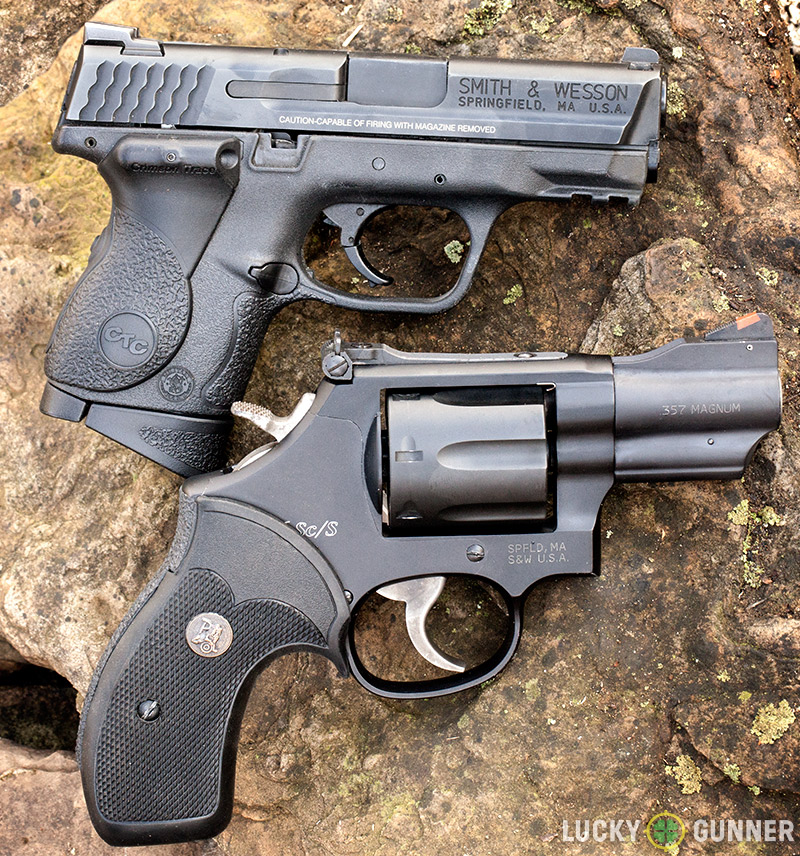 e mutually exclusive. Both are handguns, but they operate under entirely different principles. A revolver, otherwise known as a “wheel gun”, holds its cartridges in a cylinder that rotates as the hammer comes back and prepares for each shot. The revolver in the picture features an external hammer, and can be fired double action (DA) or single action (SA), which makes it a DA/SA revolver. (Double action means that with the hammer down, a single pull of the trigger with bring the hammer back, rotate the cylinder, and then drop the hammer again, firing the gun. Single action would describe the condition where the hammer is manually cocked and remains back–“condition zero”. From this condition, the trigger is more sensitive by a large margin.) Generally, there are no external safeties on a revolver. The fact of the long DA trigger pull functions as a safety. Only a fool would carry a revolver in condition zero.
 Recent years have seen a growth in the popularity of the DAO (double action only) revolver. With no external hammer to cock, every pull of the trigger is double action. The upside of a hammerless revolver is the ease of the draw from concealment (hammers have a way of snagging on clothing).
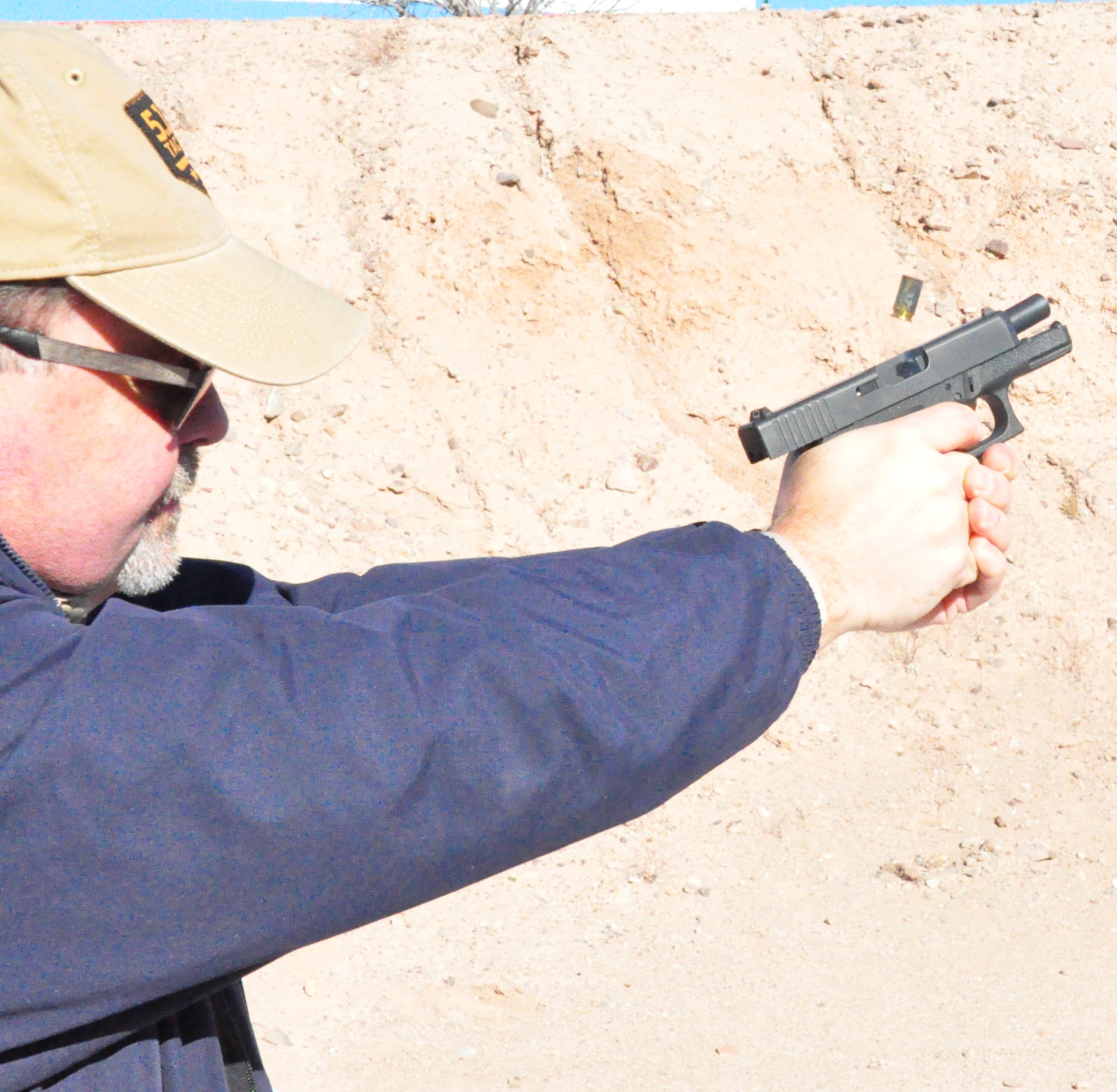
 A pistol, on the other hand, carries its load in a magazine that is inserted in the grip. As the weapon fires, the slide cycles, ejecting the spent shell casing and pushing the next round into battery. The picture at the top of this post of me at the range shows this cycling action of a Glock 36 at 1/4000 of a second–thanks to my son, Chris, for getting the picture.
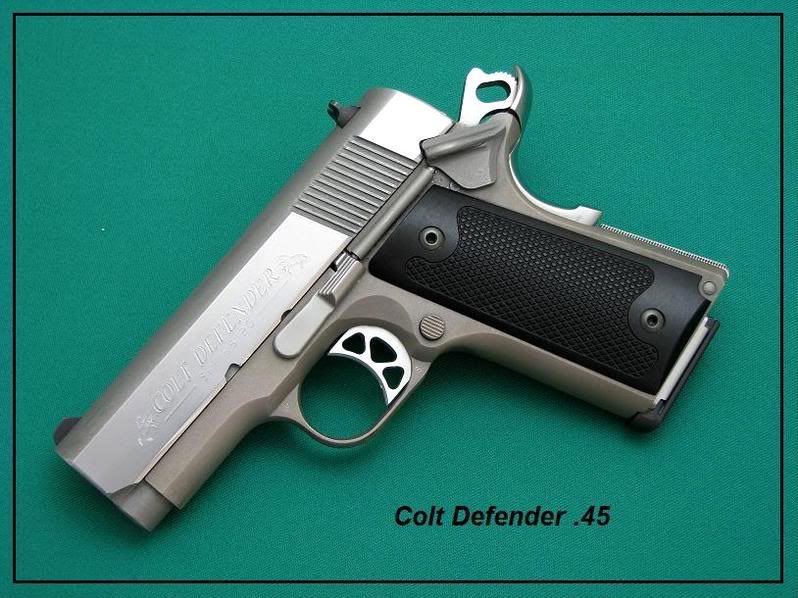
  The pistol in the picture with the revolver has no hammer, but is rather “striker fired”–a distinction that is best left to a future post. Striker fired pistols may or may not have external safeties. Some pistols have external hammers, such as the Colt Defender in the picture. As shown, the Colt is in condition one, which means cartridge in the chamber, hammer back and safety on–otherwise known as “cocked and locked.” In yet another iteration, many manufacturers make DA/SA pistols. The Bersa Thunder in the photo offers a very long, hard DA trigger pull for the first shot, which leaves the hammer back for a SA follow-up shot. For most DA/SA pistols, the “safety” is not a safety at all, but rather a de-cocker, which safely returns the hammer to its DA position.
What difference does it make?
There are so many variables, but consider just a few:
- If your character is going to shoot through a pocket or a purse, a revolver is the better choice because a pistol’s slide would likely get fouled or tangled in fabric, making a follow-up shot difficult if not impossible.
- It’s much more cumbersome and time consuming to reload a revolver.
- No modern revolver I can think of is compatible with a suppressor.
- For less-experienced shooters, a DA/SA revolver is generally a better choice.
What Caliber?
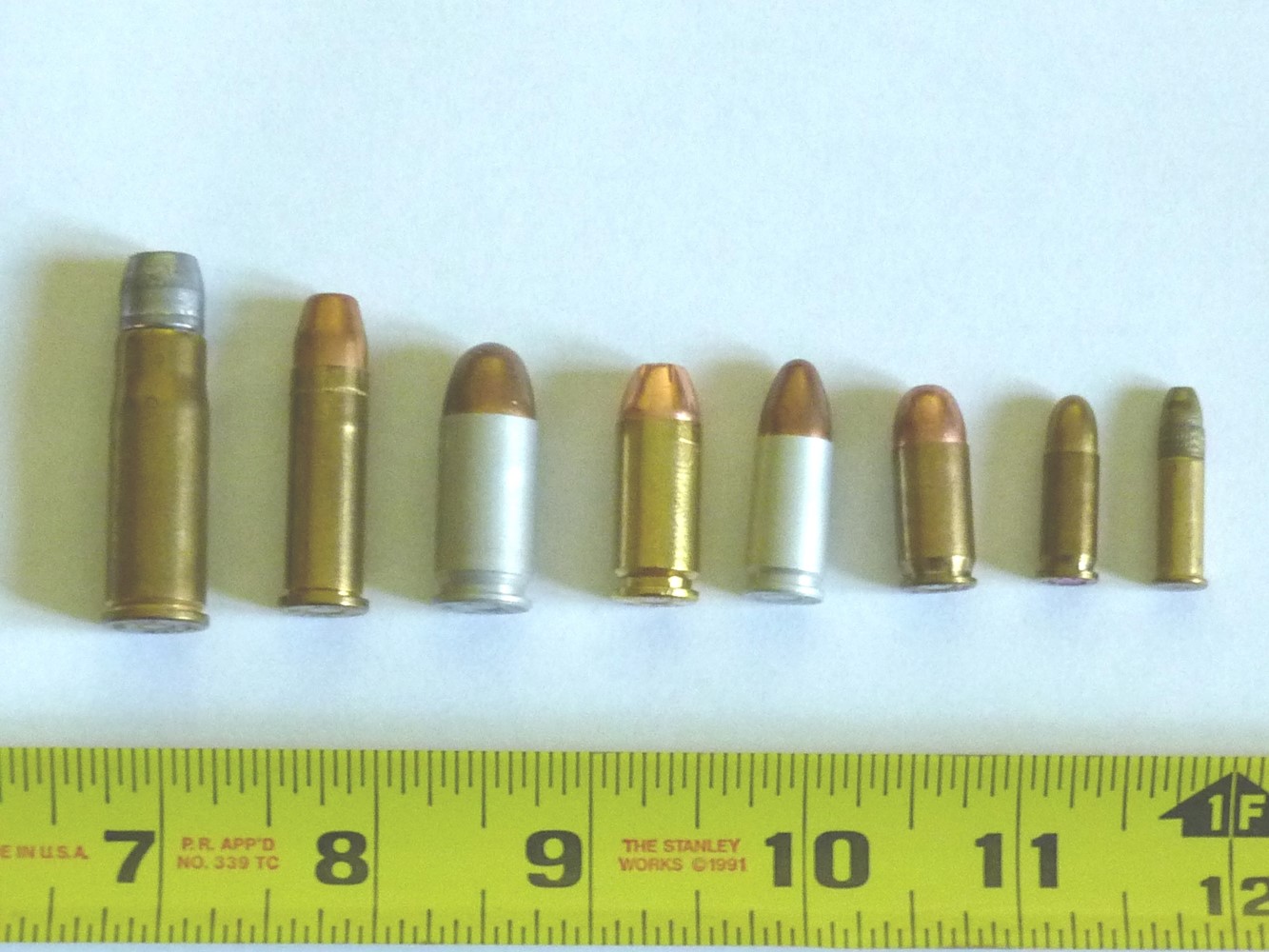
I’ve discussed bullet choices here in TKZ before, so I won’t regurgitate all of that here, but it is definitely a consideration. If your character is a cop or in the military, chances are that s/he won’t carry anything smaller than 9mm. On the flip side, I don’t know anyone who carries the Harry Callahan .44 magnum (“the most powerful handgun in the world and will blow your head cleeean off), but I know lots of people who carry .45 or .357 magnum.
Where on their bodies do they carry the gun?
 If your character is an on-duty cop or active duty military, where sidearms are worn in some kind of duty rig, the sky’s the limit for what they want to carry. You can buy holsters for all kinds of hand cannons. The choices become more limited when it’s important for your character to conceal his or her weapon. As a general rule, the larger the firearm, the harder it is to conceal. The obvious corollary is that bigger people can conceal bigger guns.
 When it comes to carrying a gun on one’s belt, the critical first choice is inside-the-waistband (IWB) vs. outside-the-waistband (OWB), and both mean exactly what the words say. Generally, OWB carry is more detectable,
 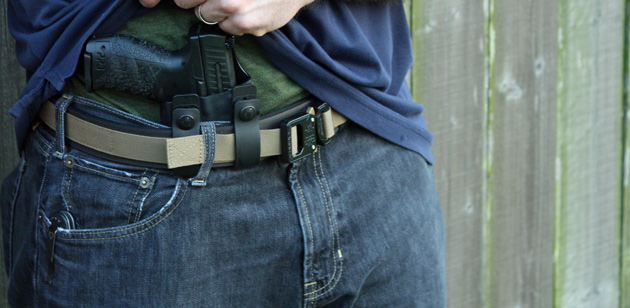 but with the right holster and an effective cover garment, it can be very effective. By contrast, IWB carry allows for concealment by means as simple as an untucked T-shirt. On the downside, the gun takes up waistband real estate that would otherwise be used by the waist.
  If your character wears skinny jeans, IWB could be a problem. IWB carry positions are referred to as positions on a clock face, where one’s navel would be 12 o’clock and the right hip would be 3 o’clock. The IWB position in the picture is referred to as “appendix carry”, and for the life of me, I don’t know how he would be able to sit down. Shoulder rigs are popular in movies and television shows, but I
 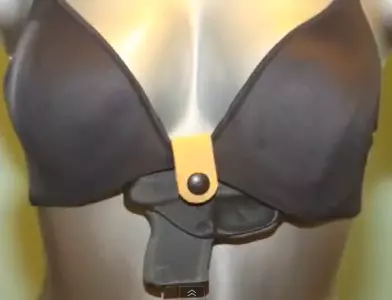 have never met a real person who wore one and didn’t hate it over time. They’re hard on the shoulders, and you can never let your arms hang normally. But the deal breaker for me would be that during the draw stroke, you pretty much have to point the gun at the person behind you, and then subsequently at yourself. That violates the basic tenets of firearm safety–as do many of the specialty retention devices such as the bra holster. ‘Nuff said, can we agree?
Now, suppose your character needs to go for deep concealment, and the weapon is merely for close-in defense? Suppose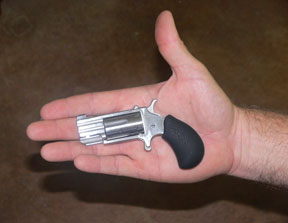 the only concealment option is a vest pocket, or perhaps a boot? Search the Web for specialty guns that are actually well-made and very effective for what they are. North American Arms makes a mini-revolver that easily fits in your fist, and can be chambered in .22 magnum, a round that shows very similar terminal ballistics to a .38 special, un
 der ideal circumstances. The tiny, nearly non-existent barrel is a problem for a shot longer than, say, 10 yards, but as a belly gun, it’s kind of impressive, and since it’s a revolver, your character gets five tries to bring justice to another character.
The Derringer lives on. Bond Arms manufactures a wide line of two-shot firearms that come chambered in nearly every caliber. One will even take 410 gauge shotgun shells. Beware, however, that there’s a direct trade-off between the weight of a firearm and the degree of felt recoil. These little guns kick like angry horses.
Questions?
At this point, rather than me blathering on answering presumed questions, let’s switch over to the real things. Any particular problems you’re tackling in your WIP?
 I recognize that I am blessed to be able to spend my days living the dream I’ve dreamed since childhood, and that alone puts writers in exotic real estate, especially in the perception of readers. It explains why
  one of my favorite pictures of another author is that of Stephen King working in a cluttered space with his feet propped up on the desk. It’s nice to get that peek behind the curtain.