About Joe Moore

#1 Amazon and international bestselling author. Co-president emeritus, International Thriller Writers.

Joining the Revolution

I’ve joined the electronic revolution and purchased an iPhone. Having been resistant for some time, I could no longer avoid the temptation of having the social networks at my fingertips, cool apps to explore, email at the tap of a button, and a personal calendar on hand. Now I can relieve my purse of my pocket-sized appointment book and my emergency Sudoku pad. No longer will I have to fumble for someone’s phone number or wish I could send a photo directly to Facebook. I can do all of these things and more.

And therein rests the problem. The iPhone, like its larger cousin the iPad, is in itself a complete source of entertainment. Miss a favorite TV show? Watch it on your device. Need to look up the nearest pizza palace? Ask Siri. Need to kill time at the doctor’s office? Read a book on iBooks. Or better yet, play a game of Solitaire.

No wonder people’s attention spans are decreasing. It makes me worry for the future of reading. Who will be able to concentrate on finishing an entire novel when so many other activities require less effort?

Thank goodness for teen fiction that captures the interest of our youth and perhaps spurs them on to develop a lifelong reading habit. Because once the older generation who gobbles up our stories in print form dies off, who will be left? Consumers who expect their reading material to arrive in the form of daily excerpts? Will the art of storytelling devolve into single page entries? How can we make reading more attractive to the younger set to compete with iTunes?

Storytelling will always be part of our psyche even if the means of delivery evolves. But as a novelist, I am concerned for the future of our art. Can those of us trained to write lengthy works adapt to the changing marketplace? What if we have no choice? Do we want to write shorter, compelling, quicker prose? Can we compete with smartphones and tablets, or must we join the revolution and change our techniques to suit them? 

“Heed this advice now!” she warned desperately

Note from Kris: I am in France this week so am handing over the reins to my co-author and sister. Take it away, Kelly!


By PJ Parrish

I was sitting in a restaurant the other day when my friend and fellow author, Tom Swift, happened to stop by and ask if he could join me.

“Yes,” I said cordially.

He sat down, his eyes slipping secretly to the paperback book lying wantonly near my wine glass. “I see,” he said insightfully, “that you are reading a popular author.”

“Yes,” I said affirmatively, nodding energetically.

“Do you like the book?” he asked inquiringly.

I wasn’t sure how to answer. Both of us had just returned from SleuthFest, which was geared for aspiring writers. There was a lot of good advice about plot structure, the differences between thrillers and mysteries, and character building.

My friend wisely picked up on my silence. “So,” he said flatly. “I take it you don’t like the book?”

“It was hard to read,” I said effortlessly.

“In what way?” he asked inquisitively.

“Well, I’m not sure what it was,” I said perplexedly.

“How was the plotting?” he asked ploddingly.

“The plot was okay. But it kind of fell apart toward the end,” I added brokenly.

“That’s too bad,” he said sympathetically. “Anything else?”

“The characters were okay but kind of cardboard,” I added woodenly.

“Really?” he said shockingly.

“Yes,” I acknowledged.

“But the book was a New York Times bestseller,” he interjected suddenly, jabbing at the book pointedly. “You are suppose to love the bestsellers. This one got great blurbs. And all the reviewers loved it.”

“Well,” I said deeply. “I just don’t know what it was about the book that I found tiresome but there was something.”

Tom Swift gave me a nod of his head, shaking it up and down, and then added a small, understanding smile, displaying his Hollywood teeth. “Well,” he said philosophically. “Some books are just like that.”

And with that, Tom sauntered away, slowly and casually disappearing into the misty dark inky black night.

I was left with my thoughts — and that bad book. I was thinking about all the good advice I had heard at SleuthFest. Really good stuff, even a great debate about talent versus technique. But one thing kept coming back to me — the thing all the good authors stressed. Robert Crais had said it best in his keynote speech: “Adverbs are not your friend.”

He didn’t say it lightly. He didn’t it dramatically. He didn’t even say it succinctly. He just said it.

Writers’ Conference Tips

I’m simultaneously energized and exhausted, and anyone who’s ever attended a writers’ conference knows how that can be possible. I just returned to Seattle from a fantastic time at Bouchercon in Cleveland, and I thought this would be a good opportunity to provide a few tips for those writers out there who have never gone to a conference and are thinking of trying it out (I heartily recommend it for those who intend to pursue writing fiction as a career).
First of all, I should clarify that Bouchercon is actually a mystery fan convention. As with other fan conventions, such as the RTBooklovers Convention, Bouchercon provides a chance for readers to meet authors whose books they enjoy, listen to them speak on panels about a variety of topics, and get signed copies of their books. The whole weekend is dedicated to readers, and writers love going because they get to meet fans and network with other writers who are going through the same trials and tribulations they are. It’s also the one place writers are treated like celebrities (there’s nothing more exhilarating than have a stranger on the elevator tell you she loves your books).
As opposed to fan conventions, writers’ conferences are geared toward authors, particularly those who are interested in learning the craft, understanding the business, or finding an agent or publisher. Confusion between the two may arise because authors tend to use the term “writers’ conference” generically.
With both types of conferences, I get a lot out of the long days and nights spent swapping information about writing with my fellow authors. My voice often ends up hoarse and I always need to catch up on sleep when I return home, but I’m also inspired with newfound energy to tackle projects that may have bogged down during my solitary confinement in front of the computer. Although I always learn something about the business and the writing craft, I especially enjoy hearing that someone else has the same doubts and challenges that I do, that I’m not alone.
I’ve been to over twenty conference and conventions over the last six years, and I consider every one of them time well spent. I list some of my lessons learned below, but I’d love to hear if anyone has their own helpful hints to add in the comments.
1.     If you can afford it, stay in or near the conference hotel. Trekking back and forth between a distant hotel and the conference center is a chore and doesn’t allow you to run up to your room to drop something off, get something you forgot, change, or simply recharge.
2.     Book as far ahead as you can. Popular conferences can fill up quickly, and there are only a limited number of hotel rooms reserved at the conference rate. I usually book the hotel room when I register for the conference because I can always cancel the hotel for no cost. If you do book late and the hotel is out of rooms, try calling the hotel daily in the hope that you can snag one of the cancellations.
3.     Dress in layers. Even if it’s warm outside, ballrooms can get chilly. Wear comfortable shoes during the day, and try to avoid wearing heavy perfume or cologne because it can be overpowering in a crowded room. Check to see if there will be any formal banquets or costume parties that might warrant snazzier duds.
4.     Target the panels you want to see ahead of time. You can usually download the programming schedule from the website a month before the conference.
5.     If you’re lucky enough to be chosen for a panel, be a generous panelist. Hogging the microphone is tempting because we all want to share our wisdom, but keep in mind that there are four or five other writers up there with you.
6.     Don’t be afraid to introduce yourself to people, even bestselling authors. That’s why we all go. I’ve made many good friends simply by joining in on a fascinating conversation, and writers tend to be very welcoming.
7.     Include people you don’t know in your discussion. You never know who’s going to have an interesting story or background or is just a really cool person. It may even be that bestselling writer you didn’t recognize.
8.     Have business cards to hand out. They don’t have to be fancy; just the basic info of name, email address, and website (if you have one). Ask for cards from people you talk to.
9.     Write down notes about people that you meet (if it’s an author, you can jot them down under the author names in the conference program). If you return next year, it’ll be a great way to remind yourself about the people you’ll see. When you see someone only once a year, it can be hard to remember the circumstances. I’m terrible with names, so please don’t be offended if this method doesn’t work for me.
10. When you’re in a discussion, always ask the follow-up questions to learn about why writers did what they did. It’s interesting to know what someone did to get published or how they wrote a book they way they did, but the reasons for their decisions can be even more illuminating.
11. Invite people to join you for lunch. I often strike up a conversation with someone I’ve met in an interesting panel and continue that discussion over a noontime nosh, usually with a boisterous group of friends who welcome the new person into the gang.
12. Check the schedule to see if there’s dinner provided. If not, plan to go out with your new acquaintances. During weekends, you’ll also want to make reservations if you go out to a local restaurant.
13. Spend your evenings at the hotel bar. It’s the place we all gather to shoot the breeze and meet new people. That doesn’t mean you have to drink; I know plenty of writers who are teetotalers.
14. If you do drink, do it in moderation. No one enjoys being around a sloppy drunk. Besides, writers love telling stories, and that kind of reputation gets passed around quickly.
15. Tip well. The waiters at this past Bouchercon were run ragged, and it doesn’t hurt to share your appreciation for them making your weekend enjoyable.
16. Wear your name badge, even when you’re in the bar. This will help me out a lot on the name problem.
17. Introduce yourself to booksellers, who also hang out at the bar. Don’t be shy about going around to the stores that are set up in the on-site book room. They love meeting writers. That’s why they’re in the business of selling books.
18. Take a nap. If you’re staying at the conference hotel, it’s easy to do.
19. Be nice and considerate, particularly to the conference volunteers. They’re putting in a lot of time and effort to create a great event. Not everything is going to go smoothly, but a little understanding and a friendly smile go a long way to getting past those rough patches.
20. Enjoy getting to know your peers. These are the colleagues you’re going to know for the next twenty years or more.

How Writers Should Die


When I first waded into the waters of self-publishing, I did so with two novellas. The first, WATCH YOUR BACK, showed me within the first month the potential for shorter books in the indie world. The second, ONE MORE LIE,became the first self-published work to be nominated for an International Thriller Writers Award, for which I will always be grateful.
And I owe it all to James M. Cain.
Cain, as most of you know, was the author of THE POSTMAN ALWAYS RINGS TWICE, his most famous work. Just behind it are DOUBLE INDEMNITY and MILDRED PIERCE. With hit movies based on each, Cain was, by 1947, one of the most famous novelists in America. The postman was delivering him a lot of money in those days.
His best books were written in a style that Cain made his calling card: the first-person confessional. The narrators recount their downfalls due to the entanglements of lust or greed or some combination thereof. There is something so direct in Cain’s prose. Spare and unsparing. Hardboiled but with a heart. Dialogue that snaps. Plots like runaway trains.
So one day I found myself sitting down to write about a man with a confession to make, and out came WATCH YOUR BACK. I liked it so much I did the same with ONE MORE LIE.
And I’m pleased to no end that the novella is back! You couldn’t get them published traditionally. They just didn’t sell. They were a staple of the old pulp era, but dinosaurs by the end of the twentieth century.
Now, with self-publishing, with low prices and instant delivery, novellas are back stronger than ever. I plan to make them a staple of my future work.
But even more important to me in all this is the example of Cain the man, Cain the writer. He was riding high when the 1950s hit, but then began a period of decline. Publishers started rejecting his stuff. He became, in the eyes of many, “damaged goods.”
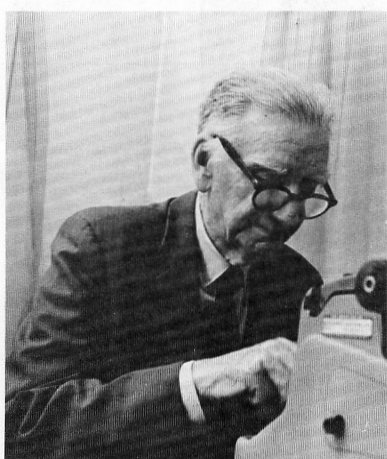
By 1963 Cain was 71 years old and without any contracts. He thought he might be the very thing he never wanted to become: an ex-writer. Yet James M. Cain still wrote a 1200 words every morning. Here he is doing that very thing, on his beloved typewriter, at the age of 75:

Now that is inspirational. And guess what? At the age of 82 James M. Cain received the largest advance of his career, for his novel RAINBOW’S END, which was published to excellent reviews. He completed another novel that was published and well received, then immediately got to work on a new one. He had just completed THE COCKTAIL WAITRESS when he died at the age of 85. That last “lost” novel has now been published by the good folks at Hard Case Crime.
That is a writer’s good death–type THE END and keel over! Don’t you believe that? You’re a writer, after all. It’s what you do. You’d do it even if everyone in your family came to you at midnight, woke you up and begged you, for your own good, to stop writing once and for all. You’d tell them to get out of the room because you’re dreaming of your next book and the boys in the basement need to get to work!
And that is why I will never stop writing. Even if the postman stops delivering checks. 

1984, the Thriller

by Mark Alpert

During our summer vacations in northern Michigan we spend a fair amount of time in the car, so my wife likes to read to the kids while we’re driving. This past summer she chose George Orwell’s Animal Farm for our automotive reading, and the kids loved it. They especially liked pointing out the hypocrisy of Animal Farm’s porcine leaders: “Hey, the pigs are breaking the rules again! They’re not supposed to sleep in beds!” And I loved it, too. From behind the steering wheel I kept interrupting my wife to shout comments such as “That pig is Stalin!” and “The battle against the farmers is really World War II!” until everyone yelled at me to shut up.

When school started last month I decided to continue the George Orwell theme by reading 1984 to my 13-year-old son. My feelings about this book were more ambivalent; I didn’t enjoy it very much when I read it for high-school English, and thirty years later I could remember only two things from the novel: the scene where Winston Smith is arrested and the infamous rats in Room 101. I recalled almost nothing about Smith as a character. In contrast to the memorable beasts of Animal Farm (especially Boxer the horse: “I will work harder!”), the hero of 1984 didn’t stick in my mind. I thought it would be interesting to read the book again and see if I liked it any better now. Is 1984 — the great-granddaddy of The Hunger Games and other dystopian novels — an entertaining book? Can it be considered a thriller?

Well, the book definitely doesn’t start like a thriller. No murder or mayhem in the first ten pages. The novel’s opening reads more like science fiction, because the author spends so much time sketching the outlines of the horrible future he’s imagined. But the extreme creepiness draws you in. While Smith hides in a corner of his apartment, writing “Down with Big Brother!” in his black-market notebook, I’m definitely there with him, anxiously wondering if the Thought Police are also watching the scene. And the plot gains some momentum after Winston starts conspiring with Julia, the Junior Anti-Sex League crusader who turns out to be a hottie.

Smith, though, isn’t much of a hero. He’s unattractive, both physically and spiritually. He has a disgusting sore on his ankle. (Orwell never explains how it got there, but it fits in with the general squalor of totalitarian London.) Winston is also irritable, peevish, self-absorbed. When he was a child, he stole food from his dying sister. His rebellion against Big Brother isn’t triggered by sympathy for his fellow sufferers. He seems most outraged by the Party’s constant revision of history. And his rebellion is thoroughly passive; everything falls into his lap. Julia is the one who initiates their affair by slipping the “I love you” note into his hand, and O’Brien lures him into “the Brotherhood” in such an obvious way that if Winston had any sense at all he would’ve immediately realized it was a trap.

For a thriller writer, these are cardinal sins. We all know that our heroes must be heroic. They must be active, clever, resourceful. But Orwell deliberately made Winston Smith a pathetic figure. He wanted to emphasize the powerlessness of the individual against the state. “If you want a picture of the future,” Orwell wrote, “imagine a boot stamping on a human face — forever.”

The other sin Orwell commits (from a thriller writer’s point of view) is clogging the narrative with the thirty-page tract supposedly written by Big Brother’s nemesis, Emmanuel Goldstein. When I read this section to my son, he asked, “Can we just skip this part?” and I said, “Sure.” And later on, Orwell takes some of the suspense out of the torture scenes by padding them with too many lectures from O’Brien. This criticism, I admit, is a little unfair; Orwell never meant the book to be a thriller. He was trying to make a point as well as tell a story, and sometimes those two aims don’t mesh.

Still, there are some powerful action scenes in 1984. I’m thinking in particular of the scene in the crowded jail cell shortly after Smith is arrested, when the anxiety and terror of the political prisoners is interrupted by the entrance of a man whom the Party is starving to death. One of the other prisoners — another pathetic figure, chinless and chipmunk-faced, with the ridiculous name of Bumstead — offers the starving man a grimy piece of bread, and the guards punish him for this crime of compassion by bashing his face in. “His body was flung across the cell and fetched up against the base of the lavatory seat…Amid a stream of blood and saliva, the two halves of a dental plate fell out of his mouth…His gray eyes still flitted from face to face, more guiltily than ever, as though he were trying to discover how much the others despised him for his humiliation.”

Thriller or not, this is great writing. And best of all, my son liked it, too.

Apologies for the System Failure…

by Michelle Gagnon

I arrived in Cleveland for Bouchercon last night around 11:30pm after an insufferable series of layovers and general travel woes, and was up until 2 am trying to post a fascinating, insightful blog about marketing with a traditional publisher. Of course, the internet in my room doesn’t work (inexplicably, neither does HBO).
So instead, now that I’ve finally managed to log on, I’ll leave a much more abbreviated post on Bcon Cleveland so far…

Firstly, I sold a house today! Yes, in between panels and wireless struggles, I managed to close a deal. It’s bittersweet, really- the first house I ever owned, and the one where my daughter spent the first three years of her life. Lots of good memories there, but some more recent, bad ones too. So all in all, I’m pleased to be moving on.

Great Young Adult panel today with our own Jordan Dane, Joelle Charbonneau, and Bev Irwin. We laughed, we cried, we discussed sex and violence (and the lack thereof) and John Gilstrap threw peanuts from the back row (not really, but I could tell he was considering it). 

Sadly, the bookroom did not manage to stock my books. It’s kind of a post-apocalyptic bookroom, there’s a mere scattering of books at every table. I’ve never seen anything like it.

On the plus side, I scored an ARC of TWELVE by Justin Cronin in my book bag. So apparently I’ll be up all night reading instead of logging time on a bar stool.

Ate lunch with Alyson Gaylin, Martyn Waites, Deborah Crombie, and Wallace Stroby. Great food here so far, although I’m not entirely convinced that my lamb burger was made of lamb. 

Side note: there’s a casino next to the hotel. Every window is branded with the following: SMOKING PROHIBITED. WEAPONS NOT ALLOWED. Who knew they were so strict here?

Tonight is the opening ceremony at the Rock n Roll Hall of Fame, and of course I forgot to pack my Led Zeppelin T-shirt. 

Did I mention that I sold my house? Still slightly giddy over it.


Making an emotional connection

By Joe Moore

While reading the news recently, a story caught my attention: At least 25 dead in Hong Kong ferry collision. Apparently, two vessels collided, killing 25. More than a dozen others were missing. It’s being called one of Hong Kong’s worst maritime accidents.

plugAlmost every day we read or hear about tragedies in the news: earthquakes, floods, tsunamis, fires, mass killings. As human beings, even the most distant, obscure news of fellow humans losing their lives or encountering other tragedies usually draws some emotion, even if it’s fleeting. But unless we’re directly connected with the people in those news stories, our emotional reaction and interest is often shallow at best. The reason is that we know virtually nothing about them. They are just numbers and statistics. If we take the time to read the article, we may see some additional details that make the people involved a little more real. There may be a human interest angle that grabs our attention for a moment or two before we turn the newspaper page or click on the next link. But basically, we don’t care deeply because we have no emotional connection with them.

As writers, when it comes to our readers, if they have little or no emotional connection with the characters in our books, they won’t care what happens to them. And if they don’t care, we’re in trouble.

An emotional connection is created when a reader formulates conclusions about our characters’ personalities based on what we show the characters doing and saying. It’s not good enough for the narrator to “tell” the reader what a brave and generous guy our protagonist is or that our antagonist is a heinous villain. We have to show the reader through the characters’ actions, dialogue, interior thoughts and reasoning, and the way they treat others and their life choices from one situation to the next. Then a connection can start to form.

A solid approach to establishing each of these is to ask: what would you do? How would you react to a situation that you’ve created in your story? It doesn’t matter whether you’re assuming the persona of the protagonist, antagonist, secondary character or a mere walk-on. You are a human and so are they. They should act and react like humans, think like humans, and reason like humans. Only when they do will the reader form the critical bond or connection. Otherwise, all you have is two-dimensional paper-doll cutouts lacking depth and dimension.

Some helpful techniques include using universal experiences. Who has not told a lie to avoid hurting someone’s feelings? Who hasn’t been faced with deciding between what’s right and what’s easy? Who hasn’t felt animosity or even hate for someone who has wronged you? When your character is in a similar situation, examine how you would react?

If you want your reader to like your character, analyze what it is that makes you like or love someone in real life. Use those emotional traits to build your character. And the opposite is also true. To create a character you want the reader to hate or despise, look for someone you dislike and figure out why. Are they egotistical, self-centered, mettlesome, cold, cruel, or mean? Utilize those universal feelings to build a strong antagonist. But never lose sight of the fact that you’re dealing with humans. Even Hannibal Lecter and Darth Vader had strong human characteristics, good and bad.

One universal element that we all can relate to is pain—both physical and mental. Don’t be afraid to dish out the pain when it comes to developing your characters. It’s okay to put pain in their path because it gives them an opportunity to overcome something and by doing so become stronger or wiser or both. Pain, like any other obstacle, is an opportunity for character growth.

The more human you can make your characters, the better chance you’ll have of your readers forming a connection with them. Always consider how you would react, then have your characters act in a similar, logical manner. And throw in a shot of pain once in a while to keep things interesting.

What about you? Think of your most memorable characters, as a writer and/or reader. What made the two of you connect?

What should a writer take on the road?


Clare’s post yesterday about her travels reminded me that I need to get ready for some upcoming globe hopping (Hong Kong and Vienna).  I’m beginning to wonder how I should handle my various devices (iPad, smart phone, Kindle, laptop) while overseas. For example, does 3G service by Apple and Amazon extend to Asia and beyond? Will I come home to a mega-roaming bill from Verizon if I so much as turn on my cell phone outside the continental United States? Do hotels nowadays provide the right kind of electrical outlets for Americans, or do we have to tote a converter in the luggage?

My husband recently had a nightmare experience with an iPad he’d purchased overseas (turns out it was sold without the right configuration for the US). He spent the better part of a day during a business trip getting the darned thing up and running.

So I’m looking for advice from any of our travel-savvy Zoners. Is there anything I should be sure to set up before we leave? Any cautionary tales or rules for the e-road?

Avoiding the Pretense

by Clare Langley-Hawthorne

I’m still on the road and by the time this post ‘airs’ I will probably be on a plane somewhere over the Pacific. It’s been a whirlwind week- long visit to Denver and not quite enough time for my body clock to reset (though after a week lazing on the beach in Palm Cove I can hardly complain!). We clocked 31 hours traveling last Sunday coming over here and I sincerely hope it won’t be that bad going back!

One thing traveling always highlights for me is there is no glamor in being a writer – or if there is it is fleeting indeed – and I chuckled over Mark Helprin’s article in the Wall Street Journal yesterday entitled ‘Skip the Paris Cafes, And Get a Good Pen.’ It was a fun reminder that the key to writing a great novel is sitting down and doing it, not posing at a cafe as if you are some kind of latter day Ernest Hemingway. This got me thinking of some of the pretensions would be writers might indulge in – and here are just a few that I’ve noticed over the last few years.

  • T-shirts announcing to the world that you are a ‘writer’ (thereby begging completely strangers to indulge your ego and asking about your novel)
  • The ‘faux-complaints’ about one’s agent, editor or book tour, announced in extra-loud tones in conference hallways or in disingenuous Facebook posts (e.g. I just got in at 3am after my first-class trip to see my UK publisher in London was delayed, ah, woe is me!)
  • And speaking of Facebook posts – you know the ones, the endless ones, that seem to spew forth relentlessly marketing someone’s latest literary offering
  • Posers on planes who heave out their manuscript, look around as if searching for inspiration among the throngs of economy seated passengers, and then wait for the tidal wave of approval (while not actually doing any writing or editing on said manuscript!).

So what kind of literary posing have you witnessed? What makes you sometimes want to just say – skip the cafes and the moleskin notebooks and just write the damn novel!

And in spirit of this post, I shall now apologize for not being able to respond to comments as I shall be in mid-air (though in economy…probably the last row next to the loos…)