About Joe Moore

#1 Amazon and international bestselling author. Co-president emeritus, International Thriller Writers.

Resolution, justice and happy endings

by Clare Langley-Hawthorne

This weekend I attended Booktown the annual book festival held in the small Victorian town of Clunes, where I heard Peter Corris, Jean Bedford, and Michael Wilding speak on the topic of the long arm of crime fiction. One issue which prompted some discussion was the issue of whether readers still look for good to triumph over evil in a mystery novel. The panelist seem to think that far more ambiguity is now allowed. They noted that writers such as James Ellroy have already upended the traditional mystery form and felt that it was possible now to end on a note in which evil, while not triumphant, certainly hasn’t been bested by the forces of good.

This got me thinking about the need for a satisfying ending and how, in many books, I have been more disappointed by a trite or glib happy ending than I ever have by books in which evil doers get away (at least in part) with their misdeeds.

Nevertheless, I do think resolution is critical in any kind of novel, and by that I mean that all the critical plot elements have been explained and resolved. I wonder though if I don’t secretly yearn for justice at the end of a mystery or thriller. Would I be satisfied with a conclusion that allowed the crime to go totally unpunished? Would I feel let down if the protagonist failed to succeed in bringing the perpetrator to justice? To be honest I’m not sure.

What about you? What kind of resolution are you looking for in a crime novel? Do you need to see justice done?

Where Do You Write?

James Scott Bell

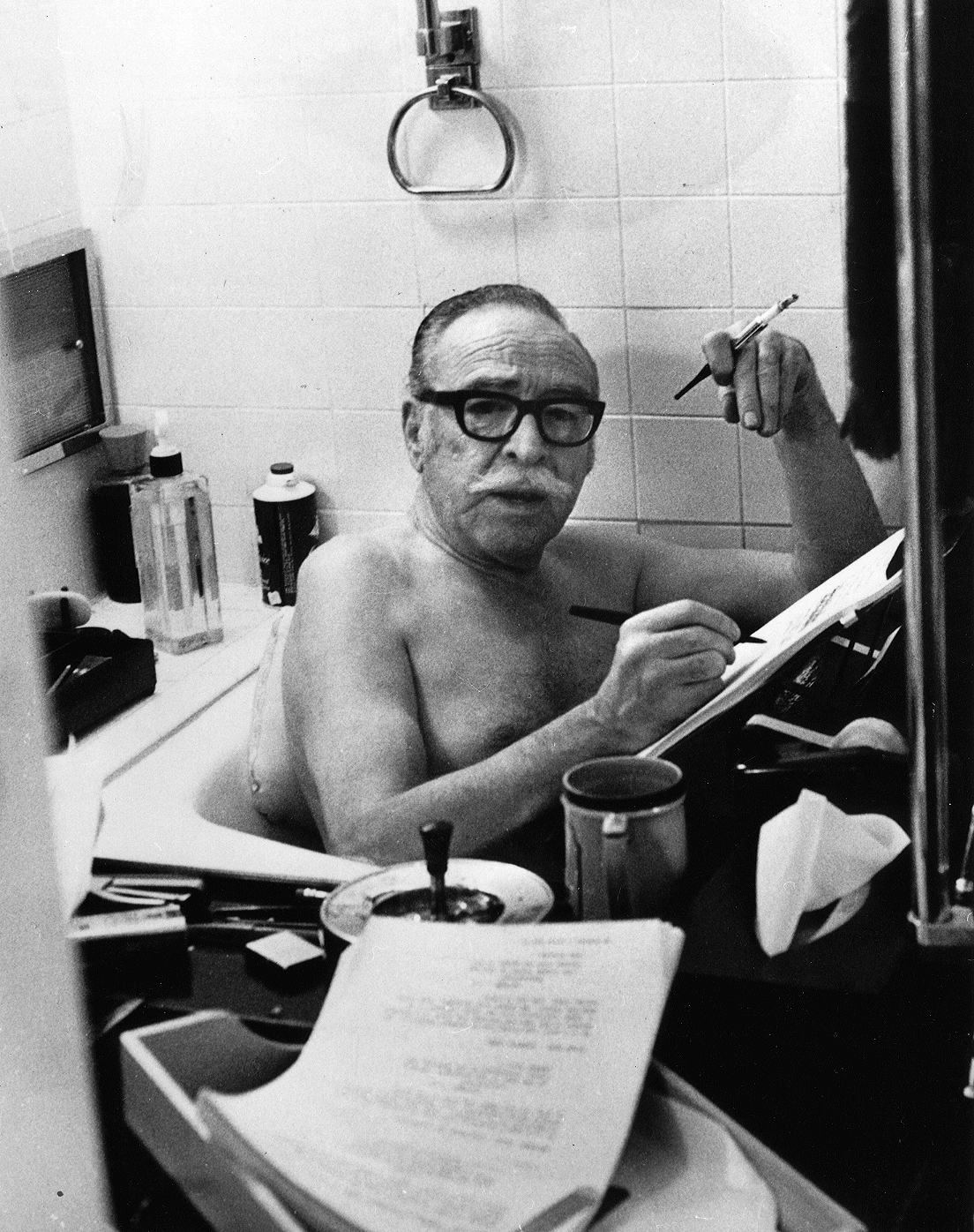
Here is a picture of the noted screenwriter and novelist, Dalton Trumbo. He’s in a nice bath, his pad and coffee at the ready. He looks like he’s enjoying the whole writer thing.


Not sure I’d like to write in the tub. I split my time between my home office and my branch offices all over the world, the ones with the round green sign.
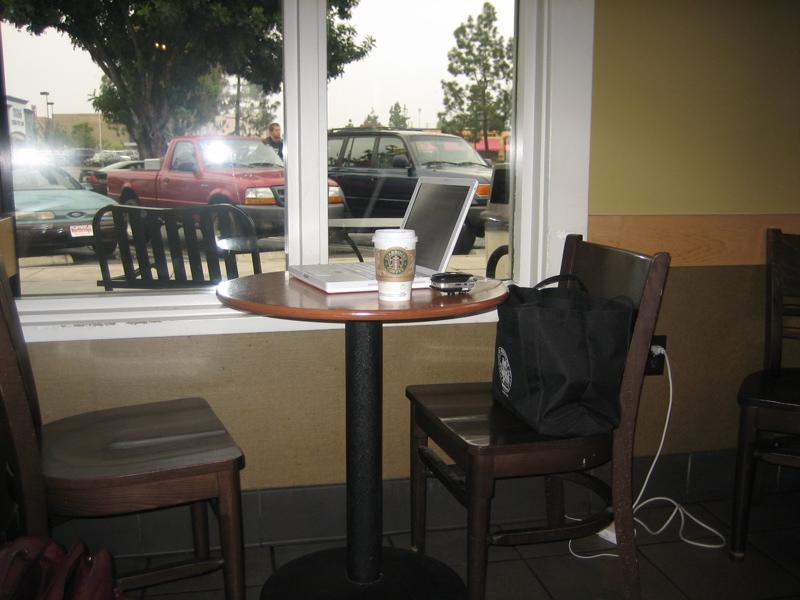
Here is the table at my local Starbucks, where I wrote several books. 


I loved that table. But they recently remodeled the store, and my table is gone. The new tables are a tad smaller and the chairs have lower backs, not nearly as comfortable. No one got my permission to do this, by the way.
So I got to thinking, if I could design my perfect writing environment, what would it look like? I think I know. It would be at Dean Koontz’s house, in the guest room upstairs, overlooking the Pacific Ocean. Dean would be kind enough to let me use it whenever I wanted to.


Then again, would that be too distracting? Would I spend more time gazing than writing? Maybe my home office, with the blinds closed and the familiar mess surrounding me, is still the better idea.
So where do you write?
If you could design your ideal writing spot, what would it look like?

Dark Humor…or…How To Embarrass Your Daughter Anywhere

DARK HUMOR or, HOW TO EMBARRASS YOUR CHILD

Bad weeks seem to be in abundance around here. I have been fortunate. I have witnessed bad and wrong and sad things, but from a distance, from the periphery. I’ve done what a could, and can, to help, while silently giving thanks that the bullets of misfortune missed me, even as I feel badly that they hit someone else. This of course, does not prevent my penchant for inappropriate comments from rising to the fore.

The saddest of a series of events occurred two weeks ago when the son of a family in my wife’s prayer group was found dead at home. He was eleven years old. My thirteen year old daughter had seen him and talked with him just three hours previously. I cannot even begin to imagine what his family went through, what they continue to go through, but I hope to never experience it.

The wake was held a week later. We went to the funeral home, where I was reminded why I want no calling hours, no service, no memorial eulogies, no pictures projected onto a screen. Harvest my organs, burn me up, and scatter my ashes into the Mississippi in view of the Café du Monde. I hope it brought comfort to them; it just isn’t for me. As with such events, I was ready to go after paying my respects. My wife and daughter, however, wanted to stay, so I wandered around the facility while they visited with the family and acquaintances. It wasn’t long before they remembered why I am best left at home, preferably attached to an ankle restraint.

Those who know me are aware that I get into trouble when I am idle. My imagination runs wild. I start talking with attractive but unfamiliar women. And I get creative. So it is that I observed that there was a table laden with toys and a basket full of bags of skittles candy in the viewing room. It was fairly obvious that these were objects which had been important to the young man during his life, and that the family wanted to share his special interests with their friends. A half-hour or so later I observed my daughter talking with some other young people who were there. They were all eating candy. I motioned her over to me and asked, “Where did you get that candy?” She replied, “It was in the basket on the table in there.” I reared back in (pretend) shock and said, “No! You weren’t supposed to eat that!. The things on that table are going into the casket with him!” She turned green, put her hand to her mouth, and said, “Tell me you’re kidding!” I smiled and said, “Okay. I’m kidding!”

I am hoping that she will forgive me before she graduates from high school.

Shrugging and Pursing

by Michelle Gagnon

Kathleen’s hilarious post on Tuesday about bad metaphors reminded me of something.

I always hit a point about halfway through each novel where my characters start doing an inordinate amount of shrugging. Seriously, if I don’t catch it in time, they’re all running around jiggling their shoulders up and down a few times a page. For whatever reason, toward the end of Act 2, I draw a blank on anything other than my go-to physical mannerisms.

So a significant chunk of the editing process for me involves sitting there and trying to come up with things people do with their mouths aside from pursing their lips. Or frequently gesturing behind themselves. Or indiscriminately pointing at things like the cast of a Broadway musical (that one was for you, Kathleen).

So today’s challenge is to share your ringers, the default ways in which you describe your characters and how they behave: physical mannerisms, looks, etc.

Aside from the ones I’ve already mentioned, here’s my list:

  • She chewed her lip pensively
  • He grimaced.
  • She rolled her eyes (An overly literal reviewer once claimed that there was no such thing as “eye rolling,” unless you physically pulled out your eyes and rolled them across a table. I rolled my eyes at that).
  • He lunged for the door (lots o’ lunging in my rough drafts. My characters lunge for everything, from beer to bombs).
  • He gulped hard.
  • She polished her glasses on the hem of her shirt. (None of my characters carry tissues or handkerchiefs, and yet many of them wear glasses that require constant polishing. Odd).
  • He grinned. (Must find more synonyms for smiling. At the moment, my WIP is filled with Chesire Cats).

Mind you, many of these are fine if used sparingly. It only becomes a problem when the manuscript is riddled with the same types of description.

So let’s hear yours…and please feel free to add humor…

Prison Letters

I had the dubious honor of receiving my first fan letter from a guy in prison. Normally I treasure fan mail, especially letters from people who take the time to write in longhand these days, but not this time. I was creeped out that a man in jail wrote to me, especially when he said I’m attractive based on my author photo. He doesn’t realize it, but from the age he stated, I’m old enough to be his mother. I wouldn’t mind compliments about my books, but let’s not make the remarks personal, okay?
It must be terribly boring to be incarcerated. I mean, what else do prisoners have to do besides read? Do prisons have libraries? If not, prisoners would have to rely on friends and relatives to send books.
My fan mentioned that he has pictures of himself on MySpace if I want to look at them, plus he commented on one of my blog posts. That means he has computer access. Are prison inmates really allowed to participate in social networks? Should I be worried that he’s checking out the photos I post on my blog? I don’t get personal, showing photos from research trips, conferences, cruises, and other excursions. But still…someone is watching.     
I’m curious about what your response would be in this situation. I have no intention of writing back. What would you do?

FUTURE WRITERS OF AMERICA . . .

By: Kathleen Pickering

200px-George_Spanky_McFarland[1]Today’s blog will make you laugh. So, you’ll forgive me for reposting an email I received from one of my California writing buddies. Since the content is writing-related, I believe the post is relevant. Besides, it’s so damned funny, I want you all to enjoy a laugh on this lovely Tuesday.

Listed below are actual analogies and metaphors written by high school students who had the great sense to entertain their teachers by submitting these fanciful descriptors in their essays. Enjoy!

The 2010 winners (and I dare say, future writers of America) wrote:

1. Her face was a perfect oval, like a circle that had its two sides gently compressed by a Thigh Master.

2. His thoughts tumbled in his head, making and breaking alliances like underpants in a dryer without Cling Free.

3. He spoke  with the wisdom that can only come from experience, like a guy who went blind because he looked at a solar eclipse without one of those boxes with a pinhole in it and now goes around the country speaking at high schools about the dangers of looking at a solar eclipse without one of those boxes with a pinhole in it.

4. She grew on him like she was a colony of E. Coli, and he was room-temperature beef.

5. She had a deep, throaty, genuine laugh, like that sound a dog makes just before it throws  up.

6. Her vocabulary was as bad as, like, whatever.

7. He  was as tall as a six-foot, three-inch tree.

9. The little boat gently drifted across the pond exactly the way a bowling ball wouldn’t.

10. McBride fell 12 stories, hitting the pavement like a Hefty bag filled with vegetable soup.

11. From the attic  came an unearthly howl. The whole scene had an eerie, surreal  quality, like when you’re on vacation in another city and Jeopardy comes on at 7:00 p.m. instead of 7:30.

12. Her hair glistened in the rain like a nose hair after a sneeze.

13. Long separated by cruel fate, the star-crossed lovers raced across the grassy field  toward each other like two freight trains, one having left Cleveland at 6:36 p.m. traveling at 55 mph, the other from Topeka at 4:19 p.m. at a speed of 35 mph.

14. They lived in a typical suburban neighborhood with picket fences that resembled Nancy Kerrigan’s teeth.

15. John and Mary had never met.  They were like two hummingbirds who had also never met.

16. He fell for her like his heart was a mob informant, and she was the East River.

17.  Even in his last years, Granddad had a mind like a steel trap, only one that had been left out so long, it had rusted  shut.

18. Shots rang out, as shots are wont to do.

19. The  plan was simple, like my brother-in-law Phil.  But unlike Phil, this  plan just might work.

20. The young fighter had a hungry look, the kind you get from not eating for a while.

21. He was as  lame as a duck.  Not the metaphorical lame duck, either, but a real  duck that was actually lame, maybe from stepping on a land mine or something.

22. The ballerina rose gracefully en pointe and extended one slender leg behind her, like a dog at a fire hydrant.

23. It was an American tradition, like fathers chasing kids around with power tools.

24. He was deeply in love.  When she spoke, he thought he heard bells, as if she were a garbage truck backing up.

***

I know. Get their names. We have agents waiting! When you stop laughing, please feel free to add your own analogy or metaphor.  Here’s mine:

He tickled her with hands like a gangster, making it hurt to laugh, so she punched him.

Feeling Bookish?

By Clare Langley-Hawthorne

News that three major publishing houses, Simon & Schuster, Penguin group and Hachette) have combined forces to create a new online retail and ‘social’ website, Bookish.com, comes at an interesting time for the industry. Clearly publishers, worried about being marginalized in the ebook revolution are trying to gain some ground – but is a website like this really the answer?

Bookish is not up and running as yet but it is being touted as a place where readers can buy books and recommend them to others. Hmmm…so what’s new about that? There are already a myriad on online sources for purchasing physical books and ebooks as well as social networking and book related sites that enable people to make recommendations and connect with like minded readers…so what will make Bookish any different? Is a website like this really the answer to publishers’ woes? Until the website is up it is difficult to know how it will be different to what is currently available, or whether it will be able to draw in the audience the publishers are obviously eager to embrace.

In the publicity materials for the upcoming site a lot is being promised including ‘real time conversations around content’, but will these promises be enough? If there is a strong emphasis on recommendations (which is what the press release suggested) how will the site differ from something like Goodreads.com? How will the publishers ensure editorial independence in the face of potentially negative reviews for their authors? (and there have been enough flame wars to know that there are sensitivities on all sides when it comes to online reviews and their authenticity/validity.) Bookish also hopes to become the destination for purchasing physical and digital books…but why will people go there rather than Amazon? Will the publishers try to undercut Amazon’s prices? How else will they convince people to buy from Bookish rather than other sites?

So what do you think? Will a website like Bookish really have any impact? More importantly, is it the kind of website publishers should be investing in?

Me, I suspect that publishers need to regain an upper hand here in terms of content and access. As a reader I am unlikely to bother going to Bookish unless there is a really compelling reason. For me that reason would be exclusive content I can’t get anywhere else (this could include author interviews, essays, short stories etc.) or that connects me with readers in a way other social networking sites cannot (if I could participate in a really cool book group session that combines video links with authors maybe). Until the website is launched it’s hard to know if all the hype surrounding it will live up to expectations, Unfortunately, I suspect Bookish won’t contain anything very novel or exciting and I doubt the Internet is hungry for yet another online bookseller.

What do you think?

– Posted using BlogPress from my iPad

Winning

James Scott Bell


What makes a winner?

Is it going on a web cam and shouting Winning?
Is it having a lot of money?
Is it owning a lot of things?
Let me contrast a couple of writers for you. (These writers are composites, BTW, so don’t ask me to name names).
The first writer has had a couple dozen New York Times bestsellers in her career. She is not shy in saying she found a formula that sells a lot of books. And she keeps cranking them out, two or three a year now. Her publisher is very happy about this.
But her readers are beginning to feel like she’s just “mailing it in.” And in secret she’ll tell you she can virtually sneeze out a book, and does. She spends a few hours a week writing and never edits her stuff. She just turns it in and lets the publisher do the rest. Which gives her plenty of time to travel to her chateau in Gstaad. Or to go to conference appearances, where she plays the diva in a way that even Joan Crawford would have applauded.
She has money. She owns things.
But is she a winner?
The other writer is someone you probably haven’t heard of yet, but those who have read her books have not been able to forget them. While she writes in a certain genre, and is prolific, her novels never have a cranked out feel. That’s because she cares about the writing too much. She cares about her readers too much. She could mail it in, but there’s something inside her that makes her constitutionally incapable of putting out junk.
She doesn’t have as much money as the first writer. Nor does she own as many things.
Is she a winner?
I’ll tell you what, you can’t get away from ancient wisdom. Buddha, Confucius, The Bible, the great philosophers . . . they have all been telling us that just having money and owning things does not make you a winner. In fact, if you’re not careful, they can shrivel you up into a thing that blows away like dried grass in a windstorm.
But this second writer, she can feel things the first writer no longer does (or perhaps never did). She feels the intense pleasure of working and caring and crying and laughing over her writing, of seeing things happen on the page that she knows are worth more than a million cranked out passages that exist just to earn more money so the author can own more things.
Is she a winner? Oh yes. And so is any writer in any genre who does more than just mail it in.
I’m talking about a writer who is courageous enough to have some skin in the game, and who isn’t in this business just to make money and own things. If the money comes, that’s great, that’s awesome. We’re not turning that down. But this kind of writer will never let it go to her head or her keyboard. She will refuse to do that to her readers.


In one of my favorite movies, The Hustler, Paul Newman plays Fast Eddie Felson, a pool shark from Oakland who wants to be the best in the world. To do that he’ll have to beat Minnesota Fats (Jackie Gleason), who hasn’t lost a match in fifteen years.
At the beginning of the film Eddie does play Fats, and is winning. But some hubris on his part leads to carelessness. At this point Fats’s manager, Bert Gordon (played with Faustian precision by George C. Scott), tells Fats, “Stay with this kid. He’s a loser.”
Well, Eddie does lose, and he’s back to the bottom of the heap. In a bus station he meets a woman named Sarah (Piper Laurie), who is also at the bottom. She drinks. She’s been abused. Yet she and Eddie forge a relationship and he moves in with her.
One day he asks her, “Do you think I’m a loser?” He tells her about Bert Gordon’s remark. Sarah asks if Gordon is a “winner.” Eddie says, “Well, he owns things.”
“Is that what makes a winner?” Sarah asks.
Then Eddie tells her how it feels to play pool. How anything can be great, even bricklaying, if a guy knows what he’s doing and can pull it off. “When I’m goin’, I mean when I’m really goin’, I feel like a jockey must feel. He’s sitting on his horse, he’s got all that speed and that power underneath him, he’s coming into the stretch, the pressure’s on him, and he knows. He just feels when to let it go and how much. ‘Cause he’s got everything working for him––timing, touch. It’s a great feeling, boy, it’s a really great feeling when you’re right and you know you’re right. It’s like all of a sudden I’ve got oil in my arm. The pool cue’s part of me. You feel the roll of those balls and you don’t have to look, you just know. You make shots nobody’s ever made before. I can play that game the way nobody’s ever played it before.”
Sarah looks at him and says, “You’re not a loser, Eddie, you’re a winner. Some men never get to feel that way about anything.”
What makes a winner? It’s not money and it’s not owning things. It’s feeling that way about something.
Like your writing. Have you ever shed a tear over it? Have you got some skin in this game?

Last week was one HUGE bunch of days.

John Ramsey Miller

I didn’t watch any of the coverage of the Royal Wedding that I could avoid. Not that I don’t appreciate romance or tradition, because both are the glue that holds the world together, but because I thought the idea of being glued to TV to watch two rich kids getting married at the cost of millions of dollars in this day and time is absurd. I understand that the Royals are important to people in the UK and to some of their ex-colonies. Even though diluted English blood runs through my veins, I’ve only been to England once, and have no intention of returning. I thought the coverage of that Royal event was going to last for weeks, maybe months, and the 328 deaths from tornadoes became secondary to a wedding an ocean away. I expected coverage of their honeymoon, perhaps all the way through their first child’s birth. And then our Special Forces whacked bin Laden and the Royal couple was abandoned as though it never happened. How’s that for a plot twist.

So after ten years we stopped the monster with a round or two through his left eye. The most wanted and hated man in the history of America. In all honesty, he probably wasn’t even in the ranks of top twenty mass murderers in the past fifty years. When you put him up against Eichman, Himmler, Hitler, Pol Pot, Mao, Stalin, or even Latvia Beria, he was something of a piker. Well, he was responsible for thousands of deaths of innocent men, women, children. And he’s cost the US 3 trillion dollars in ten years. Because of this one psychopathic, individual, we have been brutalized physically, economically and emotionally. We’ve engaged in two wars resulting in thousands upon thousands of deaths and injuries and immeasurable suffering and spending those trillions of dollars we might otherwise have used for extending our golden age. Glad he’s dead and don’t care to see a picture of him being all dead.

We write a lot about bad people. How many times do we give our killers super-human abilities. Osama bin Lauden proves once again that the worst killers are often the ones with the least amount of actual blood under their nails. It’s like getting rich. You don’t often get rich working a job, you get rich when lots of others do the work and you just direct.

Who is more evil, the killers in the trenches, or those who inspire, give them direction, define their purpose. Who do you think was worse, Hitler, or the groups of mass murderers who did the actual killing?

Writing believable villains is far more challenging than writing good guys. An effective villain has to be complex and self-deceived. A murdering brute can be frightening, but how many can hold a book together the way Hannibal Lector can?

Nothing unifies like fear. Now that the Boogy man is dead, how long do you imagine it will be before we get a new one to take his place?