
By John Gilstrap
I’m going to go out on a limb and guess that for at least a few writers, the news of Osama bin Laden’s demise was met with less than pure elation. These writers are no less patriotic than their neighbors, nor are they sympathetic to terrorist causes.
They are authors who were 50,000 words into a novel about the capture or killing of Osama bin Laden. As the mass murderer’s brains were spattering the walls in Abbottabad, the potential value of those manuscripts dropped to just about zero. Months of work (years?) shot to hell—literally. Those writers learned what I consider to be a valid—though painful—lesson:
Reality in fiction ain’t all it’s cracked up to be.
It takes a lot of work and countless hours to turn out the kind of books I write. For them to succeed among my fans, the stories need to feel timely and current, and with a contract to produce a book a year, I can’t afford waste. That’s why none of my timely, current stories are ever set in real places.
My series character, Jonathan Grave, lives in the Northern Neck of Virginia (a real place), in a town called Fisherman’s Cove (not a real place). In No Mercy, a lot of the action takes place in the fictional town of Samson in the very real State of Indiana. In Hostage Zero, one of the characters is spirited off to an unnamed village in Colombia. The bad guy who does the kidnapping is able to do so because of a series of diplomatic agreements between the United States and Colombia that never happened.
They call this stuff fiction because it’s all made up. If an author expends enough intellectual energy to construct his fictional world with a few dollops of reality and a pinch of bravado, the reader will follow him wherever he wants to go. I don’t see a reason in the world why the Fisherman’s Cove or Colombian jungle of my imagination have to be any more real than JK Rowling’s Hogwarts.
Jonathan Grave and his crew use some amazing technology in their missions. Some of it is real, but a lot of it is just plain made up. One bit of made up stuff actually prompted a Navy SEAL buddy of mine to ask how I knew about such a top secret project. I told him the truth: Having hung around with a lot of spooky people in my time, I’ve learned that there’s a development project for just about anything anyone can think of. I don’t even have to understand the technology; I just have to convince my readers that my characters understand the technology. I think of it as literary sleight of hand.
There are a lot of authors out there who disagree with me on this subject. These are the types for whom research is an obsession—a calling. For some—like historical fiction writers—the research by necessity never stops, but for the average suspense writer, I think that making stuff up is a way more efficient use of time. I know crime fiction writers whose books are equal parts story and travelogue. Los Angeles and New York seem to be the most frequently-traveled.
Fictional characters travel real streets and eat in real places. They do a lot of stuff that I frequently skip over. Think about it: Unless the specific intersection of Hollywood and Vine plays a role in the story, it might as well be the intersection of Maple and Elm, because, as a non-resident of L.A., I’m dependent exclusively on the author’s description, which means that the realness of the description is irrelevant.
Some research is just a little bit crazy. My friend Joseph Finder posted a piece a week or so ago in which he—a self-described claustrophobe—allowed himself to be sealed into a coffin so that he could adequately describe what it’s like to be buried alive. Really. Turns out it was quite unsettling. I gotta say, as a borderline claustrophobe myself, I think I could’ve just made up the darkness, stale air and panic and saved myself some long-term counseling.
(Love ya, Joe!)
The more specific a writer gets in the depiction of real things and real places, the riskier the writing becomes. The devil is deeply embedded in the details. I read a book not too long ago that involved the fire service. During a response to a call, a character flipped the switch on his Federal Q siren and got a whooping sound out of it. The scene would have worked just fine if the author had stopped short of showing off his research. A Federal Q siren doesn’t whoop. I suppose for most of his readers it wasn’t a big deal because they wouldn’t know the difference—which invites the question (happy, Jim?), why not just leave it at siren? Or, if that extra level of verisimilitude is important to the author, he could just call it a Predator Nine siren? (There is no such thing, to my knowledge, but it sounds like it could be real, and the rank and file reader would be none the wiser.)
When your character jacks a round into his Glock and thumbs the safety off, you alienate people who know that there’s typically no need to do one of those actions, and that the other isn’t possible. It’s a mistake that pushes some of the audience out of the scene. No one would raise an eyebrow, though, if the character jacked a round into his pistol and thumbed the safety off.
So, dear Killzoners, if any of you are among the fictional bin Laden hunters, I hope you’re able to retool for the hunt of a more generic terrorist. Take heart in the knowledge that you’re treading the trail followed by downtrodden Soviet threat writers.
Author Archives: Joe Moore

The Defining Scene – Character Intros
I coined the term DEFINING SCENE to describe a method I have used to introduce a main character in my books. This type of method is a technique used in the film industry. Picture Johnny Depp when he comes on the big screen for the first time in Pirates of the Caribbean. He doesn’t merely walk on and deliver lines. He makes a SPLASH. In an instant, the moviegoer knows this character by how he makes his first appearance.
You only get one shot at a reader’s first impression of your main characters. How do you set the stage?
1.) Devise a scene that gives your character a specific stage for them to perform—a showcase for them.
2.) Give them something to do that will show the reader who they are.
3.) Encompass as much of your character in this scene—in one shot—so the reader knows exactly what makes them tick, their values, their likes and dislikes, and lays a foundation for the rest of the book.
4.) Focus on CHARACTER. This is not necessarily about PLOT, unless you can devise a way that showcases your character and jumpstarts your plot, too.
5.) Build on the energy you’ve created with this introduction scene. If you put thought into this Defining Scene, the reader makes an investment in your character from that point forward.
The Defining Scene—Example
I created a character in one of my first manuscripts that was my take on an anti-heroine who is a modern Scarlett O’Hara. At the first part of Gone with the Wind, Scarlett is self-centered and not very appealing as a classic heroine. But of course, we all know how her journey ended. To this day, she endeared the name of Scarlett to people around the world.
My character, Justine, starts out with a larceny on her mind while she’s dining with an older man in a fancy restaurant. Working as an acquisitions and mergers specialist for a major corporation, she is first seen blackmailing a man to steal his energy company out from under him. She’s ruthless and uses photos taken by a private investigator, shot while the man was with a young girl. To make matters worse, Justine has researched the man’s prenuptial agreement and knows that if he is proven unfaithful, he’d lose everything. Needless to say, Justine is not a traditional heroine, but I infuse other aspects into the scene to manipulate the reader into liking her—or maybe not hating her as much—by the end of her intro.
Below are key attributes I wrote into the scene to tip the scales in Justine’s favor with the reader.
A.) She is opposite a very shady man who is worse than she is. He cheats on his wife and has affairs with under-aged girls. He’s completely unscrupulous and even propositions Justine in the end. By comparison, she’s an angel.
B.) Within the body of the scene, the reader learns more about Justine. She has a past I hint at. She is sensitive to the plight of the underage girl she accuses him of having an affair with. I save her past for later, but a hint is all the reader needs. Not much back story is required. The hint teases the reader with a little mystery, too.
C.) Acting as a conspirator with Justine is a forthright young man, Graham, who is her assistant. The way I portray him is a really nice guy who cares for his boss, despite her bad behavior. This manipulates the reader into seeing Justine the way Graham does. If Graham comes across as credible and sweet, these qualities pass to Justine by association.
D.) And because Justine kept Graham in the dark on what she had planned, she’s seen as his protector. She may be able to live with her “any means to an end” choices, but she doesn’t force him to go along with her—for his sake.
E.) Justine comes off as vulnerable and sensitive, with an identifiable and self-deprecating humor readers can relate to. By the end of the scene, the things she values become more apparent. (I even considered having her take a doggie bag home for her pooch.)
F.) Justine may come across as a ruthless person at the start, but by the end, she is portrayed as a person who might champion a good cause, without a thought for money if it’s for a valid reason.
I could have simply brought my female character into the story as a ruthless acquisitions employee, getting her assignment from her boss and wanting to dazzle him. Her boss is a man who wants to steal an inheritance out from under a nephew he’s never met, who is living off the grid in Alaska. Her boss lies to Justine about why he wants her to locate this guy. She would have gone off to Alaska in search of the missing heir, an urban goddess out of her element in the wilderness. That would have worked too, but I wanted the reader to wonder about her scruples. I also wanted her vulnerability to show from the start. I needed the reader to keep an open mind about who she is. Plus what happens at the beginning also comes back to bite her in the end as a plot twist. Everything comes full circle for a reason.
It takes thought to plot this type of scene, but remember it’s the first scene for a major character. It’s as tough, or worse, than coming up with that ever important where to start the story detail. If you know your character, you will be able to construct a scene that will showcase their unique point of view.
Do you have special ways to introduce a main character as a writer? If you’re a reader, can you share favorite book characters where the author introduced them in a memorable way and why that stuck with you?
Blind Baby Raised by Worms
By Joe Moore
When I first started attempting to write fiction many years ago, I subscribed to and devoured all the writer’s magazines out there. Writers Digest, Writer, and many more. I read every article, sometimes multiple times, and I would use a yellow highlighter to mark those pearls of wisdom from the experienced  authors on how to be a better writer. Over the years, I accumulated large piles of magazines containing many yellow highlights. When the day came to clean out my closet and give the copies away to some of my writer friends, I first sat down and went through every edition, copying those jewels of advice into one complete list. Today, I will share them all with you. Maybe you might not agree with them all, but there’s a wealth of advice from countless bestsellers that can help improve anyone’s efforts at being a better author.
And if you’re wondering why this blog post is called Blind Baby Raised by Worms, check writing tip number 35. It’s the only one I personally contributed. Enjoy.
1. Easy writing makes hard reading, but hard writing makes easy reading.
2. Surprise creates suspense.
3. Vulnerability humanizes a character.
4. Anything that does not advance the plot or build character should be deleted.
5. Their reaction to a situation shows a great deal about your characters.
6. What your characters say and do under stress reveals their true feelings.
7. Coincidence is used effectively when it sets up a plot complication instead of a resolution.
8. Use all the senses to build your setting.
9. You are not accountable for the absolute accuracy or completeness of your factual information as long as it’s plausible. Write so it sounds right.
10. You can build characterization by seeing your character from another’s viewpoint.
11. The reader doesn’t know how a story will resolve, but they should have no doubt what must be resolved.
12. As a story grows, so should the obstacles.
13. Any word that can be substituted by a simpler word should be.
14. Suspense is created by having something extraordinary happen in an ordinary situation.
15. The simile includes the quality that is being compared as well as the comparison. The metaphor’s comparative frame of reference is only alluded to in the image used.
16. There must always be conflict in some form to keep the story interesting.
17. Deleting “very” usually strengthens a sentence or phrase.
18. Your story must interest you. If it does, there’s a good chance it will interest someone else.
19. Credible prose is not self-indulgent; it exists to illuminate the story, not to show off how clever the writer can be.
20. If you cannot describe your story in one or two sentences, you’re in trouble.
21. Rather than describing your characters, come up with actions that show what they’re like.
22. One way to decide if sex in a scene is necessary is simply to delete it.
23. If it comes easy, it’s a cliché.
24. Don’t give your characters names that are similar, start with the same letter, or are hard to pronounce.
25. A cliché is a sign of a mind at rest.
26. Think of your settings as a character.
27. The reader must feel that your characters were alive before the story began and will live on after it ends.
28. Begin the story where the reader will anticipate what happens next but is compelled to guess wrong.
29. A commercial novel is one that a lot of people buy, finish reading and tell others to read it.
30. The average reader must be considered a genius with the attention span of a two-year-old.
31. To get an editor’s attention, you have about three paragraphs in a short story and three pages in a novel.
32. Conflict, the basis of all good writing, arises because something is not going as planned.
33. Villains never think of themselves as “bad guys”.
34. Always start with the character, not the plot. The needs of the character will drive the plot.
35. Always use a cheap tabloid-style blog title to grab attention.
**********
“Sholes and Moore have been writing stellar thrillers that use religious themes for some time, and their fifth effort, the first to feature Seneca Hunt, is their best yet.” – Booklist
THE PHOENIX APOSTLES, in stores June 8. Available online now at Amazon or B&N!
Are we becoming Cat People? Redux

A few years ago I felt like an alarmist when, over at Killer Hobbies, I asked whether a cat parasite might be capable of altering human behavior.
I’d just discovered that the Toxoplasma parasite changes the behavior of infected rats. Cats are the natural hosts for the Toxoplasma parasite, which gets very crafty in its attempts to reach a feline. Research shows that when a rat is infected with Toxoplasma, its brain is altered so that the rodent loses its fear of cats. The infected rat becomes much more likely to get eaten by a cat, and then—voila!—the parasite reaches its target host.
Other research indicates that even human behavior can be affected by parasites.
A parasitologist (who knew such a field existed?) reports that women who are infected with Toxoplasma tend to be more extroverted and caring—to what end as far as the parasite is concerned, is not known. My personal theory is that perhaps the parasite is trying to make us take better care of its feline hosts. I come from a family of dedicated cat lovers. As a clan, we like dogs just fine. But we’re nuts about cats. For example, I have an aunt who owns nine indoor kitties. She also feeds and takes care of dozens of feral cats.
My sister is another fierce protector of all things feline. She has appointed me executor of her estate on behalf of her two cats. I have precise instructions for where and how they’ll be cared for if they outlive her (her will even includes funding for a long-term kitty haven).
Then there’s me. My husband calls me a “cat whisperer.” When I see or hear a cat on the street, I’m magnetically drawn to it. I’m strangely drawn to it, I’m thinking now.
Our familial tendency to adore cats and care for them makes me wonder—could it be that we’re all infected with the Toxoplasma parasite, and we’ve been passing the bug down through the generations? Maybe the parasite has altered our brains to make sure that we take excellent care of its host, Mr. Cat.
Bottom line: Is a bug pulling our strings?
Technically speaking, I’m not even sure that a parasite is a bug (science teachers, help me out here). But I’m sure it looks like one under a microscope. I’ll bet it looks really disgusting, too.
The whole thing makes me think about some signs my relatives have hanging all around their houses. The signs say things like:
“The cat owns the house. We just work here.”
Things may be worse than they know.
We might all be working for a damned bug.
Update:
Now I feel vindicated for having sounded the alarm about parasites affecting humans. Radiolab weighed in recently with an entire show on the subject. Think about it next time you’re communing with Kitty!
Conferences, Panels and the New World Order

Our discussion on changes in the publishing world have highlighted the ever-shifting sands on which we stand. One aspect, which has always been contentious, is how conference organizers will recognize the increasingly fluid definition of a ‘published author’.
I still remember the controversy a few years ago when Malice Domestic revised its rules about who could participate in panels and be eligible for awards – endorsing, in effect, the traditional publishing model in the face of uncertainty over the onslaught of self- published authors. I remember my first Malice go-round (where new authors introduce their books to fans) and the plethora of authors dragging round wheelies with copies of their own self published books to sell. For the fans and other authors the resultant confusion fueled anger and resentment on both sides. In the aftermath of that controversy, and given recent ‘defections’ of high profile authors to a self-publishing model, I wonder how conference organizers are going to address the thorny issue of awards and panel allocations.
Are self-published authors to be granted the same status as traditionally published authors?
Will they be eligible for awards? Will they be able to participate on panels?
How will conference organizers decide how to allocate panels given the range of publishing options now available – and where the rules of just a few years ago no longer seem to apply (when many conferences decided only traditionally published authors could be eligible)?
So what do you think? How will these issue be resolved? I can imagine some self-published authors arguing that if Barry Eisler and Joe Konrath can be on a panel or win an award, so should they…Or should only those who were traditionally published in the past be eligible? Should volume of sales count? How should conference organizers deal with e-book authors such as John Locke,who has shunned traditional publishing, or Amanda Hocking who has gone on to embrace it?
Incidentally, We Can Do Without This
James Scott Bell
@jamesscottbell
Among writing instructors you’ll often hear the term “inciting incident.” It’s become part of the craft jargon. But not with me. In fact, I think I’ve only used it once or twice in the past, and then only to make some minor point about something else.
Now it’s time to dump it completely.
For starters, no one agrees on a definition. Is it the “action that starts the story” or the “Call to Adventure”? Is it the scene that “kicks the story into motion”? And if it is, what is all that stuff BEFORE the “inciting incident”? Stuff that DOESN’T kick the story into motion? Every scene in your book or movie better incite SOMETHING or it shouldn’t be there.
Is it an “event that forces the hero to react”? But there are many events that force reaction in a novel. If there aren’t, you’ve got a four-letter novel, spelled d-u-l-l.
Is the “inciting incident” supposed to happen near the opening of the novel? Or is it the break into Act 2? You’ll find it taught both ways.
Does the inciting incident “upset the balance of forces in the protagonist’s life”?
Well, if it does, how come it’s only one incident? There are lots of incidents in a story that upset the “balance of forces.”
Look at The Wizard of Oz. Miss Gulch takes Toto away. Dorothy gets him back and runs away. A twister hits and carries her to Oz. She meets a bunch of Munchkins and a good witch who looks like a soap bubble. She’s confronted by the Wicked Witch and threatened with death. Then she’s given the ruby slippers and told to follow the yellow brick road. She meets three odd allies, is peppered with apples by angry trees, gets intimidated by the Great Oz, gets carried away by flying monkeys and imprisoned, disposes of the Wicked Witch, gets cheated by Oz (until Toto reveals the man behind the curtain) and ends up back in black and white Kansas.
All of those incidents “upset the balance of forces.”
So instead of worrying about what an “inciting incident” means and where it goes, try it this way: You open with a disturbance. That’s change or challenge, anything that puts a ripple in the Lead’s ordinary life.
How does The Wizard of Oz start? Not with a rainbow, or birds singing, or Dorothy waking up happy. No. The first shot is her running down the road, afraid of Miss Gulch coming after Toto.
Then we get to the Act 1 break. This I call the Doorway of No Return. It’s got to force the Lead through and slam shut. That’s what Act 2 has to feel like. The Lead is in trouble and has to solve it. She can’t go running back to the placid world where she came from.
The twister in Oz does that to Dorothy. The murder of his Aunt and Uncle does that to Luke Skywalker. Life will never be the same for them. It happens to Astrid Magnussen in Janet Fitch’s White Oleander when her mother is imprisoned and Astrid is forced into the foster home system. The door has slammed shut. Literally, she can’t go home again.
Now some writers have these ideas right in their DNA and do these things instinctively. Others have to learn how to do them. Still others, even published authors, could strengthen their books by giving these craft points some study.
I urge all writers to keep up a study of the craft. Would you want your brain surgery to be done by a doctor who is reading the medical journals and constantly trying to improve? Or the one who has just returned from a year long vacation in Barbados, where he did nothing but lounge on the beach sipping Piña Coladas?
Writing is like brain surgery, except nobody dies when you make a mistake. Readers might get bored, though, if you don’t know how to disturb and then push through the Doorway of No Return.
And, on every page, incite something.
Don’t Follow Me. I’m Lost Too.
I would like to follow up, if I might, from James Scott Bell’s excellent contribution of Sunday last titled “What Will Book Publishing Look Like In Six Months?” I started to write a comment to that essay but it soon became long enough for a post of my own, so here it is, for what it is worth. I will tell you ahead of time that I have NO idea what book publishing will be like in six months, other than it’s going to be more chaotic than it is now. Herewith, however, are a couple of factors that are influencing things now that no one seems to want to talk about.
I read an article recently in the Wall Street Journal concerning the fact that publishers are noticing that self-published e-books offered at a two to three dollar price point are getting an increasing share of the market. Now, traditional publishers will tell you that they simply cannot offer e-books in that price range. For one thing (they say) it only costs three to four dollars per unit to physically publish a book. That may well be. There is an additional problem that traditional publishers face, however, an expense which is also factored into that publisher‘s list price. That problem is the very expensive cost of the Manhattan real estate upon which those who toil on the publishers’ behalf hang their hats each morning. The Konraths and the Crouchs and the Lockes and the Wynnes and yes, the Eislers who are doing quite well on their own are already paying for their own office space. It’s called home. The publishers, on the other hand, have to pick up their fixed cost (those expenses that remain the same whether they sell a million books or don’t sell any) somewhere, and they do it somewhere in the remaining twenty-two bucks of that hardcover you used to buy at Borders. Not all of that remaining money goes to the landlord for the lights and carpet and walls, but some of it does. And authors such James Patterson sell enough books to keep the candles burning. Those e-book prices accordingly aren’t going to be coming down any time soon (but read on).
Trad publishers also have another problem. They have to keep the gnomes of Zurich happy. The gnomes in this case are the parent companies like NewsCorp, Sony, Bertelsmann and the like who are looking at the balance sheets and figuring out how they are going to explain to their stockholders that the reason that the dividend checks aren’t as big this year because this or that publishing company did not perform to expectation. The money for those declared dividends comes out of that unit price as well. With the gents I mentioned earlier, their stockholders are their families. If an independent e-book authors take their families out for an extra nice meal, and the bills all get paid on time, they’re happy. That’s their stockholder report. But the traditional publishers have a constituency that is not so easily satisfied.
One might think, after considering the above, that the traditional publishers are accordingly stuck at a twelve dollar price point for an e-book. I mean, they have fixed costs, stockholders, and, of course, the author needs to be paid too. Actually, however, they are not stuck. At least theoretically. There is a school of thought — one that I happen to subscribe to — that says that at a (much) lower price point the traditional publishers could sell enough e-books to make up the difference in what they lose in selling at a higher price. It is my humble opinion that at some point, sooner rather than later, one of the traditional publishers is going to bite the bullet and price a book by one of their A list authors at three to five dollars, and then sit back with a bottle of Maalox in one hand and a .38 Special in the other, waiting to see if the sales numbers jump high enough to make up for the decrease in sales price per unit. In other words, if I’m selling one thousand books at ten dollars apiece, and I drop the price to five dollars, I have to sell two thousand books to make the same money. I think they can do it. If they do, they’ll put the Maalox to their head. If not…It will be interesting to see which publishing house will walk that plank first, and which author will be holding hands with it. And those offices in mid-town? They are the real estate equivalent of a dead man walking. I know of one gentleman who is running a very successful independent music label imprint out of a hotel lobby. He has a smartphone, a laptop, a pair of ear buds, and access to a nearby Kinkos. He farms out his publicity, promotion, booking, and marketing and he stores his artists’ music on an external hard drive that’s the size of a spiral notebook. He’s making good money. And no one even knows he’s running a business. He is the future.
As we look at the landscape, what I just described could be called the hills. What about the trees? To get a description of that we have to ask a tough question which is also being asked, and answered, by CPA bean counters in boardrooms, even as I write and you read: at what point does the percentage of e-book sales in relation to physical book sales reach the point where the manufacture and sale of physical books — either by genre, or for the industry as a whole — becomes a losing proposition? I have seen opinions that set that point as the moment when e-book sales constitute twenty percent of total books sales. Some genres have reached, and exceeded, that point already. My understanding is that, for the industry as a whole, e-book sales constitute thirteen percent of sales. It may well be somewhat more than that; I doubt that it is less. Whether the point has already been reached, however, or is reached six months or six years from now, it raises some tough questions. Will publishers gradually phase out physical books for all but their perennial best sellers? Will physical books be published in sharply limited qualities, marketed for collectors? There are some genre publishers that have survived quite nicely for years publishing limited editions (Subterranean Press and Cemetery Dance come to mind). But those limited editions come with expensive price tags.
I hate the thought of a world where a physical book is a luxury which can ill be afforded. But we have to consider that scenario as possible, too. The market, and the unseen hand that guides it, does not always come to rest upon a happy medium. At least for some.
Good Guy PDC
By John Gilstrap
Good morning, everyone. Now that you’ve had a chance to mingle and meet, let’s take our seats and get started. Welcome to the first annual Good Guy Professional Development conference. Mr. Grave, Mr. Rapp and Mr. Harvath, I need you to leave your weapons at the check station. You, too, Mr. Massey. Yes, all of them. Mr. al-Jawadi will take good care of them.
Mr. Rapp, I don’t appreciate that kind of talk here. Not all . . . Okay, apology accepted.
I’d like to offer a special welcome to President Ryan. It’s a real honor, sir. And congratulations on your son’s success as well. I think we all can agree that the world is a much safer—
Excuse me. Yes, Mr. Pitt? Because they’re Secret Service agents, that’s why. They are the single exception to the no weapons rule. Surely this makes sense to you. I thought it would. Thank you.
Moving along, this morning’s agenda includes—
Oh, good God. Who’s pounding on the door? Oh. Just ignore her, and maybe she’ll go away. What? No, I’m not being sexist. Jessica Fletcher is not welcome in any gathering that I run. Certainly not where food or tea is being served. It’s just not worth the risk.
Who locked the doors, anyway? Ah. And why did you do that, Inspector Poirot? Uh huh. I see. Well, technically, Inspector, there’s more than one killer in this room. Quite a lot more than one, actually. We don’t need a locked room, thanks. It’s a fire code violation.
Mr. Lockwood and Mr. Pike, please sit down. I don’t need your help. And Inspector Poirot does not “talk funny,” as you say. He’s Belgian. And meaning no offense, why are you two here in the first place? This conference is for lead characters. A sidekick conference is in the planning stages . . . My apologies, Mr. Pike, you’re absolutely right. I’d forgotten. You’re welcome to stay. But Mr. Lockwood—may I call you Win? All right, then, Mr. Lockwood, I need to ask you to leave.
Getting back to the agenda, we’ve got a lot of ground to cover, beginning with a panel presented by Clark Kent and Bruce Wayne discussing the difficulties of living a dual life. That will be moderated by Peter Parker.
I see you, Mr. Bolitar. Please put the laser pointer down. The red dot on my chest is certainly a riot, but it’s distracting. Thank you.
The dual life panel will be followed by a technical workshop called “How to Get 500 Rounds Out Of A 30-Round Magazine Without Reloading.” That will be jointly taught by two of my favorite Johns: John “Hannibal” Smith, and John Rambo.
Our luncheon speaker is the ever-entertaining Captain Ahab, whose keynote is titled, “Manic Monomania.” I don’t know about you, but I’ve been thinking about little else for days.
In the afternoon, we have . . .
***
The afternoon sessions are up to you, dear Killzoners. Let’s have some fun. Trying to stick to the voice of the speaker, post your suggested courses and presenters. Or interact some more with the attendees.
This could be a hoot.
(FYI, I’ll be away from the keyboard all day today, so I’ll be kinda quiet.)
It’s 10pm, does Steve Jobs know where you are?

A bit of a brouhaha erupted this week over the discovery that Apple might be collecting data on iPhone users’ locations. Apple immediately released a response firmly denying any malfeasance. However, they did acknowledge that their software contains “flaws” that affect the collection of data required for location-based services.
Don’t worry, I’m not about to wander off into the conspiracy theory woods. Well, not too far at least. I’d actually be impressed if Apple managed to track my iPhone, considering the fact that I can barely get it to function properly to make calls.
And the truth is that these days, by and large people don’t mind making their every move public. They’re freely offering up data on nearly every aspect of their lives. Via Facebook and Twitter, I receive a slew of daily posts along the lines of: “John Doe just checked into Four Barrel,” and, “Jane Doe is at SFO.” (Side note: what a gift FourSquare and programs like it are for thieves and stalkers!) Some restaurants and bars encourage “checking in” like this, offering a discount or bonus for people who do it. You can apparently even become “mayor” of the place you check into most frequently.
We’ve become a nation of oversharing, from tweeting about the bagel we just ate to discussing how much sleep we got last night and what the doctor said about our blood pressure. And it doesn’t stop there. All those little tools designed to make our lives easier also quietly file away information about us and our habits. Grocery savings cards record what you’re eating and using to clean your house. Fastrak passes record your car every time it crosses a bridge (and allegedly, according to internet posts that boldly march much deeper into the conspiracy forest, they might also be tracking your movements around major cities). In many urban areas, CCTV cameras are set up to discourage criminal activity.
I recently read Cory Doctorow’s excellent novel LITTLE BROTHER. The story is set in a near future, so many of the tracking tools that play into the plot already exist and are deeply rooted in our day to day lives. And as Doctorow points out, it wouldn’t take much for these seemingly helpful tools to be turned against us. In his book, police are able to collate data from electronic public transportation cards (like the Clipper pass we have he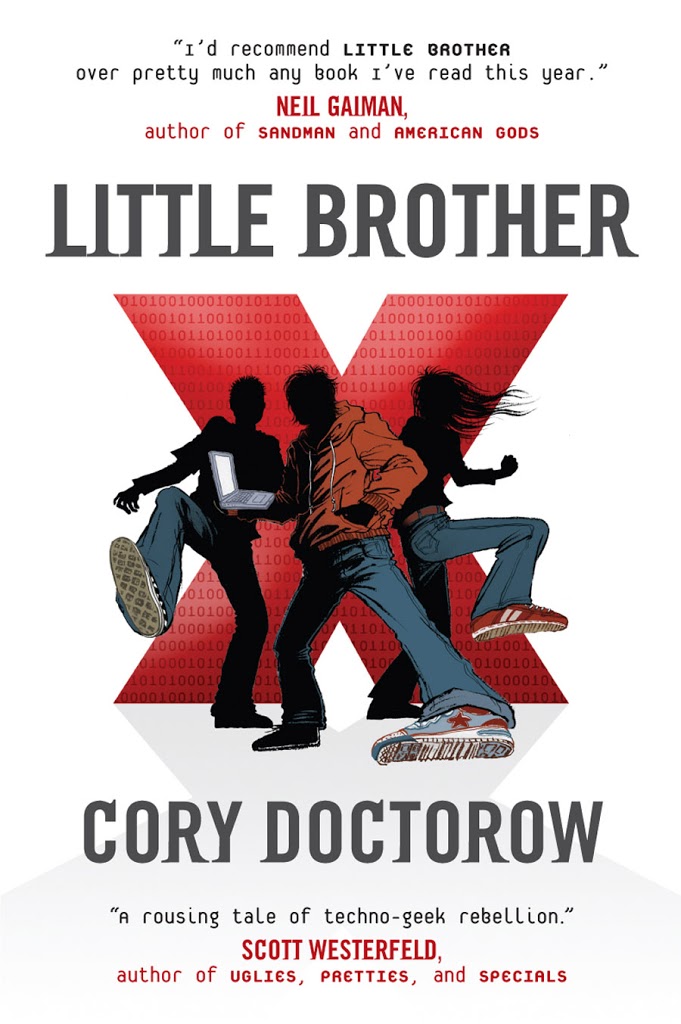 re in SF) to track “irregular” movement patterns. In addition to metal detectors, schools are equipped with cameras that analyze students’ walking patterns, and every laptop comes with a chip that monitors key strokes.
Of course, none of this is new, as any Philip K. Dick fan knows. But we’re certainly a lot closer to that potential future than we used to be. In London, the average resident is filmed 300 times a day; Britain has 4.2 million closed-circuit surveillance cameras, one for every 15 people in the country. Did you know that your computer webcam can be turned on remotely? It can. In fact, the Lower Merion School District near Philadelphia admitted to activating Webcams 42 times during a 14-month period, claiming that it did so only to track lost or stolen laptops.
But as I said, no one seems to mind. People already film the most intimate aspects of their lives for public consumption on YouTube. How do you value privacy in a culture where the prevailing dream is to become famous, even if that fame is tied to a videotaped pratfall off a ladder?
All right, I’m stepping back out of the woods. And of course, all of this provides rich material for crime fiction writers like me to mine, so I’m hardly one to complain.
By the way, I had oatmeal for breakfast, and the doctor said I’m doing just fine. Go ahead and turn on my webcam if you want to see for yourself.
Visual Tools for Writers
Talking about the state of the publishing industry can be depressing these days, so let’s go back to why we write in the first place: We love storytelling. Many of us use visual tools when we write: collages about the main character or setting, plotting diagrams, charts, timelines, and photos. I’m just as guilty as the next writer in this regard. So here are some of the favorite ones I use, and I hope you’ll share what works for you.
PHOTOS
This is the most fun. I keep a file with pictures of people I cut out from TV Guide, Entertainment Weekly, and other magazines. Then when I’m planning a novel and doing my character development, I’ll search through the pages to find the one person who looks just like my character. I used to staple these onto my character development sheets, but now I scan them into the computer and add them to my file on that person. Looking for the villain is even more fun. I’m especially fond of sneaky looking people. Perfect models won’t do. You want these profiles to be interesting and tell you something about the character. For a mystery, I’ll do the sleuth for the first book in the series, some of the continuing characters, and the suspects for each installment.
PLOTTING BOARDS
In the planning stages of a story, I’ll divide a poster board into the number of chapters I plan to fill my book and then I’ll stick Post-It notes on the poster scribbled with different plot points. This helps me see the story flow before I write the synopsis. Later, I’ll fill in the squares with ink after I’ve written the chapter. Thanks to Barbara Parker who taught me this trick, I use different colored inks for the main plotline, loose ends, clues leading to the killer, and new characters on stage.
TIMELINES
It often becomes necessary to draw a family tree. I haven’t found an easy way to do this on the computer and manage with Word. Also, when I have to calculate characters’ ages, this is where they go.
LIFE SPACE
This helps you get into the head of your character. Draw a head on a blank sheet of white paper and put your person’s name in it. Then draw cartoon-like balloons all around the head. Inside these spaces, write in what’s on your character’s mind at any given point in time. Solving a murder? Taking mother to lunch? Picking up laundry? Calling boyfriend? How many concerns are on your mind right now? Ask your character what she’s thinking about. Here’s an example from my current WIP (an artist, I am not!).
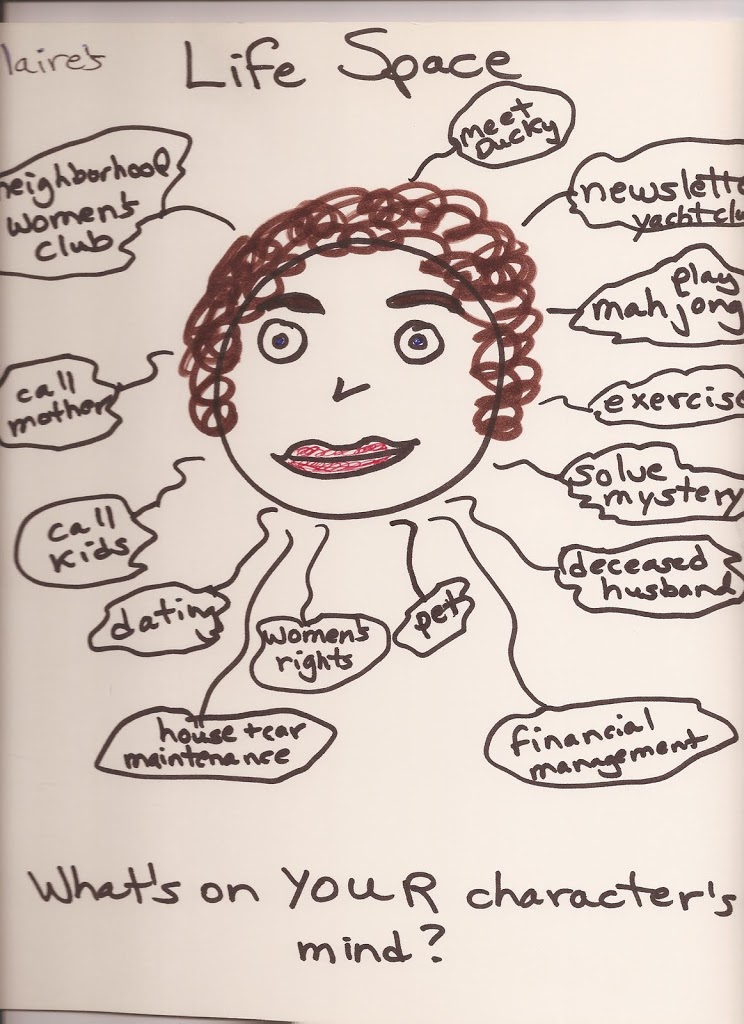
These are some of the visual aids I build when writing a story. Now let’s hear what you do.