About Joe Moore

#1 Amazon and international bestselling author. Co-president emeritus, International Thriller Writers.

“Discoverability”


Continuing Jim’s great discussion yesterday, I heard a term last week that I think sums up one of the challenges in this new e-book publishing revolution – “discoverability“. It’s one of the things a traditionally published author would look for in a publisher – their ability to get your book noticed. “Discoverability” is about being able to rise above the noise out there in e-book land and, for me at least, I think it represents a real and ongoing challenge.

While I agree that we authors should view this brave new world as a marathon not a sprint, I also think its hard enough already to juggle writing with all the publicity currently demanded. This marathon could, for so many writers, become a marketing slog to the detriment of honing their craft. For me, therein lies the dilemma. While I would love to be putting out independent e-books as well as traditionally published titles, I worry about how I am going to fit in all the marketing and publicity I need to make both a successful endeavour. Likewise I see the vast wave of self-published e-books and worry how will my books be noticed amid all the flotsam and jetsam.

So just how can a writer increase their “discoverability“?

First off the quality of the writing needs to be there – that’s a given…but then what?
  • Social networking sites, websites, blogs, twitter feeds etc. are all necessary components but there is still a lot of ‘noise’ (and a lot of writers hawking their wares!) out there in all of these;
  • Advertisements (in all print, media and digital forms) – although I think many authors have had mixed results when it comes to traditional forms of ‘advertising’;
  • Word of mouth – the most powerful of all and the driver of almost all successful novels. I suspect however that ‘discoverability‘ is an important precursor to getting this;
  • Reviews and review sites (by industry, readers as well as peers) – definitely an important component of any marketing plan – but nonetheless there remains the age old problem of books that receive great reviews but still fail to garner much in terms of sales or recognition;
  • Personal networking opportunities – still, I suspect, as important as ever, but with book tours falling by the wayside, writers have to increasingly use social networking media to achieve this.
What else should be added to the list?

Do you think that despite the revolution, traditional publishers may be able to regain an upper hand by offering more opportunities to achieve this elusive “discoverability” (and the jury is out on this one as many publishers paid little attention to getting their authors noticed anyway!).

So what does “discoverability” mean to you? How are you going to try and achieve it?


Field Report from the E-Book Revolution


As the E-book insurrection continues apace, things change on the landscape (some would call it a “battlefield”) almost weekly. Today your intrepid reporter issues a few notes and predictions which I am typing inside a tent somewhere in the literary DMZ:
– Physical shelf space continues a precipitous decline. Print sales are down 25% this year, so bookstores are folding or increasing their stationery footprint at the expense of physical books. Book buyers increasingly browse and buy online, adding to the woes of brick-and-mortar.
– E-Readers are going to explode this Christmas (again). Last year Kindles and Nooks broke the sack on Santa’s back. This year St. Nick will be lugging Kindle Fires all over the universe.
– E-fiction (what Mike Shatzkin calls “narrative text”) is already 25% of the total market. Look for it to be close to 50% by the end of next year. Shatzkin thinks it’ll be 80% within five years.
– This puts increasing stress on the Traditional Publishing Industry (TPI) because print is what made it and sustains it. TPI is doing what it has to do to survive, which comes down to keeping and making happy their A-list authors, and reducing overhead and advances (which of course means less money to invest in new and midlist authors).
– Agents are feeling the pinch, too, since their bread has been buttered by advances. That’s why many of them are transitioning into e-publishing hubs for their clients. The dollars and sense [sic] of this is still being worked out. An agent might broker a deal with a digital house like Open Road in a somewhat traditional manner. Others might offer actual e-publishing services, which raises conflict-of-interest and competency issues. Literary agent Jason Allen Ashlock argues that, “workflow restraints, small staffs, capital concerns, and the modest revenues generated by most digital properties will prevent most Agent-Publishers from adequately managing and effectively publishing more than a few titles.”
– Authors who are succeeding at being completely independent are those who are able to bring entrepreneurial analytics to the task. If you’re going to publish successfully as an indie, you have to think like a business. You have to think about genres and branding and marketing and design and all the aspects of bringing a book to the world. Authors like Bob Mayer, who are trained in strategic thinking, have an advantage. Business skills can be learned but it takes time. For that reason authors may decide to partner with a digital publishing entity. There are way too many variables to discuss here (percentages, length of time for rights, what marketing advantage is offered, and so on). Suffice to say you’ll need to be just as sharp about the details (where the devil is said to hang out) when signing away any digital rights. 
– New and frustrated authors are attracted by the nice royalties they can earn by going indie, but you still have to move units to make dough. And to do that, you have to get noticed in the ever-increasing content tsunami. The two bottom line requirements are: consistent production of quality books coupled with creative marketing efforts. Those who are able to deliver the goods at a brisk pace, and are savvy about promotion, have the best chance to reap rewards over time.
– The greatest benefit of indie publishing is speed. It’s hard to wait 12 – 18 months for a physical book to appear. Over the course of a year, from March to March, I will have eight new books out. Three of them traditionally published (one of these is non-fiction), five of them indie originals (and I’m not counting the 7 backlist books I have all the rights to and will bring out next year). I love this! Why the heck not? I love to write and my e-book income in the first 6 months surpassed my latest traditional advance. I say it is okay for writers to make money doing what they love. Radical, I know, but there it is.
– I like TPI. I wrote a nice open letter to that effect. But we all know there is a vicious business spiral going on. Imagine you’re the Ty-D-Bol man and a giant has just flushed the toilet. TPI is in that little boat, hanging on for dear life. Conference rooms all over Manhattan must feel like they’re swirling.


– BTW, did you know Robert Ludlum did voiceovers for those Ty-D-Bol commercials?
For writers considering the indie trail, the times are both challenging and refreshing. But you have to be realistic. The metaphor that e-book publishing is a “gold rush” is no longer apt. There were some early strikes for the bold (e.g., Joe Konrath, Amanda Hocking) but now things are reaching a market equilibrium. That means: an indie writing career is a marathon, not a sprint. You have to train (learn to write), get plenty of nutrition (critical feedback) and then run a smart race (strategize with business thinking, pick your spots, make your moves).
And while huge success is not guaranteed, the nice thing is the race is now open to anyone who loves to run.
So what is your current thinking on this ever-changing landscape? What do you think the future holds, say, a year from now? 


****
NOTE: I want to amend a response I made earlier this week to Paula Millhouse, who asked about the advisability of putting a book online before getting a deal. I said Nay. David DeLee respectfully dissented. So I asked my agent about this, and he said it was true a couple of years ago, but things have changed. Publishing online will not kill a potential deal if the book performs. No guarantees either, of course, but that’s always been true in the writing game. Thanks to David for the prompt.  

Things That Trip Up in the Night

It has been a happy and sorrowful week. Annalisa, my younger daughter, celebrated her fourteenth birthday. Anna, the stray cat we took in…well, she took us over, actually…died on the same day. Anna would spend her nights outside by (her) choice during the summer; in the morning I would open the front door and tell her, “Welcome to Egypt! Where cats are worshipped!” and she would saunter in, looking for breakfast, which, of course, was quick in coming. Anna would venture outside in the winter for a few moments, then appear at the rear sliding glass door, screaming the feline equivalent of “It’s cold and I have no pants!”

An aside: Anna’s death continues a pattern. Birthdays at casa de Hartlaub are viewed with simultaneous anticipation and trepidation. Bad things can happen. My mother died ten years ago on Annalisa’s birthday (I wanted to ask Annalisa, upon Anna’s death, “Who do you think will die on your twenty-fourth birthday?” but I didn’t, since I will be seventy by then, and, uh, well, it might be me!). My grandfather passed on my cousin’s special day; my grandmother went beyond on my father’s birthday, who in turn, died on the same day as another cat of ours, and of the same cause. My birthday, of course, is on September 11. No explanation necessary.

We spoil our pets around here; Anna, as a result, has chosen not to leave just yet, despite being buried in our backyard pet cemetery. She follows the example of Madrigal and Rebel, our other deceased cats, who choose to dart across our paths occasionally in different parts of the house at all hours of the day and night. Madrigal, a Siamese who loved me like no other creature ever has, has tripped me a few times in the middle of the night when I have gotten up from bed to do what old men do in the middle of the night. The first time it happened was startling; now, if she doesn’t do it once a month, I wonder where she is. Cats are not the only spirits who visit us. Someone/thing at irregular intervals walks slowly across the upstairs floor. This occurs, when it does occur at approximately three pm or seven pm. It may not happen for months, but then will occur every day for three weeks. Annalisa, when she was much younger, told us that it was an angel, and that she saw it several times at the top of the stairs, surrounded by light, looking down at her. She didn’t consider it to be frightening; it was just there. She stopped seeing it when she was about four years old. Whatever it is continues to make itself known when it so chooses.

I’m not necessarily given over to haunts and the like, but I know what I see and I see what I know. I’ve only discussed so far the strange things in our house which I am able to explain. The cats all belong here. The angel, or whatever it is, seems to have come with the house. There is one thing that occurred, however, which I am at a loss to understand, and which accordingly comes closest to that state we call “frightening.” I got up one night about three am (that old man thing again) and when I came back to bed my wife Lisa was moaning in her sleep. While I was debating whether 1) she was having a nightmare and 2) I should wake her up or 3) just let her sleep, I heard a voice in my head, the voice of a young woman, asking “Are you okay?” Lisa, still asleep, answered “um hmmm” with a lilt, as if in affirmative answer. She remembered nothing about it the next morning; I will never forget it.

Not all houses are so benevolent, particularly in fiction. Hopefully you have been watching the stylishly gory AMERICAN HORROR STORY, which has something that will offend and titillate nearly everyone. It is a psychological thriller dressed in ghoul’s weeds, centering around a family who has moved from the east to the west coast in hopes that a change of scenery will salvage their relationship. Of course, the house that they move into is loaded with ghosts. It is the family, however, that is truly and fatefully haunted, and as they continue to make the mistakes that caused them to leave Boston the viewer slowly comes to realize that they can’t get away from themselves. It’s just the thing to watch as the spirits of dead pets sit and sleep in the corners, waiting to trip the unwary in the middle of the night.

Finding My Way to The End

By John Gilstrap

Earlier this week, I got to type my two favorite words: “the” and “end.”  Truthfully, neither of the words does much for me individually, but taken in context (and in order) at bottom of a 415-page manuscript, they bear a sweet message.  It means that Damage Control, the fourth book in the Jonathan Grave series, is finally finished–at least until such time as my editor sends me the Dreaded Letter.  In the meantime, I need to submit an outline and first chapter for my next book, which I’m currently calling Untitled Grave Five. Yeah, I know, the title needs work, but I need to deliver that finished manuscript to my publisher next September 15, after which I will need to deliver an outline and first chapter for Untitled Grave Six by next October 15.

Somehow, between now and November 15, I also need to write a short story for an anthology while traveling pretty much nonstop for my Big Boy job.  It will all get done.  I’m not entirely sure how, but it will all get done.  I know this because somehow it always gets done.

Here’s the thing, though: Unlike the consensus reached after Nancy Cohen’s post the other day that most of my Killzone colleagues think continually about their writing, I find not-writing to be the easiest thing in the world to do.  I consider myself to be an observer of people and something of a dialogue sponge when folks say interesting things, but it’s rare that I think that something in life would make a good story, or that fascinating surroundings would make a good scene.  At least I never think it real-time.

Generally, I think about writing when I sit down to write.  Take this blog post, for example–take most of my blog posts, in fact.  It’s Thursday night, which means it’s time to write something.  This is what occurred to me.  Next week, I’m pretty sure that’s how it will happen again.

The short story I owe will be based on a photograph.  I chose the photo because it’s strange, and as of this moment, I have no idea what narrative I’m going to tie to it.  Next weekend, though–which is the start date I’ve assigned to myself for the short story–I have every confidence that when I sit down to write, the story will be there waiting for me.  I’ll employ no tricks or gimmicks or exercises; I’ll just start to write.  Three, four, or ten drafts later, it will be done.  I just don’t know how.

The lack of predictability in my creative process scares the bejeebers out of me.  Unlike so many other authors I speak to, I don’t have a file of potential ideas, or biographical sketches of future characters.  I wish I did, and I admire those who do.  Nine books into my career, with #11 and #12 under contract, none of this ever gets easier for me, even though I tell myself that I’m getting better at it.

One thing that has changed, though, is that I’ve learned to accept my process for what it is.  It’s my way, it works for me.  I think that my ability to turn the fiction spigot on and off is what allows be to have both a book deadline and a stressful Big Boy job.  Certainly, it helps.  One thing I know for sure, though, is that the more I try to make it easier on myself, the harder it all becomes. 

So what about you?  Are you content with your creative process, or are you fighting to change things?

The Care & Feeding of Authors

Okay, I’ll admit this reads like the six degrees of Kevin Bacon, but hang with me on this post about writer’s life.
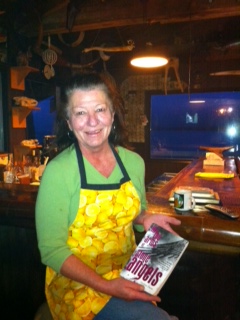
Bears in Alaska are heading into hibernation. The reason I know this is because one of my crazy sisters is hunting brown bear in the Aleutian Islands. She’s been sending photos and funny text messages over her 10-day adventure. She’s not hunting. Her husband pulls the trigger. But being the trooper she is, she dons the appropriate layers against the cold and rain to trudge alongside him, lugging water and food. For added color, she met an interesting man on this hunting expedition—a Romanian billionaire traveling with his body guard. (I’m not the only one in my family who should be writing fiction.) And because she’s my dear sweet sister, she brings books of mine to give away. The photo below is of a woman at the lodge they stayed while they hunted. She is holding my young adult book – In the Arms of Stone Angels (Harlequin Teen, Apr 2011), a cold case murder mystery for teens.
The reason I’m sharing this family story with you is that bears going into hibernation reminded me how I get when I’m in the middle of a project. I’m totally oblivious to EVERYTHING. I’m so vexed on the characters and the world I’m creating that I go without eating or eat weird stuff, forget about sleep, and my capacity for coherent conversation is limited—unless its dialogue.
Simon Wood was a guest on TKZ not long ago. Once he shared a funny story with me about how his wife caught him on the sofa watching TV when he should have been writing. He had eaten a bag of chips and had cats sleeping on his chest. Seeing the look in his wife’s eyes, he headed her off by saying he was deep in thought—that he was actually working. (Yeah, right.) But seriously, this is how it can be for a writer. We never stop working. So I’m fairly certain Simon had his brain “sweating to the oldies” as he gorged on Cheetos and snagged quality cat time.
In truth, Simon might have been indulging in another bad habit of author behavior. Snackage. Authors eat stuff and may not even pay attention to what it is. Like drones or Zombies, we are fixated on what’s in our head. It’s nothing personal, but dirty dishes in the sink, dog hair on wood floors, and a growing mass of dirty laundry become invisible. Personally, I call that a gift, but my husband has a different perspective.
So I’ve turned over a new leaf and after John Gilstrap’s fine example of slimming down and focusing on his health, I am in week 2 of a change in diet. Mostly it’s vegan. I eat raw and cooked veggies and legumes with plenty of fruit. No dairy. For those who know me, this is a HUGE change. Before, I considered meat as dessert. I would rather eat meat than even indulge in something sweet. But I’m outing myself on TKZ to say that I am committed to eating better and taking care of my health.
Anyone have a good vegan recipe?
Seriously, I have been more focused on cooking from scratch with fresh ingredients. My husband and I actually sit at the dinner table to eat instead of plopping down on the sofa with the TV on. We have semi-real conversations over dinner and not just talk about how to kill people and get away with it (a real crowd pleaser). We may even indulge in a glass of wine now and then. I’ll soon add a regular exercise program into this and not just limit my cardio to fast moving fingers over a keyboard.
For those of you smarter than I am, how do you stay healthy with your hectic schedules? What’s your routine? And I would seriously like to hear if you have any good vegan recipes that aren’t loaded with cheese.
Reckoning for the Dead (Adult thriller, Sweet Justice Book #4) – HarperCollins, Sept 2011 Now Available.

Is it a Sin?

Forgive me, for I have sinned. Last weekend, on the holy Day of Atonement, we asked forgiveness for the general sins of mankind, for anything hurtful to others we’d done in recent times, plus we requested entry for the coming year into the Book of Life which would be sealed on this solemn holiday. We asked for help to become as pure as when we were born and to realize our full potential as human beings. I did all this, but I also thought about my work.

Yom Kippur fell on a Saturday this year, making my transgression a double whammy. On each Sabbath, we are supposed to rest and avoid all thoughts of business. So you’ll have to count me as a sinner, because I couldn’t shut these musings off during the Yom Kippur service. I found myself writing blogs in my head. I studied hairstyles in my alter ego identity as Marla Shore, my hairdresser sleuth. Hmm, how would I add more shine to that lady’s hair color? I thought about my daily page quota and how I’d catch up since I was behind.

But I didn’t write those pages, nor did I write any blogs on the holiday. I tried to stay away from the computer, truly I did. However, during the service, I didn’t concentrate on the hymns and prayers as totally as I should have done. At home again afterward, I hereby confess that I checked my email and social networks. What can I say? My addiction to writing is to blame. I beg forgiveness for my irreverence and weakness of mind.

Have you ever tried shutting off your writer’s brain? It’s nearly impossible, at least for me. Even on vacation, I’ll compose mental blogs or take notes on my observations. When I read newspapers or magazines, I tear out articles to file even though they might never be used. It seems that once you begin writing fiction, you will always see things differently. Every experience becomes fodder for a story. Every observation can inspire a setting detail. Every person you meet might turn into a fictional character.

Our writer’s life is like a book, only to end when we close the last page. Thus, once a writer, always a writer. Do you agree, or have you successfully shut off your writer’s brain at times?

ON-SITE RESEARCH: Author/Dolphin Encounters? Oh, Yeah!

By Kathleen Pickering  http://www.kathleenpickering.com

My job rocks!

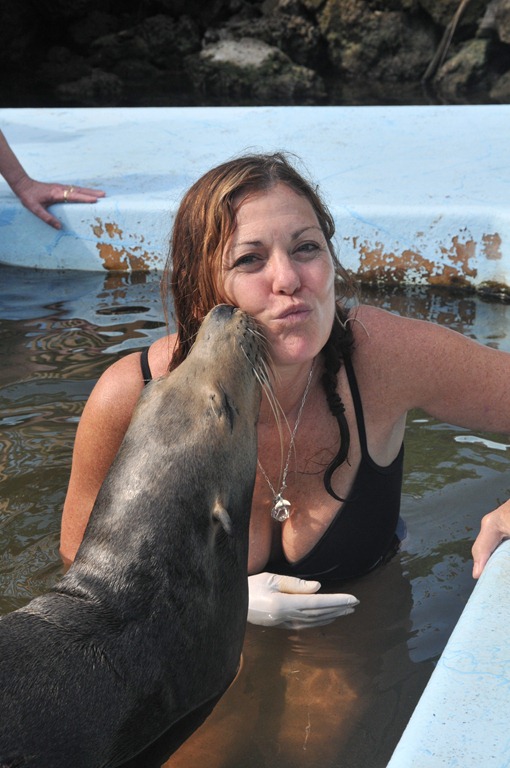
My dear friend, Heather Graham, won this amazing Dream Date with Dolphins from a fund raiser at the Dolphin Research Center in Marathon Florida. Guess who she invited? 

056_56

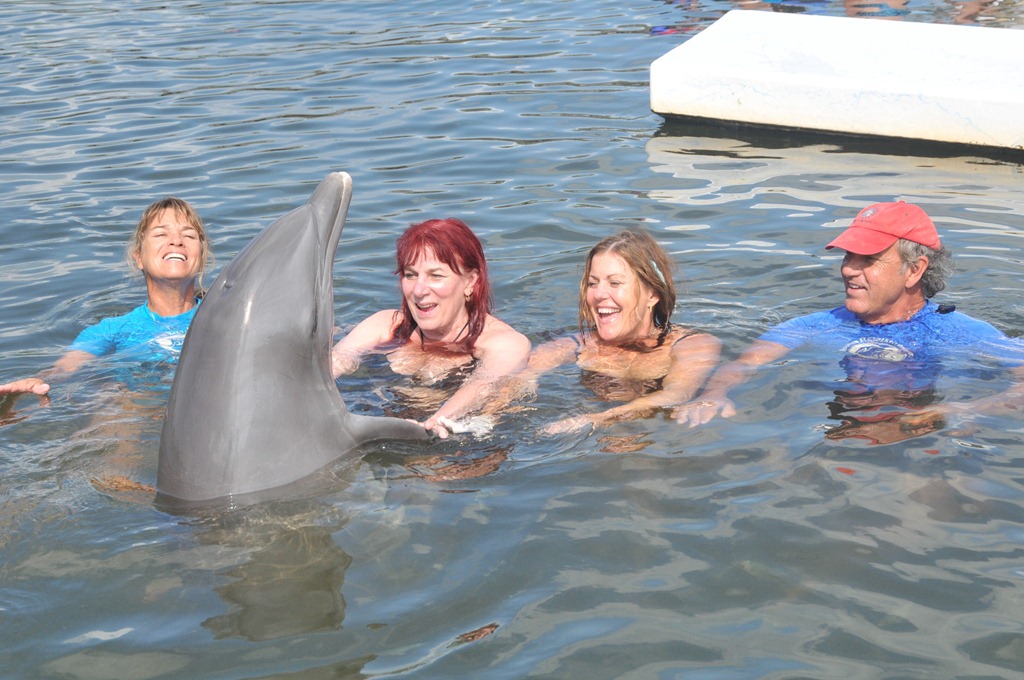
Yes, indeed. Yours truly. (This photo is dubbed: The Board Meeting)

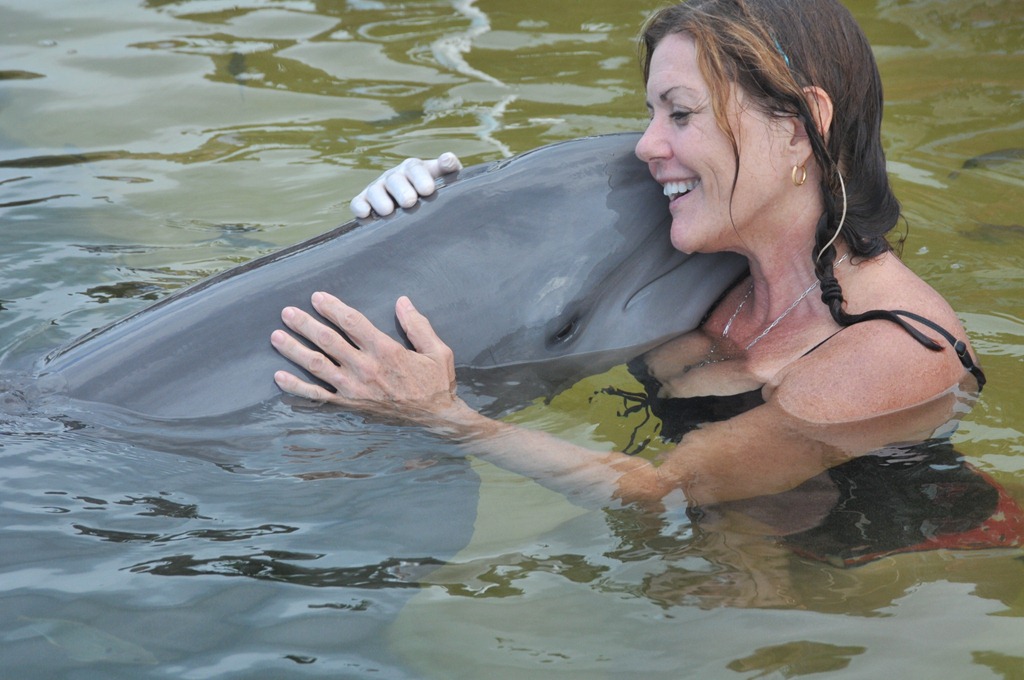
Heather and I spent the entire day with trainer, Linda, and DRC director, Mandy, who took us through their daily routine with the the dolphins. OMG! You just know that an amazing experience such as this, as well as watching Heather transform into the proverbial Mermaid while swimming with these charming creatures, could turn into nothing less than on-site research.

You see, Heather has invited me to join her, and authors Beth Ciotta and Deborah LeBlanc to write a Christmas anthology slated for 2013. The characters will be in line with her Keepers series. That said, my search for a “Keeper” character who will transform from animal to human was easily found at the Dolphin Research Center.

005_5Between the dolphins, sea lions, peacocks, exotic birds and other aquatic life surrounding the compound, you know that I discovered my character for the Keepers anthology.048_48

But, I’m not telling. Not yet, anyway.

I really don’t have a question to ask you folks today, but would welcome your comments. If you’d like to talk about how lucky I am at my job, well, feel free. I heard Steve Job’s Stanford University speech back when he originally made it in 2009. When I heard him thumbnail[3]

then, I punched the air saying, “You’re so right, Steve!”  Up until around 2005, I had been sidetracked, and letting “stuff” get in the way of my dreams. But no longer. It’s amazing how, when you decide to live true, you world unfolds in ways you’d never expect. Hence, a dream date with a dear friend at the DRC, and what do I get? The character for my next book. Not too shabby, eh?

So, let me leave you with this last link to a day made in heaven. If you have ten minutes, you may enjoy viewing Heather’s and my first ten minutes of our dream date morning at DRC.  Click Here:

http://kathleenpickering.com/Dolphin_Videos.html

Yeah, we’re hooked.

Oh, and if you’d like to read an in-depth discussion of our fun day, visit Heather’s blog: http://thelipstickchronicles.typepad.com/the_lipstick_chronicles/2011/10/dream-date.html

Happy writing, one and all!

State of Play

I had a great visit to New York, justified in part by our friends’ wedding anniversary (a fabulous rooftop renewal of vows ceremony and dinner) and, in part, by a desire to touch base with my agent. The major downside about moving back to Australia is the sheer distance it is from anywhere else. It literally took a day and a half of travel to get from Melbourne to NYC…so I was really hoping that the visit was worth it!

It was.

Meeting my agent was important for three things: 1) to get feedback on my WIP; 2) to discuss next proposals and plans; and 3) to get insight into the industry (as it continues to change, an agent’s perspective is always helpful). I also think there is no real substitute for a face-to-face meeting.

Thankfully, the feedback on all three was extremely positive, and perhaps just as importantly, my agent seemed pretty optimistic about the publishing industry in general. A year or so ago he seemed much more subdued – but (no surprise for us TKZers here) the success of e-books has definitely buoyed the industry. Here’s a few things I took away from our meeting:
  • Though the YA market continues to be vibrant, the mystery/thriller market is still tough going, with many houses streamlining their lines and focusing (again, no surprise) on their bestselling authors. It remains tougher than ever to get published (in fact, I doubt my first book would ever have sold in this market – which is a depressing thought!).
  • E-books have become extremely profitable for publishers and are creating greater opportunities for publishers to target readers. A few years ago most publishing decisions were driven by what the buyers from Barnes&Noble and Borders liked. Such market concentration wasn’t necessarily a good thing (for writers or readers) but now, e-books present a huge opportunity for a more ‘level playing field’. Even Amazon doesn’t command a massive market share and the growth of the Nook and other e-reader/book options is making the market more ‘democratic’ and accessible. Good news for authors and readers alike!
  • Given all the industry changes, agents are re-evaluating how they can advise and work with their clients on publishing e-books (particularly for their backlist). As there is potential for conflict of interest, agents are looking into the options carefully. There are now companies who work only with agents and their published writers in this respect. I think it will be interesting to see how this pans out – especially as many writers are already choosing to go it alone and self-publish their e-books with or without an agent.
So my question to you all is: how do you view the role of agents changing in this current environment (apart from selling your work to a traditional publisher)? Have your expectations regarding an agent changed with the success of e-books? If you are unpublished, are you still seeking agency representation?

What Would You Want in Your Writer Bio?


JAMES SCOTT BELL was born August 10, 1912, in Arlington, Kansas. His father worked for the Chicago, Rock Island and Pacific Railway, but quit in 1918 and moved his family of ten to Tulsa, Oklahoma, to work the oil fields. When Jim wasn’t in school or working odd jobs, he was reading Zane Gray, Edgar Rice Burroughs and pulp magazines like Black Mask.
When the Depression hit, Jim rode the rails to Los Angeles and got a job as a cub reporter for the Hearst newspaper, The Examiner. By day he tracked down stories of murder, fraud and corruption. By night, in his one room apartment on Bunker Hill, he pounded out short stories for the detective magazines. He was published almost immediately alongside such luminaries as Horace McCoy, Erle Stanley Gardner and Dashiell Hammett. When his crime novella, One More Lie, hit the racks, Jim garnered instant national fame. The story sold to MGM and became the classic 1941 film starring Joan Crawford and Robert Taylor.
Jim became one of the most sought after screenwriters in Hollywood and contributed as much as anyone to the post World War II film noir genre. He continued to put out suspense stories for the paperback original market and pulp magazines.
In 1952 Jim and Robert Mitchum got into a fight with two henchman of mobster Mickey Cohen, who had been bothering a cigarette girl at the Brown Derby. One of the thugs pulled out a .38 and shot wildly, hitting Jim just above the heart. At the hospital Jim refused sedation and insisted that a studio secretary be summoned so he could dictate the final pages of a screenplay due the next day. That script went on to win an Academy Award.
Jim kept up his prodigious output of short stories, novellas, full length books and screenplays right up to his death at the age of 99. He had just typed The End on a novel when his heart gave out. His last words were, “Don’t forget the mayonnaise.” 
Here is a picture of James Scott Bell in his office at Warner Bros. in 1947.
 
# # #
 
This flight of fancy is based on how I feelas a writer. I always admired the pros, the ones who could deliver the goods time after time. The writers who wrote to make a living and yet found a way to make their writing come alive.
What about you? If you could write your own writer biography, and it could be from any era, what would it look like? What sorts of books would you have written? Who would be in the movies based on your books?
This is not a  mere game. Use this exercise to focus on your long term goals as a writer. Ask yourself how your imaginative bio might inform your writing today.
Go ahead. What are some of the entries in YOUR writer’s biography?
NOTE: I wrote a little bit more of my philosophy of pulp fiction writing over on Rachelle Gardner’s blog

The Bi-Weekly Report From Rabbit Burn


John Ramsey Miller

As I’ve written here, I’m probably going to try my hand at going straight to eBook with my next novel. I’ve been dragging my feet for a year or so, tinkering with two manuscripts, and thinking about what I want to do going forward. Since I have no publisher on the hook for this closest one, I had no editor to guide me. I need a heavy handed editor to tell me what I should already know and point to where I should know to go. I have been told on numerous occasions my talent is of the raw variety and can be lacking in the focus department. I have heard it over and over from the best editors in the business—and I’ve worked with the best. So I found a veteran editor who left NYC for the wilds of Ohio and who is raising a family instead of a brood of needy authors. So I have ten pages of notes in a chapter-by-chapter dissection. Great stuff, and I’ve got a hearty rewrite in my near future.

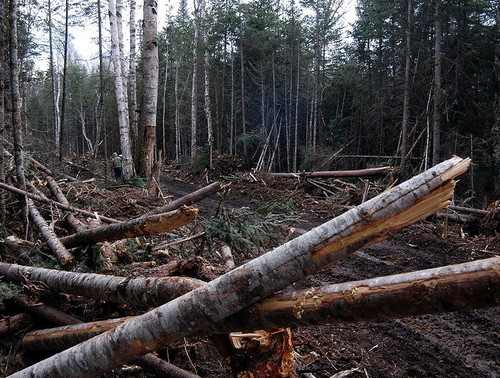
For the past two weeks I’ve been clearing a couple dozen trees—cutting them down, sectioning the trunks, splitting them, dragging the limbs into the pasture behind my four-wheeler, and stacking the wood to burn this winter. I’ve got central heat, but we like the wood-burning stove. I’m actually cutting the trees to make a yard in the ex-woods for the grandkids. I’ll build a fort, move the trampoline over and have a place kids will enjoy. My grandson has been here for three weeks. I work and he collects lizards and bugs in jars. Every night we release his catch so they can go home to their mamas. Weather has been wonderful.
Cool.
Bright
Clear.

I have not been writing, and that’s the thing I’m writing about.
I’ve been living life and thinking about writing as I go through the days.
Doesn’t matter at the present, but it might tomorrow.

I turned 62 last week.
Didn’t hurt a bit.
Didn’t mind it.

Next week I’m going to talk with my editor and start a long overdue rewrite. Then we’ll see.
I’ll keep you posted.