About Joe Moore

#1 Amazon and international bestselling author. Co-president emeritus, International Thriller Writers.

Kindle Lending Library Controversy

So unless you have been hiding under a rock (and sometimes with all the changes in the industry I would like to do this!) you will have heard that Amazon is offering to lend e-books to its Kindle-owning Prime members for free. Since then a number of issues have been raised which I think, quite rightly, places the spotlight on just how authors are going to be fairly compensated for this.

The Association of Authors’ representatives (AAR) has issued a statement stating: “The agent and author community have not been consulted about this new sort of use of authors’ copyrighted material and are unaware of how publishers plan on compensating authors for this…”

From what I have read publishers (those that consented to be in the program, at least) are being paid a lump sum for inclusion in the e-book lending library no matter how many times their titles are borrowed. Other publishers, who have apparently not been contacted (!) or consented (!), will be paid the wholesale price for the ebook any time someone borrows it. But what about the authors?

Here are some of the issues as I see them (and I would love your input on any or all of these):
  • Is what Amazon is proposing even covered by the publisher-agent contract? The AAR statement states that they think “free lending of an author’s work as an incentive to purchase a (kindle) device and /or participation in a program (i.e. Amazon’s Prime) is not covered by most contracts – nor do most contracts have any stipulation for how an author would be compensated for such use.”
  • What is the basis for author compensation? If a publisher receive a flat fee, how will that be allocated to the author? Again, the AAR seem to believe that there is really no basis for either distributing this income to authors or for determining how much authors would get as an aggregate sum in the first place for their work being in Amazon’s ‘library’ program.
  • What will be the impact on ebook sales and prices? Will Amazon’s move further devalue books? Will it decrease the price people are willing to pay for ebooks (“hey, I could have borrowed it for free!”)? Obviously we already have physical libraries where people borrow books but still, I think Amazon’s program is a significant new step. My understanding is that many of the ‘big’ 6 publishers have not agreed to be part of the Kindle lending library program – presumably over fear it would impact sales or devalue their books – but given Amazon’s clout (and willingness in the past to shut publishers out) will they feel pressured to join? Also, finally…
  • Is it a good thing that Amazon now has so much market power – both in terms of retailing and publishing?
What do you think? Sure, it’s great for Amazon Prime members who own a Kindle but what about for authors? Is it nothing more than storm in a teacup or yet another example of authors being screwed?

How to Feel Miserable as a Writer

On her website, artist and writer Keri Smith generated a lot of blog noise with her list of 10 ways an artist can feel miserable (h/t to agent Rachelle Gardner for referencing the post).
I thought the list perfectly applicable to writers, and wanted to see what you think. I’ve changed the wording slightly to reflect the writing life:
1. Constantly compare yourself to other writers.
2. Talk to your family about what you do and expect them to cheer you on.
3. Base the success of your entire career on one book.
4. Stick with what you know.
5. Undervalue your expertise.
6. Let money dictate what you do.
7. Bow to societal pressures.
8. Only do work that your family will love.
9. Do everything your editor asks you to do.
10. Set unachievable, overwhelming goals — to be accomplished by tomorrow.
So what do you think? Any of these resonate? Anything you’d add?

THE PLOT THICKENS…OR MAYBE THINS.

By John Ramsey Miller


I almost clean forgot this blog because I’ve been so absorbed in work that I almost forgot I was up to bat this week.

This week I got an emailed message from the International Thriller Writers that stated that due to the insanity in the publishing world at the moment, authors who are members can submit their self published works for inclusion in the ITW awards selection process. That, my friends, is HUGE.

Part of it went as follows:
“The awards committee would like ITW members to know that he criteria for the 2012 Thriller Awards have been expanded to include self-published work by active ITW members. Active status members may submit independently published work to the appropriate category of Thriller competition (best Hard Cover, best Paperback Original, best Short Story).

Independently published work from Associate ITW members will not be considered for competition at this time.”

There is no eBook only category, but everything is up for grabs at the moment.

Our organization is promoting eBooks self-published by members in their (our) webzine which goes to 13,000 individuals and industry related businesses.

This goes to show you how many previously published authors there are in our ranks. These are guys and gals who have proven they have the “goods” and are quite capable of writing a book that is at least readable, and probably ought to be on shelves as long as there are shelves.

I am proud of the ITW for understanding where a lot of us are right now, and largely through no fault of our own. We the houseless. Not long ago this would have been a dire situation. Whether or not our large houses need an individual at the moment, said individual needs to write, and have their work available to their readers, existing and future. I don’t know if the MWA (Mystery Writers if America) or the SIC (Sisters In Crime), or the other similar organizations will follow suit, but I think the ITW has been a leader among the organizations that “serve” us authors. It shows me that there is an organization that “gets” the situation and is trying to take care of its members. This flexibility is crucial and shows that the ITW cares about its members as individuals. I have heard that others do not want to change something it might have to change back in the future.

Recently I found a talented author who is writing top notch books, and he is self-published. I’ve been reading his series as fast as I can download them to my Kindle. I sent him a note and we started a correspondence. He wants a legitimate house to publish his work because he feels the self-published stigma. As he is successful at self-publishing a house has offered to re-release his books under their banner and take half of his profits. To his credit he has so far declined their offers because they won’t give him an escape clause in the event that they do not increase his numbers significantly. The only upside is the branding. I have heard that there are houses, both large and small, trolling the eBook world looking for authors with a following. Often they can pick up the author’s catalogue cheaply. I get it.

I look forward to the day that authors like this talented individual will not feel as though they are looked down on by other authors who are (or have been) published by a “name” house. I am finding more and more quality authors available only on Amazon. So the quality is there, and the I imagine the stigma (real or imagined) is getting to be a thinner curtain. It is the story that counts and there are more talented storytellers than publishers who will get behind them.

Sorry if this is a disjointed mess of a blog, but I am rushing so I can spend my Saturday on the planet Rewrite.


The Performance Side of Writing

By John Gilstrap

A few weeks ago, my wife and I were among the hundreds in attendance when Stephen King addressed an audience at George mason University as part of Fairfax, Virginia’s Fall for the Book Festival.

By way of full disclosure, seeing Stephen King live is to me analogous to what I imagine it would be for a classical actor to see Kenneth Branaugh.  Or Laurence Olivier.  While many of King’s stories don’s appeal to me anymore (I read Pet Sematary when Joy was pregnant–‘Nuff said?), he works the English language exactly the way I wish that I could.

He also worked the audience with supreme grace and skill.  The fact that he was entirely at ease on the stage confirmed for me that his spontaneity was well-rehearsed.  If that read as snarky, please re-read. I meant it as a statement of supreme admiration.  As one whose Big Boy Job requires dozens of speeches a year–a few to standing O’s, I hasten to add–I can attest to the importance of hard work to making things easy.

Sooner or later, we all find ourselves alone on stage–or something like a stage–and I thought I’d share some of the tricks of the trade when it comes time to entertain an audience.

First, notice the E-word.  Embrace the fact that successful speakers are first and foremost entertainers.  I don’t care if you’re delivering a eulogy or a paper on astrophysics.  People will remember you if you’re entertaining.  And they will forget you if you are not.

We all work too hard to be forgotten.  So, how can we be memorable?

Step One:  If you truly hate public speaking and are not willing to work for it, turn down the public speaking gigs.  Your audience and your replacements will both be grateful.

Step Two:  Remember that ain’t none of this about you–iy’s about the audience.  Give thme a good ride, and they’ll love you forever.  Turn to navel-gazing bullshit about your muse and your struggles, and you’ll turn everybody off.

Step Three:  Have something to say.  This is where preparation and rehearsal pay dividends.  And remember that making feel good is better than making them feel bad.  Know where your laugh lines are and wait for them.  If you don’t know how to do this part, sign up with your local chapter of Toast Masters and learn how to structure and deliver a decent speech.  (See Step Two above.)  Every person in your audience gave up the sure thing entertainment option of watching a Seinfeld rerun for the ninth time.  You owe them at least as good a ride as that.

Step Four:  Talk to your audience, not at them.  Make eye contact.  Smile.  Invite input.  The fact that this is the 4,784th time you’ve delivered this speech doesnt change the reality that it’s the first time for each of your audience members.

Step Five (and this one’s a personal bugaboo):  Yes, you need a microphone.  I don’t care if you’re James Earl Jones on crack; you’re easier to hear in the back of the room if you’re amplified.  (See Step Two–again.)

Step Six (actually, it’s 5-A):  The microphone is a voice amplification device.  It is not a pointer, a magic wand, or an extension of your Italian gesticulation hand.  To work, it needs to be pointed at your mouth.  We’re talking straight-on.  Ninety degrees.  If you’re speaking from a podium, think in arcs as you look from one side of the audience to the other.  As your head moves, the mouth-to-mike distance should remain constant.

When using a lavalier microphone (always my preference), take time to hide the cord and the transmitter.  Having that black cord swinging around gets in the way and looks ugly.  Neatness matters to the audience.  If you have an audio technician working with you, trust his advice.  If you don’t, put the microphone a fist’s width from the underside of your jaw.  For guys, that will be between the second and third buttons on your shirt.  For ladies, that means that you have to dress in anticipation of a microphone.

There’s more, of course, but I think these are the basics.  What do y’all think?  What are your tricks or cardinal rules for presentations?

The Rising Costs of Touring

by Michelle Gagnon

One of our local independents just announced that in the future, authors will be charged a $75 fee to hold an event at the bookstore.

Immediately, the local bookish listservs lit up. Words like “heinous” and “disgraceful” were thrown around. Boycotts were threatened; conversely, so were Occupy Wall Street-style sit-ins.

I understand that times are tough for booksellers, and that independent bookstores are vanishing faster than the proverbial snowball on a Texas summer day. I also appreciate the fact that by and large, most author events are a losing proposition. Frequently stores stay open late to host the event, which means paying overtime for staff to set up/clean up, ring in purchases, and MC. They also pay extra overhead during those hours (lights, heat, AC, etc), not to mention the costs of publicizing the reading via posters, newspaper listings, mailings, etc.

I get all that. But the thing is, times are tough for authors now, too. Advances have decreased dramatically. Print runs are smaller. Already negligible marketing budgets have now withered to the point of being virtually non-existent. There’s less co-op space available than ever before, and the battle for those critical high-visibility spots is intense.

A few years ago, I visited twenty-seven bookstores over the course of six weeks to promote my book. Had I been forced to pay seventy-five dollars to each vendor, it would have cost me nearly two grand. Mind you, that doesn’t include my own considerable expenses: gas and/or tolls if I drive to the event, flights and hotels if I fly. Most authors not only organize their own tours, they also pay all the associated costs out of pocket, chalking it up to necessary marketing fees. And sometimes, you drive an hour (or, heaven forbid, fly for a few), arrive at the store, and end up pitching your song and dance routine to three people, one of whom is the bookseller.

But we do it anyway. Because it isn’t just about selling books the night of the event (although that certainly never hurts). The main goal is to get to know the bookseller, and develop a relationship that will hopefully lead to them selling copies of your book long after you’ve exited the premises. At least, that’s always the hope.

Moreover, this does seem a bit unjust. There are authors who have the marketing machine squarely in their corner, whose tours are planned for them, who are met at the airport by media escorts who cart them from store to store. Authors who routinely attract between 50-100 people wherever they appear. Authors who, I’m willing to bet, will never have to dive into their own pockets to pay that $75 fee–in all likelihood, their publisher will pay it for them, and they’ll have no idea that the exchange even took place.

So here’s my proposition. Charge those authors more for their events: $125, say, or $150. For a top tier bestseller, the publishers will throw down that amount without blinking. Keep the events free for writers who aren’t regulars on the NY Times list. Give the midlisters a chance to get the word out about their books via your store, and who knows–maybe someday, they’ll be the ones attracting shoppers in droves.

That’s my two cents. But then, I can’t quite see myself camping out in the middle of a shopping mall with a placard.

It would be truly sad to see the grand tradition of book touring fall by the wayside, yet another casualty of the ebook onslaught.

Mistakes and errors in e-books

By Joe Moore

Have you noticed that there seems to be an inordinate number of mistakes and typos in e-books? How often do you see their for there, or whether for weather? How about coming across multiple words jammed together or too many spaces between words? In her Huffington Post article and subsequent CBC Radio interview, ITW Vice President Karen Dionne discusses this ever-increasing problem and comes up with some possible answers.

First, you might assume that the problem would be most apparent in self-published books, right? After all, many self-published authors have never been traditionally published and rarely can afford the services of a professional editor to scrub their manuscripts. But according to Karen, that’s not always the case. In fact, many errors appear in mainstream fiction and the culprit just might be technology. Here’s why.

An author turns in her finished manuscript, usually in MS Word, to her editor who hands it off to a copy and/or line editor. It’s polished and sent back to the writer for another once-over. Then it goes back to the editor who sends it to the typesetter. The Word doc is imported into a specialized page layout publishing program such as Adobe InDesign or QuarkXPress. The layout program is downstream from the Word doc and there’s no reversal back upstream to the manuscript.

The typesetter works with the book designer to choose font and other styling, and usually a PDF is created that is sent back to the writer for one last shot at any changes and corrections. Finally, the writer turns in final changes and the book is sent off electronically to the printer. At that point, there’s no turning back.

So far, so good. But what if the publisher decides to create and release an e-book version of the manuscript. The person who creates and formats the e-book cannot use the files created in the page layout program. They must use as a source the MS Word doc. But there’s a really good chance that all the changes and corrections made to the InDesign or Quark file were never made to the original Word file. So those errors and mistakes could make their way into the e-book.

Writers aren’t usually asked to proof the e-book. In fact, most writers don’t even bother to read the e-book releases. They assume it’s a mirror of the print version and have moved on to the next project right after the printed book is published.

Now, as Karen points out in her article, this is not always the source of errors. And some publishers treat the e-book with as much care and feeding as the print version. But because of time restraints and budgets, sometimes it’s not possible to go through the revision process again for the e-book. Still, it does make sense that this scenario is a possible cause for the number of errors seen in ebooks.

So the next time you’re reading your favorite author, and you come across a double word or an is for his or some other strange formatting mistake, don’t jump at the conclusion that it’s the author’s fault. It just might be the technology working against us.

Have you noticed more mistakes and errors in e-books than print? How about your own books? Have you ever gone back and checked the e-book to make sure known corrections were made?

——————————

BAM! Just Like That, an original short story by Lynn Sholes & Joe Moore. Download for $0.99 and get the first 13 chapters of THE PHOENIX APOSTLES as a bonus preview.

No monsters here. Just a witch having a bad hair day.

As empty nesters, my husband and I don’t usually decorate at Halloween. Our neighborhood, however, goes insane. Every year the McMansions along Ocean Drive sprout four-foot spiders that crawl up walls, mummified corpses that hang from trees, even cemeteries with body parts writhing from the ground. It’s a tad off-putting, in my opinion. The whole Halloween gestalt seems to have gotten a lot more ghoulish since I was a kid.

Because we’re not festive and we have a long, shadowy walkway, many of the roving herds of youngsters assume our house is “dark.” So every year I wind up with tons of leftover Snickers and M&MS, most of which migrates inexorably to my hips.

This year I decided to set out a pumpkin, just to let the kids know we hand out candy. So late on Halloween afternoon, I pulled into the local pumpkin patch. The manager was already closing up shop for the season. For five bucks I walked off with a magnificent display pumpkin. This gourd was a masterpiece, an intricately carved goofy face that could have been created by Disney.

Once I set the pumpkin out and put a candle inside, I got inspired. I rummaged through the house for anything scary-looking I could find. I turned up a large stone raven, an iron candelabra, and a red candle in a hurricane lamp.

It worked. By 6 p.m. we had a steady stream of Trick-or-Treaters. The thing is, our house didn’t look faux scary like our neighbors’. With candelabra blazing and a giant stone raptor glaring out the window, I think we looked actually scary. I knew I’d gone too far when a kidling ventured up to the door by himself. He seemed to be rooted to the ground in fear as he peered inside the entry.

“Happy Halloween. Um, you look startled,” I said, handing him some extra M&MS for his trouble.

The kid fled down the walkway to his waiting mom.

“No monsters there. Just a witch,” he told her.

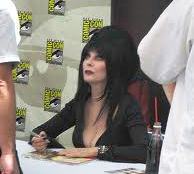
Elvira signing books at ComicCon 2007
For the record, I wasn’t dressed up as a witch. But I was having a bad hair day. Maybe he meant a sexy witch, like Elvira. But I doubt it.

I should have spent the evening writing, not trying to palm off my trigger foods on the innocent.

Next year, no pumpkin, and no inferno.

And definitely no fright hair.

What about you? Any Halloween tales for the year? What about you East Coasters? We heard Halloween got cancelled due to snow. True?

All Hallows Read


In honor of tonight’s Halloween, I thought I would plug a great idea touted by Neil Gaiman, called All Hallows Read. His premise is outlined in a recent blog post and even has its own website now. The premise is frightfully simple – give a person a scary book to read for Halloween. Not instead of trick or treating mind you (perish the thought!) but as an opportunity to encourage reading (and we certainly need more of those!).

In Australia, Halloween is pretty much a non-event with hardly anyone bothering to decorate their houses and even less bothering to hand out candy. The American Women’s Auxiliary here in Melbourne (of which I am the proud, if inept, secretary) holds an annual ‘trunk or treat’ event to provide the necessary Halloween candy fix. Basically about 100 cars roll up, open their decorated trunks and provide a kind of automotive neighborhood for kids to trick of treat along. My boys LOVE it and we now have enough candy to eat for an entire year. If only I had heard of Neil Gaiman’s great idea, I would have suggested we hold an All Hallows Read event alongside it. That would have been pretty cool.

I also think the concept of All Hallows Read is a great one and it’s got me thinking about the scariest books I’ve ever read. Given I have an exceptionally low tolerance to gore and horror, my ‘scariest books’ are pretty tame. Even my 6 year old sons would no doubt scoff at my cowardice…but I remember getting chills reading Rebecca as a teenager and the early Patricia Cornwall novels in my twenties. Last year Justin Cronin’s The Passage had me pretty spooked (but in a more distant, cerebral way than the scream-out-loud variety).

Given I am such a wimp, I could do with your help and advice:

What book would you chose to give for All Hallows Read (could be either an adult or a children’s book)

Which book was the scariest you ever read?

Has there ever been a book so terrifying that you couldn’t even finish it?

Happy Halloween!

What the Hell Do You Want to Say to Me?

You have to evolve a permanent set of values to serve as motivation. – Leon Uris
This week I’ll be leaving for Houston to teach alongside the mythic structure guru, Christopher Vogler, and the breakout novel sage, Donald Maass. Three intensive days with a room full of writers, talking about what we all love–the craft of fiction.
So it seems apt for this post to riff on a question that Mr. Maass poses at the end of his book, The Fire in Fiction.Maass wants to know what you have invested in your story, where the blood flow is. He asks, “What the hell do you want to say to me?”
Which brings us to the subject of theme, or premise. It’s the part of the writing craft a lot of writers seem to struggle with.
I’ve been reading some resources of late on the subject. Some suggest that you must know your theme up front, or your manuscript will wander. Yet many successful authors say they concentrate on the story itself and “find” the theme as they go along.
Either approach will work as long as you let the theme arise organically out of a plot that shows a character with a high stakes objective, opposed by a stronger force.
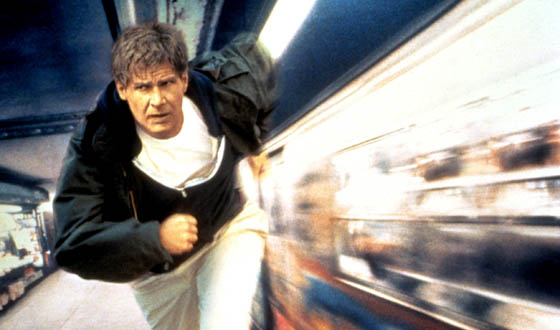
For example, in the film The Fugitive you have an innocent man on the run from the law, trying to find the man who murdered his wife. He’s got an opposing force in the U.S. Marshal’s office (embodied by Sam Gerard, super lawman). Forced to keep ahead of the law, Dr. Richard Kimble finds resources within himself he never knew existed, and eventually proves his innocence while nailing the bad guy.


So what is the theme, or premise, of The Fugitive? You could state it in several ways:
– Dogged determination leads to justice
– A good man will ultimately prevail over evil
– Fighting for what’s right, even against the law, leads to the truth
As a writer, you probably have a sense of what your theme is simply by knowing how your character will come out at the end. And you definitely should know at least that much.
For example, when I wrote Try Dying I knew my lawyer protagonist would find out who killed his fiancé, the one true love of his life, and in doing so prevail over the bad guys. In my head, then, I was thinking something along the lines of True love will pursue justice for the slain lover, and win.
That’s what the hell I was trying to say. And I believed it passionately, which is the key to a premise that works. The reader has to believe you believe it.
At some point in your writing –– before you begin or soon after you get going –– ask the following questions:
1.  At the end, what is the condition of your Lead character? Has he won or lost?
2. What is the “take away” from that condition? What will the reader think you are saying about life?
3. Most important: Do you believe it passionately?If not, why are you writing it?
Here’s an example. In Casablanca, what is Rick’s condition at the end of the movie? He has found a reason to stop his self destructive behavior (drunkenness) and his isolation (because of perceived betrayal). He’s found the inspiration he needs to go back into the world and rejoin the fight for freedom against the Nazis.
What’s the take away? True love will sacrifice for a greater good, and restore a person to a life worth living.

Rick sacrifices his true love, Ilsa, because she is married to another man and that man is essential to the war effort. Rick knows that if he and Ilsa go off together she’ll regret it (“Maybe not today, maybe not tomorrow, but soon, and for the rest of your life.”)
Coming as it did during the early years of World War II, it’s clear the filmmakers believed this passionately, because that sort of sacrifice for a greater good is what the government was calling upon its citizens to do.
So use those three power questions to find a premise worth writing about.
How about you? Do you consciously identify the themes in your stories? Do you discover them as you go along? Or do you just let it happen as the characters determine?
I’d love to hear your thoughts on this in detail, as I am currently working on a chapter on theme for a new collection. Let’s have a conversation. 

The Most Frightening Thing. Ever.

It’s Halloween weekend. We’re writers, and we do stories. It’s story time. So tell me: what is the most frightening thing that ever happened to you?

I have a number of candidates from which to choose. When I was a kid I walked into a spider web with my mouth open when the owners were home and accidentally swallowed one. It didn’t give me spider powers but I was crawling walls for weeks. I was almost carjacked in the French Quarter a few years ago. Sobriety and a 9 mm. enabled me to put a stop to that. I was almost robbed in the French Quarter at midnight, walking toward Bourbon from North Rampart on St. Ann Street, with the same result as the attempted carjacking for the same reason. The one incident that stands head and shoulders above the others, however, occurred when I was but a wee lad of twenty-one years of age in San Francisco.

I was a FM radio DJ at the time — it was too much fun to call a “job” — and one of the perks was that it enabled me to meet any number of attractive women. One of the most attractive was a Chinese woman who we will call “Mei.” I was smitten with her, in great part, alas, because she was able to tutor my body in ways that it has not been schooled before or since. There was one problem — there is always at least one — and that was that Mei’s brother, who we will call “Max,” was the leader of one of the Tong youth auxiliaries. The fact that his sister was dating a white man did not sit well with him. This bit of information was communicated to me one afternoon when I walked out of Tower Records on Bay Street and found Max and a few of his friends waiting for me. He told me that I wasn’t able to see his sister anymore. Being young and full of myself, I told him to perform an impossible anatomical act and walked away. I mean, I was on FM radio. What was he going to do? Kick my ass?

The answer to that question was a definite “yes.” That evening, I mc’d a concert at a new, small music club on the edge of North Beach, on Columbus Avenue just off of Broadway. The concert was an unmitigated disaster, an event in itself that I may describe another time. For our purposes, let it be known that after a number of small near-riots the show concluded at 2:45 am. I stumbled out of the club and onto Columbus Avenue, took a couple of steps, and noticed Max and a somewhat larger group of friends about ten feet away. I did what anyone would do. I panicked and started running down Broadway, toward the tunnel.
I had reached the tunnel mouth and thought I was in the clear when I heard shouting behind me. I threw a glance over my shoulder without slowing down and saw a group of figures running toward me. Max. And his friends. I picked up the pace — I weighed exactly half of what I weigh now — and pounded through the tunnel on the pedestrian walkway. I frequently used the walkway to get from my apartment on Russian Hill to get to North Beach and knew that there was an emergency phone about halfway down the tunnel. This was before the days of cell phones and 911 and even cordless phones, mind you, so this emergency phone was quite innovative. Pick it up and take it off its cradle, legend had it, and police would come. I never found out. As I approached the phone, I saw the cardboard sign underneath it, bearing the professionally lettered legend “OUT OF ORDER.” An unnamed but aspiring comedian had scrawled an admonition in crayon right below those words: “RUN FAST.”

I started crying. And kept running. I thought of my parents and my friends and women that I loved and that I intended to and my dog in Ohio and knew I would never see any of them again because these guys were going to catch me and kill me. That was their reputation, something which had seemed quite remote when I saw them on Bay Street, a painting of Carlos Santana and John McLaughlin on the wall behind us. And I wasn’t quite as full of myself as I had been earlier that day, if you catch my drift. I ran faster than I ever had in my life. I came out the other end of the tunnel and turned left, ducking into an area known then and now as the Tenderloin. It was and is a colorful but horrible place, a spider’s nest of the crazed and the drugged, where pain is the chief currency and waking up intact in the morning is a victory. I ran down alleys and tripped over sleeping, God-forsaken souls and in a sudden fit of genius hid in a trash dumpster until morning. I spent three days on the streets, Turk and Eddy and Larkin and some alleys I’ve forgotten the name of. On the third day I happened to see a friend coming out of an adult book store and approached him and told him what was going on. He had a little street influence. He got to Max and communicated my apologies and assurances that I wouldn’t see his sister anymore. I was permitted to resume the life I had been living, or a semblance of it. But things had changed. And not all for the better.

I moved back to Ohio a month later and started law school. I have no idea what happened to Max or Mei, or if we would recognize each other if we were to have an accidental, casual encounter on the street. I still have dreams about running through the Broadway Tunnel, however, dreams where I can never quite reach the end of the tunnel and make that left turn.