Author Archives: Joe Moore
Choosing the Best Point of View
By John Gilstrap
Stories are collections of moments the propel the plot through the eyes of characters. One of the critical decisions that an author has to make dozens of times over the course of a book-length manuscript is to determine which character each moment belongs to. I don’t think this issue applies to first-person narration because the POV is forever locked in the head of the protagonist. For third-person storytelling, though, the decision is paramount.
It’s also a key element of the overall strategy of a book. For example, in my Jonathan Grave books, Jonathan’s is almost always the primary POV for scenes in which he is involved. The exceptions are limited to moments where I want to reveal other characters’ impressions of Jonathan. I never write a scene from the point of view of Boxers, however–Jonathan’s best friend and protector–because his character works better through the eyes of others.
Because these books are a series, I have the luxury of developing my primary characters over a multi-book arc. That’s not the case for the secondary characters–the guest stars, if you will, the people who are the focus of Jonathan’s current adventures. I have to bring these focus-characters to life, make the reader love them (or hate them) and resolve their entire story arc within the confines of the current book. Plus, I have to do all of that without letting the story sag under the weight of obvious characterization. If I don’t plan well, it can become a nightmare.
As an example, whose POV is more compelling during a hostage rescue scene, the hostage or the rescuer? If the bad guy is going to be killed in the shootout, should some of the action be from his point of view, too? If so, then that means I needed to give him some scenes earlier in the story so that I don’t have to introduce his worldview to the reader in the middle of an action scene. (As far as I’m concerned, an action sequence combined with exposition isn’t an action sequence at all–it’s a muddled mess.)
These choices aren’t just limited to chases and shootouts, either. If male and female characters we both care about are meeting for the first time, whose POV is more compelling? If the meeting doesn’t go well, is it better to see the rejection from the point of view of the rejectee or the rejector?
There are of course no right or wrong answers because this writing game has no rules. There’s only what works and what doesn’t, and even that decision is bound only by artistic choice. In my heart of hearts, I think that we all know the difference, but there are few among us who haven’t on occasions stuck with the wrong choice for fifty pages too long.
The Seduction of Mystery
by Jordan Dane
No matter what genre, a book can always seduce a reader with the titillation of mystery. A suspense or thriller plot can race towards the end with its escalating stakes, but the lure of an underline mystery teases the reader and holds them tight as the storyline unfolds to reveal its fleshy curves and tantalizing secrets. The seduction is made more complete and satisfying.
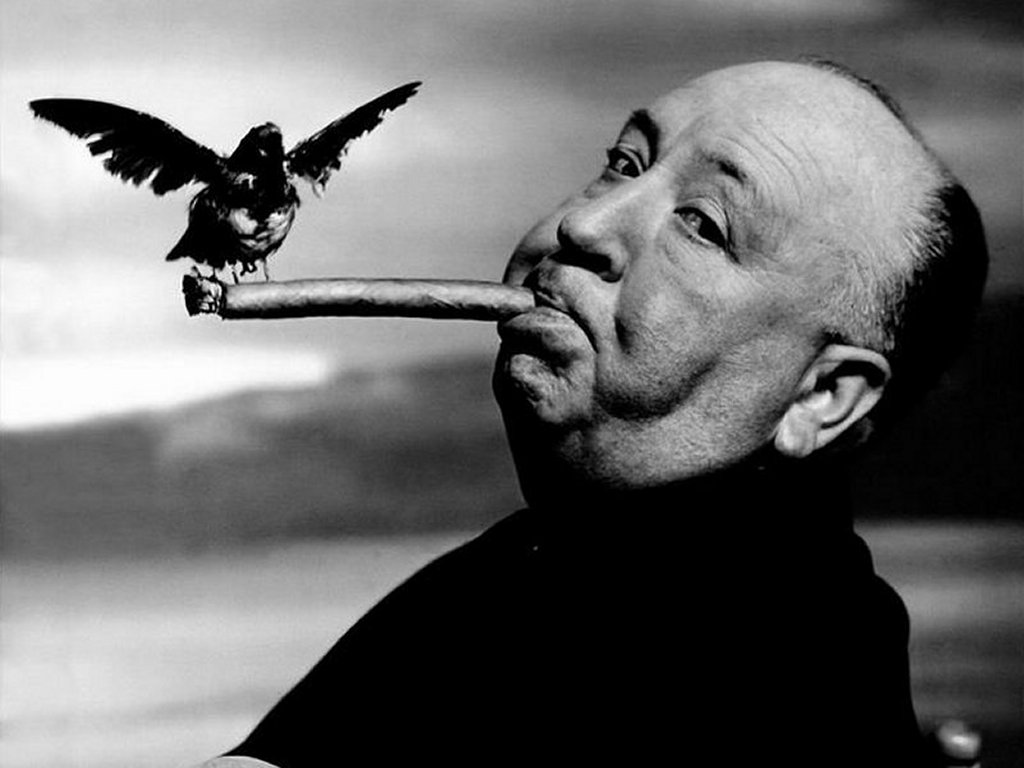
Alfred Hitchcock knew this.
Hitchcock believed suspense didn’t have much to do with fear, but was more the anticipation of something about to happen. When I read this, it was a huge epiphany for me. The idea changed how I thought about scenes and chapter endings, but I was recently reminded of the importance of anticipation in other ways when someone in my local writers’ group asked me when and how to use back story. In a seduction, back story is the equivalent of smoking a cigarette after. At some point, you want it to happen, but it’s anticipation that drives you to turn those pages all night long.
There’s no faking that.
If you’re a writer, anticipation doesn’t have to ONLY be about big plot movements. Don’t forget the voyeur in all of us, readers and writers alike. Relationships need a story arc too. Conflict and tension make them more delectable. Our main characters are tested, tortured, pushed to the limits to justify their starring role in our books. And when a man and woman are involved in a personal relationship, a writer makes them pay for wanting to be together. That’s how a writer knows when they have the right balance of emotion to suspense. If the emotional human story can be stripped out and the book no longer makes sense, then the right balance is achieved. One is integral to the other.
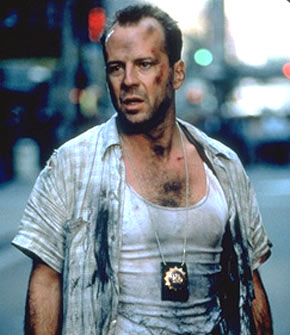
A high octane Bruce Willis movie—with its special stunts and computer generated action sequences—may not stick in moviegoers heads if there weren’t the emotional elements, the drama of his estranged wife in danger. Only his love for her puts him in harm’s way from the beginning and keeps him taking risks for her. It’s not just about saving her life. It becomes—will they get back together? A suspense/thriller plot escalates the stakes and ramps up tension as the pages turn, but something as simple as unanswered questions or a mounting attraction between two characters that you care about—while they are on a perilous journey—adds palpable heat that can sustain the rush to a gratifying end.
On my current project, I had a choice to make. I could have unfolded the story by relying on the suspense plot to be the main driver—or I could present my characters by their actions, without explaining the reason for their behavior until I absolutely had to. I chose to make my character’s back stories a strong mystery component where the plot will eventually force them into revealing themselves to each other and the reader. I’m orchestrating a seduction, one garment at a time, like a voyeur. With some elements, for key secondary characters, I layer the mystery without even knowing the answers myself. What an incredible rush! I can’t wait to see what happens.
Please share a book that seduced you completely with the right heady balance of compelling characters to intriguing plot—that unforgettable read that has stayed with you—maybe a guilty pleasure that you’ve read more than once.
Paperback Writer
By Joe Moore
“Dear Sir or Madam, will you read my book?”*
Paperback Writer, the 1966 hit by The Beatles, is a great example of a finely crafted query letter (in musical format) that lays out pretty much all the elements of a solid manuscript pitch. It covers a summary (. . . based on a novel by a man named Lear), conflict (. . . his clinging wife doesn’t understand), characterization (It’s a dirty story of a dirty man), motivation (it’s a steady job but he wants to be . . .), length (. . . a thousand pages give or take a few), author flexibility (I can make it longer if you like the style), the writer’s acceptance of reality (If you must return it you can send it here), and a heartfelt closing (But I need a break).
Chances are your query letter won’t become a smash hit on its own, although the hope is your book will. But there are some basic elements that all strong manuscript query letters must have.
It’s important to realize that the query letter is probably the most important letter a writer will ever compose. Unlike correspondence to a friend or family member, you must spend a great deal of time molding and shaping your query into the same caliber of perfection as your manuscript. So here are a few points to keep in mind before mailing it or click “send”.
Length. Agents and editors are busy professionals. They have little time to read long query letters. It’s important that you make your case in one or two pages, tops. If you can’t, the agent might assume you won’t be able to grab a reader in the first few pages of your book, either. So don’t ramble, just cut to the chase.
Attitude. Don’t come across as arrogant or condescending. Humility can go a long way to gaining respect. You should give the impression that you would be easy to work with. Listing your credentials and credits is part of the query process, but it should be done in a business-like manner and only the ones that contribute to your writing qualifications. In addition, if you have an established writer’s “platform”, include the info. A platform includes a website, Facebook, Twitter, blog, and other Internet and traditional lines of communication with significant numbers of potential readers.
Poor punctuation, grammar and spelling. Check, check and re-check your letter. Let someone else check it. Let 5 people check it. Bad grammar and misspelled words are not a sign of a professional writer. If your query contains mistakes, you’re just making it harder on yourself to gain the attention and respect of an agent.
Unprofessional presentation. There are countless reference guides and writing manuals on how to compose a proper business letter. Query letters are business letters. Showing a lack of knowledge on how professionals communicate will not score you any points.
Be brief. As stated earlier, the agent or editor has a few seconds to devote to your query letter or email before moving on to the other hundred she received that day. Get to the point, and do it fast. Identify yourself. What is your desired outcome of the letter? Why did you choose that particular agent? What is your book about? Why would someone want to read it? Why are you qualified to write it? Close with a thank-you and offer to send more. All of the above can be stated in one or two sentences each.
Be ready for the follow-up. Are you prepared to supply the agent whatever she requests; full manuscript or sample chapters, short synopsis or complete outline? If not, you may not be ready to start the query process. And assume that each agent will ask for something different, so have all variations ready to go.
Identify your genre. You must know what genre your book falls into. Know the difference between a thriller or mystery, cozy or procedural, hard boiled or medium or soft, or any of the other dozens of sub-genre. And please don’t refer to your work as a fiction novel. ALL novels are fiction. Using terms from the department of redundancy department screams amateur.
Billboard. Your query letter is a single-page billboard advertising your book. It very well could be the only shot you’ll get at SELLING yourself and your manuscript. It must be perfect. Every word has to count. You may not get a second chance. And just like that billboard on the highway you see as you speed by, the agent has just about the same amount of time to devote to your query letter. Give yourself a fighting chance and make it perfect the first time.
Now let’s take a listen to one of the best query letters ever written: Paperback Writer by The Beatles.
*Paperback Writer, © 1966 Lennon & McCartney
Old clues emerge about a family mystery
If your kin are like mine, you probably have a skeleton or two hanging in the family closet.
Some of my relatives still lower their voices when they ponder the fate of a long-lost ancestor: he is my great-grandfather and resident family skeleton, George Thomas Jones.
Very little is known about George. His name was never spoken as my father grew up in Whistler, Alabama. As the lore goes, George made his way west in the early 1900’s, leaving his wife and baby daughter (my grandmother) behind in Mobile, Alabama. It’s not clear why he went west. George may have been searching for opportunity, part of the vanguard of Scots-Irish migration at the turn of the 20th century. The only thing we know is that George died in Texas, and never returned. His name does not appear in the family Bible.
Family silence shrouded the mystery of George’s fate. Eventually my dad tried to track down any mention of his grandfather in Smithville, Texas, the town where he’d died. There, in an old register in the Episcopal Church, he found George’s name. “George Thomas Jones, found decapitated on railroad track.” A handwritten note next to entry added, “Murdered?”
Ever since the discovery that old George was beheaded and possibly murdered, my father and I have been hungry for details about him.
Last week my father discovered a letter in a box of family mementos, plus two faded photographs. Using information from the letter and a bit of deduction, he believes he finally has a picture of George Thomas Jones. In the formal studio photograph, George appears to be a handsome, well-dressed man of the era. His light eyes gaze sternly at the viewer. George has my family’s jug ears and an unruly cowlick, which defied the pomade’s attempt to slick it down. He looks a bit like my father.
We still don’t know exactly how George died, or what the circumstances were. Did he abandon his home, only to meet a dark fate? Was he a bad guy, or a working man in search of a better life for his family? We may never know. But it’s nice to finally have a face to attach to my fantasies about the family’s mystery man. As I conjure up fictional characters, these in-house stories have always helped stoke my imagination.
Do you have a family skeleton you can share? Have they ever played a part in your story-telling?
Keeping the Momentum
Following on from Jim’s great post yesterday, I thought I would write about ‘momentum’ in a novel. Having just finished the revised draft of my latest WIP (just sent it through cyberspace to my beta readers for input yesterday!), I have been looking closely at the issue of momentum as part of the editing process.
By ‘momentum’ I mean the way in which the novel moves and progresses so that a reader desperately wants to keep turning the pages. It requires a balance between conflict and suspense, exposition and relationship development (and these are by no means mutually exclusive). The reason momentum has been on my mind of late is that I have recently read three YA books that lost steam about half to three-quarters of the way through and I couldn’t understand why. They were all the kind of books that gripped me from the start and had me turning pages enthusiastically until…I wasn’t anymore.
And it was more than just ‘mid book sag’ it was a total loss of momentum and it had me puzzled – how, when the authors clearly had great conflict and suspense and terrific pacing for the first half the book did the they manage to lose that initial head of steam.
It started me thinking – what went wrong?
I came to the conclusion that there were three critical issues:
1. Predictability
About half way through these books the threads started to come together and suddenly the way forward became predictable. As a reader I started to guess how it was going to progress from hereon and thus, the conflict and suspense factor faltered and never recovered. This demonstrates that when it comes to pacing an author must keep ratcheting up the stakes and keep things unpredictable. A surprised/shocked reader is going to read on – one that has guessed the ending is not.
2. The conflict/tension between the main characters was resolved too early
Although the books I was reading were all YA this applies equally to mysteries and thrillers (in fact any novel!). All the authors I read did a fabulous job establishing initial conflict between the characters. The characters developed were complex and believable and above all, the tension and set up was really compelling. However, about half way through the book instead of this tension escalating or changing it merely morphed into immediate attraction and/or friendship and this meant the book started to fizzle rather than sizzle. When editing my own WIP, I kept this firmly in mind, so that no matter the growing attraction between the main characters that level of tension and conflict continued to increase (from both external and internal factors) so that a reader couldn’t really be sure how it was all going to resolve.
3. The authors wanted to resolve everything neatly and it showed
I think this issue was more a question of mechanics and (as all three were debut novels) experience but about half way through the book I felt that the framework of the plot began to show through – devices were more evident and coincidence suddenly took the place of real suspense. It felt as though the authors, knowing the destination they were trying to reach, had put up road signs for the reader which meant the thrill of the ride was gone (to use a cliche!).
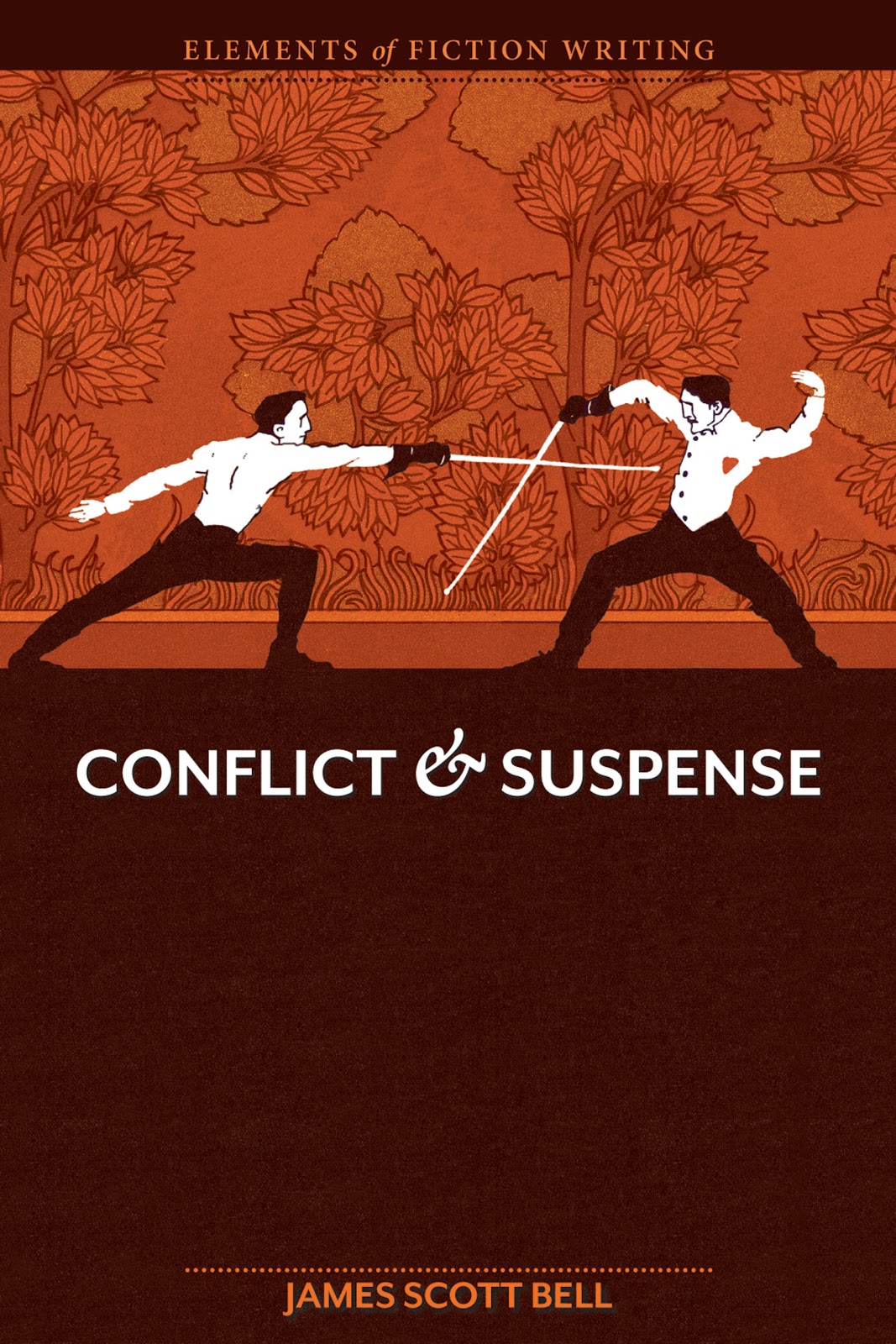
Having realized these three pitfalls, I found myself focusing on momentum as I edited my own work (trying not to fall into the same trap, which can be difficult I know). Given the book I was writing was a YA, I also closely studied books I felt really succeeded when it came to momentum (such as The Hunger Games) and tried to pinpoint what it was that kept me turning the pages. It all really came down to what Jim discussed yesterday – conflict & suspense.
So what about you – how do you keep an eye on momentum in your own work? Where do you think authors fall down when a book loses its fizz?
The Two Things Every Novel Needs
The Roads Less Traveled
Lots Of Opportunity in 2012
By John Gilstrap
Fair warning: What follows might be categorized as shameless self-promotion. I prefer to think of it as seeing pretty lights on the horizon. Either way . . .
If 2012 lives up to its potential, it could be a terrific year for me, career-wise. It’s the kind of potential that I hesitate to talk about for fear of jinxing things, but among my resolutions for this year is to be less locked-down about things in general.
Let’s start with book news. Nathan’s Run, my first novel (released in 1996), is now available in all eBook formats, with a paper version to follow sometime in the future. As an added bonus, the eBook contains a link to my original ending to the story, which should answer the single most-asked question about Nathan’s Run.
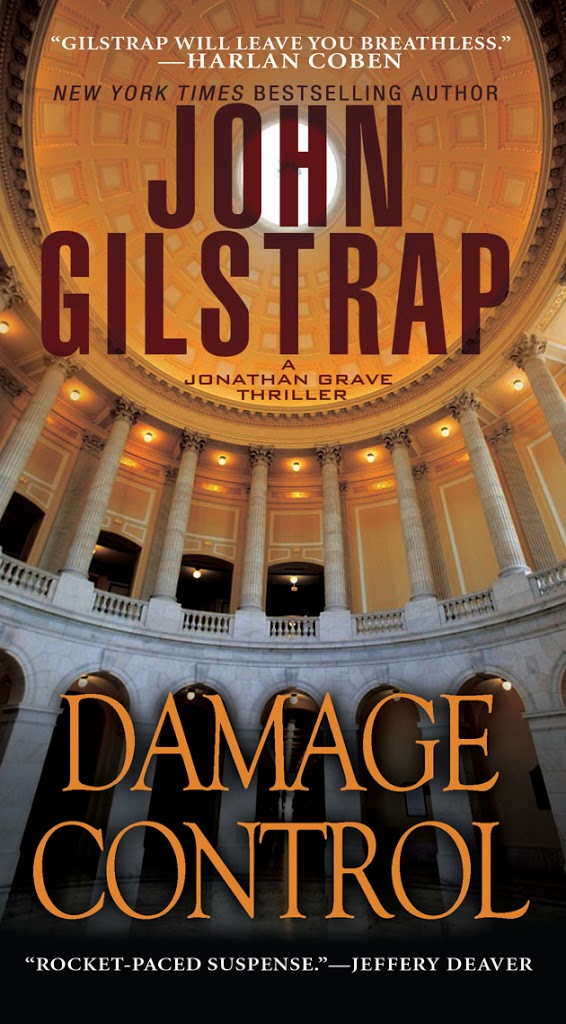
On the Jonathan Grave front, Kensington is yet again stepping up to give the series as big a push as the market can sustain. Damage Control (June, 2012) is featured in a two-page spread for the catalog, and will be released in a premium mass market format–not quite trade paper, but taller than the standard MMPB, which, if nothing else, allows for a more readable font size. This is what happens when a professional sales force truly gets 100 percent behind an author and his books. I couldn’t ask for more.
Hopefully, there’ll be movie news in 2012, as well. New Year’s resolutions notwithstanding, I have to be a little circumspect here, but we seem to have taken a giant step closer to seeing a version of Six Minutes to Freedom on the big screen. The rules of the movie game dictate that official announcements come not from me but from the producers. Suffice to say that meetings are going very well, and that all the players seem to truly get the story.
Then there’s the television series I’m developing. This, too, seems to have real legs with intense interest from all the right people. We’ll actually be doing some shooting later in the month. If it goes well, y’all will be among the first to hear. If it doesn’t, well, I probably won’t say much because I think it’s a very good, very stealable idea. (Is stealable a word?)
Finally, I would love to make this my first two-book year. I’ve had an idea knocking around in my head for years, and if I don’t get it on paper, it’s going to make me crazy. For that to happen, though, I need to write the next Grave book in six months instead of a year. If all the other stuff comes to pass, this one might not be doable, but for now, in the first week of a brand new year, anything and everything is possible.
Here’s hoping that everyone’s dreams are realized in 2012!
Mortification, in the First Person
by Michelle Gagnon
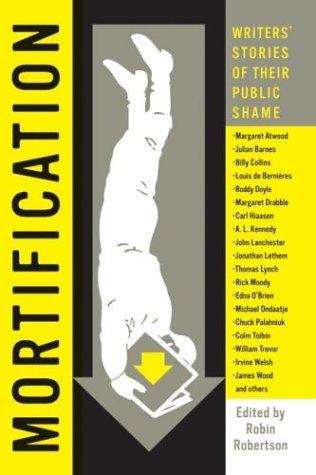
One of my all-time favorite books (and a popular gift for friends who write) is called, MORTIFICATION: WRITERS’ STORIES OF THEIR PUBLIC SHAME.
It includes vignettes from such storied authors as Roddy Doyle, Michael Ondaatje, and Val McDermid on the most embarrassing experiences
they’ve ever had during their writing careers. For example, did you know that Margaret Atwood’s first-ever book signing took place in the Men’s Socks and Underwear section of a department store? Or that some of Chuck Palahniuk’s fans started throwing dinner rolls at him during an event in San Francisco? And apparently Stephen King was once forced to sign so many books that his fingers cracked and started to bleed.
Up until last October, my most mortifying moment as an author occurred at a local bookstore, when not a single person showed up for my reading.
And then along came Litquake.
Litquake is San Francisco’s premier literary festival, a week-long celebration of the written word that features hundreds of authors reading at dozens of events. More than 16,000 people attended last year. Being asked to participate is a big deal, particularly for one of the most coveted spots.
And for the 2011 series, I was included in a great one, entitled, “These Mean Streets: Reality and Fiction Collide.”
I was the only woman appearing on a slate with a former mob informant; the terrific writer, working PI, and all around great writer David Corbett; and a slew of other big names. The event was being held at Tosca Cafe, one of my favorite bars in San Francisco.
All in all, it was shaping up to be an exciting evening. Thanks largely to the fact that the event would be happening in a bar, I even managed to convince several friends who don’t ordinarily attend readings to come along.
You can never predict how big the crowd will be at one of these events, but that night, Tosca was packed. Standing room only, easily a couple hundred people in the room.
I was nervous, and hadn’t slept terribly well the night before. Too nervous to eat very much all day, in fact. So I did what any sane person would do–I drank a glass of wine to calm myself down.
I was scheduled to be the third reader of the evening. I sat through the first two, my mouth dry, palms slick with sweat, tapping the pages of my chapter on the table (to the growing irritation of my friends).
And then, it was my turn.
I’ve performed in hundreds of dance performances, and have participated in dozens of author events over the past few years. One thing I know: the minute I get up there, the nervousness dissipates and I’m fine.
So there I was, standing in front of a microphone with a spotlight bearing down on me, facing this hot, crowded room.
Initially, everything was clipping along just fine. I read the first few pages of my chapter, and the crowd seemed appreciative–at least, no one was heckling or throwing things at me.
In the middle of page five, the words started swimming before my eyes. I paused and tried hard to force them back into focus. They refused to cooperate. I realized that for the space of at least a minute, I hadn’t said anything. Panicking, I tried to collect myself. I stood up tall, found my place, and got through another paragraph.
I’ve never fainted before in my life–never even came close. But next thing I know, I’m lying on my back with a total stranger inches from my face, yelling, “Were you locking out your knees?”
Which even in retrospect doesn’t seem to be the first thing you should ask someone who has just passed out cold.
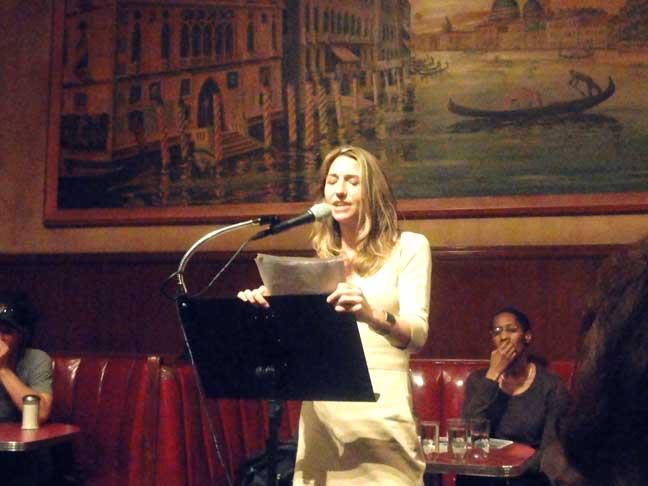
Thankfully, there was an open booth behind me. According to my friends (who delighted in detailing the exact order of events after I’d recovered slightly), I said, “I’m dizzy,” then sat down hard in the booth behind me. After which I proceeded to plummet ungracefully into the lap of the woman occupying the banquette (featured in the photo above, right before we became much better acquainted).
And of course, this was the one and only time that I’d decided to wear a dress for a reading. Meaning that I pretty much flashed the entire audience. Thank God I was wearing tights.
My friends helped me outside and plied me with glasses of water and relatively fresh air (there were a lot of smokers around). Strangers came out to check on me. The rest of the reading proceeded inside; sadly, I missed most of it. As a favor, the event organizers let me get up and finish my story at the very end of the evening.
A week later, during the closing party, Litquake impresario Jack Boulware informed me that they’ve never had an author faint before–apparently it was the talk of the organizing committee. So much so that they’re debating naming an honorary award after me next year. Word is still out on whether it will be bestowed for passing out or remaining conscious.
So now, should the editors of MORTIFICATION ever contact me, I can assuredly put Stephen King’s most embarrassing moment to shame.
I’d love to hear about your most mortifying experience, either during and event or really, at any point in your life. Please. It will make me feel better.