Yearly Archives: 2013
Good Advice from Lou Reed
By Mark Alpert
Lou Reed’s death this week really bummed me out. I loved his songs, especially the ones about New York. Here are some amusing lyrics from “Dirty Boulevard”:
This room cost two thousand dollars a month
You can believe it, man, it’s true
Somewhere a landlord’s laughing till he wets his pants
And this song came out in 1989, which means the same room is probably renting for five grand now.
One of my favorite Lou Reed albums is “Songs for Drella,” the biographical collection of songs he wrote with his Velvet Underground bandmate John Cale. The album is dedicated to Andy Warhol (whose nickname was Drella, a mash-up of Dracula and Cinderella), and the songs tell the story of Warhol’s life. The Velvet Underground was the house band for Warhol’s Factory, and it’s fascinating to listen to Reed and Cale recall those years in song. I’ve been playing the album every day since I saw Reed’s obituary.
An irrelevant aside: I met Warhol once, in the spring of 1979. He was signing copies of his book Pop-ism at the university bookstore at Princeton. I knew nothing about art — I was an astrophysics major, a real geek — but I bought one of the books anyway, just so I could meet the guy. Warhol looked terrible: haggard face, bad skin, hopelessly wrinkled clothes. But he scribbled “To Mark, Love Andy” on my book, and now I have a collector’s item that my kids can auction off.
Okay, but how does any of this relate to writing fiction? I’m getting to that. One of the tunes on “Songs for Drella” is called “Work.” Lou Reed is singing about Warhol’s ferocious work ethic. Warhol produced a phenomenal amount of art and made Reed feel guilty for not being equally prolific as a songwriter:
No matter what I did it never seemed enough.
He said I was lazy, I said I was young.
He said, “How many songs did you write?”
I’d written zero, I’d lied and said, “Ten.”
“You won’t be young forever,
You should have written fifteen.”
It’s work, the most important thing is work.
I think of this song when I’m finished writing for the day. How many words did I write? Five hundred? A thousand? Maybe I’ll even feel good about myself, satisfied with my daily output. And then I’ll hear Lou Reed’s voice in my head, channeling Warhol: You won’t be young forever. It’s work.
Reader Friday: Give Me Some Backstory
Key Essentials for An Authentic YA (Or Adult) Voice
![]() |
| Purchased from Fotolia by Jordan Dane |
On Oct 17th at the KILL ZONE blog, I critiqued the first page of an anonymous author’s work –A Game of Days. Some interesting comments on the YA voice came from this post and I wanted to share more on what I’ve learned from writing for the teen market. My personal epiphanies.
Writing for the Young Adult (YA) market and capturing the voice of YA is less about word choices (and getting the teen speak down) than it is about getting the age appropriate decisions and attitude right. Urban fantasy or post apocalyptic plots can build on a world that is unique and unfamiliar. Books like the Hunger Games by Suzanne Collins or the Divergent series by Veronica Roth can have its own voice, so teens are familiar with reading books like this.
When I went looking for solid examples of teen dialogue or introspection to share at a workshop, I searched some top selling YA books, only to find the voice I expected wasn’t there. Sure there are YA books where authors can sound authentically teen, but to keep up the realism for a whole book can be a challenge and an overabundance of “teen speak” can date the banter or be too much for adult readers to catch. (Yes, adults are HUGE readers of YA.)
As you read through this list, think about how each of these tips might also apply to writing ANY voice, even book intended for adults. Many of these tips work for cross-genre writing.
Key Essentials for An Authentic YA Voice:
1.) Use First Person or Deep Point of View (POV)—This technique of “deep” POV, or “close third” person, is used in fiction writing as a glimpse into the head of your character. In YA, I think of deep POV or close third as conversational thoughts deep inside your teen. First person POV is like reading someone’s diary.
2.) Don’t be afraid to mix POVs—You can mix POVs (for example, first person for your storyteller and third person for other characters), but since it’s your story, only you can decide how you want it to be told. Many YA stories are in first person, but more authors are exploring a mix. By adding in the element of third person for other characters, you can let the reader in on what is happening outside your character’s head and add twists to your plot more effectively. Plus if you have secondary characters or villains who may threaten your protagonist, letting the reader in on what’s in their head can make the reader more fearful for your hero/heroine. (Most adult books are not in first POV, but first POV is very intimate and fun to write. My current adult book project has first POV for the main character, but third for everyone else. Very liberating.)
3.) Don’t worry about your vocabulary. Today’s teen reader can handle it. There’s no need to simplify your choice of words or sentence structure if the character warrants it. Just be mindful of the experience level and education of the teen in your story. A homeless kid without much education won’t have an extensive vocabulary unless there’s a good reason for it. If you’re writing a futuristic dystopian book, you’ll be world building and perhaps coming up with your own vocabulary or teen life choices or social customs that would be different from a contemporary YA.
4.) Character first or story first? In my adult fiction thrillers, characters usually come at me first, but in YA I think it’s important to conceive a plot then fit the best characters to the premise. This may help you conjure the most fitting character and voice for the story, without creating a cookie-cutter teen that follows you from book to book.
5.) Don’t force it. As many kinds of teens there are, that’s how many varied “voices” you can create. As long as the story is compelling and the characters draw in the reader, the voice of YA only needs to match the tone, age, and character of that story. Don’t force voice or language that doesn’t seem real to you. Your protagonist’s voice should come naturally from the story premise and the conflict, filtered through your head as the author. If you force it, it will show.
6.) How does the story and character motivation affect your storyteller’s voice? One of the biggest mistakes writers make in YA usually has to do with the sarcastic voice. Biting sarcasm alone does not make a YA story. Without a reason for this behavior, the author runs the risk of making their character unbearable, unlikeable and a real turnoff for the reader. The manuscript must have a cohesive story with solid character motivation to go along with the attitude. Even if the voice is great, what happens? Something needs to happen. And if your character starts off with a good reason to be snarky, give them a journey that will change them by the end of the book.
7.) Know your character’s motivation. Sarcasm, voice, and maturity of your character must be driven by a reason in your story to add depth. Provide a foundation for the “attitude” your character has and don’t forget a liberal dose of poignancy. A reader can tolerate a sarcastic teen if a scene ends with brutal honesty or catches the reader off guard with something gripping to make the whole thing come to a real point.
8.) Beware of stereotypes—Avoid the cliché character (the geeky nerd, the pretty cheerleader, the dumb jock). This doesn’t only apply to YA.
9.) Can you relate to your storyteller? Peer pressure, dating, zits, kissing, sex, being an outsider, not fitting in—these are teen concerns that, as adults, we have to remind ourselves about. With each of these words, what pops into your head? Does it trigger a memory, good or bad? Sometimes the best scenes can come from these universal concerns that haven’t changed for decades. Filtered through your own experiences, a scene can carry more weight if it’s still relevant and relatable.
10.) What is your storyteller like emotionally? What effect can raging hormones do for your character? Is everything a drama? Not all teens are like this. Some are withdrawn in front of adults or in social situations. It’s important to ask yourself: What are they like around their friends and who are their friends? I would resist the urge to create a character based on a teen you know if it’s at the expense of your plot. Certain aspects or perceptions of “your teen” can influence your character, but your book is fiction. That’s why I recommend devising your plot first before you place the right teen in it.
11.) Who or what has influenced your storyteller most? Like in the movie, JUNO, the teen girl had a dry wit that sometimes referenced an older person’s humor. Not everything was “teen speak.” She was influenced by the adults in her life, using references she heard from her dad and step-mom. Her pop culture references were peppered into the humor of another generation. She still sounded young, but her dialogue appeal was more universal. Don’t be afraid to make up a word or phrase to suit your character’s world.
12.) What journey will your storyteller take in your book? Getting the voice right is only half the challenge. Your YA book must be about something—a plot, believable world building, and the reaction and journey of a real teen amidst it all.
13.) Don’t forget the imagery. Teen readers have great imaginations and can picture things in their heads like a movie. Give them something that triggers and engages their imaginations. Picture your book scenes on the big screen and write them that way, but don’t go overboard and slow your pace. Teens get it. Give them a glimpse and move on. They’ll roll with the imagery.
14.) Turn off your parent switch—If you’re an adult and a parent writing YA, you may find it difficult to turn off your mother or father switch, but you should consider it. Kids can read between the lines if you’re trying too hard to send them a “universal parental” message about conduct and behavior. Simply focus on your story and tap into what your teen experiences were—without censorship—and without the undertone of sending kids a special message. Your story will read as more honest, without an ulterior motive.
HERE is a link on a video about one teenager’s story from The Onion News (DISCLAIMER: I had nothing to do with making this video):
For Discussion:
1.) Any other writing tips to make your YA voice read as authentic?
2.) What books have you read where the teen voice seemed very real and please share why you thought so?
The plane! Da plane!
Today we welcome J.H. Bogran as our guest blogger. José is a fellow ITW member and also serves as ITW’s Thriller Roundtable Coordinator and a contributing editor to The Big Thrill. Enjoy his thoughts on research.
——————————–
Just like Tattoo in the opening of Fantasy Island, I’m always excited about planes. I still recall the first time I boarded an airplane, how the Flight Attendant—I learned to call her “stewardess” back then—showed the 10 year old me how to buckle up the seatbelt, where to find the vest and how to inflate it. Excited as I was, I distinctly remember thinking it was a bit silly to go through all these regulations for a flight that lasted twenty minutes. Again, I was ten. But hey, back you could even light up a cigarette while in flight and the armrests had built-in ashtrays. Nowadays they have volume controls and 3.5 mm jacks for headsets.
With the years came more trips, longer ones, but the little thrill remained. I’m afraid my fascination with jets has transpired into my fiction. The opening chapter of TREASURE HUNT deals with the kidnapping of a Boeing 727 in mid-air, a demand for ransom, and a getaway that included a daring parachute jump, not unlike D.B. Cooper.
Back in 1997, while doing the bulk of the research for Treasure Hunt, I took advantage of the then-pioneering Internet mostly populated with corporate sites that listed their general information. I was lucky to find that Boeing took their site seriously and had pages and pages dedicated to their current and older models. Altitude, range, velocity, cabin configurations, even pictures of the instruments in the cockpit, all I need to know about a jetliner to write a novel was there. You can read the resulting scene here.
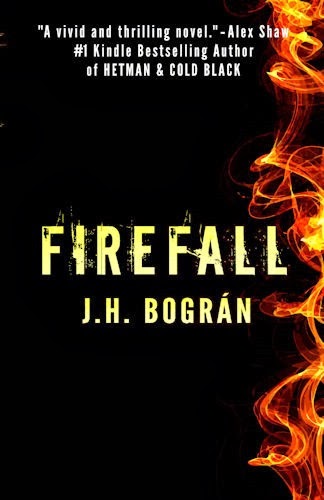
As if that was no enough, in my second novel FIREFALL, the life of my main character takes a twist for the worst when his wife and son perish aboard, you guessed it, a plane. I’d say it has a different approach from the previous work because the accident depicted this time is loosely based on one in real life that happened in 1972. I was born that year, but it has nothing to do with that decision, honestly. Suspense Magazine did me the honor of posting the aforementioned scene as an excerpt in their blog.
In fear of becoming “that author that always writes jetliner accidents,” I made the deliberate decision of not including a major scene aboard any aircraft in my current work-in-progress. Well, okay, I confess there is a very short one where the main characters arrives to New Orleans, but only because it was more convenient for him to fly there than to drive all the way from Houston!
As you can deduce, I love research. To me, that’s the fun part of beginning of a new project. Or maybe I’m just a frustrated pilot, or a pilot-wannabe as the current way speaking goes. It’s a fact that I can’t start the engine of my car without having plotted the entire route to my destination in my head. Something my wife is grateful for, especially during long trips as she hates reading maps as much as I hate a GPS device ordering me where to turn.
So, how about you? Do you have any pet-peeves you’re always finding ways to write into your stories?
———–
About J. H. Bográn
J. H. Bográn, born and raised in Honduras, is the son of a journalist. He ironically prefers to write fiction rather than fact. José’s genre of choice is thrillers, but he likes to throw in a twist of romance into the mix. His works include novels and short stories in both English and Spanish. He’s a member of the Short Fiction Writers Guild and the International Thriller Writers where he also serves as the Thriller Roundtable Coordinator and contributor editor their official e-zine The Big Thrill.
Website at: www.jhbogran.com
Facebook profile: www.facebook.com/jhbogran
Facebook author page: http://on.fb.me/ZJwEq0
Goodreads author page: http://bit.ly/1a9d07V
Amazon author page: https://www.amazon.com/author/jhbogran
Twitter: @JHBogran
First page critique:The Last Rose of Summer
By P.J. Parrish
Our critique today is titled “The Last Rose of Summer.” My comments, in yellow, follow.
The naked trees snaked upward, black capillaries against a bleached, predawn sky. The ground beneath his feet was a mire of dead leaves and copper-colored mud. A cold December wind wafted through the trees, loosening raindrops from the needles of the tall pines.
Andrew stumbled as his boot sank into a puddle, the suede immediately blanketed by a thin membrane of algae. Cursing softly, he stepped free and trudged on, grabbing the thin arms of the small trees as he scaled the slippery slope. He could no longer see the orange vest of the hunter ahead and he called for him to slow down. Pausing at the crest of the hill, Andrew rested against a fallen tree, pulling up the fleece collar of his cocoa-brown jacket. He waited for the last man of his trio to puff his way up the muddy incline.
Despite the freezing temperature, Junior Resnick’s porkish face was flushed and beaded with sweat. His brown jacket, spotted with mud, looked like a sleeping bag tied around his thick belly. “Man,” Junior said, breathless, “I thought he said it was jus’ a ways out here.” He wiped his nose with this forearm. “This is fuckin’ crazy, Andy, plum fuckin’ crazy.”
Andrew allowed himself a small smile. He enjoyed seeing Junior suffer. Wiping the mud from his trousers with a gloved hand, he turned away and started down the hill. “We’ve come this far, we keep going,” he said.
At the bottom of the ravine, he stopped on the banks of a rippling creek. The sun chose that moment to break through the heavy gray clouds, shooting eerie streaks of light into the morning mist. Andrew heard Junior’s footsteps coming up behind him and motioned for him to stop. A mockingbird’s haunting call sent creatures scampering from the brush as the wind whistled softly through the trees. The swirling mist floated over the damp ground, creeping over Louis’s shoes. He felt a stir of excitement. It was a fitting day to find a body.
Andrew stumbled as his boot sank into a puddle, the suede immediately blanketed by a thin membrane of algae. The SUEDE was blanketed? Do we care what the boot is made of? While we’re at it, do we care about algae? Get on with it! Cursing softly, he stepped free and trudged on, grabbing the thin arms of the small trees What’s wrong with “branches”? as he scaled the slippery slope. We know its slippery; it has algae on it. He could no longer see the orange vest of the hunter ahead and he called for him to slow down. Pausing at the crest of the hill, Andrew rested against a fallen tree, pulling up the fleece collar of his cocoa-brown jacket. He waited for the last man of his trio to puff his way up the muddy we KNOW it’s muddy! incline.
Despite the freezing temperature, you already said it was cold Junior Resnick’s porkish this is a loaded word. Tone it down to chubby?face was flushed and beaded with sweat. His brown jacket, spotted with mud, more mud? looked like a sleeping bag tied around his thick belly. Again, you already told us he’s fat. “Man,” Junior said, breathless, You already told us he’s breathing hard. “I thought he said it was jus’ a ways out here.” I get the feeling we are in the South somewhere. Dropping G’s to convey geographic dialect isn’t a good idea because it is hard to read over the course of a book and it is staring to establish a stereotype of Southern cops. He wiped his nose with this forearm. “This is fuckin’ crazy, Andy, plum fuckin’ crazy.” I think F word should be used VERY sparingly, as an accent, not as common venacular. It loses its impact when tossed out like this.
Andrew allowed himself a small smile. He enjoyed seeing Junior suffer. If Andrew is our hero, why make him so unlikeable so early?Wiping the mud argh…more mud from his trousers with a gloved hand, he turned away and started down the hill. “We’ve come this far, need new graph here. we keep going,” he said. New graph here too. At the bottom of the ravine, he stopped on the banks of a rippling creek. The sun chose that moment The sun is inanimate. It can’t “choose” to do anything. to break through the heavy gray clouds, shooting eerie streaks of light into the morning mist. Louis heard Junior
Okay, I know. I am being a little hard on this contributor. But I have a right to be because I wrote this way back in 1998. It got published under a new title — DARK OF THE MOON. The hero’s name changed from Andrew to Louis Kincaid. It was the book that launched the series that we are still writing today.
Sorry for not fessing up from the get-go but I just wanted to make a point. I think the critiques we do here are a damn good deal. We all seem to learn something from the give-and-take of the comments. And although it’s useful to read about the craft of writing, it can be really powerful to get feedback and see “before” and “after” writing samples. I got the idea — and courage — to show you this from Stephen King. I’ve been re-reading “On Writing” this week and in the last chapter he tears apart one of his own stories, showing us his raw first draft and the finished chapter. It’s an eye-opener.
I also wanted to share this because we recently got the rights back to our first book and are self-publishing it as an eBook. But in the process of getting it ready, Kelly and I took a hard look and decided that we could make it better. Don’t get me wrong; we’re proud of the book. But it was a freshman effort and, contrary to F. Scott Fitzgerald, there ARE second acts — if not in life than in the life of books. So rather than putting the book out there as it was originally published, we are going through it and changing some things.
Like what? Well, we’re pruning some of the “writer-ly” stuff because in the last twelve years we’ve learned that less is usually more. Here’s a good quote from “On Writing:”
“If you want to be a successful writer you must be able to describe [it], and in a way that will cause your reader to prickle with recognition…Thin description leaves the reader feeling bewildered and nearsighted. Over description buried him or her in details and images. The trick is to find a happy medium.”
We’ve also rid our book of bad dialect and gratuitous obscenities. We tweaked the secondary characters so we are not playing directly into the Southern stereotype. Yes, there are truths to be told about race in the South but it is more effective, we think now, to approach it at a thoughtful angle rather than dead-on with a hammer. And because we now know our protagonist better after living with him for twelve books, we are setting up his motivations more thoughtfully.
This has been extremely humbling, this process. It is also gratifying because we can see our trajectory as authors, see how much we have learned. But what does this have to do with me, you might be asking? Well, here’s some things you might want to take away from my first-page self-critique here:
1. Trust in the rewriting process. This is where your book is made. Get that first draft written, set it aside for at least a couple weeks then go back and look at it with a cold eye. If it looks, as Stephen King puts it, “like an alien relic bought at a junk shop where you can’t remember shopping,” you’re ready to rewrite. You’ll find glaring plot holes, thin character motivation, and lots of cheese. Embrace this process! “The Last Rose of Summer” was rewritten ten times before it found a publisher and now we’re rewriting it again. Your first draft come from your heart. Your second, third, fourth, tenth…those all come from the head.
2. Trust yourself to clean up your messes and misses. The original first chapter of “Dark of the Moon” is about five pages. In our latest rewrite we have cut it to three. Nothing important was sacrificed. But we really upped the pacing in the crucial opening chapters. Stephen King offers this formula: 2nd Draft = 1st Draft – 10%.
3. Trust that you will find your “style.” It’s what makes you unique as a writer, your special voice and way of looking at the world through your fiction that no one else has. If you read “Dark of Moon” you will hear P.J. Parrish’s voice but it wasn’t clear and confident. Now, our tone has darkened, our writing style has become leaner, and we’ve found our essential themes. It’s all epitomized in the two titles: Our working title, “The Last Rose of Summer” conveys the end of something but it sounds fuzzy, flowery and better suited to a romance. “Dark of the Moon,” taken from a Langston Hughes poem, hit just the right note.
4. Trust in your ability to learn. Yes, talent is important but so is craft. And craft can be learned. If you are a serious writer, you must be willing to constantly challenge yourself and never be content with what is easy and quick. You can hone your craft and you can get better. And yes, it might take a long time.
I am an old dog. I am still learning new tricks.
Postscript: I decided to include the “new” WIP opening so you can see our “before” and “after.” We used our first two chapters in a recent SleuthFest rewriting workshop we taught and if anyone would like to have a copy of the handout, I’d be glad to mail it to you. Email me at killzoneblog@gmail.com. Please put Parrish Handout in the subject line.
Fall Break
Writing When You’re Tired
Man, I’m tired.