conference back in 2006 as a newbie without a publishing contract, I was expecting to be dismissed by the “real” authors there. Instead, I found myself surrounded by the most welcoming, supportive professional community I’d ever met.
Yearly Archives: 2013
Getting Everything Right Is Wrong
I’m averse to making mistakes, which probably stems from my educational background. I’m an engineer by training. In that profession, errors can have devastating consequences. Miscalculate the thickness of concrete walls, and a billion-dollar oil rig sinks (Sleipner A platform). Change the design of a single bolt, and a crowded walkway collapses (Kansas City Hyatt). Underestimate the effect of cold weather on a simple rubber O-ring, and a space shuttle explodes (Challenger).
So I’ve been conditioned to avoid mistakes at all costs. The problem is that I’m no longer an engineer. I’m now in the creative fields of writing and acting. In my new professions, mistakes are just fine. No one dies. Nothing is destroyed. In fact, mistakes are encouraged. That’s how you improve.
In writing, trying to eliminate mistakes is the mistake. Yes, there are objective errors that you want to avoid in a novel. Don’t put a safety on a Glock pistol. Don’t make your continuity and timelines inconsistent. Don’t change the name of a character halfway through. These are indisputable mistakes, and yet I have seen them all in novels. Bestselling novels.
In one of my own books, THE ARK, I explained that the elevators of a slowing airplane lowered to maintain altitude. Of course, this is incorrect. The elevators should go up to pitch the aircraft up. I’ve flown planes myself. I have a degree in mechanical engineering during which I studied fluid dynamics. I know that it was wrong, and I still made the mistake. No one—including my brother, who is a former Air Force pilot—caught the error until the book was in stores. No one died, and only one reader has ever brought it up (in fact, it’s the only reason I know the mistake happened). However, the error still bugs me.
What’s more insidious for a writer is the avoidance of subjective mistakes. We want to get everything right in a story: characters, plot, twists, literary merit, creativity, emotional resonance. We want the story to be perfect, and impatient people like me want it to be perfect from the moment we start typing it.
But it never is. It can’t be. Ever. I bet you’d only be able to come up with a tiny list of stories that didn’t have a single thing you’d change. And even then, go look at the Amazon reviews for those books. You’ll find at least a few people (and sometimes hundreds of them) who don’t agree with your definition of perfection.
Voltaire is considered the originator of the phrase, “Perfect is the enemy of good.” We’re afraid that if our story isn’t perfect, it won’t be good enough. The idea for a novel that we have in our minds never comes out on the page like we imagine. Sometimes we can’t write at all because we’ll be disappointed that it won’t come out perfectly formed on the first try.
What we have to come to terms with is that making mistakes is part of the process. That’s how we learn. That’s how we make art. My wife, who is sometimes frustrated when I delay delivering pages to her to edit, gave me a T-shirt for Christmas that says, “Even if it’s crap, just get it on the page.” That notion can be freeing if you take it to heart. You can’t make it better if it doesn’t exist in the first place.
I’m getting more comfortable with making mistakes, but it’s a daily struggle. The lesson slowly worming its way into my head is that to fixate on creating the perfect novel results in creating nothing. So I’m learning to focus on the right thing: getting a story out that reflects my voice, where even the flaws and imperfections are unique to me.
How to Make Money Self-Publishing Fiction
James Scott Bell
@jamesscottbell
introduction of Perry Mason. There was no looking back. At one time Gardner was listed in the Guinness Book of World Records as the bestselling author who ever lived.
Be prepared to give some things up (TV is a jealous mistress, too) in order to find time to write.
Finishing the First Draft
By Mark Alpert
It was a terrible week in the news — the bombs in Boston, the explosion in Texas, the failure of the background-check bill — so it was a great relief to plunge into fiction. And fiction-wise, it was a wonderful week for me, because I completed the first draft of my next novel. My daily word count always rises to extraordinary (at least for me) levels when I’m nearing the end, partly because I get caught up in the climax of the book and partly because I just want to finish the darn thing. I love writing 2,000 words a day, but it also makes me feel bad about how little I write at other times. I say to myself, “Why can’t you write this much all the time? Then you could knock off a novel in two months and spend the rest of the year on your tennis game.”
But it didn’t. At this point I have no idea whether the book is any good, but at least it hangs together. Now I have to wait to hear from my editor. He already read the beginning of the book, and he liked it, but I don’t know how he’ll feel about the end. I’m not even sure how I feel about it. I’m too close to the thing. But I’m cautiously optimistic. The reason for my optimism: bullet ants. The ending has a scene featuring bullet ants. You see, I just broke my rule about never revealing details of a novel-in-progress, but I couldn’t help it. Bullet ants are fascinating creatures.
Reader Friday: Does writing make you happy?
What Advice Would You Give to Young Writers?
Today I am presenting a workshop to the Creative Writing students at the University of Texas at San Antonio (UTSA). This is a free offering of like-minded authors getting together to share their thoughts on the publishing industry and the craft of writing. I plan on sharing my thoughts on the latest trends in publishing with a focus on the Young Adult and New Adult markets. I will also spend more time talking about author craft and the epiphanies I have learned through the books I’ve written. Each book teaches you something different, right? Writing is the best way to learn those things, mostly through trial and error when you learn best from your mistakes.
I also want to spend time talking about the writer’s life and the discipline to accomplish daily goals. Usually life, the day job, and other obligations can force you to set aside your passion to write, but if it’s important to you, I say make time for it, even if that’s only a page a day.
The hardest thing I will broach is the crazy things happening in the publishing industry with regard to the changing contractual terms and what it means to self-publish or navigate the ebook services being offered by large publishers and agents, etc. But I find it hard to stop the long list of warnings that I would want them to be aware of so they don’t sign their copyrights away for the life of their book, simply to get published. It’s a scary world out there in this interim phase while the industry is sorting things out. But I don’t want to scare them off either. So I am limiting my warnings to only the most treacherous ones that dangle like gems stones and look all polished and pretty, but have complications. Things like royalty value for digital books, the ala carte subrights menu, rights reversions, and what agents and publishers are offering that could be troublesome. When the goal is to get them to incorporate writing into their daily life, or to nurture something that could become a passion later in life, I don’t want to discourage them from the start.
When I talk to young writers, I want to simply encourage them to write and recognize that if they have the drive and passion for writing, they should write whether they get published or not. I remember how important reading and writing was for me in school and how it stayed with me for my whole life. But first comes the desire and getting hooked on it. It’s a quality of life thing. I usually encourage them to keep a journal of their thoughts or characters they want to develop, or keep a file of ideas for future books. I will share James Scott Bell’s wonderful TKZ post on how to write a short story or share one of my favorite Joe Moore posts on editing your work in Writing is Rewriting. There are so many posts that I’ve found useful at TKZ that I’m still pinching myself that I am a member here.
But my question to all of you is – what advice would you give to a young writer? Someone who is in college or high school and has the writing bug? Everyone here at TKZ would have something to offer young writers. What would you tell them?
The End Game
I enjoy taking about the mechanics of writing, particularly the basics—Writing 101. The reason is that it’s where most new writers stumble and fall. It’s why so many manuscripts fail to get published or even get considered for publication. And a lack of appreciation for the basics is a huge source of frustration later on when things aren’t clicking. There are no magic beans or silver bullets in dealing with the basics. And despite some urban legends, you won’t be initiated into a secret society of published authors with a special handshake. The basics are just that: basic concepts on which to build your story without letting anything block the flow of your creativity.
It’s obvious that a strong ending is as important as a strong beginning. Your reader should never finish your book with a feeling that something was left hanging or unanswered that should have been completed. It doesn’t matter if the ending is expected or unpredictable, it shouldn’t leave the reader with unanswered questions. You don’t want to play the end game and lose.
Oftentimes, beginning writers don’t successfully bring all the elements of a story together in a satisfying conclusion. There’s no real feeling of accomplishment at the end. Your readers have taken part in a journey, and they should feel that they have arrived at a fulfilling destination. This is not to say that every conflict should be resolved. Sometimes an open-ended conflict can cause the reader to ponder a deeper concept, perhaps an internal one. Or a more obvious reason to have an unresolved conflict is to suggest a sequel or series. But something has to occur that will give your readers the feeling of satisfaction that the journey was worth the investment of their valuable time.
There are a number of methods you can use to make sure your ending works. Consider ending with a moment of insight. Your character has gone through an internal metamorphosis that causes her to learn an important life-lesson. Her growth throughout the story leads up to this emotional insight that makes her a better or at least changed individual.
Another technique is to set a series of goals for your protagonist to work toward and, in the end, they are achieved. Naturally, the harder the goals, the more satisfying the ending will be for the protag and the reader.
The opposite of this technique is to have the protagonist fail to overcome the main obstacle or goal in the story. The ending may not be a happy one for the character, but he can still experience an insight that is fulfilling for the reader. An example of this would be a character who truly believes that riches bring happiness only to find that true fulfillment comes with the loss of material wealth. In the end, the goals of becoming rich are never met, but he is a better person for it.
You might choose to end your story with irony. This usually occurs when the character sets out to accomplish a goal and expects a certain result only to find in the end the result is exactly the opposite. A con artist tries to pull off a big scam only to be conned and scammed by the victim. There’s an old saying that the easiest sell in the world is to a salesman. Watch The Sting.
How about a surprise ending? There’s probably never been a bigger surprise ending than the movie The Sixth Sense. A kid keeps telling a guy that he can “see dead people”. Well guess what? He sees the guy because the guy is dead. There were audible gasps in the theater at the ending of that one.
As you decide on an ending and begin to write it, think of the summation an attorney makes right before the jury goes into deliberation. The final verdict will be whether the reader loves or hates your book. Or worse, feels nothing. Present a convincing argument, review all your evidence, and walk away knowing you’ve done all you can to get the verdict you want.
So how are you guys at playing the End Game. Any additional tips? What about telling us your favorite ending to a movie or book?
When Titles Go Bad
Okay, we’re starting out today with a quiz. No Google-cheating for the answers either. Here are the original titles for some books. I guarantee you’ve read at least one. (I’ve read them all which is why I picked them) Can you guess what they wound up being called?
The Last Man in Europe
They Don’t Build Statues to Businessmen
Fiesta
At This Point in Time
Wacking Off
Now let’s talk about what you’re going to call your book. Because this is the most important marketing decision you will make and frankly, given the quality of some titles out there, we all need some help on this front.
The naming of books is a difficult matter.
It isn’t just one of your holiday games.
You may think at first I’m as mad as a hatter
when I tell you, a book must have three different names.
Apologies to T.S. Eliot but I’ve found that his rhyme about naming cats works for books. In my life I’ve had sixteen cats and published sixteen books. Weird stat, huh? Got me thinking about how important a name is when it comes to your book.
How important? I found a marketing survey that asked readers what was the element that most influenced why they bought a book. Excluding Gigantoid Author Name (ie James Patterson can put his name on an Altoid can and it would sell) here is the order:
1. Title
2. Cover
3. Back copy
4. Opening paragraphs
5. Price
This is why when Carson McCullers submitted her first novel The Mute to Houghton-Mifflin they bought it and renamed the book The Heart Is a Lonely Hunter. This is why after William Golding’s first novel Strangers from Within was plucked from Faber and Faber’s slush pile, it was retitled Lord of the Flies.
First impressions count. And your title is like a business card, a quick but well-calculated introduction you offer your reader in the hopes it will entice her to want to know more. It doesn’t matter if you’re traditionally published or doing it yourself, the wrong title can make or break your book – and you.
Going traditional? In your average publishing house, there will be many people with their hands on your book: editors, sales reps, marketing managers, publicists, even book buyers at the major booksellers will weigh in on the consumer appeal of your title. (Walmart threatened to not stock our book South of Hell because of the title; they backed off) Chances are your title will be challenged or even changed.
Going self-published? What you call your book will be entirely up to you so it’s really important to understand what a title needs to do. More on that in a moment.
Let’s go back to T.S. Eliot for a sec. He says that cats have three names: the first is the one the family uses in every day life. For us this was UNTITLED LOUIS KINCAID THRILLER NO. 1. That’s how it appeared on our contract. Lots of writers call their book WIP or The Book. Or in some sad cases, That Thing That Has Eaten Up My Life For Ten Years.
Eliot’s second name for cats is “fancier names that sound sweeter.” For us, it was The Last Rose of Summer, the title we submitted. We loved this title. We thought it spoke volumes about our thriller which was about the vestiges of Old South racism, forbidden love and death. But it wasn’t dark enough. It sounded like a romance.
Eliot’s third cat name is one that’s “particular, peculiar and more dignified.” This is the title your book really needs. For us, it was Dark of the Moon. We came upon that title after weeks of gnashing our teeth. I pulled my volume of Langston Hughes poems from the shelf and there was his poem “Silhouette” and our final title.
Southern gentle lady,
Do not swoon.
They’ve just hung a black man
In the dark of the moon.
They’ve hung a black man
To the roadside tree
In the dark of the moon
For the world to see
How Dixie protects
Its white womanhood.
Southern gentle lady,
Be good!
Be good!
I think some authors have “the title gene” and come up with the perfect names. Others lock onto signposts like Sue Grafton’s alphabet, John Sandford’s “Prey” or Evanovich’s numbers. Although I have to say I’m not crazy about this approach especially since it has spawned some lazy imitation gimmicks. (Hey, I’m going to write an erotic-suspense series! I just Googled condom names! Want to buy my book Vibrating Johnny?)
We’ve been lucky and have had to change only two of our titles. Maybe it’s because I used to write newspaper headlines so my brain is trained to take a story and smash it down into ten words or less that you can read from a passing car. I do know that authors struggle mightily with their titles. There’s even a award for the worst title -– and of course it’s awarded by the British.
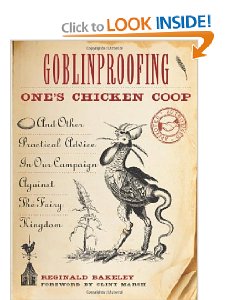
Bookseller Magazine gave their prize this year to Reginald Bakeley for his book Goblinproofing One’s Chicken Coop – and Other Practical advice In Our Campaign Against the Fairy Kingdom. The runners-up were:
How Tea Cosies Changed the World.
God’s Doodle: The Life and Times of the Penis.
How to Sharpen Pencils.
Was Hitler Ill?
In twelve years of teaching workshops and doing critiques I’ve have seen maybe one title that I thought really captured the book’s tone. (It was our own Kathryn Lilly’s Dying To Be Thin.) So I know how hard this is. Here is my advice on titles, for what it’s worth:
- Capture your tone and genre. Go on Amazon and look up books similar to yours (cruise the genre bestseller lists). Words have inflection, mood and color. Choose them carefully.
- Grab the reader emotionally. Two titles that do it for me: The Unbearable Lightness of Being and The Spy Who Came in from the Cold
- Don’t settle for clichés. Yes, it’s hard to come up with fresh permutations on old standby words (especially in genre fiction where we rely on “dark” “blood” “death” etc.) But you have to find words that are unique about your story and draw upon them. Here’s a great title that twists a cliché word: Something Wicked This Way Comes.
- Don’t use empty arcane words that you think sound cool. Examples of bad titles: The Cambistry Conspiracy. (about world trade) The Hedonic Dilemma (about psychology ethics). Penultimate to Die. (the second-to-the-last victim). Don’t worry…I made these up.
- Create an expectation about the story. You know why I love this title: A Heartbreaking Work of Staggering Genius? It makes me say, “Oh yeah, buddy? Show me!” and he does.
- Be brief and punchy. Okay, I know I just gave you a bunch of long titles I love but there is something wonderful about short titles and studies show most bestsellers have short titles: Gone Girl works. So does Tell No One, Lolita and Jaws (original title A Stillness in the Water).
- Make the title work on other levels. This is hard but worth the brain-sweat if you can do it. Consider what these titles come to mean once you get deep into the stories: Catch 22, Silence of the Lambs. But don’t get too clever. I love Louise Ure’s book Forcing Amaryllis and the title is brilliant because it is about a rape and murder. But do most understand that the title is from a gardening term about forcing a plant to bloom early? Not so sure.
- Make a list of key words that appear in your book. Is there something you can build on? For our book A Killing Rain, the title came when I heard a Florida farmer describe that drenching downpour that can kill off the tomato crop and we used it in the book. The title was there all the time and we didn’t see it at first.
- Search existing works — the Bible, poetry, Shakespeare. I found our title An Unquiet Grave in an 17th century English poem.
- Write 20 titles and let them sit for a week or so. Go back and read them and something will jump out. Find some beta-readers you can test with. Titles usually evoke visceral immediate responses. You will know immediately if they connect.
And last: Never get emotionally attached to a title. It’s the worst thing you can do because it probably will be changed. Or needs to be. Because your first title is usually, as T.S. Eliot said, a prosaic every-day thing. You can do better. It’s there. You just have to dig deep. Sweat out that great title that Eliot called the “ineffable, effable, effanineffable deep and inscrutable singular name.”
Answers to the quiz:
The Last Man in Europe (1984)
They Don’t Build Statues to Businessmen (Valley of the Dolls)
Fiesta (The Sun Also Rises)
At This Point in Time (All the President’s Men)
Wacking Off (Portnoy’s Complaint)
How Self-Publishing Has Changed the Industry
I read a recent blog post on The Guardian book blog about the 10 ways self-publishing has changed the book world and, after Jim’s post yesterday, it got me thinking about how I would explain the current state of the book world to friends and family who are neither authors, nor wanna-be writers, but who, as book readers, are nonetheless intrigued by all the changes going on in publishing.
I’ve summarized the Guardian’s top 10 list below and am interested in whether or not you agree (though I do think most of them are pretty self-evident):
- There is now a wider understanding and increased visibility about what publishing is (and acceptance that it’s more difficult than it looks). Self-publishing has enabled people to learn the process and understand what is involved which has led to a wider awareness and diversity in the publishing process.
- We are no longer confident that publishers and agents know what everyone wants or should read.
- The copy-editor is now in strong demand as writers realize the limitations of self-editing. Freelance copy-editors are now in high demand by both self-publishing authors and traditional publishing houses.
- The book as a ‘precious’ object is re-emerging as publishers produce limited, luxury editions.
- Authors are being empowered to do their own marketing and are no longer reliant on publishers to mediate the relationship between authors and their readers. Looking ahead, authors are likely to be less compliant with what their publishers demand of them.
- The role of the agent is also changing. With self-publishing, agents need to find new ways to make their work pay.
- New business models and opportunities are springing up offering ‘publishing services’ from manuscript and plot development to editorial and marketing assistance. Publishing is thus emerging as a process – accessible as a variety of different services – rather than an ‘industry’ as such.
- It’s not all about making money. Self-publishing means recognizing and preserving content that has value for someone but that doesn’t mean the process has to yield an income to be worthwhile.
- The end of the ‘vanity press’ put down. Self-publishing is now seen as the ‘homing ground of the instinctively proactive’ – those who can identify the market, meet its needs and deliver directly.
- Self-publishing brings satisfaction and happiness in and of itself as each writer meets their own needs (which may only require a finished product or small sales to a niche market).
The most important element I take from this list is the notion that publishing is emerging as a range of processes, accessible to all, rather than an industry that so many viewed as an impenetrable fortress. I am also intrigued by the comment that authors will probably become less ‘compliant’ with the demands the publishers place on them, as they are empowered to understand their own market and reader needs (especially as authors now have many of the tools [such as social media] to meet these needs directly).
Here at TKZ we have had a number of blog posts regarding the question of self-publishing, its challenges as well as its rewards. So what would you say is the number one way self-publishing has changed the book world?
Help! I’m Published and I Can’t Get Up!
James Scott Bell
@jamesscottbell
They always thought they’d have that comfortable room in the City, and maybe even get a place at the A List banquet table if things broke right.