What kind of title is Smash Cut?

TKZ welcomes our guest blogger, Sandra Brown. Sandra is the author of over seventy novels including fifty-six New York Times bestsellers. Her latest is SMOKE SCREEN (August, 2008), and her new book, SMASH CUT, is scheduled for release in August, 2009.

By Sandra Brown

I can imagine the quizzical expression on the faces of most readers when they hear the title of my next book, SMASH CUT. 

brown-sandra What the heck? Is that a noun or a verb? Neither? A little of both? A noun plus an adjective or a verb plus an adverb? Unless you work in the film industry or have a more than pedestrian knowledge of script writing, you probably aren’t familiar with the term.  I’ve been a movie fan all my life, but I’d never come across that phrase until I started writing this novel and had to do some research into screen writing jargon, looking for a term that would apply to my story. Ergo – SMASH CUT. More on that later.

Most frequently asked question: Where do you get your ideas?

Most difficult question to answer: See above.

It’s tough for me to explain how an idea originated, because typically I don’t have a clue.  Colleagues often cite personal experiences on which they base stories. Either they’re bald-faced liars (and I strongly suspect this of most of them) or, by comparison, I lead a much more boring life, because nothing ever happens to me that’s exciting enough to write about.

Not that I’m complaining. I’m a card carrying coward, so I don’t go looking for adventure. I avoid encounters with mean people, and certainly with wildlife, toxic plants, biting insects, and white water. I enjoy the great outdoors, but only if I’m appreciating it from behind tempered glass. My idea of camping out is staying in a hotel that doesn’t have  room service after midnight. I have acute acrophobia, and I’ll go into the ocean only if the beach catches fire. I know, I know, I’m a barrel of laughs.

Where was I?  Oh, right.  I don’t have anything interesting to write about unless I make it up. And only sometimes can I say definitively how an idea came to me.
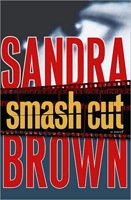
smash-cut1 To an extent, SMASH CUT is an exception. Because I can tell you that at least part of this idea came from my family’s habit of dropping movie quotes into our conversations. 

We’re all movie buffs.  We have family standards, movies we never tire of watching, movies we’ve seen so many times we can practically recite the entire script but enjoy re-watching anyway. I think the familiarity makes these classics even more delectable, although the diehards who will watch a movie only once, vehemently disagree.  These are also the people who will read a book only once. They are to be pitied. Probably a foundation should be started for them.

Anyhow, we in my family love movies of all kinds — funny, sad, scary, historical, contemporary, futuristic. Movies about war, cowboys, gangsters, love. Doesn’t matter. Our taste in films is as diverse as our taste in books. We like anything so long as it’s entertaining. 

sandra-brown In 2006, the Academy of Motion Picture Arts and Sciences (Surely you’ve heard of the Academy Awards. . .) put together a list of seventy-five famous quotes and made a great looking poster out of it. Against a black background are a big gold Oscar and all these quotes written in different fonts. We had one framed for our media room, and it draws the attention of guests who get a kick out of testing their memories. Some of the quotes are easy to identify: “Frankly, my dear, I don’t give a damn.” Some only film historians would be able to identify with alacrity.  Many are from recent pictures.  Others date back decades.

The point is, among my family members, we were able to identify all seventy-five films by title and the actor who spoke the line.

So our stockpile of movie quotes is extensive. We have a suitable quip for nearly every occasion and conversation. “Napoleon Dynamite” alone was a treasure trove. Whenever one of us drops in a line (and sometimes it’s said by several of us in unison), the rest of us “get it,” while an “outsider” is left perplexed, wondering what the heck we’re all talking/laughing about.  We’ve tried to ameliorate this rudeness by describing the movie scene and the context in which the line of dialogue was spoken, but it frequently loses it’s punch in the retelling. 

I guess you had to be there.

You may think this sounds like a real drag, something that only people with very little else to do would engage in, but in our defense, I can think of worse things families can do together.  It’s a harmless pastime.  But you’re probably asking what relevance it has to plotting a novel.  I’m getting to that, I promise. 

I suppose this family tradition was in the back of my mind when I asked myself, “What if?”

Now on this, my colleagues and I are in complete accordance. Every novelist asks, “What if. . .?”  It’s a derivative of the childhood “Play like. . .”

So I asked myself, “What if quoting lines of movie dialogue wasn’t quite so harmless? Play like one’s preoccupation with movies was detrimental or, say, deadly?”

Hmm. Interesting. Follow that and see where it goes.

About the time I began doing that, I revisited an idea which had occurred to me several years ago but had remained on the back burner: Passengers in an elevator become the targets of a vicious crime.

Hmm. Interesting. Again, follow that and see where it goes.

Are the elevator passengers acquainted or perfect strangers? Is the elevator in an office building, city hall, hospital, military post?  Who commits the crime?  Who’s the unlucky casualty?

What I didn’t realize until later is that a crime committed in an elevator poses all sorts of terrible problems, not only for the hapless fictional passengers, but for the idiotic writer who put them there!
And how would said writer tie in that scene – which was vivid in my mind and demanding to be used after languishing in my head for several years — with the movie buff? What’s the connection? And maybe the movie buff’s preoccupation with the movies isn’t a bad thing, after all. Maybe it just appears to be a negative fixation, when actually. . .

You see how this works? I keep asking, “What if?” until the plot reveals itself to me. I think of a story that way. It’s an entity that is there all along, but one day decides to shoulder its way into my consciousness. I can’t really take credit for doing anything except writing it down and passing it along to you, although more frequently than not, that shouldering thing takes months. It can be a painful process, involving a lot of hard work, self-doubt, cursing, and gnashing of teeth.

Once I had the plot for this book, I began “collecting” movie quotes and memorable scenes to incorporate into the story.  I commissioned every movie fan I know to submit suggestions, particularly favorite murder scenes. What I learned was that I’ve got some really sick friends and family members.  But I must admit, I came up with most of the film lines and images that wound up in the book. 

Now, about that title. Having done my due diligence on script writing terms, I learned that “smash cut” refers to an abrupt edit that’s specifically designed to shock, jar, or scare the living daylights out of the audience.

I hope you’ll experience a few in SMASH CUT.

~~~~~~~~~~~~~~~~~~~~

Coming up Sunday, June 14, our guest blogger will be New York Times bestselling author Steve Berry. And watch for future Sunday guest blogs from Robert Liparulo, Paul Kemprecos, Linda Fairstein, Julie Kramer, Grant Blackwood, and more.
“What’s The Frequency (Today), Kenneth?”

John Ramsey Miller

As if authors weren’t insecure enough… the sky is falling …again.

“Holy shades of the terror, Danton.” For as long as I’ve been in this game, the publishers, agents and editors have said things have never been worse in publishing, and everybody was always looking back at the “good old days.” Maybe this time they are right. If not worse, certainly our world has changed forever. And it could get worse than it is. The shakeout is not over, but there seems to be a lull in reorganizing and reshuffling at the major houses. At least it appears the wholesale bloodletting has slowed for the moment. The publishing behemoths seem to have reshuffled their cards and, leaning the fat, have resettled on their foundations. Some are acquiring books again in increasing numbers.

I’m not a businessman, but this is what I’ve managed to figure out:
More than usual even, booksellers don’t want to tie up capital in excess inventory. Most bookstores have lots and lots of books on their shelves, and the object is to roll inventory as often as possible. Thousands of books come out. If the author is new to them, and unless the buzz is enormous, they order as few copies as possible. If those sell, they might buy more, but normally they wait to see what the demand is before doing so––ordering as people ask them to. They order their stock based on the past sales of a book by a previously published author. On a clever or lucky buy, they will sell the books before they have to pay for them. Even though they can return books to the publisher for a refund, it’s a pain to lift them up and place them in boxes for shipping them back where they came from. With paperbacks they can just tear off the covers and ship them in envelopes to get credit, or a refund. I’m not sure exactly how the flow of funds between entities works because it’s irrelevant to me. Probably they send each other checks in the mail.

This is how it seems to go. If your book sells five copies, next time the store will order up to five, but probably less than five. If you are lucky, the people who bought the last book liked it enough to buy another book you wrote. But they might order it from Amazon, so the book the seller bought in anticipation of another sale to the same [hopefully loyal as if there were such a thing] customer, gets his feelings hurt and his computer places a black ball by your name.

The good old sink or swim move. A publisher pre-sells your book to the tune of 5,000 copies. They print 10,000 copies, ship the five they’ve sold, and put the other five in a warehouse in Soprano, New Jersey just off the turnpike near a group of storage tanks filled with things like food-grade motor oil. In the good old days the IRS allowed publishers and record companies to write off the (unsold inventory) boxes of books while the pages yellowed and the glue got stiff and lost its ability to hold things together. They do not tell anybody your new book is coming out, or brag about it when it does, (which is the sink-or-swim or natural selection). If it starts selling they will promote it because that makes sense. But the IRS decided this writing off inventory for years was a bad thing (on the order of writing off three-martini lunches) and put a stop to it. Martinis are great business greasers, and I believe that the captains of industry made better decisions while under the influence thanks to the 3ML. The loss of the three-martini lunch write-off did more to kill liquor sales than prohibition, but that is another story.

The way publishing works is the sort of thing you tell a room full of potential authors at your local high school if you want to nip future competitors in the bud. But seriously, authors need to know that no matter how good their books are, there’s slim chance they’ll rise to Dan Brown’s status.

The really dedicated upcoming talent will do as we authors have done and ignore the incoming rounds, forging ahead with laptops open and take our places on the shelves. The truth is, the odds are always stacked against us, and it’s the bean counters who make the decisions about our careers, not the editors and salesmen who actually like us and love our books. Always remember the words of Michael Corleone; “It’s just business.”

What I’m actually saying is that we authors are not selling dreams, which is what we think we are doing when we get into this life, we’re actually supplying a widget for the buying public and our careers depend on how many of them want to dream with us by purchasing our gizmos.

When I spoke to my local high school’s writing class the other day, I asked how many intended to become writers. I told them that when I was their age I didn’t think I’d make my living writing. I told them that life would lead them where it wanted them, and like me, although I didn’t set out to become a storyteller, the stories just began to pile up in my head and I just decided to put them down. I might not have done so had I known the probability of ever being published, but luckily I was ignorant of the astounding odds against me. I told the young people that once they discovered what they loved doing, they might be lucky enough to make a living at it as some of us have. I know the writing side pretty well, but the business side of the industry is impossibly murky. Sure there’s no security, and the work is really hard …if you do it right.

The All Important Final Clause

By John Gilstrap
http://www.johngilstrap.com

As an author, I believe that I make a silent contract with my readers to provide them with a complete entertainment experience. The suspense is a given (I hope) but there are also the light moments, the warm moments, and even the occasional tear-jerking moment. If I do my job right, I’ll hook ’em with the first line, run them through a roller coaster through all the middle chapters, and then, at the end, leave them feeling . . .

Well, it depends. More times than not, I want that last moment we have together to be one of those where you gently close the book, maybe squeezer it a little, and then say, “Jeeze, I wish it wasn’t over already.”

Think about all the ink we’ve spilled here in the Killzone talking about kick-ass beginnings. I think that endings are even more important. It’s not just about tying up loose ends, either, although obviously that’s important. I’m talking about that final note in the literary symphony. Is it a cymbal crash or a sweet pianissimo? Maybe we want them to have trouble reading through their tears.

Whatever our plan, it’s up to us and us alone to make it happen. That last scene—the last moment my readers and I have together—mean a lot to me. I agonize over it. I look at those last sentences as the final clause in the contract that I make with the people who choose to read my work.

I’m a student of last lines. Here are some of my favorites:

“And in the middle of them, with filthy body, matted hair, and unwiped nose, Ralph wept for the end of innocence, the darkness of man’s heart, and the fall through the air of the true, wise friend called Piggy.” — William Golding, Lord of the Flies

“He would be there all night, and he would be there when Jem waked up in the morning.” – Harper Lee, To Kill A Mockingbird

“But I reckon I got to light out for the Territory ahead of the rest, because Aunt Sally she’s going to adopt me and sivilize me and I can’t stand it. I been there before.” –Mark Twain, The Adventures of Huckleberry Finn

“It is a far, far better thing that I do, than I have ever done; it is a far, far better rest that I go to than I have ever known.” –Charles Dickens, A Tale of Two Cities

“Tomorrow, I’ll think of some way to get him back. After all, tomorrow is another day.” –Margaret Mitchell, Gone with the Wind

“But wherever they go, and whatever happens to them on the way, in that enchanted place on the top of the Forest, a little boy and his Bear will always be playing.” –A. A. Milne, The House at Pooh Corner

“. . . together they cried like babies on national television.” – John Gilstrap, Nathan’s Run

Come on, you must have a favorite finale to share. Let’s have it.

Bacon-wrapped Innovation

by Michelle Gagnoncreme brulee guy

Bear with me, in this post there are going to be some metaphorical leaps and truly questionable analogies. I partly blame an excellent roundtable discussion by the JungleRed crew on “weeding someone else’s garden,” both literally and figuratively.

That post was on my mind when I went to my monthly book club meeting last night. Now, I love my book club for many reasons- it forces me out of my reading comfort zone (especially when it comes to non-fiction, which research aside I rarely read willingly), and also because I usually return home with some fascinating new bit of information. Last night was no exception.

One woman was complaining about a strange-let’s call it a compulsion- that her husband has developed. At 10:30 at night, he’ll suddenly get a message on his Blackberry and will run for the door, yelling, “I’ve got to go. He’s on 24th and Mission.”

Sounds suspicious, right?

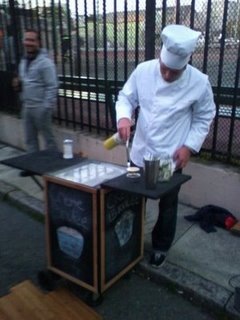
Well, it turns out that her husband is a religious follower of the bacon-wrapped hot dog guy. That’s right, there’s a guy in San Francisco who operates a guerilla (read: unlicensed) food cart, selling bacon wrapped hot dogs. He moves constantly, staying one step ahead of the authorities (hopefully)–and people find him thanks to frequent Twitter updates.

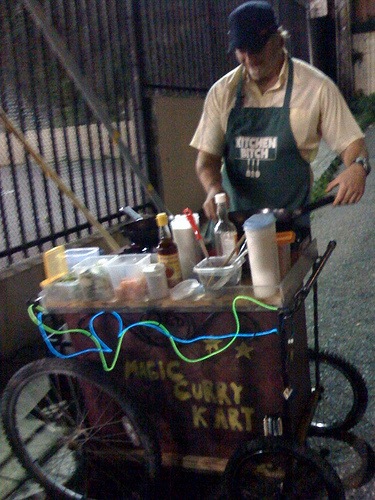
This story struck me on many levels. First, how on earth is it possible that I’ve lived in a city for over a decade and had no idea that we even had street food vendors, never mind ones who sold bacon wrapped hot dogs? After further investigation, I discovered that the bacon wrapped hot dog guy is not alone. There’s a muffin man, a creme brulee guy, and a “magic curry cart.” Even one of my favorite restaurants, Chez Spencer, has a cart. This is critical, potentially life changing information.

magic curry cart This discovery also marks the first time I fully understood the point of Twitter (please don’t jump all over me, tweeters- I just hadn’t grasped any practical applications until now). The vendors post where they’ll be appearing, and followers flock to that intersection for $1 chai and amuses bouches. Genius.

When interviewed, a few of the vendors explained that thanks to the recession they lost their high end restaurant jobs, or couldn’t get one in the first place. So, rather than give up on their passion, taking jobs in telemarketing or retail, they decided to branch out on their own. It’s a lot of work, the margins are slim, but they’ve each managed to build up a steady and devout following (my friend’s husband apparently has many cohorts who share his obsession for the food carts- a tweet goes out, and they all flock to the nearest one. It’s become an impromptu party for them).

I found their commitment and creativity inspirational.

Okay, brace yourselves for the leap.

I spoke with my agent yesterday. He returned from BEA somewhat disheartened- apparently all anyone was talking about was the downturn of the industry, the plummeting sales. And when sales are down, acquisitions are down, which creates a self-fulfilling death spiral. Editors are even more overburdened than usual; if they still have a job, chances are they’ve picked up numerous projects that were initially acquired by laid-off colleagues. There were fewer vendors at fewer booths, and as opposed to previous years the air was heavy with doom and gloom (although whether or not that is a deviation from the norm is largely a matter of opinion).

Which is exactly what the restaurant industry is experiencing. Fewer customers, smaller margins, a sharp downturn. Maybe the publishing industry should take a lesson from the street vendors- when times are tough, it’s time to innovate. Maybe that means authors take advantage of something like the new Scribd publishing program we’ve discussed in earlier posts. Maybe it means eliminating remaindering and starting with smaller print runs, or figuring out a way to build support for new authors by tapping into the popularity of more established ones. Heck, maybe we should start wrapping our books in bacon. Adapt or die, as they say. And while you’re doing it, you might as well eat well.

Now, if you’ll excuse me, I just got a tweet. The Korean Taco guy is a few blocks away, gotta run…

And special thanks to Cym Lowell for providing a link to this article on food cart vendors nationwide. I’m trying to convince my husband to visit DC so we can try the mango lassi popsicles.

Success is a 4-letter word

By Joe Moore

Okay, it’s really a 7-letter word. But I know a lot of successful authors that would use a 4-letter word when asked what it’s like to be successful. Why? For a couple of reasons. First, success is impossible to obtain. You can obtain “better”. You can achieve “improved”. But you’re always working to be successful. Success can be nothing more than a carrot on a stick just beyond your nose.

Second, success means something different to everyone. It’s a lot like describing an object as being green. Are we talking forest green, lime green, Irish green, puck green, or foam green? How about that green on the Beatles Apple logo or Kermit the Frog green?

I’ll bet if you asked any author who just sold a million copies of his last book, did it make him feel good? The answer will probably be, “Absolutely!” Does he consider himself a success? 4-letter-word no! Why? Because now his publisher expects him to sell 2 million copies of that next book he hasn’t finished writing yet. No pressure there. That’s not success. That’s a problem, albeit one we would all like to have. Now his sales are a bold number on the publisher’s ledger sheet. Now employees’ jobs rely on his success. It’s not just good enough to write another great book that sells lots of copies, he has to worry about the folks that are counting on him for their salary, their jobs, and their future.

So what is success in the publishing industry? Is it when you sell 25,000 copies, 50,000 copies, a million, become a New York Times bestseller? When can a writer kick up his or her heels and declare, “Mission Accomplished”?

Here’s a tip. Success is what you predetermine it will be. It’s what you decide before it comes. If you don’t approach success in that way, you are destined for disappointment. For some, being successful is walking into a bookstore and seeing their novel on the shelf. For other’s it’s the rush of holding a book signing and seeing the line of fans snaking out the door. And for many, it’s money.

But even if it is money, try to remember that it’s more important to predetermine what you’ll do with it, rather than wanting to be “rich”. For instance, determine the amount you’ll need to quite your day job. Or to pay off your mortgage. Or to move to Cape Cod or Palm Beach, or just a bigger house.

The point is, you determine what will make you successful. Be specific, not vague. And if you achieve it, relish it, celebrate it. Because everything after that is the sauce on the steak. And if you do achieve your predetermined success, always say the two most powerful words in the English language: Thank You.

When do you consider a writer to be a success? Have you predetermined your Mission Accomplished criteria? Have you already achieved it?

~~~~~~~~~~~~~~~~~~~~

Coming up Sunday, June 7, our guest blogger will be New York Times bestselling author Sandra Brown. And watch for Sunday guest blogs from Steve Berry, Robert Liparulo, Paul Kemprecos, Linda Fairstein, Julie Kramer, Grant Blackwood, and more.
The Jedi-writers Strike Back

I was happy to read that JA Konrath’s novella, SERIAL, has been the #1-Kindle Bestseller for the past nine days. (See his post yesterday).

Many of us have been speculating here about the potential impact of the Kindle on the publishing biz — now Konrath has leaped ahead and run his own home-grown publishing experiment over at Amazon. SERIAL (written under the name Jack Kilborn, penned with co-author Jack Crouch), is a free download. IMHO, the decision to make the download free was a stroke of marketing genius. The download brings with it branding and name recognition. And it’s a neat way to bump yourself ahead of the bestselling mega-authors, too.

Konrath announced the results of another Kindle experiment on his blog yesterday. Evidently in the month of May he made some of his smaller writings available for sale on Kindle. These were works he’d previously allowed readers to download for free from his web site. By selling those same works through Kindle, evidently he netted more than a thousand dollars in one month.

I was particularly interested to read about Konrath’s Kindle experiments in the wake of the recent news that scribd is now letting authors sell ebooks from the scribd site at an 80/20% revenue split. In a recent blog post, I mentioned that an established author (Kemble Scott) decided publish his latest book on scribd instead of going the traditional print publishing route. I just checked back over at scribd, and saw that Scott’s book, THE SOWER, has had 1933 “reads” at a list price of $2.00 each. And it’s only been posted a short time.

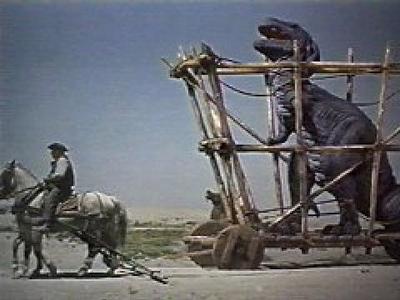
The way my fellow author friends are testing the ebook waters reminds me of that scene from Jurassic Park, where the guide tells the visitors that the dinos are testing the fences for weak links.

They remember…” he says.

A few more good pushes, and some writers might actually figure out a way to do real business in the Kindle/scribd universe. It hasn’t happened yet, but that day might be coming.

I know that in terms of relative scale in today’s publishing landscape, most writers are more like scurrying mammals than T-Rex’s. But hey, we’ve got time and evolution on our side. Give us a few years, and the whole Terra unfirma could change completely.

But that’s just what I think.

What about you?

~~~~~~~~~~~~~~~~~~~~

Coming up on our Kill Zone Guest Sundays, watch for blogs from Sandra Brown, Steve Berry, Robert Liparulo, Paul Kemprecos, Linda Fairstein, Julie Kramer, Grant Blackwood, and more.
Book Bloat or Why Less is Sometimes More

by Clare Langley-Hawthorne
http://www.clarelangleyhawthorne.com/

I’m trying to ignore the pervasive sense of doom and gloom drifting westward after the BEA in New York but I have to confess it doesn’t help when I’m in that ‘this is utter crap’ stage in my own writing. So instead of wrestling with the page my husband and I decided to watch Australia on DVD – an event we faced with some degree of trepidation – given what critics (including my own mum) have warned us about – that the film suffers from a serious case of ‘bloat’.

My own books have been accused by some of being too short (actually people have said ‘I loved it but write a longer book next time!’) – but when a story is done, it’s done and it’s extremely irritating to read books that have been puffed up and bloated by all sorts of unnecessary techniques that make you experience (usually about three-quarters of the way through) the sinking feeling that the book should, by now, be over. I call it the ‘Titanic’ effect because quite frankly three-quarters of the way through that movie, I was like ‘just sink already!’ (followed shortly thereafter by ‘just die already!’)

Some of the pernicious ‘bloat’ techniques for me are:
  1. Unnecessary description – I love gorgeous, evocative prose that creates atmosphere and sense of place. What I don’t appreciate is pages and pages of description that quite frankly as a reader I end up skipping. I subscribe to the Raymond Chandler approach where less, skillfully done, is best.
  2. Convoluted sub-plots and twists- the ones that don’t really add to the overall plot but seem to be merely a device to prolong the inevitable. If they involve secondary characters that I am not invested in (or care about) then it’s all the more yawn-inducing. Which brings me to…
  3. An unnecessary large cast of characters – the ones that sprawl endlessly and which serve only to pad out the book till it’s bursting at the seams. As far as I’m concerned unless you’re Dickens this is too hard to pull off; and
  4. Too many ‘themes’ and ‘issues’ that make you feel as though you suddenly stumbled onto a lecture series…or a non-fiction book.

So what are in your mind the worst offenders in ‘bloat-dom’?…what makes you think ‘enough already’ and realize that the books could have been done in say, 200 less pages…or in the case of Australia 2 hours less….

~~~~~~~~~~~~~~~~~~~~

Coming up on our Kill Zone Guest Sundays, watch for blogs from Sandra Brown, Steve Berry, Robert Liparulo, Paul Kemprecos, Linda Fairstein, Julie Kramer, Grant Blackwood, and more.
Dialogue Attribution in Prose – An Opinion or Two…

The Kill Zone is pleased to welcome novelist, screenwriter, and playwright Thomas B. Sawyer. Thomas was Head Writer/Show runner of the hit CBS series, Murder, She Wrote, for which he wrote 24 episodes. Tom has written 9 network TV pilots (100 episodes), and was Head Writer/Show runner or Story Editor on 15 network TV series. The best-selling thriller, The Sixteenth Man, was his first novel. Both his book, Fiction Writing Demystified, and Storybase are Writer’s Digest Book Club Selections. His latest thriller is No Place to Run. He has taught writing at UCLA and other colleges and universities. He has been nominated for an Edgar and an Emmy.

The fact that I came to narrative fiction in reverse from most writers – in that I began as a screenwriter – afforded me more than a few attitudes. And definitely not least was/is on the topic of dialogue attribution.
In novels and short stories I had long been struck by what I regard as the rampant, mindless use of “he said,” “she said,” “said he” and the like. I know that many highly regarded and/or successful writers and teachers regard such usage as a kind of pinnacle of simplicity. I agree, but not in the affirmative sense of “simple.”

As I began to contemplate my first venture into the form, I began to think about such things more seriously. Why, I wondered, would experienced, quality writers who otherwise (rightly) bust their humps to avoid using clichés, surrender to these without guilt? Or, viewed another way, when does a particular phrase cease being “economical,” and morph into a cliché?
And how many millions of trees, I asked myself, have given their lives for such conceits?
To me, even worse – no, make that dumber – is “she asked.” It’s dumber because, since it so often follows a question mark, the reader knows it’s a question, right? So why repeat it?
And then there are “he blurted,” “she exclaimed,” “he queried,” etc. If you must attribute, rather than committing those atrocities, I guess “he said” begins to look attractive.
Almost.
Did I have a solution? Yeah. When I set out to write my first novel, THE SIXTEENTH MAN, I set as a goal/challenge for myself – a little secret bar-raising, if you will – that I would never use any of those phrases. Ever. Nor, actually, any direct attribution – and yet maintain clarity for the reader. The result? While hardly revolutionary – I’ve since learned that numerous novelists do it – I’m convinced that it has made my writing better, more readable, and certainly more visual.
Here’s my approach, and the way I teach it.
Work on attribution the way you work on the rest of your writing, with the care you give to your dialogue and your descriptions. Will it make a dramatic difference to your readers? Not likely. Will they even be aware of it? Probably not. Especially on a conscious level. But – will it make a difference to you as a writer? Emphatically, yes. It’ll force you to think. To challenge yourself about stuff from which most narrative writers take the day off. So that all of your writing will become fresher.
And, in the process, I found that it contributed to finding my “voice.”
It also contributed to some criticism from certain literary types who warned me that as a novelist I could not “write for the camera.” I submit that they are mistaken. The reader is the camera. The reader is seeing the pictures. Imagining the scene.
Think about conventional, by-the-numbers dialogue attribution for a moment. “She said,” does almost nothing to help the reader envision the scene. It says nothing about the body-language of the speaker, or her inflection. Where were her hands? Was her head cocked to one side? Did she, during the speech, touch her face, or the person to whom she spoke? For me, settling for “said” implies that the speaker is delivering lines with arms hanging at his/her side. Again, for me as a reader, a brief description of body-language counts for a helluvva lot more than knowing what the person is wearing, or hair-color, or the texture of sofa-upholstery.
Admittedly, noting such detail isn’t always important, but when it helps the reader “see” the action, it seems to follow that it will also help the reader “hear” the words. In my own case, as with most-but-not-all writers, when it’s obviously clear for the reader which character is speaking, I omit attribution. But when the speaker is gesturing to emphasize a point, or is revealing, say, insecurity or anger or even an emotion that contradicts his or her words, that is worth communicating to the reader. Further, when a character’s response to another’s words isn’t spoken, but is rather a gesture, a look, that can be good storytelling.
I think of it as directing my actors – just as in my scriptwriting, describing when necessary those actions that augment their speeches – or – as in non-verbal responses – replace them entirely.

I urge any writer to try it. I think you’ll be pleasantly surprised.

~~~~~~~~~~~~~~~~~~~~

Coming up on our Kill Zone Guest Sundays, watch for blogs from Sandra Brown, Steve Berry, Robert Liparulo, Paul Kemprecos, Linda Fairstein, Julie Kramer, Grant Blackwood, and more.
All That Clutters, Isn’t Just A Family Name

By John Ramsey Miller

Once a year I get a call from a local high school English teacher inviting me to come and speak to her students for 90 minutes or so, to allow them to hear an actual author talk about the life of his kind, and answer their questions. The first year I told the students that I would answer honestly any question they wanted to ask, and truthfully at the end of the session I fully expected never to be asked back, but maybe it’s the fact that I’m their only choice of a local fiction author with books in print. I am the end of the year cap on a class that includes Stephen King’s ON WRITING, and studying a few great books. This year the teacher told me her students read IN COLD BLOOD.

Some things you never forget. The book that actually made me want to become a writer was Capote’s IN COLD BLOOD. I was a sophomore in High School and I went to a bookstore in 1965 and bought the book and I paid like $6.95 for it, plus tax. The cover is frayed from being carried around for decades and being stored here and there. I know it is a first edition, but a second or third printing, I think. Presently I have it in one of my crates in the shed, but haven’t seen it in two years.

I remember, not just reading it, but reading it straight through. I didn’t put it aside for more than a few minutes at a time to go to the bathroom or eat a few bites. In those days sleep was sometimes secondary to entertainment, and that book was astounding. The first True Crime written as a novel. Who wasn’t fascinated by the author, Truman Capote, and how this odd little man could go to a small community in rural Kansas and ingratiate himself to the community in order to gather the necessary information. A tiny, lisping squeak toy of a man––a Chihuahua running between the legs of wolves.

It’s two great stories, the crime and the authoring, and how Capote finished the book, but waited for the execution so he’d have the ending he (perhaps not prayed for) needed to give the book a knockout punch. I think the two films of that era that were true to the books were IN COLD BLOOD, and TO KILL A MOCKINGBIRD. Harper Lee and Truman Capote. Close friends and brilliant writers, both. Mrs. Lee never published another novel, and vanished from publishing in the way of JD Salinger. Truman, on the other hand, was everywhere. Truman Capote was reduced from serious novelist to social butterfly gossip spreader––a court jester of the rich and bored. Truman stopped drinking long enough to write a few stories over the years, and he kept talking about his great work to come, ANSWERED PRAYERS, but what was published (in my opinion) lacked the Capote flair, energy or purpose.

I suppose Harper Lee said everything she needed to say, and had nothing else to write that she hadn’t already put on paper. Truman Capote made a millions with COLD BLOOD, became a lazy fop, in the company of shallow people, drowning in booze and prescription medications. He’s tragic cautionary tale on many levels, but you can’t take IN COLD BLOOD away from him, or diminish its impact the reading public or on thousands of aspiring authors. Capote’s career after ICB is why I have such admiration for Dan Brown, JK Rolling, John Grisham, and the other authors who have a wildly successful book and keep writing despite their success and the additional attractive distractions flooding in around them. I have been lucky and have made a good living writing since 1995, and I always figured that if I couldn’t sell books any longer, I’d open myself a nice Chrysler dealership. Now I’m having to look at new alternatives…

I bet most of us can remember what book flipped our “Man, I bet I could do that!” switch?

Write What You Know

By John Gilstrap
http://www.johngilstrap.com

Of all the instructional clichés, I think that “Write What You Know” discourages more new writers than any other. It’s a particularly pernicious thing to say to students, who tend to take such things more literally, but it’s also misleading for adults.

So here’s the Gilstrap version of that advice: Unless you live one hell of a life, stay away from what you know.

Who wants to read about commuting to and from a job, working hard and loving a family who loves you back? I can’t imagine a more boring story. (Actually, I can. The daily diary of a novelist: Got up this morning. Made stuff up. Went to bed.)

Looking at my own fiction, I’ve never: killed anyone; escaped from prison; blown up a chemical weapons facility (came close, though); survived a plane crash; or rescued a hostage. I like to think that I make my characters’ experience real enough for readers, but there’s no way I can say that I wrote those stories as something I “know.”

I have a hunch that the person who first launched the cliché actually meant something closer to, “Write From Your Heart.” Or maybe, “Write So It Feels Real.” I can live with those. To me, it’s about extrapolating emotion.

It’s about imagination. It’s about doing what most of us started doing as children, and then never grew out of: role playing. If you’ve loved people, how hard is it to imagine what it would be like to lose them?

I’ve never been in a knife fight, but I’ve been frightened and I’ve cut my hand slicing a bagel. If I’m writing from the point of view of the attackee, I’ve got everything I need for a convincing scene. (If I’m portraying the attacker, on the other hand, I have some research to do regarding fighting technique.)

I’ve taught writing seminars at the high school and college level where “Write What You Know” has actually stymied creativity. “Does that mean we can only write about school?” students ask. “I want to write about a serial killer.”

Then write the story, I tell them. If there’s a story in your soul pounding to come out, then write the damn thing down. Get it off your chest and out of your brain. Just do enough research to make it convincing. And make me love your protagonist from within. Imagine the character fully enough that I can see what he sees and feel what he feels.

It’s about the—forgive me—Human Condition. As a writer, your job is to pull me in.

I got it! The instructional cliché should be: “Write What You Understand.”