Who knows what evil lurks…

John Ramsey Miller

With this one in the can, I will have written 52 blogs. I think some of them were worth reading. At least, and as of this writing, I have received no death threats over them. I have received death threats, and I suppose I earned them.

I wanted to clarify the thing in the anniversary blog about me setting up a portrait studio at racist gatherings. I did it to capture images of Klansmen, Skinheads, and Identity Christians, not because I was attracted to their speeches. I was a portrait photographer and I was interested in intense groups of people for series. I started with artists. I did death row inmates. I met the leader of a group of skinhead thugs who had broken Heraldo’s nose on TV and I photographed him and a few of his friends in New Orleans in the late 80s. That led to a letter of an introduction letter (on SS lightning bolt letterhead) to other groups of like-minded racists around the country. I don’t know what I did with the damned thing. I’m sure it used to be in the drawer with the collected letters from death row inmates in Angola.
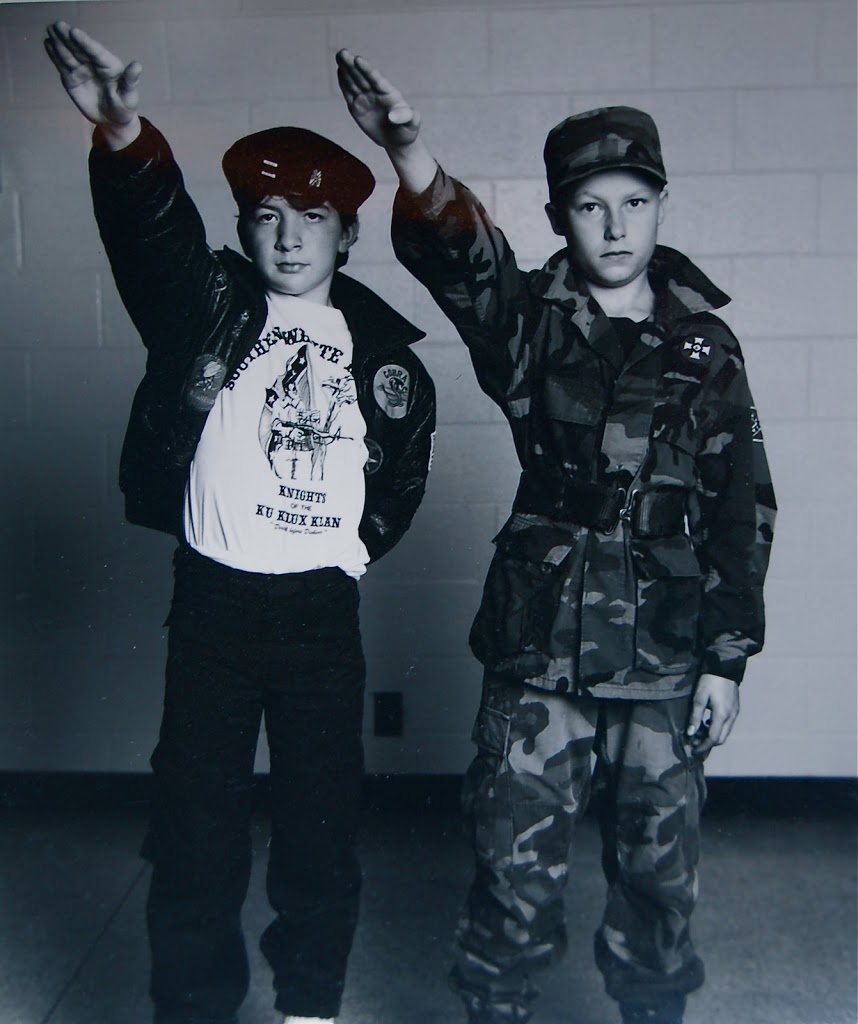
Children of Hate Pulaski, TN 1989

Here’s how I did it: I used a Polaroid back on a large format (4X5”) camera. I’d ask for the subjects to sign a release and I’d give them the B&W portraits, which I put fixative on. What I didn’t bother to tell them was that after the picture was pulled, there was a high-quality negative left over, which I could print later in a darkroom. I suppose the subjects, most of which were hardly rocket scientists, believed they had the only prints, although I never said as much.

From my childhood these people were my enemies and when I was younger they terrified me because they focused their hatred on my father. I could say that I despised them for their beliefs, which are narrow and frightening. But the truth is, I just felt sorry for them because their philosophy is based on their fear of being further marginalized in society than they already are. They are dangerous on several levels, but are inherently only slightly more suspicious of outsiders than they are each other. According to FBI sources, about one in twenty is an informant. In short they are paranoid and deluded as to their importance and potency. I found their gatherings sad affairs filled with a sort of beer hall bonding over a cold glass of hate and ignorance. I felt sorry for the children of hate, because they never have a chance (until much later) to form their own idea of self and of the value of others who are different than themselves.
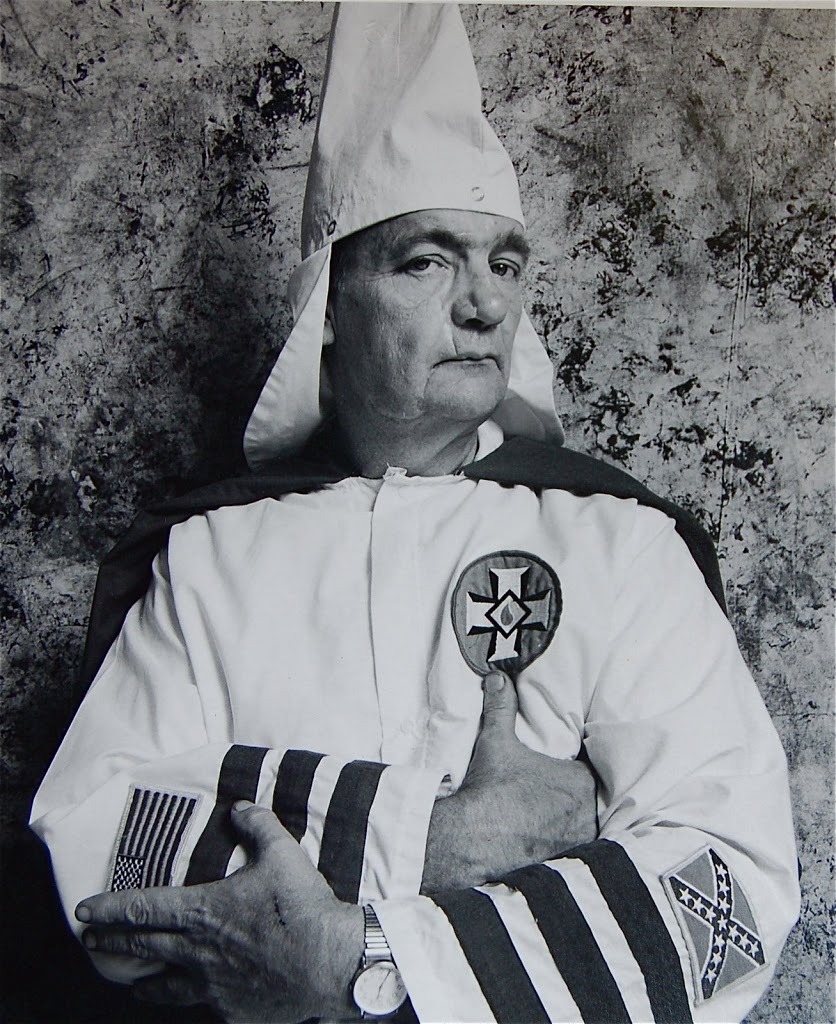
Grand Dragon of the Florida KKK 1990

When the story and pictures I’d done hit the presses, the subjects went wild. I had death threats. Several while I was being interviewed on radio in Miami. The Miami Beach police watched over me without my asking. I lived in a predominantly Jewish neighborhood and I had made a number of friends in the ADL (Anti-defamation League) while I was doing the series who made sure I was watched over. I had spent hours of time on the telephone with investigators with The Southern Poverty Law Center trading information as I learned who these people were and their relationships to each other. I guess I had much better pictures of certain subjects of interest than they did, and I had names and addresses. The racists felt betrayed when the not-so-flattering story was published, but I never told them I agreed with anything they said. I just listened and absorbed and ultimately regurgitated my experiences for a piece for Miami Herald’s Tropic Magazine entitled, MY FRIEND THE NAZI.

Grand Secret Cyclops Pulaski, TN 1989

None of the Nazis, Skinheads, Klansmen, or Christian Identity members were ever my friends. Friends don’t make your skin crawl. I wish I had been able to show them how wasteful and self-destructive their philosophies were, but that’s not usually in the realm of being remotely possible. Hate is all they have.
Knowing When To Quit

By John Gilstrap

You’ve been working on the story for the better part of a year. The plot is all you think it should be, and you love the characters you’ve created. Finally, you reach the day when you get to type every author’s favorite phrase: The End. You do your little happy-dance around the office and maybe celebrate with the family.

Then you read what you’ve written. Uh-oh. That big twist in Chapter Seventeen wasn’t as well set-up as you wanted it to be. And jeeze-oh-peeze that dialogue seems flat in Chapter Seven. And the spelling errors! Oh, my God! You hunker down and make those changes, plus dozens more. Woo-hoo! You’re done.

Then you read what you’ve written. Damn. Now that you’ve changed Chapters Four, Eight and Eleven, that Chapter Seventeen twist is so obvious that people will see it coming from ten miles away. And your protagonist’s hair color has somehow miraculously changed in Chapter Twenty-Four. Besides, you know what? This whole story might just suck. Maybe treating the story as a mystery is a mistake from the beginning. Maybe it needs to be romantic suspense. Maybe you need to start over from page one.

Maybe it was better before you started diddling with it. Maybe . . . blah, blah, blah.

A friend of mine who is a landscape painter told me once that good artists and great artists are separated by the ability to know when the trees in the painting have exactly the right number of leaves. You can have too few, and you can have too many, and a great artist knows when to quit. A successful writer knows when his story is finished and it’s time to let it go.

I struggle with this on every book I write. Hell, I struggle with it on every one of these blog posts. I’m an obsessive re-writer, but I can’t stand the notion of something being “out there” that is not exactly the way I want it to be. And more times than not, when I look at it one more time, there’s something else I feel compelled to change.

How do you all determine when it’s time to move on? How do you gather the courage to quit?

The Liar’s Club

by Michelle Gagnon

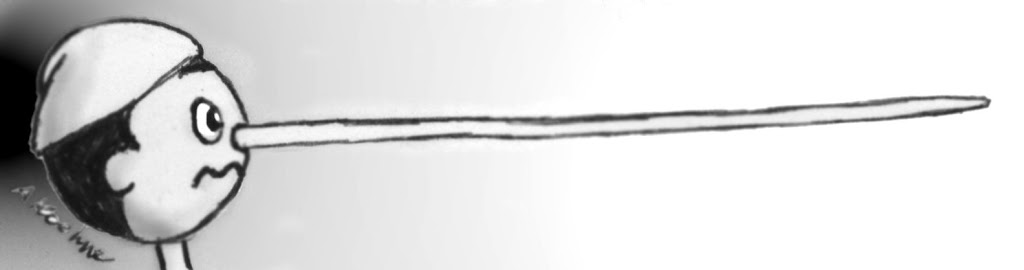
Pinocchio_3ak

No really, you shouldn’t have. I mean, sure, it is our…

ONE YEAR ANNIVERSARY!

What do you mean, you forgot? Yes, it was just a year ago today that I wrote the inaugural post for The Kill Zone. And to celebrate a year of rants, raves, and other miscellany, my fellow bloggers and I decided to do what we do best- make stuff up. Below is a series of questions. One of the answers to each question is an outright, baldfaced lie. Your job is to guess who’s fibbing.

For each correct guess, your name will be entered in a drawing for signed editions of each of our latest releases (including my coffee table book on macrame. It’s not just about macrame, it’s MADE of macrame. Patent pending).

Because after all, what anniversary would be complete without fabulous gifts?

Note: despite the outrageous nature of some of these responses, there is only one liar per question. Hard to believe, but true. The winner will be announced in my post next Thursday.

So good luck, and thanks for making this an amazing year!

1. What’s the most “outrageous truth” about yourself, one few people would ever guess?shootist

Kathryn: I once hid in the bushes outside Ted Kennedy’s home, spying on him for a Boston TV station.

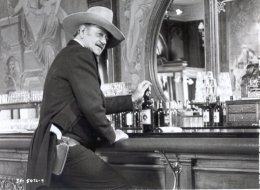
John Gilstrap: I was featured in John Wayne’s last filmed performance.

Clare: I was runner up in the 1989 “Miss Melbourne” beauty pageant.

James: I’m a descendant of the Duke of Wellington

Michelle: I was a featured guest on the Maury Pauvich show.


2. What’s the strangest interaction you’ve ever had with a fan or reader?

James: A man approached me at a conference and said God told him I was chosen to write his story. I told him I didn’t get the memo.

Clare: During an radio interview for Consequences of Sin, the host claimed he had predicted 9/11.

Michelle: At a conference, a Ted Kaczynski look-alike handed me a manila envelope filled with xeroxed diary pages outlining ominous apocalyptic predictions.

John Gilstrap: After giving 20 minutes of advice to a young writer at a signing, he walked away saying, “Huh. Well, I don’t read shit like you write.”

John Ramsey Miller: In 1997 I had a stalker who followed me on a book tour to 5 cities out of 11. She changed her appearance each time and asked me to sign a book to whatever name she was disguised as.

Kathryn: During a radio interview for DYING TO BE THIN, one caller claimed there is a conspiracy to keep America fat. I said thank goodness for that, otherwise I’d have to blame my sweet tooth.


3. What’s the craziest/most dangerous thing you’ve ever done in the name of research?


John Gilstrap: I intentionally leaned against a prison fence and walked around the perimeter to see how long it would take for a guard to respond.

John Ramsey Miller: In the mid to late eighties I set up a formal portrait studio at a series of KKK rallies across the south and at the Annual Celebration of the Founding of the Ku Klux Klan in Pulaski Tennessee.

chuck norrisKathryn: I logged onto wild and wooly web sites that gave my computer a nasty virus.

Michelle: I volunteered to be tased to see what it felt like.

James: I asked Chuck Norris to show me his Total Gym workout

Clare: I navigated piranha infested waters in a dugout canoe.

4. What’s the worst line you’ve ever read in a review or rejection of your work?

John Gilstrap: An agent offered to represent NATHAN’S RUN if I would change the protagonist from a 12-year-old boy to a divorced woman.

Joe Moore: “Weak and simple plot, unbelievable and boring characters, and poor writing make this book difficult to finish.”

James: Dear Mr. Bell: Enclosed are two rejection letters; one for this book, and one for your next book.

Kathryn: Agent rejection: “I really wanted to like your story. But I just didn’t like the voice. Or the main character. I just didn’t like anything about it at all.”

Clare: “It’s painful to read more than one or two pages at a time.”

I have to say, I was impressed with my fellow bloggers’ ability to lie with aplomb. Since I could only choose one lie per question, I was forced to omit some real humdingers. Next week I’ll include outtakes/elaborations in the post.

On a side note, Clare just officially became a US citizen (and that’s the truth). Welcome and congratulations!

The secret to writing a thriller

By Joe Moore

In a recent writer’s forum, the question was asked: What is the most important element in a story? Plot, character development, pacing, voice, etc. Of course, they’re all important. But in my opinion, there’s one element that will always get an agent or editor’s attention in a query letter. It’s the one thing that that must be in your book to make the story work? I think it’s the secret to writing a page-turning thriller.

Conflict.

Conflict deals with how your characters must act and react to reach their goals.

It’s the key ingredient that turns a stranger into a fan or causes an agent to request your full manuscript or an editor to drop everything and read your submission: a clear understanding and statement of conflict.

Is your hero in a race against the clock to solve the puzzle and find the treasure before all hell breaks loose? Is your heroine on the run to prove her innocence before the police track her down? That’s the plot. But what makes it interesting and compelling is what stands in their way. What’s tripping them up, causing them to falter or doubt or take a detour?

Conflict.

Conflict makes a thriller more thrilling. It’s the single element that keeps readers up at night. It forces the reader to continue to ask, “How is he going to get out of this one?”

There are two kinds of conflict—external and internal.

External Conflict is the struggle between a character and an outside force. The external conflict can be from another character or even a force of nature such as battling the elements—a hurricane or the extreme cold of the Arctic. External conflict usually takes place between the hero and another person or nature, or both.

Internal conflict is a struggle taking place in the hero’s mind. Mental conflict can be much more devastating that external because your character usually has to decide between right and wrong or between life and death. Internal conflict is the hero battling against himself.

Conflict causes the excitement to build to a climax, and the climax is the turning point of the story leading to a resolution. Without conflict, a story lacks life, energy and drive.

How do you approach conflict? Do you insert it into each scene? Do you use internal or external, or a combination of both? Have you ever read a story that didn’t have conflict? Was it worth reading?

Hooking your readers with red herrings

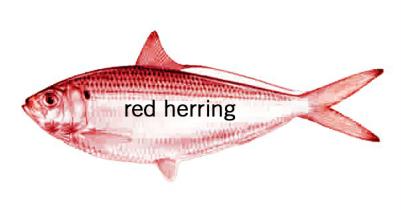
Red herring

  1. a smoked herring.
  2. something intended to divert attention from the real problem or matter at hand; a misleading clue.

A reviewer once said of one of my books, “Lilley has cornered the market in red herrings.”

I’m not sure whether that’s a slam or a compliment, but I do love planting a good red herring in my mysteries. One of the best red herrings of all time was The Red-Headed League. In this fun Sherlock Holmes story, the “league” is a falsehood to cover a bank robbery.

What makes some red herrings good, and others stink like yesterday’s…well, red herring?

Camouflage

Red herrings shouldn’t scream, “Hey, I’m a clue!” from the rooftops. Readers are smart, and they’ll be working to solve the mystery as they go. They don’t need you to stomp on ’em. The subtlety rule applies to all clues, not just to red herrings.

A fish before dying

You can plant a red herring before your victim turns up dead, right at the beginning of your story. At that point, your reader doesn’t even know who is going to get killed, much less whodunnit.

Dead fish need not apply

All clues, including red herrings, must serve to move your story forward. Don’t use your red herrings only as a way to throw the reader off. Make them integral to your plot or character-building.

Two-faced fish

In some of my books, I wasn’t sure who the villain was until very near the end of the writing process. I write all the clues so that any of them can be red herrings or valid clues, depending on the ending.

Are there any other rules that you follow when writing red herrings? What are some of your favorite red herrings in crime fiction?

When is it time to get a new agent?

By Clare Langley-Hawthorne

In recent weeks I’ve had a few friends of mine mention that they were seriously considering changing agents and this got me thinking – not about changing agents (if you’re reading this Brian, don’t worry!) but about how authors should approach this issue. How do you know when it’s time for a change and how, once you’ve made the decision, do you act on it?

First things first, how do you know when the agent you have isn’t really working out? This posed a quandary for me, for there could be many reasons:

  1. Your agent ceases to return calls or emails (the most egregious “my agent seems to have fallen off the planet” reason) – this one is a no-brainer, but I’m amazed at how many horror stories there are from authors who agents literally disappeared for months or who retired without even informing them!
  2. Your agent doesn’t like your latest manuscript or project – This is a tricky one…because a good agent may have legitimate concerns…or their lack of enthusiasm may be indicative of a poor fit and a justification for a parting of the ways.
  3. Your agent has failed to sell your work/get what you consider to be the best deal with a publisher – I’m sure if an agent fails to sell your work one option is to find another agent who thinks they can (a strategy that may or may not lead to an actual publishing deal) but I think it’s a trickier proposition when an author feels that their agent isn’t landing them the big deals with major publishers (because that just may be the way things are going to turn out regardless of the agent you have)…but I’m wondering how long should you wait to see if a deal emerges? How much time should you give an agent before you decide on a change?
  4. Your agent doesn’t appear to care about your career – I’ve heard this quite often: where an agent doesn’t seem that interested in discussing career strategies or discussing an author’s interest in branching out beyond their genre. I’ve heard from cozy mystery writers whose agents have no interest in their ideas for non-mystery books, and from authors who complain that their agents simply don’t seem interested enough in their work to care about the next career step.
  5. Your agent represents many, many authors and you’re at the bottom of the totem pole. This is a frequent lament, especially from authors with high profile agents who represent many more successful authors. I think there are pros and cons to having a high profile agent but if you aint feeling the love then…

It’s time for a change…

But how do you go about changing agents?

Although it’s not the done thing to actively seek representation when you already have an agent, obviously you should scope out other options before you take the plunge and call it quits with your current agent. I’m not sure what the etiquette is regarding this – perhaps my other bloggers can help me here – but I think first and foremost you should be professional and straight up with both parties. I don’t think any kind of underhand games should be played and, like in any business relationship, appropriate courtesies should be maintained. If there are any manuscripts currently out on submission then you should discuss how these will be handled – typically if these lead to publication then it is your former agent (who sent the manuscript out) who gets his or her commission. No doubt there are always grey areas but the lawyer in me tells me to steer clear of those!

I would be interested in hearing from my fellow bloggers and other agented (or agentless) authors on their views. When do you think it’s time to consider getting a new agent? How should you (or have you) gone about getting new representation? Do you have any stories from the trenches that could help others facing this (often) thorny issue?

Driving Dangerously

James Scott Bell

Among the stranger headlines of last week was the following:

Man Driving with Snakes in His Pants Causes Multi-car Accident

According to one online source:

A man in Hartford, Connecticut caused a multi-car crash after he claimed two pet baby snakes escaped from his pants pockets . . .

Angel Rolon, 20, told police he lost control of his SUV when the snakes slithered near the gas and brake pedals. Rolon said as he and his passenger tried to catch them, the SUV veered into some parked cars and overturned. If he had a dash cam, like the ones that BlackBoxMyCar offer, he would have been able to capture this incident!

Animal control officers at the scene were unable to locate the snakes, and police have not confirmed Rolon’s story.

Rolon was treated at a hospital for unknown injuries. Police say they gave him a summons for reckless driving and other charges. One can only assume a criminal defense lawyer is going to be faintly amused if this case lands on their desk.

Now as I recall, my dad told me never to drive with alcohol in my blood or snakes in my pants. He was very emphatic about that. Doesn’t every kid learn this valuable lesson before taking the family car out for a spin?

“Remember, son, no drag racing and no legless reptiles in your Levis. Have you got that?”

“Yes, sir.”

“If you have any ectothermic squamate in your jeans while you’re behind the wheel, you’re grounded.”

“I understand, sir.”

In all candor, though, I must admit there is an application for fiction writers here. You see, writing a full length novel is very much like driving a car with snakes in your pants–you just never know what’s going to happen. You may start out with great intentions, but somewhere along the way some major slithering will take place. You may feel prepared to handle any eventuality, but when reptiles are loose around the gas pedal you could end up in a major collision or even needing to face the lawyer of someone you hit.

We all set off on our “drive” to write with some trepidation, knowing there will be inevitable setbacks, disappointments, even book-ending accidents. But that doesn’t stop us, if we really have the chops, the desire. You want to write, you write, snakes or no.

Is that true for you? Taking a cue from the hapless Hartford driver, what metaphor do you come up with for describing the crazy journey of writing a novel? Have at it.

Conspiracy Theories Give Great Thriller

John Ramsey Miller

Human beings will do anything to turn a profit, to gain an edge. Conspiracies will exist forever and throughout the universe. Greed rules the world. Always has, always will. We thriller authors know this and have learned that you cannot really write over-the-top bad guys as long as you keep the motivation real and the character true to his or her motives. Wealth, social or political power, elevation of status, feeding a sense of self-importance, protection of the status quo, a desire to stay out of prison, a need for accolades are all motives for forming or joining a conspiracy.

When you watch a James Bond movie, how do you not wonder how the evil geniuses go about recruiting hundreds of people that will kill any and all comers, threaten the world with selective destruction for extortion of money from world powers. You have to wonder where the bad guys got the cash to build a secret base on an island or in a false volcano where the receding lake is made of steel painted to look like water. How much do they pay their evil workers? Short of buying an out-of-work army from a third world country, or recruiting in mental hospitals catering to the criminally insane, how do you find hundreds of psychopaths who will also do exactly what they are told and will live with other criminals in the middle of nowhere?
Back to conspiracies. Not all are believable, but if you remember to keep them in proper sliding scale, you’ll pull it off. The only difference between a street gang leader, a mafia don, the head of a very large business enterprise, and head of a government agency often lies in the trappings and degree reward at stake. There is little difference between the way a small time drug dealer and the head of a large bureaucracy think and plot.

I just read how organic food is no healthier than food grown using insecticides and commercial fertilizers by a conglomerate. So a chicken raised on feed made from other chickens and injected with steroids and antibiotics is no better for you than one raised by a farmer’s wife who feeds them only natural grains, roasted soybeans, corn and kelp, etc… Well that sounds a lot like what the tobacco companies used to say about the safety of cigarettes. I read about bills introduced to heavily regulate produce sold in farmers markets due to fears of salmonella and other contaminates. How many cases of food poisoning comes from local produces grown on farms as opposed to government regulated large commercially outfits? It sounds like something a Con Agra would pull because people are buying that produce from farmers markets and not the local grocery store. There’s a conspiracy to write a thriller around. The possibilities are endless and we’ll never write them all.

There is no doubt that people working for governments commit murder in the name of protecting secrets, or getting rid of obstacles and critics of the regime. It happens every day. King David sent a brave soldier to a certain death in battle so he could have that man’s wife. Joseph Stalin killed 30 million of his own people out of paranoia and in the guise of progress. Our government killed off and enslaved thousands of native Americans in order to utilize the land they inhabited.

The secret of writing conspiracies is to keep it on the page, and to always tell a little story within the bigger story that the reader can identify with, a character they can identify with and root for. Nobody who loves a thriller wants to read about a battle between titans who are equally matched and you’ve got a perfect yawn machine on paper. But you pit a preteen boy armed only with a slingshot against an armored giant with a spear and sword on a battlefield, and you have the boy kill the giant, and you’ve got yourself a story. Why? Because we are all facing giants every day of our lives, and there’s a chance that any one of us could be the boy with a slingshot.

How Not to Query

by Michelle Gagnon

Recently there was a query letter discussion on one of the lists that I frequent. Everyone chimed in with differing opinions about what works, and what almost guarantees one of those soul-crushing form letter rejections. It made me reflect back on my own letters (and yes, you read that correctly: letters, plural).

Out of curiosity, I asked the multi-talented Luc Hunt from my agency (the Philip G. Spitzer Literary Agency) to dissect two of my query letters. The first was for a book that was roundly rejected (rightfully so, I must say) by every agent I queried.

The second was the letter that got me a nibble for a full manuscript, which eventually led to representation.

So here’s the good, the bad, and the cringe-worthy. Luc’s analysis is below each letter:

Dear Mr. Hunt,

I am looking for an agent to represent my book.

“Adventures of the Almost Wed” tells the story of Alexandra, a young woman attempting to rebuild her life after a failed engagement. The novel takes place over the course of a year, opening with the break-up of the central relationship, and concluding on what was to be their wedding day. In the interim Alexandra confronts obstacles ranging from long-distance maternal disapproval to the challenges of dating a movie star. At the end Alexandra faces the future with a renewed sense of self-worth, and the knowledge that there’s more to life than love and marriage. Written in the first person, the style is similar to that of Helen Fielding in “Bridget Jones’s Diary” and Melissa Banks’ book “The Girl’s Guide to Hunting and Fishing.”

Although this is my first novel, my non-fiction articles and columns have previously been published on numerous websites, including Chickclick.com and Asimba.com.

Thank you for considering “Adventures of the Almost Wed.” I look forward to hearing from you.

Sincerely,

Michelle Gagnon

LUC HUNT:

This starts off with an all too obvious statement. No one queries an agent unless they are looking for representation. Personally, I respond best when the author gets right to the story. Michelle then goes on to tell about the plot, but does so in a way that overly simplifies the trajectory of the character’s development. She goes so far as to point out the moral. A more engaging summary would reveal an exigency latent in the narrative, and leave out the didactic conclusion. Michelle also compares her work to others, which can be positive, but is a matter of interpretation, and possibly tenuous. It is good to identify both what is familiar and unique about your manuscript. She concludes with an almost apologetic mention of her publishing credits. Politeness is welcome, but if you have little history or are not confident in the prestige of your previous venues, then just state that you are a first time author. There’s nothing wrong with not having a record.

And here’s query letter #2:

Dear Mr. Hunt,

I’m hoping that you’ll consider representing my novel “The Tunnels,” a suspense thriller set at a small East coast university. A serial killer is ritualistically murdering the daughters of powerful men in the tunnels below campus. Special Agent Kelly Jones, a jaded Clarisse Starling ten years into her career, is called in to investigate.

Kelly confronts a daunting list of suspects ranging from tweedy professors to one-armed janitors. Complicating matters further, a grief-ridden father pulls strings to get an investigator with his own agenda assigned to the case. Together, they must find a madman obsessed with pagan sorcery before he claims another victim.

My non-fiction articles have appeared in Glamour, San Francisco Magazine, and CondeNast Traveler, among other publications. The book is set on the campus of Wesleyan University, my alma mater. I researched Norse mythology and neo-paganism extensively before writing “The Tunnels.” All of the rituals outlined in the story are based on fact. I’m planning a series of books featuring Agent Kelly Jones and her continuing efforts to track down serial killers.

I’ve included a brief synopsis and the first chapter of my manuscript. Thanks for considering “The Tunnels.” I look forward to hearing from you.

Sincerely,

Michelle Gagnon

LUC HUNT:

Michelle’s second query is immediately compelling. She begins with a journalistic statement of the facts that quickly answers the who, what, why, and when of the proposal. Due to this introduction, it is easy for me to be drawn in by the action of her story. She follows the opening with an interesting communication of some of the particulars, grounding her query in what makes it unique. Michelle also gives a more developed biography of herself as an author, and provides us with details of her personal connection to the setting of the novel. This leads me to believe that not only is she an authority on her subject, but that her perspectives are likely to be well researched and credible. The query closes with a brief mention of future projects, and that a synopsis and sample chapter follow. Well done.

LUC’S FINAL COMMENTS:

In conclusion, one could certainly make too much of a query letter. It is essentially a one page introduction of the work and author to their prospective agent. The nature of the thing is surely subjective, yet I hope to have shown at least a few helpful parameters.

Luc wanted me to mention that sadly, the Spitzer Agency is currently not accepting submissions. But his comments apply to most agents, in terms of what they’re looking for and what gets tossed aside.

He also said that recently, the agency has been experiencing a blitz of “spam queries.” Apparently there are companies that will assemble a query letter for you, then send it out en masse to every agent in the business. He recommended against using one of these companies-the deluge has been such that it’s off-putting. The next Da Vinci Code could be buried in that pile, and they probably wouldn’t bother reading the query.

2009_07_28_11_33_46.pdf000

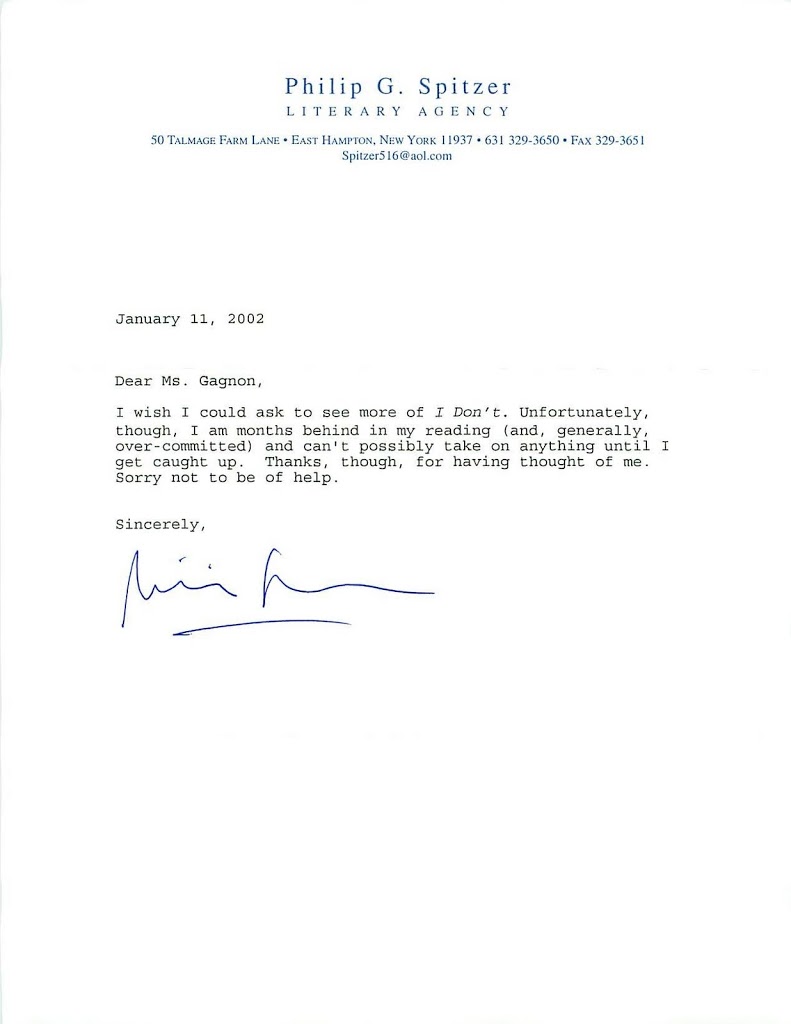
Oh, and by the way…look what I found when I dug through my files. That’s right, a form rejection letter. From my current agent (boy, did we have a good laugh about this).

So if you’re at the querying stage, take heart. Never underestimate the power of persistence. If your letter doesn’t seem to be garnering a good response, take another look at it. Show it to a few people whose opinion you trust, or sign up for a workshop that teaches you to hone it, then send it out again. It might take a few years (it sure took me that long) but in the end, persistence pays off.

For more query submission tips, check out John Gilstrap’s last post here.

Playing Fair is Overrated

By John Gilstrap

No, I know it’s not my usual day, but Michelle and I are switching blog dates this week . . .

At the Midwest Writers Workshop last week, I taught a session called, “Quit Whining and Send Another Query,” in which I shared what I know about the mechanics and emotions of finding an agent and dealing with rejection along the way.

Students expressed huge frustration with the snail’s pace at which the process unfolds. You submit a query and you wait weeks for a response. Sometimes the response never comes, so the wait stretches out interminably. I suggested that they just forget about that one and send another query. Oh, no! they cried. At a previous conference a visiting agent said that when agents request sample chapters or an entire manuscript, they expect exclusivity; they expect that no other submissions will be made to other agents until the requestor makes up his or her mind. If you send out other queries during the exclusive period, you’d be breaking the rules.

Huh? When did business become such a genteel sport? When did it become one party’s responsiblilty to make the other party comfortable during a negotiation? “It’s only polite,” a student told me. Okay, I can buy that. It’s certainly more polite than waiting five or six weeks to finally send a form rejection letter that might or might not have a hand-written signature. If the manuscript is rejected, how has the writer benefitted from losing momentum on his submissions? It it’s accepted, how has he benefitted from not knowing if there’s another agent out there who’s even more passionate about his work?

Sorry, folks, but this is business; an “implied exclusive” means as little as an “implied million-dollar advance.” Implications, like assumptions, have no place in a competitive marketplace.

Please understand that, as I told the class, my word is my bond. I unfailingly deliver what I promise. I never lie. I’m a terrible liar anyway, and I jealously guard my integrity. That said, where there’s silence in a business negotiation, there’s also a poker game in progress. Agents know that, and publishers know that, and they play the game accordingly in every negotiation.
So where is it written that the writer is supposed to sit politely and observe implied exclusivity? Did I miss a meeting? A memo?

Maybe—maybe—if the implied arrangement included a 5-day turn-around, I could buy into it; but I’ve heard too many horror stories of eight-week responses and year-long silences to see anything but a woefully stacked deck.

“But publishing is a small community,” someone said. “If you break the implied rule and submit partials to more than one agent, won’t they get angry?” In a perfect world, hell yes someone will get angry. Well, maybe not angry, but at least disappointed. That’s what happens when you’re rejected. Welcome to our world, Mr. Agent.

Let’s say for the sake of argument that three prospective agents have requested manuscripts from you. There are only three ways for the scenario to play out, and all of them are either neutral or they play to your benefit:
1. All three reject you. No one’s the wiser, so no harm, no foul.
2. One accepts you, the others reject you. No one’s the wiser, so no harm, no foul.
3. More than one accepts you. Woo-hoo! Now you get to go shopping. You get to decide which agent is your preferred choice. You accept one, reject the others. You don’t have to tell the losers why they lost, but even if you do, and the rejected agents get pissed, what do you care? You got the agent you wanted.

Let me emphasize that I am not talking about deception. If an agent asks for an exclusive and you agree, then you honor your word, pure and simple. Short of that, I think you’re free to submit at will. Want to really play hard ball? Consider this: if the prospective agent tells you outright that he expects an exclusive and you say nothing, he might assume that the deal is closed, but there’s still no contract. There has to be an offer and an acceptance. One does not guarantee the other.

I would love to hear from people who think my position is unreasonable. What am I missing? Are we writers truly honor-bound to play politely in an industry that fights dirty?