I Like to Listen

John Ramsey Miller

I went a’ traveling last week and (since our local library is on weird hours due to budget cuts) I rented books on DVD from a Cracker Barrel. Which brings me to my biggest peeve on audio books on DVD. How much trouble can it be to add a tag at the end of an audiobook disk saying, “This is the end of disk one, please insert disk two to continue?” Why do listeners have to realize that the damned disk has started over again to begin digging on the floorboards for the box to get the next disk? It’s damned unthoughtful, and some producers actually add this amazing feature that adds two seconds to a disk to some books on DVD.

I don’t know how many authors are invited to listen to the audios of their books before they are released, but I’ve never been one of them. I first heard SMOKE & MIRRORS several weeks after it was released and there was a glitch in the audio track that a short discussion between myself and the producer or narrator could have prevented. The book was unabridged and wonderfully performed by, Scott Brick, one of the absolute top talents in the business. It was the arbitrary addition of an East German accent for my antagonist in the scenes where he was being himself that were off for me. My Paulus Styer was a psychopathic master chameleon and was always in character, none of which was being an East German. Maybe it was best for the listener since it helped them know who was speaking, but I never had him speaking with that accent in my mind as I wrote. I mean his syntax was Germanish but I never heard that voice as interpreted. I am sure nobody else noticed.

My first book, THE LAST FAMILY, was read by Gerald McRainey, and everything about it was flawless, even though it was done on cassettes. I think I can convert those to disks for however long that technology lasts. Even the parts of the book (one entire subplot) that were edited out to cut run time made the book stronger.

I’m excited about the fact that the market is opening up to e-books and audio downloads that aren’t put together by publishers, and that artists might better control their careers and be paid a larger percentage of the money for their labors. The advantage in distribution and advertising, which justified the houses taking the lion’s share is evaporating, and while they risked their money up front, and lost a lot on some projects, they did all right while the model was working. I like the idea of having more control over my own product. I have friends who are actors, and for a sum would be happy to read one of my books. I’d love being truly involved in the process and directing the reading.

We all know that publishers generally don’t want the author’s input on the book once he or she has turned it in. They design the cover and show it to the author after it is designed and accepted by the house. I was lucky in that my editor enjoyed my input and ideas and solicited them at points when things could still be changed. Sometimes I felt like I was on the outside of the process and as a consequence I think I felt some disconnect from the books once they appeared on shelves. Maybe feeling that is natural. It’s sort of like seeing an old girlfriend on the street who changed her hairstyle and lost some weight…

Unlimited Free Book Giveaway

By John Gilstrap
www.johngilstrap.com

Once a year, in late June, I embark on a post of shameless self-promotion. This would be that post for 2010.

Hostage Zero, the latest entry in the Jonathan Grave thriller series launches next Thursday, and I am pumped about it. Fueled by a starred review in Publisher’s Weekly, which amazon.com was kind enough to put on Hostage Zero’s product page, and excellent advance reviews from other publications, this feels to me like it could do some real business. Let’s all take a moment to cross our fingers on that one.

Good reviews help, but it takes more than that to really get people to take notice of a book. It takes promotion, advertising, and word-of-mouth sales. I don’t mean to presume, but I hope I can count on y’all to help with that last one. C’mon, it’s an investment of $6.99. How can you go wrong?

My publisher, Pinnacle/Kensington, is really stepping up to the plate with this one. From June 29 through July 5, in an effort to build the buzz for Hostage Zero, they are giving away free e-books of No Mercy through Kindle, Sony E-Reader, B&N’s Nook and Kobo. That’s free, folks; as in, you know, FREE! Gratis. No charge. That’s a free copy of the book that is one of five nominees for ITW’s Thriller Award. How cool is that?

The real marketing push for Hostage Zero begins July 6, when the co-op money kicks in to get great placement in Borders, Walden and Books-A-Million. There’s talk of other placements, but they’re not yet firm. You should see a fairly significant online ad presence, as well.

So, the boat’s in the water, and everyone is pulling on an oar. Will Hostage Zero become a bestseller? Lord, I hope so; but then every author hopes so. That’s the really scary part of this business. Think of the hubris. Each of us believes that out of the thousands and thousands of titles that are published every year—out of the hundreds that are published in our own genre alone—this one product of our imagination will somehow break through all the noise and find a breakout audience. Who do we think we are?

On the other hand, it always happens to someone; why not us? Why not me?

Jonathan “Digger” Grave is an old-fashioned kind of hero, whose sense of right and wrong does not necessarily factor in the prevailing laws of the land. If your loved ones are kidnapped, Digger will move heaven and earth to bring them back, and he won’t mind sending people to heaven or hell if they get in his way. A former Unit operator, he is a gentle philanthropist who is intensely loyal to his friends and lethal to his enemies. He is, if I may say so myself in the spirit of shameless self-promotion, a lot of fun.

And starting next Tuesday, for only one week, you can download No Mercy for free. I like to think this is an easy decision. What do you say?

The Real Mystery Behind THE GIRL WITH THE DRAGON TATTOO

by Michelle Gagnon

So I just got back from vacation. I finally had some free reading time, and decided to see what all the fuss was about Steig Larsson’s Millenium series. I’ll try to write this post without any spoilers.

I must confess, I remain perplexed.

This series has been the biggest crime fiction crossover, arguably, since THE DA VINCI CODE.

There, I could understand the hype. The writing wasn’t the best I’ve ever read, but Dan Brown is a heck of a storyteller, and the underlying religious conspiracy themes were compelling.

To be frank, I spent most of my time reading TGWTDT scratching my head. I honestly don’t get it. The dialogue was clunky throughout, the bulk of the story revolved around a financial scheme that was underwhelming, and the characters were fairly two-dimensional. And above all that, the resolution of one of the two primary plots was largely unsatisfying. Now, some of the fault here might lie with the translator. But then most of the copies sold have been translations into one language or another. So why did this, of all books, become a runaway bestseller?

I read the next two books, and they were decidedly better. There was actually action- hallelujah- and the themes outlined in the first installment came to fruition. The characters developed some depth (although based on Larsson’s portrayal, the men in Sweden either love women to death, or are misogynistic to the point of credulity, which I found annoying).

Still- all in all, I’d rank the books in the mid-range of works I’ve read in the past year. They weren’t bad, as a whole, but they weren’t fantastic either.

So what’s the big deal? Was it the tragic backstory of Larsson’s untimely demise that kicked the marketing machine into overdrive? I haven’t read many of his fellow countrymen, but from what I understand some of their works are superior. So why did these become the books that people who never read thrillers suddenly embraced with their book clubs? Especially since none of the books was particularly literary. And the characters weren’t what one would usually expect the mainstream to embrace. We had a couple that was involved in a extramarital affair that was accepted by all parties involved (including the cuckolded husband), and a main character who was a Goth/punk Aspergers hacker. Interesting, but not the type of main character I’d expect the world as a whole to cheer for.

If someone would care to enlighten me, I’d be much obliged.


You’re gonna need a bigger boat

By Joe Moore

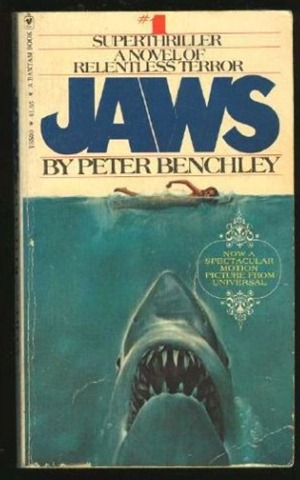
jaws Arguably, that may be one of the best lines ever written. Six words that encapsulate and summarize a situation so dire and frightening, there was no doubt in the mind of the moviegoer that the problems the characters faced had been grossly underestimated.

The movie JAWS came out in 1975 and is celebrating its 35th anniversary this summer. Few contemporary films had the same level of impact on life and the basic fears we all harbor inside. It came close to shutting down the beaches and everything people normally do at them during the summer. “Don’t go in the water” became a household phrase. Seaside resorts and businesses along the beaches were slammed while the theaters were packed and long lines lead up to the showing of JAWS. It was a phenomenon that undeniably equaled the mass hysteria of the 1938 radio broadcast of Orson Welles’ WAR OF THE WORLDS.

benchley1 The movie was based on Peter Benchley’s 1974 novel by the same name. It was and still is the only book I ever read in one sitting. I remember picking it up off a table at my mother’s house and reading: “The great fish moved silently through the night water, propelled by short sweeps of its crescent tail.” I read the second sentence, walked over to a nearby couch and read the rest of the book without a break. It was beyond captivating. It was petrifying and easily the scariest story I’ve ever read. (Number 2 on my list is RED DRAGON by Thomas Harris followed closely by THE EXORCIST by William Peter Blatty).

It’s rare that a book and a movie can have such a drastic effect on the public. Benchley and Spielberg took the basic “haunted house” scenario and gave it a fresh spin, one that hadn’t been thought of before. They presented us a new type of antagonist, one that can’t be reasoned with, one that has no motive other than hunger—an eating machine. JAWS gave birth to a whole string of similar antagonist in movies like ALIEN, HALLOWEEN, FRIDAY THE 13th, NIGHTMARE ON ELM STREET, and others. But JAWS was the first to bring it to the page and the big screen and scare the you-know-what out of us. For those who are too young or just simply want to relive the moment, here’s the original movie trailer for JAWS. Enjoy.

Have you ever found a book so engrossing that you read it in one sitting? Has a book and/or movie had as great an effect on you as JAWS had on the public at the time?

Open Tuesdays

imageIt’s time for another Open Tuesday while our blogmate, Kathryn Lilley, is on medical hiatus. Bring us your questions, comments and discussions. If you have a question about writing, publishing or any other related topic, ask away in our comments section. We’ll do our best to get you an answer.


And don’t forget you can download a copy of FRESH KILLS, Tales from the Kill Zone to your Kindle or PC today.

My New Toy!

by Clare Langley-Hawthorne

I’ve been giddy with excitement since Friday when I took possession of my new iPad and, although I haven’t bought all the apps or go totally crazy in the iBooks store, I have to admit I’m hooked. I bought it mainly because I wanted an e-reader and since the iPad offers both iBooks as well as the Kindle, it was a no-brainer for me. I also get to feed my NYT crossword addiction! Since my family and I are about to embark on a two month camping/national park odyssey the iPad is also going to be a much lighter (and let’s face it much cooler) option than lugging round a bag full of books, DVDs, DVD player, laptop etc.. The only tricky thing will be working out how to blog with it on the road.

Now I’m an old-fashioned Luddite when it comes to most technology but I have to say, having spent just over two days with my iPad, I really do think that it marks the start of some great changes to come. We’ve blogged long and hard about the whole e-book phenomenon but I know once my parents are like ‘this is cool’ the world must be changing! (for the record my parents are antiquarian book collectors so the mere fact that they are even remotely impressed says something). So here’s my initial verdict on the e-book capabilities of the iPad:

  • As my husband had already bought and loaded my own books on the iBookshelf it was very cool to see my books in e-book format 🙂
  • I like the fact that you just turn the page in an intuitive way that mimics the feel of reading a paper book. The colors and picture resolution are great (Winne the Pooh was already loaded) and I can see me reading an e-book to my children without feeling disconnected from the physical experience – so far it feels just as cozy reading to them from the iPad (despite the fact they fight over who gets to touch the screen and turn the page).
  • I liked the iBooks store but I confess I wasn’t overwhelmed by it. Searching is a bit laborious and there were a lot of titles I couldn’t find (including some of my fellow TMZers) so I think this will take some time to become optimal.
  • It was, however, way, way,way too easy to buy a book. I think I downloaded 10 free classic books and 5 paid books it about 10 minutes (seriously they may need to have an ‘e-books anonymous’ society for me!) But this is great news for authors. I can well imagine publishers vying for advertising/space on the ‘featured titles page’ once the iBook store becomes a bigger player in the market.
  • Which leads me to what I think will be a great ‘game changer’ – once Amazon and iBooks start eroding the power of big chains like Barnes & Noble I can imagine publishers will be able to diversify and niche market some of their lists better than they can presently (at the moment my understanding is they have very much a ‘will B&N buy this title’ mentality when it comes to acquisitions).
  • I was extremely excited to be able to download many of the historical books I use for research so I can read them in a portable format. I used to have to troll through them on my laptop which was very cumbersome.
  • Many publishers already have their own apps so readers can go directly to them (My publisher, Penguin USA, for instance, already has one) which is great (though not much different to what’s already out there on the web) but I can see scope for these apps to be expanded which can only help authors.
  • Already there are some amazingly cool apps that have created terrific visual/interactive content for books (Alice for iPad for example) and I look forward to many more that attract new readers (never a bad thing!)

So all in all, I give the iPad a big thumbs up. It serves my purposes well and has me finally entering the e-book age (which is a miracle in and of itself).

For any of you who have iPads what’s your verdict? Are there any new apps/developments that you think could really improve the e-reading experience? I can’t wait for historical books to have links embedded in them so I can really get the most out of my research (video links, costume designs etc. would be way cool). I was also thinking that our own JRM could produce a great ‘chicken army’ app…So what about you all, any great book app ideas???

Synopsis Writing Made Easy

James Scott Bell


Every author I know hates writing a synopsis. They hate having to try to boil down their beloved story into 2 – 3 double spaced pages. They agonize over it, moan about it in public, throw fits, start the occasional bar fight. They would rather run in front of the bulls at Pamplona, wearing clogs, than write a short overview of their novel.

But don’t buy your airline tickets to Spain just yet, because it’s really not that hard. If you’ll just follow these guidelines, you’ll always have a solid synopsis, one you can show to any agent or editor and leave them wanting more.

A good synopsis is what I call “back cover copy on steroids.” It’s intended to “sell the sizzle” and give just enough of the steak to create confidence in the project.

This is not the same thing as a detailed outline, or treatment, which is much more substantial. The synopsis is a selling document. So approach it that way from the outset.

Before You Write the Synopsis

Build a foundation. Start from the ground up, one brick at a time.

Your first brick is a one sentence summary of your book. If you can’t boil your book down into a single, compelling sentence, you are not ready to write it or sell it.

Second, expand that one sentence into back cover copy. That’s about 250 words of copy meant to sell your book to a harried consumer. You can easily learn to do this by getting books of similar genre from the library and reading the cover or dust jacket copy. Or read descriptions of such books on amazon.com. Read a lot of these, studying the form. Write your own back cover copy. Work it until you have something that would make a consumer want to buy the book.

Now you’re ready to write the synopsis.

The Parts of the Synopsis

1. The Opening paragraph

This tells us who the main character is, what he does (vocation), what he’s like. Then one line on what the character wants at the present moment. A day before the story opens, what is the character going for? Goals? Drives?

Every Lead needs the above things. This first paragraph sets up the rest of the synopsis. Here’s an example. (Note: The first time you introduce a character, use the full name and put it in ALL CAPS):

WALTER NEFF is a hotshot insurance salesman on the make for more business. He likes making money and having the occasional fling with women he makes house calls on. Even if they’re married.

2. Second paragraph

The Disturbance. (See my post on the subject). What is the incident that gets the story rolling?

One afternoon he calls on a client, and finds the client’s wife, delicious blonde PHYLLIS DEITRICHSON, wrapped in a revealing towel from sunbathing. She gets dressed and meets with him in the living room. During his pitch, Neff makes little comments about her looks and a game of sexual cat and mouse ensues. One thing for sure, when Walter Neff leaves the house he knows he’s gone overboard for Mrs. Phyllis Deitrichson.

3. Basic plot paragraphs

Now you lay out the main plot, and I do mean main. The synopsis is not the place to detail all the subplots, though you should certainly mention the important ones briefly and show how they complicate the main plot.

You obviously have a lot of freedom in this section. You’re going to be covering at least a page and a half with main plot material, the “sizzle” of the story. In the case of our example (obviously from the movie version of Double Indemnity) you’d stick to the plot to murder the husband and collect the insurance money, and the opposition represented by Barton Keyes, the sharp-eyed adjuster who can smell a scheme from miles away.

Here’s an example of one such paragraph from the middle of the synopsis:

Walter comes in to work the next day, and sitting in the hallway the last man he wants to see—Jackson, the guy from the train who talked to him in the dark. Keyes has brought Jackson in because the account of the “accident” is starting to stink. Walter has to keep from being recognized as Jackson tells his story. Keyes slowly pulls in the net, though around whom he doesn’t know yet. All he knows is that the “little man” inside him is raising Cain. And Walter knows all about how dangerous that little man is—to him and Phyllis.

4. Final Battle paragraph

Toward the end you write about the “final battle.” It’s the darkest point your Lead character faces, what’s at stake, why it’s a battle to the “death.” (It should at least feel that way to the character).

With Keyes closing in, Walter and Phyllis grow increasingly agitated. They try to meet in secret, but the strain begins to show. The seeds of distrust are sown. Then Walter discovers that Phyllis is seeing another lover. Now he must choose whether to run or take out his revenge—even if it sends him to the gas chamber.

5. Resolution

The last paragraphs (try to keep it to one or two) tell how the story ends. Don’t leave that out in your synopsis. Agents and editors want to know how you’re going to wrap things up.

Walter confronts Phyllis about her lover. Phyllis shoots Walter, wounding him, but can’t finish the job. Running to his arms she states her love for him. He doesn’t buy it. “Good-bye, baby,” he says, then shoots her in the gut.

Losing blood, Walter dictates a confession to Keyes at the office late at night, then turns to see Keyes listening. Walter tries to get out, but doesn’t make it past the front door. Keyes calmly calls the police.

And there you have it. A quick, easy guide to crafting a synopsis. Just remember:

• Don’t try to tell everything, especially with regard to subplots.

• Aim for 2 – 3 pages, double spaced. If you go to four pages no one’s going to arrest you, but you may be pulled over for holding up traffic.

• Rewrite and rewrite until it sounds like the marketing copy on dust jackets and back covers of similar books. Give it to some faithful readers for feedback. Make sure they, and you, are jazzed by it.

• Send it out when requested, then wait for the offer to see the full manuscript. While you wait, be working on the synopsis of your next novel.

So what about you? How do you feel about the “dreaded synopsis”?

It’s Conference Season Again

By John Gilstrap
www.johngilstrap.com

For me, every June marks the beginning of the writers conference season. That’s when American Independent Writers (AIW) sponsors its one-day confab in Washington, DC. Next up, in a couple of weeks, will be CraftFest and ThrillerFest, followed by Bouchercon and Magna Cum Murder, with the season ending in October. A couple of months ago, I attended my first Left Coast Crime conference, and I liked it so much that I’ll probably be returning to that again next year, which will cause me to reset the beginning of my season.

This begs the question (that’s for you, Jim), “Are writers’ conferences worth the money and effort?”

My answer is a definitive maybe. It all depends on what you seek to get out of your attendance, and what you’re willing to do while you’re there.

Agent pitch sessions. I know many authors who found their agent through the speed-dating ritual of agent pitch sessions, so I think their value is well documented—so long as you, the author, do your research and dedicate yourself to not wasting anyone’s time. First of all, don’t even begin the process until your book is finished, and your pitch is well-practiced. Just because an agent is at a conference doesn’t mean that she’s the perfect choice for your book. Concentrate on pitching agents who specialize in the kind of book you write. Don’t pitch your romantic suspense novel to an agent who loves political thrillers and does not represent romantic suspense.

Panels. Frankly, these are the wild cards of writers’ conferences. Depending on the makeup of the panel, they can be entertaining, informative, or deeply horrible. A lot about the success or failure of a panel depends on the level of preparation by the moderator, and the rest has everything to do with the chemistry created by the panelists. I believe in always putting on a good show for the attendees, but a lot of authors are very much into themselves and therefore tend to ignore the audience that’s in front of them. Also, more than a few authors are terrible public speakers. I say go to panels with reasonable expectations.

The bar. Whether you drink or not, the bar at the conference hotel is the place to be if you want to make lasting relationships with industry insiders. Too many conference attendees make the mistake of going to bed early. The bar teems with authors and editors and agents, all laid back and having a good time. Get to know them. Join the conversation groups. This isn’t the place to pitch (unless asked); it’s the place to get to know future business contacts—maybe future friends—as people, and not as stepping stones for your career.

More than anything else, these terrific business opportunities are all about having fun. So, go have some!

What say you, fellow Killzoners? Any thoughts about conferences that you’d like to share?

The Anarchist in Me

by Simon Wood

Today TKZ is delighted to welcome fellow thriller writer and anarchist Simon Wood. I toured with Simon back when Boneyard was released, and in spite of that we remain friends. I highly recommend signing up for his newsletter, it’s easily one of the most entertaining out there…

I saw my author-friend, Tony Broadbent, not too long ago. We hail from the same hometown back in the old country. We got to chatting and he gave me a pat on the head and told me, “You’re like the Gary Oldman of the mystery world.”
Gary Oldman is one of my favorite actors, but I wasn’t sure of the correlation and asked, “Is that a good thing?”
“Yes,” he exclaimed. “There’s a lot of anarchy in your writing.”Picture 220.jpgHow su
bversive, I thought. I’m a rebel without an agenda. Mother will be delighted.

Well, the little exchange got me thinking about my writing. I don’t think people hit the keyboards with an agenda or a theme tucked under their arm—or if they do, it sort of sticks out. Agendas and themes develop on a subconscious level. Well, they do for me. I don’t go out of my way to put a slant on my stories. I just try to entertain, but inadvertently, I show a little leg now and again. So, I looked for the anarchy. And I think I saw it in the shape of conflict.

Stories require conflict. It’s a driving force that characters and stories thrive on, especially in mysteries and thrillers. The nature of the genre means there are going to be casualties and collateral damage. So, I like to inject my stories with a lot of conflict. The problem is that I’m quite a literal person and I think about things in very pure terms. Blame my engineering background. When I think conflict, I think about it in its most basic of meanings—total annihilation. Everything my lead character holds dear is under attack. I create this person so that I can destroy them. I place them and their world in an ivory tower, then go about stacking as much C4 explosive around the foundation as possible to blast it all apart. It only seems fair, doesn’t it? Conflict by its nature is salt to a wound. Character assassination is key for me. Only by putting everything in a protagonist’s world at extreme risk can the character grow. There can’t be a comfort zone or a safe haven for this person. Wouldn’t you want to read about a character in a situation like that?

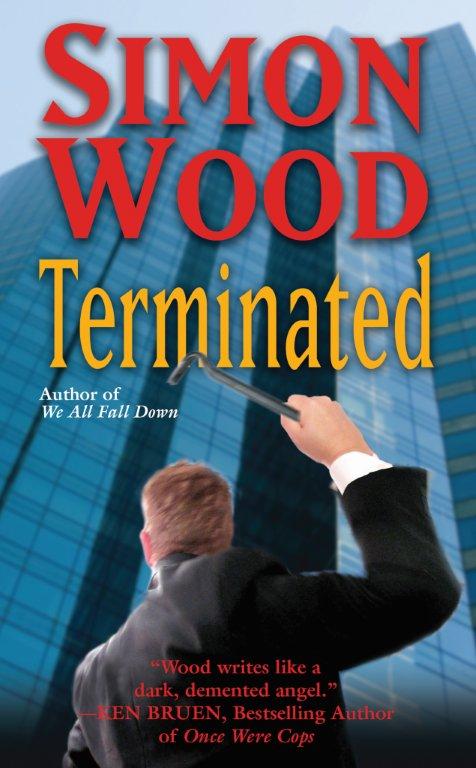
I flicked through some of my stories to see what I did to my characters and the annihilation is always there. Characters are put through the wringer and their lives will never be the same. This theme continues in my latest book, Terminated. I’ve really gone to town on the story’s protagonist, Gwen Farris. Her reputation is destroyed, her home life obliterated and she’s framed for crimes she didn’t commit. Everything she holds dear is in shambles, but if she’s to fight back, she has to develop into someone she’s never been before. Her life will never be the same and there will have to be a lot of rebuilding by the end, but she’ll be a stronger and more courageous person for it.

So I guess I do have anarchistic bent. Sorry. It wasn’t intentional. It’s just the way I tell ‘em.

Yours destructively,
Simon Wood

Simon Wood is an ex-racecar driver, a licensed pilot and an occasional private investigator. He shares his world with his American wife, Julie. A longhaired dachshund and five cats dominate their lives. He’s had over 150 stories and articles published. His short fiction has appeared in a variety of magazines anthologies, such as Seattle Noir, Thriller 2 and Woman’s World. He’s a frequent contributor to Writer’s Digest. He’s the Anthony Award winning author of Working Stiffs, Accidents Waiting to Happen, Paying the Piper and We All Fall Down. As Simon Janus, he’s the author of The Scrubs and Road Rash. His latest thriller, Terminated, is out in mass paperback. Curious people can learn more at www.simonwood.net .

It’s perfect. Now make it perfecter

By Joe Moore

Here’s a comment I hear from new writers: “I want to edit and polish my writing as I go, but I wind up getting nowhere because I’m obsessed with making it perfect the first time.”

This is so often the case starting out. You want every word to shine and sparkle and dazzle. So you spend a day or a week or a month or forever trying to get that first chapter not just perfect, but perfecter.

In my opinion, this is a crutch. It’s an excuse. It’s a disease that infects all writers when they first start out. And it will eat you alive with a good chance that your writing will be damaged. It’s as easy a trap to fall into as a subprime, interest-only mortgage with nothing down. So how do you get past this nasty little hang-up?

First, you must convince yourself that NOTHING is perfect, especially when it comes to writing fiction. Now I’m not talking about spelling, punctuation, grammar and syntax. Those are the rules of writing just like the speed limit and stop lights are the rules of the road. But those rules have NOTHING to do with perfection, only correctness. Perfection is a mental concept. It can never be achieved. There will always be room for improvement.

Next, you must allow yourself to write less-than-perfect prose the first time with the understanding that it’s more important to tell the story.

Another tip that helps is to come up with a set of REALISTIC goals that drive your writing. Your goals should be reasonable and obtainable. Make them short-term, easy and convenient. Such as: I will write 500 words per day. I will not look at what I’ve written until I complete 5000 words. I will not stop writing each day until I finish the current chapter. You get the idea. Make your goals reasonable so perfectionism doesn’t get in the way.

I believe that perfectionism creates doubt. Doubt smothers creativity. It slows down the stream of consciousness. Allow yourself to shape the story first no matter how rough, then carve out the details. And remember that you’re the only one demanding that your writing be perfect. Give yourself a break and just tell the story.

Harry Shaw, in his book Errors in English and Ways to Correct Them, said, "There is no such thing as good writing. There is only good rewriting." Science fiction master thriller writer Michael Crichton said: "Books are not written–they’re rewritten."

So don’t worry about perfection. Work at telling a good story.

Do you suffer from wanting things perfect from the start? How do you get past it and complete your manuscript?