I find myself here through the good graces of John Miller, who has honored me by inviting me to post in his place on alternate weeks, with a wonderful introduction to boot. Thank you, John, for both. As I look at the company I am in I feel a bit like the undergraduate student who finds himself at a table with a group of learned professors and who hopes that, if he stays quiet and doesn’t embarrass himself, he will be permitted to stay. Staying quiet and not embarrassing myself are not listed among my ever-dwindling list of strengths, but we’ll see how it goes.
It has been an extremely interesting week in the publishing industry, with much talk of E-Books and Kindles and hardcovers, oh my! Despite what you may have read in self-styled newspapers of record this week, physical books are not dinosaurs and the comets aren’t coming. Not just yet. E-books (and their readers) are something more than another format, and something less than a total replacement. To put it another way: when Gutenberg rolled out his printing press, people didn’t stop telling each other stories.
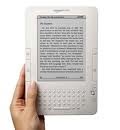
Yes; in the second quarter of 2010, the good folks at Amazon sold more e-books than hardcover books. What happened in that second quarter? For one thing, a lot of fathers (including this one) received Kindles on June 20. And we felt duty bound to load them up with an e-book or twenty. What’s the point of getting a new gadget if you can’t test drive it? Amazon also instituted a price drop for their six-inch Kindle model on June 21. Similar spikes have occurred over in the music industry during holidays, when iPods, iPhones, and iPads need to be loaded up with digital tracks. Yet, CDs continue to outsell digital music tracks on an annual basis, though their share of the market continues to drop.
Do I love my Kindle? Yes. There are books I can buy for it that are not available in physical form, some of which are original works, others of which are out of print. Of course, there are other books — more than you might think — that you cannot obtain in e-book form. The issues of publishers’ and creators’ rights are not going to be easily resolved and things are probably going to get nasty (actually, they have already) before they resolve. And pricing? Let’s save that one for another discussion. If Kindle and other e-book readers are going to be serious contenders, in the long-term, there is going to have to be some sort of uniform standard put in place in terms of editing, particularly for self-published works, to match that which traditional publishers have established. I’ve read some e-books that appear to have been carefully groomed for presentation, while others seem to have been written without coming within one hundred miles of spell-check software. And how will authors get their needle to stand out in a market of thousands of haystacks without the might and majesty of a marketing department — or a helpful bookseller — to make it jump out at a potential reader? It is difficult enough to keep track of and keep up with the embarrassment of literary riches that appear every month. At the end of the day, there is still going to be a need for mainstream publishers who are willing and able to adapt their business models for this brave, and yes, scary, new world. I am impressed with what some publishers have been doing already. Baen Books, for one, has a very cool webscription e-book site. Maybe that will be a model.
Is there a trend toward e-books? Certainly. Does it mean the end of the hardcover book? Unlikely. Physical books continue to have much to recommend. There will always be companies similar to this book printing company Printivity that will continue to print hardcover books. I don’t know if I can properly explain this, but there is a comfort level with a physical book that I don’t get with plastic. There are also a host of practical issues. Physical books don’t break when you drop them, for one thing. A physical book doesn’t have a battery that will run low on you when you’re in a hotel room in Breaux Bridge, Louisiana and its cord is in Westerville, Ohio. You don’t have to worry about scratching a book cover. You can drop a book on a spider and crush it; spiders laugh at Kindles (don’t ask me how I know this). And if you throw a book across the room, it will forgive you. A Kindle will never speak to you again. We may someday see the end of the hardcover book when you can do all of those things with a Kindle (oh, yeah, don’t use one as a coaster, either), and physical books may become collectors’ items, but I’m not going to go out and buy twenty copies of THE PASSAGE on speculation just yet.
One of the most intelligent people I know is a gentleman named Tom Leavens who has been active in the music industry for decades. When the digital era began to impact the manner in which music was distributed, sold, and consumed, he compared it to the beginning of creation, stating that after the smoke, noise, and confusion had settled, things would slowly begin to sort themselves out. Just so. In this case, the world is not ending; it’s just changing. It always has.

![[image4.png]](https://killzoneblog.com/wp-content/uploads/2010/07/image4.png) It’s time for another Open Tuesday while our blogmate, Kathryn Lilley, is on medical hiatus. Bring us your questions, comments and discussions. If you have a question about writing, publishing or any other related topic, ask away in our comments section. We’ll do our best to get you an answer.
It’s time for another Open Tuesday while our blogmate, Kathryn Lilley, is on medical hiatus. Bring us your questions, comments and discussions. If you have a question about writing, publishing or any other related topic, ask away in our comments section. We’ll do our best to get you an answer.