Juggling Multiple WIPs

by Clare Langley-Hawthorne

Now that I am getting settled once more,(if you can call waking at 3am each day getting settled!), I am finally getting back to finalizing edits to my current young adult work in progress. After nearly two months on the road with little opportunity for writing, I am eager to get back to work. I also have a number of new ideas floating around which I am impatient to start. When I met with my agent a few months ago he raised an interesting suggestion – that perhaps I consider juggling multiple WIPs at once. While I have certainly managed copy edits while writing a new project, I have never actually juggled two WIPs and I am intrigued as to the practicalities of having more than one active project on the go at once. To be honest I am a bit of a linear writer, tackling one draft at a time, but now I am seriously considering the possibility of trying to complete multiple WIPs simultaneously…and I need some advice.

  • For those of you who have juggled multiple WIPs, how did you handle it?
  • How did you divide your time and deal with the development process for each?
  • Were you able to retain a sense of balance?
  • Was it easy to keep each ‘voice’ unique or did the projects blue or affect the others?


All and any advice on juggling multiple projects will be gratefully received (!) while I try and wrap my head around getting back into the swing of writing once more…I have to tell you though moving countries plays havoc with your schedule:)!

The Nighttime Novelist

When do you write? Do you have a schedule, or are you a “snatcher of time”? Mornings? Evenings? When the kids are in bed, or before they’re off to school?


We talk here often, in posts and in the comments, about day jobs and family life and finding time to write. Let’s face it, most writers do not have the luxury of lounging on a balcony overlooking the ocean, waiting for inspiration to hit them as the butler delivers another Piña Colada. (During this economic downturn, I had to let my butler go).
So, yeah, it can be a struggle not only to find time to write, but to know exactly what to do with the time you find.
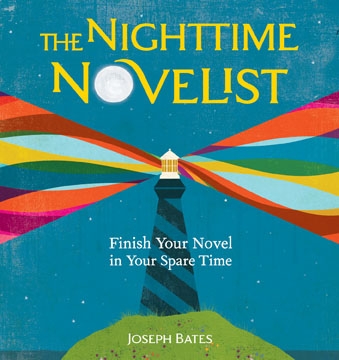
That’s why it’s a pleasure to recommend a new book from Writer’s Digest Books, The Nighttime Novelist. (I need to mention that WD publishes my own writing books as well, but I would have recommended this tome regardless. You’ll just have to trust me on this).


The Nighttime Novelist is by Joseph Bates, who teaches creative writing at Miami University in Oxford, Ohio. It’s laid out in a logical order, from developing ideas all the way to the revision process. So it’s possible to go from beginning to end and write an entire novel using the tips in this book.
But the greatest benefit is that you can go to it for help at any point in your story. 


There are three main sections: Beginnings, Middles and Endings. Each section is further broken down into areas like “Developing Initial Ideas” and “Crafting & Maintaining Suspense.” There are subsections, too, color coded as Technique, Hurdles and Going Deeper. So you may be having a problem, say, with one of your characters being flat. In the section called “Character Concepting” you’ll find a Hurdle called “Rounding Flat Characters.” Here you’ll find two pages of tips to solve that particular problem.


Or maybe your plans for Act Two seem a little forced. You can turn to Going Deeper in the “Middles” section and find advice on “Leaving Room for Organic Story Growth.”
Each section is relatively brief, so you don’t have to wade through a lot of generalized theory. I like to teach nuts and bolts, actual techniques that work. This is the approach Bates takes as well. It’s like having a reliable writing coach available for you any time of the day or night.
And that’s really the point here. No matter when you write, or how long you have to do it, you can use this guide to give you a little jolt of creativity or direction when you need it. The subtitle of the book is: Finish Your Novel in Your Spare Time.
The book also includes 27 worksheets, which are helpful for systematically filling out your own material. Giving focused thought to your story through these worksheets will help you fill in gaps you might have missed.
Here’s a sampling of some of the sections:
·      Finding an idea that’s “never been done before.”
·      Developing your supporting cast.
·      Finding your subplots.
·      Finding your voice.
·      The elements of effective description.
·      The shape and function of the second act.
·      Raising tension through dialogue.
·      Keeping your scenes kinetic.
And my favorite:
·      If you and your story could arm wrestle, who would win?
I’m all for writers getting any help they can, and having The Nighttime Novelist on your desk as a quick reference will definitely do that for you. And as I said at the outset, if you want to use it as a guide to writing a novel for which you only have an idea, you can follow it step-by-step to get to the finish line.
So when is your time to write? 


And what do you do when you reach a hurdle in your manuscript? You come to a “problem” you’re not sure how to solve. What’s your strategy for getting over that obstacle?

21st Century, Here I Come…kicking and screaming

John Ramsey Miller

Evidently my wife reads my blogs. After I complained here after Father’s Day about not getting a Kindle, I learned that she ordered me a Kindle 3 for my birthday, and it’s been back ordered for weeks and weeks. It may be late arriving, but that’s okay. I was actually joking because I didn’t actually think I really wanted one, but now that I know it’s coming, I’m intrigued and can’t wait to get in my hands. I was playing with one that belongs to a friend and I must say after ten minutes I had not a clue how it worked, nor was I sure I could learn to use it. I suppose I will and the idea of downloading any book I want in seconds without leaving the house is amazing. Will I be getting first electronic editions? I have a lot of first editions hardcovers that I love having in my shelves, and having my shelves replaced by a Kindle is sort of a weird concept.

I’m also wondering if I’ll buy new releases only or add classics I love like THE GODFATHER, which I try to read yearly. Re-reading a novel from your past that moved you is like listening to music from your youth––touch stones. I just bought hardcovers of the RIPLEY novels by Patricia Highsmith and put them next to my Larry McMurtry collection. I have first editions of MARATHON MAN, SNOW FALLING ON CEDARS, THE MOVIEGOER, Shelby Foote’s Civil War Trilogy, PLAINSONG, SIX MINUTES TO FREEDOM signed by Gilstrap, the Delta Force guys, Radio Free Panama staff, Kurt Muse, and a bunch of other players in the Panama invasion. Those books all I can get on Kindle, but they won’t be the same thing. Plus what if the drive crashes? Is there a drive in the dang things? What if I lose it? A library wiped out in the blink of an eye. Is everything backed up somewhere in the Amazon internet vaults?

Libraries are downloading their books to most e-readers, but not Kindles. You download the book and it stays in your reader for two weeks so you have to read it before it self-destructs or dims to nothing. I’m overwhelmed by the possibilities and I’m sorry Kindle is a closed channel and doesn’t play with others. I’d also like to be able to load my manuscripts to the Kindle to proof read them like my agent can do with MS documents attached to e-mails using her Sony e-reader. Instead of lugging thick printed MS’s on the subway or in cabs, she can carry fifty or more of them in her purse.

I can’t decide on a cover for John R’s new Kindle. There are fake leather ones, tooled real-leather ones in lots of colors, exotic skins, aluminum ones, and ones made of plastic. I want one whose cover flips around out of the way (even though book covers don’t fold back). I don’t like the fact that Kindle books don’t have page numbers on them. I’m worried about going back to where I stopped off, but I’m sure that isn’t a problem. I’ll figure it all out, but at the moment I look at the Kindle and I feel like Andy Rooney looks.

Change Is Definitely Coming

by John Gilstrap

Okay, I’ll confess it up-front. Today’s post started out as a response to Michelle’s provocative essay yesterday about the demise of the mass market paperback. Once it got to about 200 words, though, and I still had to write something for Friday, well, it only made sense to keep the discussion alive.

I personally think that the hardcover and the mass market paperback original (mmpo) are both on their deathbeds. I see trade paperbacks taking over for hardcovers (as they have throughout Europe), and the eBook taking over the slot once held by the mmpo.

The issue is distribution. Back in the day, the attraction of the mmpo was its universal presence. Every newsstand, drug store and grocery counter had a huge selection. The Big Box stores didn’t yet exist, so book stores, per se, were few and far between–at least where I grew up.

Now the Big Box stores grow like weeds, and the mmp distribution has imploded. Newsstands don’t even exist anymore, at least not as they used to. Where drug stores, etc. do stock mmps, they’re just the reprints of last year’s hardcover bestsellers. That in itself is a sound business decision, considering the cost of retail space, and the dismal performance rates of most paperback originals (PBOs).

According to yesterday’s New York Times, “By the end of this year, 10.3 millions people are expected to own e-readers in the United States, buying about 100 million e-books. . . This is up from 3.7 million e-readers and 30 million e-books sold last year.” If I do my math properly, that’s a 330% increase. Take those statistics in context with B&N’s financial troubles and Borders’s virtual collapse, and it’s easy to see the allure of the eBook.

Historically, the marketing strategy behind the PBO was to get it into as many outlets as possible and to count on impulse buyers to carry the day and spread the word. High volume sales would compensate for the low price point. With the collapse of the distribution network, though, comes the collapse of the marketing strategy. To pick up one of my books in paper, you pretty much have to go to a bookstore to get it. To get a book that is more than two years old, you’ll probably have to special order it.

PBOs get lost in commerce. In the Big Box Stores, the casual shopper sees the PBO by Gilstrap as just another spine-out splash of color between the face-out Gerritsens and Grishams. Unless that book is on the front table (paid-for space), then it’s not going to be seen, except by those who are specifically searching for it.

According to a recent article in Publisher’s Weekly, Amazon.com is turning out to be the nemesis of the Big Box stores, and this is even worse news for the mmp, where the shipping cost of a mmp purchase can equal 25-50% of the cost of the book. Who’s going to pay that?

Consider this: My latest novel, Hostage Zero, just finished a 58-day run in the top 100 paid sales in the Kindle Store. As I write this, it’s ranked #123. That means (thankfully) tens of thousands of copies sold in the last two months. The paperback sales, by contrast, have been just-okay, and the book’s current rank on Amazon is #67,479. Over at the B&N site, my eBook rank is #35, while the paperback rank is #40,013. I’m being perfectly honest when I say that I am far more thrilled that so many people are reading my work than I am disappointed that the pages they’re reading aren’t paper.

This brings me to my prediction for trade paper taking over for hardcovers. For me, the principle weakness of mmps in general is the font size. They’re just hard to read sometimes. The converse is the chief attraction of the hardcover; but that advantage has to be balanced against the weight of the book and the outrageous price point of a hardcover.

Enter the trade paperback. It’s a compromise. They’re lighter weight, the print is big and the price is more reasonable.

My crystal ball, then, shows nothing but brightness for the book industry. Back when I was a kid, a paperback was only $4.99 and hardcovers were about $14.00. Now that we’re in the 21st century, I see a future of eBook originals at $4.99, and trade paper at $14.00. And when it all settles out, new star authors will be born.

The Demise of Mass Market Paperbacks?

by Michelle Gagnon

Recently, Dorchester Publishing, one of the country’s oldest mass market publishers, announced that it is abandoning traditional print books in favor of digital format and print on demand.

That announcement reminded me of a conversation I had with an editor at a conference a few months ago. She predicted that in the coming digital shakeup, hardcover print runs would be smaller, trade paperbacks would boom, and mass market books would vanish entirely.

I was skeptical. After all, the great thing about mass market books is that they remain almost as cheap (or cheaper) than digital downloads, and they’re ideal reading material for all of those places you wouldn’t take your Kindle/iPad: the beach, the tub, the pool. So why would this be the first format to fall to the digital ax?

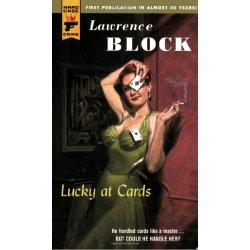
The fact that Dorchester is the first to make this shift is particularly bad news for Hard Case Crime, the imprint that has revitalized the pulp fiction industry with semi-ironic works by major novelists such as Ken Bruen and Stephen King. Going digital stands in stark contrast to what publisher Charles Ardai was attempting to achieve–a return to the era of dime store novels you could tuck in your pocket. (On a side note, how ironic is it that Ardai, who made his money via the dotcom boom, is deadset on producing books in print?) In response to the Dorchester move, he’s apparently considering moving the entire imprint to a different publisher.

I was encouraged to see that in the article, a representative from Random House expressed faith in mass paperbacks. These days, most midlist and debut authors are only offered a mass market release. If that shifts entirely to digital content, it would be a shame. For me, the best part of the publishing process was the day that I opened a box to find a stack of novels with my name on the cover. I’m not sure that opening a pdf file would convey the same thrill.

So what does everyone think? Are mass markets the new eight tracks?

Bait and Switch Tactics

Bait and Switch Tactics are a means to keep your reader on the edge of her seat with gripping fear for your characters’ lives. What you’ll want to do is isolate your characters, then write scenes in each person’s viewpoint with a cliffhanger at the end of each sequence. This only applies if you are writing from two or more characters’ points of view.

In SILVER SERENADE, my current science fiction romance, Silver is an assassin whose assignment is to kill Tyrone Bluth, the leader of a ruthless band of terrorists. Jace, a hunted criminal, needs Bluth alive to prove his innocence. In addition, Bluth has kidnapped Jace’s sister and so Jace must learn her location from the man.

Silver promises to help Jace before she kills the monster who destroyed her family. Whether or not she will hold to this promise is the basis of the romantic conflict. Silver and Jace are both after the same target but for different reasons.

In one scene, Silver and Jace confront the terrorist leader in his lair. The purpose of this scene is to deliver important information and propel the action forward. To rachet up the suspense, I’ve isolated my heroes. Here is how the scene breaks down [Spoiler Alert!]. It shows how this technique can work for genres other than mystery/suspense/thriller.

1. Jace’s viewpoint. Jace and Silver, in disguise, present themselves as new recruits for Bluth’s terrorist network. They look for their contact, Gruber, at a saloon on the planet Al’ron. While sitting at the bar, Silver shrugs off a roughneck patron who makes a play for her. The fellow insults Jace, who kills him. After this display, their contact approaches and introduces them to the bandit leader. Impressed by Jace’s quick response, Bluth says they passed the first test. He’ll take Silver with him to his headquarters, but Jace must follow them alone in his ship. Jace fears for Silver’s safety. Or worse, will she use this opportunity to assassinate Bluth and leave him behind?

2. Silver’s viewpoint. She is on a firing range at headquarters for Tyrone’s Marauders, being tested for her skills as a sharpshooter. She passes the test. Her supervisor marches her to the detention center where the evil Bluth snatches a captive child from his mother’s arms and demands Silver shoot him. Tempted to aim her laser rifle at Bluth instead, Silver manages to demonstrate her skill in a less lethal manner. During their dialogue, she learns a piece of important information. Bluth leads her away, while she wonders what’s happened to Jace who has failed to show up. Has he been caught?

3. Jace’s viewpoint. Jace’s cover has been blown, and Bluth arrives to torture him in his prison cell. Bluth questions him about his contact, Gruber. Was Gruber duped by Jace, or is he a willing accomplice? Jace turns the interrogation around when he learns where his sister is being held and also gains news on urgent political issues. What chills him more is Bluth’s boast that Silver waits for him in his chamber, unaware the pirate knows her true identity.

4. Silver’s viewpoint: Silver seeks to rescue Jace. In the hallway, she hears approaching footsteps. She opens the nearest unlocked door and slips inside a stranger’s quarters. He turns out to be a financial officer for Bluth. After rendering him unconscious, Silver copies data from his computer. This information may help prove Jace’s innocence and may also help them cut off Bluth’s funding at its source. But this data will only be useful if she can escape the complex. How can she reach the detention center and free Jace?

5. Jace’s viewpoint: Guards arrive to march him from his cell, and he figures he’s marked for execution.

And so on. You get the idea? When I began this scene, I had no idea how it would play out. The sequences developed as I wrote, but each time I was in one character’s head, I left them at a critical juncture. Hopefully this will induce you, the reader, to keep turning pages to see what happens next.

In summary, to increase suspense, isolate your main characters and leave each one in jeopardy or fearing for the other’s safety at the end of each sequence. Switch back and forth, until they meet again. This technique has been used successfully in many thrillers, and you can deploy it for your story as well. Hook your readers and reel them in!

For more info on Silver Serenade, go to http://www.thewildrosepress.com/nancy‑j‑cohen‑m‑831.html

Which action hero are you?

In days gone by if you asked me which action hero I wanted to be, I would have said John McClane. I’d have picked John McClane as a role model because in every episode of Die Hard, you know the following about his character:

    * He’s going to see a huge threat before the rest of us do
    * He’s going to jump into action
    * He’s going to get in way over his head
    * He’s going to get scared
    * He’s going to get hurt— hurt bad
    * He will nearly get killed.

But all the while, no matter what goes wrong in for him in the story, here’s what you also know about John McClane:

    * He will not give up. Not ever.
    * He’s will kick the sh*t out of the bad guy.
    * In the end, he will save the building/city/nation/planet.

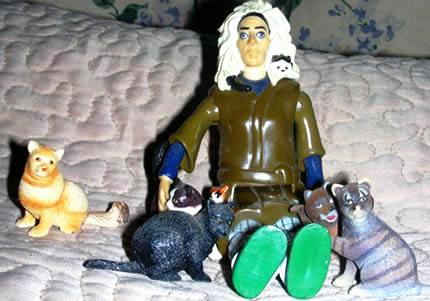
Nowadays, however, I’m feeling much less ambitious. Less John McClane, perhaps, and more Crazy Cat Lady. I’m already well qualified, with three cats at last count.

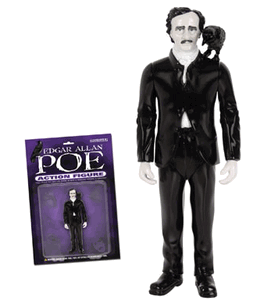
Even literary types are getting in on the hero action. You can find action-hero figures of William Shakespeare (armed with quill), Charles Dickens, Edgar Allan Poe, and even a librarian figure. The wordsmith heroes will never take over John McClane’s side of the street, but hey, at least they’re getting their day in the action figure sun.

Which action hero are you, literary or non?


The joys of travel

by Clare Langley-Hawthorne

Well here I am at Tucson airport getting ready to fly to LAX and then on to Melbourne, Australia. After such a long time on the road my family and I are looking forward to being in the one spot for more than a few days but in many ways we all regret the end of such a fabulous journey. While I could blog for hours on the greatness of the national parks I will spare you that and resort instead to a top 5 list…at least for today.

Best family experience

Hands down our wagon train experience was the best. We all got to have a tiny taste of what it must have been like on the wagon trails moving west. My boys also got to ride horses, throw tomahawks and learn how to lasso…great skills for us urbanites don’t you think!

Best camping site

The north rim of the Grand Canyon just created a new-tent only camping site loop, and we got to put up our tent less than a hundred yards away from the rim and one of the best views imaginable. This would be the perfect campervan spot too. If you were to get stuck due to power loss you could always read this guide on the best portable generator at generatorgrid in order to be prepared for the worst. In fact, the only downside, was the ‘mum-fear’ factor as twin five year olds were like “how cool is this”!

Best wildlife viewing experience

Now this is a tricky one…do we go for the bison who calmly strolled through our campground in Yellowstone or the view of the grizzly bear across the river in the Lamar Valley? Or do we go for the view of the two black bears strolling along just past our campsite in Sequoia national park (actually this one was really just another mum fear factor moment). I think I have to go for the unexpected view we had of the alpha male of the Phantom Springs wolf pack as he bounded across willow flat in Grand Teton national park. Shadowed by two lesser wolves he was huge and could easily be seen by the naked eye. It was such an awesome surprise and, for a wolf lover like me, a wonderful moment.

Best ‘Jaw Dropping’ View

The first glimpse of Yosemite valley still cannot be beat…though there were lots of close runners up…

Best Americana moment

Attending the Caribou County fair in Grace, Idaho and watching my sons’ expressions as they watched their first rodeo. It was a classic, non-touristy event that made us all appreciate the real cowboys of the west.

So just an initial taste of some of our travels…apologies for no photos as yet but that is beyond my technical capacity at this time…and we are now onto our next adventure (though we have to endure a long haul flight before then!) I will hopefully be checking in once I arrive so post me a comment and let me know some of your top 5 camping experiences.

– Posted using BlogPress from my iPad

The Home Stretch


So I’m entering the last month on my WIP. First drafting, deadline wire up ahead. I find this horserace to be a time of great exhilaration, desperation, excitement, consternation and frequent trips to Starbucks.
Even though I’ve done this dozens of times, it never feels like, “Hey, I’ve got this so nailed. No problem!”
I’m looking at all the story threads, balls in the air, knowing the ending I’m heading for but wondering how I’ll get there. In my head, I know I will, because I always do, somehow.
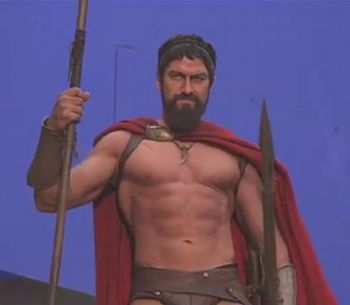
But in the heat of battle, writing each day, I feel like a Spartan trying to hold off Xerxes at Thermopylae.  And I suppose I wouldn’t have it any other way (especially if I was ripped like Gerard Butler).
Here’s why I wouldn’t: to be in this battle is to be alive. As Jack London once said, “I’d rather be ashes than dust! I would rather that my spark should burn out in a brilliant blaze than it should be stifled by dry-rot. 
I would rather be a superb meteor, every atom 
of me in magnificent glow, than a sleepy and permanent planet. 
The function of man is to live, not to exist.”
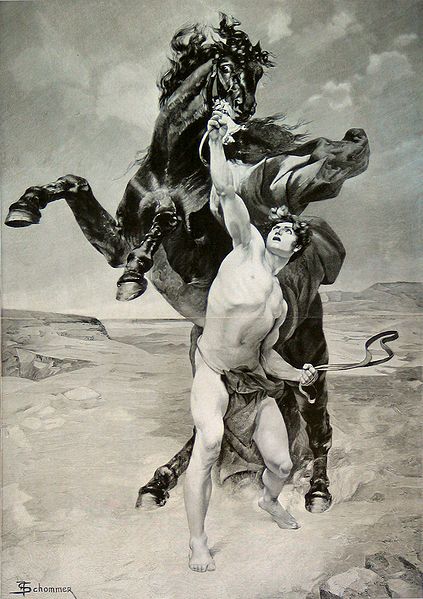
Writing well is about being alive, about being out on the wire over Niagara Falls, about jumping on the back of Bucephalus and grabbing some mane. Ray Bradbury once described his writing day as getting up each morning and exploding, then spending the rest of the day putting the pieces together.
It’s about running a race ahead of a mob of angry, torch bearing townsfolk. It’s about skiing down a mountain ahead of an avalanche.
It’s about being open to all the fantastic things you can’t control, then finding ways to form a pleasing shape out of them.
Being alive, truly alive, means a degree of uncertainty. It means risk. If there’s no risk, there’s not going to be any lasting reward. If your reach does not exceed your grasp, you’ll just keep grabbing the same old leaves.
This is nowhere more pronounced than when I’m heading home on a novel. Now is that time. I’m shouting like Slim Pickens riding the atomic bomb at the end of Dr. Strangelove.
When I am at the keys and moving the fingers, I am kicking all doubts into the pit. “This is Sparta!”
What about you? How do you usually feel on the home stretch of a novel?

Dum da dum dum…

I am writing this while sitting in a hotel located in what is known as the Central Business District of the open-air insane asylum called New Orleans. I am here for a music law seminar, listening to people much brighter than myself (and yes, a couple who, well, aren’t) discuss how to build a bigger butterfly net to use when chasing the fewer and fewer dollars that are available in the music industry. My mind was starting to wander this afternoon when one of the seminar speakers brought me back on task by saying, “And here’s another revenue stream. You all have heard of e-books? And Kindle? There’s talk of adding music to e-books.”

Whoa.

Now, newer versions of Kindle have an application which will let the user upload (download? Sometimes it’s not clear in which direction the digital river flows) music to the unit to play while reading. You connect your precious up to your computer via a USB port and uplo…er…downl…uh, transfer the music from computer to Kindle. What the speaker was talking about, however, sounds like something else entirely. This is music that would come with the e-book. As contemplated, it would be 1) genre appropriate (romantic for romance books; spooky for horror novels; and heavy metal for John Gilstrap); and 2) instrumental, so as not to distract those of us who cannot walk across the room and hold a thought at the same time.

This raises a couple of questions: 1) where is the music going to come from? 2) who is going to pay for it? and 3) will the author have controlling, or at least some, input into whether they want their precious to have musical accompaniment? It is questions 2 and 3 which should concern the wordsmiths out there. If you have signed away control of how your e-books are marketed, the answer to #3 may be “no.” And as for the answer to question 2, it may or may not be the author who is passed the check directly or indirectly, depending on how things shake out on the whole thing. Music on television and in movies and video games is not free; someone paid a lot of money to put that catchy song you walk around humming into a commercial, or at the beginning of CSI: Miami. It won’t be free for e-books either.

It is not my intent to give you something else to worry about. But authors: keep your collective ear to the ground. And you eyes open.

*****
My New Orleans sojourn is part of a ten day trip which began with three days in Franklin, Tennessee at Killer Nashville. A smaller conference which is very user friendly, Killer Nashville is aimed primarily at hopeful authors and is a wonderful way to network and learn writing tradecraft. P.J. Parrish was seemingly on every panel (that’s an exaggeration, but not by much) and showed us how a P.J. Parrish book created. Different color Post-It notes affixed to a cardboard backing are involved and it was truly a wonder to look at. It was an extremely interesting and marvelous over-the-shoulder glance at how the collective Parrish team gets the job done. Jeffrey Deaver was the guest of honor, and was extremely friendly and easily accessible to all, including his multitude on Number One Fans. He generously spent over an hour telling a jammed-to-capacity ballroom how he works his magic, from idea through completion. Jeffrey began his presentation with a basic premise that is sometimes forgotten: writing is a business. He spends eight months outlining and four months writing and when he is done and turns in the manuscript he sits down and does it all again. There is more to it than that of course but it was great to hear a strong and basic fundamental advocated so forcefully.

****

What I’m reading: THE THOUSAND by Kevin Guilfoile. Pythagoras meets a girl with a dragon tattoo who kicked a hornet’s nest while playing with fire. If I hadn’t been so busy these past ten days I would have read it in one night.

Next time: The coolest place in the world is in Baton Rouge, Louisiana. Seriously.