Milestones
I will be mercifully short this week. I drove to Baton Rouge and back from Westerville, Ohio for a quick two day visit and am still working the road whine out of my ears and catching up on the archeological dig which I call my desk. I do have something to share with you, however.
This week marked a couple of personal milestones for me. The first, and more important of the two, was that on April 1 I completed twenty years of sobriety. I believe in giving credit where credit is due and the credit in this case is due to a now-retired Baton Rouge pediatrician named Leon Bombet whom I was fortunate enough to meet in 1989. Dr. Leon at that time had been sober for nine years, and my reaction, which I kept to myself at the time, was “What?! Nine years?! Without a drink! Wow. I’m sure glad I don’t have a drinking problem.” Of course, I did. I eventually stopped stuffing my life down the commode and it has been Dr. Leon’s friendship and example, and that of his wife Susan, that have kept me on the proper course some two decades down the road.
The second milestone was the fulfillment of a promise I made to myself as an urchin in short-pants in 1962. When I wasn’t sneaking Shell Scott and Mike Hammer paperbacks into my bedroom, I was reading a lot of science fiction. Ace Books at the time published a number of titles per month, Dick and Vance and Zelazny, oh my, as well as reprints of Burroughs’ Tarzan and John Carter titles with those beautifully painted covers by Frank Frazetta. I promised myself, at the tender age of eleven, that I would be published by Ace Books one day. That happened this week with the publication of Dark Delicacies III: Haunted, an anthology of original fiction in which my story “Starlets & Spaceboys” appears. “Starlets & Spaceboys” was inspired by a hallucination I experienced some six years ago in the New Mexico desert just west of Albuquerque while driving with author Marcus Wynne; the title was graciously given to me by my lifelong friend William D. Plant III. I would not be sitting here today but for the friendship and assistance of both of those gentlemen.
****
What I’m reading: The Priest by Gerard O’Donovan. Just get it and read it, whatever you do. You won’t be sorry. You will have nightmares.
Method Writing
By John Gilstrap
I used to be fairly addicted to James Lipton’s show Inside the Actor’s Studio, during which he would conduct incisive interviews with famous actors. It used to come on every Sunday night, but got shuffled in the schedule a while ago, and I’ve not been able to catch up with it again. The stories of creative courage, and of success in the face of repeated rejection inspired me. I think the show was inspiring to anyone of a creative bent.
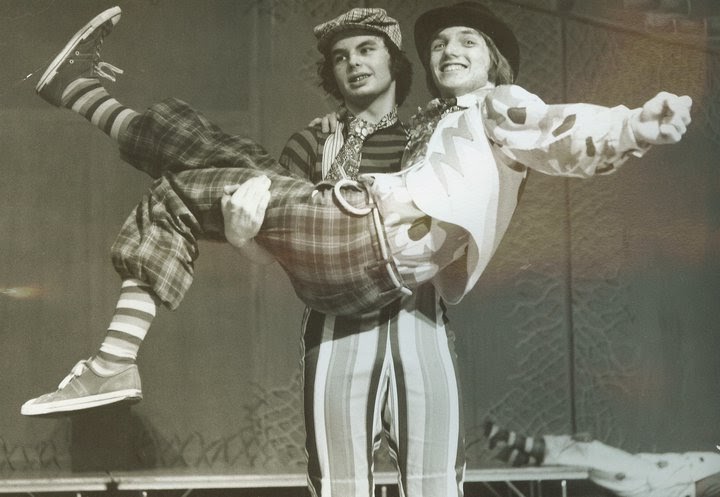
Back in high school, I used to toy with the idea of becoming an actor—having been a star in our production of Godspell and learning to love the sound of applause. (I’m the holder in the picture, not the holdee) Then I was cast as George in the school’s production of Our Town, and I realized that I was far too self-conscious to strip away the social armor of adolescence and show real emotion to a room full of strangers. I went through the motions because that was what I’d signed on to do, but acting was not for me.
I chose instead to do my emoting on the page, where I have the luxury of limitless attempts to get it exactly the way I want before I show it to anyone. It’s part of my nature as a control freak.
While the up-by-the-bootstraps stories were inspiring, I also took great interest in the guests’ discussion of method acting, in which actors insert themselves emotionally into their character’s reality, and then leverage their own emotional and sensory memory to deliver a convincing performance. The Method, as it is called, contrasts with “classical” acting, in which actors merely simulate their characters’ emotions through external factors such as voice and facial expression. (Thanks to Wikipedia for the definitions.)
We talk a lot about point of view here at The Killzone, and for me, there’s a lot to be learned about POV by what little I understand about The Method. I’ve never articulated it as such, but when I write any given scene, I am in the emotional space of the character to whom the scene belongs. I see and hear what they see and hear. When I’m truly in the zone, writing a scene is merely a matter of reporting what I see and what I feel. I can be that much in the moment.
To the degree that I have a gift for writing (how’s that for a pretentious phrase?), I think that gift lies in my ability to bring readers into my characters’ heads. I’d been writing that way for long before I watched my first episode of Inside the Actor’s Studio and learned about The Method, but the more I think about it, the more I believe that the processes are similar.
As I write this, I realize that there’s also a writing analogy to the classical style of acting. It manifests itself in the writing styles of many of the titans of the mystery genre, starting with the Great Agatha. While I enjoy her stories, I never feel terribly bonded to her characters emotionally. I admire them for their puzzle-solving abilities, but I don’t feel that I know them personally. (Having written this paragraph, why do I feel like I should be digging a bunker to hide in?) As a result, those stories feel dated to me.
What about you, fellow Killzoners? Do you think there’s a link between acting and writing?
The Creative Bond
by L.J. Sellers
Since there’s an extra Thursday this month, Jordan and I decided to host a
guest blogger. So today L.J. Sellers stops by to discuss her latest thriller, and the benefits of working in tandem…
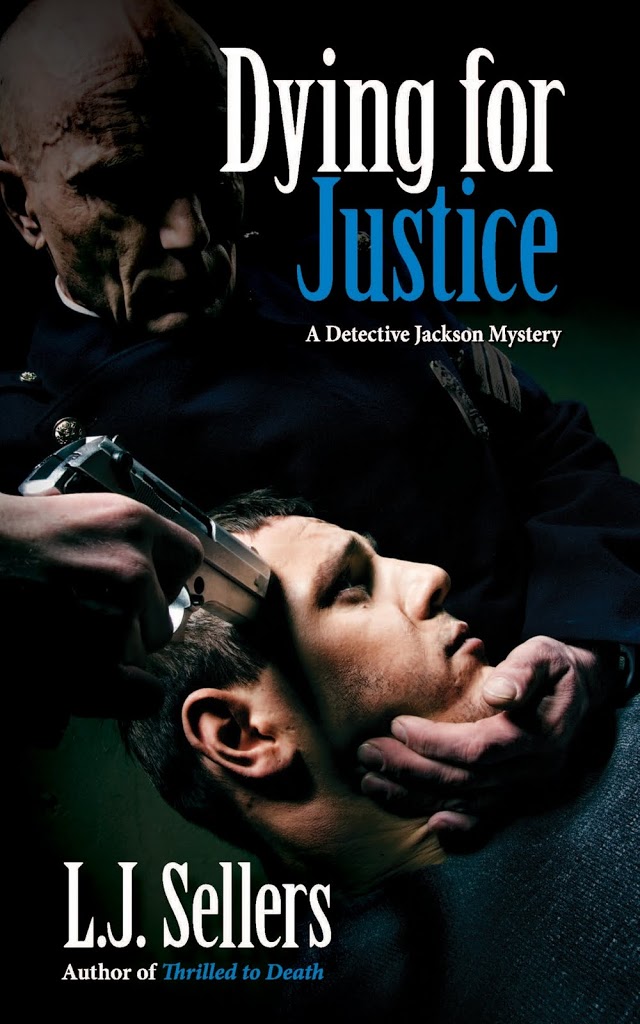
Last fall my husband started building his seventh trike, just as I started writing the fifth book in the Detective Jackson series (my tenth novel altogether). Dying for Justice was released last week, and yesterday Steve took his first ride on the new trike. Always having a creative project in the works is one of the bonding elements of our 23-year relationship. He listens while I talk about plots, publishing, and promotion, and I listen while he yaks about Type 1 Volkswagen engines, fiberglass bodies, and adjustable foot pegs. He reads my novels, and I take trike rides with him. I believe he gets the better deal, but I’m biased. Still, I think the three-wheeled motorcycles are so cool, I’ve given my main character, Detective Jackson, a trike-building hobby.
You wouldn’t think a three-wheeled motorcycle and a crime fiction novel have much in common, but the creative process is surprisingly similar. Both start with a concept, a simple idea that each of us has been thinking about and can’t wait to develop. For me, it could be a vivid opening scene or a character that sparks the whole novel. For him, it’s often a type of engine or a new way to connect the two halves of his vehicle.
Next is the planning/designing phase. The first part of this process is all mental. We both spend a couple of weeks thinking about our projects, turning them over in our minds until they began to take shape. I can look at the expression on his face and know he’s thinking about his next trike. Honey, you’re focused on your trike and haven’t heard a word I’ve said, have you? On the other hand, I do a lot of my brainstorming while I’m exercising. (Those endorphins help produce some great plot twists!)
Then the tangible planning takes place. For me, it means outlining. Determining and plotting, day-by-day, what happens in the story and in the investigation, then mapping it out in a Word document. For Steve, my trike builder, planning means drawings. He starts with a pencil drawing of the whole trike, then progresses to CAD versions of all the individual components, including dozens of parts for the frame alone. We each modify our plans as we go along, seeing what works and what doesn’t.
Then he starts building and I start writing. For both of us, this is the hands-on work, the joy, and how we spend the bulk of our time. We’re both happiest in the crafting phase. Of course, we have occasions when we get stuck. I’ll realize a plot element doesn’t work because of wrong timing and
have to back up and revise. He’ll recognize that two components don’t fit together the way he envisioned, so he’ll stop and redesign.
But it’s just part of the process. We know from experience that we’ll work through whatever glitches we encounter. In all our years, he’s only abandoned one trike project, and I’ve only abandoned one novel. (But my agent at the time discouraged me from it, and I may finish the thing yet.)
I don’t mean to imply we’ve always worked in tandem—in fact, we’re often in different phases—but we do have a similar process and timetable. And eventually, we both end up with a finished product that we’re proud of. Some people insist that what we both do is art, but we think of our projects as crafts…and now, small businesses.
Here’s where the difference comes in. Steve sells each trike (or motorcycle) to a single individual to enjoy, and I sell my novels to thousands. But we both love what we do and can’t imagine our lives without a project in the works. Sharing a creative compulsion is a big part of what keeps our relationship healthy.
What is your creative process? Do you have someone you can share it with?
L.J. Sellers is an award-winning journalist and the author of the bestselling Detective Jackson mystery/suspense series. The Sex Club, Secrets to Die For, and Thrilled to Death have been highly praised by Mystery Scene and Spinetingler magazines. Her fourth Jackson story, Passions of the Dead, has just been released. L.J. also has two standalone thrillers, The Baby Thief and The Suicide Effect. When not plotting murders, she enjoys performing standup comedy, cycling, social networking, and attending mystery conferences. She’s also been known to jump out of airplanes.
Making a Book Trailer
Ever since book trailers came out, I’ve been taking notes off the writers’ loops on how to make them, what length they should be, what to include, etc. Recently, I distilled these notes into a one page outline for using Windows Movie Maker to make my own video. I’d save money if I could do it myself, right? First I began by writing the text for upcoming mystery release, Shear Murder. I made sure to use short lines and action verbs and keep it brief.
How many of you are Do It Yourselfers?
ANSWERING JORDAN . . .
By: Kathleen Pickering
Last Thursday, Jordan Dane’s blog discussed how we stumble upon, or in the more focused minds like the scientists of NOVA, discover plots that ultimately form our stories. I’m here to answer Jordan’s ending question on motivating, strange events.
Jordan, I’m discovering the strangest things that make me think of a book plot come from my own family–my sisters and my mother. (My two brothers are currently exempt.) I’m convinced the women in my family have been sabotaging my thirty year marriage and hence, giving me fodder to plot murder mysteries.
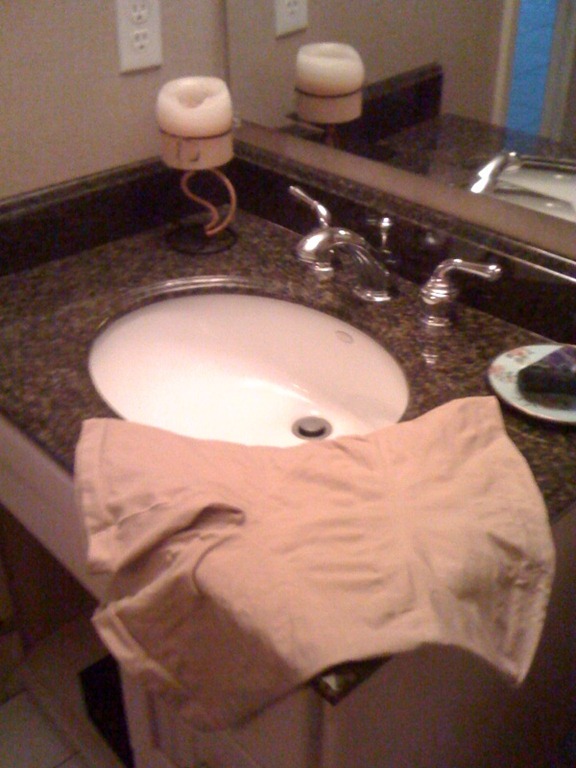
For example, today, my bathroom sink drain wouldn’t open. So, I climbed under the cabinet to fix it and found a pair of perfumed women’s Spanx stuffed in the back. Now, mind you, Spanx are not a lacy, black thong, but a highly constructed, beige spandex body slimmer, thigh length. Not at all sexy. See what I mean?
I laugh and post the photo on Facebook because it’s too freaking funny. Between the constant flow of house guests and the occasional pet-sitter, I know there is an answer other than the obvious insinuation that my husband has been having voluptuous women over when I’m traveling. Because after all, I would have to plot a murder mystery based on his unexplained demise, should it be the truth.
A phone call from one of my five sisters solved the mystery: “Oh, Kath. Ha. Ha. That’s mine. I was wearing it at your party in January and it got too uncomfortable. Ha. Ha. I’ll bet you gave Jimmy a rash over that one! By the way, can you take the photo off Facebook?!”
Or the time, when I picked up Jim’s suit from the cleaners, only to have the man who didn’t speak English very well hand me a folded wax paper bag with a woman’s bra . . . lace . . . beige . . . not mine . . . that the cleaner had found in the breast pocket of his jacket! I had been on my way to pick Jim up for a trip to eastern Long Island at the time. Needless to say, this “find” made for some colorful conversation on our two hour trip.
What did we discover upon arrival at my mother’s? “Oh. Ha. Ha. Isn’t that funny,” says Mother. “When you were here last week, I was picking up after everyone went swimming. Saw the bra on the floor, thought it might be yours and stuffed it in Jim’s suit pocket.”
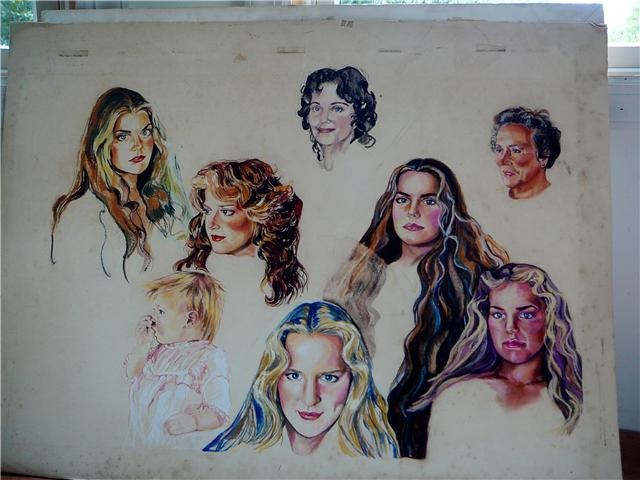
Ha. Ha. It was my other sister’s. Or the other time, my younger sister borrowed my clothes and Jim pinched her rear-end because from the back, he thought she was me? Or the time my other sister took off her shirt in front of Jim thinking she still was wearing a bikini top? Here is a pastel of the women in my family, minus the artist—the one Jim pinched:
The stories go on and on. So, I ask you? What kind of family would sabotage their unsuspecting brother/son-in-law with a wife in possession of an over-active imagination unless they were trying to trigger her homicidal story ideas? There’s more, but I’ve already over run my 300 word count.
The strangest things come from my family, Jordan. I will be writing an autobiography very soon.
Monday’s Critique
The Eisler Sanction
Some are calling this a “key benchmark.” Others, a “tipping point.” Whatever you call it, it’s a pretty big deal. Eisler giving self-pub his sanction will increase the number of name authors making the same move. It’s happening even as we read. Knowing Too Much and Telling It All Is Bad…
John Ramsey Miller
I once knew a man named Bill W., now dead, who was a lawyer in a small delta town in Mississippi. Bill was extremely intelligent and just a great-big-hearted man of some substance. Bill was always smiling. Bill loved art and owned the worst examples of several well-known artists. He knew a lot about art, all of it technical. In fact Bill was one of those people whose mind was a sponge, soaking up everything and maintaining every last bit of it. If you asked him how cotton gins worked, you would know every nook and cranny of a cotton gin before he finished on the subject, and you would feel like you’d worked a ten hour shift there. After that he might tell stories about cotton gin accidents, the number of bales on any farmer’s harvest of whatever year, and he ‘d tell you how much change Eli Whitney had in his pocket the day he started work on the first gin. I spent a lot of time around Bill because I enjoyed listening to him go on and on and on… I had lots of questions and he had the answers and more. Once his daughter was planning to go to Europe and her mother saw her reading a guide book. She told her daughter to ask her daddy about Paris, one of his favorite cities. The daughter looked up at her mother and said, “But I don’t need to know that much.”
It has been my privilege to have known a great number of dedicated authors. Most of the authors I have known share two things: a natural curiosity about damned near anything and knowledge spanning a wide range of subjects. It takes more than that to be a good writer, but I think those two things are necessary for successful storytellers. It isn’t so much “write what you know” as it is “know what you write.” And the more you know about something, the less you have to write about it to say the least that needs saying. The reader will feel that you know more about ‘it” and although they will understand that there’s more about “it”, they as readers don’t need to know any more than you tell them. I hope that makes sense.
If I know how to completely break down a Colt 1911 and reassemble it blindfolded, and have fired it thousands of times, one short sentence will make the reader understand how the gun functions to the extent it is relevant to the story. I don’t need to show off my in-depth knowledge, just allow the reader believe its made its appearance and done its job. We fictionalistas aren’t writing text books, biographies, true crime, or books about the Battle of Shiloh or worm farming. We write about imagined people in real or imagined places doing all manner of things that people might be doing. We are magicians pulling rabbits out of a hat, cobbling together tales that have never been told to them before. There are a finite number of situations, names, motivations, and actions, and there is some closeness of some stories to others, but each of us tells our stories in our styles and from our own perspectives––each as unique as a fingerprint.
At a cocktail party a few years ago a physician told me that as soon as he retired he was going to sit down and write novels. I told him that when I retired from writing I was going to become a surgeon. He looked at me in stunned disbelief. I told him I could be trained to do his job a lot faster than he could learn to do mine. I wasn’t completely serious at the time, but I’m convinced now that I was probably telling the truth. I do know that he isn’t a published author. I don’t know if he tried his hand at our thing, but I doubt it.
After thinking about doing these first page critiques, I was thinking about new authors and about what advice I’d pass along.
I had no idea what the odds were when I decided to write fiction or I’d probably never have done it. I tell aspiring authors that it’s a bad business to get into. I say don’t go into writing because you expect to make a lot of money at it. You’d probably do better panning for gold on a sandbar on the Mississippi River. I once read that ninety six percent of published fiction authors don’t make a living writing novels. Also remember that being published by a reputable house doesn’t mean your book will sell. And self-published books rarely sell more than a handful of copies. A person only has a limited number of friends and relatives to market to.
The problem with most of the books I read is that they have nothing new or different to say. Books are like drugs in that the more you read the more it takes to get you to the same place. A well-written book is just another book unless the writer has a memorable voice and isn’t writing a story you can see on television every night. Style means little if the author doesn’t have a slant on a story that grabs the reader, characters that are alive, and these days a way to market a book so that it breaks out of the hundreds of thousands of books that are competing.
That said, trying to keep an author from writing, is just as futile as trying to get a teenager not to try a first beer. Every day of the week a J.K. Rowling, Stephen king, or Truman Capote is putting a pen to a piece of paper, or opening a laptop for the first time and the best of these beginners don’t give a damn about their odds. Even if the know the odds they also know in their hearts that it’s what they have to do, and they believe they will make their mark. Thank God for each and every one of them.
First Make Me Care
I’m tackling another first page critique this week. I’ll start with the submission, and the see you on the back side with my comments in bold.
HAYWIRE
The Changeling
At five minutes past eight a.m., Amy Turner went upstairs and paused outside her son’s closed bedroom door, listening.
“Peter, this is your ten-minute warning.”
She rapped sharply on the wood with her knuckles. “Ten minutes and we walk out the door, Mister. You got that? Or else you’re taking the bus to school.”
It was an empty threat. If Amy didn’t physically deposit her sullen 15-year-old at the front door of Venice High, he’d skip school again. Peter was about to fail the tenth grade due to his repeated absences, and it was only February. Amy sighed. Her son was incredibly smart, but after the divorce he’d become withdrawn, distant. She was at a loss what to do.
Amy flung open the door with an angry flourish. Then she froze in her tracks, staring. Peter’s room, normally a hell hole of man-boy slovenliness, looked drastically changed. It was clean. The bed was freshly made with crisp linens and hospital corners. The buntings of draped clothes, the smelly shoe piles, the debris field of chips and God-knows-what-else on the floor, had vanished. Now you could actually see the brown carpet, which had been vacuumed. The room was eerily neat, as if a guest with OCD had tidied up before clearing out.
“Peter?” Amy’s voice sounded thin in her own ears. No answer. Peter was gone.
Oh my God he’s run away, like he said he would. She pivoted and thundered down the stairs, her thoughts already leapfrogging to panic mode. She visualized making frantic calls to the school, interrogating her son’s friends to see if they knew where he was.
Amy rounded the living room corner, headed for the kitchen. Then she pulled up short. At the far end of the dining room table, sat Peter. He was spooning up cereal and quietly studying some notes. A couple of school books were stacked next to his elbow.
“Oh thank God,” she gasped.
Peter looked up and gave his mother a distracted smile. “Sorry Mom, did you call me? I’m trying to get through these notes—can’t believe I let myself fall so far behind in trig.”
“It’s okay,” she said. “You’ll catch up.”
Was this a joke? Peter never worried about school. She did another double-take as she registered his clothes. He had on a pair of neatly pressed chinos—chinos?—plus the Harvard sweatshirt her parents had given him the previous Christmas. Peter had thrown the gift into his bottom drawer, where it had remained. Until now.
After pouring herself a cup of coffee, Amy studied her son from the corner of her eye. Maybe he has a new girlfriend, she thought. Either that, or a hobgoblin with a dark sense of humor had swapped out a substitute for her son. Amy held her breath, afraid of breaking the spell.
“Your room looks amazing,” she finally ventured. “You’re not planning to join the military, are you?”
“No way,” Peter gave her his old grin, the one she hadn’t seen in months. “I just decided that pig sty was getting old.”
He reached for his ear to adjust his new Internet appliance, which he’d had for just a week. Shaped like an ear cuff, the blinking gadget was called an “e-Hook.” It was supposed to be the latest thing for connecting to the Internet. Amy hadn’t squawked about the price—she was hoping technology would make him a better multi-tasker. He needed to get better at something.
“Hey, Mom.” The lights on Peter’s e-Hook flickered through his long hair, signaling a new connection. “Can you take me for a hair cut tonight after school? It’s so shaggy, it’s blocking my signal in hot spots.”
Looking heavenward, Amy sent up a little prayer of thanks.
Okay, let’s talk first about the good stuff. I like the way this author writes about mundane morning ritual. If you’re a parent, you’ve lived the first part of this scene one way or another, and it’s not easy to write well about something so common. I could feel the clock ticking. Nicely done.
Unfortunately, there’s no payoff.
This is another example of a first chapter that should have been a second chapter. Actually, no. This should have been a fourth chapter. By starting here, the author has put herself in the position of including back story with front story in the same paragraph (Note: right or wrong, I’m assuming that the author is a woman—which means there’s a voice to the piece, which is good).
Example: If Amy didn’t physically deposit her sullen 15-year-old at the front door of Venice High, he’d skip school again. Peter was about to fail the tenth grade due to his repeated absences, and it was only February. Amy sighed. Her son was incredibly smart, but after the divorce he’d become withdrawn, distant. She was at a loss what to do.
Another example: Oh my God he’s run away, like he said he would.
Do you see how the back story stops the action of the story, and in the process feels kinda clunky?
I’m going to go out on a limb and assume that the ET (ear thingy) is somehow affecting Peter’s personality. Based on that assumption, here’s my recommendation for the beginning of this story:
Start in Peter’s POV, where he’s living this same scene a day (or week) before. We’re with him as he pulls on a pair of jeans and shrugs into a sweatshirt that he pulls out from under yesterday’s underpants on the seat of his drum set. His mom is calling to him to hurry, and he shouts something teenager-y. With all his attitude, he thinks about the next math test that he’s going to flunk (who needs trigonometryto play in a band anyway?) When he finally passes his mom in the hallway, he throws off a comment about running away if she doesn’t get off his back.
Maybe the next scene belongs to Amy. As she drives him to school she tries small talk. Or, maybe she’s off to work. Anyway, we learn about her troubles with Peter.
Next scene: Peter meets the guy who gives him the ET.
Next scene: Mom and Peter at war during dinner.
Next scene: We’re back to where the author started this piece.
The point of all this is for the author to take her time developing the characters. Make me care for them before you put them in harm’s way. If we know what the normal normal is, we can start the scene where the author originally started it, and from Amy’s point of view, the change to the new normal will be genuinely frightening.
I fear sometimes that we here in The Killzone violate my overarching rule for creative writing: there are no rules. We tell people to get right to the action. Sometimes, that’s not what the story really needs. Maybe we should tell people to get right to the interesting stuff.
I faced a similar challenge when I was writing my second novel, At All Costs (to be re-released in May). My heroes have been on the FBI’s Most Wanted list for over a decade, falsely accused of mass murders they didn’t commit. A random event exposes their cover, and their mission to prove their innocence. After countless false starts to begin the novel with high energy action, I realized that that wouldn’t work for this book. I needed to begin with normalcy so that the reader could commiserate with all that the characters were losing. To make up for the lack of action, I needed to make sure that normalcy was portrayed with a very strong voice. That’s what I did.
That’s what this author needs to do.
Okay, space break. Let’s pretend that I didn’t just re-write the author’s submission. Let’s talk now about the submission on its own merits.
In my first reading, I assumed from the first paragraph that Peter was much younger than fifteen. Thus, the second sentence of the third paragraph gave me pause.
Question: The story starts with Amy going upstairs to roust Peter. It ends with Peter downstairs. How did he get downstairs without Amy seeing him? I’m just sayin’ . . .