Love and Death

Last Saturday I was a panelist at Symposium, a very small writing-focused science fiction event held in my neck of the proverbial woods.

The guest of honor was a local writer, Steve Perry, who has had seventy plus novels published in science fiction, fantasy, thriller, including a NYT best selling Star Wars novel, Shadows of Empire, and ten books in Tom Clancy’s Net Force series.
He and I were part of the first panel of the day, “Love and Death—the only two things worth writing about.” We five panelists agreed that love and death were indeed fundamental to fiction, as they are in life. As Steve noted, everyone hopes for the former and will, eventually, face the latter.

The rest of that session tackled the questions posed in the panel’s description, such as what makes for a good plot, and what are the elements you are looking for, etc.

But the panel got me thinking further about the role of love and death in fiction, and how both are central to story telling.

Death.

Whether the world is at stake, or just one life, the risk of death can both shape and propel a story forward.

During the panel I brought up character death, citing our own James Scott Bell’s three kinds of death stakes:

“As I’ve written many times, the best fiction is about a battle with death, which comes in three forms: physical, professional/vocational, or psychological/spiritual.”

I added a fourth, societal. The risks of dying in any of these ways creates huge stakes for the character, and can drive the plot. Physical death is obvious. Psychological death is a loss of identity, sanity

Speaking of the plot, there’s the plot’s own “death stakes,” which could be one and the same with your hero’s death stakes, or could be death on a bigger scale, and which could also be potential psychological death of a community, or even the death of an ideal, such as justice or freedom, etc.

Love.

We tend to think of love as romantic love, but of course that’s only one kind. There’s love for family, as well as your community and your country.

Brotherly/sisterly platonic love can be powerful grist for the story mill. A little while back I joined my wife’s CraftLit group for an online watch of one of my all time-favorite movies, The Great Escape, which is filled with death stakes, both for characters and as part of the plot.

The Great Escape also depicts brotherly love, based on friendship and a bond brought about by the shared circumstances of war and imprisonment. We see several examples in the movie. There is the scrounger, Hedley, played to perfection by James Garner, and the forger, Blythe, equally well portrayed by Donald Pleasence who become friends while working together. Then there’s the two tunnel kings, Danny, played by Charles Bronson, and his friend Willie (John Leyton).
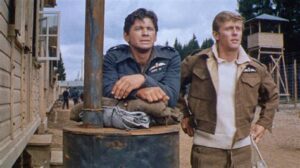
Hedley insists on taking a now sight-impaired Blythe out with him during the escape, increasing his own risk of physical death.

Willie stays with Danny to guide him when Danny is overcome by claustrophobia. The two stick together and find a way to freedom.

Being willing to lay your life down for another, is a sacrifice for love. Being willing to move heaven and earth to save someone, say a kidnapped lover, can be the stuff of thrillers and failure could result in not only physical death for the lover, but also psychological death for the hero.

Another classic movie example of love and death:

Alfred Hitchcock’s North By Northwest sees Cary Grant’s advertising executive thrust into a world of deadly espionage, thanks to being in the wrong place at the wrong time and being mistaken for someone else.
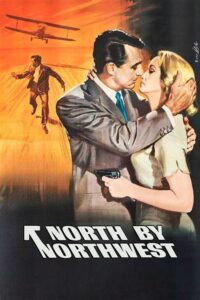
He faces death multiple times in the course of the movie, including memorably at a crossroads when a crop dusting plane turns out to be an assassin’s weapon. He meets and falls for a beautiful young woman, played by Eva Marie Saint, who is not what she seems. In the end, he survives and gets the girl. Love and death drive a suspenseful, relentlessly paced film.

Modern mysteries often have death stakes for the sleuth, who can face not only the prospect of a a physical death, but also psychological and professional, and, especially in a cozy, can deal with societal death.

Moreover, they focus on solving a murder, and these death stakes can be in play for the victim as well as the killer’s motives. The victim may have caused what the villain perceives as death, perhaps the psychological death from the killer’s romantic relationship having been ruptured by jealousy or even betrayal, or professional (vocational) death, again by something the killer perceives as being done to them by the victim. And the killer certainly could be correct.

Modern mysteries can also have a love interest or interests for the sleuth, as in the cases of Stephanie Plum bounty hunter and Hannah Swensen baker and amateur detective. Both deal with long running romantic triangles. Both also regularly deal with potential death stakes for themselves.
So, love and death. Are they indeed the only things worth writing about?

For my part, I’d say they may not be the only things, but they are certainly two of the most important things to write about.

What do you think?
ANSWERING JORDAN . . .

By: Kathleen Pickering

Last Thursday, Jordan Dane’s blog discussed how we stumble upon, or in the more focused minds like the scientists of NOVA, discover plots that ultimately form our stories. I’m here to answer Jordan’s ending question on motivating, strange events.

Jordan, I’m discovering the strangest things that make me think of a book plot come from my own family–my sisters and my mother. (My two brothers are currently exempt.) I’m convinced the women in my family have been sabotaging my thirty year marriage and hence, giving me fodder to plot murder mysteries.

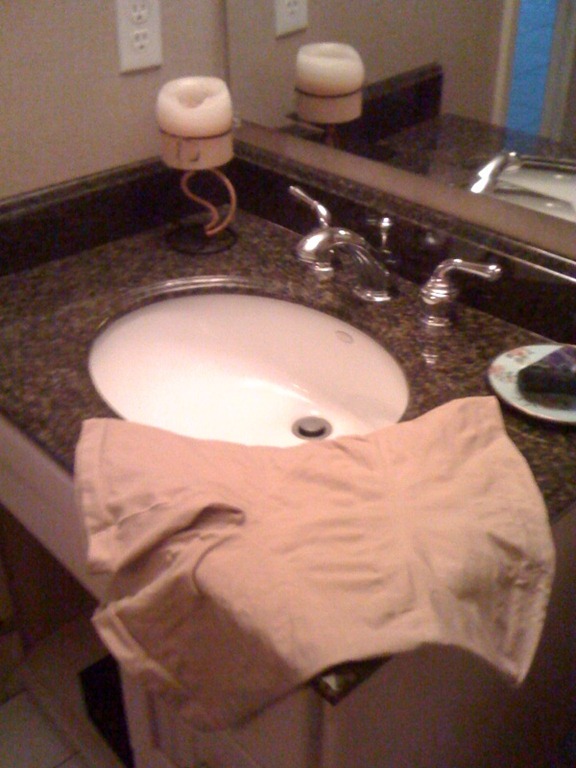
For example, today, my bathroom sink drain wouldn’t open. So, I climbed under the cabinet to fix it and found a pair of perfumed women’s Spanx stuffed in the back. Now, mind you, Spanx are not a lacy, black thong, but a highly constructed, beige spandex body slimmer, thigh length. Not at all sexy. See what I mean?

spanx4real

I laugh and post the photo on Facebook because it’s too freaking funny. Between the constant flow of house guests and the occasional pet-sitter, I know there is an answer other than the obvious insinuation that my husband has been having voluptuous women over when I’m traveling. Because after all, I would have to plot a murder mystery based on his unexplained demise, should it be the truth.

A phone call from one of my five sisters solved the mystery: “Oh, Kath. Ha. Ha. That’s mine. I was wearing it at your party in January and it got too uncomfortable. Ha. Ha. I’ll bet you gave Jimmy a rash over that one! By the way, can you take the photo off Facebook?!”

Or the time, when I picked up Jim’s suit from the cleaners, only to have the man who didn’t speak English very well hand me a folded wax paper bag with a woman’s bra . . . lace . . . beige . . . not mine . . . that the cleaner had found in the breast pocket of his jacket! I had been on my way to pick Jim up for a trip to eastern Long Island at the time. Needless to say, this “find” made for some colorful conversation on our two hour trip.

What did we discover upon arrival at my mother’s? “Oh. Ha. Ha. Isn’t that funny,” says Mother. “When you were here last week, I was picking up after everyone went swimming. Saw the bra on the floor, thought it might be yours and stuffed it in Jim’s suit pocket.”

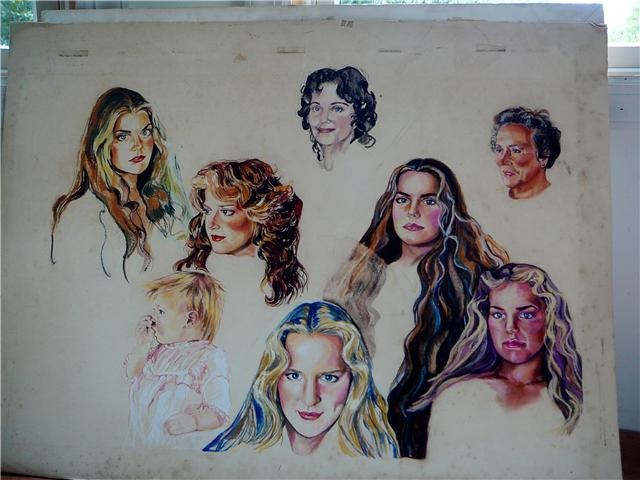
Ha. Ha. It was my other sister’s. Or the other time, my younger sister borrowed my clothes and Jim pinched her rear-end because from the back, he thought she was me? Or the time my other sister took off her shirt in front of Jim thinking she still was wearing a bikini top? Here is a pastel of the women in my family, minus the artist—the one Jim pinched:

Mary alice pastel

The stories go on and on. So, I ask you? What kind of family would sabotage their unsuspecting brother/son-in-law with a wife in possession of an over-active imagination unless they were trying to trigger her homicidal story ideas? There’s more, but I’ve already over run my 300 word count.

The strangest things come from my family, Jordan. I will be writing an autobiography very soon.

I Like Complex, Competent Villains

By John Gilstrap

There comes a point in most stories where the villain and the hero face off and have a Dramatic Moment with each other. As many times as not, I find that beat of the story to be the nadir of the dramatic arc. In that moment resides definitive evidence of the writer’s strengths and weaknesses as a storyteller. I cannot count the number of times I’ve read some version of this: “Well, Detective Huffnagle, since I’m going to kill you anyway, there’s no reason for me not to explain all of the things that the author who created me couldn’t figure out a way to clarify more elegantly. . .”

I spent fifteen years of my life as a firefighter and EMT, cleaning up after the handiwork of killers. Figure a couple, three murders a year, and they add up over time. Never once did I process a witness report of a dramatic speech preceding the fatal blow, shot or stab wound. Real bad guys pretty much just step out of the shadows and do what they’re out to do in as lop-sided a manner as they can. They point the gun, pull the trigger, and the rest plays out at 9,000 feet per second.

In my own writing, I find that the most vexing challenge can be to find the motivation for my bad guy not to pop the good guy on sight and get it over with. Motivating him to take the shot is easy; explaining his last-minute collapse in marksmanship skill is tough. Remember that scene in Behind Enemy Lines when Lt. Burnett is sitting on the rock taking a break? Our enemy sniper has for freaking ever to zero in on his shot . . . and then he misses! WTF?! How am I supposed to respect a bad guy who’s so ridiculously incompetent?

Not to run counter to the opinions of my colleagues here on The Kill Zone, but in the creepy worlds created by Thomas Harris (one of the two greatest thriller writers of all time, in my opinion), Hannibal Lecter is a lightweight compared to Francis Dolarhyde (Red Dragon) or Buffalo Bill (The Silence of the Lambs). Those guys are ninth-degree nut jobs who don’t even realize that they’re being evil. Man, that’s scary.

The other best thriller writer of all time on my list is Frederick Forsythe, whose book, The Day of the Jackal, is The Perfect Thriller. In it, the whole villain thing becomes a bit murky–just the way I like it. On the one hand we’ve got an assassin out to murder the French president, while on the other we have state security forces who torture citizens to death in their zeal to prevent the murder from occurring. I defy you to point with one finger at the bad guy in that story.

As I write this, I think I’m deciding that maybe bad guys are over-rated, and serial killers are overdone. In the wrong hands, it becomes too easy to create a character who’s bad simply because he’s crazy. There’s no moral complexity. All else being equal, I’ll take a Dennis Lehane character any day over a serial killer: a morally-centered cop, for example, who shoots a child molester simply because he has the opportunity.

Maybe morality matters less when it feels so good.