If you’ve made it through your first draft of a novel and want to edit for suspense and pace to give your book a page-turner feel, below are questions to ask yourself.
1.) Did you begin your story at the right point? Opening in the middle of action is an attention getter, but don’t spoil it with excessive back story. You can also add an element of mystery or intrigue to your opener that will draw readers in if action doesn’t exactly fit your story, but remember that less is more. You’ll always have the opportunity to weave in back story if it’s necessary as the story progresses. It might be helpful to ask yourself if the start of your book is the last possible moment before your main character’s life is changed. Change is an excellent starting point. I sometimes start the story where I think it should, then consider adding either an inciting incident by way of Prologue or a standalone jumpstart to the story that precedes where I began.
2.) Have you picked the right setting for your story? I love an evocative atmosphere or setting that adds intrigue to stories. A plot set in West Texas would have a different tone than one set in New York City, for example. Pick which might make your novel work best and do your research. If your book feels flat after it’s written, it may not be an easy fix to move the story setting, but it can make a big difference and really enhance your book.
3.) Are your subplots helping or hurting you? Subplots can be used like good harmony when it comes to ramping up the stakes. A cold case murder mystery can add a smoldering element of suspense that builds and can add unexpected twists at the end. And while the main plot is slowing down to give the reader a breather, a subplot can be just the right element to infuse a page turning feel. Subplots can also feed off the energy building in the main plot to give a rush to the reader. So be the maestro of your own orchestra of tension.
4.) Do you have flashbacks that work or drag down the pace? Flashbacks can be tricky. We’ve all read books where flashbacks drive the novel and do it effectively, but make sure yours have a purpose and build on the tension of the main plot going forward. Flashbacks aren’t just another way to sneak in back story. Give the reader insight into the main plot with an effective and brief look into the motivation of the characters, if the flashbacks are necessary.
5.) What is your black moment, when does it occur, and does it create a major reversal or dark moment for your characters to deal with? Whether you’re writing action blockbuster movie-type books or family dramas, black moments (where all seems lost) are vital for an emotional story. If you write the black moment too soon, you have a long way to go toward the end that can slow the pace. I tend to write mine midway or 3/4 through, depending on the plot. It’s also important to make sure the dark moment itself is a twist or your protagonist learns something major that he/she figures out to turn the tide in their favor. The darker the moment, the bigger the triumph.
6.) Do you use foreshadowing to your advantage or is it a detriment that deflates your tension? The right balance of foreshadowing can add a sense of pace to your story. It can propel your storyline from scene to scene, but too much can burst the bubble of any mystery and telegraph your punches. Sometimes I look at my scene endings and see if I can stop them sooner at a more critical suspense moment. Or I split up an action scene at the bottom of a chapter and carry it over to the top of the next chapter. This simple idea of splitting scenes or cutting them off at a more appropriate spot can add a sense of pace, without any major rewrites.
7.) Have you been patient enough to hold back your twists and vital information that can kick start an exciting ending? It is really hard to be patient when it comes toward the end of your book. But holding off for the big reveal for as long as possible, can save an ending. Savor the clues too and reveal them at the last possible moment. Readers will appreciate it.
8.) Are your stakes high enough? Don’t be afraid to punish your characters for failure. That’s your job as an author, to raise the stakes and abuse your characters because they can take it. They have a starring role in your book for a reason. Let them show their stuff.
Please share your tricks of the trade on adding suspense and tension to your first draft. What would you add to this list? What’s worked for you?
Who is your reader?
By Joe Moore
Every writer has to ask this question. The more you can define your reader, the stronger your voice will be in speaking to him or her. Is your reader your neighbor or your co-worker? Is she the checkout lady at the super market or the bank teller at the drive-thru? What about a fellow writer friend? Is he your reader? It’s only natural to look at all these people and everyone else in your life as your reader. But you may be wrong to do so.
I believe that the chances of any of these people being your reader or target audience are slim to none. Yes, each one of them may share some of your interests, hobbies, tastes, lifestyle and background. But there are no perfect matches to you. Well, at least with the exception of one. And that is the answer to the question. Your reader is you. You are the reader to whom you should be writing. For in doing so, your natural voice will emerge.
Your voice is the storyteller that speaks within the imagination of your reader—the projectionist creating the mental movie. It is the direct link you use to communicate the story from the page into the mind of your reader.
If you consider yourself the primary reader of your story, you will naturally avoid over-writing, clutter, over-explaining, unnecessary backstory, clumsy dialog and excessive tags. Telling yourself the story doesn’t involve bloated exposition. Telling yourself the story will make for crisper, cleaner, easier-to-understand prose.
It’s such a simple technique, most writers overlook it. When you write for yourself, you don’t have to have much explained to you. Remember that your reader (you) knows what you know at any given point in the story. So rather than talking at the reader, you’re talking to him as you would yourself. It becomes personal, close, intimate, clean, sharp-edged.
You can’t be everything to everyone—there’s too much difference between you and the teller at the bank or the checkout lady. But if you consider yourself as your primary audience, your true voice will come through loud and clear, and all those other people will then become your readers.
——————————–
Suspense Magazine called THE BLADE "One incredible suspense thriller." See for yourself at http://tinyurl.com/bdkjqr7
Moving Day
We are moving this week into our new home in Denver so my apologies but no real blog post this week as I am up to my ears in boxes. I will be thinking of my fellow TKZer Nancy as I unpack the hoard of books that travel with me (unlike her I seem incapable of biting the bullet and undertaking a much overdue cull!).
Before I do this, though, I have a question – how do you organize your books?
Do you have them in alphabetical order or by genre (or both)?
Do you shelve hardbacks and paperbacks separately or keep an author’s books together (a challenge I find on most book shelves)?
Or do you adopt a ‘put it anywhere it fits’ approach?
I’ve tried most approaches only to end up with the final ‘wherever it will fit’ option… So any advice for an untidy, somewhat irrational and not very organized book lover like myself?
Put Your Stamp On Everything You Write
James Scott Bell
@jamesscottbell
Stamp is another word for voice. It’s that indefinable something that readers (unconsciously) and agents/editors (consciously) look for in a writer.
Training: A novelette is short form (about 15k words) and I’ve been studying that form as the e-book revolution has taken off. All writers now should be producing short form work in addition to full length novels.
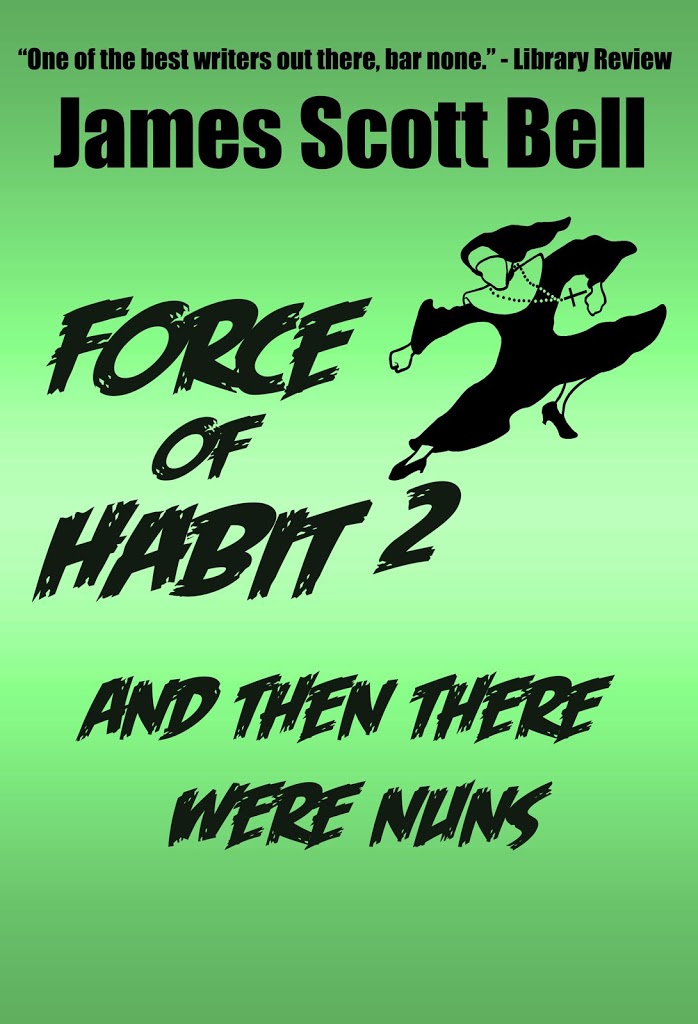
It was Audacious. Risk was involved. I did not know enough about nuns when I started. But I found a couple of experts (i.e., nuns who were willing to talk to me) for research. I wanted to be respectful and not devolve into a cartoon. And writing from the POV of a thirty-year-old former child star who went into the devoted life was a cool challenge.
The Moments I wanted to write were, first, the fight scenes. Also, there’s a wonderful moment in FORCE 2 that came out of the blue for me, so I just wrote it to see what would happen. Then beta readers told me they loved it. Thus, the wonderful alchemy of “the boys in the basement” worked again. (Hint: a celebrity is involved).
And Passion. I’ve always been interested in things philosophical and theological—the big questions of life. And in these stories I stumbled upon an issue: the use of violence to stop evil. Talk about something that is on a lot of minds these days! In the Catholic tradition there is a long-standing debate over the “just war.” Well, I brought that down to the personal: what if a nun could stop someone from doing evil by laying them out cold? And found out she was good at it? Indeed, what if part of her enjoyed it, while the other part wondered if she was entirely normal?
And: are you taking enough risks?
FORCE OF HABIT Kindle
Who Is Reading What
Who Is Reading What
It seems as if I’ve spent the last two weeks doing nothing but driving. That of course isn’t entirely true but for various reasons I’ve had to make two or three round trips into downtown each day for the last fortnight, and while it has been interesting in some ways it has been mind-numbingly boring in others. I don’t have any witty advice (even of the half variety) wry observations, or heartfelt descriptions, sappy or otherwise, of what has occurred recently, at least that I care to recount right now. Maybe next time.
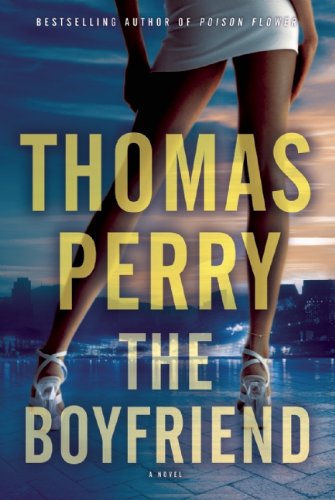
So…I thought I would just cut to the chase and ask a question: what book are you currently reading? I’ll go first. I am reading two books, actually. One is THE BOYFRIEND by Thomas Perry. It may be his best work so far. It concerns a private investigator in pursuit of a man who is killing high-priced escorts of a certain type, though never more than one in any specific city. The other is an extremely sure-footed debut novel by Becky Masterman and which is titled RAGE AGAINST THE DYING. It is narrated by its protagonist, a fifty-nine year old ex- FBI agent named Brigid Quinn. The book will go on sale on March 12; read the first sentence in the book and you will want to read the rest. That first sentence does everything it is supposed to do and more: it draws you in, makes you curious, scares the hell out of you and leads to even better things.
That’s me. My wife is reading ONE DAY AT A TIME by Danielle Steel and listening to another Steel book. MISERY by Stephen King is being read in fits and starts by my younger daughter (how in heaven’s name do you read MISERY in fits and starts? I read it once a year on a day which I set aside for that express purpose). My older son, for his part, is juggling a couple of John Sandford’s Lucas Davenport novels, as he works his way through the canon with the kind and occasional permission of my six year-old granddaughter, who in turn is reading an issue of Highlights for Children.
And you? And yours?
Reader Friday: Under Appreciated Books?
Writer’s Block Rx
Recently, since NPR seems to be running an interminable series on African leaf cutter ants, I’ve devoted much of my commute to listening to podcasts instead. And thanks to a tip from a friend, I’ve become hooked on one that’s absolutely genius, and perfect for writers and/or fans of the craft (or anyone, really): The Downey Files. Created by the Chris Downey, former writer and producer for the TV shows The King of Queens and Leverage, the description says it all:
“Welcome to ‘The Downey Files,’ a brand new weekly podcast that explores the half baked pitches and movie ideas Chris has scribbled down on beer coasters and cocktails napkins through the years. Each week, Chris sits down with a new guest to hash out these ideas in full and, you guessed it, hilarity ensues.”
My favorite episode is “The Weekend,” where Downey and Kirk J. Rudell hash out the plot of a father/daughter heist film in just under an hour. And you know what? By the end, they‘ve pitched a movie that I’d pay $10 to go see. Listening to them spitball ideas back and forth, it struck me that as novelists, a format like this could prove invaluable. After all, virtually every television show has a room full of talented writers collaborating on each episode; even for films, frequently outside writers are brought in to “punch up” a script.
Yet we novelists sit there all by our lonesome, trying to muddle out plotlines without little or no outside assistance. How many times have I prowled back and forth between my office and the refrigerator, trying to figure out how to rescue “X” from peril in a wholly original way? I’m frequently downright desperate for a fresh pair of eyes, and there are only so many times you can hit up family and friends.
Imagine that the next time you’re hopelessly stuck on a plot point, you were suddenly given the opportunity to throw half a dozen people at the problem, with everyone brainstorming a solution together. I’m convinced that if there was a team available to push me through the inevitable ruts in the road, I could probably shave a month off the time it takes to write each novel. And with all that newfound spare time, perhaps I could help other writers surmount their blocks. And so on.
This might be a pipe dream-I’m just spitballing here myself, after all. But I think there’s something to this idea. Maybe we could form a “Writer’s Block Helpline,” or start a listserv. I’m open to any and all suggestions- and if you get a chance, check out the Downey podcasts. You won’t regret it.
An Excess of Books
Nancy J. Cohen
What do you do when you have too many books in your house, and you can’t possibly read them all? Give away the print books and switch to Ebooks? That’s one solution. I prefer to be selective about the print books and combine my reading of paper copies with my Kindle reads.
Recently I had the occasion to sort through two cartons of books sitting on my dining room floor since who knows when. They contained an assortment of books obtained from conferences and booksignings. This examination became necessary when our recent ceiling remodeling had us moving loose items of furniture from the room, and we noticed flying insects along with coffee grounds material against one wall. And—uh,oh—they were in the boxes of books as well. My bookshelves are overflowing; I had no choice except to box up the surplus.
I reverently removed each book, dusted it off, shook out the pages, and stacked them on top of my washer in the laundry room. Noting the dust on the open bins in which I’d kept them, I resolved to obtain some sealed plastic containers from Target. But first, I really should decide which books to keep.
After making an appointment with the termite inspector, I proceeded to weed through the dozens of books. I made a pile out of the ones I knew I’d never read, the ones whose pages were yellowing, and the ones that only mildly appealed to me. The remainders I put into those plastic containers I’d just bought for that purpose. Hopefully these closed bins would not allow insects to penetrate even though it might not be ideal for preservation.
So what to do with the giveaways? These are not books I’d written, mind you. Those are in cartons as well and need a thorough inspection. But these discards deserve just as much respect. So here are the choices in giving away print books:
1. Donate them to the local library for their book sale.
2. Trade them in at a used bookstore and get some hard to find backlist titles in return.
3. Give them to a booklover who will enjoy them.
4. Bring them to an assisted living facility or other needy place that will accept them.
5. Donate them to the library in your housing community building which could be similar to the master planned community Epperson, if there is one. If not, you could possibly start a library there with permission.
6. Offer a couple of dozen each as a contest prize (but only the newer books). I got this idea from another writer who does a Rafflecopter contest for her gently used books.
7. One of my FB friends suggested setting up a Sidewalk Lending Library. Maybe she has nothing else to do, but I’d rather just donate the books to the community center and set one up there. Plus you might need a vendor license for this option.
Do you have any further suggestions? And no, a bonfire is not an acceptable option. Where do you store your excess TBR print books if not on your shelves?
Is social media developing a personality disorder?
It started when my Twitter account started texting my cell phone. Suddenly my inbox got flooded with messages. Hundreds of them, from people I didn’t know. All the messages were written in Portuguese. A bit of sleuthing revealed that my account had been hacked. After spending an hour deleting the reams of messages that had collected over two days, I changed my password. And voila! I immediately lost my fan base of piratas eletrônicos.
Then came a new wave of messages, purportedly from people I do know. These missives were mildly unpleasant. They said intriguing things like, “Oh my God, this person is saying horrible things about you online.” They included a link for me to click. Somehow I knew that if I clicked that link, I’d be the next person in line sending news of horrible rumors to all my contacts. Against huge temptation, I resisted clicking the links. (If you really want to read horrible things about me online, just check out my 1-star Amazon reviews).
It’s not just Twitter that’s gone wacky. Every day comes fresh news of some kind of Facebook privacy or hacking scare. Every so often I read desperate-sounding messages from friends, in which they disclaim some bizarre message that had been sent in their names. Yesterday someone sent out a dark warning that hackers were posting pornographic pictures on my timeline. The catch: I can’t see the pictures, but everyone else can. (That one turned out to be a hoax.)
And then there’s LinkedIn. I don’t use LinkedIn much, but one day I made a minor change to my profile. Somehow that simple update auto-triggered a “connection request” to be sent out to everyone in my contact book. Those contacts included a couple of ex-boyfriends who, trust me, I don’t want to be linked to again.
So what’s happening with these social media sites? My relationship with them has gone from fun to semi-fearful. It feels like I’ve been dating a guy who seemed charming and easygoing at first, only to discover that he’s a passive-aggressive control freak with a secret cyberporn habit.
I have a theory about the whole thing. I think social media sites change their character when they go public. Once the bean counters start trying to figure out ways to wring money from their user base, a la Facebook and LinkedIn, the whole experience goes cockeyed. You have to start triple-guarding your privacy from that moment on.
And let’s talk about hackers for a second. What kind of pathetic, loser soul spends his time thinking up ways to randomly annoy strangers? Is this some kind of new mental illness going around? Or simply the revelation of one?
Whenever I get exasperated by this kind of silliness, it’s always nice to come back here to TKZ. Our little plot of cybersphere is actually a community. We all are trying for the same thing–to improve our writing–without ulterior motive. (Well, except for occasional BSP–Blatant Self Promotion–when we have a new book out.)
So thank you, my fellow TKZ’ers, for being here. And tell me, have you noticed that the social media world is getting scarier? Have you had any experience being hacked or hoaxed?
Embracing the Risk Inherent
–>