Reflections, I’ve had a few

 I apologize for posting late today–life intervened last week in the form of some surgery that is basically a tweak to some brain rewiring I had done a few years ago. (Anyone interested in the details can click here.)

The surgical tweak I had done last week went fine, but it has imposed a few constraints on my life. For the next few weeks I’m not allowed to drive; turn my head; walk faster than a snail on a hot sidewalk; wear contacts or glasses, which means I’m basically as blind as a cave fish. (I did some research to find which critter is the blindest of the blind in the Animal Kingdom, and it appears to be the cave fish. Let me know if you discover some critter that’s even more myopic than my fishy friend. You never know when that kind of IFNWK (Interesting Fact Not Worth Knowing) might come in handy in your writing.

The upside to this whole experience is that the surgeons have flung open the doors of the locker of Happy Drugs. So my mood is quite cheerful, although my writing seems to have gone on a wee little vacay. I’m thinking I’ll give it 10 days before I call the Writing Police to wrangle that little mongrel called discipline back into my brain.

I just reread that last line, and I suspect the docs have given me just a few too many Happy pills today. So I’ll leave you with a question: Have you ever had a physical issue that brought life to a screeching halt, and did it affect your writing? How did you find the road back, and what helped you the most?

The Wow Factor

by Clare Langley-Hawthorne

Jim provided a great post yesterday on the reasons people abandon reading a book (mainly because, no surprise, it’s slow and boring!) and ways in which an author can make their own work ‘unputdownable’. Today I want to discuss what propels a book to the next level – what I call the ‘wow’ factor – those elements that take a book to a level where not only can you not put it down but you also can’t help but tell everyone about it. 

This is the essence of ‘word of mouth’ marketing, which can turn a book into an instant bestseller. Think about a book like Fifty Shades of Grey. Although I confess I haven’t actually read it, and no matter what you think about its subject matter or literary merit, there’s no disputing it created a buzz which encouraged millions of people to buy it. For me, the Harry Potter and The Hunger Games series have it. But how to define that ‘wow’ factor? Surely if if was that easy, we’d all be bestsellers…but it’s not and yet, it’s the elusive element that every publishing house and indie author longs to create.

For what it’s worth, I think the ‘wow’ factor probably involves a combination of the following:

  • A startling, controversial or shocking take on a conventional topic or genre.  This is what made Fifty Shades of Grey the talk of the town when it was first release. I remember being in a boot camp class and being amazed at how many women were reading it, simply because it was so illicit and controversial (which was really why I didn’t feel in the least compelled to read it!). I think the same can be said for classics such as Lolita and Lady Chatterly’s Lover. If you get people talking about a book because it raises the hackles, insults somebody’s ethics or challenges their notions of propriety it’s probably going to generate buzz (both negative as well as positive). But that is hardly enough (I’m sure there have been thousands of books about controversial topics that have bombed…)
  • An uber-intense relationship between characters that appeals to the inner romantic in us all. Think The Bridges of Madison County or the Twilight series. Despite the writing style (or lack thereof) these books pulled at the heart strings. They managed to capture the yearning for true love and, as anyone whose ever watched The Princess Bride knows, true love conquers all. It’s hard to quantify exactly why these books manage to generate such an overwhelming ‘buzz’ but I think the ‘I will love you forever’  over-the-top romance was addictive.
  • A story that touches our humanity. We’ve all read great satisfying books and recommended them to others but rarely do we rave about a book to strangers, family members and friends unless it something indefinable that captures our heart as well as our attention.  I think if a novel makes people feel good about themselves, or raises our consciousness and humanity we feel compelled to tell others about it. This is certainly what happened to me after I read Schindler’s List and The Alchemist.
  • And finally, a story that totally transcends the ordinary… Which goes to demonstrate how important it is to raise the stakes, take risks and strive to transcend the genre in any book you write.  Think of a book like Life of Pi and you’ll know what I mean.


So what do you think helps create the ‘wow’ factor? What was the last book you couldn’t help talking about with everyone you know? 

How to Write a Novel Readers Won’t Put Down

by James Scott Bell
@jamesscottbell

A friend alerted me this past week to an interesting “infographic” posted on Goodreads. The subject: Why readers abandon a book they’ve started. Among the reasons:

– Weak writing

– Ridiculous plot

– Unlikable main character

But the #1 reason by far was: Slow, boring.

Makes sense, doesn’t it? As I’ve stated here before, there is at least one “rule” for writing a novel, and that is Don’t bore the reader!

So if I may channel my favorite commercial character, The Most Interesting Man in the World:

Find out the things readers don’t like, then . . . don’t do those things.

I thank you.

Okay, let’s have a closer look.

Weak Writing

This probably refers to pedestrian or vanilla-sounding prose. Unremarkable. Without what John D. MacDonald called “unobtrusive poetry.” You have to have a little style, or what agents and editors refer to as “voice.” I’ll have more to say about voice next week. But for now, concentrate on reading outside your genre. Or read poetry, like Ray Bradbury counseled. Simply get good wordsmithing into your head. This will expand your style almost automatically.

Ridiculous Plot

Thriller writers are especially prone to this. I remember picking up a thriller that starts off with some soldiers breaking into a guy’s house. He’s startled! What’s going on? Jackboots! In my house! Why? Because, it turns out, the captain wants him for some sort of secret meeting. But I thought, why send a crack team of trained soldiers to bust into one man’s suburban home and scare the living daylights out of him? Especially when they know he’s no threat to anyone. No weapons. No reason to think he’d resist. And why wake up the entire neighborhood (a plot point conveniently ignored)? Why not simply have a couple of uniforms politely knock on the door and ask the guy to come with them? The only reason I could think of was that the author wanted to start off with a big, cinematic, heart-pounding opening. But the thrills made no sense. I put the book down.

Every plot needs to have some thread of plausibility. The more outrageous it is, the harder you have to work to justify it. So work.

Unlikable Main Character

The trick to writing about a character who is, by and large, unlikable (i.e., does things we generally don’t approve of) is to give the reader something to hang their hat on. Scarlett O’Hara, for example, has grit and determination. Give readers at least one reason to hope the character might be redeemed.

Slow, Boring

The biggie. There is way too much to talk about here. I’ve just concluded a 3-day intensive workshop based, like just about everything I do, on what I call Hitchcock’s Axiom. When asked what makes a compelling story he said that it is “life, with the dull parts taken out.”

If I was forced to put general principles in the form of a telegram, I’d say:

Create a compelling character and put him in a “death match” with an opponent (the death being physical, professional, or psychological) and only write scenes that in some way reflect or impact that battle.

The principle is simple and straightforward. Learning how to do it takes time, practice and study, which you can start right now, today.

So what about you? What makes you put a book down? And related to that, do you feel compelled, most of the time, to finish a book you start? I used to, but now I don’t. Life’s too short, and there are too many books on my TBR list!

ThrillerFest!

By Mark Alpert

This will be a short post because I’m at ThrillerFest this weekend. I’ve gone to the conference every year since 2008, and I always have a great time there. Because I live in New York City, I have no excuse for not going. The conference center at the Grand Hyatt is only a ten-minute subway ride from my apartment.

My favorite part of ThrillerFest is sharing stories with other writers. Making novels is an inherently solitary activity; although I get feedback from my agent and editor and the handful of people in my writing group, it’s nothing like the team effort of putting out a newspaper or magazine. When I edited feature stories every month for Scientific American I was constantly interacting with art directors, copyeditors, fact-checkers and freelancers. It wasn’t always peaceful — I have a bad habit of getting too emotional over stupid things — but every afternoon at three we stopped butting heads and went to a café on 49thstreet for our coffee break. I miss the place, I really do. Life is full of trade-offs: I love having the time to work on my thrillers, but I miss the camaraderie of journalism.

At ThrillerFest, though, you’re completely surrounded by other novelists. You can’t walk five feet in any direction without spilling your drink on some award-winning writer. And you can learn some valuable lessons while comparing notes. For instance, everyonegets at least a few bad Amazon reviews. (You can’t please all the readers all the time.) Everyone bemoans the current state of the publishing industry. Yet, despite all the tribulations of the business, everyone seems to be having a good time. Go figure.

Now I have to get some sleep so I can do it all again tomorrow. As Jackie Gleason used to say, how sweet it is!

Reader Friday: The Price is Right, Or Is It?

The pricing of ebooks is fodder for much discussion these days. I recently read one self-publishing advocate who says a strategy to pursue is writing scads of short stories and pricing them at $2.99 each. Unless your name is Stephen King, I’m not sure I would agree. Since full-length novels can be had for 99 cents and $2.99, wouldn’t most people think that a short story at $2.99 is too pricey? Worse, if the title is not clearly labeled “short story” and they get it and finish it in ten minutes, wouldn’t there be some blowback? 

Maybe I’m wrong. So I’m throwing it open for a little market research. How do you readers feel about $2.99 for a short story? 

Key Book Production Costs for Self-Published Authors

Jordan Dane
@JordanDane


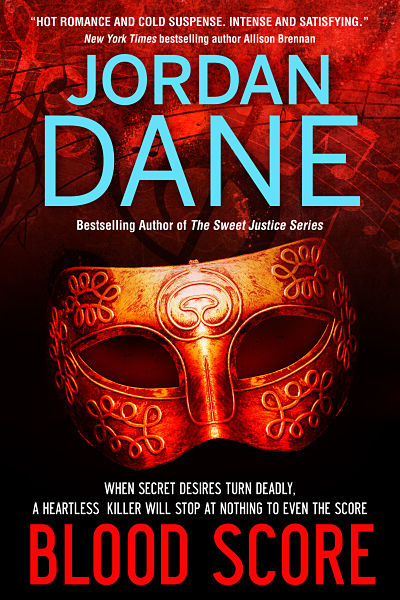
After James Scott Bell’s excellent post “We Are All Long Tail Marketers Now”, several side discussions took place in the comments regarding my self-published novel – BLOOD SCORE now available through the Amazon Kindle Select Program (my first time using this program). I’ll have the book discounted until August 1. (I love how the TKZ community gets involved with each post. Thank you.) Questions came up about my editing and production experiences with this novel since it is outside my traditionally published works.

As I mentioned in my comments on Jim’s post, the business end has always been a drain for me. Self-pubbing involves more than promo. It’s production of the actual book and the promo is ongoing (as it is for me with traditional publishers too), but with indie I’m in control of my production schedule, retail pricing and subrights decisions, and can capitalize on promo ops when I want to. Being a hybrid author, straddling traditional and indie publishing, gives me more options and many “irons in the fire.” I have many more points mentioned in another post I did on the subject. On my group YA blog ADR3NALIN3, I did a post on the “Ten Reasons Why I Am Self-Publishing.” 

I wanted to dip my toe into the waters of indie with a non-fiction book as well as a short story anthology so I would know what was involved in production and to build up my contacts for service providers. My upcoming full-length novel project will be more about learning promotion. I’ve got loads of personal bookmarks for service providers, but the marketing side of the business needed work on my part. I’ve created a Self-Pub Resource tab on my YA blog-Fringe Dweller. I hope to update it as I go along. For now it encompasses review sites for digital books. That resource tab will be a work in progress as I go.

Basically, here are the indie production costs as I see them:

1.) Edits: $500-$1800+ – This is a tough one to estimate, but important. I’ve seen this cost higher, depending on if you need a book doctor or not. It depends on how much work needs to be done and who you use as editor. A good editor is worth their weight in sales, so shop wisely. Beta readers will only get you so far. Having said that, I’ve had some good and terrible copy editors on my traditionally published books. Being traditionally pubbed does NOT guarantee you will get a good one. At least with indie books, you can make the decision on who to use on current and future projects. 

For this project I used authors/editors Alicia Dean and Kathy Wheeler. They helped with formatting and editing and made that effort painless and fun.
 

2.) Cover $150-400 – This range depends if you are doing a version for print or just digital. The print design costs more because it involves the design of a spine and back cover. You can do a cheaper cover by merely paying for one digital image from iStock or some other provider and add font and do it yourself graphically (not recommended), but a cover needs to look good on a thumbnail and a bad design can kill sales. On BLOOD SCORE, I used Croco Designs and love Frauke Spanuth, the designer. I’ve used her for blog header designs and bookmarks and now covers. She’s a German designer who works for publishers too. Her costs are reasonable on all fronts and she’s easy to work with and fast, but there are many cover designers out there now. Look through portfolios to find one you like.

3.) Formatting $100-150 – You can do this yourself, but I’ve never tried it. There are software programs, but haven’t tried that either

4.) Promotion $50-Whatever – This is totally up to you. There are many free sites that promo ebooks now (that are focused on ereaders), but there are also bundlers who will charge you $50 or so to post promo to 45 sites, etc. I’m hoping to try this with BLOOD SCORE.

5.) ISBN #s – this is an investment for future books. I bought 10 numbers, which keeps the cost down. I think the individual book price is higher to retain your own ISBN#, or you can use the one that Amazon or others assign you for free, but I prefer to have control of my own ISBNs. So this ISBN cost can cost you nothing, unless you decide you want control like I did. So spread $250 across ten books if you retain your own ISBNs.

So all in, you might pay $800 – $2400 (excluding ISBN costs), but you can manage your price to earn 35% – 70% royalty with a better monthly cash flow where you can control the price and promo ops. Using a price of $0.99 you’d earn 35%, but $2.99 or better and your royalty would be 70%. For a novel length book, I might discount it to $.99 for a certain period on release, but then move it up to $4.99. Hard to say what breakeven would be without real sales figures behind it, but you can play with the math. 

$4.99 at 70% royalty, you’d have to sell 229 – 687 books to clear the cost range I mentioned. Mind you, this does NOT take into account any promo ad costs and assumes only one price at the higher royalty rate. If you were to move that price point to $2.99 at 70% royalty, your sales would have to be 382 – 1148 to breakeven.


A writer friend of mine shot me some real numbers. (I’m also on an indie writers loop where I hear lots of good info.) It takes having a number of good books to build up your “virtual shelf” of offerings and build your readership. Again, I repeat. Good books. But my crime fiction author acquaintance is seeing $7,000 – $10,000 per month for 8 novels or so, and this will grow as new material gets added. This author crafts a solid book and writes full time. 

For me, I like having traditional contracts to fill, but I want the more immediate cash flow too, rather than waiting for royalty statements every 9 months (by the time they reach you). (Antiquated accounting methods and reporting systems for traditional publishers, in a digital age when sales are more immediate through Amazon and other online retailers, are more things that I hope will change.)


The last thing I’d like to talk about is the value of “a la carte” subrights (ie foreign rights, audio, print vs digital). In many deals, these rights are lumped in and assumed to be part of the deal, but should this continue as advances drop? Or if advances drop, shouldn’t the royalty percentage increase to offset the lower upfront money? Subrights have value to the indie author. (Here’s a LINK to a post I did on self-publishing in audio, for example.) If an author gets an offer, but the advance is marginal or too low to tie up copyrights for years (something I am presently experiencing on my back list), do you have options? 


You can certainly turn the deal down. That’s one option. I did this with BLOOD SCORE when I got an offer to buy it from a big house. After my experiences, the offer wasn’t good enough to deal with the aftermath of a rights tie up into infinity. 

Even if an advance is $10,000-15,000/book, that might not be enough if the terms of the contract are onerous over the long haul. Successful thriller Barry Eisler turned down a deal from a traditional house for $500,000+. That boggled my brain, but no one knows the terms of that deal that made Barry change his mind. He’s a real marketing guru and has a solid readership. Deals are subjective.


These days this is a personal decision each author has to make, but if publishers would negotiate on terms, a marginal advance deal might work if the number of years for digital rights can be limited before they would automatically revert back to the author (ie 2-3 yrs only) or if UK rights were granted but digital rights in the US are retained. Some successful indie authors have retained digital rights, but sold print rights (ie John Locke to Simon and Schuster). With “out of the box” thinking and a little negotiating, some of these marginal deals can be done if the parties agree on specific terms, but I’m not sure traditional houses are open to such change yet.

Food for thought and discussion at TKZ:

1.) If an advance is too low to tie up copy rights, what terms do you think can be negotiated to make the deal happen? Do you think the publishing industry is changing in this regard?

2.) If you’re an aspiring author, would you sign a contract at ANY advance to be published, or do certain contractual terms matter to you?

The Perfect Pitch

By Joe Moore

On Monday, Boyd Morrison wrote about ThrillerFest, taking place this week in NYC. HThrillerFest-VIII-logoe spoke of AgentFest, a part of the conference that gives attendees the opportunity to pitch their manuscript to some of the top literary agents and editors in the industry.

Building on Boyd’s post, I want to share some tips for improving your chances of connecting with an agent or editor, especially in person at a writer’s conference or similar event.

We all know how important it is to prepare when pitching a manuscript, whether it’s at AgentFest (this year with 50+ agents) or any other occasion: look professional, act professional, be able to summarize your premise in a couple of sentences, and know that not every book is right for every agent (most of the time, that’s why they say no).

But what about those things you don’t want to do; those things that could wreck you presentation or turn off the agent? Here are a few pitfalls to avoid:

Never refuse advice or feedback. Even if the agent or editor is not interested in your book, many times they will offer suggestions or advice on making it more marketable. Never have a closed mind and think that it’s your way or the highway. Professional agents know the market and are aware of what the publishing houses are looking for at any given moment. Also remember that just because an agent is not interested in your book doesn’t mean the book is not publishable. It’s just not for them.

Don’t begin your pitch by saying that “everyone loves my book”. Of course they do, because everyone is probably your family and friends, and the last thing everyone wants to do is hurt your feelings. If they were completely honest with you, it would be like hitting your ego with a sledgehammer. Now on the other hand, if Dan Brown, Ken Follett or Stephenie Meyer read your manuscript and loved it, I would mention that somewhere right after "hello".

Don’t be a pest. By that I mean sending the agent multiple emails, phone calls, letters, presents, or anything else that would quickly become annoying. If the agent says no, the likelihood of you turning them around with a box of Godiva chocolates is not good. Send it to me instead.

Don’t suggest that if the agent wants to know all about you they can visit your website or blog. It doesn’t matter if Michelangelo designed your graphics, James Patterson wrote your text, and Bruno Mars composed the music for your book trailer. The agent doesn’t care. All she wants to know is: who are you, what is your idea, and can you present it in a logical, concise and professional manner.

Even if your manuscript has been rejected before, don’t volunteer that information. As far as the agent is concerned, they’re getting the first look at your idea. They’re also realistic and know it’s probably been pitched before. And the fact that you’re standing there means that if it was, it was rejected. Always remember that rejection is as much a part of the publication process as line editing or cover design. It happens to everyone. Move on.

Don’t claim that no one has ever written anything like your book before. If that’s really true, there’s probably a good reason no one has. But trust me, claiming that what you’ve written is a brand new idea is as compelling as claiming you have the winning numbers for tomorrow’s lotto. What you might want to do is suggest that you’ve completed a unique and original treatment of a well-established theme or premise. That will make sense to the agent.

Never say that your book is going to be the next blockbuster or that it should be made into a movie. The top professionals in the publishing and motion picture industries cannot predict with certainty what will be the next blockbuster or bestseller. Neither can you.

In general, always assume that an agent or editor has already heard every variation on a theme there is, because they have. Much of your success in capturing the attention of an agent is you, not your story. Be enthusiastic but not obnoxious, knowledgeable but not condescending, proud but not conceded, prepared but not pushy. And most of all, be friendly and professional. Your presentation is a foreshadowing of what it would be like to work with you. Agents don’t want to spend a year or more in a wrestling match with a jerk.

Remember that literary agents and editors are people, too. Yes, they can have a tremendous impact on your writing career, both positive and negative. But just like the rest of us, they get excited when they hear a great idea. Treat them as people, not gods.

If you practice all these tips and you have a killer idea for a book, there’s a good chance the agent will hand you her business card and ask for a partial. And if by chance, she asks for a full, go celebrate. You’ve accomplished more than most ever will.

Any other pitching tips out there?

Is touring worth the tsouris?

By P.J. Parrish
Yesterday we wrapped up the Michigan Fingers Tour. Those of you from Michigan might get what this means. The rest of you just need to know that we Michiganders locate our place on earth by holding up our hand and pointing to the spot on our palm from which we hail.
The “fingers” of the Michigan mitt is the northwest area of the state up near Traverse City. It’s home for my sister and co-author Kelly – the lovely village of Elk Rapids. I, who have been rooted in the south Florida sand for 35 years now, have been “up north” for the last two weeks as Kelly and I wended our way through the great little towns of the fingers, promoting our latest book HEART OF ICE.
Our book is set in northern Michigan, so heading up north here was a no brainer. But the experience also left us going back to an old question: Is touring – and its lesser kin, signings– still worth the time and effort?
We authors debate this question endlessly. In these days of diminished expectations and budgets, only the big guns get the promotional blastoffs. And with all the social networking options (you can even do virtual signings now), does a writer still have anything to gain from taking his act on the road?
Touring used to be one of the essential tools of promoting your book. The “national tour” was a benchmark of arrival in the traditional publishing world. Even if you didn’t have enough clout with your publisher to have them pay your way, we authors often planned and paid for our own tours.
Kelly and I have done it both ways during our career. For our fourth book, A KILLING RAIN, our publisher sent us on a big-time tour that had us crisscrossing the country for two weeks. It was the full treatment, complete with escorts greeting us at airports holding up our covers, nice hotels with room service, and even business class on the last leg coming home. It was fun, exciting, rewarding. It was also disappointing and frustrating. Some stores had healthy crowds waiting for us; a few had none. By the time we hit our final Barnes and Noble (I think it was in Nashville?) we were numb with exhaustion but grateful for the crowd who turned out in what should have been a killing rain.
Now, I can hear you saying, “What’s she bitching about? At least she GOT a paid-for tour!”  Well, yes we did. But every other tour we have done, like the huge majority of authors, came out of our own pockets. Those tours have been exciting, rewarding, disappointing and frustrating. The point being: There doesn’t seem to be much difference whether our pub paid for it or we did. The effort and time invested – and results achieved – seemed to be the same.

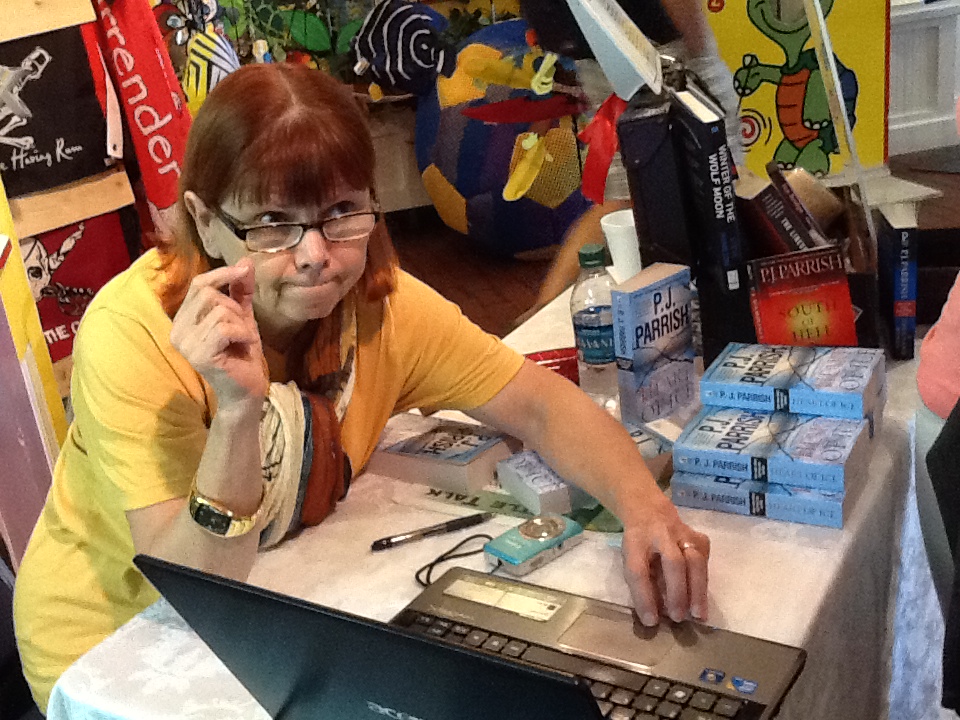
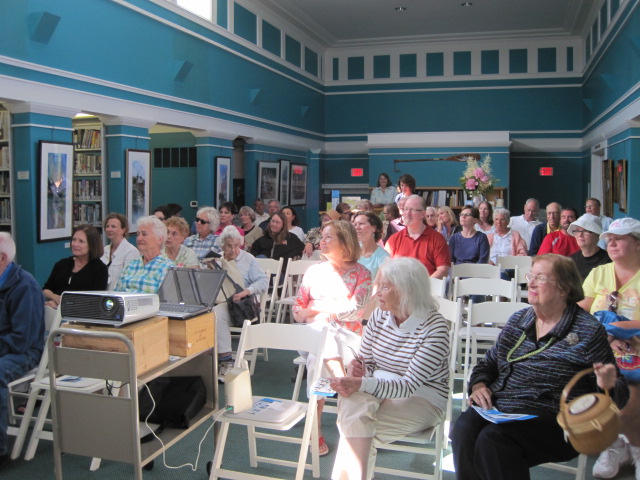
There’s a difference, of course, between whether you are doing an “event” where you are speaking, and a signing, where you are just meeting and greeting for two hours. Sitting behind the old card table isn’t nearly as demanding, of course, as giving a full-scale talk. (That’s me above signing at the Island Bookstore on Mackinac). On our current tour, we had a big adoring crowd at Saturn Books in Gaylord, a town in the middle of the state that no one would expect to worth the time. But the owner, Jill Miner, is a genius at cultivating readers; she could give indie owners lessons. Here’s the great folks at her store:
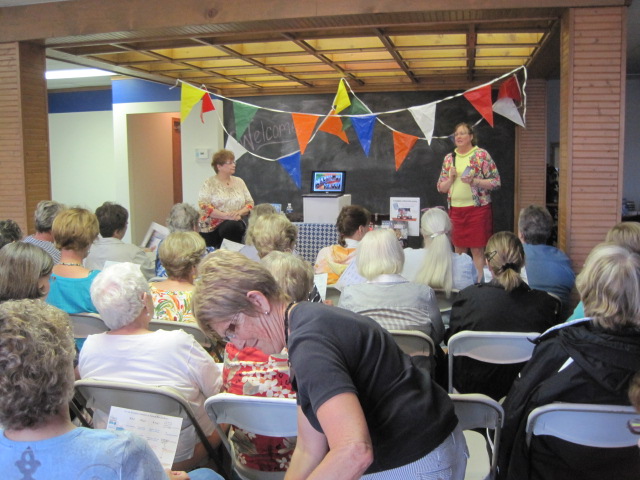
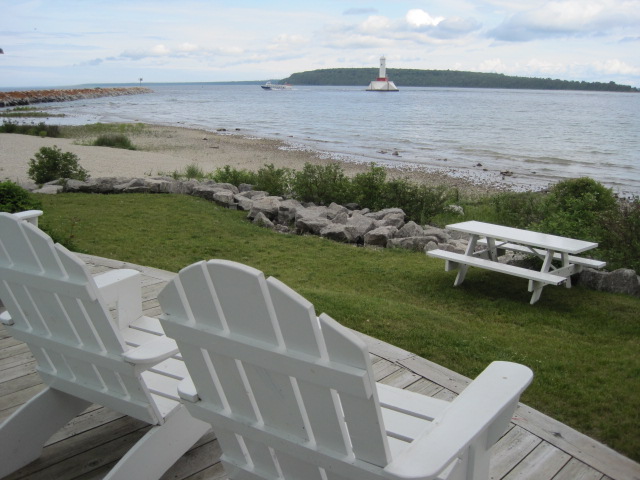
On Mackinac Island, we did a ticketed author event and had an enthusiastic crowd. Here they are. Plus the view you get if you go out the library’s back door.
Sometimes, you just can’t predict what you’re going to get. Two days after Mackinac Island, we were dreading a signing at a Books a Million because our past experience with this chain had been sort of meh. But we sold out all our stock.  At one other store that we thought would draw well, only two people showed up. (We discovered later the store had done nothing to promote us.)
The nadir was a store that, when we arrived, told us they had none of our books because they had sold out for days ago. Hello? A phone call or email would have been nice before we drove two hours. We had an emergency box of books in the trunk but the owner told us she couldn’t figure out how to charge them against her inventory. We went down the street, had a glass of wine and drove the two hours back home in the dark woods, me watching for deer the whole wretched way. (I’m paranoid about hitting a deer and wrecking the car.)
Before this, we hadn’t toured in a long time. But we did this one because our book is set in Michigan (on bucolic Mackinac Island) so we knew we’d get the regional bump. But we also did it because northwest Michigan is rife with really top-notch independent bookstores. These stores have owners who cultivate their readers and treat visiting authors like royalty. They don’t just set up a table in the back of the store and leave you to fend for yourself. They send out newsletters, pre-stock and hand-sell your backlist, do email blasts and get you local media interviews.
If you are ever in Michigan on tour, here are some of the stores you should never miss (plus most of them are in pretty towns):
Saturn Books, Gaylord. 
McLean and Aiken, Petoskey
Island Bookstore, Mackinac Island
Schuler’s Okemos/Lansing
Bookman, Grand Haven
Book Nook and Java Shop Montague
Cottage Bookstore  Glen Arbor
And downstate: Aunt Agatha’s in Ann Arbor.
So was the Michigan Finger Tour worth it?
In the plus column: we met a lot of great bookstore owners whose hand-selling helped us immensely. And we met some terrific readers, and gained many new ones. Is there any better feeling than meeting face-to-face a person who tells you they love your books? Touring gives you an infusion of confidence and affirmation that you can never duplicate on Facebook.
In the minus column: It’s tiring, often deeply discouraging, expensive, and unless you are one of those writers who can crank out chapters on a plane, you lose valuable writing time.
One final thought: They say indie stores are making a small comeback. If the ones we saw are any indication, there is, indeed, hope. And maybe hope is what is really the most important thing we get from going out on the road these days.
Just watch out for the deer.
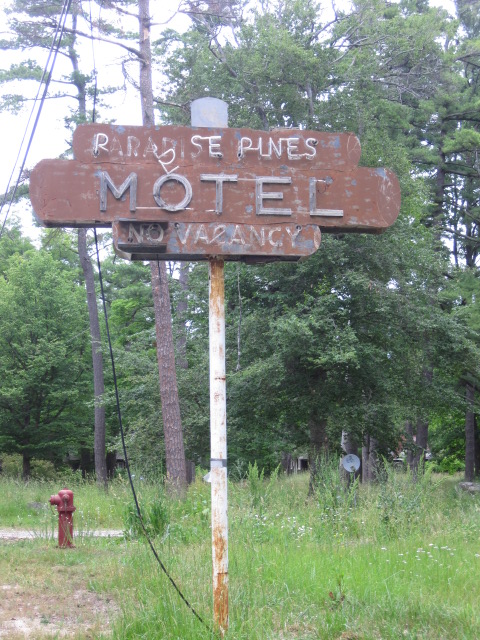
p.s. The picture leading off this blog is in the old Paradise Pines hotel in Kelly’s hometown of Elk Rapids. We did not stay here while on tour.

The Stars Are Out at ThrillerFest

by Boyd Morrison

I would love going to an actors’ convention where I could have dinner with Sandra Bullock, take an acting class from Michael Caine, audition for a role in the next Spielberg movie, and share laughs at the bar with the cast of Castle. Won’t ever happen. It sounds too good to be true because it is. But that kind of dream conference does exist for thriller writers and fans. It’s called ThrillerFest, which will be held in New York City on July 10-13, 2013.

The attendees this week include writers who live on the New York Times bestseller list. The five spotlight guests alone–R.L. Stine, Anne Rice, Michael Connelly, Michael Palmer, and T. Jefferson Parker–have sold somewhere in the neighborhood of 500 million books. And everywhere you look at the conference, you’re blinded by the star wattage: Lisa Gardner, Steve Berry, Lee Child, Catherine Coulter, Douglas Preston, Heather Graham, Brad Meltzer, Joseph Finder. It’s as if you could get into the Oscars merely by paying a registration fee.

But the really amazing thing about ThrillerFest is that you get to meet and talk to these people, not just ogle them from afar. When I was a newbie unpublished author at the inaugural ThrillerFest in Phoenix seven years ago, I didn’t know a soul. At the opening cocktail reception, I spent most of the time ambling about, listening in on snippets of conversation as I tried not to spill red wine down my shirt. Then I spotted Jon Land, an author I’d been reading for years. I gathered up my courage and nervously introduced myself, telling him that I was a huge fan. To my shock he asked me to join his group for dinner, where we had a fantastic time. In what other entertainment medium could that happen?

While I’ve mentioned some of the big names you can hobnob with, there are also plenty of up and coming writers who attend, some of whom will be household names in a few years. Imagine getting to know Dan Brown or Stephenie Meyer just before they hit it big. And because I’ve gone to the convention every year, I’m lucky to count many of these future publishing phenoms as friends.

ThrillerFest is also a great deal for unpublished authors looking to break into the business. Through an event called AgentFest, aspiring writers can pitch their novels to a who’s who of the biggest agents in publishing. I was fortunate enough to find my own agent there. Before I met her my manuscripts barely got a nibble. Now I’m the director of AgentFest, my sixth thriller, THE LOCH NESS LEGACY, has just come out, and my novels are published in 22 languages. If I hadn’t attended ThrillerFest, who knows what I’d be doing?

For those looking to hone their writing skills, CraftFest offers a wealth of knowledge that is available nowhere else. You can actually take writing classes from legendary authors like Connelly, famed for books such as THE POET and THE LINCOLN LAWYER, and David Morrell, the creator of Rambo. The biggest problem is the information overload you might experience trying to cram every nugget of wisdom into your brain.

The best part of the conference is hanging out with these authors at the bar, the central gathering place. At first you’ll regard them with awe that they have descended from the heavens to walk amongst us. Then when you’re introduced to them, you’ll realize that they’re just people, too–although extremely talented, friendly, fascinating people. They’re happy to greet fans and share their insights about the business. Buying them a drink doesn’t hurt, either, though this being New York you’d better hang onto your wallet for a bumpy ride.

If you do get some of these writers liquored up, don’t be surprised if you laugh yourself silly as they spin wild tales of publishing wackiness, crazed fans, and book tours gone wrong. After all, these people know how to tell a story.