My book group just read A Paris Wife by Paula McLain, the fictionalized account of Ernest Hemingway’s first wife Hadley Richardson, and we all agreed to having mixed feelings about Hadley and her role as Hemingway’s ‘rock’ during his early career in Paris.
The book evokes the bohemian world of 1920s Paris and name drops a lot of literary giants but at its heart is the relationship between Hadley and Hemingway. The book made me question the extent to which Hemingway relied upon and needed Hadley’s stolid support during those early days.
I wondered how many writers feel they need someone close to them to be that kind of ‘rock’ – to provide emotional as well as (often) financial support (although Hadley certainly didn’t appear to contribute financially). Then there’s the more mundane support in terms of housekeeping and family duties (Hemingway could, after all, leave Hadley and his child at home while he went to a cafe to write without being bothered by any of those pesky fatherly duties!). In this day and age, I’m not sure anyone quite gets that kind of all round, ‘solid as a rock’ support – we are all juggling so many work/life issues that we usually have to find that support from within, rather than from someone else.
Hemingway also found mentors for his work in Paris (most notably Gertrude Stein) so it’s not entirely clear the extent to which he fed off Hadley’s unwavering (if unimaginative) support for his writing (although he certainly seemed to feed off adulation and praise of any kind!). Hemingway also never lacked self-confidence or the belief that he was destined to be a ‘great’ writer – but how many of us can say the same?
So how many of us writers feel we need a ‘rock’ in our life to reinforce our confidence and help propel our careers forward (especially early in our careers when we are still finding our literary feet)? Do we require a ‘rock’ of unwavering support? Or a mentor who respects and promotes our work? Or do writers really only need a ‘room of one’s own’ in which to flourish?
In my own career I’ve certainly had very supportive friends and family, but I don’t think I’d classify any of them as a ‘rock’ in the vein of Hadley Richardson. Most of the time I feel I have to rely on myself more than others to keep the writing going. Likewise, I’ve some terrific writer friends who I turn to for much-needed support but none of them have ever really acted as a mentor for my own work. I’m not sure in this modern age whether the same kind of ‘mentoring’ really exists like it did in say 1920’s Paris. But then again, maybe I just don’t hang out in literary enough writing circles!!
So TKZers what do you think? Do you have, or indeed need, a ‘rock’ in your writing life? Have you been lucky enough to have a mentor for your career? And if you were to give advice to someone contemplating the writing life, what would you tell them regarding having either of these?
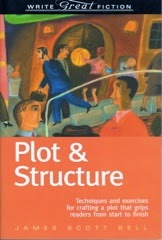
Ten Lessons from Plot & Structure
James Scott Bell
@jamesscottbell
my becoming the fiction columnist, and then to the appearance of Plot & Structure in October of 2004.
Keeping It Simple and Doing It Right
Reader Friday: Your Daily Writing Quota?
TSTL
Elaine Viets
TSTL – Too Stupid To Live.
Characters who deliberately put themselves in danger.
In movies, TSTL is usually a big-boobed, small-brained blonde who hears a funny noise in the basement. A serial killer is on the loose, but she runs downstairs without a weapon, without fear, and without many clothes – and is hacked to bits.
Cozy mysteries are brutally bashed for TSTL females, but both genders are equally guilty.
TSTL is alive and thriving in dicklit: The cop who goes after the desperate killer without calling the dispatcher – or his partner. The private eye who goes alone into the building to get the murderer because a man’s gotta do what a man’s gotta do. Besides, he has his trusty Glock.
These writers aren’t taken to task for TSTL quite as often. But it’s safe to say that TSTL thrives in all forms of the mystery genre.
Readers want to kill authors who rely on TSTL stunts.
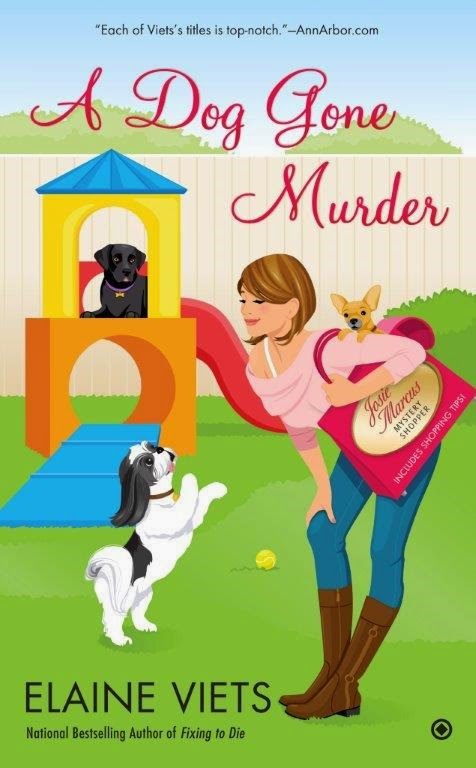
In A Dog Gone Murder, my new Josie Marcus, Mystery Shopper mystery, I worked hard to avoid TSTL syndrome. Josie mystery-shops dog daycare centers. She investigates Uncle Bob’s Doggy Day Camp, known for its commercials featuring Uncle Bob. She discovers that Bob was more of a dog than anyone knew — he’d been kicked out of the house for having an affair, and he runs with a dubious crowd. When he winds up dead, there’s a long list of suspects. The police arrest Frank, her mother’s tenant. Josie believes he’s innocent, and she has to find the proof that someone else killed Bob.
She can’t take her friend Alyce with her, either. This time her best friend has morning sickness.
Josie says she’ll let Frank’s lawyer go after the killer. She just wants information from some people who knew the murdered man – his employee, Heidi. A customer named Sharon, and Bob’s estranged wife, Candice. Here’s a scene from A Dog Gone Murder:
“I got information about all three on the Internet,” Josie said. “I even have Google Earth photos of their streets. Candice lives on a rich street in Summerdale. Heidi’s street is nicely in the middle and Sharon’s is on the skids.
“But they all have one thing in common.”
“What?” Alyce said.
“Every neighborhood has its own Mrs. Mueller. The neighborhood busybody who watches everyone and every thing.”
“And how will you find her?” Alyce asked.
“Easy. She’ll be watching her neighbors. I’ll look for the twitching curtain or the miniblind slat raised by one careful finger – the telltale signs of a snoop at work. Then I’ll get her started by saying the women are applying for a new job and I need background information. They’ll see it as their duty to tell me everything they know. Then I’ll knock on my suspects’ doors for a quick chat.”
“But the local gossip will see you do that,” Alyce said.
“Both Sharon and Heidi live in apartment buildings. I can say I’m interviewing more neighbors in their buildings. As for Candice, we’re clients of Uncle Bob’s. I’ll pay my respects for her recent loss.”
“Still TSTL, Josie.”
“What’s that?”
“Too Stupid To Live,” Alyce said. “I hate those movies where the woman says, ‘Gee, I think I hear a serial killer in the barn. I’m going out to take a look.’ Then she goes outside and he hacks her to death with a hatchet. You are not confronting a killer by yourself. You need back-up, but I can’t leave home at this stage.”
“Oh, lord, I was so wrapped up in this investigation,” Josie said, “I forgot to ask about you. How are you feeling?”
“Still living on ginger ale and soda crackers,” Alyce said. “I’m not doing much cooking. Even the smell of food makes me queasy. This stage won’t last, Josie. It will be over soon. But if you insist on this harebrained scheme, you’ll make me sick with worry. I can’t risk that in my condition.”
“Alyce Bohannon! Are you hitting me with the pregnancy card?”
“I’ll do whatever I have to if it slaps some sense into you,” Alyce said. “You’re a mother with a tween daughter. You have a husband. You’re not going off on this crazy mission.”
“But –”
“The only way I’ll allow it is if you take me with you,” Alyce said.
“How can I do that?” Josie said.
“Use your cell phone. Call me when you get to the first house and keep your cell phone on in your pocket. That way I can hear what’s happening. If there’s a problem – if you scream or I hear that you’re being threatened, I’ll call the police on my land line.”
“If I see the local busybody first, she’ll be watching me, too. That will make me doubly safe. It could work,” Josie said.
“It will have to work,” Alyce said. “Otherwise, I’ll call Ted and your mother and you’ll have to deal with both of them.”
Does it work? Read A Dog Gone Murder and find out.
A Dog Gone Murder, my 10th Josie Marcus Mystery Shopper mystery, will be published Nov. 4 as an e-book and a $7.99 paperback. Preorder your copy here http://tinyurl.com/q5dlhlj
Radio, TV and Podcasts
I haven’t ventured far into the world of podcasts, radio interviews or TV appearances. As an author, I’d rather spend my time writing the next book. Nonetheless, I’ve done a few radio spots via telephone, but I don’t seek them out. Somehow the thought of a microphone or camera aimed my way with hundreds of invisible listeners makes me nervous.
A telephone interview can be fun if done with a dynamic host who knows all the right questions to keep things flowing. The interviews I’ve done to date have gone well in this respect. But I’m wondering how these shows serve the reader and if they’re worth the time spent.
Do you listen to these shows? Have you ever bought a book based on an author interview you’ve heard/seen on the air?
Do any of you listen to podcasts? Do they influence you to follow an author’s social media sites? Buy his books? Or do you just tune in to learn what you can and then move on? Are podcasts essential to one’s media kit?
For those of you who’ve done these types of appearances, have they led to other valuable contacts? Have listeners responded? Besides the publicity, did you gain an upsurge in sales? Or did you merely enjoy the experience?
One of the speakers on “Radio for Writers” at a Florida Chapter MWA meeting recently stressed that the story isn’t about your book. It’s about you as a person and your journey as an author. Finding that unique angle or local slant is what would interest her as a reporter. See her tips for authors here: http://nancyjcohen.wordpress.com/2014/09/30/radio-for-writers/
So what’s your take on this whole live media business? Is it worth pursuing or is your time as a writer better spent working on the next book?
Speaking of radio interviews, I’ll be appearing at http://www.authorsontheair.com on Friday, October 10 at 6:00 pm EDT. I hope you will tune in!
Riding Out the Rough Spots
This has been the week from hell. I don’t know what else can go wrong. Here’s what has happened so far:
I hit the wrong button and deleted chapter sixteen and had to recreate it from memory.
I got to chapter eighteen and realized a scene I had written back in chapter five, which I was certain was absolutely brilliant, now makes no sense and I have to cut it.
My plot timeline is out of whack and I have lost three days somewhere, sort of like Ray Milland in Lost Weekend but without the gin anesthesia.
I did a virus scan and it came up with 778 “issues” but apparently none of them are fixable unless I cough up $69.99 for the Super Anti-Spyware Deluxe Version.
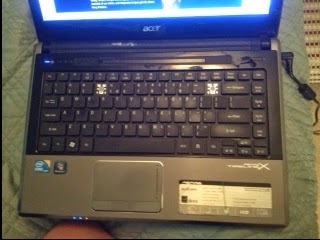
I tried to vacuum my crumb-ridden keyboard and sucked up the 4 and + keys.
I really need a vacation. The kind of vacation where I can get away from everything, including my WIP aka The Thing That Is Devouring My Soul. We all get to this point at times, right? (If you don’t, I don’t want to hear about it today, okay?) We get discouraged, disoriented in plot hell, doubtful of our talent, and desperate to just get the damn thing finished.
This is the nature of writing. It isn’t always sunshine, lollipops, rainbows, and brighter than a lucky penny. Often, very often, it is long slow slog where the words come hard and the joy comes even harder. This is where I am this week.
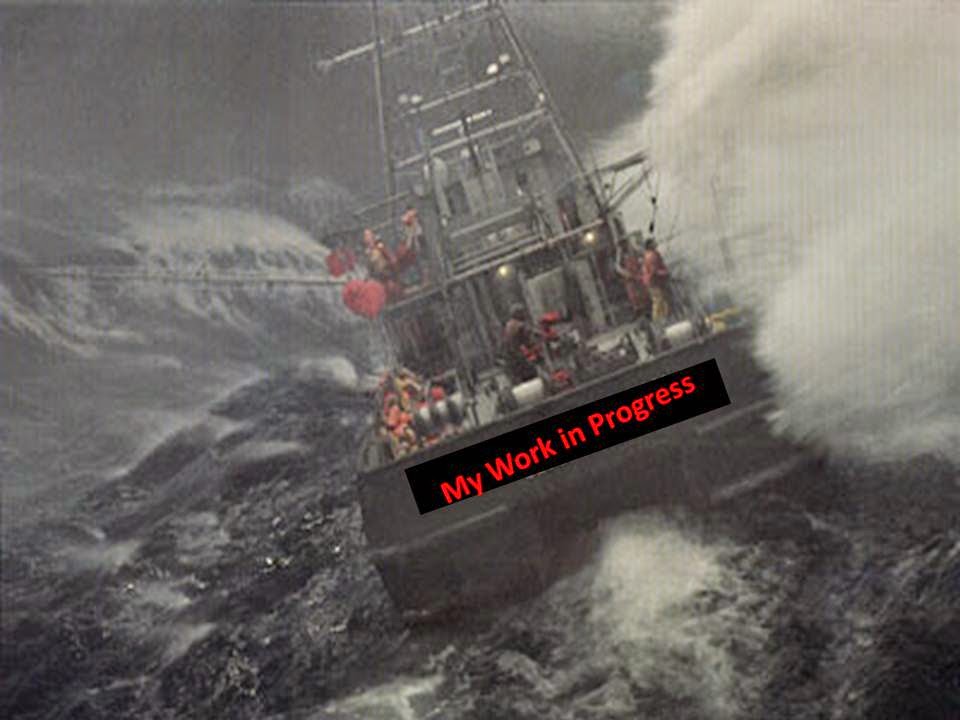
But here’s the thing: When you’re in a trough, like I am right now, you need to remember that it’s temporary. You need to know that if you just ride it out, you will end up on a crest again where you can survey the wider sea and regain your bearings. I need to be reminded of this every so often. We all do. So I made myself a list. It’s a list of the things I really love about this whacked out business. If you have something you’d like to add, please share.
- You can drink on the job and no one makes you pee in a bottle.
- You can write off trips to New York.
- You don’t have to wear a bra at work.
- You get to kill people you hate and not go to prison.
- You can have mind-blowing sex with whoever you want and not worry about rubbers, disease or your spouse leaving you.
- You get to read fan letters (I answer every one I get and save them forever like old love letters.)
- You get to be in the Library of Congress. (In 1983, I went there and asked for the librarian to bring me a copy of my paperback romance. She did. Quite humbling.)
- You get to walk into a tiny bookstore in Moose-Butt Maine and see your book on the shelf. And then find out the old lady behind the counter has read your entire oeuvre and remembers each character better than you do.
- You get to live inside your head for days, weeks, months, at a time and not get carted away in a white jacket.
- You get to find a note taped to your bathroom mirror from your spouse or kid saying, “I’m proud of you.”
- You get to do something that gives others pleasure.
- You get to do something that gives you joy.
Thanks for listening. I feel better now. Hit it, Lesley!
To Hyphenate or Not to Hyphenate?
… that is the question
by Jodie Renner, editor, author, speaker
NOTE from Jodie: FOR AN UPDATED, REVISED, EASIER-TO-READ VERSION OF THIS INFO, CLICK HERE.
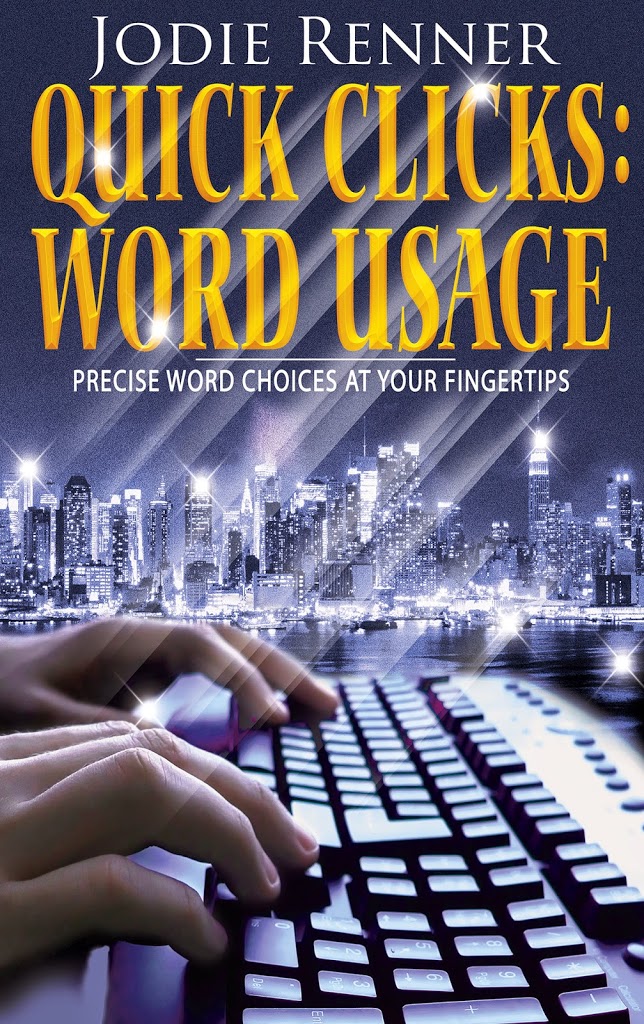
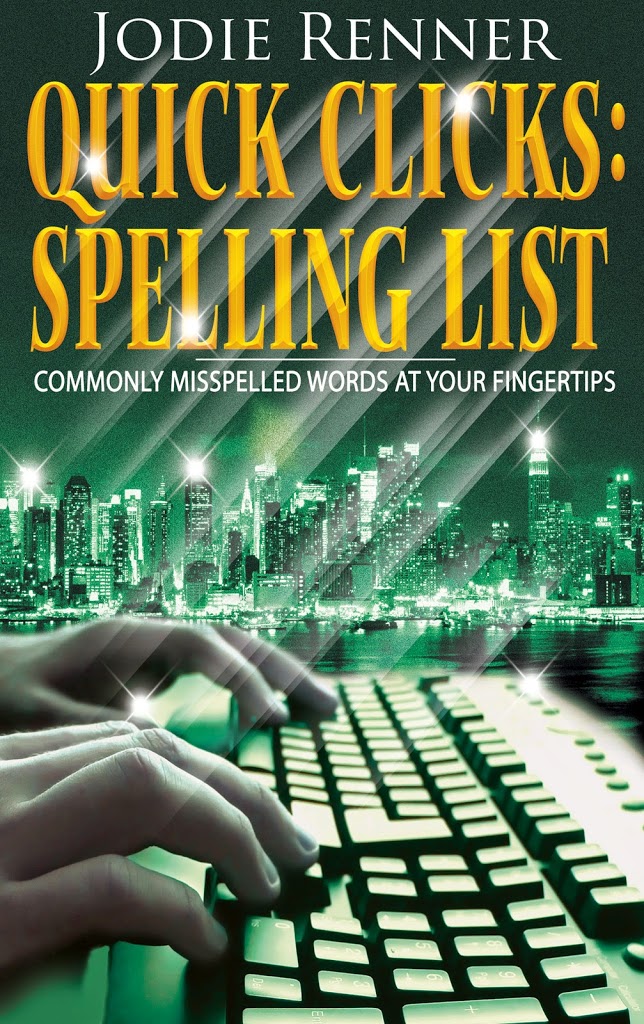
[Check out my two handy, clickable, time-saving resources for writers, editors, students, and anyone else with writing projects: Quick Clicks: Word Usage – Precise Word Choices at Your Fingertips and Quick Clicks: Spelling List – Commonly Misspelled Words at Your Fingertips. With all kinds of internal links, they’re both super quick and easy to use!]
Today I’m wearing my “Grammar Geek” hat to talk about using hyphens in fiction, nonfiction, blog posts, articles, etc. Hyphens, properly used, can actually eliminate confusion and clarify meaning. And chances are that even if you’re a really good speller, some or a lot of you, like me, often forget whether a term is hyphenated or not, so here are a few handy guidelines.
~ Is it one word, two words, or hyphenated?
According to Chicago Manual of Style (that and Merriam-Webster’s Collegiate Dictionary are considered the go-to resources for copyeditors and proofreaders), “Far and away the most common spelling questions for writers and editors concern compound terms—whether to spell as two words, hyphenate, or close up as a single word.”
When we’re busy writing, it’s easy to forget, for even the easiest words, whether it’s one word, two words, or hyphenated. Often, it can be all three, depending on the part of speech.
For example, it’s “lookout” for the noun –“Let’s head to the lookout” – but “look-out” for the adjective – a look-out tower – and “look out” for the verb – “Look out for snakes.” Similarly, castoff is a noun – “It’s a castoff”; cast-off is an adjective – “She wore cast-off clothes”; and cast off is a verb – “He cast off the boat and we headed downriver.” Many others follow the same pattern: cooldown (noun) – “We did a 10-minute cooldown”, cool-down (adj) – cool-down exercises, and cool down (verb) – “Time to cool down”. Same thing with login (noun), log-in (adj), and log in (verb). And finally, takeout (noun, M-W), take-out (adj., M-W), and take out (v, M-W).
See a pattern here? Very often, the noun form is one word, no hyphen, the adjective form is hyphenated, and the verb is two words. (Although English being English, of course there are always exceptions!)
~ Hyphen between prefix and root word?
And what about all those words with prefixes like re, un, de, pre, bi, mid, over, under, semi, sub, etc.? Is it re-read or reread? over-conscientious or overconscientious? extramarital or extra-marital? under-employed or underemployed? semicircle or semi-circle? sub-category or subcategory?
Merriam-Webster and Chicago Manual of Style both favor not hyphenating after a prefix, so according to these two recognized authorities, none of the above should be spelled with the hyphen. But British and Canadian dictionaries seem to hyphenate them more often.
However, for some reason, Merriam-Webster puts a hyphen after the prefixes self and well, as in self-defense, self-discipline, well-mannered, well-endowed, etc.
And sometimes you need the hyphen to clarify meaning. For example, you recover a lost wallet, but you re-cover a sofa. Similarly with re-creation of the scene of a crime, to avoid confusion with recreation as leisure-time activities.
~ Hyphenate compound modifiers before a noun?
Today’s post is mainly on using hyphens (or not) for compound terms (phrasal adjectives) that describe a noun, as I get asked about this a lot. For example, is it …?
A general guideline is to hyphenate two or more modifiers before a noun (so an adjectival phrase), especially if to leave as two words could cause confusion; but to leave as two separate words when they come after the noun or verb (often functioning as an adverb).
For example, “He’s a high-profile actor” but “He maintains a high profile.”
“It’s a middle-class neighborhood,” but “The neighborhood is middle class.”
“He asked an open-ended question,” but “The question was open ended.”
“It was a hands-down win,” but “They won hands down.”
“It was a computer-literate group,” but “The group was computer literate.”
“The school has a hands-off policy,” but “Keep your hands off.”
“They had a hand-to-mouth existence,” but “They lived hand to mouth.”
“The witness was an off-duty police officer,” but “He was off duty at the time.”
“I bought a flat-screen TV,” but “The TV has a flat screen.”
“My to-do list,” but “My list of things to do.”
“We strolled past side-by-side boutiques on the street,” but “Two clothing boutiques stood side by side on that street.”
“This thriller will keep you on the edge of your seat,” but “It’s an edge-of-your-seat suspense.”
~ Hyphenate to avoid confusion.
To avoid confusion or ambiguity, it’s often best to hyphenate.
For example, there’s a big difference in meaning between a small animal hospital (an animal hospital that’s small) and a small-animal hospital (a hospital for small animals). Same with a small business owner and a small-business owner. And the hyphen in “three-ring binders” tells us that three is the number of rings, not the number of binders, as might be assumed with “three ring binders.” Similarly, the hyphen in “much-needed advice” connects the much with the needed, so we know the advice is greatly needed, not that there’s a lot of needed advice. And the hyphen in “fast decision-making” shows us that decisions must be made soon, not that they’re quick decisions.
Sometimes, to clarify, you also need to separate a word into two. For example, a used-book store is different from a used bookstore. And high school-age children could imply something different from what was meant.
~ Hyphenate where numbers are involved.
Chicago Manual of Style says to also hyphenate adjective-noun modifiers, especially where the adjective is a number:
For example, a twelve-step program, a five-year-old child, a five-dollar bill, a ten-mile hike, a six-foot-tall man, a ten-pound fish, a 16-foot square room.
Notice how when hyphenated before a noun, the plural is dropped: for example, a woman is five feet tall, but she’s a five-foot-tall woman. Pregnancy lasts nine months but it’s a nine-month pregnancy,
~ Multiple hyphens in a phrase.
Hyphenate when three or more words form an adjective (or rephrase the sentence to avoid it):
high-school-age children (to avoid confusion with “high school-age children” (not a good thing!), a sixty-foot-long boat, an over-the-counter drug, a winner-take-all contest, a one-on-one game.
~ But don’t hyphenate after –ly adverbs:
Since the ly ending with adverbs signals to the reader that the next word will be another modifier, not a noun. For example, a sharply worded reprimand, a smartly dressed woman, a hastily written email.
~ The trend toward closed compounds (one word, no hyphen):
Common usage has a tendency to simplify terms. “Web site” gradually became “website”; “e-mail” is increasingly “email”; “on line” changed to “on-line” to “online”. (Also, “Internet” became “internet,” which makes perfect sense to me – why capitalize it, since we don’t capitalize other means of communication, like telephone, newspapers, television, etc.)
If you want even more detail and examples on hyphenation, you can register at Chicago Manual of Style online and do a search for “hyphens” or “hyphenation” or go to these numbers: 5.91 and 7.77 to 7.85.
Also, see my blog post, How and When to Use Hyphens, Dashes, and Ellipses.
Jodie Renner is a freelance fiction editor and the award-winning author of three craft-of-writing guides in her series An Editor’s Guide to Writing Compelling Fiction: Captivate Your Readers, Fire up Your Fiction, and Writing a Killer Thriller. She has also published two clickable time-saving e-resources to date: Quick Clicks: Spelling List and Quick Clicks: Word Usage. You can find Jodie at www.JodieRenner.com, www.JodieRennerEditing.com, her blog, http://jodierennerediting.blogspot.com/, and on Facebook, Twitter, and Google+.
Competition, Writing and Rocky Marciano
James Scott Bell
@jamesscottbell
throwing punch after punch underwater. He got a heavy bag that weighed 180 pounds (most heavy bags weigh about 50). He threw punches at that bag for hours…with bare fists. Needless to say those fists became solid granite and his arms become pile drivers.
And Now For Something Completely Different