First Page Critique: CROSSROADS

Welcome, Anon du jour, welcome, to our Saturday morning installment of FIRST PAGE CRITIQUE! We have here the beginning of a work titled CROSSROADS, so let’s cue up either the Sailcat album, Neil Young’s Comes a Time LP, or Cream’s Wheels of Fire to provide some background music and proceed:


Crossroads

Kelli Wade speeds along the 405 at night, wears her chopped jeans, favorite silk T, coffee-with-cream Chanel jacket, and cowboy boots.  She threads her way between a bus and rusty Toyota, leaning on her Harley.  Blonde hair streams straight out behind her; her helmet strapped to the side of the seat, unused.  Tears streak the sides of her face, momentarily blurring her vision of the dark traffic.

He was sleeping with that waitress-whore!  Did he think I wouldn’t find out?

She has keyed his car, front, back and both sides, before riding away from her ruined relationship.  And this, after getting word that Jackie, her college roommate, has been diagnosed with stage four ovarian cancer.

“Up yours!”  The rage in her voice blends with the deep-throated growl of the cycle’s engine.  Kelli skids off the exit ramp, swallowing back her pain and pulls up behind the Taft Building.  She chains her bike to a fat drain pipe and takes the service elevator to the sixth floor, shoving open the double doors of Sunset Investigations.  Did he think I was stupid, or didn’t he give a shit about my feelings?

She sits down hard behind her desk, alone, surrounded by darkness.  To keep her mind off murder, she begins to sort through stacks of paper, invoices, and case reports.  The normal day-to-day function of her job.

She takes a deep breath.  Is there’s any wine left in the fridge?

Dawn leaks in through the window blinds, sending streaks across the polished floor.  Other operatives of the agency begin to arrive to work, including her mother.


I’m predisposed to like CROSSROADS, Anon, because from the jump I liked Kelli Wade and how you are developing her from the jump. You get several things right. Naming your protagonist right out of the gate is a great move. You also put the reader in the moment from the first sentence by using the third person present narrative style. I especially like how you show your readers without telling them that Kelli is in Los Angeles: Taft Building + Route 405 + rusty Toyota (that sounds like award-winning author James Scott Bell’s hooptie to me!) = Los Angeles. Additionally, you show that Kelli does not take betrayal lightly. Revenge may be dish better eaten cold, but it’s pretty tasty in the heat of the moment, too. You paint a very clear picture of your character’s appearance and personality within just a few paragraphs, yet we don’t feel bombarded with information. That’s part of good pacing. The additional element of Kelli working with her mother is a nice touch as well.  More on that in a second.

Those are the positive elements. CROSSROADS needs to be cleaned up just a bit in a few places.

FIRST PARAGRAPH:

— First sentence: Kelli hits a tiny speed bump. She should be “wearing her jeans,” rather than “wears.” The third person present narrative is a good choice, but it has its pitfalls. I think you want a gerund there as opposed to a verb given that she already “speeds” along. Oh, and while you are at it: tell us the model of the Harley Kelli is riding. Enthusiasts love that information.

—  Third sentence: Let’s change that “her: her” to something else. I like to avoid using the same word twice in a row. And let’s get rid of that semi-colon. Here’s one way: Blonde hair streams straight out behind her. She has a helmet, but it’s strapped to the side of her seat, out of the way.

THIRD PARAGRAPH:

— First sentence: “She has keyed his car” …let’s change that to “She had keyed his car” since it takes place in the past, even if it’s just a few minutes ago.

— Second sentence: While we’re at it, let’s do the same thing and change “has been diagnosed” to “had been diagnosed” for the same reason.

FIFTH PARAGRAPH:

— First and second sentences: These aren’t really incorrect but I’d like to see them a little shorter and tighter. Let’s use all verbs and make a couple of other changes. As things stand right now,

“Kelli skids off the exit ramp, swallowing back her pain and pulls up behind the Taft Building.  She chains her bike to a fat drain pipe and takes the service elevator to the sixth floor, shoving open the double doors of Sunset Investigations.”  

Let’s change that to

“Kelli skids off the exit ramp. She pulls up behind the Taft Building and chains her bike to a fat drain pipe. A service elevator takes her to the sixth floor, where she swallows her pain and shoves open the double doors to Sunset Investigations.”

SIXTH PARAGRAPH:

— The next issue is a question to which I honestly don’t know the answer. It seems as though most businesses store their files and send their bills electronically.  Would a contemporary private investigation agency use stacks of paper or would Kelli be poring over files on her computer? I’ve converted almost entirely to e-billing, electronic documents, etc. That brought me up short, if only momentarily. Of course, if the book’s “present” is before 2007 she is almost certainly pouring over paper. It’s a minor quibble.

SEVENTH PARAGRAPH:

— “Is there’s any wine” should be “Is there any wine”…but I suspect that you know that, Anon. Otherwise, good proofing all the way through.

EIGHTH PARAGRAPH:

—Dawn leaks in…so…we’ve already been told that Kelli arrived at night, but was it really night or really, really early in the morning? I would like some sort of sense of how long Kelli has been sitting in her office before morning comes. This can be handled in a few words earlier in the text to give us some idea of what time of night Kelli arrived at the office.

— I like the surprise of Kelli working with her mom, but it’s a reveal that you might leave for just a little later. Or not. Also…as CROSSROADS is presently written… how does Kelli know that her mom has arrived? Is Kelli’s office door open and she sees her? Or is the door closed and she hears her? There are all sorts of ways that you can address this and you can do it by showing, not telling. As is in:

Three knocks rattle Kelli’s office door. Only one person in the office knocks like that. “Come in, Mom,” Kelli sighs.

These suggestions are made in the spirit of making a good first page better, Anon. I like the setup and I like your character. Please keep going with both.

I will now strive mightily to be uncharacteristically quiet while our friends at TKZ today offer their own observations and comments. Thank you so much, Anon, for submitting CROSSROADS to First Page Critique! And please don’t forget to circle back and let us know when we can see the rest of CROSSROADS!

READER FRIDAY: Does a big ego help or hurt writers?

Wikimedia Commons Attribution: Thomas Wolf, www.foto-tw.de

Think about very creative types. Often they are said to have ginormous egos. It makes them who they are. Think Kanye West, as an example. There are others.

1.) Many writers are plagued by self-doubt, especially when they first start out, but is a big ego part of the success formula for ANY creative art form?

2.) Does having a big ego help or hurt an author when it comes to writing?


WordPress, Script Writing, Memoirs – What does this have to do with fiction writing?

Jordan Dane
@JordanDane

It’s been a strange week. Whenever I get toward the end of a project, I sabotage my progress by finding distractions (or I let them take over “There, I said it.”). I honestly don’t want my story to be over. I’m madly in love with my latest protagonist, Braxton Valentine. Valentine: Steel Heart will be launched Oct 31 as part of a new Amazon Kindle World – Desiree Holt’s The Phoenix Agency. This will be book 1 of 2, with the second installment coming in Feb 2018. I don’t have to say good-bye to my brooding hero, but that doesn’t make it easy to finish book 1.

I wanted to have a free schedule for the holidays, not like last year where I wrote like a mad woman for a January release. Never, never, never again. That’s the goal, but in the midst of my mounting common sense comes my new website design.

Distraction #1 – I asked my designer, Maddee at Xuni, to create a WordPress site I can maintain by myself to keep the cost down on monthly tweaking and all the new releases. I’ll be launching it soon, but I had to teach myself much more than I ever thought I would know about WordPress (WP). Like a petulant child, I kicked and wailed against doing it NOW, but I eventually broke down WHILE I WAS FINISHING Valentine’s story. After I sunk my teeth into my learning curve, I found I really enjoyed getting to know more about WP & I’m thrilled that I will finally have control over my site. I still plan on using Xuni for some administrative functions. I can’t totally quit Maddee and need my fix, but it was satisfying to learn something new and gain control at the same time.

Distraction #2 – Since I saw the end of my project in sight (we’re talking final chapter, big finish, folks), I decided to make contact with a local writers group and attend one of their critique sessions. I enjoy giving back to the writing community, as other authors have done for me, and I also get a lot out of reviewing and giving feedback to others. The meeting was held at a good restaurant I like, double score, and I met new people, trifecta. But after lunch we began the critique process (which hasn’t changed in YEARS), which is to read 10 pages aloud (cold) and provide feedback. Instead of hearing submissions of fiction, I heard only one memoir and one screenplay/script before I had to cut out. In the past, this group has also had quite a number of poets. Not one fiction read. I have to say I was a little disappointed, except that I wanted to make the most of it and focus on how screenplays can still evoke emotion with good dialogue and setting.

The next day I researched script writing and read examples of famous scenes from well-known movies that were packed with very emotional content. It inspired me to double my efforts to put the right dialogue into every scene and fill it with emotion. The setting can still be sparse (especially when I am writing shorter Amazon Kindle Worlds these last few months), but the dialogue needs meat and heft. The film-goer or the reader MUST be gripped by your stripped down version of a story and their minds fill in the gaps to paint a picture in their minds that can be rich and satisfying.

Have any of you thought about script writing?

A rule of thumb – one page of a script is equivalent to one-minute of film/TV. So if you can write an approx. 50-70 pgs for episodic TV or 80-120 pgs for feature film—with good and effective story structure, packed with emotion and good dialogue—you have the bare bones to a solid novel. I’ve heard of some authors who start out by writing in a script fashion before they fill out their story into fiction. Could this be the new outline?

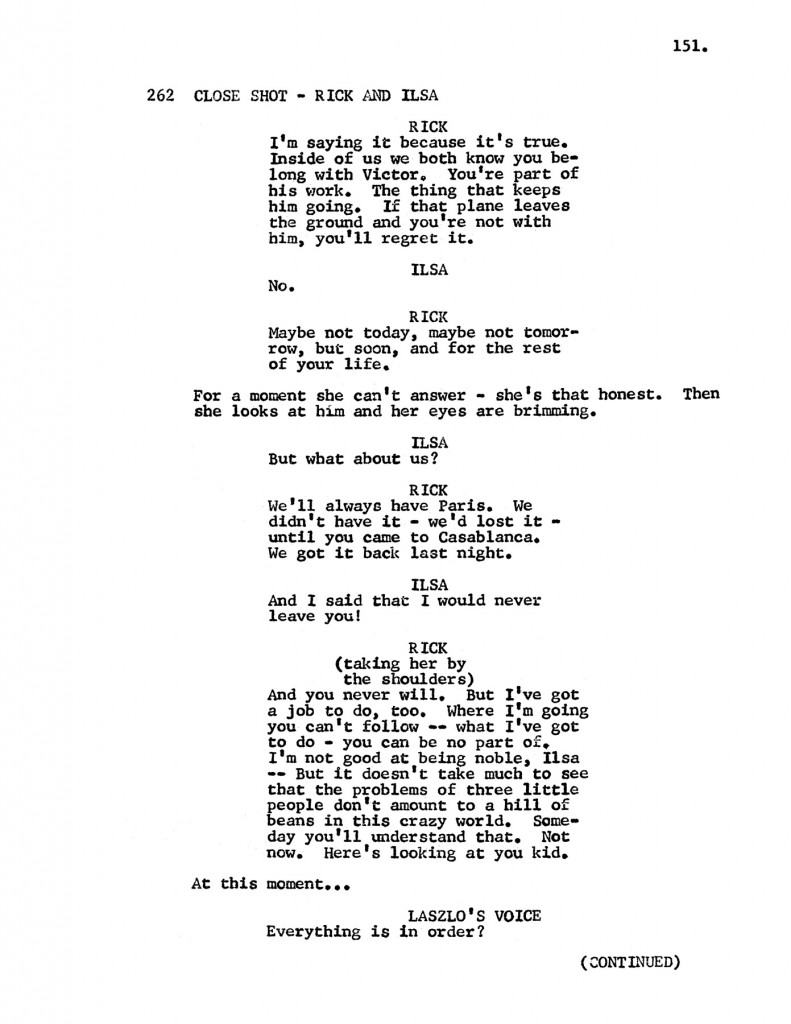
Here’s a page from CASA BLANCA – We’ve all seen this scene.

I’m not proposing that I divert all my attention to learning script-writing, but this method isn’t that far off from where I taught myself to write a tight scene with a focus on dialogue. To get a jump on my writing after work, I would take a notepad to lunch and write only dialogue lines that I heard in my head (yes, I had a lot of folks staring at me). With those lines as a framework, I would fill out the other elements later (setting, body language, action, introspection). The brain is an amazing team player. While you are doing other things, it is still working on your story or your research. If you’ve ever read a full script, you know how the brain fills in the gaps and makes you see a movie rolling in front of your mind’s eye.

So my “fiction group” diversion lit a fire under me. I suppose inspiration can come at you fast.

Even the Memoir writer in the critique group got me to shred through the words that readers will skim (as Elmore Leonard said) to realize that even your own memoir needs emotion and a point. Unless you are famous, who is your target market? If you’re a survivor of an ordeal, you can share your journey and be inspirational, but your average person who only wants to chronicle their life will have a “story” with no end (yet) and a ramble of back story and mental musings without a point. My dad’s memoir is a case in point. It shall never see light of day because he can’t stop editing it—which is a good thing because he’s still here to wordsmith it.

For Discussion:

1.) What diversions have paid off for you as a writer?

2.) Have you ever considered writing a script for your book – or started with a script and fleshed it out into a novel?

3.) How many of you maintain your own website? Do you enjoy WordPress?

VIGILANTE JUSTICE (Mercer’s War – Book 3) – $1.99 Ebook

In Montana, when a disturbing pattern of missing teens and college students falls under the FBI’s radar, former CIA operative Mercer Broderick fears the violent abductions are at the heart of a dark web of conspiracy that must be stopped and Brotherhood Protectors won’t be denied from the fight.

First Page Critique: STEEL

Welcome to the Tempering Zone, where we’ll examine and hone the first page of STEEL.

(You know I had to go there.)

Today I’ve asked our Brave Writer lots of questions. As writers, we want to keep our readers asking the right questions—questions that occur to them because they’re excited to imagine how a story might move forward. What we don’t want is for readers to furrow their brows because they don’t quite understand what’s going on.

I get a pleasing sense of the world the Brave Writer is building: antique and magical, with a strong protagonist who is emotionally complex. With a little examination and reworking, it can be an very good beginning to what I assume is a YA novel.

STEEL

Chapter 1
Helia crept along the wall, her senses on high alert. The stars shone into the open-air courtyard, the uncertain light drawn toward the low-burning fire pit in the center. She walked just on the edge of this light as she carefully drew the spell of invisibility. It wasn’t true invisibility, but this spell made the caster as unnoticeable as was humanly possible. Another person would only see her if they looked at her directly. The flickering flames and trembling starlight could conceal even that.

Even with the spell, Helia forced herself to walk as if she was being watched. Straight and stiff, with her head held high with confidence. She walked as thou a crowd were analyzing her every move. As if the royal family was there to evaluate her. As if she needed to prove to the gods that she was strong, stronger than they gave her credit for.

She almost made it. She almost left her house without losing her guise. But as she passed the opening to the living room, both her confidence and her spell crumbled.

Her eyes flickered for just a moment to the right. Just for a moment, because they were so used to looking there. Looking for her twin brother and seeking his approval. Because Urian was the only one she felt like she could trust completely. And so he was the only one who could stop her from doing what she needed to do.

I need to do this, she reminded herself.  It’s for everyone… No it’s for me. It’s all for me because if I stay here…

If she stayed here she would have to face many more months of pity and severe disappointment. Her mother bursting into tears, her aunts scowling and scolding, and the rest of the village skirting around her like she was a plague. She needed to be somewhere where people didn’t know her, a place where the past wouldn’t crush her.

This was the right thing to do. But still, she stood there for half a minute—wishing hard for her twin to come out and tell her to stay—but then she forced her feet forward and flew toward the entrance of their tiny house. Just before she went outside, she snatched her bow and quiver from the stand right next to the door, heedless of the clatter it made.

Laura’s Mini-Synopsis:

A girl tries to use an invisibility spell to sneak out of her house and run away because she’s affected adversely by some event in her past. But she loses her confidence and the spell falls apart, so she’s no longer invisible. She leaves anyway, knocking stuff around noisily as she grabs her bow and quiver from beside the door.

Thoughts

“Helia crept along the wall, her senses on high alert. The stars shone into the open-air courtyard, the uncertain light drawn toward the low-burning fire pit in the center. She walked just on the edge of this light as she carefully drew the spell of invisibility. It wasn’t true invisibility, but this spell made the caster as unnoticeable as was humanly possible. Another person would only see her if they looked at her directly. The flickering flames and trembling starlight could conceal even that.”

Immediately I envision a wall with a wide, flat surface at its top, and it sounds like Helia is  creeping along there in a cat-like manner. Further reading shows that she is in fact walking, keeping her back close to a wall. Please be more clear.

We have stars shining into the courtyard, their light “drawn toward the low-burning fire pit.” Is there a fire in the fire pit? Or is the fire pit itself on fire? Wouldn’t a fire actually compete with starlight to the starlight’s disadvantage? It’s a pretty-sounding sentence, but feels like window dressing.

Cloak of invisibility: Let’s leave the revelation that it isn’t true invisibility for a slightly later reveal. We are dragged down by this detail. It’s a cloak of invisibility! Let us enjoy it for a moment before dashing excitement about it. Later, we can discover its limitations. IRL we purchase things that immediately seem fabulous, and later find they aren’t all we think they are. (I’m looking at you, As Seen on TV Bacon Boss!) And I don’t really understand what “that” describes in the last sentence.

The first paragraph of a novel works well when it’s focused on character and action, with  a small bit of scene-setting. Not trappings. We know she is being careful and alert. But that’s all we learn about her. Too much detail about the cloak and the light slows down the action in what is a very tense situation.

“Even with the spell, Helia forced herself to walk as if she was being watched. Straight and stiff, with her head held high with confidence. She walked as thou a crowd were analyzing her every move. As if the royal family was there to evaluate her. As if she needed to prove to the gods that she was strong, stronger than they gave her credit for.”

This paragraph is at odds with the first. She’s supposed to be creeping, yet she’s also trying to walk with royal self-possession. It makes her sound very childish. If this is the intention, okay. But it is still confusing. Use “as if she were” rather than “as if she was.” Use “were” if the situation is conditional or contrary to reality. Same goes with “As if the royal family were there…”

There’s a lot of information here: we learn that she’s someone who might be viewed by a crowd, or a royal family, or the gods. Either that, or she has a very active fantasy life. Again, it slows the action, and feels like it’s only there to foreshadow or telegraph what’s in her universe. Don’t try to give it to us all at once.

“She almost made it. She almost left her house without losing her guise. But as she passed the opening to the living room, both her confidence and her spell crumbled.
Her eyes flickered for just a moment to the right. Just for a moment, because they were so used to looking there. Looking for her twin brother and seeking his approval. Because Urian was the only one she felt like she could trust completely. And so he was the only one who could stop her from doing what she needed to do.”

What is the cause and effect here? As it reads, everything falls apart, and then she looks into the living room, seeking out her brother. Or does she lose her confidence and guise because her eyes flickered to the right, hopeful that her brother is inside, waiting to stop her? (I assume she looks toward the living room.) As I read the second bit, I assume the latter is how you mean it.

Whichever way you mean it, try to make the sequence immediately clear to the reader. Don’t require the reader to step lively to follow the action. Linearity and cause and effect are things that even mature writers sometimes struggle with. I know I do. I’ve put characters on scene, then added a quick couple of lines about how they got there. Lots of writers get away with it all the time, but it’s not a good habit. Reveal with subtle details, not exposition.

Also, her breaking of the spell seems like it would be a bigger disappointment to her. We get no reaction.

I do very much like the way Urian fits into the story. In a few lines you’ve sketched out their relationship: they are very close, and he is the sensible one, and she’s the one prone to acting on impulse. Nice.

“I need to do this, she reminded herself. It’s for everyone… No it’s for me. It’s all for me because if I stay here…
If she stayed here she would have to face many more months of pity and severe disappointment. Her mother bursting into tears, her aunts scowling and scolding, and the rest of the village skirting around her like she was a plague. She needed to be somewhere where people didn’t know her, a place where the past wouldn’t crush her.
This was the right thing to do. But still, she stood there for half a minute—wishing hard for her twin to come out and tell her to stay—but then she forced her feet forward and flew toward the entrance of their tiny house. Just before she went outside, she snatched her bow and quiver from the stand right next to the door, heedless of the clatter it made”

The reader will assume she’s already had this discussion with herself. You only need a line or two about what a relief it will be to not see her mother’s disappointment, and have the villagers avoid her. Give us just enough to make us curious. The internal dialogue is awkward and you’ve already done a good job of showing her hesitation by talking about wanting Urian to talk her out of it.

Is the house tiny? Given that it has a courtyard, I imagine it to be bigger. And I wonder about the phrase “living room” too. It doesn’t feel like a contemporary story and the concept of a living room is modern.

I might end with something like this:
Fighting tears, but resolved, Helia flew for the doorway, pausing only long enough to snatch her bow and quiver from their stand. The loud clatter of the stand falling onto the tiles followed her as she disappeared into the night.

Title: The opening doesn’t seem to have any connection to steel at all. Is it perhaps a story about the invention of steel? Or is it that she needs to prove herself to be as strong as steel to the gods? I’m not sure.

In a way, this first chapter feels like a prologue to a story. We know that Helia’s young and feels compelled to leave a difficult, if ultimately safe situation. I would expect that Chapter 2 might see her well into the action—perhaps older, already having some adventures behind her. But if it is, indeed, the very beginning of her adventures, leave more of your juicy details for later revelations.

Thanks for sharing this with Kill Zone!

*photo credit: GoDaddy stock photo

Breathing Life Into Secondary Characters

Photo purchased from Shutterstock

As writers, we all lavish attention on the main characters of our stories. But what about the minor characters? Too often, a story’s  secondary characters get short shrift during the writing process.

And that’s a shame, because it’s often the minor characters–the second bananas–who often carry the show. Don’t short change your reader by giving them secondary characters who are generic or cardboard: the “leggy blonde” who is tossed in for a frisson of sexual tension; the “beefy cop” who turns up at a crime scene; the “tired-looking” hotel clerk. Those types of descriptions tell the reader that the writer needed to include a particular character to move a scene forward, but didn’t put any effort into bringing the character to life.

All secondary character need to live and breathe for the reader. In his book On Writing, Stephen King said that every character in a book thinks of himself or herself as the main character. Whenever that character is on stage, even briefly, he should be presented as if a spotlight is shining on him.

When it comes to strong secondary characters, a few standouts come to mind: Dill in To Kill A Mockingbird; Melanie in Gone with the Wind; the wealthy, pompous Lady Catherine De Bourgh in Pride and Prejudice.

Which secondary characters are the most memorable for you in thrillers or mysteries? As a writer, do you struggle with the challenge of portraying second bananas?

First Page Critique: “Deliah and the One Penny Blue”

Today we have yet another in our series of soul-crushing First Page Reviews.

Of course, I’m being a bit sarcastic. The intention is never to be soul-crushing, even when that seems to be the outcome. (We’ve all been there, on both sides of these little eviscerations.)

I’m not a big fan of first page reviews. They aren’t without some value, of course, because certainly they provide a glimpse of the writer’s ability to render readable prose, which is a square-one necessity in this business. (You’ll notice that this alone usually eats up over 90 percent of the feedback we provide here, and about 60 percent my own feedback today). And perhaps, to set up a scene… specifically, an opening scene. But that’s about it. They tell us little about the story arc itself. Nor should they. Stormy skies and perfectly coiffed hair and the color of sunsets, because we’ve all seen the color of sunsets and don’t need to be told – often the hallmarks of a first page – aren’t really the point, while they certainly can be stage lighting if handled properly.

We also often get some sense of initial foreshadowing, of course, but if the entire story is visible beyond a vague hint on page one, that, too, is a mistake. First pages aren’t there to tell us about the story itself. Nor should they. They are there to begin the process of setting up the story. Stormy skies and perfectly coiffed hair – often the hallmarks of a first page – aren’t really the point, while they certainly can be stage lighting.

And therein resides a paradox. Because if we don’t yet know the story arc, we can’t really access how well the setup for it has been handled… beyond, of course, the prose itself. So here we are, having come full circle to focus on the sentences.

That said, let’s see how today’s brave author (we are contractually obliged to include that phrase in these intros) does with her or his first page.

My not-quite-as-cynical commentary (really, I’m hoping I can help) follows.

Twilight coloured everything with purple shadows. Squeals echoed down the slope while the last of the kids raced the darkness home, the boys rounded up and kept safe by girls like us.  Surrounded by poplar trees, at sea in a stretch of grass and daisies, the tall ship appeared around the curve of the hill. A well-worn and familiar playground in Old Town, the tilted deck was strung with rope nets and a faded black flag flew above.

Our shoes stirred up the damp smell of woodchips as the two of us reached the hull and climbed up onto the deck. The boards sounded hollow, empty beneath our feet. Leaning back against the worn timber, I tore open the paper, and hot vinegar clouded up into my face, sharply comfortingly. With my eyes downcast, I offered the chips to Martha.

We ate in silence as the night pressed down around us. My wet clothes had chilled with the evening air and kept me from forgetting what had happened earlier. Though I tried to fill up somehow, swallowing past the rawness in my throat, my jaw was hard with tension. I felt overly conscious of every gesture and the quiet was building.

When the food was gone, I scrunched the paper, holding it close to my nose to inhale the familiar scent. It smelled of late nights; the familiar bustle around the fryers and the fluid motion of Martha working beside me. I clenched the paper tighter, wringing it between my hands. Sweat budded over my top lip and I coached myself to speak, to break the spell somehow.

Alongside, Martha crossed her arms and tilted back against the wooden balustrade, looking up at the sky. Waiting.

It was lonely, sitting side by side with my oldest friend. I toyed with the discarded paper, flicking it back and forth with my fingertips. I had a sense of something counting down.

“Can you stop that?” said Martha. Still, she didn’t look at me.

My cheeks flushed hot but I imagined I could hear ice cracking over dark water.

“I didn’t mean for it to go that far!” I choked suddenly, swiping at my eyes.

Martha finally looked at me, lips pressed tight together. “So, what the hell happened, Penn?

Here’s my first impression. And really, I say this with love and empathy: you’re trying too hard. Much too hard. My fear is a crusty old editor, whose taste for purple prose (ironic, since this is the color you evoke in your opening line) has soured like the tongue of a senior chef auditioning newbies for a cooking show.

Okay, now I’m trying too hard.

Shadows aren’t purple. Dusk skies are purple. Shadows are a lack of color. It’s never wise to try to revinvent nature.

So the girls have rounded up the boys and are keeping them safe on the way home, all of them squealing. Really… I don’t think this works. And if they’ve all headed home, nobody is squealing anymore.

Your sentence introducing the “tall ship” works better if you flip it around, like this: The tall ship appeared around the curve of the hill, surrounded by poplar trees, at sea in a stretch of grass and daisies. Another note: hills don’t curve, they slope. And the ship doesn’t “appear” unless ot or you are moving (a point of view thing); rather, om this case it is fixed in place, because it isn’t really a ship at all.

You’re trying too hard. The biggest rookie mistake, and the most common, is to try to sound like a professional author, but end up sounding like someone trying to sound a certain way. Professional authors live in a world where they understand that less is more, where adjectives and adverbs and over-wrought metaphors are the very things that mark the writing of a newbie.

This essence – sounding like a professional – is the hardest thing to teach and to learn (among a core set of more precise principles, which are absolutely teachable and learnable). The best way to learn is to have someone blue pencil your own narrative to understand why it is perceived as otherwise.

Your next paragraph is a confusion of up-and-down geometry: shoes stirred up… climbed up… empty beneath… leaning back… tore open the paper… clouded up… eyes downcast. This is literary motion sickness, I’m afraid.

Martha looked up at the sky… waiting for what, exactly? Whatever she was waiting for, it wasn’t going to descend from the heavens.

Nothing (beyond description) happens until your sixth paragraph. This is the whole point of the scene (and the first page): they feel like something is coming. That all of this is “counting down” to something, and this is the something that will crack open the story. This moment is the point of the scene… I suggest you get to it a bit quicker, cutting out all the existential pondering of sights and sounds, which really means nothing in context to what’s about to be revealed between the two girls… who must have taken a pass at gathering boys and protecting them on their way home.

Because that is what the reader will care about. The reader won’t care about what kind of tree surrounds them, or what smells are wafting about, or what vinegar smells like… because none of that is what the scene is about.

Begin with this awareness, and build an impactful lead into the moment when the girls get real about whatever happened that still haunts them, in context to what they know or don’t know, and can discuss or shouldn’t discuss.

This upgrade is an example of what I like to call mission-driven scene writing, versus overly sensated English Comp 101 scene writing. At the professional level, even on a first page, crusty old agents and pub house readers and even browsing readers on Amazon’s preview pages instinctively know the difference.

One other comment: your title… it makes me go, “huh?” You can do better.

Hope this helps. Killzoners (I won’t say “what think ye?” again, I got killed for that one), please weigh in and help this writer get over this purple hump.


How to Cure Mid-Novel Sag

by James Scott Bell
@jamesscottbell

The plot doctor is in.

I see the waiting room today is full of pantsers. They have that lost look in their eyes that usually appears in the middle of their first drafts.

One comes up to me and says, “Doc, I was having so much fun! I was writing along, letting the characters take me wherever they wanted to go. Now I’m forty thousand words in, and I’m frozen. I don’t know what to write next! Every choice seems like a rabbit hole! Help me, Doc, please!”

“Of course,” I say. “Just have a seat and—”

“Is there any hope?”

“Who’s your plot doctor, huh? Now just wait a moment and all will be well.”

There are plotters here, too. One approaches slowly, as if fearing recognition. He whispers, “Doc, I can’t figure out what went wrong. I had the whole thing mapped out and the pieces were falling into place. But the middle is sagging. Not enough oomph. What can I do, Doc?”

“Well, let me tell you—”

“Not so loud, Doc. I don’t want these pantsers giving me the raspberry …”

I’ve treated many such cases over the years. A cursory examination of the patient usually calls for three things: a shot, a couple of pills, and preventive measures.

1. The Shot

The first step is a shot of the potent “mirror moment” drug. I’ve seen immediate improvement to the eyes (which sparkle) and the mouth (which smiles or shouts Yesss!) after an injection.

The mirror moment gives the writer a new and powerful insight into what their novel is really all about. That illumination shines both backward (to the beginning) and forward (to the ending), stimulating new scene ideas and added character depth.

2. The Pills

Now I give the writer a couple of pills, with the following instructions: take the first one and see if that clears things up. Give it a few days to work. If, however, the symptoms persist, pop the second.

The Best Move Pill 

Step away from your manuscript. Go find a quiet spot or your favorite coffeehouse table, and use a pad and pen (I find this an aid to creativity).

Write down the names of every major and minor-recurring character in your novel.

Now, dedicate a page to each of these characters, answering the following question: Considering what this character wants out of the story, what is the best possible move he or she can make RIGHT NOW?

Please note that most of your characters will be “offscreen” at any given moment in your manuscript. That’s okay. They are not inert. They are in the process of planning, conspiring, sneaking, escaping, suffering … they are all doing or experiencing something. (When characters are offscreen, I call their activities “the shadow story.”)

This exercise will give you lots of plot material, scene ideas, and possible twists. See how it goes. After some time has passed if there is still significant sag, you have this:

The Guy With a Gun Pill

Raymond Chandler once wryly noted, “When in doubt have a man come through a door with a gun in his hand.”

Of course it does not have to be a literal man with a gun. It can be any character introduced in some surprising fashion. We’re not talking about a one-off character in a scene, but a recurring character who will add complications to the protagonist’s life.

When you place a new character in your story, you immediately inherit all of that character’s backstory, agendas, secrets, shadow story and so on. Additional scenes arise organically. As you create the new character, ponder a few questions:

  1. What can this character do to make life more difficult for my Lead?
  2. Can this character bear a secret that will upset my Lead’s applecart?
  3. Do they still make applecarts?
  4. Is there a hidden relationship this character can have with another in my cast?
  5. What is this character’s agenda?
  6. How far is this character willing to do to gain his objective?
  7. How can I give this character an even stronger motive?

Writers who dutifully take their medicine usually contact me in a few weeks to report being in the pink again. They have pep in their step and a twinkle in their eye, along with a few other clichés.

I am happy to hear it, but then I advise one further measure.

3. Preventive Medicine

If you want your heart to be healthy, you’ve got to eat healthier (and I never even went to med school!). Have you heard of Burger King’s new offering, the Rodeo Burger? It’s described as “two savory flame-grilled beef patties totaling more than ½ lb. of beef, topped with three half-strips of thick-cut smoked bacon, our signature crispy onion rings, tangy BBQ sauce, American cheese and creamy mayonnaise all on our sesame seed bun.”

I’m so there!

(Yeah, maybe once every three years.)

Anyway, I try to make my heart happy. It takes some discipline (e.g., steamed broccoli) and some hard work (e.g., actually eating the steamed broccoli).

Writing is no different. So if you’re a pantser, don’t be afraid of work and study. Get over the fear that any planning beforehand is stifling to your creativity. It’s not. You need to learn that surprises happen in the planning, too.

You plotters can continue to shore up your foundations with a growing knowledge of powerful story beats, which will allow you to leave a planned route for another choice. You can do that because you’ll know the next beat to write toward. You won’t be lost; you’ll be enjoying the trip!

Ah, the waiting room is clear. My work here is done. The doctor is out.

Do you often feel a sag in the middle of your manuscript? How have you solved that problem in the past?

READER FRIDAY: What creature in the animal kingdom best describes your writing style?

Wikimedia Commons public domain

Are you the slow but steady turtle? Do you write as fast as a rabbit in heat? Get creative and describe your writing style. (This is a tee up for Basil Sands who never disappoints.)

For bonus points, share your favorite author and tell us what his/her ‘writing style’ animal would be?

A Brief Pause To Refresh, Recover

We are taking a “Personal Day” time-out to give some of our impacted bloggers time to recover from Hurricane Irma. (And we haven’t forgotten Harvey!) Our thoughts go out to everyone who was affected (and continues to be affected) by the weather events.


First Page Critique: Angry Vines

By John Gilstrap

A brave anonymous author offers up a page for feedback.  First, the page, then the feedback (Italics are all mine):

Title: Angry Vines

A man, dirty and thin from living too many months with too little of anything, traveled slowly through the woods. He had been paid to deliver a package, and was traveling by the light of an oil burning lantern. Even though it was early enough now that the first hint of the sun was starting to peak over the ground and bleed into the sky, he’d been told that the cottage was well disguised, and didn’t want to risk missing it.

He was searching for any hint of a building of some sort. A crow that had been circling overhead for some time flew down and perched on his shoulder, cawing loudly in a mocking laugh when the man jumped. 

When the man regained his composure he shook the bird off, swatting at it as it flew to a nearby branch. “What did I say about doing that without warning me?” He said with the same tone someone might use to talk to a very young child that just broke a well established rule.

The crow cocked its head and blinked its beady black eyes. The man assumed this was the only response he was going to get and walked past it, holding his lantern up to continue his search. He didn’t stop when the crow finally spoke, hopping from branch to branch behind him.

“I didn’t see a thing up there. Are you sure you didn’t get us lost?” 

“I know how to read a map.” He replied indignantly. The man had it tucked under his arm, with the package.

“Don’t take everything I say so personally.” The crow flew back to the man’s shoulder, apparently too tired to keep hopping after him. “Maybe there isn’t even a cottage to begin with. I don’t think the kind of person that would hire a strange man to deliver something would have any problem sending him on a wild goose chase through the woods.” 

    The man shook his head. “I’m delivering this for a witch, and a powerful one at that. If someone like that wanted to mess with me, she would have done it by shrinking my head or turning my skin green. Not pay me to not deliver a package.” 

“Oh.” The crow said. “I didn’t know she already payed you.” And after a moment added “I think you’d look better with a smaller head.”

Hi,  It’s Gilstrap again.  And now for my thoughts:

First of all, I love the crow.  I love the wry sense of humor, and the last line of this sample is perfect.  I do hope it’s the end of the scene because that would be a very strong close.

Structurally and stylistically, I think this is a troubled piece, and the trouble starts with the first two words: A man.  Unless there’s a compelling reason to keep this character’s identity a secret, it’s very hard for a reader to bond with a pronoun.  If at all possible, give him a name.  For my purposes here, we’ll call him Tony.

Whose POV is this?  Who perceives him to be dirty and thin from living too many months with too little of anything?  This would work so much better if we were in [Tony’s] POV, and rather than seeing what he looks like, we could feel his exhaustion.

“Traveled slowly” is a great example of why -ly adverbs are loathed by so many.  Trudged, crawled, staggered, wandered and countless other stronger verbs would make a stronger sentence.  Consider: “. . . trudged through the woods, his way lit only by the dim light of an oil lantern.  Overhead, a crow flew lazy figure eights, no doubt mocking Tony for his dwindling strength.”  See below for why I added the crow here.

I don’t think we need to know in para 1 that he’s been paid to deliver a package.  Let us know that he’s searching, and let us wonder why.

[A]ny hint of a building of some sort is redundant.

A crow that had been circling overhead for some time flew down and perched on his shoulder, cawing loudly in a mocking laugh when the man jumped. The sudden introduction of the crow is jarring.  Stay in Tony’s POV.  Consider:

The flutter of approaching wings startled him and he jumped as the crow that had been mocking him landed on his shoulder.  When the bird cawed, Tony heard laughter.  He swatted it away and it flew to a nearby branch.  “What did I tell you about startling me?”

The crow hopped to a new branch, and then another one.  “Are you sure you didn’t get us lost?”

“I know how to read a map,” Tony replied.

“And I know how to fly,” the crow said.  “I didn’t see a thing up there.  And I’ve had enough of this hopping business.”

Tony made no effort to prevent him from returning to his shoulder.

“Maybe your witch friend sent you on a wild goose chase,” the crow said.  “Maybe there is no cottage.”

“It’s here,” Tony said.  “If she were trying to mess with my head, she could have just shrunk it.  Or turned my skin green.”

They trudged in silence for a few steps.  “I think you’d look better with a smaller head,” the crow said.

Okay, that was presumptuous of me.  I took the liberty of essentially rewriting your piece, but I did it for a reason.  By sticking to the moment and eliminating backstory, the narrative becomes more compelling.  Let us come to like the characters and experience things through their eyes as the events unfold.

Much of what you expose in dialogue, such as “I’m delivering this for a witch and a powerful one at that . . .” is information that the characters would already know, and therefore would not reasonably be spoken at this time.

That’s my take on the piece.  What say you, TKZers?  Fair warning: When this blog entry is posted, I will likely not have a reliable Internet connection, so I will probably not be able to interact with other posters.