About Joe Moore

#1 Amazon and international bestselling author. Co-president emeritus, International Thriller Writers.

Letting Action Define Your Characters

by Clare Langley-Hawthorne

I just finished a book (which shall remain nameless) for my first Australian book club meeting and despite all its accolades and awards I couldn’t believe how totally uninvested I was in any of the characters. I’ve been mulling over the reasons for this ever since I skimmed my way to the finish yesterday and this morning I woke to find I knew exactly what the author’s problem was – she had failed to let her characters be defined by action.

In many ways this is a classic literary novel mistake because, lets face it, in a mystery or a thriller there’s no way an editor would let us get away with having passive characters who spent half their time engaged in inner monologues about how they felt!

We have blogged a lot on this topic but never has the reason been made so clear to me as it was after finishing this book. Although there were some dramatic moments and a terrific historical backdrop, none of these had any resonance as the characters seemed to be little more than distant, passive observers to all that was occurring in the book. So I compiled a short list for myself, as a reminder of what not to do, when I feel the literary urge coming on (and believe me, getting pseudo-literary is one of my many failings as a writer:)!)

1. Rein in those inner monologues and angst. While okay in small doses this book diluted the power of any angst-defining moments by having the main character ruminate ad nauseam. It would have been far better for the character to have been confronted by his past – in a direct and visceral way so the reader could have seen (rather than being told) how this impacted the character.

2. Cut the literary bull. Too much pondering, pretty metaphors and dream sequences drag a story down (and this book had enough of these to sink the Titanic). Far better to let the plot move the character through his or her emotions.

3. Let action/reactions tell the story not the author. In this book I felt that as a reader I was being told too much by the author – to the point where I didn’t see the characters as real. They became little more than a literary device for the author to tell me her clever observations on the societal issues of yesteryear (yikes!).

4. Insist the plot drive character development. As far as I could tell I didn’t witness any real character development or change, I was merely told that it had happened by the author.

5. Ensure each character is true to life not a literary contrivance. In this book almost all the character flaws were described but never actually witnessed. Once again, without action or plot points to reveal these I was never invested as a reader.

So if you had to do a list on using action to define characters what else would you add (or change on my list). Have you read any book recently that you have found similarly lacking? And why do authors of so-called literary books often forget the basics that we, in our field, would never be able to get away with?!

Pound the Keys and Drop the Pounds

James Scott Bell

I was presenting at the Surrey International Writers’ Conference last month, and a fellow writer told us about this doctor who’s invented a treadmill desk. His theory, this doctor, is that you have to move a little to lose a lot (thus the title of his book, yes, Move a Little, Lose a Lot). Our bodies at rest (like when we’re sitting and typing) slow down the metabolism and preserve our body fat, so we have enough energy to run away from a mastodon should it invade our cave.
So says this doctor. But if you work at your desk and walk at the same time, hey! Drop those ugly pounds while you’re answering emails or talking to clients!
Reminds me of that scene in Woody Allen’s Bananas, where product tester Fielding Mellish tries out a prototype exercise desk, with less than optimal results. Have a look:


Now Dr. James Levine, of the Mayo Clinic, seems to have ironed out all those bugs. The only problem is that his desk costs around five grand. Here’s a picture.
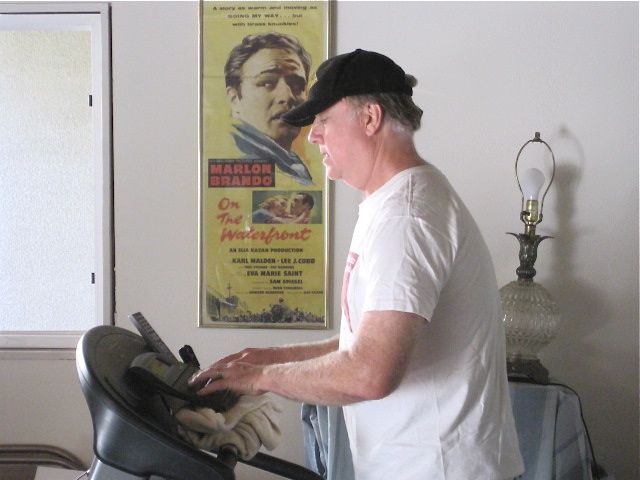
Always looking for a way to save a few bucks (or a few thousand), I figured out a cheapie alternative. As in zero dollars. I already have a treadmill. And I have an AlphaSmart Neo. I just stuffed a towel in the gap between the bar and console, and rested Alphie on top.
Walk at a steady 2.5 and . . . type!
Here is your intrepid correspondent, shedding pounds and creating art, under the watchful eye of Marlon Brando in On the Waterfront.

This must make me the very definition of a lean, mean writing machine.
Which leads to today’s question: where is the strangest place you’ve ever written?  

How Far Do You Go?

Brother Gilstrap mentioned yesterday that it was his job as an author of thrillers to give his readers a wild ride. ‘Tis true, of course, but it got me to thinking about what happens when we climb aboard a horse which we expect to be a stallion but which seems, at least out of the gate, to be a foal. It has happened to me, and I daresay at some point it happens to everyone who reads a fair number of books: the first couple of pages grab you, but twenty or so pages into the story you find that the grip is becoming looser by the paragraph.

My question to you is, how deeply do you go into a book before you check out? What is your line of demarcation? Do you give the author a chance to change your mind? Do you immediately hang it up? Or do you hang in until the bitter end? For me, if I’m not immediately enjoying a book by a familiar or favorite author, I go one-third of the way into it before I even think about calling it quits. If I’m reading a book by an author unfamiliar to me, it’s a bit more complicated. If the narrative (or my mind) seems to be wandering before I’m one hundred pages in, I may consign it to my “later” pile in favor of something more immediately appealing. The same is true if I have no idea what has been happening during the thirty pages or so I just read, or can’t recall, in the words of the famous limerick, who has been doing what and to who. At that point I tend to put the book down wet.

But what about you? How far do you go? A few pages? A few chapters? One-third? One-half? Or do you engage in the literary equivalent of speed dating: the story has to impress you in five minutes, or you’re done?

*******

What I’m reading: The Emperor’s Tomb by Steve Berry. Worth reading for the mention of abiotic oil alone. And for so much more. Berry is a master of rendering the complicated and complex interesting and exciting. And yes, it’s a wild ride.

Last Lines

By John Gilstrap
Over the years, we’ve devoted a lot of space here at The Killzone to the importance of first lines, but in the grand scheme of things, I spend far more time in my own writing fretting over the last line.  I’ve lost track of the books that have held me solidly in their spell all the way till the last couple of pages, only to betray my devotion by short-changing me on the ending.  I vow never to do that.

As a writer of thrillers, I think it’s my job to give my readers a wild ride, filled with exciting twists.  I work hard to make my characters seem alive to readers, and I’m often harder on the good guys than I am on the bad guys–at least for a while.  I owe it to my readers to bring the story to a satisfying ending.  That doesn’t mean that I promise a “happy ending” necessarily, but I do guarantee a sense of peace when the journey is over.  It’s the kind of commitment that I think breeds trust between a writer and his readers.

Now that I’m writing a series, I face the additional challenge of leaving enough of a cliffhanger to compel readers to look forward to the next book without also incurring their wrath by making them feel baited and switched.  To pull all of that off within the time constraints of my contract, I have to know the point to which I am writing the story.

All too often these days, I read books by brand name authors who seem to end their books by running out of words.  The plot develops, climaxes and then . . . I’m at the back cover.  One of the most egregious examples in recent years is John Grisham’s A Painted House.  I actually wondered if I had picked up a defective book where the last chapter had been removed.  Don’t get me wrong: I think Grisham is a great story teller, and as I read it, I thought that House was one of his best.  And then . . . thud.

An even more famous example is Stephen King’s The Stand.  There I was plowing through hundreds of thousands of words, loving it, loving it, loving it, and . . . what are you kidding me??

Here’s the thing about this three-act structure most of us adopt in our writing: A story had a beginning, a middle and an end, and each part is equally important.  There’s no room for laziness.  Every component of every scene needs to pull the reader forward.  The last scene is most important of all, I think, because that’s what the reader will remember forever.

I haven’t always gotten it right, either–at least not if you read some of the letters I’ve gotten over the years.  Nathan’s Run in particular has generated a number of letters from fans who wanted one more chapter.  In fact, the chapter they craved was in my original draft.  I took it out and reinserted it four or five times before I decided to leave it in the drawer.  Without giving too much away, I thought–and I still think, but am less sure–that the story ended when the action ended, and that the final feel-good knot-tying chapter was a step too far.

Of course, I’m the curmudgeon who believes that JK Rowling’s biggest misstep in the largely-wonderful Harry Potter saga is the final chapter–the coda, really–of The Deathly Hallows.  I would rather have imagined the future instead of having it spelled out for me.  It didn’t ruin anything for me; it just felt like one too many bits of storytelling.

What do y’all think?  Any favorite endings out there?  Terrible ones?

For me, the best closing line ever written, bar none, comes from To Kill A Mockingbird: “And he’d be there when Jem waked up in the morning.”  It tells us everything we need to know, and let’s us just float on the satisfaction of time well spent.

Tipos

by Michelle Gagnon

There was a lively debate about typos last week in one of the crime fiction forums. This is always a particularly painful subject for me. You see, I’m a bit of a perfectionist, especially when it comes to my books. I’ve gone through each and every one of them with a fine-tooth comb at least twenty times before they leave my hands and head off to the printer. My sister, a talented editor and copy-editor, has also read through each manuscript three or four times by that point. And of course, my editor and copyediting team at the publishing house have played their part in making sure that the final product is as close to perfect as we can get it.

And yet, somehow, someway, they always get in there.

I first discovered this with my debut THE TUNNELS. My book club offered to read the book, which was a real thrill until they sat down and said almost in unison, “Oh my God, that typo!”

Turns out that a particularly glaring one appears early in the book. I was completely mortified. I raced home after the meeting and dug up my final line-edited copy of the manuscript: no typo. How it got there remains a puzzle to this day.

Which is why I adamantly refuse to crack the cover on my books once they appear in printed form. Because one of those little buggers probably snuck in there. And some sharp-eyed reader is going to make a note of it, and think less of me because of it. Which makes me crazy.

My favorite part of the discussion last week, however, involved other peoples’ “worst typo” ever stories. So I took it upon myself to consolidate the really, truly awful, culled both from that site and other sources:

  • Based on a completely unscientific analysis (conducted by me), one of the more common typos involves neglecting to include the “l” in the word “public.” Several people listed this as an issue, including a woman who produced a newsletter sent to 20,000 pub(l)ic employees, supervisors, and the district office. I would argue that there’s a definite Freudian component to this one.
  • Along the same lines…one contributor used to live on St. Denis Street. Unfortunately their Catholic newsletter incorrectly recorded the “D” in “Denis” as a “P.” And yet somehow, the mail continued to arrive at their house. Apparently they had a better mail delivery person than I have ever been blessed with. Or at least one with a decent sense of humor.
  • Penguin Group Australia once had to reprint 7000 cookbooks due to a typo. The recipe in The Pasta Bible called for “salt and freshly ground black people.” The lesson here: spell check and autofill are not always your friend.
  • One author received a note from a reviewer who, “loved the book, but was concerned by the fact that at one point your heroine looks out across a sea of feces.”
  • And finally, one from the history books: A bible published in the 1600s in London omitted the word “not” in the Seventh Commandment, leading to the mandate, “Thou Shalt Commit Adultery.” Perhaps this is the version many prominent politicians were raised on.

So I’d love to hear any great (as in, truly terrible/mortifying/hilarious) typo stories.

The First Line Game, part II

By Joe Moore

Last month, my blogmate Jim Bell posted a blog called The First Line Game, a cool exercise he and some friends do to have fun with the first lines of their WIP. We’ve often discussed the power (or lack of) that first lines have on the reader. It can’t be emphasized enough how much a first line plays into the scope of the book. For just like first impressions, there is only one shot at a first line. It can set the voice, tone, mood, and overall feel of what’s to come. It can turn you on or put you off—grab you by the throat or shove you away. It’s the fuse that lights the cannon.

Some first lines are short and to the point—built to create the most impact from a quick jab. Others seem to go on and on and on. And only when we arrive at the period at the end do we see how expertly crafted it was for maximum effect.

So in the spirit of sharing what I consider examples of pure genius, true literary craftsmanship, and genuine artistic excellence, I’d like to share what I think are some of the best first lines in literary history. Let’s start with two of the most famous:

It was a dark and stormy night; the rain fell in torrents, except at occasional intervals, when it was checked by a violent gust of wind which swept up the streets (for it is in London that our scene lies), rattling along the house-tops, and fiercely agitating the scanty flame of the lamps that struggled against the darkness. —Edward George Bulwer-Lytton, Paul Clifford (1830)

It was the best of times, it was the worst of times, it was the age of wisdom, it was the age of foolishness, it was the epoch of belief, it was the epoch of incredulity, it was the season of Light, it was the season of Darkness, it was the spring of hope, it was the winter of despair. —Charles Dickens, A Tale of Two Cities (1859)

Lolita, light of my life, fire of my loins. —Vladimir Nabokov, Lolita (1955)

I am an invisible man. —Ralph Ellison, Invisible Man (1952)

The sun shone, having no alternative, on the nothing new. —Samuel Beckett, Murphy (1938)

This is the saddest story I have ever heard. —Ford Madox Ford, The Good Soldier (1915)

It was a wrong number that started it, the telephone ringing three times in the dead of night, and the voice on the other end asking for someone he was not. —Paul Auster, City of Glass (1985)

The sky above the port was the color of television, tuned to a dead channel. —William Gibson, Neuromancer (1984)

All this happened, more or less. —Kurt Vonnegut, Slaughterhouse-Five (1969)

If you really want to hear about it, the first thing you’ll probably want to know is where I was born, and what my lousy childhood was like, and how my parents were occupied and all before they had me, and all that David Copperfield kind of crap, but I don’t feel like going into it, if you want to know the truth. —J. D. Salinger, The Catcher in the Rye (1951)

Through the fence, between the curling flower spaces, I could see them hitting. —William Faulkner, The Sound and the Fury (1929)

Ships at a distance have every man’s wish on board. —Zora Neale Hurston, Their Eyes Were Watching God (1937)

He was an old man who fished alone in a skiff in the Gulf Stream and he had gone eighty-four days now without taking a fish. —Ernest Hemingway, The Old Man and the Sea (1952)

It was the day my grandmother exploded. —Iain M. Banks, The Crow Road (1992)

It was a pleasure to burn. —Ray Bradbury, Fahrenheit 451 (1953)

It was love at first sight. —Joseph Heller, Catch-22 (1961)

Once upon a time, there was a woman who discovered she had turned into the wrong person. —Anne Tyler, Back When We Were Grownups (2001)

We started dying before the snow, and like the snow, we continued to fall. —Louise Erdrich, Tracks (1988)

Every summer Lin Kong returned to Goose Village to divorce his wife, Shuyu. —Ha Jin, Waiting (1999)

In my younger and more vulnerable years my father gave me some advice that I’ve been turning over in my mind ever since. —F. Scott Fitzgerald, The Great Gatsby (1925)

"To be born again," sang Gibreel Farishta tumbling from the heavens, "first you have to die." —Salman Rushdie, The Satanic Verses (1988)

The seller of lightning rods arrived just ahead of the storm. —Ray Bradbury, Something Wicked This Way Comes (1962)

Granted: I am an inmate of a mental hospital; my keeper is watching me, he never lets me out of his sight; there’s a peephole in the door, and my keeper’s eye is the shade of brown that can never see through a blue-eyed type like me. —GŸnter Grass, The Tin Drum (1959; trans. Ralph Manheim)

In the late summer of that year we lived in a house in a village that looked across the river and the plain to the mountains. —Ernest Hemingway, A Farewell to Arms (1929)

He was an inch, perhaps two, under six feet, powerfully built, and he advanced straight at you with a slight stoop of the shoulders, head forward, and a fixed from-under stare which made you think of a charging bull.  —Joseph Conrad, Lord Jim (1900)

The past is a foreign country; they do things differently there.  —L. P. Hartley, The Go-Between (1953)

I write this sitting in the kitchen sink. —Dodie Smith, I Capture the Castle (1948)

Of all the things that drive men to sea, the most common disaster, I’ve come to learn, is women. —Charles Johnson, Middle Passage (1990)

In the town, there were two mutes and they were always together. —Carson McCullers, The Heart is a Lonely Hunter (1940)

High, high above the North Pole, on the first day of 1969, two professors of English Literature approached each other at a combined velocity of 1200 miles per hour. —David Lodge, Changing Places (1975)

The cold passed reluctantly from the earth, and the retiring fogs revealed an army stretched out on the hills, resting. —Stephen Crane, The Red Badge of Courage (1895)

Let’s finish with my personal all-time favorite:

It was a bright cold day in April, and the clocks were striking thirteen. —George Orwell, 1984 (1949)

So which ones have I missed? If it’s not on this list, what’s your favorite first line?

————————————
THE PHOENIX APOSTLES, coming June 2011
"A knockout apocalyptic thriller." – Douglas Preston

Save the snollygoster, and other dying words

I voted for a snollygoster this week, and I’m not ashamed to admit it.

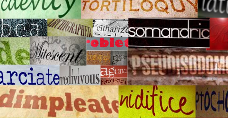
Snollygoster (“a shrewd, unprincipled person, especially a politician”) is a word I adopted this week over at SaveTheWords.org. The web site enables people to “adopt” underused or dying words that are at risk of being dropped from the English language.

According to Savethewords, 90 percent of everything we write in English is communicated by only 7,000 words. People can browse through the Savethewords site, adopt neglected words, and pledge to promote them by using the words in everyday communication. (The site has a fun interactive display–the words actually leap at you and demand to be chosen).  

As writers, we all love finding fresh and original-sounding ways to communicate. Who doesn’t want to sprinkle her prose with potent words such as mingent (discharging urine), philagyrist (someone who loves money), woundikins (a mild profanity), jobbernowl (a stupid person), or mowburnt (crops spoiled by becoming overheated)? 

Once you’ve adopted a word over at Savethewords, you can order a tee shirt with your word printed on it.  Maybe next election I’ll order some shirts with “Snollygoster” printed on the back and hand them out to my least-favorite candidates. Hopefully they won’t bother to look it up.

How about you? Is there a particular word you’d like to save from extinction?

Is a Higher Profile Agent Better?

by Clare Langley-Hawthorne

So I few of my writing friends are in the process of changing agents and agonizing over who to approach. Most have references from other writers which (in my opinion) is a good way to proceed but they are also weighing up their options based on the status of the agents involved. This reminded me of a conversation I had at a writers conference a few years ago where a young would-be author quizzed me on the merits of getting a ‘high profile’ New York agent versus a local California agent (something I was totally unqualified to help her with!).

When I was looking for an agent this was the last concern on my mind (hey, I was amazed anyone would want to represent me at all!) – what I really wanted was an agent that felt like a good fit for my work and who would champion my books.

Still, I wonder whether the perception continues that having a higher profile, ‘status’ agent is better. Does it perhaps help when it comes to landing a book deal (?), does it make an author feel more important to have an agent who represents a whole heap of bestsellers (?), does it, in short, matter (?)

So what do you think? Does a higher profile agent make a difference?

Want to Be a Professional Writer? Act Like One.

James Scott Bell

I’ve been teaching at writers conferences for over fifteen years, and I’ve seen a ton of aspiring writers in various stages of disequilibrium. Everyone wants to get a book contract, and everyone’s a little scared they never will. They hear stories about the odds and it sends shivers to the tips of their typing fingers.
Those who persevere have a chance.
In the course of these conference years I’ve seen a number of writers who have gotten that contract and gone on to be published by major houses. I’ve even helped a few get there, which is nice. And while it’s nearly impossible to judge why one manuscript makes it and another, which is comparable or even better, does not, I have made note of one item. The overwhelming majority of writers I’ve seen make it are those who look and act like a professional.
When you meet unpublished writers who act like pros, you form the immediate impression that it’s only a matter of time before they make it. This impression is not lost on agents and editors.
So what are the marks of a professional?
1. Grooming. Successful writers-in-waiting look professional. They do not come off as slobs or slackers. They dress sharply though unpretentiously. They say you can’t judge a book by its cover, but we do it all the time with people. Don’t shoot down your first impression by looking unkempt or having stink-breath that can kill low flying birds.
2. Industry knowledge. Professionals know something about their profession. They spend time reading blogs and books and the trades, though not to the exclusion of their writing.
3. To the point. A pro has the ability to focus on what the other person (e.g., an agent) will find valuable and, most important, can deliver that in a concise and persuasive manner. You should be able to tell someone, in 30 seconds or less, what your book is about, in such a way that the person can immediately see its potential.
4. Courtesy. Common courtesy goes a long way. If you have an appointment with an agent, be there two minutes early. When you’re done, thank them. Follow up with a short and appropriate e-mail.  Don’t call them unless you’ve been invited to. Don’t get angry or petulant, even if there’s a reason for it. Burning bridges is never a good career move.
5. Take action every day. Over the long haul, a successful professional in any field is always in a growth mode. Always looking for ways to improve, studying, doing, taking action toward goals. When you do this, day after day, you begin to build momentum. That, in turn, will fuel your confidence and keep you going. And there is nothing an unpublished writer needs more than motivation to keep going.
So . . . keep writing. Keep learning. And act like a pro. 

Bringing Inhumanity Home

I love a good history. This week, while I’ve been healing, I’ve been reading a history on my Kindle. BLOODLANDS, by Timothy Snyder. It is the true story of the largest loss of human life in human history, and all due to the efforts of two men: Adolph Hitler and Joseph Stalin. Hitler is the illustration for evil, but Stalin made Hitler look like Mother Theressa. I’m not talking about their soldiers killing each other, and people in the way of those battling forces, but innocent people targeted specifically. Genocide and ethnic cleansing and murder and destruction of life on such a scale that it is inconceivable. The thought of having tens of thousands of people to slaughter millions is so stunning there is no word to describe it.

We write books about threats on a personal level, not wholesale butchery. As I read the statistics––fifty thousand here, three hundred thousand there ––I realized that the scale made less of an impression than two here and ten there. Each of these forty or fifty million individuals had a life and a story, as each killer had, but with few exceptions they were never recorded except as a name and number, a space in a hole or bones under the sky. If you want to read the whys and hows of the mega murder of whole ethnic populations, political movements, and religious groups, it’s a good enough book. But in all of the numbers and statistics and justifications and evil there was one scene that most horrified and affected me. There were two orphaned Jewish children on the street in the Warsaw ghetto when a van stopped to collect them for death. The girl, holding her brother’s hand, told the German soldiers, “Please, sir, don’t hit us. We will get into the truck ourselves.” I am more haunted by those words, and that scene, than by all the murder and mayhem in the entire book. Sometimes, one personalizing paragraph is worth a library of facts and figures. You suddenly can imagine your own children or grandchildren in the same situation and it breaks your heart on a whole new level.

What I’m driving at here is the small stories within larger ones often make the difference to the reader.