
The pricing of ebooks is fodder for much discussion these days. I recently read one self-publishing advocate who says a strategy to pursue is writing scads of short stories and pricing them at $2.99 each. Unless your name is Stephen King, I’m not sure I would agree. Since full-length novels can be had for 99 cents and $2.99, wouldn’t most people think that a short story at $2.99 is too pricey? Worse, if the title is not clearly labeled “short story” and they get it and finish it in ten minutes, wouldn’t there be some blowback?
Maybe I’m wrong. So I’m throwing it open for a little market research. How do you readers feel about $2.99 for a short story?
Key Book Production Costs for Self-Published Authors
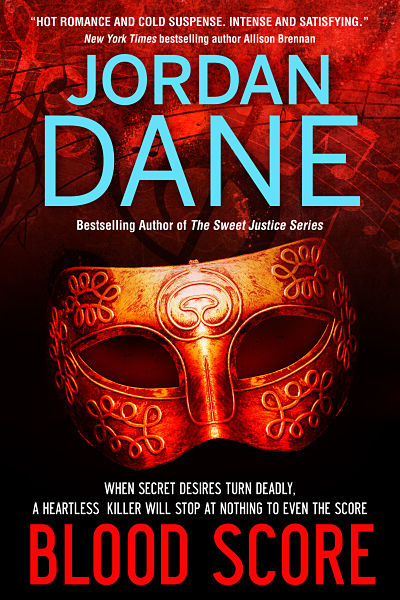
After James Scott Bell’s excellent post “We Are All Long Tail Marketers Now”, several side discussions took place in the comments regarding my self-published novel – BLOOD SCORE now available through the Amazon Kindle Select Program (my first time using this program). I’ll have the book discounted until August 1. (I love how the TKZ community gets involved with each post. Thank you.) Questions came up about my editing and production experiences with this novel since it is outside my traditionally published works.
As I mentioned in my comments on Jim’s post, the business end has always been a drain for me. Self-pubbing involves more than promo. It’s production of the actual book and the promo is ongoing (as it is for me with traditional publishers too), but with indie I’m in control of my production schedule, retail pricing and subrights decisions, and can capitalize on promo ops when I want to. Being a hybrid author, straddling traditional and indie publishing, gives me more options and many “irons in the fire.” I have many more points mentioned in another post I did on the subject. On my group YA blog ADR3NALIN3, I did a post on the “Ten Reasons Why I Am Self-Publishing.”
I wanted to dip my toe into the waters of indie with a non-fiction book as well as a short story anthology so I would know what was involved in production and to build up my contacts for service providers. My upcoming full-length novel project will be more about learning promotion. I’ve got loads of personal bookmarks for service providers, but the marketing side of the business needed work on my part. I’ve created a Self-Pub Resource tab on my YA blog-Fringe Dweller. I hope to update it as I go along. For now it encompasses review sites for digital books. That resource tab will be a work in progress as I go.
Basically, here are the indie production costs as I see them:
1.) Edits: $500-$1800+ – This is a tough one to estimate, but important. I’ve seen this cost higher, depending on if you need a book doctor or not. It depends on how much work needs to be done and who you use as editor. A good editor is worth their weight in sales, so shop wisely. Beta readers will only get you so far. Having said that, I’ve had some good and terrible copy editors on my traditionally published books. Being traditionally pubbed does NOT guarantee you will get a good one. At least with indie books, you can make the decision on who to use on current and future projects.
For this project I used authors/editors Alicia Dean and Kathy Wheeler. They helped with formatting and editing and made that effort painless and fun.
2.) Cover $150-400 – This range depends if you are doing a version for print or just digital. The print design costs more because it involves the design of a spine and back cover. You can do a cheaper cover by merely paying for one digital image from iStock or some other provider and add font and do it yourself graphically (not recommended), but a cover needs to look good on a thumbnail and a bad design can kill sales. On BLOOD SCORE, I used Croco Designs and love Frauke Spanuth, the designer. I’ve used her for blog header designs and bookmarks and now covers. She’s a German designer who works for publishers too. Her costs are reasonable on all fronts and she’s easy to work with and fast, but there are many cover designers out there now. Look through portfolios to find one you like.
3.) Formatting $100-150 – You can do this yourself, but I’ve never tried it. There are software programs, but haven’t tried that either
4.) Promotion $50-Whatever – This is totally up to you. There are many free sites that promo ebooks now (that are focused on ereaders), but there are also bundlers who will charge you $50 or so to post promo to 45 sites, etc. I’m hoping to try this with BLOOD SCORE.
5.) ISBN #s – this is an investment for future books. I bought 10 numbers, which keeps the cost down. I think the individual book price is higher to retain your own ISBN#, or you can use the one that Amazon or others assign you for free, but I prefer to have control of my own ISBNs. So this ISBN cost can cost you nothing, unless you decide you want control like I did. So spread $250 across ten books if you retain your own ISBNs.
So all in, you might pay $800 – $2400 (excluding ISBN costs), but you can manage your price to earn 35% – 70% royalty with a better monthly cash flow where you can control the price and promo ops. Using a price of $0.99 you’d earn 35%, but $2.99 or better and your royalty would be 70%. For a novel length book, I might discount it to $.99 for a certain period on release, but then move it up to $4.99. Hard to say what breakeven would be without real sales figures behind it, but you can play with the math.
$4.99 at 70% royalty, you’d have to sell 229 – 687 books to clear the cost range I mentioned. Mind you, this does NOT take into account any promo ad costs and assumes only one price at the higher royalty rate. If you were to move that price point to $2.99 at 70% royalty, your sales would have to be 382 – 1148 to breakeven.
A writer friend of mine shot me some real numbers. (I’m also on an indie writers loop where I hear lots of good info.) It takes having a number of good books to build up your “virtual shelf” of offerings and build your readership. Again, I repeat. Good books. But my crime fiction author acquaintance is seeing $7,000 – $10,000 per month for 8 novels or so, and this will grow as new material gets added. This author crafts a solid book and writes full time.
For me, I like having traditional contracts to fill, but I want the more immediate cash flow too, rather than waiting for royalty statements every 9 months (by the time they reach you). (Antiquated accounting methods and reporting systems for traditional publishers, in a digital age when sales are more immediate through Amazon and other online retailers, are more things that I hope will change.)
The last thing I’d like to talk about is the value of “a la carte” subrights (ie foreign rights, audio, print vs digital). In many deals, these rights are lumped in and assumed to be part of the deal, but should this continue as advances drop? Or if advances drop, shouldn’t the royalty percentage increase to offset the lower upfront money? Subrights have value to the indie author. (Here’s a LINK to a post I did on self-publishing in audio, for example.) If an author gets an offer, but the advance is marginal or too low to tie up copyrights for years (something I am presently experiencing on my back list), do you have options?
You can certainly turn the deal down. That’s one option. I did this with BLOOD SCORE when I got an offer to buy it from a big house. After my experiences, the offer wasn’t good enough to deal with the aftermath of a rights tie up into infinity.
Even if an advance is $10,000-15,000/book, that might not be enough if the terms of the contract are onerous over the long haul. Successful thriller Barry Eisler turned down a deal from a traditional house for $500,000+. That boggled my brain, but no one knows the terms of that deal that made Barry change his mind. He’s a real marketing guru and has a solid readership. Deals are subjective.
These days this is a personal decision each author has to make, but if publishers would negotiate on terms, a marginal advance deal might work if the number of years for digital rights can be limited before they would automatically revert back to the author (ie 2-3 yrs only) or if UK rights were granted but digital rights in the US are retained. Some successful indie authors have retained digital rights, but sold print rights (ie John Locke to Simon and Schuster). With “out of the box” thinking and a little negotiating, some of these marginal deals can be done if the parties agree on specific terms, but I’m not sure traditional houses are open to such change yet.
Food for thought and discussion at TKZ:
1.) If an advance is too low to tie up copy rights, what terms do you think can be negotiated to make the deal happen? Do you think the publishing industry is changing in this regard?
2.) If you’re an aspiring author, would you sign a contract at ANY advance to be published, or do certain contractual terms matter to you?
The Perfect Pitch
By Joe Moore
On Monday, Boyd Morrison wrote about ThrillerFest, taking place this week in NYC. H e spoke of AgentFest, a part of the conference that gives attendees the opportunity to pitch their manuscript to some of the top literary agents and editors in the industry.
Building on Boyd’s post, I want to share some tips for improving your chances of connecting with an agent or editor, especially in person at a writer’s conference or similar event.
We all know how important it is to prepare when pitching a manuscript, whether it’s at AgentFest (this year with 50+ agents) or any other occasion: look professional, act professional, be able to summarize your premise in a couple of sentences, and know that not every book is right for every agent (most of the time, that’s why they say no).
But what about those things you don’t want to do; those things that could wreck you presentation or turn off the agent? Here are a few pitfalls to avoid:
Never refuse advice or feedback. Even if the agent or editor is not interested in your book, many times they will offer suggestions or advice on making it more marketable. Never have a closed mind and think that it’s your way or the highway. Professional agents know the market and are aware of what the publishing houses are looking for at any given moment. Also remember that just because an agent is not interested in your book doesn’t mean the book is not publishable. It’s just not for them.
Don’t begin your pitch by saying that “everyone loves my book”. Of course they do, because everyone is probably your family and friends, and the last thing everyone wants to do is hurt your feelings. If they were completely honest with you, it would be like hitting your ego with a sledgehammer. Now on the other hand, if Dan Brown, Ken Follett or Stephenie Meyer read your manuscript and loved it, I would mention that somewhere right after "hello".
Don’t be a pest. By that I mean sending the agent multiple emails, phone calls, letters, presents, or anything else that would quickly become annoying. If the agent says no, the likelihood of you turning them around with a box of Godiva chocolates is not good. Send it to me instead.
Don’t suggest that if the agent wants to know all about you they can visit your website or blog. It doesn’t matter if Michelangelo designed your graphics, James Patterson wrote your text, and Bruno Mars composed the music for your book trailer. The agent doesn’t care. All she wants to know is: who are you, what is your idea, and can you present it in a logical, concise and professional manner.
Even if your manuscript has been rejected before, don’t volunteer that information. As far as the agent is concerned, they’re getting the first look at your idea. They’re also realistic and know it’s probably been pitched before. And the fact that you’re standing there means that if it was, it was rejected. Always remember that rejection is as much a part of the publication process as line editing or cover design. It happens to everyone. Move on.
Don’t claim that no one has ever written anything like your book before. If that’s really true, there’s probably a good reason no one has. But trust me, claiming that what you’ve written is a brand new idea is as compelling as claiming you have the winning numbers for tomorrow’s lotto. What you might want to do is suggest that you’ve completed a unique and original treatment of a well-established theme or premise. That will make sense to the agent.
Never say that your book is going to be the next blockbuster or that it should be made into a movie. The top professionals in the publishing and motion picture industries cannot predict with certainty what will be the next blockbuster or bestseller. Neither can you.
In general, always assume that an agent or editor has already heard every variation on a theme there is, because they have. Much of your success in capturing the attention of an agent is you, not your story. Be enthusiastic but not obnoxious, knowledgeable but not condescending, proud but not conceded, prepared but not pushy. And most of all, be friendly and professional. Your presentation is a foreshadowing of what it would be like to work with you. Agents don’t want to spend a year or more in a wrestling match with a jerk.
Remember that literary agents and editors are people, too. Yes, they can have a tremendous impact on your writing career, both positive and negative. But just like the rest of us, they get excited when they hear a great idea. Treat them as people, not gods.
If you practice all these tips and you have a killer idea for a book, there’s a good chance the agent will hand you her business card and ask for a partial. And if by chance, she asks for a full, go celebrate. You’ve accomplished more than most ever will.
Any other pitching tips out there?
Is touring worth the tsouris?
By P.J. Parrish
Yesterday we wrapped up the Michigan Fingers Tour. Those of you from Michigan might get what this means. The rest of you just need to know that we Michiganders locate our place on earth by holding up our hand and pointing to the spot on our palm from which we hail.
The “fingers” of the Michigan mitt is the northwest area of the state up near Traverse City. It’s home for my sister and co-author Kelly – the lovely village of Elk Rapids. I, who have been rooted in the south Florida sand for 35 years now, have been “up north” for the last two weeks as Kelly and I wended our way through the great little towns of the fingers, promoting our latest book HEART OF ICE.
Our book is set in northern Michigan, so heading up north here was a no brainer. But the experience also left us going back to an old question: Is touring – and its lesser kin, signings– still worth the time and effort?
We authors debate this question endlessly. In these days of diminished expectations and budgets, only the big guns get the promotional blastoffs. And with all the social networking options (you can even do virtual signings now), does a writer still have anything to gain from taking his act on the road?
Touring used to be one of the essential tools of promoting your book. The “national tour” was a benchmark of arrival in the traditional publishing world. Even if you didn’t have enough clout with your publisher to have them pay your way, we authors often planned and paid for our own tours.
Kelly and I have done it both ways during our career. For our fourth book, A KILLING RAIN, our publisher sent us on a big-time tour that had us crisscrossing the country for two weeks. It was the full treatment, complete with escorts greeting us at airports holding up our covers, nice hotels with room service, and even business class on the last leg coming home. It was fun, exciting, rewarding. It was also disappointing and frustrating. Some stores had healthy crowds waiting for us; a few had none. By the time we hit our final Barnes and Noble (I think it was in Nashville?) we were numb with exhaustion but grateful for the crowd who turned out in what should have been a killing rain.
Now, I can hear you saying, “What’s she bitching about? At least she GOT a paid-for tour!” Well, yes we did. But every other tour we have done, like the huge majority of authors, came out of our own pockets. Those tours have been exciting, rewarding, disappointing and frustrating. The point being: There doesn’t seem to be much difference whether our pub paid for it or we did. The effort and time invested – and results achieved – seemed to be the same.
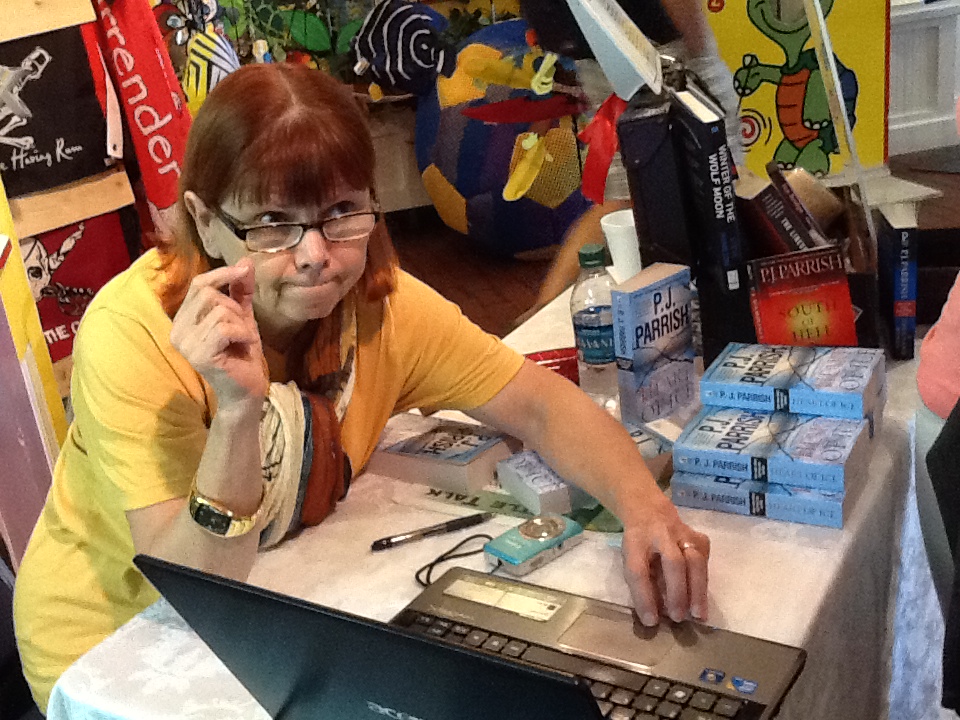
There’s a difference, of course, between whether you are doing an “event” where you are speaking, and a signing, where you are just meeting and greeting for two hours. Sitting behind the old card table isn’t nearly as demanding, of course, as giving a full-scale talk. (That’s me above signing at the Island Bookstore on Mackinac). On our current tour, we had a big adoring crowd at Saturn Books in Gaylord, a town in the middle of the state that no one would expect to worth the time. But the owner, Jill Miner, is a genius at cultivating readers; she could give indie owners lessons. Here’s the great folks at her store:
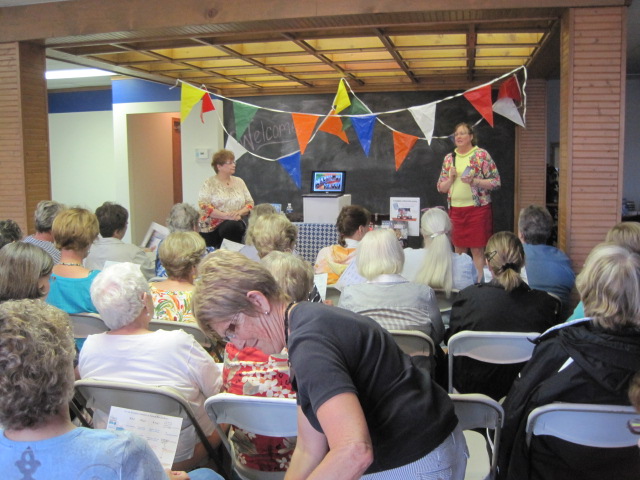
On Mackinac Island, we did a ticketed author event and had an enthusiastic crowd. Here they are. Plus the view you get if you go out the library’s back door.
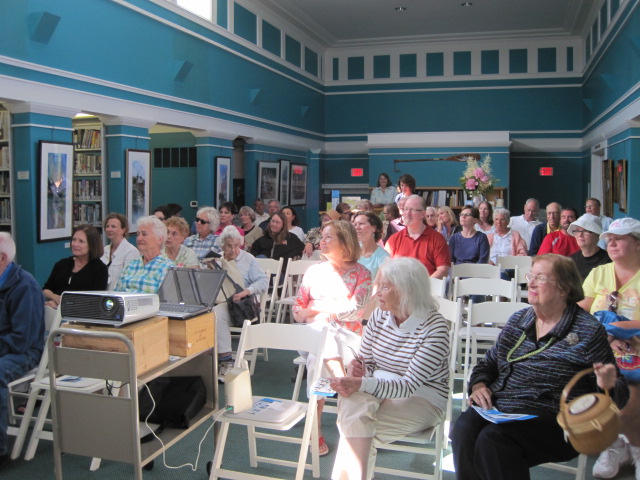

Sometimes, you just can’t predict what you’re going to get. Two days after Mackinac Island, we were dreading a signing at a Books a Million because our past experience with this chain had been sort of meh. But we sold out all our stock. At one other store that we thought would draw well, only two people showed up. (We discovered later the store had done nothing to promote us.)
The nadir was a store that, when we arrived, told us they had none of our books because they had sold out for days ago. Hello? A phone call or email would have been nice before we drove two hours. We had an emergency box of books in the trunk but the owner told us she couldn’t figure out how to charge them against her inventory. We went down the street, had a glass of wine and drove the two hours back home in the dark woods, me watching for deer the whole wretched way. (I’m paranoid about hitting a deer and wrecking the car.)
Before this, we hadn’t toured in a long time. But we did this one because our book is set in Michigan (on bucolic Mackinac Island) so we knew we’d get the regional bump. But we also did it because northwest Michigan is rife with really top-notch independent bookstores. These stores have owners who cultivate their readers and treat visiting authors like royalty. They don’t just set up a table in the back of the store and leave you to fend for yourself. They send out newsletters, pre-stock and hand-sell your backlist, do email blasts and get you local media interviews.
If you are ever in Michigan on tour, here are some of the stores you should never miss (plus most of them are in pretty towns):
Saturn Books, Gaylord.
McLean and Aiken, Petoskey
Island Bookstore, Mackinac Island
Schuler’s Okemos/Lansing
Bookman, Grand Haven
Book Nook and Java Shop Montague
Cottage Bookstore Glen Arbor
And downstate: Aunt Agatha’s in Ann Arbor.
So was the Michigan Finger Tour worth it?
In the plus column: we met a lot of great bookstore owners whose hand-selling helped us immensely. And we met some terrific readers, and gained many new ones. Is there any better feeling than meeting face-to-face a person who tells you they love your books? Touring gives you an infusion of confidence and affirmation that you can never duplicate on Facebook.
In the minus column: It’s tiring, often deeply discouraging, expensive, and unless you are one of those writers who can crank out chapters on a plane, you lose valuable writing time.
One final thought: They say indie stores are making a small comeback. If the ones we saw are any indication, there is, indeed, hope. And maybe hope is what is really the most important thing we get from going out on the road these days.
Just watch out for the deer.
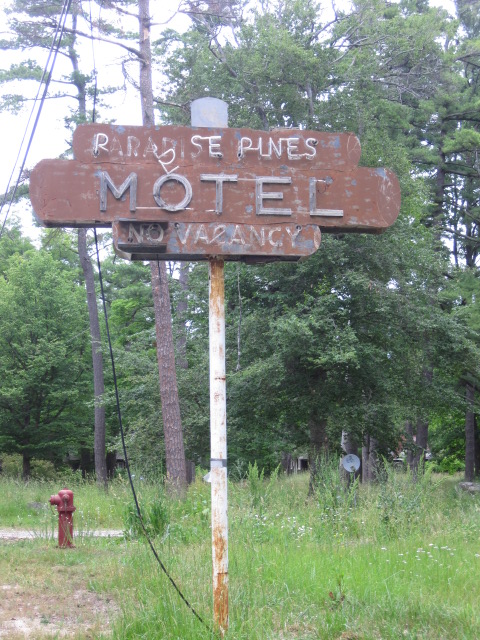
p.s. The picture leading off this blog is in the old Paradise Pines hotel in Kelly’s hometown of Elk Rapids. We did not stay here while on tour.
The Stars Are Out at ThrillerFest
I would love going to an actors’ convention where I could have dinner with Sandra Bullock, take an acting class from Michael Caine, audition for a role in the next Spielberg movie, and share laughs at the bar with the cast of Castle. Won’t ever happen. It sounds too good to be true because it is. But that kind of dream conference does exist for thriller writers and fans. It’s called ThrillerFest, which will be held in New York City on July 10-13, 2013.
The attendees this week include writers who live on the New York Times bestseller list. The five spotlight guests alone–R.L. Stine, Anne Rice, Michael Connelly, Michael Palmer, and T. Jefferson Parker–have sold somewhere in the neighborhood of 500 million books. And everywhere you look at the conference, you’re blinded by the star wattage: Lisa Gardner, Steve Berry, Lee Child, Catherine Coulter, Douglas Preston, Heather Graham, Brad Meltzer, Joseph Finder. It’s as if you could get into the Oscars merely by paying a registration fee.
But the really amazing thing about ThrillerFest is that you get to meet and talk to these people, not just ogle them from afar. When I was a newbie unpublished author at the inaugural ThrillerFest in Phoenix seven years ago, I didn’t know a soul. At the opening cocktail reception, I spent most of the time ambling about, listening in on snippets of conversation as I tried not to spill red wine down my shirt. Then I spotted Jon Land, an author I’d been reading for years. I gathered up my courage and nervously introduced myself, telling him that I was a huge fan. To my shock he asked me to join his group for dinner, where we had a fantastic time. In what other entertainment medium could that happen?
While I’ve mentioned some of the big names you can hobnob with, there are also plenty of up and coming writers who attend, some of whom will be household names in a few years. Imagine getting to know Dan Brown or Stephenie Meyer just before they hit it big. And because I’ve gone to the convention every year, I’m lucky to count many of these future publishing phenoms as friends.
ThrillerFest is also a great deal for unpublished authors looking to break into the business. Through an event called AgentFest, aspiring writers can pitch their novels to a who’s who of the biggest agents in publishing. I was fortunate enough to find my own agent there. Before I met her my manuscripts barely got a nibble. Now I’m the director of AgentFest, my sixth thriller, THE LOCH NESS LEGACY, has just come out, and my novels are published in 22 languages. If I hadn’t attended ThrillerFest, who knows what I’d be doing?
For those looking to hone their writing skills, CraftFest offers a wealth of knowledge that is available nowhere else. You can actually take writing classes from legendary authors like Connelly, famed for books such as THE POET and THE LINCOLN LAWYER, and David Morrell, the creator of Rambo. The biggest problem is the information overload you might experience trying to cram every nugget of wisdom into your brain.
The best part of the conference is hanging out with these authors at the bar, the central gathering place. At first you’ll regard them with awe that they have descended from the heavens to walk amongst us. Then when you’re introduced to them, you’ll realize that they’re just people, too–although extremely talented, friendly, fascinating people. They’re happy to greet fans and share their insights about the business. Buying them a drink doesn’t hurt, either, though this being New York you’d better hang onto your wallet for a bumpy ride.
If you do get some of these writers liquored up, don’t be surprised if you laugh yourself silly as they spin wild tales of publishing wackiness, crazed fans, and book tours gone wrong. After all, these people know how to tell a story.
The Magical Midpoint Moment
Being a structure guy, I’ve always been fascinated by how story works. When I was first learning the craft, I spent a year studying the 3 Act structure, taking my cues primarily from Syd Field’s classic, Screenplay. In that book, Field talks about plot points, the hinges that lead the plot into Act 2 and Act 3. But I found frustrating a lack of definition of how these plot points worked. What was supposed to be in them? Field knew something happened, he sensed it, but wasn’t quite able to define it.
After watching movie after movie and charting their structures, it came to me. Especially that first plot point, which I began calling “the doorway of no return.” That’s because something has to happen to thrust the lead character into the dangers of Act 2. When you know this in your plot, and put it in the right place, it keeps your novel from dragging and gives it the momentum it needs to carry it to the end. It’s crucially important.
Then, a couple of years ago, I decided to do more in-depth study on what many writing teachers call the “midpoint.” If you do a search about midpoint on the Internet, you’ll find all sorts of ideas about what is supposed to happen here. Some people talk about “raising the stakes.” Others talk about this being the point of commitment. Still others say it’s a change in the direction of the story, or the gathering of new information, or the start of time pressure.
So once again I started watching movies with the midpoint in mind. And what I found blew me away. Even though the writers may not have been conscious of it, they were creating something in the middle of their stories that pulled together the entire narrative. The name I gave it is the “look in the mirror” moment. My workshop slide looks like this:
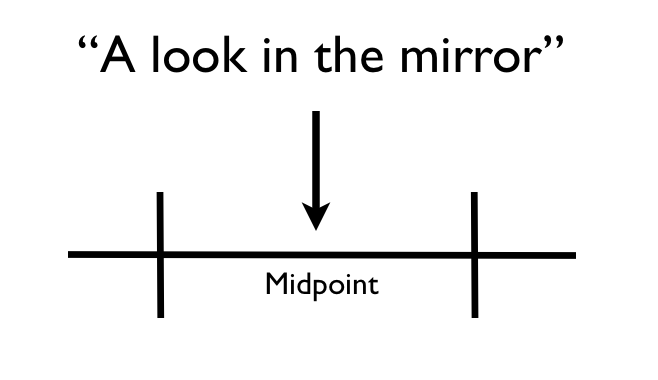
At this point in the story, the character figuratively looks at himself. He takes stock of where he is in the conflict and, depending on the type of story, has either of two basic thoughts. In a character-driven story, he looks at himself and wonders what kind of person he is. What is he becoming? If he continues the fight of Act 2, how will he be different? What will he have to do to overcome himself? Or how will he have to change in order to battle successfully?
The second type of look is more for plot-driven fiction. It’s where the character looks at himself and considers the odds against him. At this point the forces seem so vast that there is virtually no way to go on and not face certain death. That death can be professional, physical, or psychological.
These two basic thoughts are not mutually exclusive. For example, an action story may be given added heft by incorporating the first kind of reflection into the narrative. This happens in Lethal Weapon when Riggs bares his soul to Murtaugh, admitting that killing people is “the only thing I was ever good at.”
These two basic thoughts are not mutually exclusive. For example, an action story may be given added heft by incorporating the first kind of reflection into the narrative. This happens in Lethal Weapon when Riggs bares his soul to Murtaugh, admitting that killing people is “the only thing I was ever good at.”
A few more examples may help.
In Casablanca, at the exact midpoint of the film, Ilsa comes to Rick’s saloon after closing. Rick has been getting drunk, remembering with bitterness what happened with him and Ilsa in Paris. Ilsa comes to him to try to explain why she left him in Paris, that she found out her husband Viktor Lazlo was still alive. She pleads with him to understand. But Rick is so bitter he basically calls her a whore. She weeps and leaves. And Rick, full of self disgust, puts his head in his hands. He is thinking, “What have I become?”

The rest of the film will determine whether he stays a selfish drunk, or regains his humanity. That, in fact, is what Casablancais truly about, in both narrative and theme.
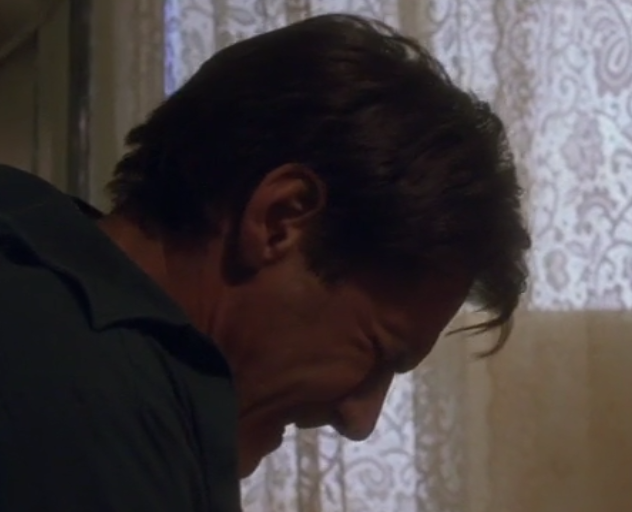
In The Fugitive, an action film, at the very center point of the movie Dr. Kimble is awakened in the basement room he’s renting, by cops swarming all over the place. He thinks they are after him, but it turns out they are actually after the son of the landlord. But the damage is done. Kimble breaks down. He is looking at the odds, thinking there’s no way he can win this fight. There are too many resources arrayed against him.
Then I went looking for the midpoint of Gone With The Wind, the novel. I opened to the middle of the book and started hunting. And there it was. At the end of Chapter 15, Scarlett looks inside herself, realizing that no one else but she can save Tara.
The trampled acres of Tara were all that was left to her, now that Mother and Ashley were gone, now that Gerald was senile from shock . . . security and position had vanished overnight. As from another world she remembered a conversation with her father about the land and wondered how she could have been so young, so ignorant, as not to understand what he meant when he said that the land was the one thing in the world worth fighting for.
Scarlett wonders what kind of person she has to become in order to save Tara. And the decision is made in the last paragraph:
Yes, Tara was worth fighting for, and she accepted simply and without question the fight. No one was going to get Tara away from her. No one was going to send her and her people adrift on the charity of relatives. She would hold Tara, if she had to break the back of every person on it.
And that is the essence of GWTW. It’s the story of a young Southern belle who is forced (via a doorway of no return called The Civil War) to save her family home.
Also, notice how this is different from other definitions of the midpoint you’ll see. Virtually all books on the craft approach it as another “plot” point. Something external happens that changes the course of the story. But what I detect is a character point, something internal, which has the added benefit of bonding audience and character on a deeper level.
Also, notice how this is different from other definitions of the midpoint you’ll see. Virtually all books on the craft approach it as another “plot” point. Something external happens that changes the course of the story. But what I detect is a character point, something internal, which has the added benefit of bonding audience and character on a deeper level.
In preparing for this post, I grabbed three of my favorite movies and went to their midpoints. Here’s what I found:
In Moontstruck,right smack dab in the middle, is the scene where Loretta goes into the confessional, because she has “slept with the brother of my fiancé.” The priest says, “That’s a pretty big sin.” Loretta says, “I know . . .” And the priest tells her, “Reflect on your life!” He is actually instructing her to look in the mirror!
There’s a perfect mirror moment in It’s a Wonderful Life. It’s the moment where Mr. Potter offers George Bailey a well-paid position with his firm, a job that will mean security for George’s growing family. In return, though, George will have to give up the Building & Loan his father started. Potter offers George a cigar and George asks for time to think it over. He is actually requesting look-in-the-mirror time, and is seriously considering this move. Then he shakes Potter’s hand, and the oily exchange suddenly clarifies what’s at stake for him as a person. “No,” he says, “now wait a minute here. I don’t need twenty-four hours. I don’t have to talk to anybody. I know right now, and the answer’s No!” George had to make a decision as to what kind of man he was going to be. And he chose not to become another Potter.
Finally, in Sunset Boulevard, in the middle of the movie to the minute, Joe Gillis also has to decide what kind of man he is. Norma Desmond, his benefactor and lover, has tried to kill herself because Joe found a girl his own age that he wants to start seeing. When Joe hears about it he rushes back to her mansion with the thought that he’ll finally tell her it’s over, that he’s leaving. But she threatens to do it again. And Joe sits down, literally, next to a mirror. In that moment he makes his fateful decision, the one that drives the rest of the movie.
Could the reason these movies are classics, and others not, be that the writers understood the power of the look in the mirror? Whether instinctive or purposeful, they knew exactly what to do.
Books:
In the middle of The Silence of the Lambs, Clarice is alone in her room, having just heard of Chilton’s betrayal of Lecter, meaning she won’t get any more information from him, meaning the certain death of the kidnapped girl she’s been trying to save. The odds are now firmly against her and the FBI. In the shower, Clarice reflects back on a childhood memory which symbolizes loss for her.
At the midpoint of The Hunger Games, Katniss accepts the fact that she’s going to die. The odds are too great: I know the end is coming. My legs are shaking and my heart is too quick . . . . My fingers stroke the smooth ground, sliding easily across the top. This is an okay place to die, I think.
And, if I may, in the exact middle of my thriller, Try Dying, Ty Buchanan’s home has just been firebombed. His fiancée has been murdered. And he reflects on two kinds of people, those who keep driving toward something, and those who have “given up the fight.”
The question I had, and couldn’t answer, was which kind was I?
Of course, not every film or book will have a “mirror moment” like I’ve described. But the ones that do have a depth about them, a better cohesion and focus, and a satisfying arc. That’s the sort of thing that makes a reader search out more of an author’s work.
Since I incorporated “look in the mirror moment” into my workshops, students have reported it has been incredibly helpful in discovering what their novels are really all about. The nice thing is you can explore this moment at any time in your writing process. You can play with it, tweak it. Whether you are a plotter or pantser, just thinking about what the “look in the mirror” might reveal will help you find the real heart of your novel.
That’s why it’s a magic moment (cue The Drifters)
UPDATE: Since this post first appeared, I’ve written a book on the subject called Write Your Novel From The Middle: A New Approach for Plotters, Pantsers and Everyone in Between.
GOING BACK: THE ANGRY PLANET
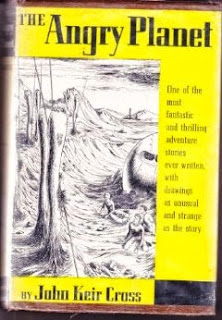
Sometimes I sits and thinks and sometimes I just sits. I was sitting and thinking yesterday when a book that I last read around fifty-five years ago, when I was but a wee lad, popped unbidden into my head. It was a science-fiction novel, now long out of print, titled THE ANGRY PLANET and it was written by a British author named John Keir Cross. I can remember exactly where I got the book — the Lane Avenue Shopping Center branch of the Upper Arlington, Ohio Public Library system — and why I picked the book up. There was a movie that was heavily advertised at the time titled The Angry Red Planet that was making the rounds of the drive-ins at the time, and I thought that maybe the film was based on the book. It wasn’t, and as it turned out the book THE ANGRY PLANET was much better than the similarly titled movie could have ever hoped to be. It was, in fact, the first book that really and truly grabbed me by the lapels and made me a reader.
THE ANGRY PLANET was aimed squarely at the youth market in general and boys market in particular, and was originally published in 1946. The basic plot concerned a couple of teenagers stowed away on a rocket to Mars and had a number of adventures. There were two species of Martians at the top of the food chain which naturally were at mortal war with each other. One type was tall and thin and benevolent and friendly and resembled a celery stalk; the other type was short and squat and evil and resembled a mushroom without the stem. The nice Martians had these long, thin razor-sharp swords which they used to dice the bad guys up; they needed them, because the bad guys were much stronger, and possessed these powerful tendrils which they used to pick the nice guys up and snap them in two like a Slim Jim or a…well, like a celery stalk. The book ended with the Earth guys escaping from Mars by the skin of their teeth just as it looked like the nice Martians were going to lose a huge battle with the nasty ones. I read that book several times; at some point after the fact learned that there was a sequel to the book titled RED JOURNEY BACK, which I never saw or got to read. Remember, this was in the very early 1960s, when the only “Amazon” was Wonder Woman or a river in South America, take your pick, “computers” were what we called people who could operate slide rules or adding machines, and “kindle” was something you did to keep the fire going. Things moved on. I discovered detective fiction and paperback books on those revolving wire racks in the drugstore. But I never really forgot THE ANGRY PLANET. Sure, it got buried in my subconscious under birth dates and telephone numbers and learning how to drive, but I never truly forgot that book. Cross really had a talent for writing battle scenes, and the story was illustrated here and there with black and white line drawings that were somewhat disturbing for reasons that I couldn’t quite identify then but undoubtedly could today, if I had a copy of the book in my hand.
Just for grins I thought I would see if RED JOURNEY BACK was available on any of the e-book platforms. It isn’t. Along the way, however, I did some research and learned that Cross, back in the day, was somewhat renowned as a writer and editor of adult horror fiction. Some first editions of his work, including THE ANGRY PLANET, trade hands for a pretty penny. I also discovered for the first time that I’m not the only one who read THE ANGRY PLANET; there are any number of bloggers out there with memories better than mine who also have an actual copy of the book and still take time to re-read it.
Accordingly, I’m wondering…what is the first book that really and truly made you a reader? Do you have a copy of it? Is it still in print?
Reader Friday: Why the Flops?
Looks like Disney’s $259 million reboot of The Lone Ranger is headed for Flop City. It follows another major disappointment, Sony’s $150 million White House Down. What do you suppose is going wrong?
On the positive side, what recent movies do you recommend?
Interface: A Critique
INTERFACE (a thriller)
First Page Critique
Tom Faraday awoke feeling like he had been sleeping forever, and immediately struggled to recall where he was, or how he had got there. Some nights, he reflected, you hope you remember. Others you hope you forget. Tom was not sure which category the previous night would crystallise under. Right now he was just feeling the after effects of what must have been an evening of extraordinary excess.
He rolled over in the hotel bed and blinked repeatedly. The alarm clock read 8:30 a.m. Next to the clock was his watch, and next to that an electronic card key for his room. Picking it up he saw he was at the Western Star Hotel, in Waterloo, central London. This seemed vaguely familiar, but a stabbing pain deep in his head was making it hard to think clearly. He slipped on his watch, a present from his mother, slid out of bed and padded across to where his suitcase lay open. From a small zipped compartment he retrieved paracetamol and swallowed them down with gulps from a bottle of mineral water. He then stumbled into the bathroom, and was greeted by a tired visage in the mirror. His eyes were bloodshot, hair unkempt, stubble unusually obvious. He stroked his chin distractedly, thinking he must have forgotten to shave the previous day.
Back on the desk he found an elegantly printed invitation, and as he read it his memories started to return. The card bore his name in calligraphic handwriting, and was to the launch party for CERUS Technologies’ new office building. Tom rubbed his eyes and thought hard. What did he know?
He knew his name. He knew his age: 26. He remembered his job. He was a lawyer at CERUS Technologies. And he remembered the party.
He remembered getting there by taxi, late on Friday night. He remembered William Bern’s speech. And he remembered drinking a few beers. And then a few more. Perhaps a lot more. Of the trip back to the hotel, he remembered nothing. Friday night had come and gone.
He stretched slowly and looked for another bottle of water. Apart from the headache he did not feel too bad. Hopefully no harm done, and the rest of the weekend to recover. The noise of a mobile phone ringing broke him from his thoughts. His phone. He retrieved it from his pocket, noticing the battery was nearly dead.
<><><>
Critique by Nancy J. Cohen
The opening line is great. It immediately draws me in, wondering the same thing as the character. Where is he, and what is he doing there? I would delete “he reflected.” We’re in his viewpoint, and that qualifier is unnecessary.
Crystallize has a “z” not an “s”.
Delete the “just” before “just feeling.” This is one of those overused words. For more info in this regard, please see my review of a fabulous self-editing program at http://bit.ly/12iU9nZ. The Smart-Edit software points out all the words and phrase you overuse and much more.
What kind of drug is paracetamol?
I’d separate into a new paragraph, “The noise of a mobile phone…”
The cell phone is in his pocket? Is he still wearing his clothes from the night before? Or did he get dressed in them?
So the guy is hungover from a workplace party. I’m intrigued, but I am wondering where this is going. Hopefully the caller will inject more information. You do point of view very well, and I have no problems with the pacing especially if a dialogue ensues.
At first, I thought Tom had memory loss and couldn’t remember how he got where he is. But he does seem to recall everything, except maybe the cab ride back to the hotel. Then again, where does he normally live? My questions tell you I am hooked and would read more. I’d be hoping, though, that something happens to tell me all isn’t right and things are going to get hairier from here on in. Good job and Happy Fourth of July!
Writing Contests
Nancy J. Cohen
Writing Contests for Published Authors
Being a finalist in a writing contest can lift your mood, while not earning any kudos can depress you. So why enter them at all?
One reason to enter a contest for published authors is to expose new readers to your work. A judge might become a new fan. It’s another way to get your name out there. Plus, if you win, you’ll be able to call yourself an Award-Winning Author. That looks good on your book cover and in your professional biography. If you’re a finalist, you can get mileage out of that term as well. The ensuing publicity can broaden your readership.
On the other hand, low scores can totally strip you of confidence. In the mystery field, there aren’t a whole lot of contests to enter. If you write humorous cozies like I do, there’s no sense in entering the Edgars. You have to be nominated for most other awards like the Agatha, and that becomes a popularity contest as conference goers vote for the winners. There’s little judging with feedback or specific criteria like in the romance field.
Thus this past year I entered both my paranormal romance and my mystery into separate contests sponsored by RWA chapters. I did enter Shear Murder in the Florida Book Awards, even knowing a work of serious crime fiction would be more likely to win. My purpose was to gain the attention of whatever librarians might read my entry, although with the $50 entry fee, the cost of four print books (over $50), and the $15.41 postage, I might not bother again.
My romance didn’t garner a single nod in the myriad of contests I’d entered. I could understand this reaction because my mixed genre story might not appeal to the standard romance fan. My paranormal romance stories have a humorous touch and blend elements of science fiction and fantasy with mythology.
I’d had better hopes for my mystery, Shear Murder, but this title didn’t make the cut at the Daphne award sponsored by RWA’s Kiss of Death chapter. I’d entered it into the mainstream category because romantic suspense is more the cup of tea for this group. And then I got my scores back. Talk about demoralizing!
My heart sunk at the first score, 44 out of 88. Is my writing that bad? Does my series only appeal to a select group of fans? But as I read the comments, I realized that maybe this judge didn’t read a lot of cozies. Her final remark was, “A struggle to complete the reading.”
Oh, wait, there were two more scores. My spirits lifted. The next one was 72 and the last one was 87 out of 88! The last judge said, “This book is superb; masterfully written.”
So who am I to believe? Judge number one or Judge number three? Might I have finaled if not for that one judge who obviously didn’t get my work?
It doesn’t matter. The point here is that judging is subjective. One reader might love our book and another might say it should never have been published. I went for the goal and didn’t make it, but that doesn’t mean I won’t try again. I did, once in my lifetime, win the HOLT Medallion Award. If it happened once, it can happen again. You just have to grow a thick skin to keep trying and weigh the investment of time and money against the possible benefits.
Do you consider writing contests for published authors to be worthwhile?