
Let’s pretend this picture is the cover art for your next book. What title would you pick for it? Create a one-sentence cut line describing your story!

My husband sends me strange links and records off the wall TV programs for me because he knows how I think about story inspiration. Sometimes a news story could fill out a back story of a character or become the main action or mystery behind a book. Recently he sent me this LINK. This story came from Associated Press reporter Sean Murphy. Who doesn’t love a cold case murder mystery?
Especially one that has a double twist.
 |
| Jimmy Williams, Leah Johnson, Michael Rios |
You would think that discovering the skeletal remains of three teens (who were thought to have run away in 1970) in a rusted car at the bottom of a lake would be interesting enough. How did their car end up in the lake? Why weren’t they found until now? Rumors had run rampant. Locals speculated that the three teens had stumbled upon a drug deal at a rural airstrip and been killed with their bodies dumped, never to be found. Some folks thought the kids ran away to California, never to be heard of again. Most people who knew the kids suspected foul play, but leads went nowhere.
Police found a vehicle (a 1969 Camaro believed to belong to one of the missing kids) while conducting a routine diver training exercise at Foss lake, 100 miles west of Oklahoma City. Score one for the home team. But if that wasn’t enough, the over-achievers found a SECOND car, containing two to three more bodies. (Ew, that they don’t know if they have two or three bodies. That doesn’t mean poor math skills. It could mean they only have “parts.”)
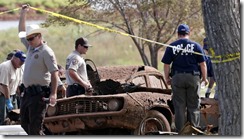 |
| Foss Lake outside OKC – Crime Scene |
All the skeletal remains are likely connected to missing persons reports that are still open and unsolved. Unrelated, presumably. The teens were on their way to a high school football game and went missing in 1970. The second vehicle, thought to belong to John Albert Porter, most probably carries the remains of another man and a woman. The grandson of Porter feels certain the find solves the case of what happened to his grandfather.
Both cars were found submerged in twelve feet of water, fifty feet from the end of a boat ramp near the marina. I’m not sure how both vehicles would have ended up fifty feet from the end of a boat ramp. Talk about taking a wrong turn?! Lakes in Oklahoma can be filled with sediment due to the red clay soils. They would make excellent training cases for police divers, but tough for anyone looking for six missing people, apparently.
The bones were sent to the Medical Examiner’s office for determination of cause of death. You can’t just presume drowning, but without flesh on the bones and with all the abrasive sediment, that can’t be an easy job. If the bodies can be identified, that could give six families closure.

But a writer can conjure all sorts of other explanations for a story like this one. Who would’ve wanted to see the kids dead? What had they witnessed? With two cars in the lake, who was using the red dirt lake for a body dump site? Without the flesh on the bones, what if someone in the area was harvesting organs to sell on the black market?
So what do YOU think happened? How would you spin this emotional gut wrenching story for the two vehicles?
by Jodie Renner, editor, author, & speaker
A novel won’t draw me in unless I start caring  about the protagonist and worrying about what’s going to happen to her – in other words, until I get emotionally engaged in the story. And it’s the same for most readers, I think. For me to warm up to the protagonist, he has to have some warmth and vulnerability and determination, some hopes and insecurities and fears.
As readers, to identify with and bond with the protagonist – and other characters – we need to see and feel their emotions and reactions to people and events around them. When the character feels and reacts, then they come alive for us and we get emotionally invested and start to worry about them and cheer for their small victories. Once you have your readers fretting about your hero and rooting for him, they’re hooked.
As the late, great Jack M. Bickham said, “Fiction characters who only think are dead. It is in their feelings that the readers will understand them, sympathize with them, and care about their plight.”
Show those feelings.
So bring your characters to life by showing their deepest fears, worries, frustrations, hopes and jubilations. If readers see your hero pumped, scared, angry, or worried, they’ll feel that way, too. And a reader who is feeling strong emotions is a reader who is turning the pages.
And engage the readers’ senses, too, so they feel like they’re right there, by showing us not only what the character is seeing, but what they’re hearing, smelling, touching, sensing, and even tasting.
Show their physical reactions, too.
Besides showing us your character’s emotional reactions, show their physical reactions as well to what’s happening to them.
Show the stimulus before the response, and show the reactions in their natural order.
To avoid reader confusion and annoyance, be sure to state the cause before the effect, the stimulus before the response, the action before the reaction.
And to mirror reality, it’s important to show your character’s visceral reaction to a situation first, before an overt action or words. And show involuntary thought-reactions or word-reactions, like a quick “ouch” or swear word, before more reasoned thought processes and decision-making.
As Ingermanson & Economy put it, “Here’s a simple rule to use: Show first whatever happens fastest. Most often, this means you show interior emotion first, followed by various instinctive actions or dialogue, followed by the more rational kinds of action, dialogue, and interior monologue.”
And don’t skip those first steps! Remember, we’re inside that character’s head and body, so you deepen their character and draw us closer to them by showing us what they’re feeling immediately inside – those involuntary physical and thought reactions that come before controlled, civilized outward reactions.
As Bickham points out, it’s important to imitate reality by showing the reactions in the order they occur. You may not show all of these reactions, but whichever ones you choose, show them in this order.
First, show the stimulus that has caused them to react.
Then show some or all of these responses, in this order:
1. The character’s visceral response
– adrenaline surging, pulse racing, stomach clenching, heart pounding, mouth drying, flushing, shivering, cold skin, tense muscles, sweating, blushing, shakiness, etc.
2. Their unconscious knee-jerk physical action – yelling, gasping, crying out, snatching hand or foot away from source of heat or pain, striking out, etc.
3. Their thought processes and decision to act
4. Their conscious action or verbal response
Showing your characters’ feelings and responses will bring them to life on the page for the readers and suck readers deeper into your story world, your fictive dream.
But don’t go overboard with it — you don’t want your protagonist to come across as gushing or hysterical or neurotic. It’s important to strike a balance so the readers want to relate to and empathize with your main character, not get annoyed or disgusted with her and quit reading.
So how do we strike that balance? How do we as writers find the emotions to bring our characters to life, but also find a happy medium between flat, emotionless characters that bore us and hysterical drama queens or raging bulls that make us cringe?
Bickham advises us to consider how we’ve felt in similar circumstances, then overwrite first, and revise down later. “I would much prefer to see you write too much of feeling in your first draft; you can always tone it down a bit later…. On the other hand, a sterile, chill, emotionless story, filled with robot people, will never be accepted by any reader.”
 Do you have any techniques that work for bringing out your characters’ reactions and feelings? And for ensuring that you don’t go off the deep end with it?
![[Writing-a-Killer-Thriller_May-13_120%255B2%255D.jpg]](https://killzoneblog.com/wp-content/uploads/2013/10/Writing-a-Killer-Thriller_May-13_120-25255B2-25255D-189x300.jpg)
Jodie Renner is a freelance fiction editor and the award-winning author of three craft-of-writing guides in her series An Editor’s Guide to Writing Compelling Fiction: Captivate Your Readers, Fire up Your Fiction, and Writing a Killer Thriller, as well as two clickable time-saving e-resources, Quick Clicks: Spelling List and Quick Clicks: Word Usage. She has also organized two anthologies for charity. You can find Jodie at www.JodieRenner.com, her blog, http://jodierennerediting.blogspot.com/, and on Facebook and Twitter.
It’s time. Sometimes you just know it. I’ve had a great twelve months being part of this Kill Zone crew of stellar writers, but I’ve decided to cede my spot to another blogger. I’ll still be following the fascinating blogs by my colleagues, so you won’t see the end of me around here.
Naturally, moving on like this has me thinking about endings in novels, particularly the ends of characters. Death is constant companion for us thriller writers. My wife is a doctor, so we often say that she saves people for a living, and I kill people for a living. In my stories I’ve slain many characters, and not just the bad guys.
In my book ROGUE WAVE, which is a disaster thriller, a key character dies at the end of the story. My editor strenuously argued for me to save the character, and we had an hour-long discussion about the ramifications of this death. In the end I convinced her that the character had to die, and I think the ending is more poignant for it. I’ve gotten many emails from readers who cried over the death. To me that was a compliment because it meant that the character had become real for them. Even if they hated that it happened, the readers almost unfailingly felt that the death fit within the story’s themes of love and selfless sacrifice.
I take great care in the decision of whether or not to kill off one of the good guys. I don’t think you can cavalierly flout the trust a reader has invested in you to deliver a satisfying story. On the other hand, to build suspense there has to be real jeopardy for the characters. If readers believe you’ll never kill off someone they’ve come to care for, where’s the tension in the story?
In my Tyler Locke series I do kill off someone who becomes a major character in one of the novels. It has a major impact on the other characters, even into subsequent installments of the series. Again, some readers didn’t like this death, but it also made them worry for all the other characters in future novels. If Boyd killed that person off, they might wonder, he’s just crazy enough to whack anyone. The tension level is automatically raised.
Obviously I didn’t kill Tyler Locke. He’s the star of the series. He can’t be killed off unless I’m doing away with the series altogether (Lee Child has proposed this very idea at several conferences when he has talked about someday ending the Jack Reacher series). For instance, no one even considers that James Bond is going to die at the end of the movie, so how can there possibly be any suspense?
If the writer might dispatch someone the main character loves or cares about, that concern is transferred to the reader. It conveys a personal stake in the outcome, which a reader will care about more than the end of the world as we know it. And if the reader knows you’ve done it before, an ending where all the good guys survive can be even sweeter, the relief more palpable.
A death of this kind can also make the story more believable. If every single good guy survives when bullets are spraying at him like they’re coming from a lawn sprinkler, while every single bad guy dies with a well-aimed headshot, the story becomes ridiculous. That kind of spectacular luck in a novel only emphasizes that you’re reading fiction. A key death, I think, confers some plausibility, even in an over-the-top action adventure. Movies have been doing this more commonly in the last few years. Think of The Dark Knight or Skyfall. Both of them were praised for a grittier, more realistic treatment of comic book and Bondian adventures, and both featured tragic deaths that had severe consequences for the plot and main characters.
Where I think authors get into trouble is when they make the deaths meaningless. As a reader, if I’ve spent hours getting to know a character, it’s deeply unsatisfying for him to die for no reason. It just seems like a mean or thoughtless gesture by the author, as if it were done for no other reason than to provoke shock. Some readers may appreciate that it makes the story seem more like real life, but unless it’s incredibly well-done, I find it off-putting.
Like my decision to move on from The Kill Zone, how you handle the characters has to come from your gut. I don’t take the decision to kill one of the good guys lightly, but when the end feels right, I know it.
Even though I won’t be a regular contributor, I’ll still be hanging out in the comments section from time to time. Thanks to all my fellow KillZoners for giving me this opportunity and to all of you who taken the time to read and comment on my blogs. Take care.
you’re burning to tell. Do that first, and the money will follow. How much, no one can say. But joy tips the balance in your favor. For example, in addition to my novels and novellas, I’m writing short stories about a boxer in 1950s Los Angeles. I make some scratch every month on these. But more than that, I love writing them. It’s a different voice and genre than I normally write in, which has the added benefit of keeping my writing chops sharp.

“By the mere fact that we bother to read a novel, thus expending time which might otherwise be passed in company with actual people, we are going out of our way to meet the characters to whom the novelist wishes to introduce us. He therefore owes us an assurance that they shall be even more worth our while than the average actual person.” – Clayton Meeker Hamilton, A Manual of the Art of Fiction
What fictional character would you most like to have dinner with? What would you talk about?
What follows is the first page of a work entitled A HARD MAN TO KILL, with my comments afterward. Hope you enjoy both — Joe Hartlaub
How do you juggle between writing, marketing, and having a life?
Things used to be simpler when all we had to worry about was selling to a NY publishing house. When I wrote for Kensington, I turned in one book a year. Easy, right? I wrote my Bad Hair Day mysteries and nothing else. No blogs or Facebook posts. I didn’t have a second publisher to worry about making deadlines with double the work. Promotion consisted of mailing out packets of bookmarks to booksellers, letters to reader groups, and personal appearances.

It wasn’t until my option book was turned down that I started writing in other genres to see what would sell. Now it’s years later, and Wild Rose Press has picked up my romances while Five Star is publishing my ongoing mystery series. I am preparing to self-publish an original mystery and a few other items on my agenda as well. Currently, I have four books in various stages of the publishing process. This means edits and page proofs, along with research, plotting and promotion.
Never before have we had so many options. It’s an exciting era, but it’s also utterly time consuming. Who has free time when we can publish our entire body of works through various formats, and spend hours on the social networks promoting them?
Establishing priorities is paramount. When I’m in a writing phase, I set myself a daily quota of five pages a day. That’s my minimum, and I have to be at least halfway through before I’m permitted to peek at my email via Microsoft Outlook. I have to be finished before going online. This is the only way to get your writing done. Do it first before anything else intrudes.
When I’m in a revision phase, I also set limits. Maybe it’s one chapter per day to edit or 50 pages per day to proofread. Again, this work must get done.
As for the rest of the day, it’s spent on promotion and marketing, interspersed with errands, meeting friends for lunch, or whatever else is on my daily schedule. I’m fortunate that I can write full-time. My retired husband helps out with errands, freeing more of my time. Some of you may not have this luxury. In that case, you have to set your own limits.
How many pages can you reasonably write in one day? How many pages can you edit or proofread on a steady basis? How many days a week can you devote to your writing career?
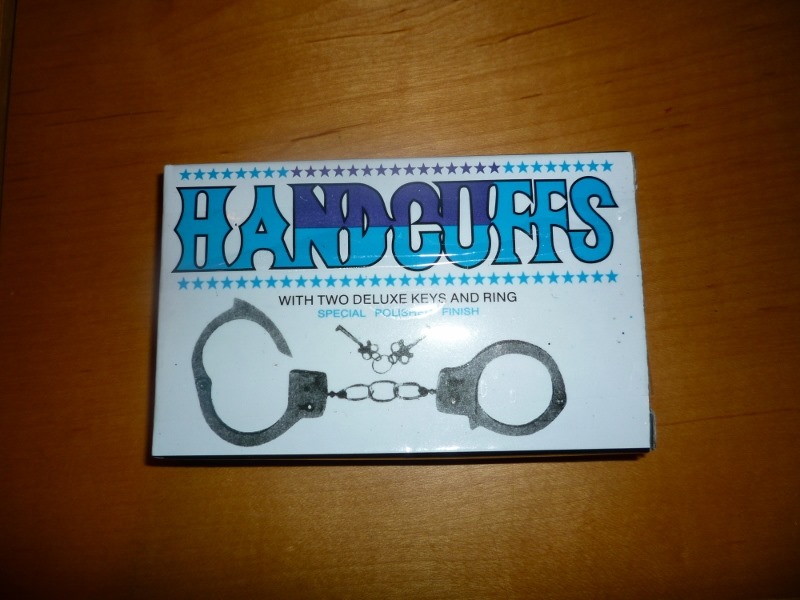
Do you enjoy social networking and marketing, or would you rather watch paint dry? Does someone have to handcuff you to the keyboard to get you to participate?
Where it comes to marketing, create a specific promotional campaign for each upcoming title. Follow this template so you’re not reaching blindly in the dark. As for the social nets, pick a select few and check in there often. Visit the other sites whenever you get to them. Schedule tweets ahead of time if you have a chance. I’ll visit Facebook several times a day because I feel this one is the most important.
Twitter comes next for me. I’ll pop in there every now and then and do a few posts. Pinterest isn’t on my daily role call. I’ll pin photos after I do a blog post with pictures I’ve uploaded. Goodreads is on my list but not on a daily basis, as is commenting on other people’s blogs and posts. You have to do what feels right for you.
I’m a big believer in lists. Write down your writing and business goals for the year. Each day, decide what you have to accomplish. These lists will give you a concrete path to follow. Write down the marketing plan for your next book. This will give you a specific focus, i.e. a blog tour or a book trailer. What you don’t want to do is flounder about, because that’s truly a time waster.
So what’s your plan for today? Mine included writing this blog. Marketing task number one is done. On to task number two.
