Hard part #2

By Joe Moore
@JoeMoore_writer

You’re writing a novel. Maybe you’ve even finished it. Congratulations. The hard part is over, right?

Wrong.

Now comes hard part #2: getting ready to sell it to a publisher. Even before you start your search, there are some basic concepts you should research first. They can prove to be costly detours on your way to finding an agent and editor if you don’t. Having the correct information by doing your homework can make for a smoother journey to publication.

First, you need to define your audience. It’s important that you know what type of person or group will go out of their way to find and pay to read your book. What are the characteristics of your target reader such as their age, gender, education, ethnic, etc. Is there a common theme, topic or category that ties them together? And even more important, what is the size of your target audience?

For instance, if your book is a paranormal romance set in the future in which the main characters are all teenagers, is there a group that buys lots of your type of book? If not, you might need to adjust the content to appeal to a broader audience. Change the age of the characters or shift the story to present day or another time period. If your research proves that a large number of readers buy books that fall into that category, making the adjustment now could save you a great deal of frustration later.

Next, you need to define your competition. Who are you going up against? If your book falls into a specialized sub-genre dominated by a few other writers, you might have a hard time convincing a publisher that the world needs one more writer in that niche.

The opposite problem may occur if your genre is a really broad one such as cozy mysteries or romance. You’re going to have to put a unique, special spin on your book to break it out of the pack. Or accept the fact that the genre and your competition is a wide river of writers, and you only hope to jump in and go with the current. Either way, make the decision now, not later.

The next issue to consider is what makes your book different from all the others in your genre. Do your homework to determine what the characteristics are of books that your potential audience loves. This can be done online in the dozens of Internet writer and reader forums. And you can also do the research by discussing the question with librarians and books sellers. Once you know the answers, improve on what your target audience loves and avoid what they don’t.

Just keep in mind that you can’t time the market, meaning that what’s really hot right now might has cooled off by the time your book hits the shelves. The moment you sign a publishing contract, you’re still as much as 12-18 months behind what’s on the new release table right now.

Another detail to consider in advance is deciding how you’ll market and promote your book. Sadly, this burden has fallen almost totally on the shoulders of the author and has virtually disappeared from the responsibilities of the publisher. Start forming an action plan including setting up a presence on the Internet in the form of a website and/or blog. Also, is there a way to tie in your theme to a particular industry? How can you promote directly to your audience? For instance, if your romance novel revolves around a sleuth who solves crimes while on tour as a golf pro, would it be advantageous to have a book promotion booth at golf industry tradeshows? If your protagonist is a computer nerd, should you be doing signings at electronics shows? How about setting up a signing at a Best Buy or CompUSA? Follow the obvious tie-ins to find your target audience.

Writing is hard work. So is determining your target audience and then promoting and marketing to them. Like any other manufacturing company, you are manufacturing a product. Doing your homework first will help avoid needless detours on the way to publication.

———————–
shield-cover-smallTHE SHIELD by Sholes & Moore is now available in print and e-book.

“THE SHIELD rocks on all cylinders.”
– James Rollins,New York Times bestselling author of THE EYE OF GOD.


Not Quite Ready for Prime Time

Yesterday, Clare alerted us to a great discussion about how professional writers create by listening to an inner voice. It occurred to me that we also need to develop another “inner ear”, one that can discern whether our own work rises to the level of being publishable.

It’s difficult to tell someone their work isn’t ready for publication, or even submission. I ran into this situation the other day. A friend told me (breathless with excitement) that she’d signed up for an agent pitch session at an upcoming conference. 

“You’re pitching your XYZ manuscript?” I asked in disbelief.

A happy nod. “I finished it over the weekend,” she said.

Cowardly Lion here didn’t tell her friend the truth–that her project is not ready. It’s nowhere near ready.

It’s interesting to note that this same writer friend can provide a keen analysis of other people’s writing. Just not her own.

I wonder if we all tend to have a blind spot for our own writing. Perhaps the way we “hear” our writing is influenced by the way it unfolds within our imagination. Stories can live so vividly inside our noggins. Unfortunately, there’s a huge leap between seeing a  story in the imagination, and conveying it successfully on the page.

Bridging that gap is a critical part of the writer’s job. 

Have you ever sensed you had a “blind spot” for something in your own writing? How did you correct it?

Your Brain when Writing

by Clare Langley-Hawthorne

A recent article in the New York Times describing a study on the neuroscience of creative writing (‘This is Your Brain on Writing‘) provides an intriguing glimpse of what happens to your brain when writing fiction. I guess it wasn’t something I’d ever thought about in scientific terms at least – but, if this study is correct, there appears to be a number of similarities (in terms of brain function) between writers and people who are skilled at other actions such as sports or music. The study also found  differences in brain activity between professionally trained writers and novice writers who were asked to continue a short piece of fiction after a few minutes of brainstorming. What were these differences? 

Well, for starters they found that during the brainstorming section of the study, novice writers activated their visual centres of the brain, while the brains of expert writers showed more activity in regions of the brain involved with speech. The researchers concluded that novices ‘watched’ their stories like a film inside their heads while the ‘experts’ were narrating their stories with an inner voice.

Secondly, when the writers started to actually write their stories, areas of the brain crucial for retrieving factual information and holding multiple pieces of information (possibly characters and plot lines) became active.

Finally, they also found that in the expert writers the caudate nucleus (the region of the brain that plays a vital role in how the brain learns and which activates as a skill becomes more automatic with practice) ‘lit up’ in a similar way to that observed in people who were experts in music or sports.


Now, creative writing is a notoriously difficult thing to study in the brain – for a start, you don’t usually perform the creative process while lying still inside an MRI machine – and it also sounds from this article like some experts believe the results of the study are too crude to be all that meaningful. Others however feel the study provides some real insight into the regions of the brain that ‘light up’ when a person is involved in the writing process. 

For me, the most intriguing aspect of this study was that a researcher even attempted to look at what the brain does when a person is being ‘creative’ – although I so wonder whether we can ever really understand how creativity works in terms of the brain (for a start it seems to me that many writers access their creative process in very different ways). To be honest, I was also a little depressed by the novice versus expert results. I tend to be a very visual person and so I fear, had I been included in the study, my brain would have acted like the ‘novice’ during the brainstorming sessions at least (after my years of writing practice that seems depressing!)

Who knows, maybe one day neuroscientists will be able to use their studies to create a designer drug that will make us all awesome creative writers…or maybe they’ll identify the crucial area of the brain that needs to activate in order to become a bestselling author…Then again, perhaps delving too deep into the brain of a writer isn’t exactly a good idea (we can invent just too many ways for this research to be used for evil…)

So what research would you like to see in the science of creativity? I think it would be cool to see whether the brains of brilliant writers work differently to mere mortal folks like me and (as brilliance so often comes with madness) whether mental illness has an impact on the creative process.

What about you? If you could be included in a study on the neuroscience of writing, what kind of study would it be?

Your Brain when Writing

by Clare Langley-Hawthorne

A recent article in the New York Times describing a study on the neuroscience of creative writing (‘This is Your Brain on Writing‘) provides an intriguing glimpse of what happens to your brain when writing fiction. I guess it wasn’t something I’d ever thought about in scientific terms at least – but, if this study is correct, there appears to be a number of similarities (in terms of brain function) between writers and people who are skilled at other actions such as sports or music. The study also found  differences in brain activity between professionally trained writers and novice writers who were asked to continue a short piece of fiction after a few minutes of brainstorming. What were these differences? 

Well, for starters they found that during the brainstorming section of the study, novice writers activated their visual centres of the brain, while the brains of expert writers showed more activity in regions of the brain involved with speech. The researchers concluded that novices ‘watched’ their stories like a film inside their heads while the ‘experts’ were narrating their stories with an inner voice.

Secondly, when the writers started to actually write their stories, areas of the brain crucial for retrieving factual information and holding multiple pieces of information (possibly characters and plot lines) became active.

Finally, they also found that in the expert writers the caudate nucleus (the region of the brain that plays a vital role in how the brain learns and which activates as a skill becomes more automatic with practice) ‘lit up’ in a similar way to that observed in people who were experts in music or sports.


Now, creative writing is a notoriously difficult thing to study in the brain – for a start, you don’t usually perform the creative process while lying still inside an MRI machine – and it also sounds from this article like some experts believe the results of the study are too crude to be all that meaningful. Others however feel the study provides some real insight into the regions of the brain that ‘light up’ when a person is involved in the writing process. 

For me, the most intriguing aspect of this study was that a researcher even attempted to look at what the brain does when a person is being ‘creative’ – although I so wonder whether we can ever really understand how creativity works in terms of the brain (for a start it seems to me that many writers access their creative process in very different ways). To be honest, I was also a little depressed by the novice versus expert results. I tend to be a very visual person and so I fear, had I been included in the study, my brain would have acted like the ‘novice’ during the brainstorming sessions at least (after my years of writing practice that seems depressing!)

Who knows, maybe one day neuroscientists will be able to use their studies to create a designer drug that will make us all awesome creative writers…or maybe they’ll identify the crucial area of the brain that needs to activate in order to become a bestselling author…Then again, perhaps delving too deep into the brain of a writer isn’t exactly a good idea (we can invent just too many ways for this research to be used for evil…)

So what research would you like to see in the science of creativity? I think it would be cool to see whether the brains of brilliant writers work differently to mere mortal folks like me and (as brilliance so often comes with madness) whether mental illness has an impact on the creative process.

What about you? If you could be included in a study on the neuroscience of writing, what kind of study would it be?

Write As If It Were Impossible To Fail

@jamesscottbell


Here is another entry from the unpublished journal of that great pulp writer, William “Wild Bill” Armbrewster. The first entry can be found here. The second is here.

I was killing a dame when Benny walked in.
The dame was Gilda Hathaway and she was an icy blonde in the story I was pounding out for Black Mask. The killer was her husband, an action Jackson named Mickey Hathaway. He was about to use an ice pick on his wife when Benny said, “Hello, Mr. Armbrewster.”
“What? Huh?” I looked up from my Underwood, which was sitting on my usual table at Musso’s in Hollywood. “Don’t you know better than to interrupt a writer when he’s typing?”
“I’m sorry, sir, I thought we had—”
“I don’t care what we had! Go get yourself a Coke and let me finish my murder!”
Benny put his head down, but he did what I told him. I liked that about the kid.
Mickey dispatched Gilda, then wiped his fingerprints off the ice pick. He was out of the apartment by the time Benny got back to the table.
“Say, kid,” I said, “you’ve got the hangdog look of a mortician without a stiff. What gives?”
“I do have a stiff,” Benny said. “It’s that story you told me to write. I just couldn’t. I don’t know, I froze. I just sat there staring at the paper.”
“Welcome to the world of the professional writer, son.”
“This is what it’s like?”
“A blank page is God’s way of telling us how hard it is to be God.”
He stared at me like I was the blank page.
    “Before you try to write anything,” I said, “you’ve got to get your head right. You’ve got to get your mind running like Seabiscuit at Pimlico.”
Benny took a sip of his Coke, looking more concerned than ever.
I took out a White Owl, bit off the end, fired it up. A matronly woman at the adjoining table gave me a hard look. I made a mental note to put her in my story as another victim of the ice pick killer.
“You’ve got a will to fail,” I said.
“I do not!” Benny said. Good. He had a fighting spirit. He was going to need that if he wanted to make it in this game.
“Cool your radiator, Benny. We all have a will to fail. It’s subconscious. It’s deep in the memory banks. All of the things we tried to do in our past, and failed at, collect there. All the embarrassments we’ve suffered, all the people who made fun of us, those experiences pepper our brains. It’s human nature. We almost always act in order to avoid pain. So rather than try something and possibly fail, we freeze up. Or we choose something easy because we know there’s no risk of failure. We don’t act boldly.”
Benny was silent, but I could tell I was getting through.
“Our job is to fight that will to fail, to give it the boot. You were afraid I’d rip apart your story, so you didn’t write it.”
Benny paused, frowned, then said, “You’re right.”
“Of course I’m right. This is Armbrewster you’re talking to.”
“So what do I do?”
“You really want to know?”
“More than anything!”
“More than a new Packard?”
“Yes!”
“More than a sweet gal to smother you with kisses?”
“I kind of want that,” he said. “But only after I’m a successful writer!”
“Just what I wanted to hear, kid. So here’s what you must do from now on––write as if it were impossible to fail.”
“That’s it?”
“It? Why, boy, I’m giving you the Promethean fire here! If the gods find out I’ve told you, I could get lashed to a rock and have my liver pecked out by a predatory bird! Which, by the way, isn’t all that different from working with an editor.”
“But I can’t just write that way, can I?”
“You’re not a Presbyterian, are you?”
“Methodist.”
“Then you’re a free-will being! And as such you are in control of your thoughts. And if you don’t control them, they will certainly control you. It takes effort, sure, but so does anything worthwhile. Now, have you ever done anything successfully?”
“Sure.”
“Like what?”
“I ran the anchor leg on our state championship relay team in high school.”
“Aces! Think about that moment.”
“Now?”
“No, in the late Spring of 1954. Of course now! Close your eyes and keep ’em closed.”
He did as I asked.
“You remember taking the baton?” I said.
“I sure do.”
“Remember your adrenal glands firing on all cylinders?”
“Uh-huh.”
“How about the roar of the crowd, the feel of the track, the exhilaration of crossing the finish line?”
“Yes!”
“Drink it in!”
“I’m drinking!”
“Keep those eyes closed. Your teammates are around you, slapping you on the back.”
“Yes.”
“And your best girl is in the stands, watching.”
“Judy Parrish! How did you know?”
“This is Armbrewster. Now, you’re feeling good, right?”
“Yes.”
“You see? You’re in control of your thoughts and your thoughts feed your feelings. Now, I want you to see yourself standing in Stanley Rose’s bookstore, holding your novel from Scribner’s in your hands, as a crowd starts to gather for your reading.”
Behind those closed lids, Benny’s brain was starting to run. When he smiled, I knew he was ready.
            “Open your eyes! Next time you freeze up, remember those good feelings and imagine yourself with the book. Then write as if it were impossible to fail.”
“Does it really work?”
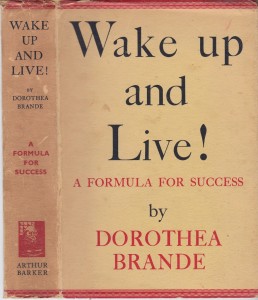
“A sweet kid named Dorothea Brande wrote a book called Wake Up And Live! and it sold a million copies. It’s the only way to stomp that will to fail and write your best stuff.”
“Gee. I feel better already.”

“Swell! Now get back to your room and start typing.”
Springing up, he almost knocked over the table. He did a 50-yard dash out the door.
I sat back, remembering when I felt the way Benny did right now––ready to write like the wind. To write as if I couldn’t fail. That got me through a lot of cold nights and dismal days. And now here I was, making a living with the written word, but also realizing I’d been skating on the story I was working on. The encounter with Benny left me with the uneasy feeling I was playing it safe, mailing it in, avoiding risks. That old will to fail can sneak up on you like a jungle viper.
“Phooey!” I said.
I tore out the page I’d just typed, crumpled it, tossed it on the small pile at my feet. Then rolled in a fresh piece of paper.
This time, Gilda had an ice pick of her own.

Do you have fear when you write? Do you find yourself afraid to take risks? 


Write As If It Were Impossible To Fail

@jamesscottbell


Here is another entry from the unpublished journal of that great pulp writer, William “Wild Bill” Armbrewster. The first entry can be found here. The second is here.

I was killing a dame when Benny walked in.
The dame was Gilda Hathaway and she was an icy blonde in the story I was pounding out for Black Mask. The killer was her husband, an action Jackson named Mickey Hathaway. He was about to use an ice pick on his wife when Benny said, “Hello, Mr. Armbrewster.”
“What? Huh?” I looked up from my Underwood, which was sitting on my usual table at Musso’s in Hollywood. “Don’t you know better than to interrupt a writer when he’s typing?”
“I’m sorry, sir, I thought we had—”
“I don’t care what we had! Go get yourself a Coke and let me finish my murder!”
Benny put his head down, but he did what I told him. I liked that about the kid.
Mickey dispatched Gilda, then wiped his fingerprints off the ice pick. He was out of the apartment by the time Benny got back to the table.
“Say, kid,” I said, “you’ve got the hangdog look of a mortician without a stiff. What gives?”
“I do have a stiff,” Benny said. “It’s that story you told me to write. I just couldn’t. I don’t know, I froze. I just sat there staring at the paper.”
“Welcome to the world of the professional writer, son.”
“This is what it’s like?”
“A blank page is God’s way of telling us how hard it is to be God.”
He stared at me like I was the blank page.
    “Before you try to write anything,” I said, “you’ve got to get your head right. You’ve got to get your mind running like Seabiscuit at Pimlico.”
Benny took a sip of his Coke, looking more concerned than ever.
I took out a White Owl, bit off the end, fired it up. A matronly woman at the adjoining table gave me a hard look. I made a mental note to put her in my story as another victim of the ice pick killer.
“You’ve got a will to fail,” I said.
“I do not!” Benny said. Good. He had a fighting spirit. He was going to need that if he wanted to make it in this game.
“Cool your radiator, Benny. We all have a will to fail. It’s subconscious. It’s deep in the memory banks. All of the things we tried to do in our past, and failed at, collect there. All the embarrassments we’ve suffered, all the people who made fun of us, those experiences pepper our brains. It’s human nature. We almost always act in order to avoid pain. So rather than try something and possibly fail, we freeze up. Or we choose something easy because we know there’s no risk of failure. We don’t act boldly.”
Benny was silent, but I could tell I was getting through.
“Our job is to fight that will to fail, to give it the boot. You were afraid I’d rip apart your story, so you didn’t write it.”
Benny paused, frowned, then said, “You’re right.”
“Of course I’m right. This is Armbrewster you’re talking to.”
“So what do I do?”
“You really want to know?”
“More than anything!”
“More than a new Packard?”
“Yes!”
“More than a sweet gal to smother you with kisses?”
“I kind of want that,” he said. “But only after I’m a successful writer!”
“Just what I wanted to hear, kid. So here’s what you must do from now on––write as if it were impossible to fail.”
“That’s it?”
“It? Why, boy, I’m giving you the Promethean fire here! If the gods find out I’ve told you, I could get lashed to a rock and have my liver pecked out by a predatory bird! Which, by the way, isn’t all that different from working with an editor.”
“But I can’t just write that way, can I?”
“You’re not a Presbyterian, are you?”
“Methodist.”
“Then you’re a free-will being! And as such you are in control of your thoughts. And if you don’t control them, they will certainly control you. It takes effort, sure, but so does anything worthwhile. Now, have you ever done anything successfully?”
“Sure.”
“Like what?”
“I ran the anchor leg on our state championship relay team in high school.”
“Aces! Think about that moment.”
“Now?”
“No, in the late Spring of 1954. Of course now! Close your eyes and keep ’em closed.”
He did as I asked.
“You remember taking the baton?” I said.
“I sure do.”
“Remember your adrenal glands firing on all cylinders?”
“Uh-huh.”
“How about the roar of the crowd, the feel of the track, the exhilaration of crossing the finish line?”
“Yes!”
“Drink it in!”
“I’m drinking!”
“Keep those eyes closed. Your teammates are around you, slapping you on the back.”
“Yes.”
“And your best girl is in the stands, watching.”
“Judy Parrish! How did you know?”
“This is Armbrewster. Now, you’re feeling good, right?”
“Yes.”
“You see? You’re in control of your thoughts and your thoughts feed your feelings. Now, I want you to see yourself standing in Stanley Rose’s bookstore, holding your novel from Scribner’s in your hands, as a crowd starts to gather for your reading.”
Behind those closed lids, Benny’s brain was starting to run. When he smiled, I knew he was ready.
            “Open your eyes! Next time you freeze up, remember those good feelings and imagine yourself with the book. Then write as if it were impossible to fail.”
“Does it really work?”
“A sweet kid named Dorothea Brande wrote a book called Wake Up And Live! and it sold a million copies. It’s the only way to stomp that will to fail and write your best stuff.”
“Gee. I feel better already.”

“Swell! Now get back to your room and start typing.”
Springing up, he almost knocked over the table. He did a 50-yard dash out the door.
I sat back, remembering when I felt the way Benny did right now––ready to write like the wind. To write as if I couldn’t fail. That got me through a lot of cold nights and dismal days. And now here I was, making a living with the written word, but also realizing I’d been skating on the story I was working on. The encounter with Benny left me with the uneasy feeling I was playing it safe, mailing it in, avoiding risks. That old will to fail can sneak up on you like a jungle viper.
“Phooey!” I said.
I tore out the page I’d just typed, crumpled it, tossed it on the small pile at my feet. Then rolled in a fresh piece of paper.
This time, Gilda had an ice pick of her own.

Do you have fear when you write? Do you find yourself afraid to take risks? 


The Serial Killer

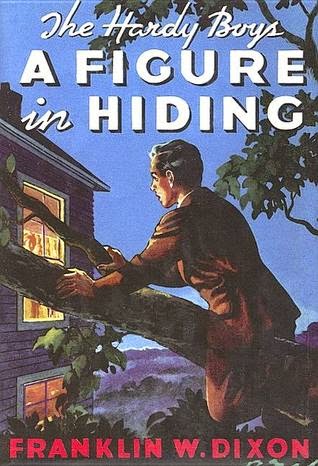
I am very fond of series fiction. I always have been, going back to The Hardy Boys and their (much) lesser known peers, The Walton Boys (not the ones on the mountain). I probably will be for as long as I am able to read. I’m having a problem, however, with that wonderful and delectable corner of the genre or whatever you want to call it where the new book in the series builds upon what has happened before. More often than otherwise, a year or more passes between books in the series, I’ll go to pick a new one up, and I have no freaking idea what happened previously. I can remember the main characters, and usually a supporting character or two, but past that…it can be really hit or miss.

Some authors are aware of this and do an excellent job of doing a back-and-fill to bring new readers (and yes, older, forgetful ones) up to snuff without bringing the narrative to a grinding halt and having the characters engage in an awkward dialogue designed to summarize the mayhem that has occurred over the past x number of books. Others don’t. That’s fine. But let’s not put too fine a line on it. We have an aging population and not everyone who reads a series is necessarily going to remember, in the words of my favorite limerick, who was doing what and to do twelve months ago. Accordingly, when Detective M shows up in the squad room sans the ring finger on his right hand there are a few of us who might not recall how that happened.

If you write series fiction, why should you care? Someone probably has added the information to a Wikipedia entry somewhere that lays it all out. Maybe so. I would submit to you, though, that most readers don’t want to have to stop in the middle of the narrative and look things like that up. If I had ten bucks for every reader who has told me, “Yeah, I used to read them but it got so I couldn’t figure out what was going on” I’d have a house next door to Sandra Bullock in New Orleans’ Garden District. Well, maybe a room over a garage in rear of the house next door to Ms. Bullock’s; but I hope you take my point.

Here is what I would request of those wonderful authors who labor mightily in the grammar mine of series fiction, and yes, those who publish them, and to whom I have been grateful for over fifty years and will continue to be so: take a cue from your cousins in the television medium. Each time I turn on an episode of Justified or Hell on Wheels or 24 any of the other half dozen or so dramatic series I watch the first thing I hear and see is, “Previously on (you fill in the blank)…” and short clips of what has happened before, as are relevant to the current episode, are presented. Could we have a “what has gone before” introduction of anywhere from a few paragraphs to two pages to refresh our memories — if you don’t do so elsewhere in the narrative — in the latest installment of your series? And maybe, if appropriate, could we have a listing of characters as well once you have more than say, seven folks with histories bumping into each other on a regular basis over the course of several books? I would consider it a favor to me, and to your legions of readers, acquired and potential.

So tell me: is this a problem? Or I am just grumpy today? Or both?  Or neither?  Is what I advocate reasonable? Or is it too much trouble to go to for what is a minor problem? 

The Serial Killer

I am very fond of series fiction. I always have been, going back to The Hardy Boys and their (much) lesser known peers, The Walton Boys (not the ones on the mountain). I probably will be for as long as I am able to read. I’m having a problem, however, with that wonderful and delectable corner of the genre or whatever you want to call it where the new book in the series builds upon what has happened before. More often than otherwise, a year or more passes between books in the series, I’ll go to pick a new one up, and I have no freaking idea what happened previously. I can remember the main characters, and usually a supporting character or two, but past that…it can be really hit or miss.

Some authors are aware of this and do an excellent job of doing a back-and-fill to bring new readers (and yes, older, forgetful ones) up to snuff without bringing the narrative to a grinding halt and having the characters engage in an awkward dialogue designed to summarize the mayhem that has occurred over the past x number of books. Others don’t. That’s fine. But let’s not put too fine a line on it. We have an aging population and not everyone who reads a series is necessarily going to remember, in the words of my favorite limerick, who was doing what and to do twelve months ago. Accordingly, when Detective M shows up in the squad room sans the ring finger on his right hand there are a few of us who might not recall how that happened.

If you write series fiction, why should you care? Someone probably has added the information to a Wikipedia entry somewhere that lays it all out. Maybe so. I would submit to you, though, that most readers don’t want to have to stop in the middle of the narrative and look things like that up. If I had ten bucks for every reader who has told me, “Yeah, I used to read them but it got so I couldn’t figure out what was going on” I’d have a house next door to Sandra Bullock in New Orleans’ Garden District. Well, maybe a room over a garage in rear of the house next door to Ms. Bullock’s; but I hope you take my point.

Here is what I would request of those wonderful authors who labor mightily in the grammar mine of series fiction, and yes, those who publish them, and to whom I have been grateful for over fifty years and will continue to be so: take a cue from your cousins in the television medium. Each time I turn on an episode of Justified or Hell on Wheels or 24 any of the other half dozen or so dramatic series I watch the first thing I hear and see is, “Previously on (you fill in the blank)…” and short clips of what has happened before, as are relevant to the current episode, are presented. Could we have a “what has gone before” introduction of anywhere from a few paragraphs to two pages to refresh our memories — if you don’t do so elsewhere in the narrative — in the latest installment of your series? And maybe, if appropriate, could we have a listing of characters as well once you have more than say, seven folks with histories bumping into each other on a regular basis over the course of several books? I would consider it a favor to me, and to your legions of readers, acquired and potential.

So tell me: is this a problem? Or I am just grumpy today? Or both?  Or neither?  Is what I advocate reasonable? Or is it too much trouble to go to for what is a minor problem?