Empowering History?

In a recent lecture, Hilary Mantel, the bestselling author of the historical novel, Wolf Hall, berated her fellow female writers for what she considered ‘falsely empowering’ their female characters in their work. This lecture, detailed in an article by The Telegraph newspaper (see link here), raises an interesting issue for any historical fiction writer, or indeed any writer incorporating the social, political or economic landscape of a particular time or place. Characters, after all, must be viewed within a frame or context – even when that appears to weaken rather than empower them.

Mantel’s major concern is with some (unnamed) female writers who retrospectively make their female characters look stronger or more independent than they would have been during a particular historical period. “A good novelist,” she argues, “will have her characters operate within the ethical framework of their day – even if it shocks her readers.” Fair enough – even though implicit within her statement is a criticism of predominantly female authors she obviously believe falsely attribute ’empowering’ characteristics upon their historical characters (even though I’m sure authors of both genders have been guilty of the same!). I also think Mantel’s criticism fails to address the expectations in the current book/publishing market and the demands for a more nuanced approached to historical fiction.

Many writers want to uncover forgotten voices in history – to give  a voice to people whose stories may not have been sufficiently examined in traditional historical textbooks or fiction. They also want to give readers a connection to these people – making them relatable as well as consistent with their time period. This can often be no easy task – as Mantel herself points out, many modern readers would find the beliefs and opinions of many historical figures unpalatable. That doesn’t mean, however, that writers shouldn’t be allowed to explore the commonalities that bind people together. No one, after all, would really want to immerse themselves in a world in which the characters have little or no redeeming features. Likewise, I think many women today would want to read historical fiction that relegate female characters to being weak, uninteresting or dull. In many ways it was the desire of readers to connect with female characters of the past that has created fiction that aims to have ’empowered’ female characters.

So how should a writer approach the delicate balancing act of appealing to modern readers, presenting an intriguing and relatable character, and yet remaining true to a historical period/place or social milieu? This is where Mantel could perhaps have been less strident and more forgiving of the challenges facing historical (as well as other fiction)  writers. With my own work, I know I want to portray strong characters even though I remain mindful of the social, political and economic constraints they would face during the time period I’ve chosen. To be honest, I’m not sure many editors would be interested in a completely ‘unempowered’ female character…it would certainly be a difficult book proposal to sell!

For me, history is not something that needs to be ‘revised’ in my fiction, but equally well, I want to explore the depths of my female characters that make them relatable to modern readers. I worry that Mantel’s view implies that somehow writers simply aren’t doing their homework even though the balancing act is a far more delicate one (in my opinion).

So TKZers, do you agree with Mantel that some writers have been guilty of falsely empowering their female historical characters? How do you approach the task of developing your characters against the context/landscape of their time period? If you are a reader of historical fiction, which do you value more, complete historical accuracy or characters who, despite the era, are still relatable?



Open Forum on Reading Habits

by James Scott Bell
@jamesscottbell

The Kindle turns ten years old this year. A good time to ponder the question, What hath Bezos wrought?

The question comes on the heels of a controversial article from The Guardian UK, which posits that the downturn in e-book sales in 2016 may be related to “screen fatigue.” We simply spend too much time on our phones, computers, tablets, and TVs that the printed page is kind of a relief, says the author.

Another article in The Guardian proclaims that the Kindle is now unhip:

“[The Kindle] was new and exciting,” says Cathryn Summerhayes, a literary agent at Curtis Brown. “But now they look so clunky and unhip, don’t they? I guess everyone wants a piece of trendy tech and, unfortunately, there aren’t trendy tech reading devices and I don’t think people are reading long-form fiction on their phones. I think your average reader would say that one of the great pleasures of reading is the physical turning of the page. It slows you down and makes you think.”

There are a couple of assumptions baked into these articles which, upon closer inspection, do not hold flour. First of all, ebook sales outside of the traditional publishing system are doing just fine. According to the latest Author Earnings Report, between early 2016 and early 2017, overall Amazon US ebook sales grew 4%. “While that’s not the kind of double-digit (or triple-digit) growth we had seen in the earlier days of the ebook era, it’s still more than enough to offset the ongoing shrinkage at Barnes & Noble’s Nook. In other words, albeit slowly now, the overall US ebook market is still growing.”

Still, one might ask if reading habits are changing or morphing back into pre-Kindle practices. So I’d like to throw this open to the TKZ community and visitors.

What are your reading habits like today as opposed to ten years ago? Has anything changed more recently, say in the past five years?

Here’s my answer. When I got my Kindle as a Christmas present in 2010, I was giddy. You mean I can carry around the complete works of Dickens? For 99¢? And Jack London? All in this nifty little device? Cool! And then there is the massive Project Gutenberg library, with so many public domain works — fiction and non-fiction — available for free.

I did continue to frequent my local Barnes & Noble, however, where I would purchase the occasional new release from a favorite author.

But my nearby B&N is no more. The last time I was in a B&N was out of town, about six months ago. The last new print book I purchased, at full price, was on that day. It was a mass market paperback called Nick of Time by a guy named Gilstrap.

I’ve pretty much stopped buying physical books, in no small part because my bookshelves are stuffed. There are volumes stacked on the floor. I’m in the slow process of trying to weed these out, though I find parting to be of such sweet sorrow I often end up reading rather than weeding. My wife has to get me back on task. At least I don’t add to the glut by buying new books. I’m using the L.A. Public Library system more than at any time since I was a kid.

I’m also listening to more library-loaned audio books via OverDrive. 

As far as ebook purchases go, I find myself resistant to prices above $7.99. When I see that a publisher is pricing the ebook the same (and sometimes higher) than the hardcover, I actually snort, shake my head, and go light a candle for the poor author.

So how does all this shake out?

  1. I still love having a massive Kindle library.
  2. I also love having a dedicated Kindle. Not a tablet. I don’t want to multi-task. When I’m on a plane, or waiting somewhere, I just want to read.
  3. I like the ability to highlight books on the Kindle, especially nonfiction. That way, I can print out a 2-5 page précis of the salient points for review and study.
  4. I’ll read on my phone via the Kindle app, but only on occasion. My eyes favor the E ink of my 2nd Gen. Kindle, the one I got for Christmas. (Though I’ve heard the Kindle Oasis absolutely rocks, so that may be in my future).
  5. I have heard reports, however, that among the youngsters they do virtually everything on their phones now, including reading.
  6. I download a lot of samples. So if you want to sell me, make those first pages stunning (see why TKZ does those first page critiques?)
  7. Very rarely do I buy new printed books anymore.
  8. Though I do still like the feel of reading a physical book—laying it open across my chest if I begin to snooze, or throwing it across the room when I get disgusted. As Dorothy Parker once remarked,“This is not a novel to be lightly tossed aside. It should be thrown with great force.”

Your turn. What are your reading and buying habits now in the age of the Kindle? I’m asking that you chat this up amongst yourselves, as I am currently in an undisclosed research location and may not get to comment. So dive in!

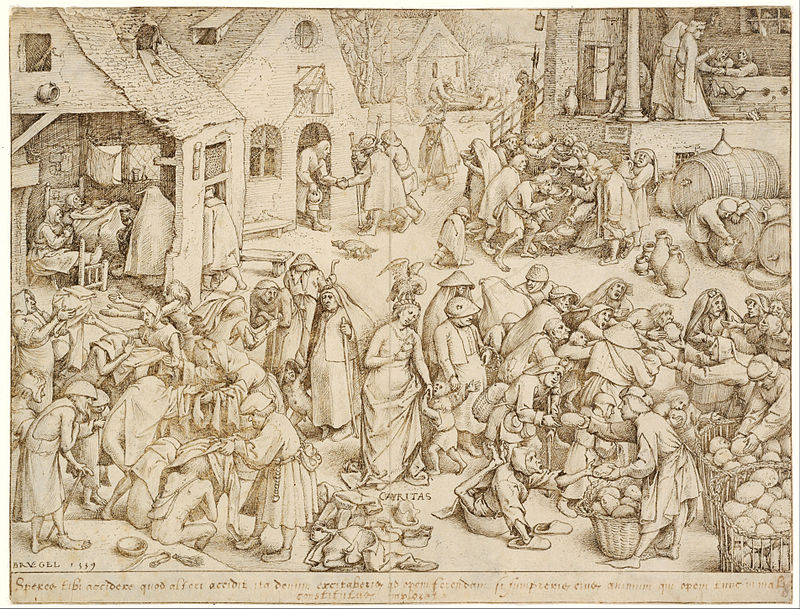
The Corporal Works of Mercy

Caritas: 1559, Pieter Brugel the Elder

Bear with me, please. If you stick to the end of this humble offering it will help you with your writing and your life. Guaranteed. Just give me a few minutes.

I usually wake up in the morning with a coherent thought. It is often a song title or phrase — this morning it was “Gimme Danger” by The Stooges — but sometimes it will be a title or a name or an object. Several weeks ago on a Saturday morning the phrase “Corporal Works of Mercy” was standing there at 0500 hours reporting for duty in the forefront of my consciousness.

I hadn’t thought of the Corporal Works of Mercy for decades. They were drummed into me by rote memorization by the good, stern and strict Sisters of Charity at St. Agatha Grade School, and if you put a gun to my head I can still recite a few of them:  clothe the naked (this always elicited a snicker or two from one of the ten year olds in the classroom corner); visit the sick; feed the hungry; shelter the homeless; visit the imprisoned;  and bury the dead. I just checked myself and I only missed one: give water to the thirsty. Those nuns did a pretty good job. Anyway, the term nagged and tugged at me all day, right up to the time when I retired for the night.

I found out why a couple of hours later when I was awakened by a telephone call. The caller was an acquaintance that I hadn’t spoken with for several years, an alcoholic like myself. He somehow had my number which I had given him all that time ago, and was taking me up on the offer that I had made: he could call me anytime, anywhere, if he needed help. The caller needed help, badly. I provided it that night, and since then we’ve formed a de facto AA group with another guy we both know, a good guy whose problems would send most people into a ceiling beamed room, holding a chair in one hand and a rope in the other. It’s been a humbling experience.

Two days after that weekend phone call I got the news that an elderly client and friend of mine who had seemingly disappeared was in fact a patient in a rehabilitation center not ten minutes from my home. I immediately went to see him. It was the first time I had ever seen him smile. I told him that I would visit, and that I wouldn’t stay long — I’m not really a social animal — but that I would visit frequently, and have fulfilled that promise. I don’t have to, but I want to. I take the sense that he will not be leaving there, and I want to do what I can to help him with his passage.

Both of the above actions would qualify, I think, under the heading of “visit the sick.” There are a whole bunch of other works of mercy there for the choosing, however.  Writing a check to help someone out is wonderful; but what people in need really, really require is your time and an act of friendship. You don’t have to go very far to do it, either. There are volunteers needed at food banks and The Make-A-Wish Foundation and St. Vincent de Paul clothing stores and yes, at rehabilitation centers, places where you encounter people at their worst and lowest and need somebody to…heck, to be nice to them for a few minutes. Those of us who are a bit older and are watching those in our personal herd go ahead of us into the next adventure need to make sure that they don’t make the transition alone. With regard to the latter, women know this. Men generally do not. Women go and visit and sit by the bedside and hold their friends’ hands and give them comfort. Men sit and say, “Gee, I wonder how (insert name here) is doing. I probably should call him. Or something.” Guys, if you think about it, do it.

What I am here to tell you, however, is that it’s not a one way road. My writing and my work has gotten better since I have been visiting my one friend and meeting with my other.  What the Sisters didn’t tell us is that doing one or two or all of the Corporal Works of Mercy will focus and settle the doer. It is in a sense counterintuitive; if you’re spending time with someone else that’s time away from writing or working or all of those things that you have to do. Just so. But. But. There is a lot of focus on exercising the mind and the body. What we often forget, however, is that we need to exercise the spirit. I would submit to you that the spirit motivates our writing as much as the mind. Try it, at those points in your life when your life is low or troubled or afflicted. It works.

Thank you for bearing with me. I know that at least a few of you who visit these pages regularly are already heavily involved in the Corporal Works of Mercy, even if you don’t call them that. What do you do? What would you be interested in doing? Please share. I will be somewhat uncharacteristically quiet, but I’ll be here. Thank you.


Interesting Publishing Trends to Watch in 2017

JordanDane
@JordanDane

I found these trends interesting and wanted to share them here at TKZ. As many of you know, I’ve been writing with author friends on various Amazon Kindle Worlds where they host/create a world and invite authors to write for their series. It’s been fun and I get to explore many topics and experiment with styles and research topics and lengths. Plus the group of launching authors share promotion and benefit from each other’s readerships when we cross promote. So given that, I thought you might like to explore these ideas for your writing goals.

Novellas, Anthologies & Co-Authoring – What makes this growing trend popular is affordability and the recognition of shorter attention spans. These shorter types of books are cheaper for authors to produce and affordable for voracious readers to buy. With people’s shorter attention spans, the shorter format is more convenient. The cheaper price point also allows readers to try new authors without busting the bank. Win/Win. As for anthologies, a group of authors can merge their resources to come up with a top-notch product and also save on production, distribution, and promotion costs that can be shared jointly. Multiply the aggregate authors combined reader base and it’s another win/win.

Changing Book Themes Influenced by an Evolving World – In my latest book (due out June 8th – Vigilante Justice) I explore the topic of conspiracy theories and immigration. I brainstormed my “what if” question on those topics and came up with a story that could’ve been ripped from the headlines. It’s a risk to attempt books on the edge of politics, which I leave out of the story. Instead I focused on the emotional human conflicts that were organic to such a story. Be aware of the realistic elements to our culture and society and the struggles we have to infuse them into your themes. You not only explore your own thoughts, but you can crystallize conflict in such a human way. Such themes may be the refugee crisis, climate change, LGBT issues, terrorism (both international and domestic), and drug addiction. As an author you could choose to write about the stark reality of these themes, or you could provide a Utopian escape for readers to find refuge. Give your world building a dose of reality or provide readers a panacea for what they see on TV or in the news.

Indie & Hybrid Houses – Today, authors have options on how to publish, whether it’s self-publishing or attempting to sell to indie or hybrid houses. The Big 5 Publishers are also an option, but the author would have to consider giving up creative control & handing over copyrights and still be required to promote. Many smaller houses are offering better royalty rates and could give the author a more collaborative approach with more control.

Audio Books – With the growing popularity of products like Amazon’s Echo and Google Home, many consumers are gaining access to audio books in their homes, These can be techy types who liked controlling everything in their domain or older folks who (if they can remember Alexa’s name – insert my parents’ names here) like to be read a nighttime story. This kind of technology has enhanced the audio book market and authors can ‘self-publish’ their own audio book format through ACX.

For DISCUSSION:

Have any of you tried variations of these trends and found success? Please share.

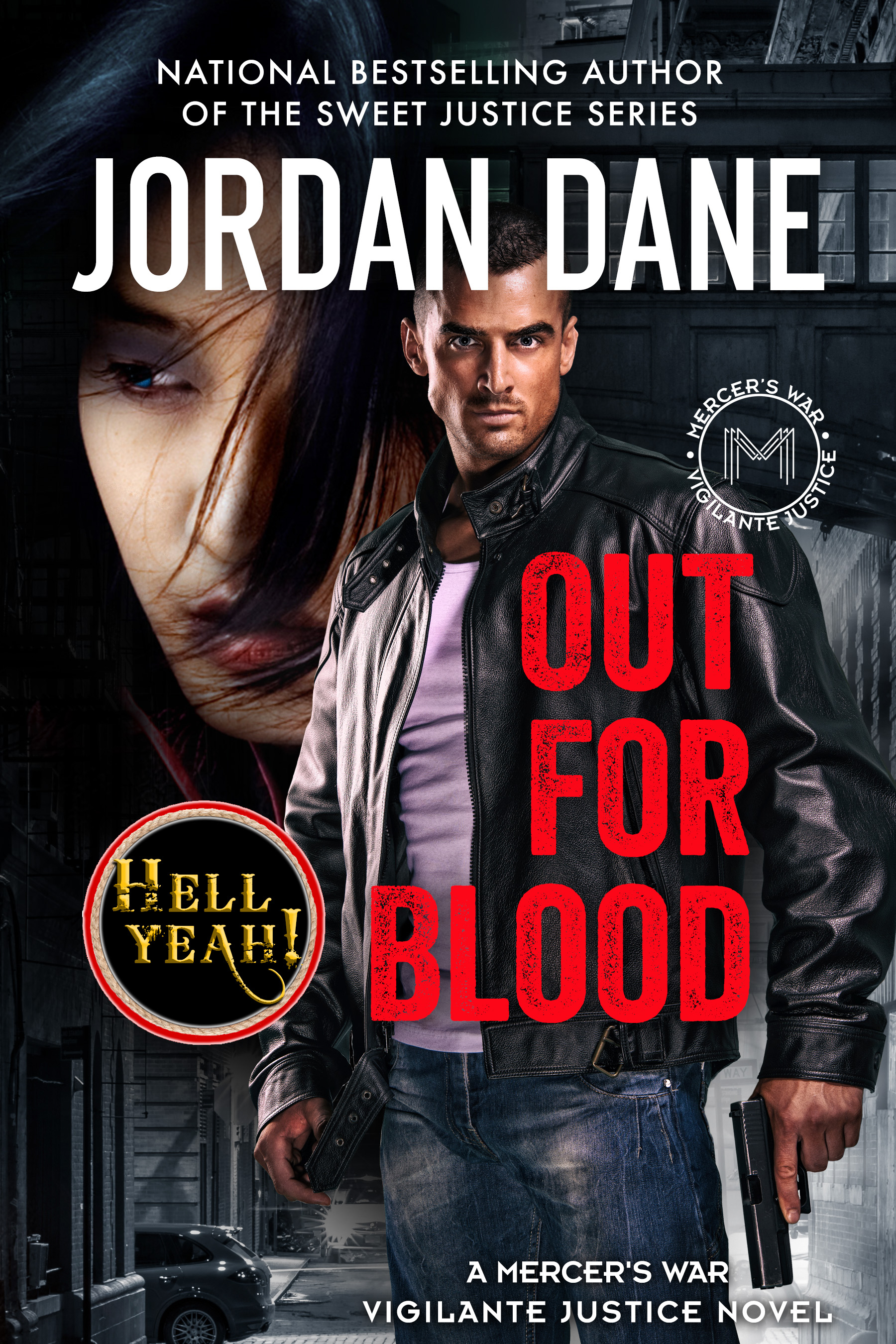
Out for Blood $1.99 Ebook

After the Jaguar destroyed his world, former CIA operative Mercer Broderick targets the faceless cartel boss using the Equalizers as pawns in a deadly game to avenge the murder of his beloved wife and child. (Mercer’s War – Book 2)

When Is It Time to Let Your Old Work Go?

What do you do with your unpublished/unsold work? Where is your juvenilia? Do you treasure it, or let it go?

I’m a let-it-go person. My first two unpublished, and probably unpublishable novels are around here…somewhere. Well, the second one might be in a box in the mudroom. At least I think it made it onto the moving truck eleven years ago. I kind of hope it’s not, because I really don’t want anyone finding it and reading it when I die. (Let alone trying to publish it–that never works out well for the dead writer. I’m put in mind of some of Shirley Jackson’s early story drafts that were published posthumously. And isn’t there 3/4 of a Hemingway novel out there somewhere?) There are probably also drafts of that second novel on 3.5″ floppy disks in my office closet.

My very first unpublished novel may not even have made it onto a 3.5″ disk. I think I finished it in 1998. Before I wrote it, I read a Somerset Maugham autobiography that suggested that all writers should finish their first novel and then immediately put it away in a drawer. It’s only just this minute that I realized he said, “a drawer,” and not, “the trash.” So perhaps I shouldn’t have completely lost track of it.

I have a 17-year-old son who is embarrassed by everything he’s done in the past–the past being fifteen minutes ago, or longer. I’m not that bad, but I don’t feel the desire to go too far back and look at the writer I was. It took years and years and years for me to get that (third) first novel published. To get it good enough. While I’m very comfortable with reflecting on my own work, or poking fun at my old habits–the first 3 short stories and first 2 novels I wrote all had old-fashioned silver-handled vanity hand-mirror and brush sets in them!–in workshops or, well, here, I don’t necessarily care to see them on paper.

It’s a lot like travel. If I am not overburdened with luggage, I’ll take my SLR camera with me because I love, love, love to frame the world through the camera’s lens. But if I can’t take it, I don’t stress about it. The things I see and do live in my memories. There are times when I’ve consciously said, “I will remember how this looks and how it feels.” And I do. That’s enough.

I remember how it felt to write those books and stories. They are landmarks on my journey through the writing life, and I don’t need physical evidence of them. Bits and pieces of them survive in other work. Creativity is never, ever wasted. The words and ideas make their way through my fingers and travel out into the world. I guess I could go full-on dork and say I set them free and they take on their own lives. Or not. And I get to make new ones. Always new ones.

What’s your relationship with work from your past?

A “Moveable Feast” That Never Grows Stale

    Photo purchased from Shutterstock by KL

I’m in the air today on the last leg of a long-delayed  return trip to Paris. The last time I was in the city was 1978 (yikes!). I was worried that since then Paris might have gone the way of so many urban cities, losing its charm and character in the endless pursuit of development and “progress. To my delight, I’ve discovered that Parisiennes value (and therefore preserve) their history and characteristic lifestyle. If anything, Paris is more beautiful than it was in the 70’s (that decade was not a cultural high point for most if any cities, as I dimly recall).

I won’t be able to check in again until the wee hours later today, but please share if any favorite location of your extreme youth has also survived the test of time. Have you ever been back after a long absence to a place that emanates  a rosy, nostalgic glow in your memory? Did you find it to be the same as you remember, worse, or better?


Deeper Thinking About Writing Your Scenes

by Larry Brooks

Deeper than what, you might fairly ask?

Perhaps, deeper than you’re thinking about them now. Because too often, newer writers (in particular) begin writing a scene without a clear intention for that scene. As a means of discovery (finding and vetting story options), this can be viable and legit…

… but unless you rethink and recast the scene once you do understand the purpose of a particular scene – its mission, if you will – chances are that scene will become a liability.

New writers tend to forget that next step.  The scene rambles, then it finds (perhaps stumbles upon) its purpose… then it’s on to the next scene.

If you have a bunch of scenes created this way, you may have tanked the whole novel on this one issue of craft alone.

Scene writing is its own core competency, separate from – yet every bit as essential as – the other primary core competencies you need to manifest: 1) a conceptually-rich premise, 2) character, 3) theme, 4) structure and 5) writing voice, including dialogue and the general nature of your narrative.

That’s six core competencies (categorically) in all.

If this was an athletic contest of some kind, scene writing would be where you actually manifest your skills and instincts on the field/court itself, while the others reside in the realm of preparation and training, strategy and game plan, teamwork and aggression.

Obvious? If you could read enough manuscripts under development, you’d see that it isn’t.

One of the stories I was coaching recently had this little wrinkle: the main character’s quest was interrupted by a flashback scene showing the hero as a boy delivering newspapers, falling off his bike and being laughed at by a group of girls standing on the opposite corner.

Then the reader was taken right back in the thick of the hunt for the adult hero’s blackmailer.

That little flashback was actually well done, but it was like a helping of turkey sage dressing plopped onto the plate that was otherwise a steak dinner. I kept waiting for it to connect to the main dramatic spine of the story.

I read on. And on. It never did.

I asked the writer why this scene was even in the story.  He said it was there because he loved it. This had actually happened to him, back in the day, and he’d never forgotten it. Yeah, I countered, but why is it in this story, in which the hero has no adult issues with women laughing at him, or with any childhood issues at all?

He said he thought it contributed to characterization. He said he thought it was cool.

It didn’t. It wasn’t. It a distraction, the slamming of a Pause button. His answer to my question was a defensive scramble, a rookie rationalization, rather than logic that fit into the professional level of craft understanding.

You know that truism about killing your darlings? This was a case study for that.

The scene didn’t have a purpose in this story. It was strategically indefensible. It contributed nothing to narrative exposition… which is something that all of our scenes must accomplish (with a caveat that this contribution may read differently in the contextually-unique opening setup scenes, an awareness of which is a subtlety that separates new writers from proven pros).

Scenes are, by definition, strategic in nature.  

When a story works, its scenes have a reason to be.  A purposeful mission to fulfill. And, a context that helps define the mission based on where it resides within the story.

There are many ways to boil this down into a storytelling principle, like this:

Every scene in your novel needs to move the story forward at an expositional level. The riskiest scenes are when the writer defends it as a tool of characterization, rather than a tool of exposition that is informed by characterization.

The best scenes accomplish both.

The question becomes this: how does your scene move the story forward, literally, by injecting new information or nuance into the narrative?

My advice, to both planners and pantsers: don’t write the scene until you know. Or if you must, don’t label the scene as “final” until you have a good answer.

So how do you know? One word: context. By understanding what has happened before the scene… and, with equal clarity how the scene will tee up what happens after it.

Putting that evolved clarity into your scenes often becomes the primary value-add of the revision process.

Here are more questions you should ask about your scenes:

What single element of exposition does this scene contribute to the narrative?

Is there, in fact, more than one expositional mission for the scene? Hopefully not by your design. There shouldn’t be multiple scene missions in an expositional context (one scene showing a car crash and a drug deal and a sexual encounter… not a good idea), especially after the Part 1 setup quartile. If so, consider creating separate and sequential scenes, even a series of scenes, to deliver them.

If there is no obvious mission for a scene, why are you considering this scene at all? If the answer serves anything other than the dramatic forwarding of the story… pause and rethink.

If your scene is there simply to create or reinforce setting and show characterization (which can work early in a story, and not all that often), or to fill in blanks that the reader is fully capable of filling in themselves, consider adding that context to scenes that do have a  clearer narrative mission as the main purpose and point.

Knowing the scene’s mission, you can now cut into the scene (begin it) at the last possible moment, avoiding obligatory chit-chat that doesn’t setup the “moment” the scene delivers.

Ask yourself how the scene changes the story. If it doesn’t, look closer at it. Your entire story arc needs to appear as a sloping line, either up or down, it should never be cruising along at one dramatic altitude.

Is your scene part of a dramatic sequence?  

Each beat of a sequence that contributes new information is worthy of its own scene. Consider separating scenes in a tightly unspooling sequence by using skipped lines (white space) as transitional devices between them.

Do you know how to set up a scene to empower the scenes that follow?  Seek to understand how, and when, each scene connects to the whole.

Where in the scene does its moment of revelation (fulfillment of the mission) occur?  The later the better… even down to the last sentence. Which means, you are writing lean-and-mean on both ends of the scene itself.

After the mission is clear… then what?

Once the mission of a scene is identified, the questions sound like this: What is the best creative strategy for this scene (cut in as late as possible, dramatize the key moment, transition out at the height of the drama)?

Does it leverage previous scenes, and thus remains bound in alignment to them?

When you are clear on the mission of a scene, and when that mission contributes momentum to the forward motion of the story, only then do the artistic options for it become fully clear.


Less Focus For Better Writing

by James Scott Bell
@jamesscottbell

On a recent Saturday morning I took one of my famous homemade cappuccinos out by the pool and reclined on a lounge with a Dean Koontz and my AlphaSmart. My intent was simply to enjoy an hour of relaxed reading before getting back to a scene in my WIP.

The weather was sublime (“Looks like another perfect day, AH love L.A….” – Randy Newman), and I found myself contentedly sipping my brew and doing absolutely nothing. Looked at the sky, the clouds, a distant plane floating toward Burbank or LAX. A little part of my mind said, You can read now. But I didn’t listen. I was enjoying the fine art of loafing.

Which lasted about three minutes. Because something happened I know has happened to you. Up there in the writing bungalow of my brain, the staff was working under the radar. A messenger send down a memo. It was about one of the secondary characters in my WIP. It was an idea that brought her more fullness and sympathy and was perfectly in keeping with her backstory.

I grabbed my AlphaSmart and wrote a page of voice journal—the character speaking directly to me. It was deep and evocative and I knew a lot of it was going right into my book.

As I said, you know that feeling. In the car, the shower, at the grocery store—a great idea flashes and you jot it down or record it as a memo on your phone. And you can’t wait to get back to the keyboard.

This bit of serendipity got me to thinking that maybe I should try to be more systematic about my loafing. I’m naturally good at it, but how much better could I be if I used a little discipline?

In an article in the Harvard Business Review, “Your Brain Can Only Take So Much Focus”, Dr. Srini Pillay writes about our over-emphasis on focus. We have our to-do lists, timetables, goals. And there’s nothing wrong with that. But it turns out we also should be practicing “unfocus.”

In keeping with recent research, both focus and unfocus are vital. The brain operates optimally when it toggles between focus and unfocus, allowing you to develop resilience, enhance creativity, and make better decisions too.

When you unfocus, you engage a brain circuit called the “default mode network.” Abbreviated as the DMN, we used to think of this circuit as the Do Mostly Nothing circuit because it only came on when you stopped focusing effortfully. Yet, when “at rest”, this circuit uses 20% of the body’s energy (compared to the comparatively small 5% that any effort will require).

The DMN needs this energy because it is doing anything but resting. Under the brain’s conscious radar, it activates old memories, goes back and forth between the past, present, and future, and recombines different ideas. Using this new and previously inaccessible data, you develop enhanced self-awareness and a sense of personal relevance. And you can imagine creative solutions or predict the future, thereby leading to better decision-making too. The DMN also helps you tune into other people’s thinking, thereby improving team understanding and cohesion.

Dr. Pillay recommends building “positive constructive daydreaming” (PCD) into your day. I do this very well at my local coffee house. I stare. Out the window. Sometimes at people. I’m really working, though. That’s PCD time!

Another tip from the good doctor: power naps. “When your brain is in a slump, your clarity and creativity are compromised. After a 10-minute nap, studies show that you become much clearer and more alert.”

But the technique that really jumped out at me was this:

Pretending to be someone else: When you’re stuck in a creative process, unfocus may also come to the rescue when you embody and live out an entirely different personality. In 2016, educational psychologists, Denis Dumas and Kevin Dunbar found that people who try to solve creative problems are more successful if they behave like an eccentric poet than a rigid librarian. Given a test in which they have to come up with as many uses as possible for any object (e.g. a brick) those who behave like eccentric poets have superior creative performance. This finding holds even if the same person takes on a different identity.

When in a creative deadlock, try this exercise of embodying a different identity. It will likely get you out of your own head, and allow you to think from another person’s perspective. I call this psychological halloweenism.

This is close to something I’ve done on occasion. I may have finished a draft and am doing the first read through. Something’s not working. I don’t know what.

I set it aside for awhile and do something unfocused: like pleasure reading, eating a Tommy Burger, or riding my bike. Then when I go back to it I think of a favorite author and pretend he’s looking over my shoulder at the draft. I have him say, “I think you need to ….” and just imagine what he would advise. It’s amazing how often this can break the logjam.

In light of all the science, then, I’ve determined to take a little more unfocus time on weekends.

I’ve also gotten more specific about how I spend my focus time. I’m a morning person. I like getting up while it’s still dark and pouring that first cup of java and getting some words down. I can write for two or three hours straight. But I’ve stopped doing that. I am forcing myself to take a break after 45 minutes of writing, to let the noggin rest a bit. Ten minutes maybe. Then back to work.

In the afternoon, from roughly 1 – 4, I can’t focus like I do in the morning. So I’ll write (or edit) in 25-minute spurts. Then I’ll get up and do something unfocused for fifteen minutes. Or I might lie on my back on the floor with my legs up on a chair for ten minutes, and deep-breathe. Then I go for my next 25-minute writing stint. I believe this is called the Pomodoro Technique.

Oh yes, and this cannot be emphasized enough: tame your social media distractions or they will eat your brain!

There’s a famous story (one of many) about the dictatorial head of Columbia Studio, Harry Cohn. He walked on the lot one morning and strode past the writers’ bungalow. It was completely quiet. He blew his stack and started cursing at the building.

Suddenly, the place burst with the sound of typewriters clacking away.

Harry Cohn shouted, “LIARS!”

In retrospect, maybe he should have given them all a raise. They were unfocusing!

So what about you? Do you ever practice “unfocus”? 

***


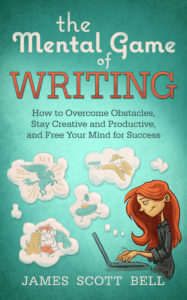
For more on the mental side of the writing life, see The Mental Game of Writing: 29 Secrets For Overcoming Obstacles And Freeing Your Mind For Success.