
Photo purchased from Shutterstock
Has becoming a writer caused you to learn anything new about yourself? Something you wouldn’t have known, if you’d never started writing?

Happy Monday! Today we have a first page critique entitled 12 Rules. My comments follow and I’m hoping that TKZers provide some great input and feedback for our brave submitter. I will be on a plane to Europe so may not be able to respond to comments – but I’m sure it will be a great discussion!
Title: 12 Rules
Chapter 1
Everything around them tended to die, including people. She always struggled with keeping pretty flowers in her room alive by forgetting to water them, and he never could sustain tiny house pets lifespan beyond a couple of weeks. Even inatime things like hopes and dreams had a tendency to writher over time between the two.
Though they both had to admit, this was the first human to die in their presence.
As heartless as Arlo hated to be, the person who had fallen quite literally at their feet was of no importance to either of them. It was Parks’ third cousins step sister. Technically, she wasn’t really family according to him.
Two weeks ago they were at his annual family gathering. Everyone was drinking, laughing, and having a good time as far as Arlo could tell. Her and Parks were huddled by a picnic table full of all the younger kids while sipping on red punch, discussing the boy Parks believed to be his nephew, but wasn’t all that sure. He was cute, Arlo had commented, and in the corner they were devising a plan to get him to talk to Arlo. She knew Parks was the wrong person to ask when his first suggestion came with, “accidently spill your drink on him.” Before she could even fathom saying a word to the gorgeous new stranger, Parks’ mom pulled them over for a picture. Lined up by height, Arlo of course was at the front along with a younger lady who was very pretty. She smiled at Arlo, flashing perfect whitened teeth over baby pink lipstick that popped. Then there was blinding flashes of more than one camera, and then the flashes were gone and she was seeing spots. Everyone stood up, including the nice lady next to her. Parks had already been back at her side with a new and improved plan, but never got the chance to tell her. The lady’s eyelids fluttered and her ocean blue eyes rolled like pool table balls backwards, and she tumbled to the ground like a tiny building- quick and short. The lady didn’t just fall to the side or backwards, she fell forward; right on Arlo’s sunshine yellow shoes she’d been so excited to wear. And just like that, the lady had smeared death all over her new converse. Following the fall and destroyed shoes had been earfuls of screaming.
Now they were bumper to bumper in early morning traffic yelling at each other over a blaring radio.
“You were supposed to take that exit we passed like ten minutes ago!” Arlo shouted. She felt the need to cup one of her hands around her mouth like a mega phone. But leaned back in the driver’s seat, he still refused to listen.
My Comments:
Somewhere in this first page there is a great story waiting to emerge – I can see glimmers of a cool, detached, wry POV and the beginnings of a story about two people who can’t keep anything alive suddenly being confronted with an actual death. Unfortunately, this story is stymied by some stylistic choices, a passive choice of sentence structure, and a lack of characterization that robs the page of much of its dramatic tension.
In brief, I think these are the main issues that need to be addressed:
Overall, I think there’s a good story lurking beneath the surface of this first page, but the writer could benefit from cleaning up the sentence structure, grammar, and pronoun use, adopting a more active voice, and immersing us in the scene with action, dialogue and more detailed characterization for this first page.
So TKZers what other advice or feedback would you provide our brave submitter?

I hope you all had a great July 4th holiday. I hosted my parents for a ribs dinner for my holiday celebration. I’ve been on a ketogenic diet (more of a lifestyle than a diet) and have been feeling AMAZING. I’m more energized and have been sleeping well and waking up refreshed and ready to go. As I’m writing this, I’ve had my Keto Coffee, which is like a buttery latte with strong coffee. Yum!
For today’s post, I wanted to share the idea behind a book that a friend recommended me to read. JUST A MINUTE by Wess Stafford is based on a theme that touched me – “In the heart of a child, one moment can last forever.” Although this is a Christian-based book, it holds stories that can touch anyone. Its chapters are split into several categories: moments for rescue, to build self-worth, to form character, to discover talent, to awaken the spirit, to stretch the mind, and to realize one’s calling.
If you think back in your life, can you remember times when the special attention of an adult helped define who you became as an adult? These moments don’t have to be earth shattering. Just moments you have never forgotten, for a reason, because they meant (and still mean) something to you all these years later.
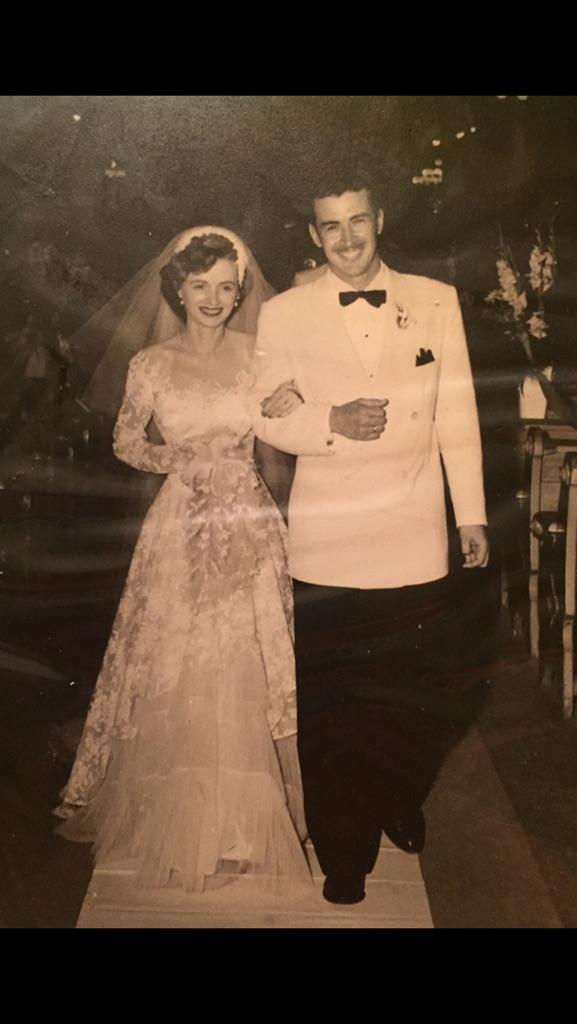
My parents have given me a lifetime of these moments. They recently celebrated their 67th anniversary and I wanted to share their wedding pictures with you.
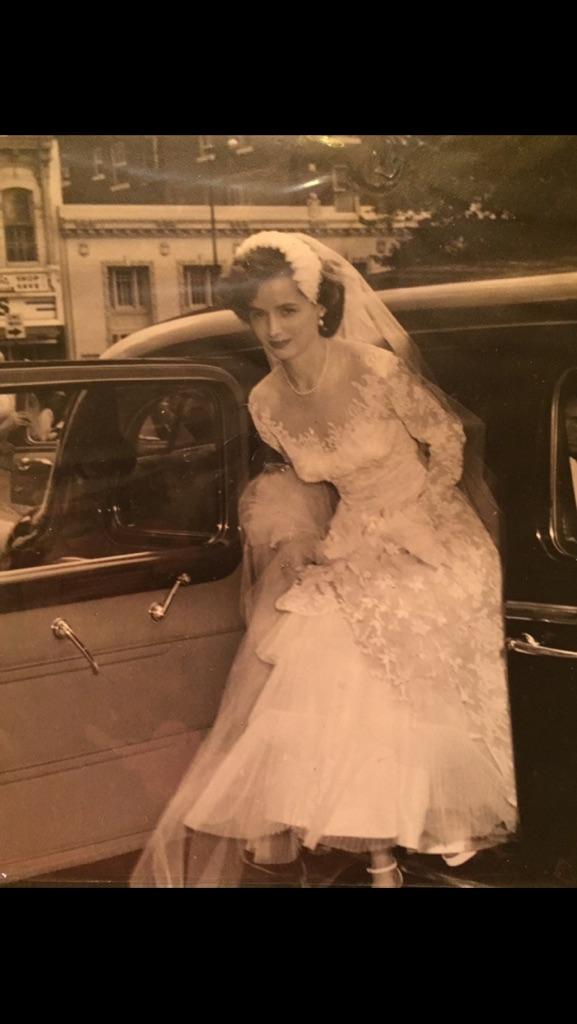
My mother has given me many of these life-altering moments. She is the first person I think of when I ponder who I was as a child and who I became as an adult. My father had his influence, but my mom was in the trenches with us growing up while dad worked long hours to keep my five siblings in private school in a house he designed (as an architect).
Under the category of TO DISCOVER TALENT – my mom had the opposite effect. After it took me a few years to decide what my major would be in college, I called her to say that I had made up my mind and that I would be getting a B. S. (Business Degree) with an emphasis on Accounting. The first words out of her mouth were, “You’re not good at math.” Yeah, thanks for the vote of confidence, mom. In complete irony, I proved her wrong (sort of). I had 6 hours of deficiencies in math that kept me from taking a necessary course – Statistics. I was advised to bite the bullet and take the 6 hours in other math courses before I would be considered proficient enough to endure Stat. With my Irish dander up, I called B.S. on that and just took the damned Stat class. I finished with a B, one of my lowest grades. When it came time for my graduation, I realized I was still short those 6 hours before I could graduate. I went to the Dean of the school (someone who knew me well from all my hours on the Student Council) and asked him to waive the 6 hours. It obviously was a mistake if I could pass Stat. He agreed and said he would remove the deficiency if I could tell him a good joke. For the price of a good joke, I graduated with honors. Yes, my mom stirred up my competitive spirit and raised the Irish in me–a skill that has served me well.
Under the category of TO FORM CHARACTER, My mom once caught me sneaking out a small bottle of aspirin filled with liquor when I was going to a party of teens. I had planned to share that little bottle with a few of my girlfriends. When she found it in my purse, she told me I was busted and couldn’t go to the party. I told her I understood and was prepared to take my lumps. I didn’t make a fuss. But after a short while, my mom rethought her position and came to me with a moment that changed my life forever. She said that if I promised NOT to take a drink at the party, she would still let me go. She trusted me. That moment of trust made me feel like an adult. At the party, even though alcohol was present, I did not take ONE SIP of it. I told all my friends that I had made a promise to my mom that I would keep. That life lesson stuck with me. After that, I never lied to my mom. I learned that lies diminished me, then and now. If I couldn’t face the truth of who I am as a human being and had to resort to a lie to fake it, what did that make me? I learned to own my truth.
Mom also learned a lesson. If she didn’t want to really know something about me, she shouldn’t ask if she couldn’t handle the truth. I loved shocking her whenever she asked me about things happening in my life. This was the woman who said on my wedding day, “I’d tell you about the birds and the bees, but I’m afraid you’d correct me.” Reality isn’t in her wheelhouse.
What about YOU, TKZers? Who influenced the adult you have become? Please share some of your stories and what you learned from them.
By PJ Parrish
It’s Show and Tell Day here at TKZ school. Some of you might be old enough to remember Show and Tell Day. (I’m told schools don’t do it much anymore, alas). Like all kids, I loved it because it was a break from the daily grind. You got to sit back and listen to your classmates tell tales and sometimes do tricks. I remember one kid who brought his pet salamander. Another girl showed off her Barbie collection. Then there was the kid who brought in a rock. There was a lot of giggling as he started. What the heck could you say about a rock? But then he told a great story about how he and his family had gone canoeing on the Platt River in northern Michigan on vacation and he had tipped over and almost drowned. He found the rock on the shore and brought it home as a souvenir of his big day. Needless to say, we were enthralled. He almost died! I never forgot him.
With that prelude, let’s take a look at today’s submission. Thank you, dear writer, for letting us learn from your work.
Nephilim of Flame
Wren Wilson held her face in her hands but she had no more tears left in her. Besides, tears belonged to the grieving, not the guilty. The town had its first murder in more than forty years and Wren was responsible. The media had eaten up the story, a heroic sacrifice that led to Wren’s escape from a madman. Somehow it had made the horrible murder easier for the town to handle. They had put Wren on a pedestal like she had accomplished something. Wren was sick to her stomach thinking about it. Not because the tragedy of it all, but because it was a lie. The lie came easily to her lips after so many re-telling’s. Wren knew she didn’t deserve the sympathy and good will showered on her. She was no damsel in distress and certainly no hero.
Wren took a deep breath and lowered her hands to blankly out the car window. The sunny day was already beginning to become overcast as the funeral procession approached the cemetery. Wren watched the distant clouds, doing her best to ignore the sight of the hearse and flashing lights ahead. Wren daydreamed that she was out on a normal drive with her parents, unconcerned with big city problems like murder. For a few minutes, she managed to become lost in the tranquility represented by the car window. The illusion shattered when the car pulled to a stop and Wren glanced forward, they had arrived to the cemetery.
Wren picked her way carefully to the cemetery plot where the hero would be interred. She had been asked to say a few words today and she fretted over what to do. To her left she could see TV crews filming the mourners while reporters updated their viewers on the day’s events. Wren tried to keep a mournful look on her face. She knew cameras would be focusing on her. Wren plucked at her black dress irritably. She glanced up and met the eyes of some of the other mourners, lowering her head quickly. Their sympathy made it worse.
Wren sighed and shook her head, they didn’t know the whole truth, that is why they gave her those looks. Wren had lied to the police, to the media and to her family. She had conspired to keep the truth from everyone.
_______________________
As you might guess by now, I’m using this as a springboard to talk about showing versus telling in fiction. What we have here is an intriguing idea (a woman who harbors a dark secret about a murder). But the idea is obscured by two problems that are common to many openings — confusion and too much telling. Let’s tackle the confusing part first.
What’s happening on the surface isn’t the problem — Wren Wilson, the putative protagonist, is at a funeral thinking about the dead person, her own status in her community and the secret she carries.
But what’s below the surface is really confusing, especially about the relationship between Wren and the person being buried here. We get this line first: The town had its first murder in more than forty years and Wren was responsible. This implies Wren murdered someone, probably the person being buried? Which makes her a criminal. Then we get this line: The media had eaten up the story, a heroic sacrifice that led to Wren’s escape from a madman. Which makes me think that Wren was abducted maybe and she killed him and escaped? So she’s not a criminal; she’s a victim. But if she was abducted, she killed in self-defense, no? So that’s not a murder. It’s a justifiable homicide.
The town lauds her, “showering her” with “good will and sympathy.” So apparently, she did something really brave and positive? But she feels so guilty about it, she’s cried-out and can’t stand to look out at the cemetery but then she “picked irritably at her black dress.” I don’t understand what is going on in this character’s head. I also don’t understand who is being buried — the “madman” or someone else who so far has no grounding in the story. After I re-read this several times, I also wondering if maybe Wren was abducted (by the “madman”) and someone ELSE saved her (“the hero”) but he got killed in the process and now folks are mourning him?
Wren picked her way carefully to the cemetery plot where the hero would be interred.
Who is this “hero”? I thought she was the hero. We go on:
She glanced up and met the eyes of some of the other mourners, lowering her head quickly. Their sympathy made it worse.
Wren sighed and shook her head, they didn’t know the whole truth, that is why they gave her those looks. Wren had lied to the police, to the media and to her family. She had conspired to keep the truth from everyone.
Other mourners? Why is this person being mourned? Again, I think the confusion is just because the initial implication here is that the “madman” who was “murdered” by Wren is now being buried. But that makes no sense given the use of “hero” and “mourners.”
I get that the writer is going for some misdirection here. Wren was some kind of victim at the hands of a madman but became a “hero” herself by escaping. But apparently, this is not true. Wren herself tells us it is a lie. So that is a great source of tension and intrigue. But I think the writer needs to clarify the characters here — the “madman,” the “hero” and Wren’s relationship to them. And who is being buried?
Now let’s talk about the showing versus telling. There is minimal action here: Wren is driving up to a cemetery where a burial is taking place and walks to the grave site. That is all that happens. Everything else is thinking, remembering, regretting, thinking, sighing, thinking…
Everything is told to us. All the crucial information is conveyed through Wren’s thoughts. The first paragraph — that critical door into the reader’s imagination — is 99 percent backstory. Now, I don’t like trying to rewrite someone’s opening because we all tell our stories in our own voices, but I just want to suggest a different approach to make my point. What if this scene opened at the END of the grave site ceremony? We see Wren standing there, feeling exposed under the TV lights and cameras and the eyes of the people in her town. Maybe a pastor says a quick last word about the person being buried (so we know who it is) and Wren has a BRIEF thought about him. (No long backstory — you dribble that out artfully later!)
Then one by one, a few folks come up to talk to her. DIALOGUE IS ACTION! And this is how you begin to fill in the backstory. Let me take a stab at it:
Wren saw a woman in black moving slowly toward her but it was too late to dodge her. It was her old sixth grade teacher.
“Wren, you poor thing,” the woman said, embracing her. “I don’t know how you can come here today. Not after what that man did to you. You’re so pale. Are you okay?
Wren pulled away. “I’m fine, Mrs. Marsh.” But she wasn’t. She was downing Ambien every night and staring out the window of her florist shop every day, unable to fill the simplest order. (You slip in what she does for a living).
Wren turned to get away, nearly bumping into the tall man. The WMRK emblem of his TV station was emblazoned on his blue blazer. Mark Standish…the reporter who had been there when the police first brought her out, clothes torn, face streaked with blood. She still wondered how he had heard about her escape.
“When you going to give me the story, Wren?” Standish asked.
“I told you all as much as I remember,” she said. But she hadn’t. She hadn’t told anyone what had really happened in that week she had been held captive in that basement. She had told just enough to be called a heroine, just enough to get the sympathy of everyone in town.
Wren pushed past him and went to stand under a tree. She pressed a hand to her chest and shut her eyes tight. FILL IN HER WITH SOME BRIEF FLASHBACKS TO WHAT HAPPENED. Wren turned to look back at the grave site. The mourners were leaving, heading back to their cars, popping up umbrellas as a light rain began to fall.
Wren waited until they were all gone then walked slowly back through the rows of plastic chairs to the edge of the grave. She looked down at the black casket.
“We know,” she said. “You and me. We are the only ones who know the truth.”
Well, you get the idea. What I am trying to do here is to convey the same backstory but through the actions and dialogue of the characters. You needn’t have slam-bam death and destruction in your opening. But you need tension and action. Dialogue is action. It is showing. Use it!
Okay, I know I am running long but I like this submission for its potential so let me quickly go over a few more things in Track Change edits:
Wren Wilson held her face in her hands This is an odd image and sorta cliched. Can you find a more compelling first line? but she had no more tears left in her. Besides, tears belonged to the grieving, not the guilty. The town had its first murder in more than forty years and Wren was responsible. The media had eaten up the story, a heroic sacrifice that led to Wren’s escape from a madman. Somehow it had made the horrible murder easier for the town to handle. They had put Wren on a pedestal like she had accomplished something. Wren was sick to her stomach thinking about it. Not because the tragedy of it all, but because it was a lie. The lie came easily to her lips after so many re-telling’s. Wren knew she didn’t deserve the sympathy and good will showered on her. She was no damsel in distress and certainly no hero. This is an info-dump of backstory. This needs to come out slowly, gracefully, throughout the first chapter, not in the first graph. The first graph should be a tease not a tell-all confessional.
Wren took a deep breath and lowered her hands to stare? blankly out the car window. The sunny day was already beginning to become overcast as the funeral procession approached the cemetery. Wren watched the distant clouds, doing her best to ignore the sight of the hearse and flashing lights ahead. Wren daydreamed that she was out on a normal drive with her parents, unconcerned with big city problems like murder. For a few minutes, she managed to become lost in the tranquility represented by the car window. I think this odd jump back to childhood clutters things up here. The illusion shattered when the car pulled to a stop and Wren glanced forward, they had arrived to the cemetery. I think this whole graph could cut. It doesn’t add anything.
Wren picked her way watch your choreography here. Did she drive or was driven? She needs to get out of the car. carefully to the cemetery plot where the hero Huh? would be interred. She had been asked to say a few words today and she fretted over what to do. To her left she could see TV crews filming the mourners while reporters updated their viewers on the day’s events. Wren tried to keep a mournful look on her face. She knew cameras would be focusing on her. You already implied this. Wren plucked at her black dress irritably. whiplash change of mood She glanced up and met the eyes of some of the other mourners, lowering her head quickly. Their sympathy made it worse.
Wren Note that you started every graph with her name. You also could use some variation in your graph length. Dialogue would go a long way to breaking up how this gray mass looks on the page sighed and shook her head, they didn’t know the whole truth, that is why they gave her those looks. Wren had lied to the police, to the media and to her family. She had conspired to keep the truth from everyone. Nice intrigue being placed into the story but you must find a way to convey this through ACTION and dialogue instead of all thought.
One last thing: I really don’t like the title. When I read this cold the first time, I thought, uh oh…they gave me a fantasy story and I am terrible at those. But this story appears to be contemporary (though we get no sense of time) and set in a big city or a town. (the writer uses both phrases and they imply different places). I had to Google Niphilim. Turns out it is the Nephilim were the offspring of the “sons of God” and the “daughters of men” before the deluge, according to Genesis in the Bible. That’s kinda sorta interesting but for a contemporary murder story? Not so sure. I also don’t get the “of Flame” unless it’s put there for alliteration. I love biblical and literary allusions in novel titles, but if your reader is sent scurrying to Google to get it, you’re in trouble. I think it might work for fantasy, or especially dystopian fiction. For this story, as we understand it in 400 words, I think it’s off tone.
Again, thank you writer for submitting and don’t give up. I sense there is a good story and character here waiting to escape.

Photo: “Tree Tunnel” by Gaurang Alat, courtesy unsplash.com
Good morning, and let’s give a hound-dog howdy to Anon du jour, who has gathered up a seemingly endless supply of courage and submitted the first page of work-in-progress DEATH KNELL for our collective consideration!
Title: Death Knell
Chapter One: The Visitor
No one is ever who they appear to be. Peter Templeton had this thought as he stepped out of his car and looked up into the crimson blanket that covered the evening sky. It was a gorgeous sunset and cast a glow over his entire neighborhood. Another perfect ending to another perfect day in his now perfect life, he thought.
Across the street, neighborhood children scattered and laughed. He watched the children play for a minute and smiled. Two years ago, he sat in a small cubicle and knew it would be his grave. Now, he was living in a world where children played on well-manicured lawns, driveways were lined with vehicles named Cadillac, Lexus and BMW, and people spoke to each other across wooden fences. He shook his head and smiled again.
As if on cue, a silver Mercedes drove up the driveway next door. The driver honked two short bursts and waved as he got out. That was Simon, Peter’s neighbor and financial planner. Simon sat in a different type of cubicle and helped old people enjoy their final days. By the look on his face, he enjoyed it as much as anyone.
Peter waved back and thought his life in a different cubicle. He didn’t enjoy it nearly as much as Simon did. He hated every minute of it. When he was younger, Peter thought heartbreak and pain were the worst things he would ever experience. But he was wrong. Boredom, he discovered then, was a whole new kind of hell. It was a living hell where you lived the same day over and over and over again. A hell where the seconds felt like minutes, the minutes felt like hours, and the hours felt like days. A hell where you prayed for death to end the boredom. But those prayers were never answered. They didn’t even give you the freedom to kill yourself back then. Time was the only thing he was allowed to kill.
He looked over the lawns and thought about what a difference a few years can make. Back then, he just existed. He was a zero then. A nobody. He was a murderer in the eyes of the law and a criminal to everyone else. He was a loser waiting to die. And he knew the world would be a better place without him.
Then his salvation came out of nowhere. It pulled him from his hell and dropped him in the middle of this quiet, calm and gorgeous neighborhood. It removed all of the failures in his life like a strong tide and cleansed them in a sea of normal society. Gone were all the wasted dreams, lost loves, and poor decisions. Now, he was really living. He was a winner now. And God-damn it, he loved every second of it.
Peter took a deep breath and looked down the street again. Tree branches made a canopy over the road. For a second, it reminded him of the tropical leaves on the island. They formed a natural ceiling and made the island feel like a great cathedral. He looked around again and took another deep breath. There were many funerals in that cathedral and he witnessed too many of them. He didn’t miss that at all.
Anon, you’ve got an interesting setup here. It sounds as if Peter is a guy who has taken the opportunity to reinvent himself and has done so to his satisfaction. You’re hinting just enough to bait the hook in the reader’s interest and sink it. I have the feeling that Peter’s past is going to come knocking on his door and I would love to be there when it does. You’ve got the substance down. Let’s work on the form of your project just a bit to get it ready for publishing.
— Let’s begin with a little housekeeping. The color of the text in your submission went from blue to black about halfway through it. I’m not sure if the problem was on your end, mine or somewhere in between, but please check that on your manuscript before you send it off an agent. Your text color can be any color you like so long as it is black unless your target tells you otherwise. You also want to proofread a bit more carefully. For one example, you state in the fourth paragraph that
Peter waved back and thought his life in a different cubicle.
You left out the word “about” or “of” between “thought” and “his.” I do this so often in my own writing when my fingers are flying faster than my brain, that I am embarrassed to the extent that I might have a tee shirt created that states “I BEAT GRAMMARLY!” A proofreader (either you or someone else) will hold you in good stead.
— With that out of the way, let’s look take a look at Peter’s interior monologue. Your story is told in the third person past tense, so we want to have a clear delineation between what Peter is directly thinking and what our omnipresent narrator is telling us. You can do this by setting Peter’s thoughts off in italics when you want to tell us what he is thinking. You can say “he thought” once in a while but if you use it once early on with the thought italicized your readers (particularly TKZ readers, who are among the most intelligent on the planet!) will get the idea. You can remind them every once in a while but using “he thought” too frequently will become as boring as “he said.” Also, please note that if Peter is engaging in an internal monologue he is going to be thinking about “my” rather than “his” now perfect life. Let’s see how that will look in your first paragraph:
No one is ever who they appear to be, Peter Templeton thought as he stepped out of his car and looked up into the crimson blanket that covered the evening sky. It was a gorgeous sunset and cast a glow over his entire neighborhood. Another perfect ending to another perfect day in my now perfect life.
— I also got a little distracted by your use of tenses. I noted earlier that Death Knell is told in the past tense. That’s all well and good. We understand that all of the events in the book took place in the past. You need, however, to distinguish between the “past,” which is when your primary narrative occurs, and the “remote past,” which occurs before your main narrative. We use the “past perfect” tense for this. The “past perfect” tense is formed by taking the past tense of “to have” (which is “had) and combining it with the past participle of the verb you are using. It’s easier than it sounds. Here is what happens when we utilize it in the fourth paragraph of Death Knell, where Peter begins to really rock ‘n’ roll about the past and about how things are much better today:
Back then, he had just existed. He had been a zero then.
and…
He had been a murderer in the eyes of the law and a criminal to everyone else. He had been a loser waiting to die. And he had known the world…
It makes for easier reading, given that the reader doesn’t have to sort out the past and the remote past, as you, the author has already done it for them. Which brings us to the next thing on the list:
— Your writing style is just a bit repetitive in spots, Anon. You have a slight tendency to use the same words in close proximity to each other and to repeat what you have already stated or indicated. You are hardly alone in overwriting. I’m in that very large room with you. So is Charles Dickens. The late Harlan Ellison, in his column The Glass Teat, did a short but hilarious sendup of Dickens and the seemingly endless repetition of Tiny Tim’s classic line “God Bless us, every one!” in A Christmas Carol. To correct this, read through your work and if you are describing the same thing over and over, or using the same word more than once in a paragraph, get rid of it and use a synonym.
Let’s look at that fourth paragraph again, where with a snip here and a clip there we can move things along just a bit faster by reducing the use of the phrase “He was”:
Back then, he had just existed. He had been a zero then, a murderer in the eyes of the law, a criminal to everyone else, and a loser waiting to die. He had known the world…
That’s all I got, Anon. In the interest of brevity (…) I tried to focus on the broad picture and give an example or two rather than to go through and pick out each and every potential error. I will now attempt to remain uncharacteristically quiet while I give our wonderful readers a turn at commenting on your work. I sincerely hope, Anon, that you keep plugging away so that we can see the rest of Death Knell at some point in the future. And thank you for submitting to First Page Critique!
Your story is told in the past tense. All of the events described took place in the past. The problem arises when you have to distinguish between events which took place in the past in your main narrative — and events which took place even further in the past. That’s where the past perfect comes in. It’s easy enough to use
— Peter waved back and thought about his life in a different cubicle.

MONTANA AUTHOR TAKES A SMALL BITE OUT OF THE BIG APPLE
The population of my Montana home town is around 25,000—about the same number of people I encountered during six days at Book Expo America (BEA) and BookCon in New York City.
BEA is the biggest annual convention of book publishers, booksellers, distributors, librarians, and authors in North America. With 840,000 square feet of exhibit space at the Javits Center and nearly 500 exhibitors, the show is so big that Publishers Weekly covers it with daily tabloid reports of 70-100 pages each.
The event is open to industry professionals, not the public. I was fortunate to be invited to check out the inner workings of the business. What a learning experience it was!
Big names draw big crowds. Celebrities launching new books stayed busy autographing advance reading copies (ARCs). Some wait lines rivaled Splash Mountain at Disney World. This year’s stars included a couple of guys named Patterson and Clinton who co-wrote a thriller, along with Nicholas Sparks, Sally Field, Barbara Kingsolver, Trevor Noah, and more.
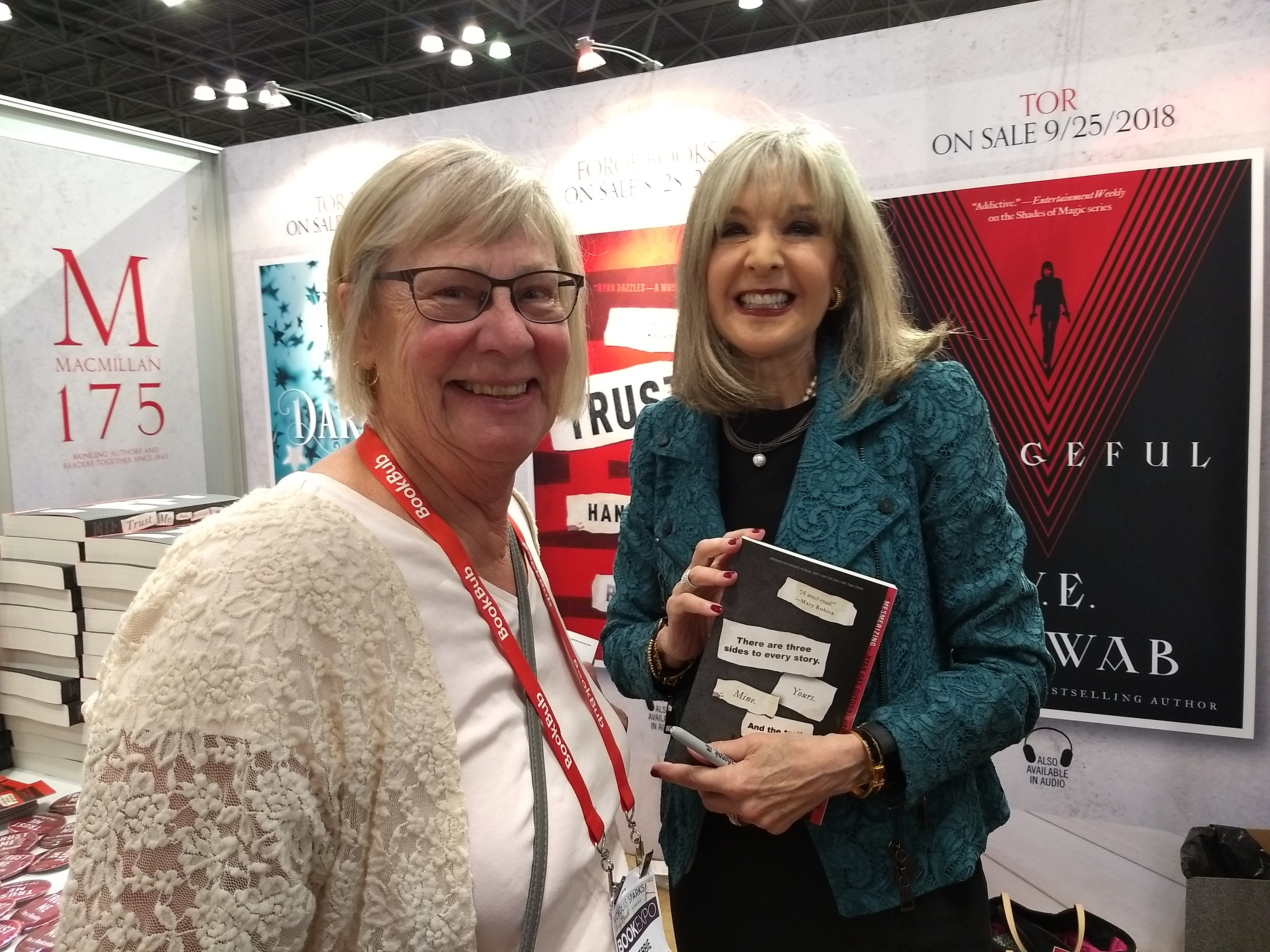
Debbie Burke and Hank Phillippi Ryan
I was delighted to meet the charming Hank Phillippi Ryan at the signing of her new book Trust Me. A few weeks before, I’d watched Hank teach a great online class sponsored by International Thriller Writers (TKZ’s own James Scott Bell also taught a segment of the webinar).

One Librarian’s Bounty
Librarians from all over the country flock to BEA to pick up bagfuls of free ARCs to help them decide what to order for the coming year. Their biggest expense must be the charge for overweight checked baggage!
Important lesson to authors: librarians are your best friends. If librarians get behind your book, their efficient network can put millions of eyes on your work. See, not all librarians are there to ruin your mood! I guess we all had that one librarian who thought they owned the place, but thinking about it now, knowing that they have way more to do than just sitting behind a desk, maybe it’s time to cut them some slack. You may want to do some research into schools like USC Marshall to get a better understanding of what the essential roles are these days of a librarian.
Not surprisingly, Amazon isn’t exactly the most popular kid on the BEA playground. The headline of one daily report read: “Amazon’s Actions Remain a Problem,” a quote by the CEO of the American Booksellers Association. The article talked about the impact of “lost jobs, stores, and uncollected taxes” due to the online giant.
The Big Five (Hachette, HarperCollins, Macmillan, Penguin Random House, Simon & Schuster) had large showy booths on main aisles. In contrast, Amazon’s booth was in a distant corner, far from the entrance.
Since Amazon’s Kindle Press had published my thriller Instrument of the Devil, I trekked all the way to the rear of the exhibit hall to visit them. But when I got there…..
Black curtains surrounded all four sides of the booth. Through the gauzy fabric, I could see people moving inside. But there was no entrance.
Hmmm.
Upon further investigation, I was told Amazon specifically requests a private booth for book publicists to meet with major media to pitch upcoming titles.
Oh.
In addition to the Big Five, scores of indie publishers had booths, representing niche markets for religious, ethnic, political and social issues, health and fitness, food and cooking, short fiction collections. No matter what off-the-wall subject you imagine, chances are someone has published a book about it that shows up at BEA.
Children’s and YA book publishers were out in force, introducing thousands of new products: print books, graphic novels, puzzles, interactive 3D devices, plus tie-in merchandising like costumes, cuddly stuffed characters, sports equipment, etc. There were even quaint retro items like pens and stationary. Could writing actual letters be making a comeback?

Waiting for autographs from their favorite authors
BEA runs from Wednesday through Friday for industry pros. BookCon follows on the weekend and is open to the public. Thousands of readers crowded the Javits Center on Saturday and Sunday. They pored over new releases, waited in line for autographs from favorite authors…

BookCon 2018
…and posed for photos dressed up as popular book characters.
Older folks (like myself) often complain about young people zombie-walking through life with bent necks, mesmerized by their smartphones. Yet at BookCon, I didn’t notice a single example of that disconnection. Kids engaged with each other and were excited about new adventures in reading. Witnessing that gave me hope.
Audio book sales continue to grow by double digits, 30+% increase in the last year alone.
A major BEA sponsor for 2018 was Blackstone Publishing. In 1987, the family-owned independent audio publisher started producing cassettes in a garage in Ashland, Oregon. They tapped into the town’s renowned Shakespeare Festival for narrating talent.
Three decades later, Blackstone has expanded into a full-service publisher of print and e-books in addition to audio, employing more than 200 people. Still headquartered in Ashland, they’ve increased their presence in NYC with acquisitions editors, audio narrators, and a sound studio that’s second to none.
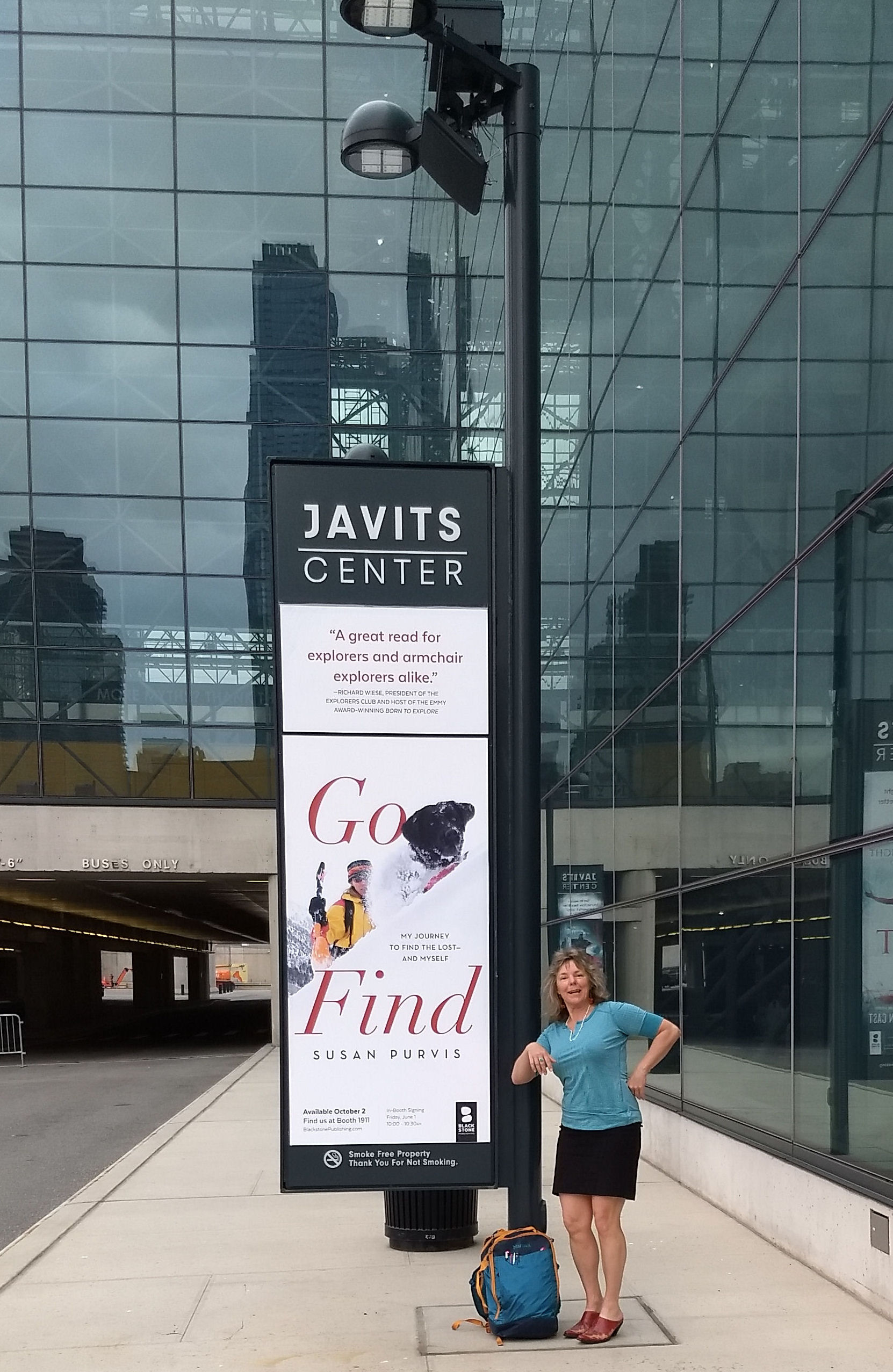
Excited debut author Susan Purvis with the banner of her new book
Last April, I wrote about cadaver dogs and mentioned Susan Purvis’s upcoming memoir, Go Find, which Blackstone is publishing. At BEA, they rolled out the red carpet for Susan, including a 10-foot-tall banner at the entrance of the Javits Center.
At their booth, lighted signs showcased new releases. Book covers were displayed on video screens. During signings, representatives guided people through the waiting line, graciously giving out swag including postcards, book bags, and ARCs.
This contrasted sharply with some author signings sponsored by bigger houses where I wondered if cattle prods might be in use!
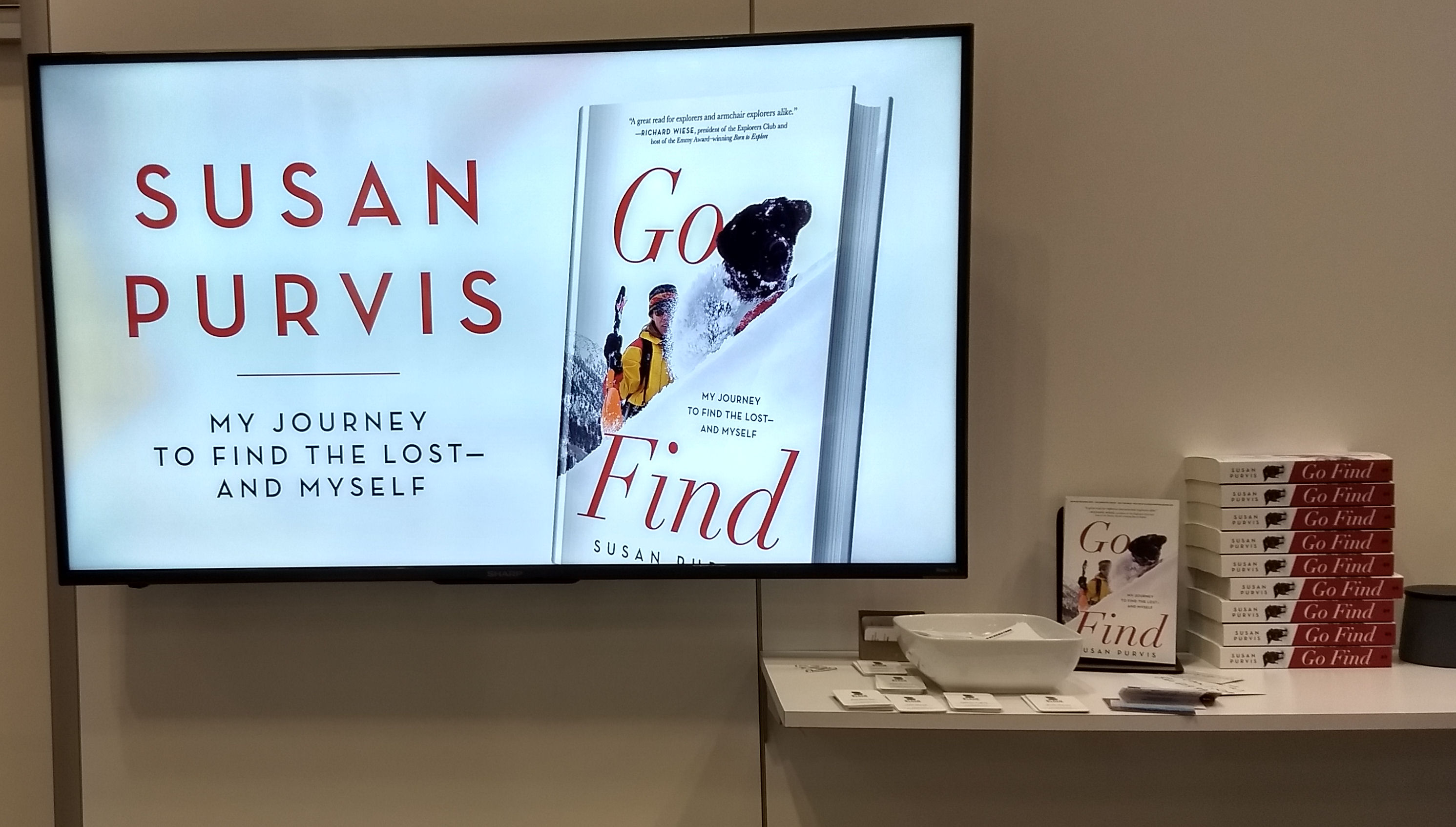
Blackstone’s good treatment of authors has resulted in them picking up bestsellers like Orson Scott Card, cozy queen M.C. Beaton, and mother-daughter fantasy writers P.C. Cast and Kristin Cast.
Despite BEA’s gargantuan scope, it offered opportunities to make personal contacts.
A couple of hours into the first morning, I sank down at a vacant table, already exhausted, eyes glazing over. A woman with a similar dazed expression sat across from me and we commiserated about feeling overwhelmed. Her name was Bee Kapitan, a designer from Vancouver. She had just received an Independent Publisher Award for her interactive e-book How To Say Cheese. I showed her the proposed cover for my new book, Stalking Midas, and she graciously made suggestions. She introduced me to the burgeoning world of interactive book design. We’ll be keeping in touch.
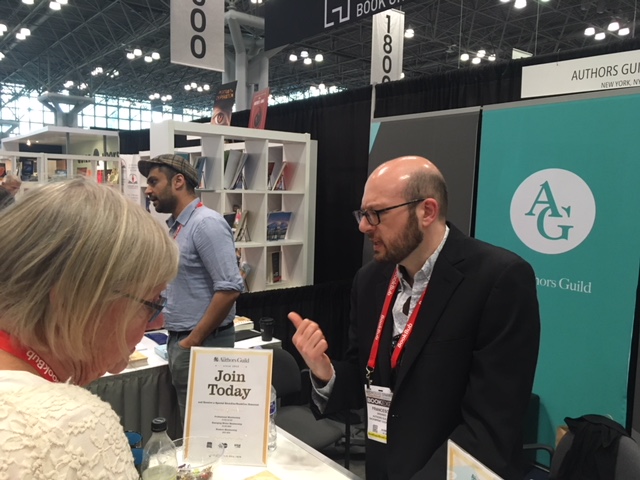
I’m learning from Umair Kazi (l) and Francesco Grisanzio (r)
Another valuable connection occurred with the Authors Guild. I knew of their excellent advocacy for writers but hadn’t gotten around to joining. At their booth, I talked with staff attorney Umair Kazi and digital services coordinator Francesco Grisanzio about rights reversion. Their guidance helped me make a career decision I’d been putting off. Needless to say, after their assistance, I signed up to become a member.
Another service they offer to authors is contract review. Before you sign a publishing contract, AG attorneys will review it and clarify the Byzantine maze of legalese. That alone is worth the $125 annual dues.
Authors Guild has also forged a communication channel into Amazon to register author complaints. Hopefully AG’s advocacy will temper Amazon’s review policies that, to authors, often appear capricious and arbitrary.
BEA gave me amazing insight into the publishing business. If I included all the adventures and interesting people I met in the Big Apple, this post would run into next week!
I’ll stop now and turn it over to TKZers for questions and comments.
A final post script: on the trip home I was privileged to meet a 91-year-old Holocaust survivor. That story is too long to add here but it can be found on my blog.

Book photo by Svetlana Lukienko/Canva
The other day I conducted an informal Facebook poll asking if people read acknowledgement pages in books. Because folks who respond to online polls are self-selecting, I wouldn’t make bank on the results. Still, they rather surprised me.
After a brief intro, my direct question was, “Do you read acknowledgement pages?” (Pretty tricky, huh?) All forty-some commenters said that they do. Some said so quite emphatically. Confidentially, I need to hire a better pollster because it wasn’t the answer I was looking for. I find writing out the acknowledgements for a book terrifying. There are writers who do it elegantly, and writers who don’t do it at all. Mine are never elegant, and I know I always forget someone important. (And anyone who helps even slightly with a book is important.) I was half-hoping I would learn that no one reads acknowledgements and they think they’re a waste paper. That way I could go on with other projects. It took me five days of dithering and starting and stopping before I finally got them finished. I write fiction for a reason. Acknowledgements are reality in a very pure form.
I like thanking people. I really do! I’m a regular thank-you note writer, and have been since the days when my mother stood over me to make sure I did them. For me, saying thank you for something is often easier than asking for help in the first place. But not in the case of writing acknowledgments. There’s something so absolutely final about writing acknowledgements. They’re there on paper forever–well, until it rots or the pixels die or we have a digital apocalypse, anyway. If I do it wrong, everyone will know!
I don’t have a system for writing acknowledgements. There’s a list in every novel’s notebook where I write down the names of people I mean to thank. But before I start writing what will go in the book, I always peruse my bookshelves to see what others have done. There are no existing rules that I know of.
Here are some random examples from my shelf:
Judy Blume, IN THE UNLIKELY EVENT: 3+ pages
Johnny Shaw, FLOODGATE: 1 page
Con LeHane, MURDER IN THE MANUSCRIPT ROOM: 1+ page
Elmore Leonard, BE COOL: A brief paragraph with song attributions and a line to Aerosmith and Steve Davis. Also a line in the dedication. All at the front of the book
Margaret Atwood, THE BLIND ASSASSIN: A paragraph with the names, only, of 50 + people, then copyright content notes
Rhys Bowen, CROWNED AND DANGEROUS: 8 lines thanking several people on the dedication page
IAN RANKIN, SAINTS OF THE SHADOW BIBLE: None
That’s a small spectrum of acknowledgements, but they’re all pretty much different. Is one better than another? I don’t think so. It’s a matter of style. Do I think that a writer who only thanks three people rather than fifty is an ungrateful person? Absolutely not. I doubt readers think so.
I confess that it’s gotten more difficult for me over time. If I had a quarter of as many books as Margaret Atwood, I would probably just starting listing folks as well. One can only extoll the amazing virtues of one’s agent so many ways. At this point I have to go back and make sure I’m not repeating myself.
The FB poll opened my eyes to how important acknowledgements can be to readers, as well as reviewers and bloggers. Acknowledgements give readers a behind-the-scenes glimpse at the writer’s process and the publishing scene. They also give us a glimpse into the personality style of the writer. Or maybe not. I’m not quite decided on that. I never met Elmore Leonard, and I haven’t met Judy Blume or Margaret Atwood, but their acknowledgements styles reflect what I imagine them to be (or to have been) like. And while I don’t know the rest of the writers in my examples well, I know them enough to find their styles compatible with their personalities. And they’re all lovely people.
There are two instances where I’ll go straight to the acknowledgements page. The first is if I know it’s a heavily researched novel. I love to hear about sources. The other is if I know the writer fairly well. There are few things more embarrassing than learning a year after the fact that someone put you in their book.
Writers–How do you approach acknowledgements? I’m dying to know what your process is!
Readers–Do you read acknowledgements? Do you judge the writer by what you read? What do you look for? Please tell us!
 The other day I was talking casually with a sports fan acquaintance, and heard him refer to an “eLight” (EE-light) league. After hearing several more references to this strange-sounding league, I realized he meant to say “elite”.
The fear of mispronouncing a word is one of my secret social anxieties. I grew up in a world where one would be mocked or loftily dismissed for mispronouncing any word in the dictionary. As a child, I loved discovering new words through reading books, but I grew fearful of using them in speech after an unfortunate run in with the word “redolent “. It seemed logical to my 12 year old brain to pronounce it as “re-DOH-lent”. The drubbing I received for that mistake (turns out it’s pronounced “RED-i-lent”) made me phobic about using any fresh word in conversation unless I had looked up the pronunciation in a dictionary first.
My strict pronunciation lookup rule protected me from social humiliation until age I was 37, when I tossed the word “detritus” (pronounced as “de-TREE-tus”) into conversation with a British friend. He gave me a puzzled look.
”Do you mean detritus (dih-TRY-tus)?” he asked.
Immediately I realized my mistake. Fortunately my British friend seemed to interpret my gaffe as one of those across-the-pond linguistic mutations, and we moved on. But I renewed my commitment to my childhood pronunciation lookup rule.
By now of course, someone has written a book, YOU’RE PROBABLY SAYING IT WRONG, about 150 commonly mispronounced words.
I fared pretty well on the article’s extracted list of commonly mispronounced, probably due to my lifelong lookup rule. It turns out I have been mispronouncing “gif”, however. The guy who invented the gif says it’s pronounced “jif”, not “gif” with a hard “g”. My dictionaries are no help on this one: they provide both pronunciations.
Damn the techie torpedoes; I’m sticking to “gif”, with a hard “g”.
Have you ever felt embarrassed because you mispronounced a word in conversation? What are some words that you tripped over?
“There is a muse, but he’s not going to come fluttering down into your writing room and scatter creative fairy-dust all over your typewriter or computer.”
Stephen King, On Writing.
The Ancient Greeks believed there were goddesses or muses who were the sources of knowledge and inspiration for the creative arts. From Calliope and Errato in poetry to Melpomene (tragedy) and Thalia (comedy), they personified the force of creative inspiration. Even today, many people describe creativity as a capricious power to be harnessed – some even speak of it as a kind of ethereal being, who (when the mood is right) flutters down to bestow inspiration (and possibly genius) on the lucky artist or writer. I don’t hold a great deal of stock in the ides of muses, simply because as a writer I don’t have the luxury of waiting for the muse to appear. For me, inspiration comes with the active practice of writing – a ‘bum in your seat’ kind of inspiration rather than a sprinkling of fairy-dust. Although this week I found, in the midst of some dreadful first draft writing, there was a moment of inspiration – generating a single line that opened up a character and a relationship in a way I hadn’t expected. In that moment, it truly was as if I had a muse on my shoulder but she certainly wouldn’t have been able to visit had I not been typing away in the first place.
As Stephen King describes it, the muse is ‘a basement kind of guy’ and my fellow blogger, James Scott Bell often likes to refer to the ‘basement guys’ when he describes his writing process. I like the analogy, particularly because, as King says, writers still have to do the grunt work regardless – because only in burning the midnight oil can you find the bag of magic in the end. Although sometimes, especially when stuck in the middle of a chapter, I really wish there was some other-worldly goddess who could visit and endow me with talent and inspiration:)
Apart from the concept of the muse as an ethereal visitor, there’s also the real life people that many called their muses. From Dante’s childhood sweetheart Beatrice to F. Scott Fitzgerald’s wife – these so-called muses inspired and motivated the creation of great works of art. Often times, these muses were lovers, mistresses or wives – I couldn’t find any great example of a husband muse but maybe I didn’t search widely enough! I like Anais Nin’s perspective when she wrote: “For too many centuries women have been being muses to artists. I wanted to be the muse, I wanted to be the wife of the artist, but I was really trying to avoid the final issue — that I had to do the job myself.”
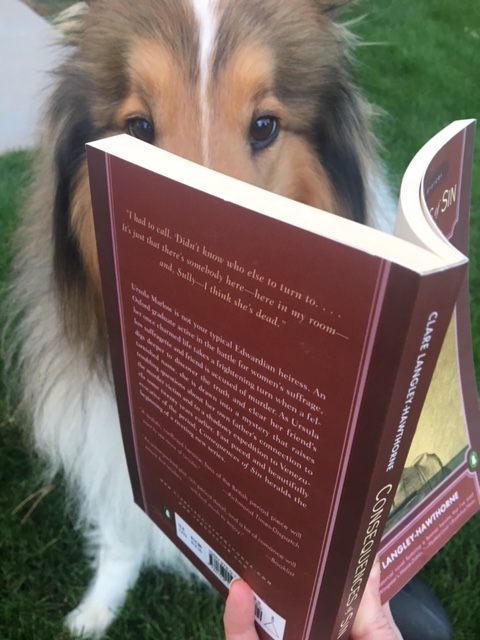
I guess my only real muse is my collie Hamish – he’s my constant companion, lying on the floor by my chair while I’m writing. He’s always willing to listen as I complain or tear my hair out in frustration, and is always happy to misinterpret my triumphs (a completed chapter!) as a request to play tug with a chew toy. He willingly goes for multiple walks a day when I need to clear my head and is always content to lie next to the couch when I resort to watching Masterpiece Theatre as ‘research’. In honor of him (and my previous collies) I always try to include at least one collie in each novel I write:) As you can see from this photo, he really is the perfect writer’s muse.
As much as I would love to embrace the whole concept of the muse, I think my attitude can be best summed up by a quote from a fellow Australian writer, Kerry Greenwood (of Phryne Fisher fame), when she said. “If I ever saw my muse she would be an old woman with a tight bun and spectacles poking me in the middle of the back and growling, ‘Wake up and write the book!'”.
So TKZers do you have a muse? If so, in what form does your muse visit (real or imagined)? Do you ever feel like you could use one to sprinkle some fairy-dust of inspiration?
For your reading enjoyment, we have the first 400-word submission from a work-in-progress introduction from an anonymous author. When I got this submission, the first few lines were broken apart, so I had to reunite them. I don’t know if this weighty first paragraph was the author’s intention, so forgive me if it doesn’t look right. I’ll have my feedback on the flip side. Please share your thoughts in the comments.
***
She had the dream again last night. It lingered as awareness of morning pulled her up and her thoughts coalesced into memory. Audrey Grey saw Jacob’s imprint on the pillow beside her. The light through the curtains told her it was time to get up, too. She stood under the water, transitioning to the day ahead. Thoughts of her dream receded as the day took hold. She dressed and finished a buttered bagel. He should be back anytime. The knocking surprised her. Not tentative and apologetic like you might expect so early in the morning. It sounded . . . commanding. She tiptoed to the window and eased apart a slit between the blinds. A man in a gray and black uniform waited. She let the slats fall shut and took inventory of her appearance. Wet hair, worn skinny jeans, baggy knit top. He knocked again.
You don’t just ignore the police at your door. It’s dishonest and she couldn’t lie to a cop about not being home. Her clumsy fingers fumbled with the lock and slid the chain off. The door always stuck a little, but with an extra tug it gave way. She leaned into the door frame, face to face with the visitor. She could see the gold shield, the belt fully rigged with gear and the black gun at his side.
“Good morning, Ma’am. My name is Officer Mike Welden, Wake County Sheriff’s Department.” He consulted a black notebook flipped open in his hand. His questioning eyes moved from the page to her wary ones.
“There’s been an accident and the identification on the injured party gave this address. Do you know Jacob R.
Grey?” She caught her breath. “Yes, he’s my husband.”
“May I come in?”
She stepped back allowing him to enter. His trained eyes scanned beyond the entry and he spoke her line.
“Would you like to sit down?” Obediently, she took a seat on the edge of the sofa, swiping at shower damp tendrils of hair falling onto her face. “You saw my husband? Is he okay?”
“I found him, yes, ma’am. It appears he was hit while on his bicycle this morning. He’s been taken to Duke Hospital.”
No. He would be here soon. They had to buy a grill for the cookout. “I’m sorry, what do you mean, ‘appears’?”
“We have no witnesses, so it’s not clear exactly what happened.
FEEDBACK
OVERVIEW – This intro is a classic opener with police knocking on the door of a wife to share bad news about the husband or a family member. Here at TKZ, we preach to start with a disturbance and cops at your door would qualify, but I would’ve liked to see the dialogue with more tension and intrigue. With this being a bicycle accident, the lines are bland. If you isolate only the dialogue and take everything else away, nothing much happens.
Would it have been better to open with the bicycle accident?
We also have an opener with someone in their own head and thinking about a dream, but with the dream not explained any more than a vague 2-line notion, it’s not interesting either. I’ve opened with internal thoughts of a character, but the writing has to intrigue and create elements of mystery to keep the reader (or an editor and agent) turning pages.
It’s my opinion that the author might try to find a better place or a better way to start. Let’s drill down into the details.
OPENING LINE: ‘had the dream again last night.’
The dream is only brought up twice in this weighty opening paragraph. With the first line and this one in the middle of the first paragraph – ‘Thoughts of her dream receded as the day took hold.’ There is so little known about the dream, it’s almost not worth bringing up. It’s a cheap tease that doesn’t work for me.
To intrigue a reader, there needs to be elements of mystery that would force them to want to know more about the dream. In these two lines, even the author dismisses the importance by saying ‘her dream receded as the day took hold.’ If this dream is significant, more of it needs to be layered in and it must reflect or foreshadow what is about to happen–or create the start of a mystery to be solved–otherwise it’s not worth the focus.
If this is a dream where Audrey symbolically loses her husband Grey or can’t find him, that might provide an answer as if she is telepathic or deeply connected to him. If the dream is of something else that will carry through the story, like a distinct thread that evolves, then more needs to be hinted from the start.
Maybe the dream is something buried in Audrey’s subconscious that has put Grey in danger. The author must show patience at dangling this kind of story element into the story, but there needs to be more in order for it to gain traction.
To play with this opener, the author could have the cops get Audrey out of bed from a dead sleep. I liked the imagery of her waking to see Jacob’s imprint on his pillow. She could be more traumatized and her mind muddled if they wake her from an exhausting night of bad dreams, only to wake into her own nightmare.
But I’m more of a fan of action in the opening. Hard to say what I might’ve done in these 400 words, but the bicycle accident would appeal to me more. The reader could be drawn into Grey’s world of normalcy as he rides his bicycle, only to be suddenly struck down by a mystery assailant who races from the scene. BOOM! Opener. Then build on the foreboding dream of Audrey’s that comes to fruition with a knock on her door with police standing there. Solid start.
DISTRACTING LINE – ‘You don’t just ignore the police at your door. It’s dishonest and she couldn’t lie to a cop about not being home.’
This line should be deleted. It’s a strange thought for her to even think about not opening the door to police. A lie about not being home is odd. Most people would be intrigued as hell about why cops were at the door. Why isn’t she? It makes her sound flaky and doesn’t read as solid motivation. In the following line, there’s a focus on action where ‘her clumsy fingers fumbled with the lock.’ That shows her mental state, as if she’s nervous (and rightly so) which is contrary to her strange thought about not opening her door as a dishonest gesture.
VISUAL IMAGERY – In the second paragraph, Audrey comes face to face with the policeman. This struck me as odd, given the next imagery of her staring at his duty belt and gun. I would imagine a cop would be taller than Audrey, unless she’s tall. If she’s shorter, her eyesight might see his duty belt better. I can see her distraction with it. Many people aren’t familiar with guns and she might be intimidated by it, but the police are there for a reason and she doesn’t seem curious enough about why they are there. If this image is important, then clean it up and make the cop more intimidating, if that’s the intention, but in the whole intro, Audrey doesn’t act like a normal wife getting bad news about her husband. I’ll explain below in the section on CHARACTER MOTIVATION.
HOUSEKEEPING – There’s plenty to clean up, line by line. I’m sure other TKZers will help with that, but something that stood out was the cop’s mention of Jacob R, about halfway down. Who is Jacob R? Didn’t the police have his last name? Why would the cop only call him by his first name and an initial? When Audrey says, “Grey?” I had to reread to get the leap she made. (Maybe she jumps in to add it and interrupts him, but there’s punctuation of em dash that would help make that clearer. The author should explain why the police only referred to Jacob R or use his full name. Presumably they would have it since Jacob is at the hospital and survived the accident. He would have ID on him.
In the sentence that starts with ‘His trained eyes scanned beyond the entry and he spoke her line.’ If this is in Audrey’s POV, the author leaps into the head of the cop when referring to ‘his trained eye.’ The author should delete the word ‘trained.’ I also had to reread the last part of that line – ‘he spoke her line.’ This is out of order from real action. How would Audrey know he was about to speak her line -‘Would you like to sit down?’ In that one short paragraph, two characters are speaking and it’s confusing. Separate the lines with space to make things more clear and I would write the cop’s line more distinctly to show he’s speaking.
“It’s best we sit down. After you.” The big man took charge and Audrey lead him into the parlor.
“You saw my husband. Is he okay?”
CHARACTER MOTIVATION – Officer Welden tells her that he found her husband, saying ‘it appears he was hit…’ Instead of Audrey focusing on what a real wife might want to know – “If he’s okay, why isn’t he home?” “Was he injured? Where is he?”
Instead, Audrey focuses on the word ‘appears’ and acts like a sleuth, at the expense of the well being of her poor husband. If she comes across as jarred by the news, physically and mentally, she would be more sympathetic and the tension and emotion would be escalated. But with this cold reaction, it only adds to the bland nature of this opener. The reader will care more if they can relate to the character and Audrey’s understandable emotion.
After Audrey asks if her husband is okay, Officer Welden only says, ‘I found him, yes, ma’am’ before he jumps to more of what happened. This is a police notification to a family. They would be more concerned with sharing news about the husband’s condition and where he’s been taken. Audrey can push for details on the case and who caused the accident once she knows her husband is okay and sees for herself, but there is no sense of urgency on Audrey’s part and the cop should explain more about Jacob’s condition.
“Your husband sustained a broken arm and a few cracked ribs. Doctors at Duke Hospital are examining him now.”
Audrey mentions an internal thought of ‘No, He would be here soon. They had to buy a grill for the cookout,’ (a line that I would italicize to show an internal thought for the reader). The emotion or her confusion isn’t in sync with her cold reaction and focus on the word ‘appears.’ Put more emotion into this section and have her react like a more normal wife and the reader will care more too.
DISCUSSION:
1.) What is your feedback, TKZers?
It takes guts to submit your work for critique. Any comments are solely for the purposes of providing help to a fellow author. We’ve all been here. Thanks for your submission, brave author. The beginning of every story is my greatest challenge, always. Tweak this and perhaps re-imagine a different beginning for Audrey and Jacob and you’ll have a solid start.