By PJ Parrish
I’d give anything for a nice sharp stone in my shoe right now.
I’m trying to start over with my work in (non)progress. A while back, I threw out the first five chapters. I knew in my gut it was bad, but it took me three months and many sleepless nights to finally admit it. You know that door metaphor I use here a lot? I like to say that finding the right door through which to enter your story is maybe the most important decision a writer has to make. Well, I had entered my door — it was a very pretty writerly door — but it turned out to be a dead-end.
Which brings us to our First Page Critique today. I will let you read and then we’ll talk.
Title: Joe Blatz
Joe Blatz put his Bic pen up to his mouth and began to chew on the cap, lightly this time, because he didn’t want to ruin another one. He was thinking about what he should write on his report about his last case. He was trying to stick to the facts and not color his words too much with his attitude toward the slimy perp he had just cornered, cuffed, and stuffed into a patrol car not three hours before. These country crooks really pissed him off, and on some days he had a shorter fuse than others.
He was sitting in his basement office in his log home in the country, about 5 miles from Cannonsville, Tennessee. His basement was paneled with dark wood and had carpet on the floor. The basement was divided into two sections, one toward the back of the house where his office was, and one in the front that was more of an entertainment area that contained a leather couch, big-screen TV, a wet bar, and a full-size refrigerator. He didn’t use the entertainment area that much, preferring to relax either upstairs or on the front porch in one of his rocking chairs.
Joe pushed himself away from his desk and leaned back in his wooden desk chair, an antique he had picked up at a country estate yard sale several years before. It was made of solid oak and was scarred up enough to give it ‘character,’ as Joe put it. He liked scuffed up, half worn out things that other people seemed to shy away from. When someone said something was worn out and needed to be thrown away, he thought it was just getting broken in. He was a man of simple tastes, beer and bourbon, and simple viewpoints.
Joe turned his chair back to the desk and pulled it in and went back to writing. He was almost finished. Then he would fax his report to his client and the local police in Cannonsville, who were interested in it, too. Cannonsville’s police department was shortstaffed and had come to rely on Joe’s reports whenever he wrote them and it involved their jurisdiction. It helped them put together evidence and sometimes help them convince the local district Attorney to prosecute a case. Joe didn’t mind helping out the local police, especially since that’s where he got his dog from.
_________________
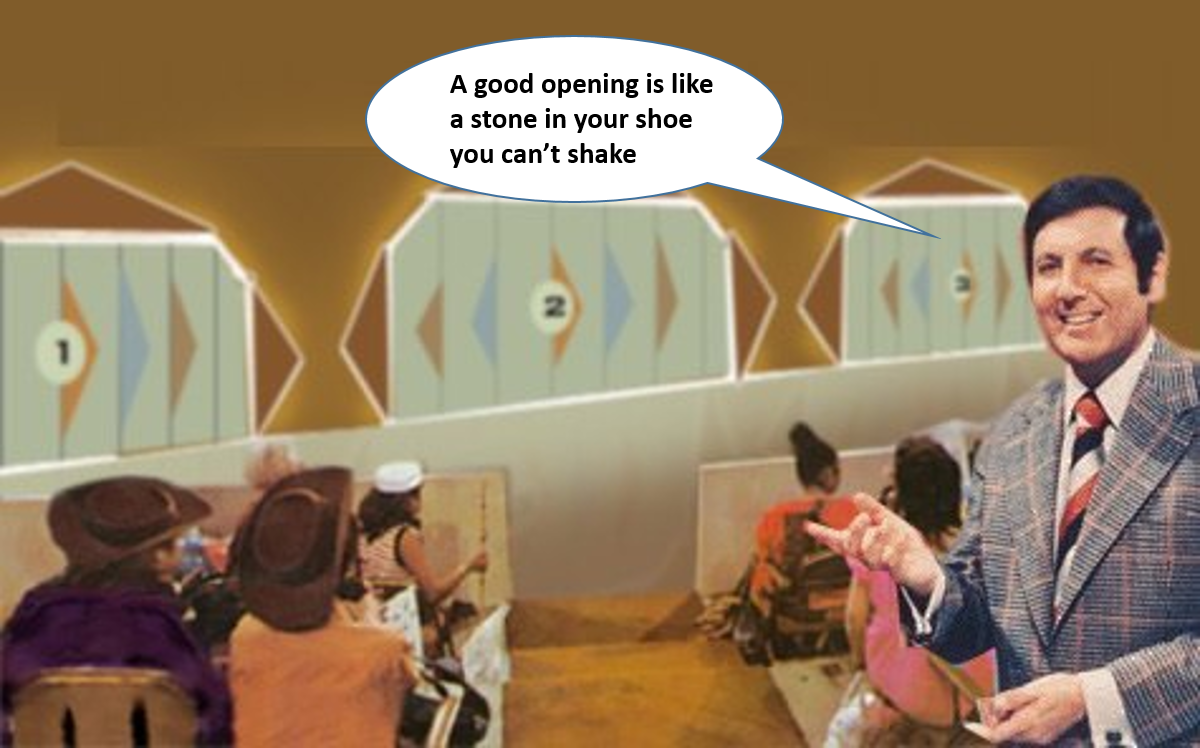
I’m back. (By the way, before I forget, that quote about the stone in the shoe is not from Monte Hall. It’s from Chuck Wendig. I just put Monte in there to get your attention.)
About Joe Blatz…
He might be an interesting guy. He might have an interesting job (though we aren’t told what he does, except push perps into cars when the local cops are too busy). He likes bourbon, has a cool old desk and a dog. But what Joe is doing here is not very interesting at all. Nothing is happening. All we’re getting is memory and thoughts. Note the sentence constructions:
“He was thinking about what he should write…”
“He was trying to stick to the facts…”
“He was sitting in his basement office…”
“He was almost finished…”
Now, there is nothing wrong with the writing here, on the surface. Gets the job done. But it is passive, and the situation itself is static. As we always say here, it is hard in a mere 400 words to see where a story is going, but when it starts in a neutral gear like this, it is hard to get excited about the journey ahead. Often, I suggest to writers that they might have entered their scene too early. Here’s an example of this that I made up:
The phone jarred Joe from his sleep and he grabbed the receiver. “Yeah?” he stammered, his voice raspy from last night’s Camels and Christian Brothers.
“We got another one. Young, pretty. Just floated up on Juno Beach.”
“Did she have the pink ribbon around her neck?”
“Yup. Just like all the others.”
“I’ll be there in fifteen minutes.” Joe hung up and swung his feet to the cold floor. He didn’t like the bad feeling that was gathering in his gut.
This is where the same scene begins, in my humble opinion:
The body, nude except for the ribbon around the neck, moved back and forth with the incoming tide. It was like the water was trying to gently rock the girl to sleep. Or back to life.
Joe stood three feet away, as close as the yellow tape would allow, staring hard at the ribbon. Pink…just like the others, all six of the other girls he had seen dead in the water during the past four months had been the same.
He turned away. Except for this one. This one he recognized.
Do we need the phone call? A case could be made for it. (See below). But I think you have a better chance of your story feeling fresh if you enter your scene at a prime moment of disturbance. Show us something happening live. Give us some emotion. Don’t waste the precious opening moments of your book clearing your throat with unimportant action. Get into a scene as late as possible.
However…
The problem with Joe Blatz is that I think the writer perhaps got into the scene too late. Three hours too late, to be exact. What is the most interesting thing mentioned? That Joe busted two creeps in his free-lance cop role. I’d much rather read about that then Joe writing his report and thinking about his old desk.
I started reading an 2018 Edgar nominee this week called Ragged Lake by Ron Corbett. He opens with a two-page omniscient description of a remote cabin in the forest built by an odd family of squatters. A forestry worker discovers the family murdered:
The boy never went inside the cabin. Peered through a window and then took off for Ragged Lake, making good time on his snowshoes, then telling the bartender at the Mattamy something bad had happened by the headwaters of Springfield. Something that shouldn’t have happened, because no cabin should have been out there on O’Hearn timber rights on O’Hearn land. Something evil-bad had happened.
They needed to phone someone.
That’s the end of chapter 1. Chapter 2 opens with a continuation of the close omniscient point of view:
The call was logged in at the and Cork’s Town detachment of the regional police at 6:17 p.m. on a Tuesday evening. An elderly dispatcher took the call, asked a few questions, then reached for an incident report form and repeated most the questions. After that, the dispatcher hit a key on his computer and a list of names and phone numbers appeared on his screen. He dialed the third on the list.
Note the natural bridge between chapters with “the call.” The next graph is the protag, Frank Yakabuski answering the call and the plot is off and running. The writing is atmospheric and spare, so I don’t mind the lack of a personal point of view and we get to the real case — a true disturbance — quickly, by page 4. The writer could have segued straight into Frank at the cabin, like I outlined in my scene above, but I think this slower move into the case works okay. Especially since it segues smoothly into Frank’s POV and all info is related almost exclusively through crisp dialogue. And we are introduced to Frank’s father, who is wheelchair bound after a freak shotgun accident, who I suspect is going to serve as Frank’s confidant, in the vein of James Garner’s dad Rocky in “The Rockford Files.”
I bring this book up just to point out that there are no hard rules — so, yes, you can ease into a scene and no, you don’t always have to use intimate point of view. But you still have to find a good door into your story. Whether the door swings open fast or creaks slowly ajar just wide enough for the reader to slip in, that’s what we call style.
Compare the measured opening of Corbett’s Ragged Lake with the opening of James Scott Bell’s latest Your Son is Alive:
Your son is alive.
A scrawl in red crayon. Messy block lettering across a piece of 8×10 white bond that had been tri-folded and placed in a blank business envelope.
It had been slipped under Dylan Reeve’s door in the middle of the night.
Dylan, holding the note, stumbled to a chair, sat heavily, his bathrobe bunched up under him. He didn’t know how long he sat there. All he knew was he hadn’t moved, except to wipe his eyes.
Finally, he got up, went to the kitchen where he phone was plugged in next to the coffee maker. He called Erin.
Boom…we’re dropped right into the central conflict of the story. James could have opened at the point when the boy disappeared ten years prior. He could have even opened with — ack ack — a prologue showing the boy getting abducted then jumped ahead to show the Reeves falling apart and getting divorced. But James picked door number 3, no backstory, no preludes. Just a nice big stone in the reader’s shoe.
The door chosen here to enter Joe’s world I don’t think is the best one. I’d bet there is a better one, maybe even later in the book that relates to the real case. I suspect the two perps mentioned have nothing to do with the actual plot. I suspect they are what I call a “false case” injected into the beginning to introduce the protag.
You have to be wary of “false case” openings. I recently beta-read a manuscript for a good friend who has published many thrillers. His chapter 1 features a fascinating protag quickly solving a case, then waiting for his superior to call him about the next one. It’s well-written and introduces his protag really well. But I questioned the wisdom of opening with a “false case” instead of going right to the real one, which begins in chapter 3. I told him that his false start could be justified because 1. It is short and juicy and 2. Its exotic locale would be a nice contrast to the rural American setting for the real case. But I still am not sure he wouldn’t be better off just letting his hero take off on the true path. Law and Order does this “false case” opening sometimes. But they always manage to link it to the real case eventually. That’s a big difference.

As I read Joe Blatz, I kept thinking of Alice in Wonderland, the part where Alice falls down the rabbit hole into the hall of doors. She’s overwhelmed trying to figure out which one to enter and in the end discovers a door behind a curtain that looks promising. But the door is too small. I think that is this writer’s problem here. The door to Joe Blatz’s world is so small, we’re getting no vision as to what’s on the other side.
Also, the passive construct has the additional problem of being all TELL and no SHOW. Rather than playing out the action “on camera” (Joe cuffing and stuffing the perps), we get his memory of it. Rather than showing us how Joe feels about these low-lifes via his actions on the scene and his live thoughts or better yet, dialogue, we have to rely on the writer telling us, “these country crooks really pissed him off, and on some days he had a shorter fuse than others.” Wouldn’t you rather see Joe’s fuse go off? I would. I want to follow a pro-active hero, not a Bic-munching muser.
One more thing. I hope the title is only a working one. This isn’t a title, it’s a label. It’s okay to use a character’s name in the title, but you have to make it mean something. It wasn’t Gatsby. It was, ironically, The Great Gatsby. He is a criminal whose real name is James Gatz, and the life he has created for himself is an illusion. T. Jefferson Parker didn’t call his Edgar-winning thriller about cop-cum-bodyguard Joe. He called it Silent Joe because Joe’s adoptive father taught him: “Mouth shut, eyes open. You might actually learn something.” The “silent” also has a poignant second meaning for Joe personally.
Yeah, I know…Emma, Jane Eyre, Rebecca, Carrie, and Lolita. But remember that Nabokov didn’t call her Lola, and for good reason. Here’s his great opening paragraph:
Lolita, light of my life, fire of my loins. My sin, my soul. Lo-lee-ta: the tip of the tongue taking a trip of three steps down the palate to tap, at three, on the teeth. Lo. Lee. Ta. She was Lo, plain Lo, in the morning, standing four feet ten in one sock. She was Lola in slacks. She was Dolly at school. She was Dolores on the dotted line. But in my arms she was always Lolita.
Now that’s a heck of a “door” — to Dolores and the havoc she wreaks on Humbert.
Try to pick the right door. You want your reward to be an engaged reader, not a lifetime supply of Turtle Wax.