About Joe Moore

#1 Amazon and international bestselling author. Co-president emeritus, International Thriller Writers.

Pick up the Pace for a Real Page-Turner

by Jodie Renner, editor & author

Readers of fiction often complain that a book didn’t keep their interest, that the characters, story and/or writing just didn’t grab them. Today’s readers have shorter attention spans and so many more books to choose from. Most of them/us don’t have the time or patience for the lengthy descriptive passages, long, convoluted “literary” sentences, detailed technical explanations, author asides, soap-boxing, or the leisurely pacing of fiction of 100 years ago.

Besides, with TV, movies, and the internet, we don’t need most of the detailed descriptions of locations anymore, unlike early readers who’d perhaps never left their town, and had very few visual images of other locales to draw on. Ditto with detailed technical explanations – if readers want to know more, they can just Google the topic.

While you don’t want your story barreling along at a break-neck speed all the way through – that would be exhausting for the reader – you do want the pace to be generally brisk enough to keep the readers’ interest. As Elmore Leonard said, “I try to leave out the parts that people skip.”

Here are some concrete techniques for accelerating your narrative style at strategic spots to create those tense, fast-paced scenes.

~ Condense setup and backstory.

To increase the pace and overall tension of your story, start by cutting way back on setup and backstory. Instead, open with your protagonist in an intriguing scene with someone important in his life or to the story, with action, dialogue, and tension. Then marble in only the juiciest bits of the character’s background in tantalizing hints as you go along, rather than interrupting the story for paragraphs or pages to fill us in on the character’s life — which effectively eliminates a lot of great opportunities to incite reader curiosity and add intrigue with little hints and enticing innuendos.

~ Include hints at questions, secrets, worries, fears, indecision, or inner turmoil to every scene.

This will keep readers curious and worried, so emotionally engaged and compelled to keep turning the pages.

~ In general, develop a more direct, lean writing style.
Be ruthless with the delete button so your message and the impact of your story won’t get lost in all the clutter of superfluous words and repetitive sentences. I cover lots of specific techniques with examples for cutting down on wordiness in my book,  Fire up Your Fiction.

~ Rewrite, condense, or delete chapters and scenes that drag. 

Do you have slow-moving “filler” scenes, with little or no tension or change? Reduce any essentials from the scene to a paragraph or two, or even just a few sentences, and include it in another scene.

~ Keep chapters and scenes short.

This will help sustain the readers’ interest and keep them turning the pages. James Patterson is a master at short chapters, and his followers seem to really like that. Especially effective for reluctant or busy readers.

~ Start each scene or chapter as late as possible, and end it as early as possible.

Don’t open your chapters with a lengthy lead-up. Every scene and chapter should start with some kind of question, conflict, or intrigue, to arouse the curiosity of the reader and make them compelled to keep reading. And don’t tie up the events in a nice, neat little bow at the end – that will just encourage the reader to close the book rather than to keep reading in anticipation. Instead, end in uncertainty or a new challenge.

~ Limit explaining – Show, don’t tell.

Keep descriptive passages, expository passages, and ruminations, reflections and analyses to a minimum. Critical scenes need to be “shown” in real time, to make them more immediate and compelling, rather than “telling” about them after the fact. Use lots of action, dialogue, reactions, and thoughts. And keep the narration firmly in the viewpoint character’s voice – it’s really his/her thoughts, observations, and reactions to what’s going on.

~ Use summary to get past the boring bits, or skip ahead for effect.

Summarize in a sentence or two a passage of time where nothing much happens, to transition quickly from one critical scene to the next: “Three days later, he was no further ahead.” Skip past all the humdrum details and transition info, like getting from one place to another, and jump straight to the next action scene.

~ Make sure every scene has enough conflict.

In fact, every page should have some tension, even if it’s questioning, mild disagreement, doubts, or resentments simmering under the surface. Remember that conflict and tension are what drive fiction forward and keep readers turning the pages.

~ Every scene needs a change of some kind.

No scene should be static. Throw a wrench in the works, make something unexpected happen. Add new characters, new information, new challenges, new dangers. And the events of the scenes should be changing your protagonist in some way. Change produces questions, anticipation, or anxiety — just what you need to keep reader interest.

~ Use cliff-hangers.

For fast pacing and more tension and intrigue, end most scenes and chapters with unresolved issues, with some kind of twist, revelation, story question, intrigue, challenge, setback or threat. Prolonging the outcome, putting the resolution off to another chapter piques the readers’ curiosity and makes them worry, which keeps them turning the pages.
~ Employ scene cuts or jump cuts.

Create a series of short, unresolved incidents that occur in rapid succession. Stop at a critical moment and jump to a different scene, often at a different time and place, with different characters – perhaps picking up from a scene you cut short earlier. Switch chapters or scenes quickly back and forth between your protagonist and antagonist(s), or from one dicey, uncertain situation to another. And of course, don’t resolve the conflict/problem before you switch to the next one.

~ Use shorter paragraphs and more white space.

Short paragraphs and frequent paragraphing create more white space. The eye moves down the page faster, so the mind does, too. This also increases the tension, which is always a good thing in fiction.

~ Use rapid-fire dialogue, with conflict, confrontations, power struggles, suspicion.

For tense scenes, use short questions, abrupt, oblique or evasive answers, incomplete sentences, one or two-word questions and responses, and little or no description, deliberation or reflection.

~ Use powerful sentences with concrete, sensory words that evoke emotional responses.

Utilize the strongest, most concrete word you can find for the situation. Avoid vague, wishy-washy or abstract words, and unfamiliar terms the reader may have to look up. Concentrate on evocative, to-the-point verbs and nouns, and cut way back on adjectives, adverbs and prepositions.

Also, take out all unnecessary, repetitive words and those wishy-washy, humdrum “filler” words and phrases. And use plenty of sensory details, emotional and physical reactions, and attitude. (For more on this, see Fire up Your Fiction.)

A well-disguised example from my editing:

Before:

Kristen fired him a dirty look, probably because he was doing this in piecemeal and not getting straight to the point as she would have liked him to. Her voice was terse. “Why not?”

After:

Kristen fired him a dirty look as if to say, Cut to the chase. Her voice was terse. “Why not?”

Or just:

Kristen fired him a dirty look. “Why not?”

~ Vary the sentence structure, and shorten sentences for effect at tense moments.

Shorter sentences give a pause, which catches the attention of the reader. At a critical moment, don’t run a bunch of significant ideas together in one long sentence, as they each will be diminished a bit, lost in among all the other ideas presented. You can also go to a new line for the same effect.

For a fast-paced, scary scene, use short, clipped sentences, as opposed to long, meandering, leisurely ones. Sentence fragments are very effective for increasing the tension and pace. Like this. It really works. Especially in dialogue.

For more tips with examples for picking up the pace, check out Jodie’s editor’s guides to writing compelling fiction, Writing a Killer Thriller, Fire up Your Fiction, and Captivate Your Readers.

Jodie Renner is a freelance fiction editor and the award-winning author of three craft-of-writing guides in her series An Editor’s Guide to Writing Compelling Fiction: FIRE UP YOUR FICTION, CAPTIVATE YOUR READERS, and WRITING A KILLER THRILLER, as well as two clickable time-saving e-resources, QUICK CLICKS: Spelling List and QUICK CLICKS: Word Usage. She has also organized two anthologies for charity: VOICES FROM THE VALLEYS – Stories and Poems about Life in BC’s Interior, and CHILDHOOD REGAINED – Stories of Hope for Asian Child Workers. Jodie lives in Kelowna, BC, Canada. Website: www.JodieRenner.com; blog: http://jodierennerediting.blogspot.com/; Facebook. Amazon Author Page.
Marketing Lessons from Mad Men

@jamesscottbell


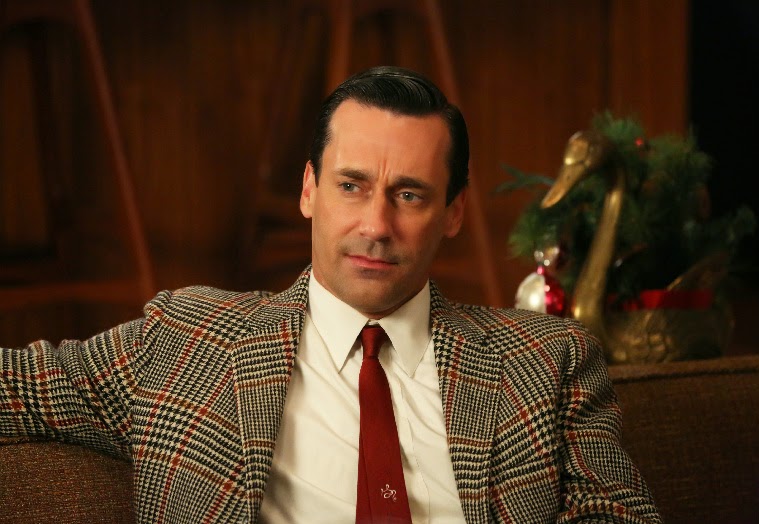
On a recent episode of Mad Men, “The Monolith,” a huge IBM computer is being installed in the offices of Sterling Cooper & Partners. Don Draper, reduced to hack work as some sort of vindictive punishment, watches from his office.
A character named Lloyd is overseeing the installation. Taking a smoke break, Lloyd asks Don if advertising really works.
Don says, “It helps if you have a good product.”
Boom. All advertising wisdom and marketing strategy must ultimately be filtered through this one non-negotiable. You’ve gotta have a good product, a quality thing to sell.
This is as true for books as it is for Brylcreem. You can pour

all the time and money you want into getting the word out, but that only gets you an introduction. To succeed people have to like your product enough to become a repeat customer, this is why businesses that believe they have a good product to offer customers spend so much money on marketing campaigns from the likes of IRN, LLC and other marketing agencies.

So how do you know when you have a quality book? Here’s one way:
Find five beta readers, one of them a professional editor whom you pay. Do a little research and put in a little effort, and you’ll get a quality group together.
Four out of the five beta readers need to tell you they really liked your book. They don’t have to love it, though that would be the best result. But they have to more than like it. They have to really like it.
These are your scientific categories:
1. Loved it!
2. Really liked it!
3. Liked it.
4. Only okay.
5. Dreadful.
6. Don’t ever ask me to read anything of yours again.
7. I am getting a restraining order against you.
Your book needs to score a 1 or a 2 from 4 out of the 5 beta readers, and the professional editor must be one of the four.
Is that a high standard? You bet it is. Because if you want to be a name brand and not the generic, that’s where you need to aim.
The second thing Don says to Lloyd is, “What makes your product unique?” This is only slightly less important than the first lesson. You might be able to build a readership with well-written genre pieces that are, nevertheless, derivative. But to truly break out you need to give your writing something more.
What is that thing? It’s you. It’s your voice giving your story everything you’ve got. It’s your imagination churning to make your concept just a little fresher. It’s you going beyond the first thing that jumps into your mind. In every scene you are not settling for what’s obvious.
One exercise for coaxing out your voice is the page-long sentence. Every now and then in your WIP choose a single emotional moment. Then write one run-on sentence until it fills a page. Let your imagination go wild. Most of this you won’t use. But you will find, usually toward the middle or end of this exercise, some narrative gold. This is the stuff that sets you apart.
The third marketing lesson from Mad Men is this: don’t get drunk. Drunk Don Draper is not charming, artful or clever.
The fourth marketing lesson comes from a Don Draper pearl of wisdom: “The day you sign a client is the day you start losing them.” In advertising, the client demands to be dazzled. They need to believe the agency is going to work magic for them.
It’s the same with readers. They’ve given you a chance, they’ve paid their money and they’ve got your book. Will they love it? Make them love it. Then make them love the next one, and the next. It’s a high bar, as I mentioned, but it’s the only one worth stretching for. True, you’re not always going to make it, but you’ll be a better writer for the effort.
The final marketing lesson is this: It helps if your author photo looks like Don Draper. Lacking that, remember that people do form an opinion of you based on your public persona. Don’t just fling yourself wildly into social media madness. Be professional, courteous and positive. Make people glad when they read something from you, be it book, blog, update or tweet. Take the long view. Your career is a marathon and intemperate remarks can become pebbles in your shoes.
Brylcreem had one of the most famous ad lines in history: “A little dab’ll do ya.” 
Try a little dab of advertising wisdom and see if it doesn’t help your writing career.

So do you think about your books as part art, part craft and part product? Don’t you think you should? 

Marketing Lessons from Mad Men

@jamesscottbell


On a recent episode of Mad Men, “The Monolith,” a huge IBM computer is being installed in the offices of Sterling Cooper & Partners. Don Draper, reduced to hack work as some sort of vindictive punishment, watches from his office.
A character named Lloyd is overseeing the installation. Taking a smoke break, Lloyd asks Don if advertising really works.
Don says, “It helps if you have a good product.”
Boom. All advertising wisdom and marketing strategy must ultimately be filtered through this one non-negotiable. You’ve gotta have a good product, a quality thing to sell.
This is as true for books as it is for Brylcreem. You can pour

all the time and money you want into getting the word out, but that only gets you an introduction. To succeed people have to like your product enough to become a repeat customer.

So how do you know when you have a quality book? Here’s one way:
Find five beta readers, one of them a professional editor whom you pay. Do a little research and put in a little effort, and you’ll get a quality group together.
Four out of the five beta readers need to tell you they really liked your book. They don’t have to love it, though that would be the best result. But they have to more than like it. They have to really like it.
These are your scientific categories:
1. Loved it!
2. Really liked it!
3. Liked it.
4. Only okay.
5. Dreadful.
6. Don’t ever ask me to read anything of yours again.
7. I am getting a restraining order against you.
Your book needs to score a 1 or a 2 from 4 out of the 5 beta readers, and the professional editor must be one of the four.
Is that a high standard? You bet it is. Because if you want to be a name brand and not the generic, that’s where you need to aim.
The second thing Don says to Lloyd is, “What makes your product unique?” This is only slightly less important than the first lesson. You might be able to build a readership with well-written genre pieces that are, nevertheless, derivative. But to truly break out you need to give your writing something more.
What is that thing? It’s you. It’s your voice giving your story everything you’ve got. It’s your imagination churning to make your concept just a little fresher. It’s you going beyond the first thing that jumps into your mind. In every scene you are not settling for what’s obvious.
One exercise for coaxing out your voice is the page-long sentence. Every now and then in your WIP choose a single emotional moment. Then write one run-on sentence until it fills a page. Let your imagination go wild. Most of this you won’t use. But you will find, usually toward the middle or end of this exercise, some narrative gold. This is the stuff that sets you apart.
The third marketing lesson from Mad Men is this: don’t get drunk. Drunk Don Draper is not charming, artful or clever.
The fourth marketing lesson comes from a Don Draper pearl of wisdom: “The day you sign a client is the day you start losing them.” In advertising, the client demands to be dazzled. They need to believe the agency is going to work magic for them.
It’s the same with readers. They’ve given you a chance, they’ve paid their money and they’ve got your book. Will they love it? Make them love it. Then make them love the next one, and the next. It’s a high bar, as I mentioned, but it’s the only one worth stretching for. True, you’re not always going to make it, but you’ll be a better writer for the effort.
The final marketing lesson is this: It helps if your author photo looks like Don Draper. Lacking that, remember that people do form an opinion of you based on your public persona. Don’t just fling yourself wildly into social media madness. Be professional, courteous and positive. Make people glad when they read something from you, be it book, blog, update or tweet. Take the long view. Your career is a marathon and intemperate remarks can become pebbles in your shoes.
Brylcreem had one of the most famous ad lines in history: “A little dab’ll do ya.” 
Try a little dab of advertising wisdom and see if it doesn’t help your writing career.

So do you think about your books as part art, part craft and part product? Don’t you think you should? 

Getting Inside the Mind of a Killer

One of the skills a thriller writer needs to master is getting inside the head of the villain. This can be hard to do if you’re not a villain yourself. I’ve never killed anyone or ordered an execution. I’ve never tortured an enemy or smuggled drugs across a border or hacked national-security secrets out of a Defense Department computer. The challenge isn’t describing how to do these things; you can read manuals to learn how to hack a computer, and there have been excellent newspaper stories detailing the mechanics of smuggling. (And if you want to learn how to torture someone, just read a book on the CIA’s recent history.) No, the problem is describing the why. Why is the villain doing all these awful things? Does he/she have a reason or an excuse? A traumatic childhood? A thirst for power or riches or revenge? A misguided idealism? Or just plain old psychopathic insanity?

Without a thorough understanding of your villain’s motives, you run the risk of defaulting to the Snidely Whiplash cliché, the evildoer who cackles and twirls the ends of his mustache as he reveals his foul plans. But how can you achieve this understanding without descending into villainy yourself? You have to employ your imagination, sure, but what can you use as a real-world guide?

One strategy is to read the memoirs of famous villains. Mein Kampf is a good example. The manifesto of the Unabomber is another. It’s definitely not pleasant reading, but it can be instructive. You learn that evil really does exist. And that we should take hateful people seriously and never underestimate them.

This past week, as a result of the horrible murders in Isla Vista, California, we have another manifesto to add to this sad genre. The 22-year-old berserker, Elliot Rodger (who killed himself after stabbing three people in his apartment and fatally shooting three more on a rampage across the college town), wrote a 140-page memoir titled “My Twisted World” and e-mailed it to two dozen people before he went on his spree. After reading about the killings in the New York Times, I clicked on the link to Rodger’s memoir and spent the next hour perusing it. Here are the things I learned about this kid’s particular strain of banal evil:

1) He was a pathetic creature full of grievances, both large and petty. One of his earliest memories was getting upset at his three-year-old birthday party because another kid got the first slice of cake. His background wasn’t extremely privileged, but he had some contact with the spoiled-brat Hollywood world, and its screwed-up values infected his mind. He expected everything to fall into his lap and threw tantrums when it didn’t happen. He played computer games for hours at a time and failed at school. He became obsessed with playing the lottery and freaked out when he didn’t win. And he grew enraged at all women because none of them would have sex with him. This was his primary grievance, the one he repeated ad nauseumthroughout the manifesto. He was an “unkissed virgin” and he deserved better. It drove him mad to know that other people were having sex and he wasn’t. So he decided to take revenge.

2) Were there any mitigating circumstances? He was bullied in school. His parents divorced, and he had conflicts with his stepmother. And yet I got the sense that he was the main cause of his own misery. He wasn’t liked because he wasn’t likeable. It’s a vicious circle, I suppose.


3) I was shocked at how openly racist this kid was. He was a Eurasian obsessed with “hot blonde girls” and he shows vile scorn for any Asian, black or Latino man who has the nerve to date a white woman. I know there are millions of other racists who share these attitudes, but it’s rare to see them expressed in print like this. The newspaper reports didn’t emphasize this aspect of his personality, which seemed surprising given the fact that three of Rodger’s victims were his two Asian roommates and their Asian friend. In the manifesto, Rodger calls his roommates “repulsive.”


4) The kid was a world-class narcissist. Just listen to him: “Humanity has never accepted me among them, and now I know why. I am more than human. I am superior to them all. I am Elliot Rodger… Magnificent, glorious, supreme, eminent… Divine! I am the closest thing there is to a living god. Humanity is a disgusting, depraved, and evil species. It is my purpose to punish them all. I will purify the world of everything that is wrong with it. On the Day of Retribution, I will truly be a powerful god, punishing everyone I deem to be impure and depraved.” It’s hard to take this stuff seriously, right? And yet the kid kept his promise. He had his Day of Retribution.

No, it’s definitely not pleasant reading. But texts like this are windows on the world of evil, and getting a good view of the Adversary can be useful for both fiction and life.

Getting Inside the Mind of a Killer

One of the skills a thriller writer needs to master is getting inside the head of the villain. This can be hard to do if you’re not a villain yourself. I’ve never killed anyone or ordered an execution. I’ve never tortured an enemy or smuggled drugs across a border or hacked national-security secrets out of a Defense Department computer. The challenge isn’t describing how to do these things; you can read manuals to learn how to hack a computer, and there have been excellent newspaper stories detailing the mechanics of smuggling. (And if you want to learn how to torture someone, just read a book on the CIA’s recent history.) No, the problem is describing the why. Why is the villain doing all these awful things? Does he/she have a reason or an excuse? A traumatic childhood? A thirst for power or riches or revenge? A misguided idealism? Or just plain old psychopathic insanity?

Without a thorough understanding of your villain’s motives, you run the risk of defaulting to the Snidely Whiplash cliché, the evildoer who cackles and twirls the ends of his mustache as he reveals his foul plans. But how can you achieve this understanding without descending into villainy yourself? You have to employ your imagination, sure, but what can you use as a real-world guide?

One strategy is to read the memoirs of famous villains. Mein Kampf is a good example. The manifesto of the Unabomber is another. It’s definitely not pleasant reading, but it can be instructive. You learn that evil really does exist. And that we should take hateful people seriously and never underestimate them.

This past week, as a result of the horrible murders in Isla Vista, California, we have another manifesto to add to this sad genre. The 22-year-old berserker, Elliot Rodger (who killed himself after stabbing three people in his apartment and fatally shooting three more on a rampage across the college town), wrote a 140-page memoir titled “My Twisted World” and e-mailed it to two dozen people before he went on his spree. After reading about the killings in the New York Times, I clicked on the link to Rodger’s memoir and spent the next hour perusing it. Here are the things I learned about this kid’s particular strain of banal evil:

1) He was a pathetic creature full of grievances, both large and petty. One of his earliest memories was getting upset at his three-year-old birthday party because another kid got the first slice of cake. His background wasn’t extremely privileged, but he had some contact with the spoiled-brat Hollywood world, and its screwed-up values infected his mind. He expected everything to fall into his lap and threw tantrums when it didn’t happen. He played computer games for hours at a time and failed at school. He became obsessed with playing the lottery and freaked out when he didn’t win. And he grew enraged at all women because none of them would have sex with him. This was his primary grievance, the one he repeated ad nauseumthroughout the manifesto. He was an “unkissed virgin” and he deserved better. It drove him mad to know that other people were having sex and he wasn’t. So he decided to take revenge.

2) Were there any mitigating circumstances? He was bullied in school. His parents divorced, and he had conflicts with his stepmother. And yet I got the sense that he was the main cause of his own misery. He wasn’t liked because he wasn’t likeable. It’s a vicious circle, I suppose.


3) I was shocked at how openly racist this kid was. He was a Eurasian obsessed with “hot blonde girls” and he shows vile scorn for any Asian, black or Latino man who has the nerve to date a white woman. I know there are millions of other racists who share these attitudes, but it’s rare to see them expressed in print like this. The newspaper reports didn’t emphasize this aspect of his personality, which seemed surprising given the fact that three of Rodger’s victims were his two Asian roommates and their Asian friend. In the manifesto, Rodger calls his roommates “repulsive.”


4) The kid was a world-class narcissist. Just listen to him: “Humanity has never accepted me among them, and now I know why. I am more than human. I am superior to them all. I am Elliot Rodger… Magnificent, glorious, supreme, eminent… Divine! I am the closest thing there is to a living god. Humanity is a disgusting, depraved, and evil species. It is my purpose to punish them all. I will purify the world of everything that is wrong with it. On the Day of Retribution, I will truly be a powerful god, punishing everyone I deem to be impure and depraved.” It’s hard to take this stuff seriously, right? And yet the kid kept his promise. He had his Day of Retribution.

No, it’s definitely not pleasant reading. But texts like this are windows on the world of evil, and getting a good view of the Adversary can be useful for both fiction and life.

For the Love of Horror & History

Jordan Dane
@JordanDane


On Monday, my lovely TKZ blogmate Clare Langley-Hawthorne had a post called “Losing the Past” where she discussed the state of the historical. I must admit I’ve been intimidated from trying to write an historical. The research seemed daunting, not to mention the world building and dialogue challenges, but I’ve always loved classic literature set in a historical time period made into movies, like Little Women, Pride and Prejudice, Wuthering Heights, David Copperfield, and Jane Eyre. There is something very compelling about taking a peek into the past to see the cultures, classes, location settings, and period clothing. Whether in a book or on screen, it’s a beautiful escape to a different time and place. Historicals aren’t dying out, they’ve become the new black if they’re reimagined into something fresh.


Lately I’ve become enthralled by TV period pieces, especially if the writing and storytelling are solid and the visuals and world building are memorable. Shows that have pulled me in are: Fox’s Sleepy Hollow, BBC’s Ripper Street, and Showtime’s Penny Dreadful. I watch other shows for different elements towards my writing, but these shows have influenced me into crossing the line of my comfort zone. I firmly believe, for me, that I must seek out projects to push my perceived limits. I think I learn more about myself when I do it. The only limit to any writer is the limit of their own imagination.


So when I was recently asked to contribute to a time travel anthology (with an amazing group of authors), I accepted with great enthusiasm (even though it scared me). I accepted the challenge because of my love for these three shows and my desire to push my writer limits. I wanted to share these feature film quality shows with you to see if they stir your imaginings as writers for inventive plots, attention to detail on world building and research, and the fearlessness of the creative mind to combine ideas that may not connect easily.


Icabod with skullSLEEPY HOLLOW – The motto at Sleepy Hollow these days is “Embrace the Ridiculous.” Show creators and the talented writers have thrown together very unlikely elements to create what’s been called WTF TV. On paper, the pitch for the show would’ve sounded absurd – Washington Irving adaptations of Headless Horseman and Rip Van Winkle, mixed with Revelations in the Bible and the Four Horsemen of the apocalypse and historical conspiracies from the Revolutionary War. Icabod Crane is reimagined as a Revolutionary War hero and Revelations “witness” who arises from his secret grave at the same time as the Headless Horseman (aka Death) starts a killing rampage in the quiet town of Sleepy Hollow. The battle of good versus evil has found a home. Crazy, yet it works. The added touch of humor to this “man out of time” story makes Icabod a very endearing character. There’s tongue in cheek humor and the show is notably very ethnically blended. Sleepy Hollow is making history in more ways than its flashbacks.


Ripper SettingRIPPER STREET is set in Victorian London right after Jack the Ripper left his mark. Fear runs high that the monster will return. The shows are tightly written, very emotional, and there is great sensitivity to social issues of the time that reflect on those same issues today. Another thing I love about Ripper Street is the portrayal of early forensics and crime scene analysis. Many scenes are laughable (ie surgical operations done in the open without sterilization or proper care for infection) yet accurate for the time period. Costumes are stunning and the street settings are vivid with great care for detail.


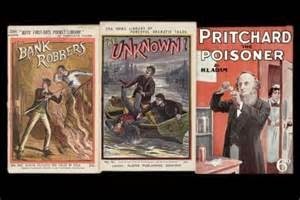
Penny Dreadful BooksPENNY DREADFUL – The show title of Penny Dreadful comes from history, the name given to paper pamphlets filled with terrifying stories. Such stories (also known as Penny Blood, Penny Awful, & Penny Horrible) plus stage performances of the genre were the rage in London during the Victorian time period. They were printed on cheap pulp paper and aimed at working class adolescents. Fear abounded and made fertile ground for when Jack the Ripper wreaked havoc on the streets.


Cast 1Penny Dreadful is an homage to literary horror and classic monsters of the time: Bram Stoker’s Dracula, Mary Shelley’s Frankenstein, and The Picture of Dorian Gray by Oscar Wilde, etc. What I love about Penny Dreadful is the intense world building in every scene. The details of lush sets and gorgeous costuming and the use of practical literary monsters (not animated computer generate imagery). The horror is visceral.

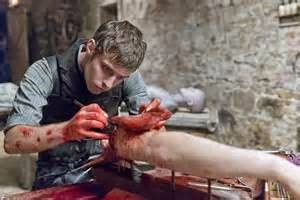
Dr VicHere is Dr Victor Frankenstein slaving over his “creature” in secret. The scene where Victor lays eyes on his living creature (and the creature sees his creator for the first time) is an unforgettable moment where the viewer holds a breath to watch the touching intimacy. Everything about this show speaks to me of good writing, solid storytelling, and memorable characters in classic conflict. Visually stunning. It’s a feast for the eyes, mind, and heart.


For Discussion: What shows stir your writer imaginings? Have they ever influenced you to write a genre you’ve never tried before?

If it comes easy, it’s probably a cliché

By Joe Moore
@JoeMoore_writer

It was a dark and stormy night.

If you were the first writer to have used that as an opening line, then it was brilliant. What a vivid way to create an immediate setting and mood. Congratulations on a fresh, original beginning. For everyone else, that line is a cliché. A language cliché to be exact. In addition to language clichés, there are character and plotting clichés. We all know not to use them, but sometimes they slip through when we’re not looking. So how do we avoid clichés like the plague and fix them in the blink of an eye?

First, let’s define the three types. As mentioned, language clichés are bits of speech that have been used so often they lose their original luster or charm. You’d have to be blind as a bat to not understand my crystal clear definition. It should hit you like a ton of bricks.

Character clichés are those we’ve seen too many times such as the prostitute with a heart of gold (includes a language cliché) or the disgraced, wrongly accused cop who winds up catching the killer.

Plotting clichés are well-worn storylines such as the farmer boy who turns out to be a king or the self-taught musician who eventually performs with the philharmonic. Two common plotting cliché examples that I’ve seen dozens of times are books and movies based on the “Bad News Bears” and “Death Wish” themes. The Bad News Bears theme usually deals with a group of outcasts or “losers” who reach the lowest point in their collective lives only to be pulled together by a strong, charismatic leader and wind up coming out winners. This theme does not have to deal with sports. Watch the movie THE HOUSE BUNNY as a good example.

The Death Wish theme is usually the story of a common “every man” who experiences a tragic event in his or her life. Seeking justice but not getting help from the police or government (or any authority group), he/she steps out of a normal existence, takes matters into his/her own hands and finds justice and revenge by becoming judge, jury and executioner. THE BRAVE ONE is a great example of the Death Wish theme. It’s only through unique characters or settings that these clichéd themes keep working. Try to avoid them at all costs.

Language clichés are fairly easy to spot and fix like the one in the previous sentence. They often appear in your first or second draft when you’re writing fast in order to get the story onto the page, and you don’t want to stop your momentum to think of an original description of a character or setting. There’s nothing wrong with that because you have every intention of going back and cleaning them up.

My first tip is to do your cliché hunting with a printed copy of your work, not on the computer screen. As you read along, use a color highlighter and mark everything that’s a cliché or even questionable. Then go back to the computer and take the time to consider each one and how you can improve them. In some cases, just substituting the real meaning in place of the cliché is enough. For instance, he’s as crazy as a loon could become he’s insane. Isn’t that what you really meant? How about, that kind of book is not my cup of tea could become I don’t enjoy that kind of book. Again, that’s the meaning you intended, so simply stating it could fix the problem better than relying on a cliché. Taken out of context, these might sound boring, but chances are that simplifying the meaning won’t stop the reader like a worn out phrase might. One caution though: it’s important to maintain and be true to your “voice” when using this simplifying technique.

One place where you can sometimes get away with clichés is in dialog. But that doesn’t mean you should. If a character uses a cliché, make sure it’s part of his or her “character” and not just an excuse for lazy writing.

Character clichés are a little harder to fix, but the sooner you do, the better off you’ll be, and the more original your story becomes. Here’s an example: the disgraced cop is an anti-hero. He’s got deep dark issues but we still pull for him because he’s fighting for what’s right. Maybe he’s an alcoholic because he can’t get over the murder of his family. Try removing one of the main elements that drive the character; the disgraced career, the alcohol addiction or the dead family. Does his character change in your mind? Does he become more interesting? Can you still tell his story? If taking away or substituting an element suddenly creates a fresher character, you’ve probably avoided a character cliché. Another tip: If your character’s action shows a serious lack of common sense, treat it as a cliché. You should always be considering what you would do in the same situation as your character. Would you react the same as what you just made your character do? If not, it’s probably a cliché.

Plot clichés need to be fixed from the start. The further you are into the story, the more work it takes to backtrack and change major elements. So before you begin, try this. Write out a short description of your story. Approach it as if you were writing the story blurb to go on the back cover of your book. Once you’re done, ask yourself if sounds familiar. Let someone else read it and ask the same question. If you can remember the same situation occurring in numerous movies, TV shows or books, it’s probably a cliché.

There’s nothing wrong with a cliché as long as you’re the first person to use it. After that, it loses its luster fast. Not only that, it’s a sign of lazy writing. As a good friend of mine once said, a cliché is the sign of a mind at rest.

How do you perform a “seek and destroy” on clichés? And how do you feel when you come across one in a book. If the story is really great, do you overlook clichés or do they cause you to think less of the writer?

——————————-

shield-cover-smallDownload now: THE SHIELD by Sholes & Moore

“THE SHIELD rocks on all cylinders.” – James Rollins, New York Times bestselling author of THE EYE OF GOD.

Coming soon in print and audio.

Writer quirks and superstitions

Speaking of learning about the past, as Clare did yesterday, I just received a blast from my family’s past. A big truck arrived at Chez Kathryn on Sunday morning, bearing a treasure trove of inherited family artifacts. I use the word “artifacts” advisedly. Some of the items we just received, while interesting and beautiful, are also a tad…unusual.

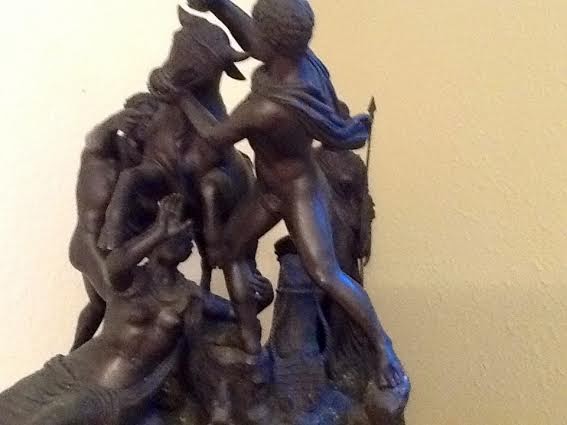
For example: there’s a Victorian-era bronze replica of the Farnese Bull  being wrestled to the ground by men wearing fig leaves. I  call this piece “The Creature,” but it actually depicts the Roman myth of Dirce. According to the rather misogynistic tale, Dirce is tied to the bull as punishment for her “wrong” behavior. (I’m ashamed to admit to Clare that I had to look up that info on Google).

Then there’s a pair of carved wooden busts picked up during Grand Tours undertaken by 19th-century kinfolk. I have reunited the couple for the moment on a fireplace mantel.

There’s also a Civil War-era saber. The saber was discovered hidden inside the walls of the family home in Whistler, Alabama. (When I unpacked that little treasure, I of course swung it over my head and let loose with a Rebel Yell, in honor of my vanquished ancestor.)

And as interesting as that saber is, it can’t hold a candle compared to the Crusader sword and Assyrian shield, which have yet to find placement on the walls of our extremely contemporary home.


Then there’s a silver, wagon-wheel thingee. I can’t figure out what the heck the thing is. It’s very ornate, and obviously was wheeled out for some kind of formal purpose. A special wine presentation, perhaps? Anyone have a clue about this one? Clare? I’m thinking about calling it the Chariot of the Bacchus Gods. It’ll come in handy during our housewarming party, I’m sure.


I was going to discuss writer quirks and superstitions today, really I was. But I think my rambling and these pictures give you an idea of the theme I had in mind: as writers, we all inherit our share of odd quirks. Some of those quirks inevitably find their way into our writing.  At the rate I’m going, I foresee writing a family saga spanning decades and generations–something very James Michener-ish. Or perhaps more torrid, like THE THORN BIRDS.

So my question for you today: what odd quirk have you inherited as a writer? Or what have you inherited from your ancestors that’s bizarre or fascinating?