Now, on with the blog post . . .
Author Archives: Joe Moore
Another Coup for Self-Publishing
Show me the money!
By Joe Moore
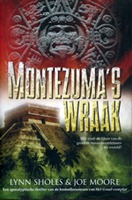
First, some breaking news to share–MONTEZUMA’S WRAAK, the Dutch version of my new thriller, THE PHOENIX APOSTLES (co-written with Lynn Sholes) was released on August 18 by my Netherlands publisher Karakter Uitgevers.B.V. Here’s a look at the cover.
And now for today’s post.
According to a recent article in Forbes, the sale of adult hardcover novels was down 23% in the first half of this year. Despite the downturn, some authors are holding their own. Their names may be familiar. Chances are you’ve read a few of their books. So why are these guys doing so well while most of the industry is in a state of funk? Forbes attributes it to the increasing popularity of ebooks, but even more so the diversification of these writers’ personal brands.
James Patterson is a good example. Mr. Patterson signed a 17-book, $150m book deal in 2009 with Hachette. Teaming up with a number of co-authors, he placed 20 titles on Publishers Weekly’s year-end bestseller list. Those titles totaled 10m copies. In addition, he sold 750k ebooks. He’s also expanded into the YA market with great success.
Other examples of authors doing well in tight times is Stephenie Meyer, whose Twilight series at one point accounted for 15% of all books sold in the US; and J.K. Rowling, who is about to jump into the electronic book market by launching Pottermore, her new virtual online bookstore. Pottermore will offer ebook versions of her novels compatible with any e-reader. Other collateral merchandise will be offered as well.
What the numbers don’t show is the quality of the writing. That, of course, is in the eye of the reader. Much criticism has been leveled at James Patterson that his books lack the depth and magic of some of his early works. I see comments on writer forums saying that Patterson has sold out and become an assembly line pouring out books just to make money. The commenters don’t understand why people keep buying his books. It reminds me of what people say about a very popular local restaurant. “No one ever goes there, it’s always too crowded.” The reason James Patterson makes so much money is because bazillions of readers around the world are willing to buy his books. Why? Because they like reading them.
Now for the list of the highest paid authors (May 2010-April 2011). Get out your royalty statements and compare.
James Patterson ($84 million)
Danielle Steel ($35 million)
Stephen King ($28 million)
Janet Evanovich ($22 million)
Stephenie Meyer ($21 million)
Rick Riordan ($21 million)
Dean Koontz ($19 million)
John Grisham ($18 million)
Jeff Kinney ($17 million)
Nicholas Sparks ($16 million)
Ken Follett ($14 million)
Suzanne Collins ($10 million)
J.K. Rowling ($5 million)
What does this mean for writers that make less money that these folks? It means that people still want to buy books and be entertained with good stories. I consider all this to be a very positive sign. How about you? How does this list of mega-authors make you feel? Are you deflated or defiant?
Rave reviews, for a fee
Note: Clare was on sick duty yesterday, and I must piggyback on her excuse with my own today. A close family member had a stroke last week, and has just returned home from the hospital. I’m helping him with his recovery, so I must beg off.
I’ll leave you all with a link to an interesting article in the New York Times. It describes the emerging trend of fake book reviews–positive reviews that are purchased for five bucks a pop. Here’s the link:
In a Race to Out-Rave, 5-Star Web Reviews Go for $5
Just a few years ago, rave-only reviews were likely to come from the author’s friends and family. Now, it turns out, you can buy ’em by the bushel. The practice even extends to book blogs, where you can buy full-length, positive reviews.
Many people don’t pay attention to online reviews, but for those that do, do you think that this practice will devalue them? Have you run across any reviews you suspected weren’t “real”?
(My thanks to Patricia Smiley for bringing my attention to the NYT article.)
Just call me Nurse Clare
So another apology and another missed blog post. After returning from the USA to help look after my Dad, I’ve had one boy suffering from croup and a horrible plague-like cough and another boy who I just picked up from the school health center after falling badly in PE (cut up face, blood nose, wounded knee – he did a good job with that face plant on the asphalt!)…So instead of writing my blog post, I am on full ‘nurse mom’ duty as of now! Hopefully next week things will have calmed down and we will be back to my normally scheduled blog!
No Fear, No Envy, No Meanness
James Scott Bell
Twitter.com/jamesscottbell
Damned with faint praise. Or something like it.
Damned with faint praise
I was stuck on what to write for this week’s offering but as usual something came up, and it wasn’t that quesadilla I had for lunch. It is a wondrous age we live in, and it seems that for good or for ill, something new is developed every day. So it is that there is a new development that the authors in our audience — particularly the mid-list folks who, imho, provide the solid backbone of the publishing industry — might want to be made aware of. Amazon is slowly adding a feature, or element, or whatever you might want to call it, on their book title pages titled “What Do Customers Ultimately Buy After Viewing This Item?” and which consists of a list of four or five titles, accompanied by the percentages of buyers who bought another book to the exclusion of the one they were originally looking up. This is to be distinguished from the “Customers who bought this book also bought” (emphasis added) feature. No, the “ultimately buy” feature tells the world what percentage of the audience looked at your book, found it wanting, and bought another book by someone else instead! It’s kind of like sitting in the autograph room at Bouchercon and hoping that someone will come up to your table, and just as someone does, their friend says, “oh, let’s go meet ______ ____________ instead.” It’s not being done with every book by every author, and, at least as far as I can tell, it’s only being utilized by amazon.co.uk. Maybe the Brits have thicker skins, though I don’t think so: I learned of this feature from a British author, whose novel had received the implicitly rough treatment, and the author was, uh, not happy.
I don’t think that this new feature is going to be welcomed with open arms by authors on either side of the Atlantic. Am I wrong, here? What I sense is a suggestion to the effect that if you’re looking for something to read, you might find something you like better elsewhere, and we have a jury of your peers to tell you so. As for the authors themselves, I could see this busting up some friendships. I mean, if you have ten books published, and Amazon is noting with each one that a certain percentage of people would rather buy a book by, say, Author A, that might create a problem. I really don’t see how it helps anything, either. It’s might be intended as a sort of “Recommended If You Like” referral, but it isn‘t, and they have one of those already with their “ People Who Bought this book also bought“ feature. It strikes me as more of a “Why would you want to read this when you could read that?” Or to put it another way, it’s almost like an article in your neighborhood newspaper which states that while your wife might still love you, she would rather be tupped by your next door neighbor, as would seventy per cent of the women on the street. Oh, and your Kindle books aren’t safe from this thing, either.
So what do you think of this? I would include a link to an example of this, but I don’t want to embarrass anyone, even indirectly. But have you seen this? Have you been a — I hate to use this term, but there is no other — victim of it? And should Amazon, UK or US or otherwise, get some feedback about it? What say you?
For the Love of the Game
By John Gilstrap
I hate what professional sports has become.
I blame free agency. Yes, I understand that from the players’ point of view free agency is the equivalent of emancipation, but I don’t think of sports from the point of view of the player. I’m a fan—a paying customer—and I miss the days when teams were about, you know, teams. I miss the teaching moment that was built around the pre-free agency notion that the individual was subservient to the team. That’s why we put our kids into sports, right? So that they can learn the lessons of teamwork?
Nowadays, professional sports is all about the money. Okay, it’s always been about the money, but I lament the migration of the prima donna from its former exclusive domain of opera to the gridiron and the baseball diamond.
In a few short weeks, I will once again, for the forty-seventh time, walk into the whirling propeller that defines being a Washington Redskins fan. Yes, Dan Snyder is Satan incarnate, and I won’t recognize eighty percent of the names on the roster, but dammit, this team is the descendant of Sonny Jurgensen and Billy Kilmer (yes, and Joe Thiesmann, but decent Washingtonians don’t speak of The Ego). The Redskins will yet again lure me into their web with early season wins, and they will yet again fall apart in mid-October. I’m not a sports stats fan, but I’ll bet bucks to buttons that no team on the planet has given up more fourth-quarter leads than the Redskins.
The disparity that separates real sports from their professional cousins is most widely illustrated this time of year during the Little League World Series, currently being televised on ESPN. It’s refreshing to watch 12-year-old athletes giving their all to win a game simply for the right to proclaim themselves winners. If you haven’t watched any of these six-inning games yet, you really ought to take the opportunity to do so.
First of all, it’s great baseball, complete with breathtaking offense and defense, but also littered with the occasional egregious error. I cannot imagine the thrill these kids must feel when they watch the recordings of themselves, complete with sportscaster commentary and instant replay.
And here’s the heart-wrenching part: Often as not, the losing team cries. These boys have put everything into the game, and while their athletic prowess might have matured, their emotions have not. They’re kids, and they’re all heart. Someday, the best among them will probably join the ranks of free agents, but for this brief slice of time, they’re just athletes, pure and simple.
There’s a writing analogy to be made here–those who write for the love of the craft versus those who write because their franchise demands it–but I’ll leave it to you, dear Killzoners, to connect those dots.
My White Whale
by Michelle Gagnon

There was an interesting post on Slate this week entitled, “Overrated: Authors, critics, and editors on ‘great books’ that aren’t all that great.
The article got me thinking about which stories endure, which eventually fall by the wayside, and why. In a world where people now fit their innermost thoughts into 140 characters or less (counting spaces), lengthy descriptive passages such as those found in TESS OF THE D’URBERVILLES probably strike the modern reader as tedious, while back when it was first published, that type of writing was the norm. It’s also interesting to see that some of the people quoted cited both GRAVITY’S RAINBOW and Joyce’s ULYSSES as being overrated, but for very different reasons.
I’ve read a decent number of the canonical ‘great books,’ and enjoyed most of them (including TESS, although I’m not generally a big Hardy fan).
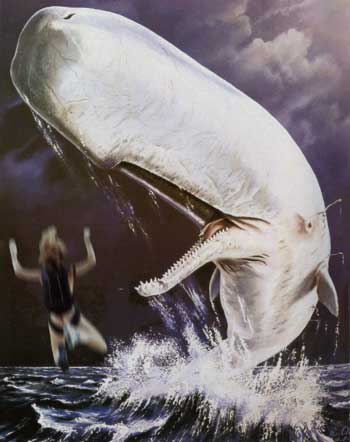
But there’s one that has become my own personal white whale: appropriately enough, MOBY DICK. It’s one of the few books that I’ve never finished, despite gritting my teeth and picking it up a half dozen times. I always enjoy the beginning, and sweep through the first twenty chapters.
Then I hit Chapter 32: Cetology, and my eyes glaze over. I have yet to make it through Ishmael’s attempts to classify whales scientifically. I read a page or so, then set the book down. One thing leads to another, and MD inevitably ends up back at the bottom of my TBR pile. I suppose I could always just skip the chapter, but I’ve never done that with a book before and something inside me balks at the thought.
Plus, I honestly have a fairly limited tolerance for sea shanties.
Yet this is supposed to be one of, if not the, “Great American Novels.” So am I really missing out by not finishing? Or has Melville passed his expiration date? How relevant are the classics to our contemporary lives now? Are some so outmoded they no longer qualify as great literature? More importantly, are certain books lauded as great simply because they’ve managed to survive the tests of time?
In the article, Elif Batuman points out that, “the right book has to reach you at the right time, and no person can be reached by every book.”
I love that observation. Sometimes I wonder if I’d still enjoy Milan Kundera as much if I read him now, or if Gabriel Garcia Marquez’s 100 YEARS OF SOLITUDE would make such an impression. I rarely go back and re-read books- there are simply too many amazing new stories coming out every week.
So today’s question is this: which great book let you down?
Cover Copy
How are you at writing back cover copy for your story? Most fiction writers don’t train for the advertising biz, and yet we’re expected to come up with log lines and blurbs and back cover copy. Recently, I read another author’s blog where she talks about optimizing your bio and cover copy for search engines by using keywords. Huh? And here I thought my profile was pretty good. As for cover copy, I can never come close to the witty style my former publisher used to promote my Bad Hair Day mysteries. I can write the story, but condensing it into a few lines that are entertaining while employing keywords is beyond my scope. Here is one area where I’m glad to get editorial input.
Let’s say we’re writing a mystery about a produce grocer who operates a booth at a weekday morning farmer’s market. When one of the other vendors ends up dead, suspects may include mutual customers, rival vendors, conniving relatives, and snarky suppliers. To make it easy for me, we’ll set it in Florida. So what would our keywords be here?
Amateur sleuth
Cozy mystery
Culinary (especially if vegetarian recipes are included)
Florida
I’m sure you can come up with more keywords. Anyone want to pitch in?
Now let’s have a go at the cover copy:
Before he can take a bite out of his organic Gala apple, green grocer Jimmy Octagon notices a commodity not on the menu at the farmer’s market. Normally a beehive of energy, honey seller Aldreshia Meyers is dead as a turnip over by the onion stand. With the mayor threatening to shut down the market and Jimmy’s vendor license on the line, he’d better find the killer fast or else he might become the next victim of the lethal Green Menace.
Okay, I warned you I’m bad at this, didn’t I? Note that I neglected to use a single keyword. Why don’t you give it a try?