
I’m off to New York today to attend a friend’s 10th wedding anniversary party and to see my agent. I’ll be back online (I hope) next week. In the meantime, any pearls of wisdom (?) – I am saying ‘a few words’ at the anniversary/renewal of vows ceremony and hope not to sound too soppy, sentimental or dull. Any advice??
Author Archives: Joe Moore

An Open Letter to Traditional Publishing
James Scott Bell
Twitter.com/jamesscottbell

Dear Traditional Publishing,
You’ve been taking it on the chin pretty good over the last year, so I wanted to write you a little letter and buck up your spirits. You’re an old and good friend. I want you to know that.
We’ve had great times together and they’re not over. We’ve done almost 30 books, you and I, and we have more in the pipeline. You send me royalties and never once has one of your checks bounced. I appreciate that!
But your head must be spinning like Victor Ortiz’s after Floyd Mayweather coldcocked him. With the e-reader revolution hitting harder than virtually anyone predicted, you’ve really hardly had time to get up off the canvas. I don’t want you to be counted out (and I certainly am not one of those in the cheap seats shouting for your demise!)
There is, however, something you need to understand. A lot of my writer friends are suffering right now because you’re dropping them. Yes, this is business, and the cold hard truth is you just haven’t got the dough coming in you used to. This limits the amount you can spend on new and midlist writers.
But there are lots of writers who signed contracts back in the day, before 2005 or so, whose books you’ve let go out of print. These writers would like to bring out these old books as e-books to try and make themselves some much needed scratch, but you are in most cases steadfastly refusing to give back any “electronic” rights. You’re going to hang onto those forever and just let the books sit there in digital land hoping they bring in a few beans.
Can I make a suggestion? Don’t play hard guy on this just because you’re bigger. Don’t pummel the struggling authors. Let them have their books. You’re not going to make a ton of lettuce on these. Being generous at this point would go a long way toward re-establishing some good will.
As for me, I am glad that it’s not either/or with us. I have you and I have self-published books that complement what we’re doing together. In point of fact, I’m doing what you always tell your authors to do: increase their platform, increase their readers. I’m making hundreds of new readers each month with my e-books, and that will only increase. Any author making new readers who feed into traditional offerings is creating a win-win situation. You can use a little more of that, I daresay!
Well, I know there’s a lot on your mind and you’ve probably got meetings to attend (watch out for those three martini lunches, though. Things aren’t that bad), so let me just give you some props and thanks. You let me have my dream. You have treated me fairly, and even though we’ve had a few disappointments, I am grateful that I get to be a working writer because you once took a chance on me.
Which is why I am hoping for your recovery. Of course we both recognize that things will never be the same. Too much has changed and will continue to change. But we still need people who love books — yes even books printed on paper! — collectively working toward the production of quality literature. You’ve been doing that for a long time and I’m pulling for you to keep on doing it in some form or fashion in the future.
Hope this helps a little. Keep in touch. Maybe next time I’m in New York you can buy me a drink.
Yours truly,
a.k.a. K. Bennett
The Zombification of Miller

John Ramsey Miller
I’ve been reading a lot of Zombie books lately, and I’m not truly remorseful. A guilty pleasure. There are so many, and so many authors writing in that horror sub-genre write great books indeed. Damn it, people just like Zombie hoards. It seems to me that before NIGHT OF THE LIVING DEAD, Zombies were unfortunate people brought back to life by a Voodooie priest to become a slave of some sort. Usually there was a secretish herby drug involved that accomplished this and (supposedly) there have been actual cases of Caribbean-based people who were once dead, and had no memory of their prior existence. Whatever. But the point is (as far as I know) they didn’t spend their time above ground, looking to eat flesh and brains until John Carpenter’s low-budget Chittlin’ yard party outside the old farmhouse near Pittsburgh.
James Scott Bell’s Zombie lawyer, Mallory, breaks the mold, and it’s an hilarious book. A Vampire’s trial held at night is a hoot I know he thought his book through, and made his zombie more realistic than most authors writing about Zombies. But his book is comedy and not horror so much.
Each Zombie book, like the Vampire ones, is different but shares certain similarities. There are lots and lots, but I’ll list a few.
1) Some sort of virus (celestial based or scientific experiment gone bad) gives the dead their locomotion fuel
2) The physical sharing Zombie Juice, or the airborne Zumbo-dust that covers the world, makes you become one upon dying
3) Being Zombified cuts IQ toward single digits. They can move around mostly in a shuffle, but can’t open doors, or use ladders, although steps are not a problem.
In some of these books Zombies learn tricks like opening doors and even setting up ambushes.
4) only opening the skull and scattering brains stops the things.
5) They do not respect old relationships and will eat their immediate family as soon as they’ll eat a politician
6) They begin to rot out and decay which adversely affects their appearance and gives them an unpleasant odor
7) They can walk if they have retained their legs, or crawl if legless, but wheelchairs are too complex to operate. If immobile, a zombie head can lie waiting like a rock until an ankle or a finger finds its way into its mouth.
8) All they think about is eating flesh and or brains
9) They have a keen sense of smell, see and hear well above the average living human
10) They often repeat old habits like going home to eat their friends and family, or go to the mall
10) They tend to gang up
11) The children zombies are usually faster moving than the adults
12) They coexist peacefully until preying
So this got me to thinking about how much disbelief I should suspend. I was asking a Chiropractor the other day how if tissue and muscle was rotting normally, how long could a Zombie walk around before critical disconnection and failure of the ability to locomote. If they can “live” just fine for years without eating, why do they go to so much trouble trying to eat something they can’t digest or pass? He said, “None of it is possible.” He wasn’t willing to theorize. I can believe all of it in a well-written story, but I do have questions galore that I often wonder how the writer can deal with. Bodies decay to bones, which are connected by living tissue and not even a reanimated brain can make tissue regenerate.
I think people are so into Zombie books because it appears society could degenerate and the institutions that keep us safe, break down. When anarchy is the norm, the strong will try to subjugate the weaker members of the non-society. I suppose that is a big factor in the surge of popularity. Plus, I think people just like seeing Zombies get it, more than they do ghouls or politicians.
If you want to read two very good series, try Stephen Knight’s GATHERING DEAD series, or Joseph Talluto’s White Flag of the Dead series.
What’s your guilty pleasure in novels?
Reader Baggage
By John Gilstrap
A couple of weeks ago, I received an email from a “fan” who loves my books, but is deeply annoyed that I allow my “left wing liberal politics” invade my work. I’ll give those who know me well a moment to stop laughing.
As evidence of my “politically correct bullshit” he notes that in Threat Warning, my fictional terrorists are “God fearing Christian men and women” when “we all know” that the true terrorists are Muslims. In my reply, I ignored the substance–including his assessment of who my fictional terrorist truly are–and thanked him for reading my work. Some conversations are just not worth having.
For the record, I work very hard to keep politics out of my writing. It just doesn’t belong. I’ll leave that subgenre of the thriller market to Brad Thor and Barry Eisler—between the two of them, the ends of the political spectrum are well covered. Still, I guess it makes sense that because Jonathan Grave is a former Delta operator and he uses a lot of weaponry, people might assume that he’s a right-winger, but that would be based only on the clichéd assumptions made about groups of people. Truth be told, I don’t think that Digger would have much time for any politician.
This email got me thinking, though, about how much of our reading is informed by the baggage we bring to the material we choose. We’ll all give a second (or third or fourth) chance to a writer whose earlier work impressed us, but think about how hard it is to give that same break to the same author who everyone loves, but whose first effort you experienced was sort of meh.
And it’s not just true of books. I like just about everybody, but there are a few folks on my shit list whose email correspondence always seems snide or hurtful. I have to remind myself that it’s entirely possible—maybe likely—that no offense was intended, and that where there’s no intent, there’s no foul, right?
When I was in junior high, I read my first Great Novel: Lord of the Flies. I was a better than average student, and as I read it, I remember being so proud of myself for catching on to the social subtext—the symbolism—of the book. My cousin was a high school English teacher at the time, teaching Lord of the Flies to seniors. When he told me that the pig-killing scene had Oedipal overtones, I thought he was making it up. Even after he explained it, I didn’t get it. That’s because I was reading an adventure story while he was teaching literature.
In Threat Warning, I wrote a thriller that my fan apparently read as a political treatise. At a book signing years ago, a very enthusiastic fan lauded Nathan’s Run for its symbolic depiction of the plight of the American Indian. She meant it as a compliment and I took it as such. I never told her that American Indians never once entered my consciousness as I wrote the book.
I’ve come to the conclusion over the years that once my words are published, my opinion of what I meant to say has no more validity—perhaps even less validity—than the opinion of those who read the words through their own filters. That’s the nature of art in any form, I think. I get my shot when I create it; after that, it’s all up to the observer/consumer.
What do you think? If a book arouses in you an intense emotion, does it matter that it might never have been the author’s intention to do so? Do authors’ intentions for their own work matter at all after the book is published?
Marketing in a Digital World – Maximizing FREE

By Jordan Dane
After Joe Moore’s interesting post yesterday – More Signs of the Times – about ebooks, online book pirates, & marketing, I thought I’d share what I’ve been focused on with my upcoming Young Adult book – On A Dark Wing (Harlequin Teen, Jan 2012) and the advance marketing we’re targeting for this release.
You might assume that targeting younger readers would automatically include a more savvy online promo approach, but more and more adult readers are turning to online resources to discover authors. With the growth in smart phones, having an aggressive online marketing strategy is important to create buzz for your books.
Below are some things I’m doing. I’ve also added promo ideas that I’ve heard lately and hope you’ll find some have merit.
1.) GROUP Blogs – The Kill Zone is a fine example of how a group blog can draw online traffic, provide a service to its followers and share the workload. I’ve just started a group blog – TEENSHIVER – for Texas authors who write dark young adult books that make a reader shiver. TeenShiver will have an outreach to area schools, libraries & retail stores, as well as to readers of YA in our state, yet with an online presence that is global. Since publishers tend to spend money regionally, rather than on more costly national campaigns (unless you’re James Patterson), this concept has been well received by our publishers since we are optimizing our traffic while featuring our books too. We are offering our publishers a better place to justify spending budget dollars. Our followers will benefit too. Texas has amazing book conferences and the TX book review/blogging community is vital, thriving, and supports homegrown authors.
2.) Virtual Book Tours – Many of you might be familiar with virtual tours, but I wanted to share a link that I think might help you figure out who to include on your tour stops. Quantcast (www.Quantcast.com) is a site where you can query a domain to see how much traffic they get and their demographics. Many blogs may request a spot on the tour, but since we are all tight on time or on deadline, writing a post or answering questions for an interview take time we may not have unless the site is active. Virtual tours today have hosts, generous bloggers willing to take on the host duties of pulling their community together for an effective tour, plus an author’s publisher can add a budget for a grand prize to generate buzz and participation. There is so much more to say about how these are run today, but not enough space here. Physical book tours are hit or miss as far as foot traffic & how successful they can be, but with virtual tours you never leave home and the blog traffic keeps coming long after you’ve posted.
3.) Twitter – I’ve found twitter to be a wonderful community to get to know and if you post your blog link or website or stir up a virtual tour, you can actually track the stats on your blog. This is quantifiable data. Social media spots like Facebook don’t have stats on traffic because they are not set up to conduct business well. Twitter is free and can be used effectively to enhance the draw to your blog or other objectives. Cultivate the book blogging & review community. They are truly amazing & avidly into books. We use twitter here at TKZ. If you’re a TKZ fan, follow us at this LINK.
4.) Blogging – Whether you do a group blog or fly solo with your own, blogging is free and has stats for traffic analysis. If you have an active blog with commenting followers and an even more active lurker community (reflected in stats for your site hits), blogging is a resource that can be especially useful to the self-published author, the aspiring author trying to get their name out, and the pubbed author with “out of the box” promo objectives. Used in conjunction with twitter, this can be an effective way to post interesting articles to the blogosphere without costing you the money that a website domain would.
5.) Street Teams – This is a concept that may be more prevalent with young adult readers, but there are adults volunteering their time for this too. Street teams started with the music community for people wanting to support their bands. Authors have taken this concept a step further and created clever ways to tie this promo function into their books. You can post a sign up on your website (like a yahoo group) where avid readers can send contact info to participate in a buzz campaign for your next release or an ongoing support group. You set up the criteria they need to be approved (ie must have a blog or post to X number of blogs for an advance review, etc. Publishers’ qualifications are posted on http://www.netgalley.com/ and gives guidelines on what these pre-qualifiers might be.) These avid fans (with special team names you create) are promised special insider information about your upcoming release, sent advance teaser quotes from your book, given swag like bookmarks or other token gifts or signed book covers, sent bookmarks/postcards to hand out—in exchange for help to spread the word about your next book, both online and word of mouth. Again, this is a huge topic without room to expand here.
Bottom line—take advantage of what is free on the internet. Get to know the growing technology that readers are using and come up with fun new ways to get your name or brand out there. Even if you are an aspiring author or thinking about self-publishing, having an online presence is important to develop a solid foundation of marketing your work and exposing your name to the publishing industry and readers who might be looking for you.
If you’re a reader, I’d love to hear how your search for books has changed in this more digital world as newspaper review sections have declined and other resources have dried up? Where do you go online for book recommendations?
And if you’re an author, I’d love to hear any other ideas for online promo that you think might be worth consideration. What has worked for you?
Reckoning for the Dead (HarperCollins, Sept 27, 2011. Book #4 – Sweet Justice adult thriller series)
“Jordan Dane crafts nail-biting thrillers with fully-realized but very damaged characters, and plots that twist and turn and double-back to bite the unwary. Her novels are 21st Noir with guts and heart and a wicked sense of humor.”
—Jonathan Maberry, New York Times Bestseller
“Jordan Dane crafts nail-biting thrillers with fully-realized but very damaged characters, and plots that twist and turn and double-back to bite the unwary. Her novels are 21st Noir with guts and heart and a wicked sense of humor.”
—Jonathan Maberry, New York Times Bestseller
More Signs of the Times
By Joe Moore
In a recent article in The Economist, it was reported that in the first five months of this year, sales of consumer e-books in the U.S. surpassed those of adult hardback books. Only a year before, it was 3 to 1 in favor of hardbacks. Amazon now sells more e-books than paper copies. It’s predicted that as more bookstores close, that will just continue to increase.
Another sign of the times: furniture manufacturers like IKEA are introducing book cases that aren’t designed to hold real books.
The publishing industry is running behind newspapers and music in moving into the digital world. But while the music and newspaper industries are in decline, many publishers feel the transition to ones and zeros will have better results. One big reason is that digitization will breathe new life into old titles and out-of-print books. Some genres, such as serialized romance novels, has a very short shelf life. This will no longer be a big factor since e-books never go out of print. Fans can access these books any time after publication thus extending the income potential for the publisher and author.
Despite this glowing advantage, the article also points out a couple of darker concerns. Number one on the list is piracy. Unlike a digitized movie or music album, e-book files are very small. BitTorrent-powered peer-to-peer websites make sharing and downloading books easy. Accessing the latest bestseller for your e-reader takes only seconds. And it’s widespread and growing like weeds. I get a couple of Google Alerts a week notifying me of new websites where my e-books can be downloaded for free.
Pricing is another threat and directly contributes to piracy. The higher the price, the better the chance that someone will go looking for a free download.
Then there’s the demise of the brick and mortar bookstore. As more stores close, the ability of a publisher to market and promote their books disappears. In the case of Hollywood, fully produced movie trailers run on TV and the Internet, and with music, radio stations are the main path to promotion. But as the number of bookstores decreases, so does the ability of publishers to promote their latest books, virtually the only cost efficient marketing outlet they’ve had up until now.
So with the steady growth of e-books, which one of these issues has directly affected the writers out there? Is your backlist being given a rebirth in digital format? Are your books being pirated? Are the bookstores in your town hanging on or vanishing? Has your publisher found other avenues to promote your work?
Milking a “crime” for all it’s worth
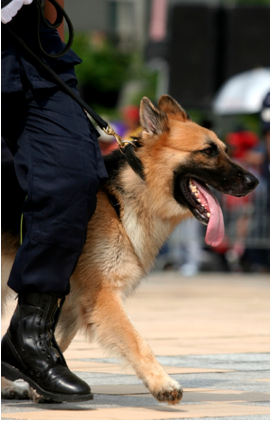
As a writer, I’ll admit it–I don’t get out much. My days mostly revolve around my laptop, the dog park, and reruns of K9 Cops on Animal Planet.
So whenever something mildly interesting does happen, I run with it. Like last week. A guy driving an over-sized pickup ran into a parked SUV at the dog park, whacking off a good-sized chunk of fender. I left to find the SUV’s owner, while the pickup driver sought a pen and paper from other bystanders.
I returned with the SUV’s owner, and discovered that the guy in the pickup had taken off without leaving a note. It was a hit and run. A young girl, a budding Nancy Drew type, had had the presence of mind to jot down the pickup’s license plate. The police had already been called.
I had actually recognized the guy’s face, so I stayed while the police arrived and took statements. When it was my turn, I gave a detailed description of the pickup driver. Unfortunately, I didn’t know his name. “But his dog is a white German Shepherd named Freedom,” I added helpfully. I kept referring to “we” as I described what had happened.
“Who was with you at the time?” the patrolman asked.
“Just my dog, McGregor.”
“I wonder if I should write that down,” he said, looking like he was trying not to smile.
From that day on, every time I went to the dog park, I was on high alert. I was determined to spot the pickup driver, just in case he tried to sneak in his white Shepherd for a game of fetch without being caught.
Two weeks later, I saw him. He was lounging by the fence, chatting up the owner of a Great Dane like he had nada a care in the world.
I leashed McGregor, stole back to the parking lot, and located the pickup. After a brief struggle over the morality of turning snitch, I called 911. I gave my name to the operator, recounted the hit-and-run incident, and said, “The guy’s here right now if you’re still looking for him.”
I expected the 911 operator to chide me for taking up emergency time with a minor call–after all, this is Los Angeles. But instead, she put me on hold. And then, by God, I was patched through to an officer. It was the patrolman I’d given my statement to two weeks earlier.
He told me that they’d found the pickup driver after running his plate.
“The guy copped to the whole thing,” he said. “We told him we had a solid witness on him, so he had nowhere to go on it. The insurance companies are working it out. Thanks for calling it in, though.”
I slunk back to the dog park. Maybe it was my imagination, but I was sure the Shepherd’s owner gave me a stare down. I felt certain I’d find a pile of poop on the hood of my car later on.
I think I’m too much a sponge for this sort of thing. I make notes over every little event, thinking that someday I’ll use it in a story.
I guess I really should get out more. Take up skydiving or something.
How about you? Do you “use” real life events as kindling for the fire in your fiction? Are you oddly pleased when something unpleasant happens in your life, just so you know what it feels like?
Proposals vs. Manuscripts
A friend of mine asked me the other day about how and when published authors use proposals to sell their work as opposed to having to write another complete manuscript. I said that authors under contract typically do a proposal for their next book and that often their publisher has an option (or first right of refusal) on any other project they may be working on, so authors will probably submit a proposal for this too. I have to admit though I have only my own, limited experience, to go on, so I thought I would throw the question out to my fellow killzoners and find out what they have to say.
Although I do know a fellow mystery writer who managed to sell a new cozy series based only on a two page concept, I have heard of others who supply a synopsis plus the first few chapters as their form of proposal. An editor I spoke to in the romance genre said it was typical for a published author to do this rather than having to provide a completed manuscript (the reasoning being that they have proven their ability to complete a book already) but my own agent seemed to suggest that when venturing outside one’s genre a writer might have to finish the book first before it could be ‘sold’ to a publisher.
So fellow killzoners, what has your experience been?
- Since your first publication (which almost always is sold on the basis of a completed manuscript) have you typically submitted proposals or completed works for future projects?
- If you use proposals, are these only to your own publisher or to other publishers too?
- What format do these proposals take? A short synopsis plus chapters, or a more detailed chapter outline, or something else?
- A friend of mine has a great proposal template that includes subtitles such as ‘backdrop’, ‘hook’, ‘set up’ and ‘character snapshots’ – do you use similar elements or just a short summary?
- If you were advising a newly published author in this regard, what would you tell them to bear in mind regarding proposals?
- How many books did you have published before you could typically get away with using a proposal rather than writing the entire thing?
And for our blog readers, do you have any questions regarding the use of proposals to sell novels? If there are any agents or editors out there, how do you view proposals and in what circumstances are they (or aren’t they) the way to go.
– Posted using BlogPress from my iPad
What Makes a Novel a Page Turner?
James Scott Bell
Twitter.com/jamesscottbell
When you get right down to it, what is it that readers love most about the reading experience? I think it can be summed up quite simply. It is the emotional pleasure of being so engrossed in a story that they must turn the page to find out what happens next.

That means there is one thing your story absolutely cannot be, and that is predictable. To the extent that it is, reading pleasure is dissipated. This applies to any genre, of course.
So one of your goals as you begin to craft a novel is to figure out ways to pleasantly surprise the reader. For example, you avoid creating flat characters. You give us rounded characters, which E. M. Forster described as being able to surprise us in a convincing way.
Another way you create the page turning effect is through the element of mystery. Not just something you find in a whodunit. No, it’s well beyond that. The skillful withholding of information is one of the best things a novelist can learn to do.
Especially in the opening chapters. My rule for openings is to act first, explain later. This simple guideline will greatly increase the readability of your first pages, and even beyond. Leave mystery inherent whenever possible and explain things only progressively. Drop in hints and actions that make the reader wonder, “Why is this happening?” or “Why is she doing that? Feeling that?”
Pull the reader along with unanswered questions, saving final revelations until well into the book.
Our own John Gilstrap does this masterfully in his novel At All Costs. In Chapter One, we see Jake Brighton, by all accounts a highly competent body shop manager for a Ford dealer. He’s going about his business when a heavily armed team of Feds busts in and arrests him. As he’s handcuffed and on the floor:
He fought back the urge to sneeze and tried to make the pieces fit in his mind.
We’ve been so careful.
Careful about what? Gilstrap doesn’t tell us. Not until the final line of the chapter:
He wondered if he and Carolyn still owned the tops slots on the Ten Most Wanted List.
Whoa! Another question raised: What could this outwardly normal and hardworking man have done to be at the top of the FBI list?
Again, Gilstrap makes us wait. For almost a hundred pages. As Jake and his wife Carolyn try to escape town with their thirteen-year-old son, putting a long-ago plan into effect, we are drawn further in by the mystery of their background. (In a nice twist, not even the son knows what his parents have done).
It is only when the chase is on that Gilstrap reveals their hidden secret. By then we care for these people and we are hooked by the action.
Here is an exercise that will pay tremendous dividends for you: Go through the first five thousand words of your manuscript and highlight all the material that is explanatory in nature, that tells us things about the character’s past.
Then step back and find a way to withholdthe most important information. I believe in a bit of backstory up front to help us bond with a character, but not in giving us an entire life history. It’s a judgment call, but that’s what this writing craft is all about. This exercise will help you make an informed choice.
For example:
Rachel had never been the same since her daughter, Tessie, died at age three.
Obviously, this is a major piece of information about Rachel’s emotional state. Instead of coming right out and telling us about it, consider showing us something about Rachel that indicates the trauma without revealing its source. For instance in a restaurant scene:
Rachel reached for the teapot. And froze. The tea cozy had a flower pattern on it, the same one––
“What is it?” Mary asked.
Rachel opened her mouth to speak but no words came out. She noticed her hand trembling in mid-air. She withdrew it to her lap. “I’m sorry,” she said. “Would you mind pouring?”
Only later will it be revealed that the last time Rachel was with Tessie they’d had a “tea party” with a set that looked exactly like what is on the table at the restaurant.
Look for opportunities to keep readers wondering what the heck is going on––in plot, in character emotions, and in the world of the story itself. If you want to see a master at work on all three levels, read Rebeccaby Daphne du Maurier, or see the film version directed by Alfred Hitchcock.
Think back on some of your favorite novels. Do they not contain this essential element of mystery in the opening chapters, and even well beyond?
Note: the first part of this post is adapted from The Art of War for Writers.
On the Road Again
I feel as if I am the only person in the world who is not at Bouchercon this week. I had planned to attend, but a music law seminar in New Orleans which I need to attend to keep my continuing legal education hours current and which has traditionally held in August was inexplicably switched to September, butt-up against Bouchercon. So it is that as you read this I will be in my car, somewhere between Ohio and Louisiana.
I have not flown commercially since 1997. I never liked flying to begin with — when you get down to it, I have control issues — and between the hassles of transporting an unloaded firearm in checked luggage and the thought of a jihadist with a LAWS rocket in hand staring longingly at the silver undercarriage of my plane I made the decision to drive everywhere I need to go. I have never regretted it. I probably will never get to Europe, and getting to the West Coast to serenade Michelle Gagnon with “Happy Birthday” in person will take some planning, but folks who fly everywhere miss a lot. It takes me fourteen hours to drive from my front door to the French Quarter, and that’s with stops for gas, coffee, and draining the crankcase. Westerville to Cincinnati — I can see the house my father where my father was born in from I-71, just after I cross the bridge into Kentucky — to Louisville where I switch over to I-65. The next big crossroads is Nashville, with its amazing intersection of interstate highways right in the middle of the downtown. You best be paying attention to where you are going or you might find yourself heading to Memphis, Chattanooga, or, if you’ve really cocked yourself up, back toward Louisville. I figure that if I can traverse it successfully then Alzheimer’s Disease remains at bay. Less than three hours later I am in Birmingham. With luck and good fortune I stop for lunch with Michael Garrett, with whom I have been friends for a half-century and who was the first editor for a bespeckled, quirky-looking guy named Stephen King. After lunch or otherwise I dog leg down to I-59; south of Tuscaloosa, the state of Alabama slowly melts into Mississippi, which after three hours or so becomes Louisiana. Or so the signs say. Once the swamp starts it is hard to tell the difference. And strange things happen. On a number of occasions, mostly late at night or very early in the morning, a pack of wild black dogs will run onto the freeway south of Picayune, Mississippi and chase my car for a few hundred feet. I almost wrecked the first time it happened; now I toss Milk Bones at them. Eventually, however, the swamps and the dogs gradually give way. I take the entrance ramp to I-10 west and isn’t too long at all before New Orleans rises to the south like a fever dream, as close to a foreign country as you will find within the borders of the United States.
Each trip is much the same, and each trip is a little different. I’ve actually made friends with gas station attendants and waitresses along the way who know the names of my wife and children, even though I see them infrequently (the gas station attendants and waitresses, that is). I would have missed a lot if I had flown, and not just with respect to traveling to and from New Orleans. I’ve gotten speeding tickets in Liberty Hill, South Carolina, been propositioned in a Baton Rouge hotel parking lot at 5:00 AM by a prostitute in a cheerleading outfit, and crammed a Pulp Fiction week’s worth of adventures a few years ago during a road trip to Phoenix with Marcus Wynne driving with a trunk load of machine guns, knives, hand grenades, and other assorted and sundry weapons. For demonstration purposes only, mind you. When the country is passing underneath you at 500 miles an hour, you can miss a lot; on the ground, every mile holds a potential story.