

“Cleanliness is indeed next to godliness.” —John Wesley
* * *
Yes, that’s right. Today is National Clean Off Your Desk Day. Oh, great. I just finished putting away the holiday decorations and was working on tax info to turn over to our accountant, and now they tell me I have to clean off my desk. I don’t have time for this.
But I’m a good team player, and my desk definitely needs some reorganization, so I went to the National Clean Off Your Desk Day site to get some inspiration and advice on exactly how to proceed. Here’s what they say:
This day is an opportunity to begin your new year with a clean and organized workspace. Whether your desk is in a private or shared office, cubicle, home or a make-shift desk on the counter, having your workspace uncluttered and organized will help you work more efficiently. A clean workspace improves productivity and inspires us, too. It often gives us a sense of serenity. (My emphasis)
They go on to outline a step-by-step process:
- Remove everything from your desk. Yes, everything.
- Clean the surface. As you replace items, clean them with the appropriate cleaning supply. Usually, a damp cloth is sufficient, but other electrical items need specific care.
- Get out the shredder and the garbage can. Shred, file, scan documents, business cards, recipes, photos as needed.
- Place all documents and photos in the appropriate locations.
- Shred and toss outdated documents, non-working pens, junk mail.
That’s good advice, and I was just getting ready to start on Step One when something occurred to me. Maybe there’s another way to look at this.
* * *
“Cleanliness is the scourge of art.” —Craig Brown
I don’t know if Craig Brown is correct, but since I place myself on the messier side of humanity, I want to believe it. Is it possible that creative people are messier than others?
I found evidence in an article on sciencedaily.com entitled “Tidy desk or messy desk? Each has its benefits.”
Working at a clean and prim desk may promote healthy eating, generosity, and conventionality, according to new research. But, the research also shows that a messy desk may confer its own benefits, promoting creative thinking and stimulating new ideas.
Well, that’s a relief. Maybe I can ignore the chaos for a while longer.
In an experiment overseen by psychological researcher Dr. Kathleen Vohs, 48 participants were asked to come up with novel uses for a ping pong ball. Half the participants worked in a messy room and half in a neat room. The result?
Overall, participants in the messy room generated the same number of ideas for new uses as their clean-room counterparts. But their ideas were rated as more interesting and creative when evaluated by impartial judges.
“Being in a messy room led to something that firms, industries, and societies want more of: Creativity,” says Vohs.
And we all know creativity is the lifeblood of good fiction.
So my desk isn’t messy. It’s simply a manifestation of my creativity. I like that.
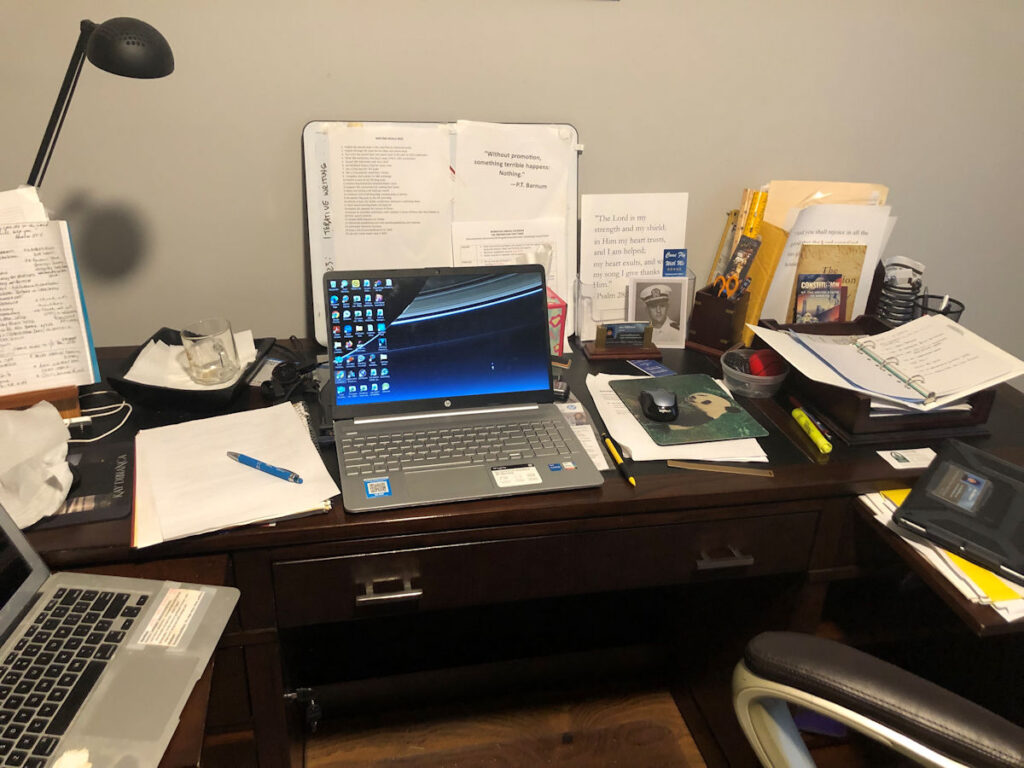
Now where did I put that stapler?
* * *
So TKZers: What does your desk look like? Does a messy desk inhibit your work? Or does it inspire you?
* * *

My ten-year-old protagonist and aspiring novelist, Reen, understands the signs of creativity. When her 9-year-old cousin points out a smudge on Reen’s shirt, she replies, “No problem. Authors are supposed to be sloppy. That’s because we’re creatives.”
I like the way she thinks.
Click the image to go to the universal book link.
Yay, creativity! I feel better now about my messy desk.
Creatives unite! Maybe we should have a National Mess Up Your Desk Day.
Have a great week.
My desk at the day-job looks like the office supply truck backed in and blew up… but that’s genetic I believe… Dad’s desk was a nightmare, but he knew where everything was… Sometimes he’d call home while on a trip, ask Mom to go to his desk to find something, telling her where to look on the desk, which pile to dig into, and how deep in the pile – adding to put back whatever she found in the same place in the same stack…
On the other hand, Mom’s not nearly as “disorganized” – a relative term, I s’pose…
I noticed, too, in architecture studio in college, those oversized drafting tables (yes, I’m that old), were used to their maximum carrying capacity… Creative minds? Or just collegiate sloth and sloppiness?
I think you can guess where I fall on that question… 😉
Hi George.
That’s a great story about your father. Organized mind = messy working environment. I can identify.
Have a good week.
My father was a “stacker”. Piles everywhere. But he could tell you what pie to check for the file he needed.
File by pile I always say… 😁
This reminds me of the saying, “If a messy desk is the sign of a messy mind, what’s an empty desk a sign of?”
Mine looks like a hot mess, but like others, I know where everything is. I do keep the notes and research for only one WIP on there at a time. Mostly…
Good morning, Becky.
I almost used that quote from Einstein in the post. I’d love to see what his desk looked like.
A “hot mess” is a good description.
There are photos on the Internet of Einstein’s desk taken the day after he died. Looks like home.
My desk looks like…a junkyard in a windstorm. I dated a guy for 26 years, and it’s a wonder I did when after the 3rd date he came into my house and said, “I’ve read that a person who can stand clutter is well-adjusted…and you’re very well adjusted.”
I do like an organized office and maybe once a year I’ll go through it, tossing junk (only to need it the next day) and cleaning everything. But it doesn’t stay that way long. Is it brother Gilstrap who starts out each morning with a pristine desk?
Hi Patricia.
“A junkyard in a windstorm.” I’m loving the metaphors people are coming up with.
Nice to know that we’re not only creative, but we’re well-adjusted. 🙂
Have a good week.
Does a messy dining table count?
When we have guests, I have to scrape off my piles of files, books, scattered notes, backup drives, and pencils w/o erasers, erasers w/o pencils, and all the other garbage. That’s often when I uncover projects I’d forgotten about, buried under current garbage.
I intend to file stuff in the two-drawer cabinet but it’s already crammed so I have to clean it out before there’s room for new stuff. Sigh.
If I ever have a designated office with an actual desk, I won’t know what to do. Maybe start making up “National Day of XYZ” events.
Thanks for the smiles, Kay.
Good morning, Debbie.
The dining room table is a great desk. So much real estate. Funny, isn’t it, that no matter how large the work surface, a creative mind can use it all.
Have a great week.
I have a weekly house cleaner, so I declutter so she can clean my office, which includes minimal desk dusting, etc. I fear most of my decluttering is stacking papers which I promise myself I’ll go through “soon.”
But I know where everything is … except for that one item that’s been in the way for days/weeks/months, but when I actually need it, it’s disappeared.
Morning, Terry.
House cleaners come to our home every other week, and we tell them to just leave the offices alone. Problem solved (for a while.) When the dust gets unbearable, we’ll have to declutter and let them at it. 🙂
Have a good week.
Love it! But Kay, I notice the wall you face is bare. Mine, on the other hand, is as messy as my desk. You’re missing out.
Good morning, Harald.
I have one picture hanging above my desk: the usual university diploma. But I have 8 or 10 framed pictures sitting on the floor, waiting to be hung. We’ve been in this house about six months, and those poor pictures are still leaning against the wall, gathering dust.
Now that you’ve brought that to mind, maybe I’ll get those pictures hung. On the other hand …
Have a good week.
I have two offices and hence two desks. I try to keep things organized and neat. Try. Today I have four computers with 7 monitors going. Last week was cleaning day for the other desk. A bunch of old business cards, dead pens, and swag hit the trash,
Good morning, Alan.
Two offices and two desks! A writer’s heaven. Sounds like the ideal setup.
Have a great week.
Good morning, Kay! I cleared my writing desk in the past few days as I’ve decluttered my writing office. Much “Jenga-ing” was done in the room and closet, as well as giving away some stuff, and rearranging of books on shelves. It feels good to see more of the floor again, and have a clear desk.
Full disclosure: my “writing desk” is at a 90 degree angle to my computer hutch, where I do my writing on a Mac Mini and a larger flat screen monitor, using wireless mouse and keyboard.
Additional disclosure: we’ve also been organizing and cleaning out stuff in the living room (now done). because we are hoping to get a bonded pair of kittens soon, our first cats in nearly two years.
Hope you have a great week!
Good morning, Dale!
The first of the year is a great time for “Jenga-ing.” Sounds like you’re off to a good start.
And kittens! Oh, boy. What a wonderful way to start the year. Good luck with them.
It’s also Kiss a Ginger Day. Soon, I am going in search of a member of the Weasley family (Harry Potter) or a ginger snap cookie whichever comes first.
My desk is a folding table in the corner of my bedroom/office. It holds my iMac, router, and printer. On top of the printer are two plushy dogs given to me by my niece. They judge me when I stay up too late watching YouTube shorts of cats and puppies. Everything else in bedroom stuff. Clutter has never bothered me one way or the other in the creative process. These days, the clutter is on my desktop, not the desk.
Ginger Snaps! I love ’em. You remind me I need to pick up a box the next time I make a run to the grocery.
Your setup sounds ideal. We have two printers. The remote one is in my husband’s office. I have an old Brother printer that’s tethered to my HP laptop. The printer is sitting on an upside-down cardboard moving box next to my desk. One of these days…
I just got a new desk together thanks to my son–an L-shaped desk. I love the space and all the drawers! Still, there’s not too much surface visible as I spread my notebooks for writing classes out, my calendar, pens, bookmarks, bill sheet, etc.
I’ve always been a bit messy but I did start with a clean desk on Jan. 1st, lol. It’s just easier with my arithritis and tendonitis to have things within reach.
Congratulations on your new desk, Traci! Hope you put all that new space to good use.
Have a great year!
My desk looks like a landfill. I’ve considered pouring gasoline on it and starting over. I hope this means I’m creative and not just a slob.
“A landfill.” That’s priceless, Elaine.
No slobs here. Only creative geniuses. 🙂