
by James Scott Bell
@jamesscottbell
 All writers get rejected. Well, almost all…there have been a few first-time-out successes (though often followed by a second-book failure, leading to another form of rejection: no new contract).
Many writers report on the rejection slips and letters they received, putting them in a pile, or in a file, or on a spike in the wall. Persistence and production is what mattered. The pulpsters would get their stories returned by SASE (quiz, kids: what does SASE mean? No Googling!) and put them in another envelope and send them out again.
There are some famous rejections in literary lore.
“It is impossible to sell animal stories.” (To George Orwell re: Animal Farm)
“We are not interested in science fiction which deals with negative utopias.” (To Stephen King re: Carrie)
“If you insist on re-writing this, get rid of that Indian stuff.” (To Tony Hillerman re: The Blessing Way)
I will add mine. I was going through some old file drawers the other day, and found it. My very first book proposal and my very first rejection letter! Now, this was for a nonfiction book, and I was truly wet behind the ears (i.e., just out of college). It was a form letter, which began with a warm “Dear Author.”
In answer to your present query, we are not interested in seeing this manuscript as we are not looking for this type of book on this subject matter at this time.
We appreciate your writing us about your manuscript and would be open to future queries about other books you are writing.
Sincerely,
The Editorial Staff
Hey, at least they appreciated me! And said they were open! (That they said this to every author they rejected was a thought that did occur to me.)
In that same file drawer, I found an even earlier letter, this one concerning a screenplay I had written as a film student in 1975. It was from Hal Barwood, whom I’d met when he was living in a house on the street I grew up on. He was the writer, with his partner Matthew Robbins, of Sugarland Express, Spielberg’s first feature film. And other successes. He’d invited me to send him my script, which I did. (I also found the script. Boy, was I not ready for prime time!).
He wrote me a very nice letter on Universal Studios letterhead, with some sage advice.
The idea underlying your story would make a charming and professionally workable premise for a TV movie. But what I think you have started to write is a stage play. There’s nothing wrong with that — much of the dialogue is very snappy — however, in the movies much of the storytelling should happen on the bench during the “time outs.”
He could have ended it there, but finished with this:
Don’t despair — anyone who can crank out engaging stories like this one should keep his nose to the grindstone.
That’s the kind of encouragement that can make all the difference to a young writer. When I finally put my nose to that grindstone thirteen years later, it would be another seven years before I started to sell.
Persistence and production.
Now let’s talk about successes. I was also going through my bookshelves clearing out space. Over the years I’ve collected bunches of Alfred Hitchcock and Ellery Queen magazines. These I decided to donate. And then I just happened to look down at one of them, and this is what I saw:
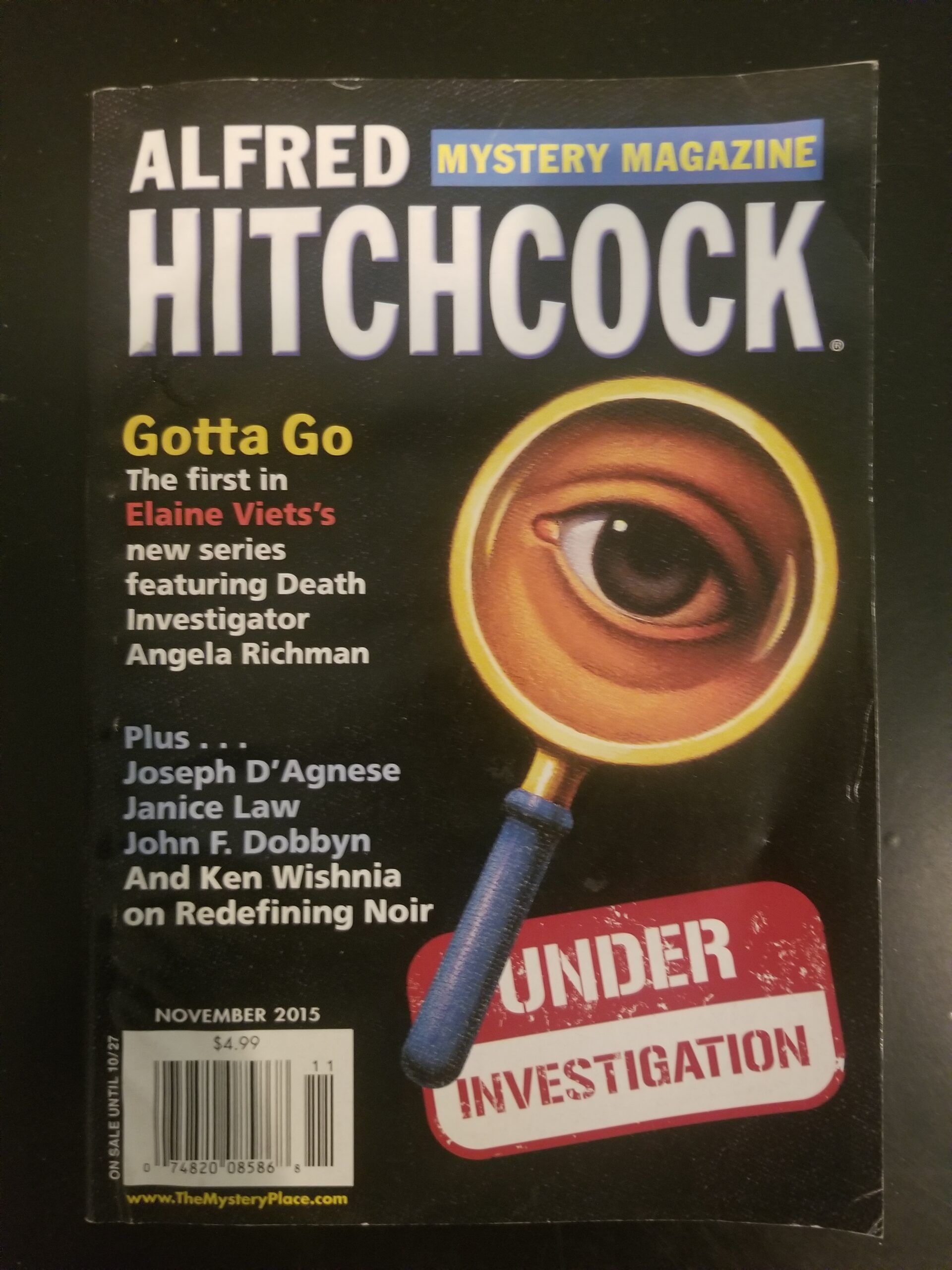
Our own Elaine Viets got the cover for the debut of her new series! Boom! I’d call that a major score.
I’ll never forget the box of books I received when my first thriller was published. My book! In print! From a real publisher! I was on my way. It wasn’t always smooth sailing (is it ever?) but I stuck around. I’m still sticking.
So let’s take a stroll down Memory Lane. Do you remember your first rejection slip? (For you kids, rejection email.) How about your first success, however you define that? Let’s hear your stories. And keep producing and persisting. Carpe Typem!
I’m just curious, in the part of the rejection letter from Mr. Barwood that says “however, in the movies much of the storytelling should happen on the bench during the “time outs.” I’m not sure I’m quite following this advice in terms of what is meant by on the bench during time outs? You don’t tend to think of movies having lulls.
My script had a basketball player central character, so the reference to the “bench” and “time outs” was in that context. What he was trying to tell me was that my dialogue had too much exposition.
Oh my, Jim, my first attempt at TV writing was far more embarrassing. The Man from U*N*C*L*E was a huge hit in the mid-1960s. I wrote a “script” for the show by hand on lined three-ring notebook binder paper and sent it to the studio. A few months later, some kind soul mailed it back with a mimeographed form rejection that said they couldn’t accept scripts unless submitted by an agent. That’s probably how I first learned about agents.
My first “paid” acceptance was a short story to an amateur lit-mag (photocopied and stapled) put out by two college guys. Received a $5 check…that bounced.
P.S. I always wondered which is correct: a SASE or an SASE?
My first book was purchased by the first editor I sent it to at Berkley, and was published, so that was my first (only) success. The second book I submitted, which was in a completely different genre, received this rejection:
“I enjoyed these chapters very much–you have a good eye and ear for contemporary characterization and dialogue. The problem is that our schedule is currently tighter than before because we did away with a couple of fiction slots. That means we have to be even more highly selective in our acquisitions. This is softer and quieter than many of the contemporaries we usually do, which could be a good thing, but I’m sorry to say we do not have room for it.” She gave me a list of agents she trusted, and I sent the aforementioned book to one of them, receiving the reply, “I have to be enthralled to represent a writer, and I am not enthralled with your submission.”
At the time, I was devastated. My career as a writer seemed to me to be over, so I started second-guessing my writing skills. I bought a shelf full of writing books but became more confused with all the contradictory information in them. Was I supposed to write this way, or that way? Because I can’t not write, I completed six more novels (first drafts) yet have never had the courage to do anything else with them.
But, oh, how times change. No, I still haven’t tried to publish another book, but reading about other writers’ struggles and determination to succeed has made me realize that I was silly and immature. The true stories from other writers of years of struggles and dogged determination make me either ashamed, or tired. I know that if I want to publish again, I need to buck up and forge ahead. So, I either do, or I don’t. I guess we all have that choice.
I guess I was born with too much self confidence, thinking that editors would love whatever I sent them. It didn’t help that the first thing I ever wrote was accepted by “Woman’s World Magazine”. Then the novel proposals I sent off to editors came back by return mail in that SASE (see Debbie, that’s how you get around the a or an thingy).
But I kept at it for 30-something years and finally an agent took me on and then my dream publisher. My mantra? DON’T EVER GIVE UP.
LOL, Pat! You’re so smart!
My first “acceptance” was for a short-short “story” (more of me learning POV). Sadly, the magazine went under before I got that coveted contract.
Great post, Jim.
I earned my first rejection in 1983, from the Magazine of Fantasy and Science Fiction, for my short story, “Devil in A Three-Piece,” which was supposed to be a satire of corporate culture, set in Hades. I sent the story off, and my SASE returned in precisely 3 weeks, with a typed form rejection letter. I was crushed.
Three years later I submitted a 2000 word story to OMNI Magazine I’d slaved over and ran through my critique group. Three weeks later, just before Thanksgiving, I received a personal rejection from fiction editor Ellen Datlow, which I sadly no longer have. She praised the immediacy of the story, a comment which kept be going for years.
My first fiction sale was 23 years later, a year after I’d started taking writing classes and workshops. I was enrolled in an online one-on-one mentoring program with Mary Rosenblum through Long Ridge Writing school. One week they had an editor, K.C. Ball, who ran a little flash fiction magazine visit the forum as a guest and be interviewed online and answer questions.
I learned about her magazine, Ten Flash Quarterly, which published ten flash fiction pieces every quarter. K.C. would choose a prompt to serve as a kind of theme for each issue.
The Winter 2010 issue had “an encounter at a lonely crossroad at dusk,” and a story popped nearly full form into my head, “Dead Wife Waiting,” which I wrote, ran by my then critique group, and submitted via email to K.C. Two days later she got back to me, and said she loved the story, and if I made one minor change she would buy it.
Her suggestion definitely improved the story, and I made my first sale, 26 years after my first submission. We went on to collaborate on three stories, selling two of them.
Since I had heard all the horror stories about rejections when I started to write, my expectations were very low. I don’t remember being upset about getting rejections, and I can’t remember which one was first. (One thing that does upset me is when the agent or publisher doesn’t respond at all. It doesn’t cost anything to send a form email.) Most memorable rejection was at a writers conference where I met with several agents. One of them told me, “You sure know how to write, but fiction isn’t selling.” 🤨
After a bunch of rejections, I received an email from a small publisher offering a contract for my first manuscript, and I was thrilled. One of those “I’ll always remember where I was when that happened” moments.
My favorite story, though, was Snoopy when he received the famous rejection letter that said, ““Dear Contributor: Many thanks for submitting your story to our magazine. You are the worst writer we’ve ever seen. Leave us alone. Drop Dead. Get lost.”
Snoopy leans against his dog house and says: “Probably a form rejection slip.”
Charles Schulz was a genius.
I haven’t done the query go-round yet but have heard about the lack of response from agents (in particular) from friends who have run that gauntlet.
Charles Schulz was indeed a genius! I loved “Peanuts”, and especially adored the Snoopy reading rejection letters he’d received bits.