
by James Scott Bell
@jamesscottbell
 All writers get rejected. Well, almost all…there have been a few first-time-out successes (though often followed by a second-book failure, leading to another form of rejection: no new contract).
Many writers report on the rejection slips and letters they received, putting them in a pile, or in a file, or on a spike in the wall. Persistence and production is what mattered. The pulpsters would get their stories returned by SASE (quiz, kids: what does SASE mean? No Googling!) and put them in another envelope and send them out again.
There are some famous rejections in literary lore.
“It is impossible to sell animal stories.” (To George Orwell re: Animal Farm)
“We are not interested in science fiction which deals with negative utopias.” (To Stephen King re: Carrie)
“If you insist on re-writing this, get rid of that Indian stuff.” (To Tony Hillerman re: The Blessing Way)
I will add mine. I was going through some old file drawers the other day, and found it. My very first book proposal and my very first rejection letter! Now, this was for a nonfiction book, and I was truly wet behind the ears (i.e., just out of college). It was a form letter, which began with a warm “Dear Author.”
In answer to your present query, we are not interested in seeing this manuscript as we are not looking for this type of book on this subject matter at this time.
We appreciate your writing us about your manuscript and would be open to future queries about other books you are writing.
Sincerely,
The Editorial Staff
Hey, at least they appreciated me! And said they were open! (That they said this to every author they rejected was a thought that did occur to me.)
In that same file drawer, I found an even earlier letter, this one concerning a screenplay I had written as a film student in 1975. It was from Hal Barwood, whom I’d met when he was living in a house on the street I grew up on. He was the writer, with his partner Matthew Robbins, of Sugarland Express, Spielberg’s first feature film. And other successes. He’d invited me to send him my script, which I did. (I also found the script. Boy, was I not ready for prime time!).
He wrote me a very nice letter on Universal Studios letterhead, with some sage advice.
The idea underlying your story would make a charming and professionally workable premise for a TV movie. But what I think you have started to write is a stage play. There’s nothing wrong with that — much of the dialogue is very snappy — however, in the movies much of the storytelling should happen on the bench during the “time outs.”
He could have ended it there, but finished with this:
Don’t despair — anyone who can crank out engaging stories like this one should keep his nose to the grindstone.
That’s the kind of encouragement that can make all the difference to a young writer. When I finally put my nose to that grindstone thirteen years later, it would be another seven years before I started to sell.
Persistence and production.
Now let’s talk about successes. I was also going through my bookshelves clearing out space. Over the years I’ve collected bunches of Alfred Hitchcock and Ellery Queen magazines. These I decided to donate. And then I just happened to look down at one of them, and this is what I saw:
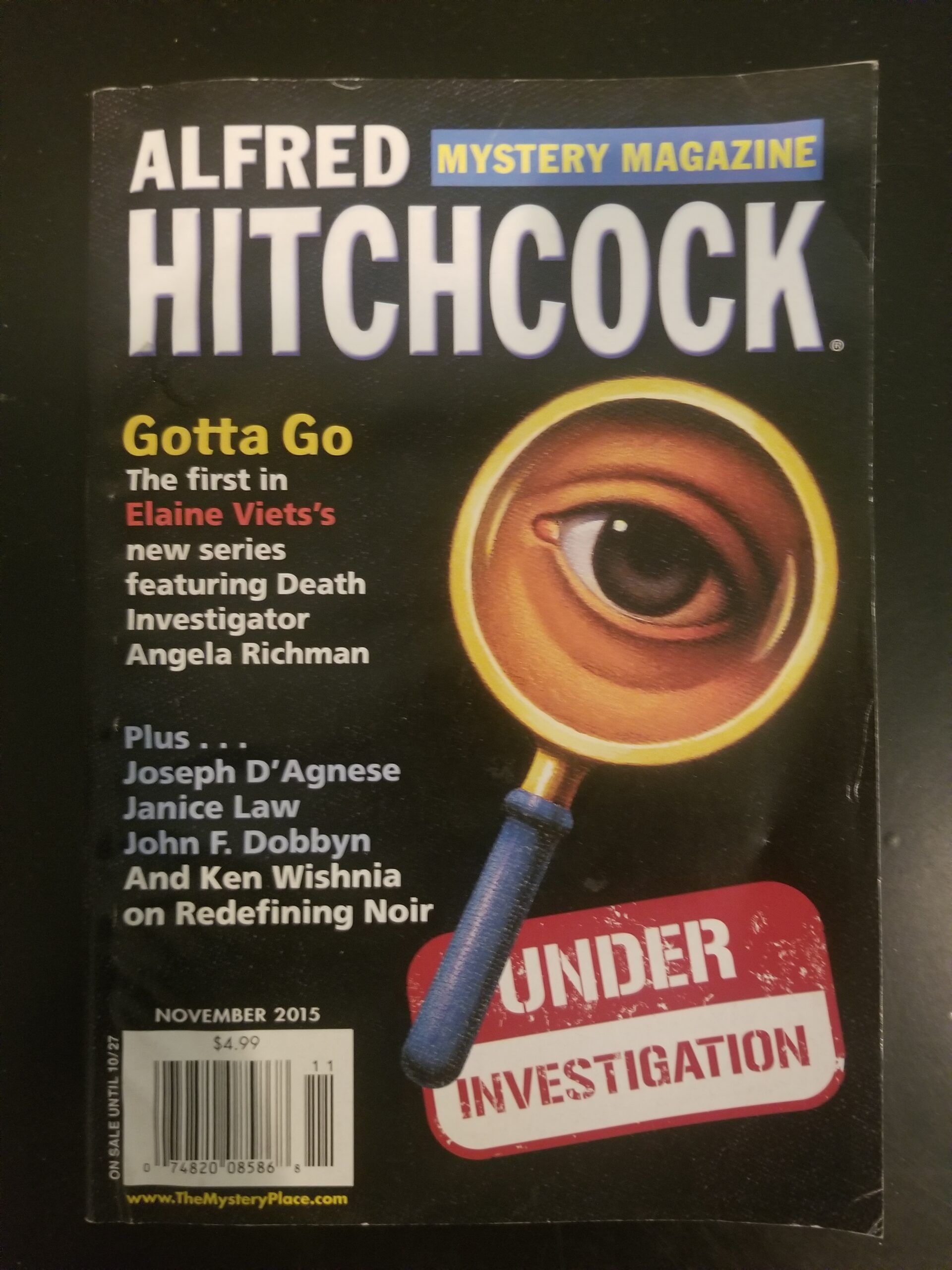
Our own Elaine Viets got the cover for the debut of her new series! Boom! I’d call that a major score.
I’ll never forget the box of books I received when my first thriller was published. My book! In print! From a real publisher! I was on my way. It wasn’t always smooth sailing (is it ever?) but I stuck around. I’m still sticking.
So let’s take a stroll down Memory Lane. Do you remember your first rejection slip? (For you kids, rejection email.) How about your first success, however you define that? Let’s hear your stories. And keep producing and persisting. Carpe Typem!