
The reader subscription service Oyster has launched. Offering a library of 100,000 titles (with more to come), Oyster gives a reader unlimited access to their library for $9.95 a month. Think Netflix for e-books.
Market research: As a reader, is this something you might be interested in? What might it mean for writers?
Yearly Archives: 2013
Talking Trailer Trash
By Elaine Viets
All the cool kids have book trailers. If you’re lucky, your publisher will pop for one. If not, should you spend your money for your own trailer? If you’ve never done an exhibition trailer hire for one of your projects before, now may be the right time to make a call like this.

I think it’s good advertising.
A book trailer is an animated version of the elevator pitch. It’s fun to show off your trailer on your Web site and Facebook page, like tooling around in a new car. Of course, you have to Tweet it.
Then what?
The book trailer is just starting its work. I have four trailers now and find new uses for them with each book. 
– Signings at bookstores and libraries. Most bookstores and libraries will run book trailers on their Web sites and Facebook pages. Unlike author photos, which seem to feature identical “Is the ordeal over yet?” smiles, book trailers look fresh and different. Nobody ever says, “You don’t look like your book trailer.”
– Media interviews. Send the station your book trailer for their Web and FB pages. Some TV stations will use it on air. Others will post it on their Website, promoting your book after your interview. Newspapers use them, too.
– Special events. I do a number of charity events when my mysteries debut. Some of the e-vites feature the book trailers.
– Sites that show off book trailers. My favorite is Shelf Pleasure www.shelfpleasure.com. More free publicity. (That’s its name. I’m not pulling your leg, or anything else.)
How much does a book trailer cost?
A one or two-minute trailer can run $5,000 to $7,000 and up, especially if it has original video and a professional announcer. Even with stock footage and photos, book trailers can quickly rack up price tag between one or two thousand dollars.
If you’re clever, like TKZ’s Nancy Cohen, you can make your own book trailer. Nancy described how she made her trailer for “Shear Murder” here:
http://nancyjcohen.wordpress.com/2011/08/01/book-trailer-how-to/
I use EZ Book Covers. Kelly Nichols, one-half of the mystery duo PJ Parrish, is easy to work with, partly because she’s also a writer. Over the rumbles of rolling logs, I hope you’ll hear this: She’s good. I wouldn’t recommend her just because she’s a friend. I’ve paid less than $500 for all four book trailers, including music and photos.
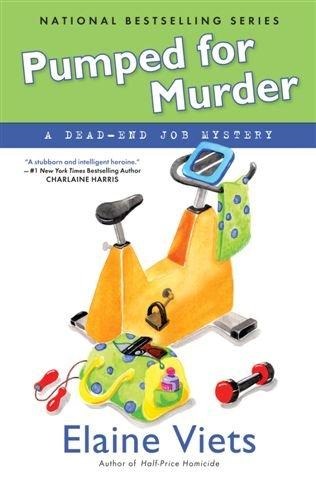 My first trailer, for “Pumped for Murder,” a Dead-End Job mystery about extreme body building, was nearly two minutes long: 1:58. http://www.elaineviets.com/new/misc/trailers.asp
Kelly had to really search to find photos of women body builders, but she got some doozies.
Then mystery author James Swain told me that book trailers don’t have to be so long. He recommended short pitches to get the message across. He’s right. Here are the short trailers for “Final Sail,” set aboard a yacht: http://www.elaineviets.com/new/misc/trailers.asp
![FinalSail_approved[1]](https://killzoneblog.com/wp-content/uploads/2013/09/FinalSail_approved-25255B1-25255D_thumb-25255B1-25255D.jpg "FinalSail_approved[1]")
And “Board Stiff,” a paddleboarding mystery. http://www.elaineviets.com/new/misc/trailers.asp
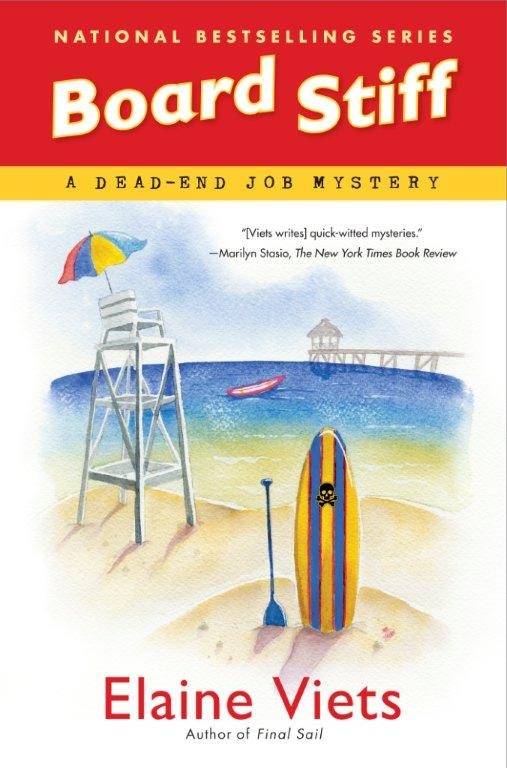
Thankfully, there’s no video of me taking standup paddleboard lessons.
I have a show on Radio Ear Network, so I narrated my videos. I also assembled a focus group of writers and friends to look at the rough cuts. That’s essential. Sometimes, I got so wrapped up in the video, I lost track of the story. 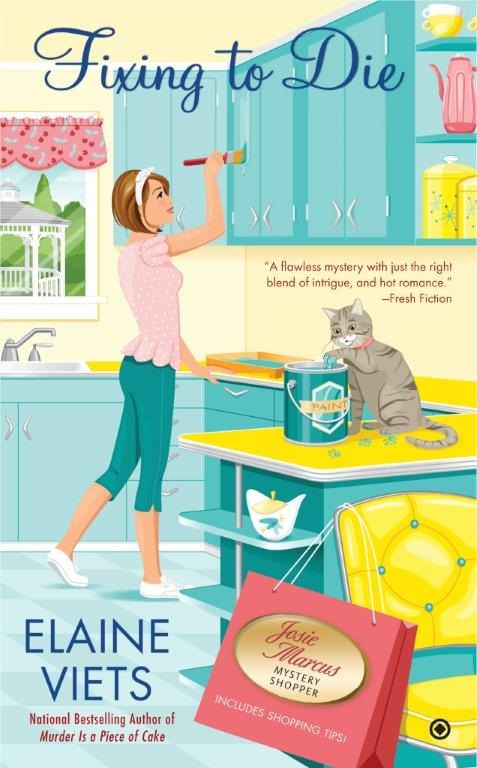
My new trailer is for “Fixing to Die,” my November Josie Marcus Mystery Shopper mystery. This short trailer was different from the Dead-End Job mysteries, which are set in anything-goes South Florida. Josie is a St. Louis single mom who’s newly married and renovating her first house. The trailer and the music needed a sitcom feel. http://www.youtube.com/watch?v=y7B8_GR0WIo&feature=youtu.be
Six months worth of work and seventy thousand words reduced to 57 seconds: That’s the art and the goal of the book trailer.
Book Production
What happens after you sell a book to a publishing house? Despite what you may think if you’re a new author, your work is far from finished. In case you haven’t had experience yet with this stage in the writing process or if you are an interested reader, let me describe it for you.
First you’ll hear back from the editor with line edits. Usually we get these as Track Changes in Microsoft Word. The editor will write comments in the margins relevant to the story and will delete/add sentences in the body of the work. You may or may not have a deadline for returning revisions, with your corrections also done in Track Changes.
Assuming your editor accepts this version, next you’ll receive the copy edits. If you’re unsure about the difference between line or story edits and copyediting, see my article here: http://bit.ly/18zyJbj. You make corrections again and send them back. Often I’ll find problems like sentences that should be bumped ahead to the next paragraph, missing punctuation or dialogue attributed to the wrong character. These are formatting errors.
Next come the page proofs or galleys. This is your last chance to make changes and to proofread your work. Again, you’ll have a deadline, often a week or two, in which to respond.
Sometime along the way, you may be lucky enough to receive an advance peek at the front cover design. Recently I got the one for my next mystery, and I immediately sent back two corrections and some color preferences. I’m lucky my publisher is so accommodating.
You may also get a glimpse at the inside cover flap (for a hardcover) and back cover copy. Once I felt the wording was too revealing about the suspects and requested changes. It’s nice when you have a chance to give your approval.
Naturally, if you are self-publishing, you have to hire people to do all these tasks. But you’ll still have the proofreading and corrections regardless of which route you take.
At the moment, I am working on four books. Three are already written. On Book 1, I’m waiting for page proofs and final cover design. This one already has a scheduled publication date. On Book 2, I am hoping for an offer followed by line edits. These will take me a while since the story is a long one. On Book 3, I’m working with an editor toward self-publishing my first original title.
As for book 4, I’m only at the synopsis and research stage, but I need to start writing it soon to finish by my editor’s requested date. Add in various trips and holidays within the next few months, and I’ll be lucky to have time to breathe. This requires prioritizing. The books that come in with edits or page proofs from my publishing houses will be first on the list.
So you see, until a book is actually on the virtual (or real) bookshelves, your work isn’t finished. When the book finally is for sale, then you’ll be jumping on the marketing bandwagon. And that starts a whole new ride.
How many of you have several works in production at the same time?
First Page Critique: THE CIRCLE

Today we have a first page from a story called THE CIRCLE. My comments follow.
***
Leigh looked up from her mum’s casket, concentrating on the slatted, pitched ceiling of the church. The familiar voice of the chaplain droned on from the pulpit and she focused not his words, which would surely undo her, but to the soothing and steady cadence. She held the back of her forefinger to her nose, wincing as she touched the swollen, chapped skin.
Reaching in her handbag for a tissue, her searching fingers settled on the age-softened newspaper article her mum had given her just two days ago. A jolt fired through her stomach and she yanked her hand out and clenched her palms in her lap, her fingers twining together until her knuckles blanched.
What had they been like?
The unspoken question itself felt traitorous. A glance to her left confirmed that her dad—that is, the only man she’d ever known as a father—was sitting upright, only the sparkling reflection on his cheeks belied his stoic figure.
Leigh took a steadying breath. Today she would ask Uncle Pete about the article. She cast a quick glance over her shoulder to see if she could spot him in the pews but her attention was caught by a man near the door in plain green Barrack Dress, staring at her.
She turned around to face forward again, her brow puckered. The military uniform must mean he was a friend of her dad. But surely the man was too young? Her dad had retired from the service when she was a baby. And the man had rudely not looked away when she’d held his gaze.
She turned to look again, but now there was only empty space where he’d stood.
###
Leigh found Uncle Pete at the reception back at the house. He was loading a plate from the buffet of casseroles and cakes in the dining room. When he saw her, he set it down and held out a hand. As she hugged him, he tucked her head under his chin.
“Hey little bit,” he said. “I’m so sorry. Your mum was one of a kind.”
Leigh relaxed into his embrace, hitching in a stuttering sigh. Though they weren’t related, she’d called him uncle as long as she could remember. And now he might be the only one who could help her. “Can I talk to you alone?”
***
My comments: I like the premise the writer establishes in this first page. We immediately know that the narrator is going through multiple crises–her mother has just died, and she just learned that the parents she has always known are not her real parents. There’s also a hint of military intrigue to come. This is a good opening situation.
In general, the writing here is strong enough to keep me reading. I would suggest some tweaking to make it even stronger. I put my specific suggestions in bold red.
Leigh looked up from her mum’s casket, concentrating on the slatted, pitched ceiling of the church. The familiar voice of the chaplain
(Perhaps mention the chaplain by name, if he’s familiar?) droned on from the pulpit. She
(I think this sentence is stronger if broken up) focused not on
(Missing preposition inserted here) his words, which would surely undo her, but to the soothing and steady cadence.
(After inserting the missing ‘on’, the combination with ‘to’ doesn’t read well. Might need to rewrite this sentence)
She held the back of her forefinger to her nose, wincing as she touched the swollen, chapped skin.
(This sounds stronger to me without the ‘the’. Also, the first sentence of the paragraph already has a gerund clause. Try to vary the structure of sentences in every paragraph as much as possible, to punch up the rhythm.)
Reaching in her handbag for a tissue, her searching fingers settled on the age-softened newspaper article her mum had given her just two days ago.
(Another gerund clause, plus there are two “ing” words in the same sentence. As writers, we all tend to overuse one type of structure, punctuation, or phrasing in our first drafts. This writer might want to check for the overuse of ‘ing’ throughout the manuscript.)
A jolt fired through her stomach and she yanked her hand out and clenched her palms in her lap, her fingers twining together until her knuckles blanched.
(Here, there are too many actions in one sentence: jolt, yank, clench, twine, and blanch. Consider breaking this sentence up to strengthen the flow.)
What had they been like?
(I put this in italics to indicate inner thought. This sentence was a bit jarring to me as I read it. It might have worked better if we’d gotten some clue about what was in the newspaper. Perhaps the narrator could glance down and register a word from the headline, a picture, or something that would set up her internal question.)
The unspoken question itself felt traitorous.
(This sentence felt slightly awkward to me.)
A glance to her left confirmed that her dad—that is, the only man she’d ever known as a father—was sitting upright. Only the sparkling
(ING Alert. Break up this sentence to make it stonger. Also, ‘sparkling” didn’t convey tears to me on the first read) reflection on his cheeks belied his stoic figure.
(“Belied his stoic figure” seems stiff, somewhat Churchillian. It doesn’t match the tone of the rest of the piece.)
Leigh took a steadying breath. Today she would ask Uncle Pete about the article. She cast a quick glance over her shoulder to see if she could spot him in the pews but her attention was caught by a man near the door in plain green Barrack Dress, staring at her.
(ING Alert. And again, there are too many actions in one sentence. Separate the man’s action to distinguish it from hers.)
She turned around to face forward again, her brow puckered.
(This might just be me, but I don’t like the word ‘puckered’. I think it’s because I read so many manuscripts that overdo facial and hand tics.)
The military uniform must mean he was a friend of her dad. But surely the man was too young? Her dad had retired from the service when she was a baby.
(It might be stronger to mention the name of the Service. Specific descriptions give the reader hints about your characters’ backgrounds, and adds authenticity to your writing)
And the man had rudely not looked away when she’d held his gaze.
(Why is this rude? Wasn’t she staring at him as well? “Rudely not looked away” is slightly awkward, as well. )
She turned to look again, but now there was only empty space where he’d stood.
###
Leigh found Uncle Pete at the reception back at the house. He was loading a plate from the buffet of casseroles and cakes in the dining room. When he saw her, he set it down and held out a hand. As she hugged him, he tucked her head under his chin.
“Hey Little Bit,” he said. “I’m so sorry. Your mum was one of a kind.”
Leigh relaxed into his embrace, hitching in a stuttering sigh.
(ING Alert)
Though they weren’t related, she’d called him uncle as long as she could remember. And now he might be the only one who could help her. “Can I talk to you alone?”
(The formatting of the paragraph detracts from the tension of the scene, and it’s slightly unclear who is asking the question. It might be stronger if you show her voicing a muffled question into the wool of his jacket, or something like that.
***
Overall: I made a lot of suggestions for this page, but the fixes are all fairly minor, and easily made. This is a manuscript that seems very promising to me. It just needs a polish and some tweaking to get it to the next level. The writer should examine the rest of the manuscript for some of the issues we’ve discussed.
Thank you for submitting this page, Writer! Well done, and keep going with this story!
TKZ’ers, do you have any suggestions or anything you’d like to add?
To Review or Not to Review
I was at a presentation recently on ways authors can use social media and the dreaded issue of ‘reviews’ came up – with the presenter advising many would-be authors that a great way to engage future readers is to use social media to review other people’s books that occupy the same ‘space’ as your own.
Fair enough…perfectly reasonable…why not…except I always feel a panic attack coming on when it comes to the whole issue of reviews. Perhaps it’s my English heritage but I’m very, very wary of offering any kind of on-line commentary on books that have been published that are of a similar genre to mine (and even those that are not) because:
- What if I hate the book but I’ve met the author and he/she seem very nice…
- What if I think the book was so-so but it’s a major bestseller and so my opinion might look like nothing more than sour grapes…
- What if I love the book but my review seems like little more than vanity or pandering…
- What if an on-line opinion starts a flame-war?
Now in person I am more than happy to air my opinion on almost any topic:) My concern is always that once out there on the internet (via social media, blog posts or other review forums) it’s out there forever and it has an unlimited potential to come back and bite me.
Of course, good reviews are rarely the problem, but I think your credibility gets called into question if the only reviews you ever write are of the gushing, over the top ‘I love it!!!!!’ variety. If I’m going to present my opinion on-line I want it to be authentic, informative and interesting…which isn’t going to happen if I only report on the books I totally loved.
So I’m wondering what other writers do when they approach the issue of reviews in the online world. Do you:
- Only review books you love?
- Be honest, and just put your opinion out there? or
- Avoiding reviews all together?
I’m not sure how many TKZers post reviews on sites like Goodreads or Amazon (again I’m pretty reluctant to do either) or whether you express your opinions on social media like Google+, Facebook etc. On the one hand I think writing reviews can establish an authors credibility in terms of knowing their genre and being enthusiastic and involved in the writing world. On the other hand I think reviewing other people’s work can open up a whole can of worms (especially if it’s not a glowing endorsement) and so I still hesitate…
So what do you do when it comes to reviews?
Don’t Kill Your Thrills With Premise Implausibility
Last week I wrote about the most important rule for thriller writers to follow, namely:
Never allow any of your main characters to act like idiots in order to move or wrap up your plot!
I think I spoke to soon. There is a second rule that is of equal import: the overall premise of the thriller must be justified in a way that is a) surprising, and yet b) makes perfect sense.
This is not easy. Otherwise, everybody would be writing The Sixth Sense every time out. Not even M. Night Shyamalan is writing The Sixth Sense every time out!
So what can we do to up our chances of getting our thriller ending right?
1. Think About Your Contractual Obligation
Thriller readers will accept almost any premise at the start. They are willing to suspend their disbelief unless and until you dash that suspension with preposterousness. In other words, the readers are on your side. They’re pulling for you. You have entered, therefore, into an implied contract with them. They suspend disbelief, and you pay that off with a great ending.
I often hear writers say things like, “Oh, I’ve got a great premise. I don’t know how it’s going to end, but it will have to end sometime. And if I don’t know how it’s going to end, then surely the readers won’t guess!”
That is called, in philosophical discourse, a non-sequitur (meaning, “it does not follow”). I can name one big-name author right now whose last book was excoriated by readers because it had a great set-up, and hundreds of pages of suspense, and then was absolutely ridiculous at the end. I won’t name said author because I believe in the fellowship, and I know how hard this thriller stuff is to pull off.
Nevertheless, I’ve heard said writer say (he/she/it) does not worry about how something’s going to end until (he/she/it) gets there. And said author has paid the price for it.
2. Build the Opponent’s “Ladder”
A thriller or mystery does not begin with the hook, the body, or the Lead character’s introduction. In your story world, it always begins in the past with the Opponent’s scheme. (NOTE: this is not where you begin your book. It’s what you, the author, should know before your book begins).
Erle Stanley Gardner plotted his mysteries with what he called “The Murderer’s Ladder.” It starts with the bottom rung and runs up to the top. There are 10 rungs:
10. Eliminating overlooked clues and loose threads
9. The false suspect
8. The cover up
7. The flight
6. The actual killing
5. The first irretrievable step
4. The opportunity
3. The plan
2. The temptation
1. The motivation
So what you, the writer, need to work out is, first, the motive for the scheme. This is in the heart and mind of the opponent. He is then tempted to action, makes a plan, looks for opportunity, etc. When Perry Mason gets on the case, with the help of detective Paul Drake, they look for clues along the rungs of the ladder, the place where the opponent might have made a mistake.
The point of all this is, when you build your own ladder for the opponent, it will not only help your premise makes sense, it will give you all sorts of ideas for plot twists and red herrings.
3. Write the Opponent’s Closing Argument
This is an exercise I give in my writing workshops. It’s simple yet powerful. At some point in your plotting, whether you are an outliner or a “pantser,” pause and put your opposition character in a courtroom. He is representing himself before a jury, and must now give a closing argument that attempts to justify why he did what he did.
This step rounds out your opponent, gives him added dimensions, perhaps even a touch of sympathy. It also keeps you from the dreaded moustache-twirling villain. No stereotypes, please.
I see a pantser in the back row, raising her hand. “Yes, ma’am?”
“I just can’t write that way! I have to discover as I go along!”
“And you know what you’ll discover? That you have to force an ending onto all that material you’ve come up with. So you’ll go back and try to change, mix and match, but will then discover there are too many plot elements you can’t alter without changing everything else around it, so you’ll end up compromising at the end. Sometimes you’ll make it, but even popular writers who do it this way only bat around .400 on their endings. But if you follow the three steps above, your pantsing writer’s mind will still be able to play, but play with a purpose.”
“But . . .but . . .”
“But me no buts! This isn’t easy, you know. If it was, celebrities wouldn’t hire ghost writers when they try to cash in on the thriller market!”
Make sense? Have you ever found yourself backed into premise implausibility? What did you do about it?
The Old College Try
By Mark Alpert
Monday’s the first day of school in New York, and both my kids are nervous. My son is starting high school and my daughter’s going into seventh grade. They’re worried about all the usual things — making new friends, dealing with new teachers, resuming the nightly struggle with homework. (Frankly, I’m worried about that too. I hate cracking the homework whip.)
I try to empathize with my kids by telling them how nervous I got on my first day of college. I remember it so clearly, the sick feeling in my stomach as I drove with my parents down Route 1 in New Jersey and saw the Gothic spires of Princeton on the other side of Lake Carnegie. But that feeling vanished as soon as I met the other kids in my dorm. By dinnertime I was laughing my ass off. (And I hadn’t even drunk my first beer yet.) College turned out to be the best four years of my life. Well, at least the most amusing four years.
And those old college ties can be very useful for a novelist. Over the decades since graduation I’ve stayed in touch with my thesis adviser, Professor Richard Gott of Princeton’s astrophysics department. Dr. Gott is one of the world’s leading authorities on time travel. In his book, Time Travel in Einstein’s Universe, Gott describes how a spaceship could travel back in time by maneuvering around a pair of rapidly moving cosmic strings (infinitely long strands of high-density material left over from the Big Bang). He’s a brilliant, fascinating man, so when I was writing my first novel — a science thriller titled Final Theory — I decided to add a fictional version of Dr. Gott to the cast of characters. And when I finished the first draft I asked my old prof to look over the manuscript and tell me what he thought of it.
His first reaction: “Well, I recognized me.” He also recognized some of the other characters who were based on real scientists. Better yet, he fact-checked the manuscript, pointing out a multitude of scientific errors. If not for his help, I would’ve come off like a real dunce.
I also reached out to Princeton’s alumni magazine, which gave the novel a nice review. The book got some additional exposure when I wrote a cover story for the magazine about the latest advances in cosmology. And whenever I have a new book coming out, I make sure to send an advance copy to the magazine’s editor.
In a world of limited attention spans, this kind of resource is invaluable. Making the connections sometimes requires a bit of work, but it’s worth it. Although I attended Columbia for grad school, until recently I hadn’t made much of an effort to maintain ties with the place. But now I’ve signed up to participate in an alumni book fair that’ll be held at the Columbia campus on Saturday, October 12th, from 11 am to 5 pm. So if you happen to be in New York that weekend, drop by the alma mater and say hello!
Reader Friday: Quote Respond
Occasionally we’ll run a quote from a provocative post and ask you, dear readers, to respond to it. Today’s comes from author Lara Schiffbauer:
“Now, as we know, some writers have (what appears to be) lucky success. I’m not saying they don’t work hard, or aren’t talented. But, how many hard-working, talented writers do you know? That’s right. Quite a few, huh? And what makes any one writer who has that crazy-good success better than any of the others that you know? See what I mean? For every one lucky hard-working, talented writer there are many hard-working, talented authors who just didn’t have the stars align in quite the same way.”
Start a conversation in the comments!
The Trilogy Trick – Guest Spot with Michelle Gagnon
I am very excited to have Michelle Gagnon as my guest, but she is definitely no stranger to TKZ. Many of you know Michelle was a former contributor extraordinaire to our blog and I’m excited to hear her thoughts on trilogies and her latest release. Welcome, Michelle!
Hi folks, I’ve missed you! So good to be back on TKZ.
With the success of The Girl with the Dragon Tattoo and The Hunger Games, trilogies are all the rage these days. In fact, when I first pitched an idea for a young adult novel to my publisher, they specifically requested a trilogy. I agreed, because hey, what author wouldn’t want to guarantee the publication of three more books? Besides, I’d written a series before. How much harder could a trilogy be?
The first one, DON’T TURN AROUND, turned out to be the easiest book I’ve ever written. The rough draft flowed out of me in eight weeks; it was one of those magical manuscripts that seemed to write itself.
I sat back down at the computer, confident that the second and third would proceed just as smoothly; even (foolishly) harboring hopes that I’d knock the whole thing out in under six months.
Boy, was I wrong.
Here’s the thing: in a regular series, even though the characters carry through multiple books (and occasionally, plotlines do as well), they’re relatively self-contained. In the end, the villain is (usually) captured or killed; at the very least, his evil plan has been stymied.
Not so in a trilogy. For this series, I needed the bad guy—and the evil plot—to traverse all three books. Yet each installment had to be self-contained enough to satisfy readers.
Suffice it to say that books 2 and 3 were a grueling enterprise. But along the way, I learned some important lessons on how to structure a satisfying trilogy:
- Each book has its own arc. Well, that’s obvious, right? But what this really means is that book 3 can’t feel like a mere continuation of book 2. Even if your villain/evil plot spans all three books, you need to provide resolution at the end of each installment. This is a good place to employ what I’ve dubbed, “The Henchman Rule.” At the end of each book, someone needs to be held accountable; otherwise your hero/heroine won’t seem to be making any headway. And the best solution for this? Get rid of the main baddie’s number 2, his right hand man. My favorite example is the stripping of Saruman’s powers at the end of The Two Towers. Sauron must wait to be dealt with in The Return of the King, but his main wizard is handily dispatched by Gandalf (suffice it to say, I didn’t have much of a social life in junior high school).
- Avoid “Middle Book Syndrome.” What I discussed above is particularly challenging in the second book of any trilogy. This is the bridge book, the one where the characters need to move forward in their quest, but not too far forward. Traditionally, this is also the book that concludes with your main character (or characters) beaten down, exhausted, and uncertain of the possibility of success. Which can be a pretty depressing note to end on, unless you also provide them with a key: something that will help them surmount obstacles in book 3. That key can be any number of things: more information about the evil plan, the villain’s only vulnerability, etc. But the main goal is to set the stage for book 3, while still wrapping up enough threads to keep your readers happy.
- Character arcs need to span all three books. In a standalone, the main character faces some sort of incident that jettisons her into extreme circumstances (ie: Katniss’s sister losing the lottery). An escalation of events follows: the character is forced to confront her own weaknesses, and to discover her hidden strengths. At the end of Act 2, the character is usually at a low point, facing potential failure. Then, in the final act, the character rises to the occasion and ends up saving the day. In a trilogy, these same rules apply: but the conclusion of each book corresponds with the act breaks. Example: at the end of The Girl who Played with Fire (#2 in the trilogy), Lisbeth is horribly injured; she needs to overcome that incapacitation in order to finally vanquish her father in book 3.
- Avoid information dumps. Always a good rule, but trickier with trilogies. While working on the final installment, I kept butting up against this issue: when characters referred back to earlier events, how much background information was necessary to keep readers from becoming irrevocably lost? In the end, I provided very little. The truth is, it’s rare for people to start with the third book in a trilogy; I’m sure it happens, but it’s the exception, not the rule. So what you’re really doing is giving gentle reminders to people who might have read the last book months earlier. Provide enough information to jog their memory, without inundating them. It’s a tricky balance to strike, but I’d recommend erring on the side of giving less, not more.
So those are my tips, earned the hard way. Today’s question: what trilogies (aside from those I mentioned) did you love, and what about them kept you reading?
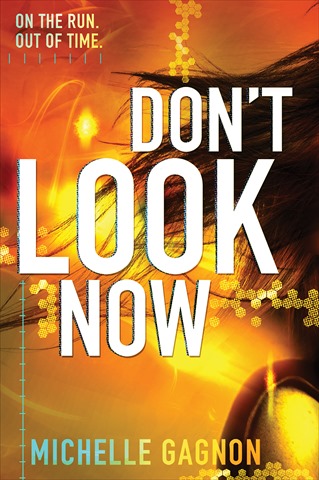
 Michelle Gagnon is the international bestselling author of thrillers for teens and adults. Described as “The Girl with the Dragon Tattoo meets the Bourne Identity,” her YA technothriller DON’T TURN AROUND was nominated for a Thriller Award, and was selected as one of the best teen books of the year by Entertainment Weekly Magazine, Kirkus, Voya, and the Young Adult Library Services Association. The second installment, DON’T LOOK NOW, is on sale now (and hopefully doesn’t suffer from “middle book syndrome.”) She splits her time between San Francisco and Los Angeles.
Blade Of Hearts critique
Today’s first-page critique submission is called BLADE OF HEARTS. Take a look. My comments follow.
Banda Sea, Indonesian Islands
12 June, 1994The shot pounded the confined space of the ship’s bridge with an impossibly loud explosion compared to the handgun’s size. The captain slammed into the console and slid to the deck, streaks of bright red blood smearing the panels. A pretty young blonde woman on the deck outside the room screamed and buried her face into the chest of a young man standing next to her. Rough hands reached down and grabbed the ship’s captain. Blood sprayed from between his lips on rapid panting gasps as he was dragged through the hatch and onto the aft deck where the rest of the ship’s passengers waited, trembling. They tossed him against the bulkhead where he crumpled to the painted metal deck slicked by his quickly pooling blood. Mustering his strength he rolled onto his back and forced himself to sit upright looking into the eyes of his assailant. Thirty years in the Marines meant there was no way he was going to die whimpering or squirming, he would face them, he would not cower.
“I am Colonel Galang,” the leader strode smugly before the trembling group of missionaries, his voice an odd high pitched flat tenor that sounded like he was forcing it to sound more masculine than it naturally was, like a fourteen year old boy trying to sound like a grown man. His face was that of a youth who seemed unnaturally aged. Though the skin was smooth and hairless it held the distinct look that belied a life of violence, like a centuries old vampire trapped in a teenaged body. Galang’s lips stretched tight in a frightening imitation of a smile that would’ve made a pitbull tremble with terror, “I am the most feared pirate in this ocean and you are my prisoners.”
“May God have mercy on your soul when you meet him,” said the captain through pale blue lips.
Colonel Galang glanced over to the gray haired man, his smile briefly faded then snapped back with an intense ferocity and he took three quick steps that brought him in front of the captain.
“No,” he leaned down to his face, “may I have mercy on your god when he meets me.”
Galang stood and reached across his body to a scabbard that hung on a belt around his waist and dragged out a heavy looking machete as long as his arm. He placed the blade on the captain’s shoulder and dragged it slowly across the man’s neck, eliciting a trickle of blood. The retired Marine officer stared unflinching into Galang’s eyes showing neither fear nor contempt, his face registering a sense of pity, as if he knew something more than the pirate leader before him. In a blur of motion, Galang spun a graceful ballet-like pirouette and brought the edge of the machette hard against the captain’s neck instantly severing his head with a clean cut. Blood jetted from the stump of the neck as the body remained upright against the bulkhead. The head rolled across the deck halting at the feet of the pretty blonde his lips nearly touching her toes as his mouth stretched in wide, gasping attempts at breath. She swooned into the arms of the young man standing next to her, his face registering every line of terror that the captain’s had not.
1: Omniscient point of view is a method of storytelling in which the narrator knows the thoughts and feelings of all of the characters in the story. The advantage to using it is that the storyteller can convey a great deal of information in a short amount of time and space. The disadvantage is that it virtually eliminates a personal connection between the characters and the reader. There’s nothing wrong with that if it’s the goal of the storyteller. That’s what we have here—third person, omniscient POV. What I came away with was a sense that this is a prolog, especially since it is dated 1994.
2: Whose story is it? Not the captain. He’s already lost his head over this. Colonel Galang? Maybe, if the story takes place in 1994. Also maybe, if the story jumps to a future or present time and he continues his pirating ways. The pretty young blond woman? Maybe, although since she wasn’t graced with a name, probably not. The young man? Side note: what does young mean? Eight years old? Eighteen? I’m 65. You can imagine what young means to me.
3: We’ve all heard Professor Jim Bell’s rule: act first, explain later. My compliments to this writer. He/she did just that.
4. The gun shot sounded bigger than the handgun’s size. Was it a derringer or a Dirty Harry .44 magnum? If this is omniscient POV, go ahead and tell us.
5. There’s a whole lot of trembling going on. The rest of the passengers waited, trembling. The figurative pit bull trembled.
6. The second paragraph had a bunch of comparisons including pre-pubescence, hairless skin that gave away a life of violence, and centuries-old vampires (don’t forget the hyphen). Hard to mentally see all those images.
7. Eliciting a trickle of blood? Eliciting? This word choice and visual doesn’t work for me.
8. Graceful ballet-like pirouette? See previous comment.
9. Machete? Machette? Check your spelling.
10. …his mouth stretched in wide, gasping attempts at breath. Impossible. How about: …his mouth frozen in a final, gasp for breath.
I would probably continue to read just to see if the story was about the pretty, young blonde. Hey, I’m a guy. But right now, I feel nothing for any of these characters. That’s not a tragedy. It’s the downside to omniscient POV. Hopefully, the story involves someone I will grow to care about. At this point, who knows. This appears to be an action/adventure story. My kind of book. But the writer has to know what he/she is getting into. There’s a stronger “hook” here than some of the previous first-page submissions, but there be dragons in them waters. Beware.
My hat’s off to the writer for having the courage to submit this sample. Best of luck with your WIP.
So, dear Zoners, what do you think. Would you keep reading or go watch Disney on Ice?