Designing a Thriller – Guest Post Virna DePaul

Host – Jordan Dane


I’m thrilled to host my friend, Virna DePaul. Virna is an esteemed member of the International Thriller Writers and recently interviewed me for ITW’s wonderful e-newsletter for my latest release, but Virna and I had met once before at a Romance Writers of America annual conference. We struck up a conversation at a Karen Rose workshop on writing suspense and had lunch after. At the time, Virna hadn’t sold yet, but she left a good impression on me that she was determined to succeed. Boy has she ever. Welcome Virna DePaul, TKZers!
Thank you to the Kill Zone and in particular Jordan Dane for having me as a guest today!


Roller coaster rides. Haunted houses. Horror flicks. And of course, suspense and thriller novels. What do they have in common? They scare us, yet there’s always a certain number of riders, participants, and readers willing to go back for more. Again and again, we seek out experiences that make our hearts race, and alternately tighten our muscles with anticipation and make us dizzy with relief. Why?


Because these experiences affirm our existence even as they wash away its ordinariness. They give us the illusion of being out of control and ultimately triumphant even as we remain both safe and, let’s face it, relative victims to the whims of fate.


We’ll board a roller coaster only because we know the ride will be quick and we can choose to never ride it again. We’ll see a horror movie only because we know we can walk out of the movie theater or cover our eyes at any time. And we’ll read a thriller novel only because we know we can put the book down until we’re ready to dive back in.


Of course, the key to any great thriller experience is that even given these options, we are swept away in spite of ourselves. We forget reality and simply soak in the larger-than-life wonder of the moment. We feel, we agonize, and we rejoice even as some part of our brains know we’re being manipulated by words, images, or mechanical engineering.


I write romance, both contemporary and paranormal, but my novels always have a suspense element in them. Much like a roller coaster architect, I enjoy designing a thrill ride for my audiences. I take into consideration who they are, what their expectations are, and how I can mix things up to bring them something fresh and new. I wield plot to provide suspension, loops, or a straight drop. I use characters to transport a reader to another time and place, keeping her safe even as I provide her maximum thrill and catharsis. I especially like knowing that at the end of my novels, readers will always have a happily-ever-after in the romance plot. And finally, I enjoy the fact that despite being the architect of my novels, I embark on a wondrous journey, too.


In my Para-Ops series, I take my readers from Washington D.C to North Korea to Los Angeles to France. I introduce them to an elite special ops team comprised of a vampire, werebeast, mage, and wraith. In my contemporary novels, I explore the world of undercover cops and state special agents who chase down drug lords and murderers. But always, no matter the genre or the specific plot, I strive to give my readers two things: a thrilling ride that sweeps them away, and enough satisfaction and hope at the end of the story that they can’t help but want to take the ride again.


How about you? Do you seek out thrills just in books or other places, too?


Experience Virna DePaul’s “intriguing world” protected by an elite Para-Ops team with a unique set of skills. In Virna’s latest release, Chosen By Sin (Para-Ops #3), you’ll meet a werebeast hero, a vampire heroine, and a host of other paranormal creatures such as a mage, human psychic, wraith (ghost), demons, and dragons. You can learn more about Virna and her series at www.virnadepaul.com and http://www.chosenbysin.com/.
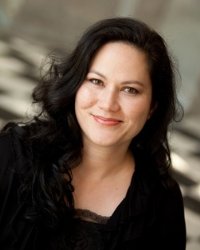
Virna DePaul is a former criminal prosecutor and now national bestselling author for Berkley (paranormal romantic suspense), HQN (single title romantic suspense; Shades Of Desire (Special Investigations Group Book #1, June 2012)) and HRS (category romantic suspense; It Started That Night (May 2012)). Writers, join Virna’s mailing list to access her archive of monthly writing “cheat sheets.”


Blurb from Chosen By Sin:


The longest life isn’t always the happiest one…


Five years after the Second Civil War ends, humans and Otherborn—humanlike creatures with superhuman DNA—still struggle for peace. To ensure the continued rights of both, the FBI forms a Para-Ops team with a unique set of skills.


For now, werebeast Dex Hunt serves on the Para-Ops team, but his true purpose is to kill the werewolf leader he blames for his mother’s death. Biding his time, Dex keeps his emotional distance from his team members and anyone else he might care for, including a mysterious vampire he met in L.A.

As a doctor, vampire Jesmina Martin has dedicated her immortal life to healing others. As a scientific researcher, she’s trying to prolong life spans, in particular those of her adoptive dragon-shifter family and the werewolf who saved her as a child. Her greatest hope lies with Dex, a werebeast she believes can gift immortality to others.

Only Dex knows nothing about his gift or the fact Jesmina wants to harness it. After a passionate night together neither expects to see the other again. Weeks later, they are reunited in France and forced to acknowledge a fragile miracle—a new life struggling to survive. At the same time, they must stop a group of rebel shape-shifters hoping to unleash every demon in hell. But before Dex and Jesmina can save their child or the world, they must relinquish their secrets, face their fears, and open themselves to love.

Buy the book HERE.

Writing is Rewriting

By Joe Moore

I just finished the first draft of my new thriller, THE BLADE, co-written with Lynn Sholes. This is our sixth novel written together; this one coming in at a crisp 92,500 words. Now that the first pass on the manuscript is finished, the rewrite begins. As E.B. White said in THE ELEMENTS OF STYLE, “The best writing is rewriting.”

Some might ask that if the manuscript is written, why do we need to rewrite it? Remember that the writing process is made up of many layers including outlining, research, first drafts, rewriting, line editing, proofing, more editing and more proofing. One of the functions that sometimes receives the least amount of attention in discussions on writing techniques is rewriting.

There are a number of stages in the rewriting process. Starting with the completion of the first draft, they involve reading and re-reading the entire manuscript many times over and making numerous changes during each pass. It’s in the rewrite that we need to make sure our plot is seamless, our story is on track, our character development is consistent, and we didn’t leave out some major point of importance that could confuse the reader. We have to pay close attention to content. Does the story have a beginning, middle and end? Does it make sense? Is the flow of the story smooth and liquid? Do our scene and chapter transitions work? Is everything resolved at the end?

Next we need to check for clarity. This is where beta readers come in handy. If it’s not clear to them, it won’t be clear to others. We can’t assume that everyone knows what we know or understands what we understand. We have to make it clear what’s going on in our story. Suspense can never be created by confusing the reader.

Once we’ve finished this first pass searching for global plotting problems, it’s time to move on to the nuts and bolts of rewriting. Here we must tighten up our work by deleting all the extra words that don’t add to the reading experience or contribute to the story. Remember that every word counts. If a word doesn’t move the plot forward or contribute to character development, it should be deleted.

Some of the words that can be edited out are superfluous qualifiers such as “very” and “really.” This is always an area where less is more. For instance, we might describe a woman as being beautiful or being very beautiful. But when you think about it, what’s the difference? If she’s already beautiful, a word that is considered a definitive description, how can she exceed beautiful to become very beautiful? She can’t. So we search for and delete instances of “very” or “really”. They add nothing to the writing.

Next, scrutinize any word that ends in “ly”. Chances are, most adverbs can be deleted without changing the meaning of the sentence or our thought. In most cases, cutting them clarifies and makes the writing cleaner.

Next, go hunting for clichés and overused phrases. There’s an old saying that if it comes easy, it’s probably a cliché. Avoiding clichés makes for fresher writing. There’s another saying that the only person allowed to use a cliché is the first one that use it.

Overused phrases are often found at the beginning of a sentence with words like “suddenly,” “so” and “now”. I find myself guilty of doing this, but those words don’t add anything of value to our writing or yours. Delete.

The next type of editing in the rewriting process is called line editing. Line editing covers grammar and punctuation. Watch for incorrect use of the apostrophe, hyphen, dash and semicolon. Did we end all our character’s dialogs with a closed quote? Did we forget to use a question mark at the end of a question?

This also covers making sure we used the right word. Relying on our word processor’s spell checker can be dangerous since it won’t alert us to wrong words when they are spelled correctly. It takes a sharp eye to catch these types of mistakes. Once we’ve gone through the manuscript and performed a line edit, I like to have someone else check it behind us. A fresh set of eyes never hurts.

On-the-fly cut and paste editing while we were working on the first draft can get us into trouble if we weren’t paying attention. Leftover words and phrases from a previous edit or version can still be lurking around, and because all the words might be spelled correctly or the punctuation might be correct, we’ll only catch the mistake by paying close attention during the line edit phase.

The many stages making up the rewrite are vital parts of the writing process. Editing our manuscript should not be rushed or taken for granted. Familiarity breeds mistakes—we’ve read that page or chapter so many times that our eyes skim over it. And yet, there could be a mistake hiding there that we’ve missed every time because we’re bored with the old stuff and anxious to review the new.

Spend the time needed to tighten and clarify the writing until there is not one ounce of fat or bloat. And once we’ve finished the entire editing process, put the manuscript away for a reasonable period of time. Let it rest for a week or even a month if the schedule permits while working on something else. Then bring it back out into the light of day and make one more pass. It’s always surprising at what was missed.

One more piece of advice. Edit on hardcopy, not on a computer monitor. There’s something about dots of ink on the printed page that’s much less forgiving than the glow of pixels. And never be afraid to delete. Remember, less is always more.

How do you go about tackling the rewriting process? Any tips to share?

How do you describe your main character?

Recently in the comments section of one of John G’s posts, a TKZ’er asked, “What is the best way to describe a main character in a story?”. 

As tjc and John suggested, there are a few generally recognized rules you should  keep in mind when describing your protagonist:

* It’s considered cliche to have your character gaze into a mirror or something similar to deliver physical description. 


* Physical descriptions of the main character are best provided from the POV of secondary characters.


* For your protagonist as well as secondary characters, avoid using “description dumps.” Here’s an example of a description dump:


A woman entered the room. She stopped and drilled me with intense blue eyes. She was in her mid-twenties, tall, thin, and blonde.


This type of a straight-on physical description right after a character’s introduction will bring your story to a grinding halt. (Note: Credit for “description dump” goes to Chris Roerden, whose excellent books about the craft of writing, including DON’T MURDER YOUR MYSTERY, deserve to be on any writer’s shelf.)


* If your main character has any specific physical traits which will be used later, make sure to spell those out up front. Otherwise, your reader may form an image of your character that clashes with later scenes. For example, if your character is particularly tall or short, old or young, that’s likely to come up in later scenes in relation to other characters. If your reader  has already formed a specific impression that doesn’t agree with your details, it’ll be jarring note.


Even though most writers are aware of these rules, it’s amazing how often they violate them. In book after book, I get irritated by an author who brings his story to a full stop every time a character is introduced. Other books, including best sellers, freely use the mirror cliche to convey physical description. I suppose they do this because it’s hard to convey physical description in a fresh, original way. I’ve tried various approaches to describing the main character in my series. Kate Gallaher is a television reporter, so I’ve used cameras, secondary characters, and her own anxiety about her looks to convey what she looks like. And yet people continue to ask, “What does Kate look like?” Their reactions to her appearance are like a Rorschach test for their own attitudes. Some readers can’t believe that a woman who is 25 pounds overweight can be attractive enough to lure men.  Others see her as a modern-day Venus.


What approaches do you use when describing characters in your stories. Do you have any other do’s and don’ts to add to my list?

Resistance is Futile

by Clare Langley-Hawthorne


I had great difficulty rousing myself to write this blog post as we are down at my sister’s beach house on the amazing Great Ocean Road and so I am definitely in holiday mode! This is the Australian summer and we are taking our last opportunity to enjoy surf and sun before the school year starts next week. Anyway, I’ve been thinking a lot about resistance lately – those pesky barriers that seem to get in the way of actually writing. Call it procrastination. Call it fear. Whatever it is, it’s resistance. The brick wall that prevents you from getting the job of writing done.


For me resistance takes the form of a little voice inside that makes me doubt my own abilities. It goads me into avoiding the difficult task of facing an empty page and quite often, it works. To overcome this I remind myself that writing is my profession and, no matter how daunting the task sometimes seems, I just need to roll up my sleeves and get down to it. I succeed in overcoming ‘resistance’ in this way..well, most of the time…


I am just coming down off the high of finishing my WIP and so a new project beckons and with it the dreaded empty page…and so the little voice starts and I have to draw upon all my will power to combat the ‘resistance’. It’s kind of like the anti-force!


At least for the next few days I can be in holiday mode but then the real work starts. So what kind of resistance do you face when writing? Is it a little voice that undermines your confidence or an external force that tries to divert you from the writing course?


How do you overcome resistance? 

What is Writing All About?

James Scott Bell
Twitter.com/jamesscottbell


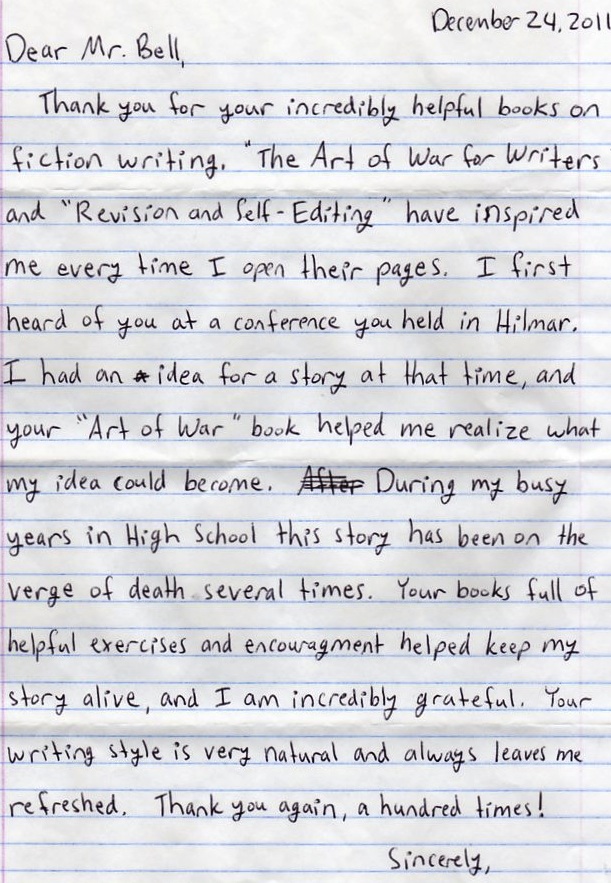
Last month I received a lovely handwritten letter from a high school student (reproduced here with the writer’s permission):


Dear Mr. Bell,

Thank you for your incredibly helpful books on fiction writing. “The Art of War for Writers” and “Revision and Self-Editing” have inspired me every time I open their pages. I first heard of you at a conference you held in Hilmar. I had an idea for a story at that time, and your “Art of War” book helped me realize what my idea could become. During my busy years in High School this story has been on the verge of death several times. Your books full of helpful exercises and encouragement helped me keep my story alive, and I am incredibly grateful. Your writing style is very natural and always leaves me refreshed. Thank you again, a hundred times!
Sincerely,

How gratifying to get a letter (written on actual paper!) from a young lady who wants to write. She had come to a seminar I held in central California, and apparently my books have helped her.
That, to me, is what writing is all about. If I had to pick one thing to explain why I do this, it would be that I want to move people with words. If it’s fiction, I want to create an intense emotional experience. If it’s non-fiction, I hope to instruct and entertain at the same time.
All other things – money, awards, “fame,” professional associations – are ancillary to this, because those things come only after you connect with enough readers, over time.
So:
1. Why do you write?
2. If you had to distill what writing is “all about” in a sentence, what would that be?

Soothing the Beast

I write this while listening to “Whipping Post” by The Allman Brothers Band, the live version that goes on for about three days from the At Fillmore East release. I need to hear music, in isolation, while I write. Such was not always the case. During the short time I lived in San Francisco, when I was less interested in writing and more interested in meeting new ladies, I used to carry a beat up spiral notebook down to Fisherman’sWharf, find an empty bench at Ghirardelli Square, and sit and write. Sooner or later, a winsome lass would approach and ask what I was doing, or, better yet, ask who I was (“Well, yes, actually, I amRichard Brautigan!”). This would no longer work, at least I don’t think so, and I don’t really want to upset the apple cart of my life to find out, so I eschew the coffee shops and the overpriced, trendy sandwich chain that offers free Wi-Fi in favor of the clutter of my basement office, where I blast my music as loud as I like.
I go on listening jags. It varies with my mood. The Allman Brothers Band disc a temporary swerve from Miles Davis. I’ve been listening to complete sessions of In a Silent Way and Bitches Brew, three to six hours of music at a stretch. If you think you’ve hit a wall with your writing, try listening to In a Silent Way, even if you don’t like jazz. I find that for some reason jazz music of a certain type opens up a corner of my mind that isn’t always accessible.  Before I got on the Miles jag, I listened to nothing but Guided by Voices for three weeks. In contrast to Davis’ extended pieces, GBV songs are anywhere from 35 seconds to three minutes long. In the last few months I’ve done this with Tom Waits, Black Keys, Fats Domino, Jimi Hendrix, and Kronos Quartet. I can’t write without it. On the other hand, if I’m disturbed by a phone call, a whiny cat, or news of a leaky or plugged up commode, my whole train of thought is derailed. Sometimes for the entire day. It’s not noise I seek, but noise of a certain type.
Some writers listen to music while they work. Others whistle. And others require a cone of absolute silence. Which are you? What works for you? And if it’s music that lures your muse into the room, what music?

Pure Coolness

By John Gilstrap


I’m writing this blog post on Sunday, January 15 knowing that when you read it, I will be in the middle of a very, very cool day.  Actually, a warm day, I hope.  In Las Vegas, where I’ll be signing books this morning at the 2012 SHOT Show.  According to the show’s website, www.shotshow.org, “The Shooting, Hunting, Outdoor Trade Show (SHOT Show) and Conference is the largest and most comprehensive trade show for all professionals involved with the shooting sports, hunting and law enforcement industries.  It is the world’s premier exposition of combined firearms, ammunition, law enforcement, cutlery, outdoor apparel, optics and related products and services.”  Last year, over 50,000 people attended.


I was invited to the show months ago by the nice people at 5.11 Tactical, a well-respected manufacturer of tactical apparel–the very kind of geat that Jonathan Grave wears as he charges through my imagination.  In fact, in preparation for the show, 5.11 tactical sent me a carton of gear, including shirt, pants, jacket and the best pair of boots I’ve ever worn.  I’ll be wearing the attire for the book signings and the press conference.


I’ve never enjoyed this kind of VIP treatment before, so I confess to being a little giddy.  Take a look at my official itinerary from yesterday:


6:30am — Firearms instructor will pick you up at the hotel
7:00am — arrive at range, setup/meet with range staff, gear check, etc.
7:00am-7:30am — Orientation, area familiarization, safety briefing, etc.
8:00am-11:00am — Firearms training
11:00am-12:00pm — Knife training
12:00 — depart back to hotel for lunch and classroom training
12:30-1:30 — Prefense Technologies — lecture, PowerPoint presentation, student interactive, etc.
1:30-2:15 — Prep for author panel
2:30-3:30 — Author Panel Press Conference, Venetian Murano Room 3306.

Really, how cool is that?  As I write this, I’m hoping that the knife training comes complete with either thick padding or fake knives.  You’ll know the answer, I suppose, if you see a post here next week.


Tally ho!

Handling the Crush

by Michelle Gagnon

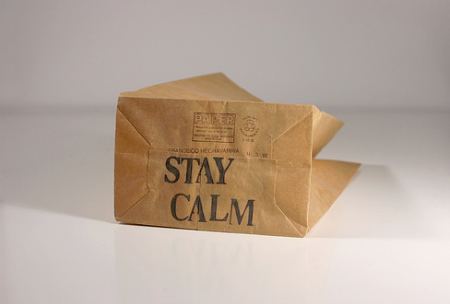
I’ll be keeping this short and sweet today, because as you can probably tell by the title of my post, I’m feeling overwhelmed. In fact, I had to drag myself away from the paper bag I was busy hyperventilating in to compose this post.

I finished a book yesterday, only to find out that the deadline for the next one is just a few months away. And I have yet to write the first page of that one (argh!)

Somewhere in there are two week-long school vacations and a slew of long weekends, plus the editing of the book I just turned in (which I suspect-no, know-will require a major overhaul), plus the line edits of a third book.

I realize that this might come across as ungrateful. Believe me when I say that I am incredibly thankful to be under contract at the moment, when so many other people are having a tough time. A year ago, I was worried about selling one more book, and I ended up with two contracts for four. So this is a classic example of be careful what you wish for. Because now, I’m utterly swamped.

On top of everything else, chances are that I’ll be selling my house, finding a new place to live, and moving there in the same four month time period. With a five year-old and a cantankerous cat (and of course, said cat makes finding a pet-friendly place in San Francisco even more of a challenge).

So I’m actively soliciting advice on how to manage all this without losing my proverbial marbles.
My question to you all is…how do you handle it when life comes at you all at once?

Release Day!

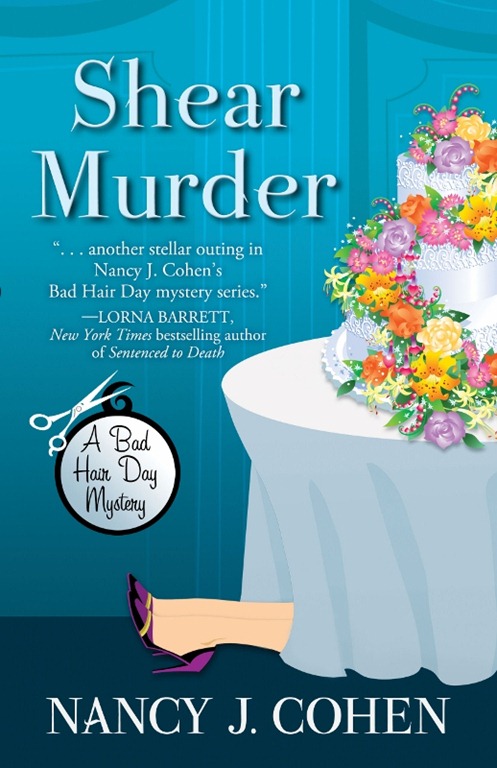
Today is the official release date for Shear Murder, my ShearMurder (518x800)tenth Bad Hair Day mystery, so you’re going to have to put up with my shameless self-promotion. That’s the trouble when we authors must toot our own horns. We get as tired of talking about Me as you do hearing about it. Lately I’ve been clogging the loops and social networks with my blog tour announcements. I want to make it worthwhile for my hosts by getting a crowd on days when I guest post. But it means I am constantly tweeting and FB’ing and listing my tour dates and topics. I sent out one email newsletter to my fans already and will send another blast next month on my book’s official sale date.            

What? You thought I said today was the release date? Indeed, I did. However, for this publisher, that means the books are shipped from the warehouses today. They’ll be ready in the bookstores on February 8, the actual “on sale” date. Confusing, isn’t it? It was a lot less so with my prior publisher, who just had one pub date. As it is now, I’m not sure which day to urge fans to buy the book. Does it really matter anymore?

Here are a couple of sample interview questions from my online blog tour:

Tell us about your latest book.

Shear Murder is the tenth book in my Bad Hair Day mystery series. It’s the culmination of a personal journey for my hairstylist sleuth, Marla Shore. It’s about weddings and new beginnings. Just when Marla is planning her own nuptials, she gets caught up in another murder investigation. Marla is a bridesmaid at her friend Jill’s wedding when she discovers the matron of honor—the bride’s sister— dead under the cake table. She has a lot going on in her life, but when Jill pleads for her help in solving the case, Marla can’t refuse. It’s a fast-paced tale with humor, romance, and suspense as Marla races to find the killer before her wedding day arrives.

Considering the book is a mystery, how much can you tell us about the antagonist?

Since the story is a whodunit, I can’t tell you much! Many people had reason to want Torrie, the matron of honor, dead. Torrie was the bride’s sister, and Jill had a secret past that Torrie threatened to expose. How far would Jill go to maintain her sister’s silence? Then again, Torrie’s colleagues each had their own reasons to want her out of their way.

Meanwhile, Torrie’s husband inherits a piece of property that Torrie had jointly owned with her sister. How badly does he need the money from a property sale? And speaking of commercial property, Jill’s uncle and cousin were involved in a shady real estate deal with the owner of Orchid Isle, where Jill’s wedding took place. Did Torrie learn too much about his secrets? And so on. As you can see, there are a number of suspects. You’ll have to read the story to figure out which one of them is the culprit.

What motivated you to write this story?
My books all have happy endings, and so I wanted to give my series one, too. Seriously, my fans wanted to know when the next Marla Shore mystery would be coming out, but my former publisher had cancelled the series. As the markets changed, I decided to finish this book and give my readers the closure they deserved. So I really wrote it as a response to fans and in gratitude for their support. I hope they are pleased with Shear Murder. It was a delight to write, and I had fun bringing back all the secondary characters we’ve grown to know and love. I am grateful to Five Star for getting this book in front of readers. So if you’re looking for a humorous mystery centered around weddings with a whodunit puzzle to solve, check it out.

Watch the Book Trailer
BUY NOW!

Muscling the Muse: Or Three Easy Steps for Talent on Demand

By: Kathleen Pickering http://www.kathleenpickering.com

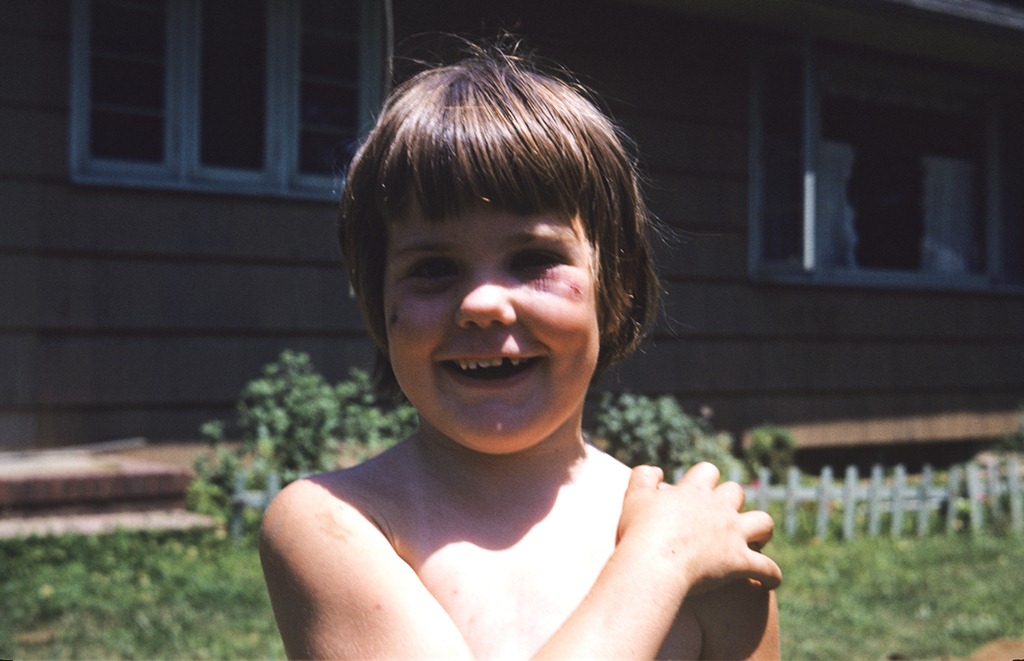
I was a sweet, but scrappy kid. Caught a couple of bruises along the way, but as you can see from the photo, whatever tangle caused the shiner, it wasn’t enough to get me down. I was quick to smile.

black eye

That’s how I feel about the writing process. You can’t let challenges get you down. I figure it this way: Writing is fifty percent talent, fifty percent Muse. Both need my undivided attention to stay strong. Every other obstacle will fall away with these two muscles pumped.

As stated above, talent for one’s vocation is a muscle that must be exercised. Otherwise, the gift atrophies. So, I write and write, and write some more. At different times, in different places or adhering to a schedule for a particular project. Whatever works. I do it.

There are talented individuals in  every field  who never realize their genius because they never exercise their gifts. Worse, some never know they possess unique skills at all. To that end, I highly encourage every thinking soul to explore what excites them. Always investigate topics that pique your interest. My mantra: Honor your passion. (Unless, of course, you are a terrorist or a serial killer. Then I suggest you seek help!)

My passions are writing and public speaking. These are the muscles I exercise. As we all know, the more we work our muscles, the more defined they become.

It is my sly little Muse, however, who until recently had me wrapped around her finger. For way too long I let her govern my work with her whims and fancies. Not any longer. When my editor asked for three more proposals, I realized I could not just wait for my Muse to wave her creative wand. She needed muscling.

So, you ask, how do you muscle your muse? I have three simple but important rules.  While they require determination, they are so easy that your Muse won’t even know she/he is being manipulated.

1. LOVE YOUR MUSE. You may say, of course I do! But keep in mind the self-critic can be cruel to our adventurous Muse. No matter what your talent, your individual creative view is unique to you. You have to respect that fact and let nothing damage your self-worth. It is your individuality that makes you one with the world. You might say, Not so. The world would carry on just fine without me. I say, the world might carry on if you were not to love and exercise your muse, but the world–and you–would sadly miss a profound part of creation. Otherwise, why are you here in the first place?

No one else sees the world quite as you do. It’s the Kurt Vonneguts, the Picassos, the daVincis, the Einsteins, the Maria Tallchiefs, the Luciano Pavarottis and Maria Callases, the Stephen Kings, The Kathleen Pickerings (just checking to see if you’re still reading) and YOU who make the world go ‘round.

All artists have their critics. They all have their admirers. Neither matters. You and only you matter to your Muse. If you don’t love what your Muse offers, you will not let him/her create. Your talent will atrophy and you will wonder why you have become a sarcastic and bitter being rather than a shining light.

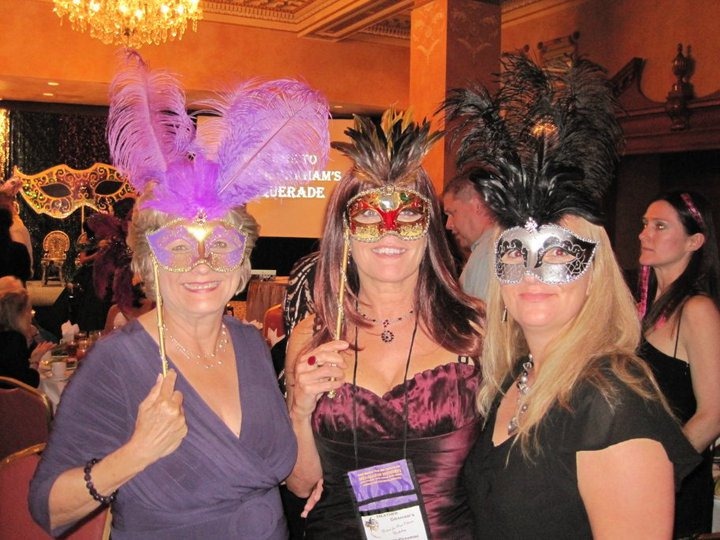
writersforneworleans-2010At Heather Graham’s Writers for New Orleans conference with authors Linda Conrad and Traci Hall.

2. FEED YOUR MUSE. Now that she/he is loving you back, you must feed your Muse. What others call writer’s block, I call a poor diet for the Imagination. The Muse needs exposure to everything delectable—and sometimes things not so tasty in life. That means your Muse accompanies you on your travels. Let her be the finger that taps the keyboard or opens the books on your research. Let your Muse listen in on conversations and initiate a few of her own. Then Listen. Watch. Smell. Touch. Devour. Your Muse will not disappoint you. With love and food, your Muse will be generous in return. You might even get a belch for a good laugh out of the deal. That works, too!

3. LET YOUR MUSE FLY. Muses are flighty creatures. They may burrow. They may forage. But, once they feel safe, they fly. Your job as an artistic soul is to give your Muse the updraft, the cliff’s end, the launch pad to soar. Your Muse may create unusable material at first, but the more he/she exercises the muscles in those wings, the more beautiful the magic dust that will alight from them. Don’t be afraid. (Fear is an awful four letter word that shall not be used.) Love your Muse enough to let him/her take a chance, test an idea. Create. A Muse’s wings may be as delicate as a dragon fly’s or as powerful as an eagle’s. Only by launching from that artistic limb of “what if” will you know which wings your Muse possesses. Think of the freedom!

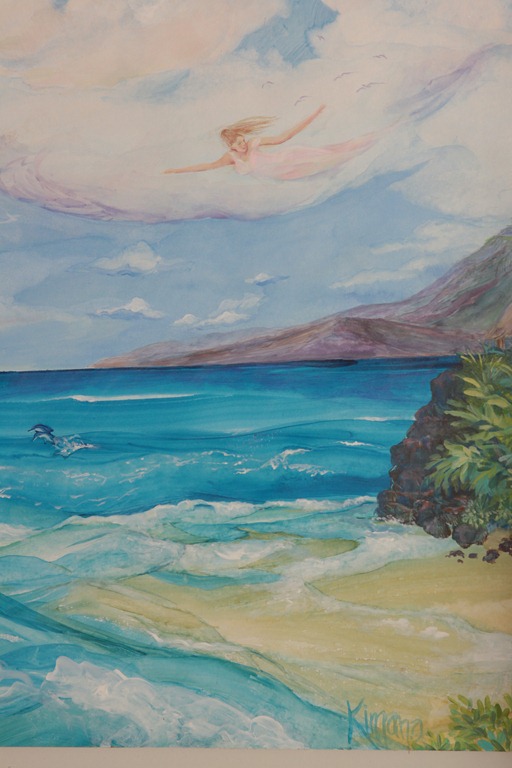
dreaming aMy artist friend, Kimana Evans, once asked me how I see my myself. I told her that in my dreams I fly. She gifted me with this wonderful water color of me . . . or shall I say, my Muse. (Can you see me flying in the clouds?) I love this artistic expression created by my friend. This painting hangs where I write. It reminds me of my passion, talents and Muse every day.

I’d say I’ve come a long way from that scrappy kid with the shiner! I may have had to muscle my way into a foothold in my creative world, but I have certainly carved out my ground. I know that by honoring my talent and adhering to the rules for my Muse, I will create the impression that I was born to make. So far, the journey has been exciting, challenging and way too much fun to be called work. I am a grateful woman.

So, tell me. What do you do to keep your talent fresh and your Muse loved, fed and flying?

Happy Writing or whatever your talent may be!

PS: By the way, Kimana would be happy to create a painting for you, as well. You can find her on Facebook: www.facebook.com/people/KimanaEvans/ Tell her I sent you.