by Clare Langley-Hawthorne

by Clare Langley-Hawthorne
It seems pretty obvious Vampires take up more than their fair share of resources, don’t you think?
Stay tuned for upcoming guest appearances at the Kill Zone:
By John Ramsey Miller
I am sitting in my writing studio, a converted feed shed I renovated, and I was looking out the double-pane window at my long driveway through a thick fog, and listening to one of my dogs on the porch chewing a ham bone and gentle rain pattering on the roof. As I peered down my driveway, I saw a deer silently move from the tree line and stand on the gravel. She turned her head as though she could see me and stayed frozen for a few minutes, and the dogs (I have three) never knew she was there. She decided (maybe she smelled the dogs) to stamp her front feet, which got my dogs’ attention and they began running toward her, blasting her with a cacophony of uttered threats and promises. As they approach the three ribbons of electric wire that encloses three acres, they stopped. I watched her reaction, which was to stand and stare at the approaching animals. Somehow she knew they would or could not cross the wire to make good on their threats, and I knew she somehow intuited this. But how? After a few minutes, she walked into the trees, and they lost interest and returned to the porch. I wonder how many times this has happened when I was not watching, and I thought about all the times my dogs seemed to be at the fence barking to beat the band, and I had no idea what they saw or heard that had them there. Now, after watching this, I will assume it is the same doe once again playing with the dogs for her own amusement. I know animals do things for their own amusement. My Australian Shepherd does not chase balls I throw for my Labradoodle to retrieve, but he will chase the Labradoodle down and hold him by the scruff of his neck, or by his tail, to keep him from getting to the thrown ball. This has to be because it amuses the shepherd, and because he knows that his holding action frustrates his playmate.
We writers are observers and we record our observations and add our own spins to what we see and hear. At the moment I am concocting a story of some length. My novel begins with a man and his dog on a boat. In this tale, my protagonist is propelled unwillingly and unknowingly into a conspiracy involving very powerful men and women. In the opening chapters he is visited by four men in search of something my protagonist has that they want and something they have come to retrieve. They also plan to kill him, a man they have never met and to their misfortune underestimate. In the first few scenes a secretary of state is assassinated, and the connection to that event and the man are as unknown to the reader, as to the man. The visitors shoot the dog, and my dilemma was whether or not to let the dog die trying to protect someone he cares about. I thought about this for weeks as I went about my daily routine, and I finally decided the dog’s instincts, loyalty, and nobility had to be rewarded, so I let him live. It wasn’t because some readers freak when we kill animals, but because I liked the creature I created based on my experiences with my own animals. Like the animal who is mismatched by professional gunmen, so too is my protagonist, who is an older man with no knowledge of, or use for high tech understanding. That old man is me to some extent, but he has neither phone (cell or land-line) much less a computer. Retired from the military, and estranged from his family due to his life choices, he spends his days fishing the lakes near Therio, Louisiana, and minding his own business, surrounded by neighbors who do not know him, but admire him for his qualities. He is the man I wish I could be, and I write him knowing that I fall miles short of him. But he is a man of integrity who is called on to face enemies he is inferior to (skill wise), but superior to morally speaking. He is a man with violence in his history, with right on his side, and who doesn’t have a chance as far as the reader knows. I’m having a blast writing him, and his enemies, who come to respect him even though they want nothing but to kill him and retrieve something he has been given. I think it’s the best story I’ve ever stumbled into, but others may disagree.
The creative process is so difficult on so many levels, but nothing is more rewarding when the process bears fruit, or more frustrating when it fails. Each time I sit down at this black box to start a new story I don’t have any idea whether or not I will be able do it all over again. So far I’ve been lucky, and hopefully the quest will only end when I am no longer able to sit here and think and dream. We talk about marketing, and building an audience, so we can be successful by the ways that are measurable, but what this is really about is the battle between us and filling the blank page.
One of these days I will write the doe I saw, and of her playing with the dogs, her sworn enemies. I will know when I need her and she will serve to make a point, and advance the story I’m wrestling with. I will continue to write characters with traits I wish I possessed and putting them through paces I can only imagine while I’m sitting at this laptop or gathering eggs or playing with my wonderful and complicated grandchildren. I hope someday those grandchildren will read my books and see something of the best of me in the pages they turn, and feel the awe and excitement I feel for my characters. To me, that hope is far more important than the checks that come in the mail, what my editor or publisher thinks, or just about anything else my overtaxed mind can imagine through the fog.
By John Gilstrap
http://www.johngilstrap.com
Before getting to this week’s real topic, I thought I’d preen with a bit of shameless self promotion. A while ago, I revealed that I had optioned the film rights to my nonfiction bestseller Six Minutes to Freedom. I can now announce officially that I have signed on to write the screenplay as well. Hoorah! For details, please visit my website (see above). I am thrilled beyond belief.
We now return you to our originally scheduled blog . . .
I was chatting the other day with a writer-in-waiting who was distraught that “no agent wants to represent me.” Ah, the angst. She moaned, “I’m never going to be published.”
At that point, she’d collected 7 rejections. Seven. As in one less than eight. And they’re just cold-hearted form letters to boot. Can you imagine? Oh, please.
I wager most of us have a collection of blistering rejection stories. My favorite of the 27 rejections I accumulated before I finally landed an agent was the New York publisher whose rejection consisted of my own letter sent back to me with a stamp—you know, one of those rubber things that you pound on an ink pad—that said “No.” As if it would have broken her hand to actually hand write those two words.
Okay, I have another favorite, too: the one who sent me my rejection letter two months after my book had been published.
Rejections are a constant in this business. I know more than a few authors whose rejections numbered in the triple-digits before they finally made a connection. It’s just the way it is.
During this rejection stage, you often hear dejected writers complain, “Nobody wants my book.” Self pity aside, such is never the case. Nobody’s rejecting your book; they couldn’t possibly be. That’s because nobody’s seen your book. They’re rejecting your query.
In my experience, the vast majority of query letters suck.
They’re flat, lifeless bits of business correspondence that get lost in the shuffle of the hundreds of other bits of flat, lifeless business correspondence that litter an agent’s desk or email inbox every day. It’s astonishing, really, when you think that after spending months or years crafting a novel, a writer would quickly pound out a query letter and launch it into the world where creativity and originality of voice means everything.
At the moment when a query letter matters, it is the most important document of your creative life. It’s the only tool you have. It needs to be carefully nurtured. Carefully crafted. If you’re interested, I wrote an essay on query letters a few years ago. You can read it here: http://www.johngilstrap.com/essayqueryletter.html .
What about you? Have you got any inspiring (or frightening) rejection stories you’d like to share? C’mon, spill. We’re all friends here.
At Left Coast Crime a few weeks ago, I was part of a great panel on utilizing the Internet to market your book. This is a bit of a double-edged sword: now that much of the marketing burden falls on authors’ shoulders, being able to reach people without an insanely expensive direct mailing is invaluable. However, online networking can also become a tremendous time suck, drawing valuable hours away from what writers should primarily focus on: their manuscripts. Today I’ll discuss which sites I’ve found most valuable in a head-to-head match up, as well as sharing how I stay on top of them without losing my mind.
I confess to being one of the “old people who joined up and ruined Facebook.” I now have more than a thousand friends, and probably post something to the page once or twice a week. I’m also on MySpace, but have found Facebook to be far more user-friendly to someone as technologically challenged as myself. (However, if I was working on a YA novel, MySpace would probably be where I devoted more of my focus). A couple of things to bear in mind when using these or other social networking sites:
Shelfari vs. GoodReads
The trick to these is joining groups that read books similar to yours. I’ve generally found Shelfari to be more useful, although I do get updates from GoodReads discussions as well. The Shelfari groups just seem to more active, especially the “Suspense/Thrillers” one, which graciously invited me to lead a discussion of Boneyard last August. Every so often I’ll remember to log in and update my home page with the books I’ve read recently.
I’m not a big tweeter. I post links to my Kill Zone posts (and guest posts,) and occasionally link to articles or posts that I found interesting, but I simply don’t have time to announce what I had for lunch every day.
I know other crime fiction authors love Crimespace, but I haven’t used it much. Most of the Ning circles (and I’m part of five) don’t seem very active to me. This could be my own failing- I find them challenging to navigate, and frankly my other pages are so easier I forget about these. Same goes for Gather, Bebo, Linked In, etc. You might have better luck. If you write books with a Siamese Cat sleuth, and there’s a Siamese cat appreciation group on one of the social networks, by all means take advantage.
Newsletters:
I have a pet peeve. Say we met at a conference and chatted about marketing. I offered to continue the discussion by email. Then, I find myself getting a deluge of newsletters from you, none of which I signed up for. Or worse yet, you mined my email address from a mass email sent by a mutual friend (note: always bcc people on those emails). This has happened to me more times than I can count. DO NOT add people to your newsletter unless they have specifically asked to be included. Have a sign up sheet on your website, and make it easy for people to unsubscribe.
And that’s my two cents. So what have the rest of you found to be useful? Any tips to share?
By Joe Moore
Don’t get me wrong. I believe that the only rule we should apply to writing fiction is: There are no rules; do whatever you want as long as it works. Okay, if you pressed me to the wall, I would have to add two others: don’t bore the reader, and don’t confuse them.
When I speak of fiction writing “rules”, I don’t mean the basics of spelling, grammar, punctuation, syntax, split infinitives, daggling participles, and the other stuff we learned in school. As artists, let’s move beyond the assumed knowledge and manipulation of the English language to the aesthetics of writing. The rules that apply to the art of storytelling.
When dealing with the art of storytelling, the great Kurt Vonnegut declared 8 rules to write by. If it makes you feel better, let’s call them suggestions. But we should all take them to heart because they go directly to the heart of telling a compelling story.
Here they are:
1. Use the time of a total stranger in such a way that he or she will not feel the time was wasted.
The reader’s time is not only valuable, it’s sacred. There are a million other things demanding his or her attention. We should repeat that every time we sit down to write.
2. Give the reader at least one character he or she can root for.
The worst reaction that a reader can have is that they don’t care if the protagonist makes it or not. Let the hero or heroine see the goal line, then put a big wall in their way and hope the reader cheers for them to climb over it.
3. Every character should want something, even if it is only a glass of water.
This goes for all characters from the main stars right down to the single-scene walk-on.
4. Every sentence must do one of two things — reveal character or advance the action.
If it doesn’t, delete.
5. Start as close to the end as possible.
This is my all time favorite rule to write by. Whether it’s a scene, chapter, or the entire book, get to the point. Anything that happens before that, delete.
6. Be a sadist. No matter how sweet and innocent your leading characters, make awful things happen to them — in order that the reader may see what they are made of.
Our characters are judged by their actions and reactions. Have them work for it.
7. Write to please just one person. If you open a window and make love to the world, so to speak, your story will get pneumonia.
Picture the typical fan that comes to your book signings. That’s who you’re writing to.
8. Give your readers as much information as possible as soon as possible. To heck with suspense. Readers should have such complete understanding of what is going on, where and why, that they could finish the story themselves, should cockroaches eat the last few pages.
This one sounds contradictory at first. But it’s not. It’s just another way of saying, cut the fat and get to the meat.
No one wants to slap a set of rules on creativity. And I don’t think Mr. Vonnegut meant to do so. But he called them rules because he wanted writers to pay attention. He wanted all of us to become better artisans. Read them each time you start to write. And when you finish for the day, read them again.
How about you? Do you follow his rules? Do you have others that help you in advancing your craft?
This particular story jumped in and out of the point of view of two characters within the confines of a two-person scene. On first reading, nothing seemed really wrong with the scene; I had to reread it several times to figure out why it lacked suspense and kept the reader at a distance. I finally decided that the real problem with the scene was its POV. In other words, there was way too much head-jumping going on.
So here’s a general guideline to help you avoid a POV trap:
Use only one POV per chapter or section (Sections separated by asterisks or a space).
The story we were reading in group had a POV that shifted between paragraphs (aka omniscient POV). That constant shifting created a confusing overall effect. I think it may be possible to present POV this way, but it probably takes an extremely skilled writer to pull it off. So why even play with POV fire?
by Clare Langley-Hawthorne
http://www.clarelangleyhawthorne.com/
Today the Kill Zone blog welcomes our guest, award-winning author Neil Plakcy. Neil is the author of Mahu, just re-released in trade paperback by Alyson Books, and its two sequels, Mahu Surfer and Mahu Fire, which won the Hawaii Five-O award for best police procedural, and is a finalist for the Lambda award for best gay men’s mystery. His fourth book, Mahu Vice, comes out August 2009. Neil is the Vice President of the Mystery Writers of America, Florida chapter.
A few years ago, as he was getting his breakout novel Mystic River ready for publication, Dennis Lehane spoke at the Miami Book Fair. He’d just published the fifth Patrick and Angie book, Prayers for Rain, and he said that he’d put them through so much that they had just stopped talking to him. He thought he’d give them a break and write something else.
That idea really resonated with me, and I started to think about all the other fictional detectives, and their families and friends, who’d been put through the wringer a few times. In Les Standiford’s Deal series, Deal’s wife Janice leaves him after she’s been kidnapped, nearly drowned, and who knows what else.
The king of putting a character through hell, as far as I’m concerned, is John Morgan Wilson. Poor Benjamin Justice has lost his job and his reputation, been raped, infected with HIV, and had his eye put out. Just thinking of all that stuff makes me shiver. My hero, Honolulu homicide detective Kimo Kanapa’aka, is my alter ego, and I can’t imagine putting him through so much—it’d kill me, if it didn’t kill him!
Not to mention the complications you set for yourself, as a writer, when you make such a major change to a character. If you shoot your protagonist in book one, then the effects of that shooting are going to resonate for a while. Kill off a girlfriend or fiancée, as they used to do regularly in the James Bond movies, and your hero’s got to get a little shy of entering a new relationship. Zoe Sharp’s Second Shot begins with Charlie Fox getting shot—and the effects of that shooting resonate through not only that book, but Third Strike, the book that follows, as well.
The same goes for the supporting players. Kimo’s best gal pal since high school, Terri, loses her husband in Mahu, the first book in my series. And then, in Mahu Surfer, the poor thing ends up in a firefight at her uncle’s house. In an early draft of the third book, Mahu Fire, I put her on the mountainside among the others Kimo needs to rescue.
Then I stepped back. How could I do that to her? And more important, would she ever talk to Kimo again after being traumatized in three books? I believe in recycling characters—but I knew that I couldn’t keep putting Terri in jeopardy, or she just wouldn’t remain a convincing character.
When I was in graduate school at FIU, our teachers, including Les Standiford and James W. Hall, reinforced to us that what happened in our books had to matter to our characters. It wasn’t enough for a detective to investigate a case; he had to have a personal stake. In Mahu, Kimo was fighting to restore his reputation at the Honolulu Police Department, and then in Mahu Surfer, he struggled to prove that he could be as good as any cop on the force, if given the chance. I added an extra bounce by bringing in an old nemesis and then putting his close friend at risk.
As I’ve written more books, it’s getting harder to find that personal connection for Kimo, without incurring what I think of as the Cabot Cove Syndrome. I used to wonder why anyone would associate with Jessica Fletcher, since her neighbors, friends and colleagues died so regularly. How much could Kimo’s friends and family take before they would get the hell away from him? And how to avoid the coincidence factor? Fortunately I write about an island, where there are lots of personal connections, where the cops either grew up with the crooks or are related to them, but it’s still important to maintain credibility.
In Mahu Fire, I brought back a sympathetic teenager from Mahu, who’d gone through some hard times, and made things even tougher for him. I teamed him up with a new character I hoped readers would care about. People care about kids, right? And then in Mahu Vice, which is coming out this August, I threw Kimo’s gay pal Gunter into danger, along with Kimo’s troublemaking brother-in-law.
But I try and remember, especially with these supporting characters, that they are civilians, not police officers, and then when they go through trauma, it’s going to take them a while to recover. Kimo’s a tougher guy; by the time we meet him in Mahu, he’s been a cop for nearly six years, three of those as a detective. He’s still got a soft heart, but his skin has been toughened by what he has seen and experienced on the street.
I’ve been shaking up his personal life, though, moving him in and out of romance, but to me that’s all part of his emotional growth and development. Getting dumped isn’t quite as life-threatening as getting shot at, but it’s still pretty painful.
For now, Kimo and his friends and family keep talking to me. Maybe some day, like Patrick Kenzie and Angie Gennaro did with Dennis Lehane, he’ll stop. But for now I’ll keep on throwing him curve balls and seeing how he, and his loved ones, react.
~~~~~~~~~~~~~~~~~~~~~~~~~~~~~
CALENDAR OF UPCOMING GUESTS
Mark your calendar for the following guest blogger at the Kill Zone:
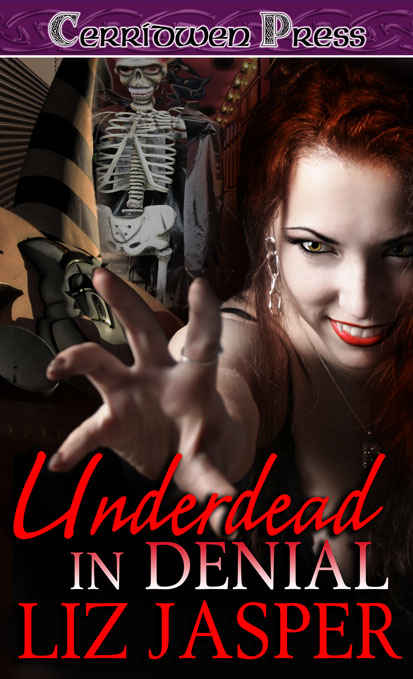
Liz Jasper, March 29
By John Ramsey Miller
I have been guilty of having the smell, or swirling of, Cordite in the air after gun play. The other night watching TV I heard one of the techs on CSI (someplace or other) saying that she smelled Cordite in a room, which is more than unlikely since Cordite hasn’t been around since WWII. There is no Cordite whatsoever in modern ammunition. With modern ammo you can smell the pungent Nitroglycerin after firing. Modern powder is basically sawdust soaked in nitro coated with graphite. In very simple terms, the shape and coatings control the burn rates. Of course, you won’t get any smell when using air guns (for the best ones click to read the review here) but with real guns, there’s definitely a smell.
To smell Cordite you’d have to have people firing very old ammunition. According to a quick check under Cordite on Wikipedia: “The smell of Cordite is referenced erroneously in fiction to indicate the recent firing of weapons.” So from now on, unless I am writing a period piece, it will be “The pungent smell of nitroglycerin, sawdust, and graphite swirling in the air.” Or I’ll just say, “the smell of gunpowder.”
We’ve discussed accuracy in fiction here before, and maybe it’s worth a second go-round. There are more mistakes made about guns than most other subjects in modern fiction. Maybe that has to do with the fact that the majority of authors are not gun familiar, or comfortable with guns. When it comes to guns, I don’t know everything about them, but I do know enough to safely handle Airsoft Guns all of my adult life. I am hardly an expert on the subject, but I know several (Scotty Boggs, Jason Parr, and Gary Reeder) and never hesitate to ask them for technical advice.
Modern gunpowder is slow burning and non-explosive until it is put into a confined space to allow compression and a spark is introduced by a primer. If you put black powder into an ashtray and put a cigarette in there, your fingers will throb for a very long time and the blackening will be burned into the skin. It explodes without being compressed when a spark is introduced, or rather it burns so fast it seems to explode. John Gilstrap can write here about explosions as he is an expert in energetic materials. When I was in college I put a cigarette into an ashtray I’d poured black powder into.
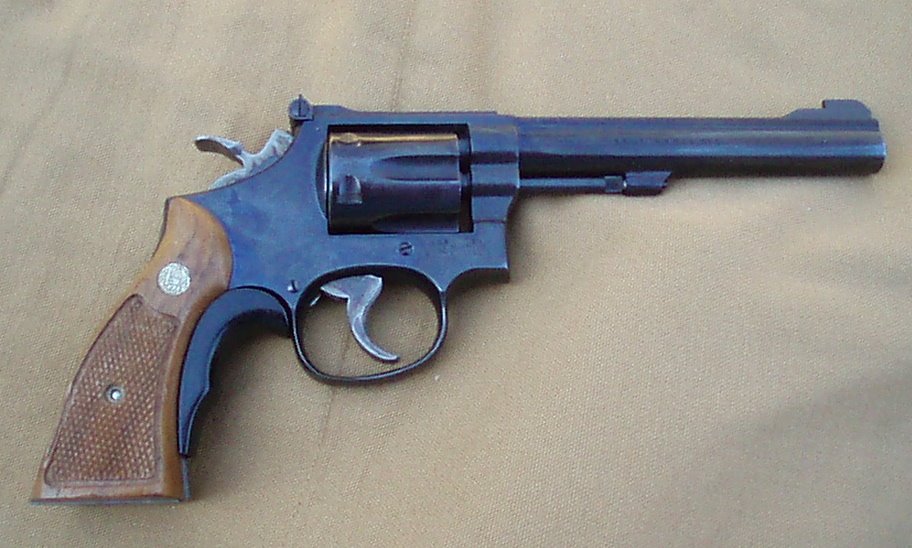
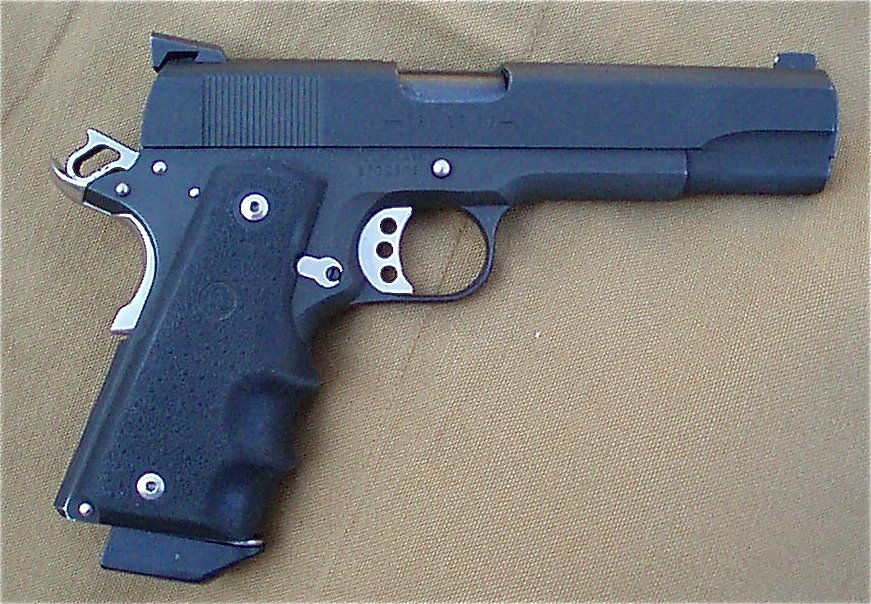
Here I present a few basics, and probably as much information as an author really needs to know to keep gun owners from laughing out loud and maybe never reading that author’s books again. The two handguns depicted below are my own: the revolver is a Smith & Wesson K-22 Model 17 in .22, and the semi-automatic is a Colt 1911 Model 80 in .45 ACP.
REVOLVERS are guns with cylinders that turn (clockwise or counter-clockwise depending on the manufacturer, model, and date issued) to allow a new bullet to present itself before the firing pin in its turn before the barrel. They are also called “Wheel” guns, and may or may not have an exposed hammer. Some hammers are shrouded so the hammer won’t get caught on clothing. They will hold from five to nine rounds depending on caliber and model. Revolvers do not usually have safeties. Not being cocked and/or not having the trigger pulled back is the revolver’s sole safety method. Older guns may be fired if the hammer is struck by force and the firing pin hits the shell’s primer. That is why most cowboys carried the cylinder under the hammer empty. Modern revolvers have a block between the pin and the primer unless the trigger depressed when the hammer falls. There are two types of revolver: the DA, for double action and the SA, for single action. With an SA you have to cock the hammer to move the cylinder (think cowboy gun) or the DA, whose cylinder turns as you squeeze the trigger, or when you cock the hammer.
A SEMI-AUTOMATIC handgun has no cylinder, but is fed cartridges (bullets are the nose of a cartridge) from a magazine (housed in the handle), which holds the cartridges in a stack under pressure from the spring. As each bullet is fired, the receiver slides back from the pressure of the explosion and the extractor grabs the rim of the casing to pull it from the chamber, and flip it out to the right. (There are a few left-handed 1911s whose casings flip to the left). The receiver then moves forward under spring tension and, as it goes, it pushes the next cartridge in the magazine into the chamber and leaves the hammer (or striker assembly in the Glock) cocked for the next trigger pull.
All handguns have some safety mechanism. Some have magazine disconnects (won’t fire without at least an empty clip in place) or some firing pin block (to prevent firing when dropped) is usually incorporated. Most semi-automatics have one or more safeties, and some have none to speak of except a lack of trigger pull. A Colt 1911 (They come in several calibers including .45 ACP, .38 Super. 9MM, and .22 LR) has several including a thumb safety, a grip-strap safety, and on some a half-cock, and one that involves pushing back the receiver a fraction of an inch to prevent it from firing. The latter would be a last ditch to keep the gun from going off, and if you miscalculate and the gunman is lucky, the bullet will pass through your palm. When semi’s last bullet is fired and its case ejected, the receiver locks open to let the user know the weapon is out of ammunition. Slap in a mag, release the receiver, and there’s a new round in the chamber.
You will hear over and over that “Glocks do not have safeties.” But they do. Glocks do not have “external” safeties, but they have the two-part “safe-trigger” which actually is a safety. On a Glock the “Striker” (no internal hammer) is half cocked by the first 1/4″ of slide retraction while chambering a cartridge. The other “half-cocking” of the striker is the first stage take up of the trigger pull. On a Glock you get ONE SNAP, then you have to jack the slide resetting the half cock on the striker to have another snap. With some practice you can only pull the slide back just enough to reset the action without ejecting the “dud” round for another try. Interesting isn’t it? There may be exceptions to what I’ve written, but I think it is accurate enough to get a writer around in a shootout. And probably more than most of you want to know.
A cartridge is made up of four parts: Casing, Bullet, Primer, and Gunpowder. The bullet is the projectile that is seated in the casing, but the cartridge is never accurately called a bullet. A shotgun round is referred to as a shell. A shotgun shell (or round) that has been fired is often called a hull. A shotgun shell holds either pellets or a single slug.
A magazine can hold as many rounds as its length and width accommodates. Some mags hold bullets in a straight line and some are wider to allow staggered rounds. Low capacity factory magazines hold from six to eight rounds. You can keep one on the chamber to add an additional round to the gun’s capacity. Hi-capacity magazines hold more shells than a standard mag. I have had fifteen round mags, and some handgun magazines hold twenty or even thirty rounds. Some handgun drum magazines hold more …a lot more.
A magazine can be called a clip. In the military a rifle or machine gun has a Magazine, handguns can have clips. People rarely say clip any more but it was once common to call any magazine a clip. There are clips that hold .45 ACPs in a half moon for use in .45 LC revolvers, and to shoot 9MM rounds in a 38, but they are rare enough that an author shouldn’t need to concern themselves with those.
There’s lots more to know like available calibers, shotgun gauges, How a barrel length’s effects powder burn and velocity, range, knock-down values, recoil, and trajectory. There are enough bullet types and weights to fill several books. And every author who writes weapons should buy a copy of Gun Digest so they can read about and look at the weapons they write about. Write it off as reference material. Get the latest one you can find because they add new gun models yearly, but anything in the past ten years is plenty for most applications. Any bookseller has them and EBay has lots of them used. Here’s the link:
http://shop.ebay.com/?_from=R40&_trksid=m38&_nkw=Gun+Digest&_sacat=See-All-Categories
You can study guns for the rest of your life, but the truth is, authors don’t need to know very much to keep from writing someone shoving a clip into a revolver, playing Russian Roulette with a Glock, or just writing convincingly about what a character has in their hand, handbag, or holster, or how that gun works.