Beware the Clunky Plot Device

by Michelle Gagnon

So I’m reading a fairly well-known book right now, and hit a passage that almost caused me to stop reading.

The heroine is fleeing a pursuer barefoot. She narrowly escapes, making it to her car. Just when I was starting to worry for her pedicure, the author explains that, thankfully, she keeps an extra pair of shoes on hand for just this sort of situation (since, apparently, barefoot pursuits happen regularly in her day-to-day life). So she will be spared the embarassment of running unshod throughout the remainder of the storyline a la John McClane in Die Hard.

Really?!

This is something that happens all too frequently: the clunky plot device. I understand that there are times when as a writer you need a cell phone to go dead, or to drop a call. And now that I’m a proud AT&T customer, I’ll admit that it actually does happen with alarming frequency- I experience more dropped calls now then in 1997, frankly. (Love the iPhone. Hate the network).

But must it always happen at a critical juncture?

Okay, I get it: particularly in our genre, plot devices are a bit of a necessary evil. Heck, I’ll confess to utilizing some of these zingers myself: dropped calls, failed radio transmissions, the works. Sometimes you need your hero/heroine to be unable to call for help. Sometimes you need them to be shod in suitable footwear. I actually don’t always mind these devices, but for God’s sake, please give me something. Say that the heroine remembered that her gym bag was in the backseat, with a pair of sneakers inside. There, now you’ve given me a reason to buy into what you’re selling. But just an extra pair of shoes? That’s laziness, plain and simple.

Other irritating devices:

* An object that the hero just happens to have in their possession, which ends up saving his/her life. A Bible in the shirt pocket that stops a bullet, for example.

* The hero escapes imminent danger, but then stops to hang out somewhere absurdly close to where he/she was just in peril. This usually results in the hero narrowly escaping death…again…only to have the exact same thing occur pages later. I call this the, “Will they never learn/for God’s sake, keep moving!” plot device.

* “It was all just a dream!” ‘Nuff said.

* Along with the inconveniently dropped call/ dead cell phone, I submit its benevolent twin, the perfectly-timed call that either saves the hero’s life, or provides him/her with a critical piece of information that advances the story.

* An adjunct to the perfectly-timed call is the extraordinarily convenient event that no one could ever predict, which ends up saving the hero ie: a flock of birds suddenly distracting the killer. Or a car passing by at just the right moment. Or a gun materializing within hand’s reach for no good reason.

* The hero ignoring a perfectly good escape route, only to choose a far more difficult path that is fraught with bad guys/demons/molten lava.

Do plot devices bother you? And which do you hold particular esteem or contempt for?
Look who’s talking

By Joe Moore

I’m in a mentoring program helping unpublished writers tighten up their work and get it ready for submission. I also visit a few writers’ forums each week and contribute my two cents to the basic questions from writers just starting out. One of the topics that comes up often is narrative voice. So here are a few of my thoughts on the subject.

scream Although dialogue plays a critical role in fiction, having a story told completely with dialogue would be out of the ordinary if not downright creepy. No matter how many characters there are in a typical novel, there’s one that’s always there but is rarely thought of by the reader—the narrator. Sort of like the referee at a football game, the narrator’s job is to impart necessary information and, in general, keep order. Someone has to tell us about stuff like the time of day, the weather, the setting, physical descriptions, and the other things that the characters either don’t have time to tell us about or don’t know.

And just like the characters, the narrator—the author—has a voice or persona. Some authors like to be a part of the story and make themselves know through a distinct personality and attitude. Others prefer to remain distant and aloof, or completely transparent. One of the main things that determine the narrator’s voice is point of view.

Most stories are written in either first- or third-person. If it’s first-person, it’s usually subjective. Subjective POV tells the reader all the intimate details of the narrator—her thoughts, emotions, and reactions to what’s going on around her. There’s also first-person objective. This story technique tells us about what everyone did and said, but without any personal commentary. First-person narration is all about “I”. I read the book. I took a walk. I fell in love.

In between first- and third-person is a rare POV called second-person. You don’t see this technique used much, and when you do, it’s about as pleasant as standing in line for hours at the DMV. Second-person narration is all about “you”. You read the book. You took a walk. You fell in love.

Next comes third-person. There are a couple of third-person types starting with limited. As the term implies, this is a story technique told from a limited POV. It usually involves internal thoughts and feelings, and is the most popular narration style in commercial fiction.

We can also use third-person objective. The narrator tells the story with no emotional involvement or opinion. This is the transparent technique mentioned earlier. The interesting advantage of third-person objective is that the reader tends to inject more of his or her emotions into the story since the narrator does not.

Then there’s third-person omniscient. With this POV, the narrator pulls the camera back to see the bigger picture. He is god-like in his knowledge of everyone and everything. This POV works well when dealing with sweeping epic adventures that might span numerous generations or time periods. Unlike first-person subjective which is up close and intimate, third-person omniscient is distant, impersonal, and sometimes cold. The reader has to use his imagination more when it comes to emotions because there’s no one to help him along. Third-person narration is all about “he, she and they”. He read the book. She took a walk. They fell in love.

The other key element in determining narration and voice is verb tense. Most stories use the past tense. This is what most readers are comfortable with. The opposite of this would be the incredibly annoying and almost unreadable second-person present tense. If you’re interested in experimental, artsy writing and want to use this technique, make sure you’re independently wealthy first.

So who does the talking in your books? Does your narrator’s voice seem warm and fuzzy, cleaver and funny, or cold and distant? Do you stick with the norm of third-person past tense or do you like to venture into uncharted territory? And what type of narration do you enjoy reading?

A book that changed your life

By Kathryn Lilley

Last weekend I heard a great program on This American Life called “The Book That Changed Your Life.”

It reminded me of a recent discovery I made: I learned that a book I gave to a friend 30 years ago had actually changed his life.

Thirty years ago, I was 23 and newly graduated from Columbia Journalism School. He was 22, and a charming slacker. We dated just long enough for me to conclude that he had a serious pot habit (I was naive about drugs 30 years ago, and slow to catch on).
As our relationship hit the rocks, I gave him a copy of a book I was reading at the time, The Republic. I marked up passages that I thought applied to him. I don’t recall which ones they were–probably the sections that described Plato’s concept of a well-ordered society. I’m sure it was a bit of a reproachful gift, a pseudo-intellectual parting shot.

Recently I received a long, thoughtful email from my former friend. It was a thank you note. He said The Republic had had a huge impact on his life; he credited it with helping him give up drugs and recalibrate his approach to life. He’s now a successful businessman.

It’s hard to believe that one book was responsible for all that, but I was glad to hear his story.

I can’t think of any books that changed my life in such a profound way (I do recall faking a southern accent for an entire year after reading Gone With the Wind, and another year of nightmares after reading When Worlds Collide, but those don’t count).

How about you. Have any books changed your life?

Pirates of the Web

by Clare Langley-Hawthorne

Yesterday’s New York Times ran an article entitled “Will Books Be Napsterized” and I have to confess it felt as though yet another nail was being hammered into the coffin of traditional publishing. Although I’m not at all the kind of person to a) become neurotic about the whole thing or b) don a placard proclaiming the end of the world is nigh (hold it, I’m an author, I’m exactly that kind of person!), recent articles about the digital piracy issue still give me pause.

According to this article there are currently 166 copies of Dan Brown’s The Lost Symbol available free on the web – 102 of these copies attributable to one file sharing site alone (RapidShare). Now I’m all for authors promoting free content on the web and encouraging new readers but only when the writers and publishers get a chance to actually authorize this to occur. Although Dan Brown’s book is clearly still selling strong in both traditional and e-book format, you have to wonder what the impact of digital piracy will be in 3 or 5 years from now when e-books account for a much greater proportion of the market. Illegal file sharing could then significantly impact even a bestseller like Brown – but imagine the impact on smaller publishers and authors alike. It could be (as the NYT article says) a Napster like event.
The article cites evidence from multiple studies that indicate that 95% of music downloads are “unauthorized, with no payments to artists and producers”. Given the angst-ridden state of the publishing industry today – can you imagine if this were true for books one day?
Apparently file sharing sites usually try to console the industry by pointing to the success stories of the music industry – who have used free content as a way of building a sustainable fan base. Again, I totally accept and agree that free content is a great way to introduce readers to your work – and that building a readership base who will hopefully go out and purchase more of your work is critical – yet as the NYT article points out, authors rarely get to recoup their artistic investment by playing to packed arenas or using pirated e-books as ‘concert fliers’. The majority of authors are probably totally unaware of pirated copies of their books available on the web (I certainly am – and given my lowly status I can’t say I’m worried now but I certainly would be if I actually became popular:)).
So what do you think? Are the Napster fears justified? Is the promotional value of free content enough to justify some of the existing file sharing? Look into your crystal ball and tell me what you see (but please if you see me destitute on a street corner talking to myself just keep it to yourself…)

My Favorite Westerns

by James Scott Bell

I love a good Western. This uniquely American genre sums up our collective spirit better than any other. In fact, the decline in the popularity of Westerns seems to track right along with the fragmentation of our society. So a look back at the classics (I’m not into post-modern revisionist oaters) is also a look back at ourselves, as we were, silhouetted against the horizon. Maybe in doing so we can re-learn a few things.

Anyway, here are my top five Westerns:

SHANE

1953, dir. George Stevens

Not just the best Western ever, but one of the top American films of any genre. Mythic, amazing to look at, and featuring one of the great villains: the grinning Jack Palance (he earned an Oscar nod for his turn as the gunfighter Wilson, the “low down Yankee liar”). Alan Ladd and Van Heflin are superb as the mysterious gunman and rock solid homesteader (the early scene where they team up to remove a stump is a symbolic prophecy for the entire film). Also earning an Oscar nomination was the young Brandon De Wilde as Joey (yes, it’s easy to parody “Come back, Shane!” But it’s been done, so don’t go there). The film should be seen on the big screen if at all possible.

The movie is about the need for a community to band together to defeat evil.

SEVEN MEN FROM NOW

1956, dir. Budd Boetticher

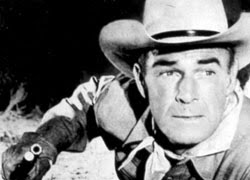
When director Budd Boetticher, writer Burt Kennedy and B star Randolph Scott got together for a series of Westerns in the 1950’s, no one paid them much mind. But the French critics recognized true auteur artistry when they saw it, and these Westerns were rediscovered and are now honored. Seven Men is the best, a prime reason being the fabulous turn by Lee Marvin as the villain. The quiet scene where he verbally emasculates a husband in front of his wife is as memorable as any gunfight in any corral. The movie succeeds despite its low budget and fast shooting schedule (Boetticher trademarks). Randolph Scott becomes an icon here, and the film is a gem you need to watch more than once. Please disregard the awful theme song that the studio stuck in over Boetticher’s objection.

This is a movie about revenge and greed, two of the best motivations.

HIGH NOON

1952, dir. Fred Zinnemann

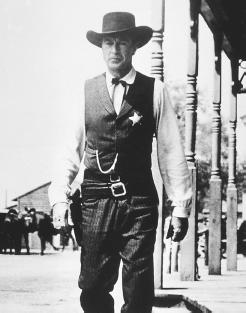
Gary Cooper displays his acting chops almost entirely with his weathered face (and earned his second Oscar as a result). You know the story. A retiring town marshal, newly married to Grace Kelly (Grace Kelly!) stays to face the just pardoned killer coming back for revenge. He’ll raise a posse, he reasons. But as the clock ticks toward high noon, when the train with the killer arrives, everyone seems to have an excuse not to help him. Not only that, his Quaker wife, opposed to all guns, says she’ll leave him if he stays. Talk about pressure (Grace Kelly!) The hit song, “Do Not Forsake Me,” that haunts the movie is one reason so many bad songs were planted on so many Westerns in the 1950’s.

Lesson: there’s a duty to stand up to evil even if you’re alone.

STAGECOACH

1939, dir. John Ford

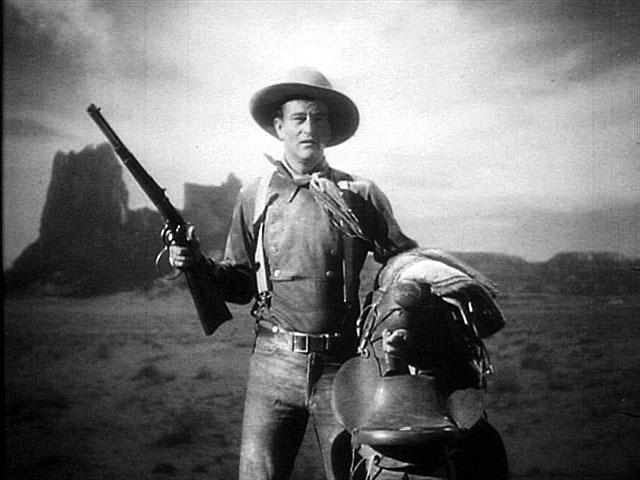
Why this title for John Ford, and not, say, The Searchers or My Darling Clementine? Because I just like this better. It moves. It has heart and none of the clunky Ford humor that mars his “bigger” films. Yes, Ford deserves his accolades, especially for his framing of Western vistas, but when it comes to the West I don’t think he ever did it better than here. It’s the film that made John Wayne a star, of course, just as he was about to fade into obscurity as a C level serial actor. Thomas Mitchell (Oscar winner) and Claire Trevor deliver standout supporting performances.

We learn that sometimes it’s the outcasts who are the moral ones among us.

MONTE WALSH

1979, dir. William A. Fraker

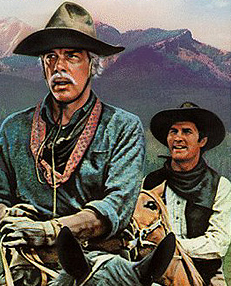
It’s a bookend with Shane, taken from the novel by Shane‘s author, Jack Schaefer, and also featuring Jack Palance (in a very different role). It’s about the end of the West, the swan song of cowboying as a way of life. Lee Marvin stars in the title role and evokes a bittersweet rendering of what it once meant to be a man of honor. The theme song, sung by Mama Cass, is actually one of the few that is perfect for the film’s mood. Netflix this underappreciated classic. (The Tom Selleck remake for television is also excellent).

The lesson here is pure Americana: the only honorable way to live is by being true to yourself. That’s an essential lesson for writers, too.

Honorable Mention: Ride the High Country, The Magnificent Seven, 3:10 to Yuma (Glenn Ford/Van Heflin version).

So what about you? What are your favorite Westerns and — most especially — why?

UPDATE: Netflix apparently doesn’t have the original Monte Walsh available. However, it is due to be shown on Turner Classic Movies on March 27, 2010, 2 p.m. (Eastern). If you go here you can have them send you an email reminder and IMPORTANT: you can click to vote that it be released on DVD. Enter your vote today!

Hello Sixty…

John Ramsey Miller

Sixty years ago today I was born in Greenville, Mississippi at Kings Daughters Hospital. I’ve enjoyed every single day since, and look forward to the next decades and making new friends, appreciating the ones I have, and finding new challenges. Next week, for instance, as part of celebrating my 60th I am going to walk rolling plains and attempt to stalk and kill a Bison that is roughly the size of a Dodge Ram and do it with a handgun. If the Buffalo wins, you can bet I was thrown into the next county with a smile on my face. Well, maybe not a smile.

I often think about how lucky I have been. A perfect wife, a wonderful family, great friends, few enemies, great careers that enveloped me, the lessons I’ve learned, the events I’ve participated in, the people I’ve shared experiences (both good and bad) with.

This is about all I can think of to say.

Commercial Storytelling

By John Gilstrap
www.johngilstrap.com

Efficiency is key in writing fiction. In this contexts, efficiency means getting in and out of scenes at just the right time to keep the story moving along. It means using the right amount of dialogue to communicate just the right message.

I think there are lessons to be learned along these lines from television commercials—not all of them, of course, but from some of the good ones. I’m particularly partial to television ads that are less focused on selling a product than on selling an image. Product-oriented oriented ads can certainly be effective—I’m thinking of the new Mac vs PC ads, for example—but as effective as they are, I don’t see a lot of story.

I’m talking about commercials like the famous Mean Joe Green Coca-Cola ad from twenty years ago. A hobbled football player makes his way down the tunnel on his way to the training room when a little boy offers him a coke to make him feel better. In the reaction, there’s a moment when the boy’s feelings are hurt, but then he’s richly rewarded. Great ad.

I also love the old Folger’s Coffee ad where the college kid arrives in the wee hours to a home that is fabulously decorated for Christmas. The house is completely still, completely perfect. He puts on a pot of coffee and the family awakens.

Then there are the ones who choke me up every time. Anheuser Busch is among the best of the best. Remember the ad about soldiers arriving home to the applause they should receive every time?

I was in a bar in Vail, Colorado for the Super Bowl in 2002 when Anheuser Busch’s “Tribute” ad brought complete silence. The entire team of Clydesdales bows to the newly-mangled New York skyline. It still gives me a chill and brings a lump to my throat.

Think about what storytelling really is: It’s about making an emotional connection with your audience and driving it home. I think these examples do exactly that. How about you? Any favorite ads that tell a good story?

Hello, my name is…


by Michelle Gagnon

A confession:
You know those people who claim they never forget a face?
I’m not one of them.
In fact, I’m terrible with faces. Which wouldn’t pose that much of a problem, but I also happen to be awful with names.
My current line of work has only exacerbated the problem. As a writer, I probably meet a few hundred new people a year. Dozens of other writers, readers, and booksellers introduce themselves to me at conferences, readings, events. I make a valiant effort to to commit their faces to memory, even use mnemonics to try to remember their names. And all I end up with is a nearly overpowering desire to shout out, “Mayonnaise!” whenever anyone looks vaguely familiar.

I have a private theory that if my brain wasn’t completely clogged up with early eightie’s song lyrics, I’d be better at this. You should be able to erase files from your mind as easily as you do from your computer (heck, my computer erases files all the time, on its own, without any help from me whatsoever). Gone would be Duran Duran, and the next time I sat at the bar at Left Coast Crime, the name “Anne” would pop into my head when a woman approached.

Alas, despite my best efforts, that hasn’t happened.

Context is also problematic. Say I run into a former classmate at the grocery store. It doesn’t matter how many fourth periods we suffered through together. Without a blackboard and erasers handy, my best guess will be that she goes to the same gym. (I run into people who claim they go to the same gym as I do on a regular basis. It’s all the more puzzling since I rarely set foot in the place).

When I first dove into social networking sites, I was hoping they would prove the answer to my prayers. All those faces and names matched up to each other–perfect! I’d finally have a handy reference to skim before any major event.
And then what do people do? They post a picture of Bruce Lee next to their name. Or a photo of themselves taken in 1972. Or of their dog. Not helpful, people.

In two weeks I head to Bouchercon in Indianapolis. For those who don’t know, it’s one of the largest crime fiction conferences. Thousands of new faces and names to remember.
Some of the people I encounter I will have met before. Chances are I shared a drink with them at some point as well (I find that sadly, alcohol doesn’t help my faculties. Shocking, I know.)

I’ll arrive armed with a welcoming smile and jars full of gingko biloba, and will rummage frantically through my dusty memory files as they remind me that we sat next to each other at a banquet for two interminable hours a few years ago. I’ll pretend to remember, when the truth is I probably don’t (I’ve been to more than my fair share of interminable banquets). The name badges can be helpful, but at conferences they tend to function as de facto wallets/PR material holders, which means that nine times out of ten the person’s name is obscured. I also have yet to master the art of reading the badge without being painfully obvious about it.

I have a friend who has a trick to compensate for this. He always exclaims, “How long has it been!” as soon as anyone approaches him. Generally, this induces said person to provide some helpful tips that narrow the field. He also has a charming Irish accent, which glosses over the discomfort when it turns out they actually have never met. I could try to fake an accent, but I’m not very good at those either.

So, I’m asking a favor. If we have met before, please don’t take offense at the blank expression on my face. I really am doing my best to remember, but all I’m hearing is “Hungry Like a Wolf” on a steady loop.

How fresh are your second bananas?

By Kathryn Lilley

In any successful novel, the hero is the star of the story, but it’s the lesser characters–the second bananas–who carry the show. As a reader I get annoyed by stories that feature secondary characters who are limp or cardboard: The “blond, leggy” girl who is tossed in for a smidgen of sexual tension; the “beefy cop” who turns up at a crime scene; the “tired-looking” hotel clerk. At these moments it’s like the writer is screaming to the reader, “Hey, I need to include this character to move the scene forward, but don’t bother paying attention to him.”

All secondary characters, major or minor, need to live and breathe for the reader. In his book On Writing, Stephen King said that every character in a book thinks of himself or herself as the main character. Whenever that character is on stage, even briefly, he should be presented as if a spotlight is shining on him.

During a radio interview about my latest book, Makeovers Can Be Murder, the host asked me questions about a couple of the minor characters in the story. One of the characters had two walk-on appearances in the book; the other guy you never even saw, just heard him referred to. And yet the host had a sense of them, was drawn in enough to speculate about their motivations. I felt happy about that, like I’d done my job as a writer.

When I think of strong secondary characters, a few standouts come to mind: Dill in To Kill A Mockingbird; Melanie in Gone with the Wind; the wealthy, pompous Lady Catherine De Bourgh in Pride and Prejudice.

Which secondary characters are the most memorable for you in thrillers or mysteries? (Other than Dr. Watson–too easy.) Do you think most authors in the genre do a good job or a poor job or portraying second bananas?

Places that Resonate

by Clare Langley-Hawthorne

Watching the first episode of Ken Burns’ new documentary series on America’s National Parks I was struck not only by the beauty of the American wilderness but also its profound impact on people – and how that impact helped redefine a national consciousness. This got me thinking about the role of landscape and place in my own writing. I’ve blogged about this issue before but in my current WIP I’m interested in exploring the interaction between characters and the landscape portrayed.

I think evoking a landscape serves more that just decorative, thematic or descriptive purposes – I think it also helps reveal character. In my latest WIP when I considered the setting of my book I looked at a number of questions about such as:

How do my main characters feel about the landscape – are they at home or are they outsiders?

If one or more of them are at odds with the landscape – how can I use this to reveal inner depths or hidden aspects of my characters?

If landscape is to be a character – how will its mood evoke a sense of place and set the tone for the book?

How can I avoid cliches about the landscape and try and discover either a new perspective or a hidden sensibility that can add texture and dimensionality (hmm…is that even a word) to the book?

After watching the first part of Ken Burns’ documentary (and after camping at the awe-inspiring Crater Lake a few weeks ago) I have a renewed respect for the joys of writing about the impact of landscape not just on our lives but on our souls. I’ll be dusting off my copy of Landscape and Memory by Simon Schama and wrestling with all sorts of philosophical ruminations on the significance of landscape – but don’t worry I haven’t forgotten the most important maxim, never let landscape get in the way of a good story.

Some of the best thrillers and mysteries use a strong sense of place to establish mood, progress plot as well as reveal character. But what do you (as readers and writers) think should be some of the key considerations that an author should take into account regarding landscape and place? Are my questions on track or should I chuck my romantic sensibilities aside and consider something else?