by Clare Langley-Hawthorne

- Establishment of setting
- A trigger for action
- A build up of suspense and conflict
- A critical choice
- Resolution
by Clare Langley-Hawthorne
The New Year’s kickoff (other than the Rose Bowl) is usually a time of resolutions, goals, wishes. I’ve had a few of the latter. For example:
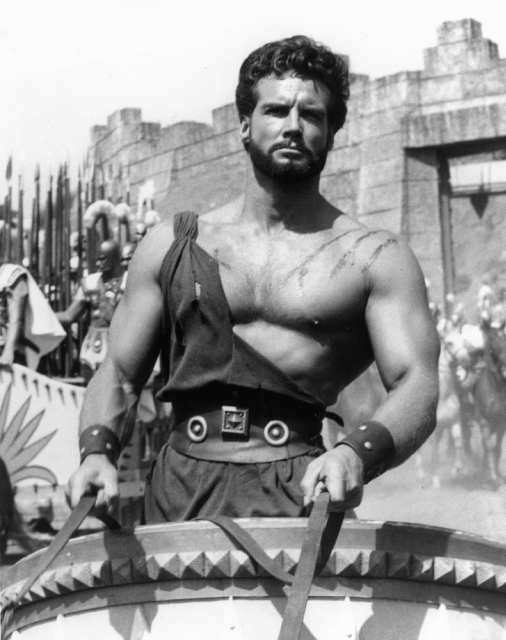
I wish I had the body of Steve Reeves.
I wish I could have played center field for the Dodgers.
I wish I had played quarterback for the USC Trojans, won the Heisman, and played my whole NFL career for the Rams.
I wish I could have seen Laurette Taylor on Broadway.
I wish I could sing like Ray Charles. I wish I could tickle the ivories like Martha Davis.
I wish I could have seen Jim Thorpe play football, Babe Ruth play baseball, and Beethoven play the piano.
I wish I could have had dinner with Shakespeare and Winston Churchill at the same time.
I wish I could write as effortlessly as Stephen King seems to.
But after wishing those things, I remind myself that I’ve got my own package to work with. The cards I was dealt. My job is to till the soil, plumb the depths, hose the driveway, paint the ceiling and write the books that come out of my particular package. I have to keep improving what I have, taking it as far as I can, leaving what is out of my hands to the forces that be.
As far as 2010 goes, I wish to make some plans. The overarching plan is to make this year the most productive of my writing life. Not necessarily in quantity–though I do have several projects in mind–but quality. This will be my twenty-second year as a serious writer, my fifteenth as a published novelist. I know a lot more now than when I began. If I don’t use this knowledge, and leverage it, then I’m wasting my experience.
So here’s to 2010 (for many of you, seeing 2009 in the rear view mirror is not a bad thing), and may it be productive for you in the best way possible.
What are some of the things you wished for at one time in your life?
What are your plans for the new year?
By John Ramsey Miller
The truth is I forgot all about New Years, and it was around five PM on December 31 when I was returning from a trip to see close friends in Apex, NC that I remembered. My mind is rapidly turning to liquid soap with an A1-sauce center. We kept two of our grandchildren New Years Eve and were in bed asleep by nine o’clock. Am I getting old? God I hope so, because if I’m young, its all over for humanity.
It was nice taking a break from the blog. I turned in a short story, which readers will be able to purchase as a download along with a short story by each of the other bloggers here. Until recently I didn’t think of myself as a short story writer, but a short story is no harder to write than a good chapter in a novel. Truthfully I was tempted to publish the opening chapter of a book I’m writing now. It worked well as a short story and that got me to thinking that perhaps most opening chapters in novels would make stand-alone stories. I’m reading a book right now by a first-time novelist that will be published in a few months and the first chapter would make a great short story. It’s the assassination of Tsar Nicholas and his family from the Tsar’s POV.
I have truly loved all of the Arkady Renko novels by Martin Cruz Smith: GORKY PARK, RED SQUARE, HAVANA BAY, STALIN’S GHOST, and WOLVES EAT DOGS. I truly love Russia in the Winter, although I never intend to be there then. In fact I do not ever intend to visit the Soviet Union ever. Not my sort of place even though it’s a successful socialistic model of Utopia.
God, I love a good story, long or short. My favorite book of short stories (of late) is Laura Lippman’s HARDLY KNEW HER. What a brilliant collection of stories. THE CRACK COCAINE DIET stunned me and I went rollicking through the book and couldn’t set it down. I don’t read a lot of short stories, but when I hit a great collection like Vonnegut’s classic, WELCOME TO THE MONKEY HOUSE, Stephen King’s NIGHT SHIFT… It’s great. Feel free to make recommendations for your favorite great short story collections here under comments.
By John Gilstrap
www.johngilstrap.com
I received this in an email the other day from a writer who is frustrated in his efforts to find an agent:
“. . . I couldn’t get anything other than a form rejection letter, if that. My perfectly-spelled, perfectly-punctuated and personalized cover letters would earn me a form rejection from a flunky I’d never even written to. . . I know I’m not at fault here. My cover letter’s been tweaked (I even read your essay on JohnGilstrap.com to make sure I covered all my bases), I’ve written four different synopses for [redacted] and I know the fault’s not with the writing.” [Hotlink added.]
I feel his angst when I read this. The email vibrates with frustration. It also showcases astonishing hubris.
He spells and punctuates perfectly and is clearly not at fault when his work does not resonate with a prospective agent. Hmm. I’ve been in this publishing game for going on 15 years and I can’t think of a thing I have done in my work or in my life that I executed perfectly (trophy wife and perfect kid excepted). Perhaps his claims are true–I have no frame of reference–but even if they were . . . well, they couldn’t be, could they?
Writing is a two-way communication that requires an author to put words on the page and then a reader to appreciate them. I’m not even sure that spelling and punctuation count all that much. Think about it: while a chemical dictionary may be perfectly spelled and punctuated, it will never become a runaway bestseller in the trade fiction market.
If a query or manuscript receive consistent rejection, the fault must, by definition, lie with the author, mustn’t it? Is it reasonable to blame a reader for not liking the book he’s reading? It doesn’t mean that the author is untalented–I understand that Herman Melville was a terrific writer, but you’d never prove it by me–it just means that the writing, when judged by its own merits, didn’t seal the deal. It could be plot or characterization or voice, or any one of a thousand other causes, but the only solid, readily identifyable data point is that the audience rejected the offer. Absorb it. Deal with it.
But please don’t claim perfection.
This curse of hubris seems to be gaining wide acceptance on Internet boards where like-minded, frustrated writers-to-be rally around the fiction that the publishing establishment is united in excluding newcomers. They’re not being rejected because their work is substandard or unmarketable, you see. It’s the conspiracy. Given this widely-accepted “fact”, wouldn’t you know that there is an ample supply of publishers and editors and fee-agents who are more than willing to help introduce these people to the wild and wooly world of “alternative” publishing?
I guess for some people, anything is better than facing the truth. (And yes, I understand that there are a number of circumstances where self-publishing is the best way to go for certain nonfiction. Vanity publishing, not so much.)
Receiving criticism is hard. Rejection is even harder. As the market for novels continues to shrink, I’m dismayed that the ranks of published authors will shrink along with them. I just pray that I continue to make the cut. If one day I don’t, though, it will ultimately be my fault for not having provided the right story to the right marketplace at the right time.
The instant that anyone in any business begins to fancy himself a victim of his customer base, it’s time to change professions.
What do y’all think? Everyone knows that the industry and the marketplace are changing at a dizzying rate, but is it ever the reader’s fault when a writer does not “succeed”? (Succeed is in quotation marks because in a creative field, success is a word that defies definition.)
Happy New Year, everyone! Did you miss us?
This week Clare and Joe have already covered New Year’s resolutions and the looking forward/looking back aspect of the change in decades. So I’m going to leap into a different issue…
In December it was announced that Kirkus Reviews was falling victim to the same fate as many other review sources, and that parent company Nielsen was shutting them down (although today there were claims that it might be resurrected. Time will tell).
The closing of Kirkus was met with both cheers and dismay—dismay because the number of book review sources (outside of proliferating blogs) continues to diminish. And cheers because Kirkus reviews tended to be notoriously snarky. (One famous example: on Dave Eggers’ bestselling memoir, “A Heartbreaking Work of Staggering Genius,” Kirkus proclaimed: “It isn’t.”)
In the aftermath of the announcement of their demise, many writers seized the opportunity to gloat online, posting their worst Kirkus excerpts in chatrooms and on social networking sites. The response was at times as harsh as the worst Kirkus reviews. Esther Newberg, an executive vice president at International Creative Management, went so far as to say that she was, “Sorry people were losing their jobs . . . but it’s never been a publication worth anything. . . . . Good riddance.”
But for me, the worst thing about Kirkus was that their reviewers had the latitude to be as nasty as possible precisely because they were allowed to hide behind the veil of anonymity.
Now, Publishers Weekly stands as one of the only remaining publishers of anonymous reviews. And today I’m going to argue that allowing PW reviewers to retain that anonymity is downright wrong.
Before the advent of Amazon.com, Publishers Weekly was mainly a trade magazine. A starred review in the publication was something that might propel library orders, and could potentially spark more attention among store buyers. However, by and large the only exposure the public had to those reviews was the positive book cover excerpts.
Not anymore.
Now, the Publishers Weekly review is usually the first- and sometimes only- review posted on your book’s Amazon.com page. It’s also heavily featured by nearly every other online site, from Barnes & Noble to Powells. And that review sits there in perpetuity. It’s the first thing a reader sees when they’re considering purchasing your book online. As the industry continues to shift toward eBook consumption, those reviews will only gain prevalence.
Shouldn’t something that has more of an impact than ever before at the very least contain some attribution? Doesn’t an author who gets slammed by a PW review have the right to know who’s slamming him? Perhaps he could take comfort in the fact that the reviewer was clearly a cozy lover, and he wrote a horror novel. Or perhaps it’s someone she cut in line in front of at a convention. Or accidentally stabbed, and this is the reviewer’s means of extracting payback (mind you, I’m not saying any of that has happened. But until we see some names, it’s certainly within the realm of possibility).
The downside of the internet is that it’s provided a forum for people to hide behind anonymity when writing things that they would probably never say in person. We see it here sometimes, the most vitriolic comments tend to be posted anonymously.(This is a tremendous pet peeve of mine. Everyone has a right to their opinion, and because we don’t believe in censorship here at TKZ, we agreed long ago to let every comment stand. But it really irks me when someone lashes out, yet doesn’t have enough courage in their convictions to claim them.)
I believe that allowing one of the few remaining seasoned review sources to participate in that trend damages everyone. If a reviewer really hated a book, let them go on the record saying so. Those reviews are too important now for the veil of anonymity to persist.
Happy New Year to everyone! With the arrival of a new decade, one thing is obvious: technology is moving at light speed. What was hot just a few years or even months ago is old and obsolete today. It used to be that early adaptors lived on the bleeding edge. Now the bleeding edge barely starts to hemorrhage before something new comes along. It took a long time for things like VHS tapes, over-the-air analog television, and dial-up Internet connections to be given a decent burial. In today’s environment of wireless streaming video, smart phones, Wi-Fi, and e-readers, we really have to pick and choose, and do our research to hang on to something for any length of time.
But my post isn’t about tomorrow’s innovations; it’s about those warm-and-fuzzy things we grew up with that are either on the trash heap or on a fast track to oblivion.
Let’s start with postage stamps. OK, I know, you just used them to send out your Christmas cards. And like me, you got a lot of cards delivered by the mailman. But this Holiday Season, I received more e-cards than traditional Hallmarks. As a matter of fact, quite a few were Hallmark e-cards. With texting and email, who buys rolls of stamps anymore?
Next comes faxing. It used to be that faxing was the only way to instantly get an important document from point A to point B. Well, not quit instantly since sometimes you got a busy signal or the recipient’s machine was out of paper or you programmed the wrong number and set it for after hours delivery and there was a guy in Indiana whose phone kept ringing and he wanted to hold you under the water until the bubbles stopped. But it was fairly quick and reliable. Today, just scan the document and email it as a PDF attachment. Cost? Next to nothing. Faxing is as dead as your New Years ham.
When was the last time you actually opened that huge, dictionary-size copy of the Yellow Pages? With Google, Internet Yellow and White pages, all those books do is kill trees. Then they clog up the landfill. Aren’t you glad you’re not a Yellow Pages advertising salesman?
Ten years ago I wrote dozens of checks a month to pay bills and buy stuff. Today I average maybe one a month. With online banking, PayPal, and Quicken, writing checks is right up there with listening to music on AM radio. There is still AM radio, right?
Video rentals made Blockbuster a blockbuster business. Then came Netflix, the Blockbuster killer. Then came Red Box, the Netflix killer. Then came Blockbuster Express the . . . well, being reactive instead of proactive in the tech world means you have one foot in the grave. Soon, wireless, on-demand, streaming 1080p video will kill them all including DVD and Blu-ray. I guess after that, we’ll just have to think of a movie and it will appear in our heads. BTW, watch for no-glasses-required 3D television coming soon to a Best Buy near you.
Picture a large group of big heavy books with matching covers that took up a complete shelf in your office. They were called encyclopedias. Remember the last time you went to find information in an encyclopedia? Me neither. By the time it would take me to pull the book from the shelf, I can find the answer online from 100+ sources.
Aren’t you glad you’re not an encyclopedia salesman? Or a fax machine salesman? Or work in a video rental store?
And I saved the best for last. Newspapers. I know I’ll get a lot of “you’re crazy” comments on that one. I’ll be honest, I love reading the newspaper while sipping my coffee each morning just like everyone else. But let’s face it, folks, printing newspapers and having them delivered by some guy in a noisy little POS car at 5:00 AM no longer makes for a profitable business model. Some have already fallen. There will be more in the new decade.
Technology marches on. Today it’s marching so fast, that it’s hard to keep up. So don’t get too attached to that latest gadget. You might be trying to sell it on eBay tomorrow and no one even meets your reserve price.
Here’s a final thought about technology: "640K ought to be enough for anybody." — Bill Gates, 1981
is there anything you can think of that is on it’s way out the door in 2010?
on trying to adapt as best I can. I shall shift my position in the stagecoach and see how it feels:)
It’s Christmas break here at the Kill Zone blog. During our 2-week hiatus, we’ll be spending time with our families and friends, and celebrating all the traditions that make this time of year so wonderful. We sincerely thank you for visiting our blog and contributing to our rants and raves. We wish you a truly blessed holiday season and a prosperous 2010. From Clare, Kathryn, Joe, Michelle, John G., John M., and Jim to all our friends and visitors, Seasons Greeting from the Kill Zone authors.
See you back here on Monday, January 4.
Tis the Season of Joy, and since this is the final post at Kill Zone for a couple of weeks, I thought I’d leave you with some of the purest joy I know. It comes from the world of dance.
If you ask the question, who is the greatest dancer who ever lived, you’ll get several responses. No doubt Fred Astaire will get a huge number of votes. Maybe Gene Kelly, Rudolf Nureyev, Nijinsky, Margot Fonteyn, Bill “Bojangles” Robinson, a few others.
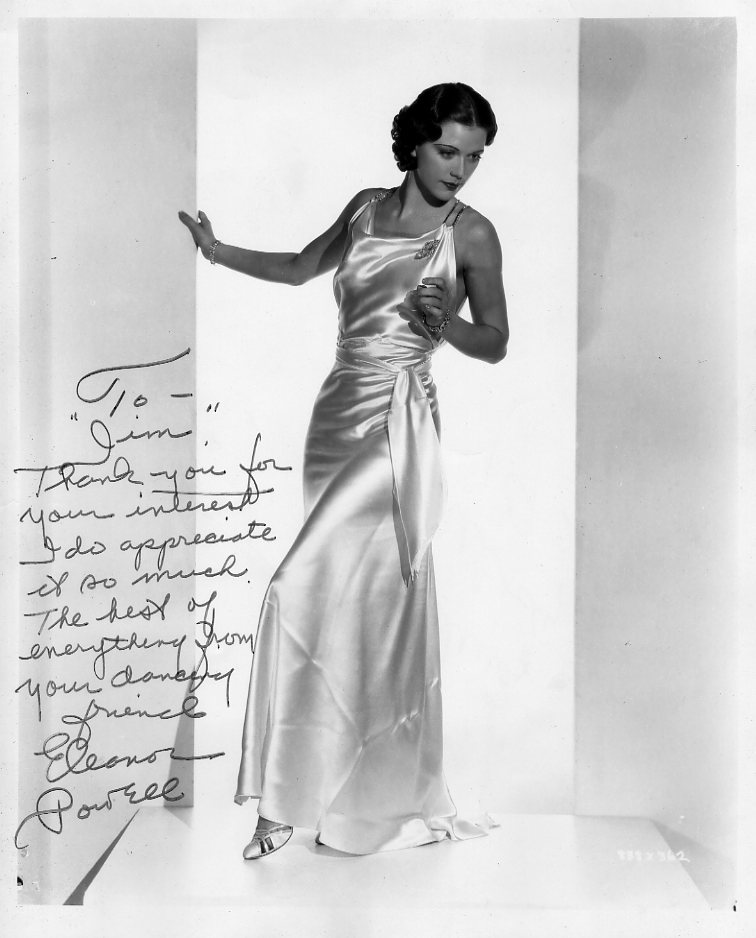
But there’s one name you’re probably not all that familiar with that deserves to head the list. I’m talking about Eleanor Powell.
I met Miss Powell in the mid-70’s when I was in film school. In the days before DVDs and TCM, we had to find our films at revival houses. One night I went with some buddies to see Born to Dance, the 1936 musical starring Powell and James Stewart. And she was there. She spoke, and afterwards we went up and met her. She couldn’t have been classier.
I wrote her a thank you letter and she wrote back and we started corresponding. At some point I invited her to come speak to a film class, and she readily agreed. So I drove my Ford Pinto into Beverly Hills, picked up her and her secretary, and drove us up to Santa Barbara. She gave a lecture and then, to demonstrate a point, she stepped out from behind the podium and started to tap. She was around 64 at the time. And she was still poetry in motion.
Ellie retired fairly early, after marrying Glenn Ford (a matrimonial misstep as it turned out). After her divorce from Ford she mounted a successful night club act, and was rediscovered by millions via the That’s Entertainment series. A quietly devout woman, she spent her latter years working with young people, inspiring them to a higher vision. “Who we are is God’s gift to us,” she used to say. “What we become is our gift to God.”
Why do I call her the greatest dancer of all? Because not only was she the equal of Astaire in tap (he was in awe of her, and that’s saying something); she was also a ballet dancer, a gymnast (she could kick to perpendicular, bend herself completely backward, and spin like a top) and, if modern dance had been in vogue, she would have been the equal of Cyd Charisse or Gwen Verdon.
In other words, she could do it all, and she does it all in the one film she made with Astaire, Broadway Melody of 1940. Here she dances ballet on point, taps, ballrooms, bends and spins, all with her singular grace. This film has what is, IMO, the greatest tap dance ever recorded, Begin the Beguine. Just look at how much fun they seem to be having. That’s another mark of their greatness, because they rehearsed this number for weeks, to the point of exhaustion. It was worth it. It is, without question, my favorite three minutes of film of any kind.
There’s also another great tap number from the film, the “Juke Box Dance.” It’s the first one they worked on together. So sit back and enjoy the two greatest dancers of all time, just diggin’ it. A merry Christmas to all, and to all a good night!
John Ramsey Miller
I was twelve years old, it was 1962, and the struggle for civil rights was gathering speed and the social fabric and traditions of the old South were undergoing enormous strains and stresses, and the threat of violence was thick in the air. My father was the minister of the First Methodist Church in Starkville, Mississippi. I remember that September on a warm evening standing on our front porch with my father and my brothers and watching a torch-lit parade of citizens came into view and marched past the church and parsonage en route to the courthouse where they hanged an effigy of James Merideth, a young black man who was registering at Ole Miss. My father was a Christian and spoke each Sunday in a loud voice from his pulpit, and during the week in softer tones, but always steadily on message. His message was that regardless of skin tone, all of God’s children deserved to live their lives as equals. It seems odd now that we lived under an established and traditional social and economic system of apartheid.
It was three months later, and the weather had turned cold enough so that there was ice on the ground. I remember that my brother, Rush, and I were passengers in the family station wagon that afternoon. We stopped at a light on the highway and watched as a group of black children, who had been standing on the corner, hurried across the highway in front of the car. I remember there were six or seven children and that they were shivering in the wind, and that they wore tattered clothes and that one of the children was shoeless, and I remember horns honking behind us and how my father stared at the group until they were on the porch of a hovel, and had gone inside.
Later that afternoon, or that night, I remember one of the few loud arguments I ever heard my parents have. After a while my mother came into the den and told us that Christmas was going to be a slim one because our father had spend our family’s main Christmas funds on the needy. I think we were not happy about it at the time, but we had Christmas as a family and if it was slimmer than usual I can’t say because I do not remember and it matters not at all. The only thing I can say is that there was a family that lived in a house where the wind found its way through the cracks, but that the family who lived there had new coats and shoes, and enough to eat that Christmas because my father made sure of it. I don’t know what other gifts I got that Christmas, but I have never forgotten the one Christmas gift that my father gave me that day. But for him I might not have understood what Christmas is really about. The spirit of Christmas is in showing our love and appreciation to our family, our friends and to reach out to touch as many of the people we can who are in need of our love, our understanding, and our compassion.
Merry Christmas and a Happy New Year.