Your Best Writing Advice

James Scott Bell


Today is “Talk Among Yourselves Day.” I want to hear from you.

The question I have is: What’s the best writing advice you ever received?

It doesn’t matter if you’re published, pre-published or simply the town eccentric — what is it that someone told you, or that you read, which has served (and is serving) you well as a writer?

I get asked this question a lot, and my own answer as been pretty consistent over the years. I’ll share that with you later in the day, in the comments, so for now let’s get the conversation going.

What’s the best writing advice you ever received?

Life is taking up all of my time.

By John Ramsey Miller

The Ramsey is back this week because I realized that although it may be pretentious, it is a vital part of my identity. Originally I put the Ramsey in because there were more than one John R. Millers scribbling. It is my actual name, even though the census bureau only wants the R, and has deemed the Ramsey irrelevant to existing in the rolls.

I’ve spent the past week learning to be a census taker, or an enumerator, and it’s been an eye opener. The idea of going up to a house and knocking on a door where I am not expected runs against my nature, and not necessarily being welcome to be on the front porch amazing. If you have never been told to “Get the F*ck off my property and don’t come back!” you are missing some real life up close. I took an oath and am fully capable of keeping your deepest secrets or I could go to prison for six years and be fined $250,000.00. So, although I love gossip, I’m not telling anybody anything that is PII (Personally Identifiable Information), or regarded as a “State Secret, or (as we say in the trade) a High Secret of the Federal Gov’ment.

I’ll say this about the Census Bureau, my class was comprised of people from all walks of life, some of which are working more than one job. Nicest bunch of people you’ll ever meet outside a writer’s conference. I’m not a best selling author doing research or looking to supplement my vast income from sales of my books, I’m another co-cog in the wheel and I like that.

I need to be knocking on doors and meeting people and running from dogs, and being rejected because I am a federal agent for a meddlesome government. I have awesome powers. “No Trespassing” signs do not apply to me and this is something the owners of the property often object to. The other day I went to an isolated location to pick up some old fencing for my chickens and the owners of the property had to walk down to a gate just like the one on the border of a small country. When they arrived I told them as a census worker I could have entered and he said, “That’s what guns are for.” And he meant it, or so you’d think is you didn’t know him, which I didn’t. After three shots of Ancient Age after loading the fence segments on my trailer, I told him, “You don’t have to cooperate with the census. This is America. Even though it is in the Constitution and serves purposes too numerous to mention, you can tell them to f*ck off, or chase them to your gate with a gun. They “can” fine you $100.00 (probably never happen) but they’ll have to come back and keep trying. But privacy is your right. And they probably won’t fine you. Do this for me,” I said. “Put a sign by the fence that says, “Census workers. There are two of us living back here in a cabin with two dogs and a cat. We don’t allow anybody on our property uninvited, which there is a mortgage on. I will tell you that there were two of us (a married couple) that were living here on April 1, 2010 and nothing else is any of your business. I’m crusty and my wife lets me be.” He agreed to do that.

The truth is most people who say, “get off my property” are good people. My fence buddy certainly is, but he is suspicious of the government and with good reason. I feel the same way about the government I have been watching for the past forty years. But I also know that the census is a good thing. I do believe that the information that links named people with a place in time is a great historical record (The PII records are sealed for 72 years), and the statistics are available to corporations looking for a factory location, an office, and so forth. The government uses the stats to bend and twist to justify this or deny that. Not my job to worry about that, but my right to worry if I like.

So for the next four weeks or so I’m not an author. I’m off today to run a rural route out in the county and knock on doors, and help gather information and not as an author, but as a strange man at the door asking impertinent questions. I’m sure I’ll have all the research for writing about door-to-dooring I’ll ever need.

So, guys and gals, when someone knocks on your door and asks to fill out a form because you didn’t mail it back in time, or fill it out, think of he or she as me, and smile and agree or refuse, but remember that person is somone’s son or daughter father or grandfather or whatever and be nice. believe me it matters.

Lend Me Your Ears

By John Gilstrap
www.johngilstrap.com

Everyone is born with different gifts. I’ll tell you right now that I was at the end of the line when athletic prowess was being bestowed. I can’t hit, throw, kick or dribble worth a lick. Honest to God, in elementary school, the kid with braces on his legs was chosen for teams before I was. I’m not making that up.

I did okay in all things nerdy, though. I’ve been a voracious reader for as long as I can remember, and an aspiring writer since first grade. I still have some of the stories I wrote back in elementary school, and when I read them now, I become ever more appreciative that my parents spared me the truth and encouraged me anyway. At that age, I guess passion counts more than ability.

By the time I got to high school, writing well was about my only talent, granting me a certain measure of nerdy notoriety. Teachers loved me and jocks hated me for screwing up the bell curve in English class. In my sophomore year, I discovered a new talent: public speaking. Trophies in forensics and debate led to coveted roles like emceeing school talent shows. Turns out that public speaking is a great confidence-builder.

Fast forward thirty-five years, and here I am writing this blog entry on a flight to San Diego, where next week I will deliver three separate speeches as part of my big-boy job. I can’t wait. Truthfully, when I read that public speaking ranks among the top five phobias in people’s lives, I just don’t get it. Being in front of an audience is like living at a higher plane.

Which brings me to my point for today’s post:

We’ve spilled significant cyber ink over the past couple of years talking about the horrors and frustrations of book tours and store signings, and Lord knows I’ve lived my share. I hate sitting at that front table while people walk past as if I’m invisible, thoroughly absorbed in their pursuit of Michelle Gagnon’s next book. “We’re both in the G section,” I yell, but they just don’t care. The problem with most in-store signings is that I just don’t sell many books.

Give me a crowd to talk to, though, and I can sell a ton. Earlier this week, I spoke to the Charlottesville Newcomers, a luncheon group of about 100 ladies gathered at the Glenmore Country Club in Keswick, Virginia. I have a number of presentations in my repertoire, but the one I delivered on Tuesday is called “Dare to Dream.” It starts out as a funny look behind the scenes of the book and film businesses, and ends with a great inspirational message for anyone who’s ever been talked out of pursuing their artistic dreams. The audience was terrific. They could not have been more gracious. At the end, the applause rolled on way past polite, and into the range of genuinely appreciative. Several of the attendees told me that I was the best speaker they’d ever had. (At the risk of sounding grotesquely immodest, I get that a lot.)

And I sold a ton of books. More to the point, Barnes & Noble sold a ton of books. I’d arranged to have them bring stock to the luncheon and to set up in the back of the room. I don’t know the exact numbers, but I signed for a good 40 minutes.

It goes this way every time I get to work an audience. The problem is finding the audiences. If book tours were built around a speaking circuit, I’d willingly tour for weeks on end. Hell, lots of people earn serious cash by delivering speeches. How do you break into that market without first surviving a plane crash or being snatched by pirates? What a terrific way to earn a living! (The question is not rhetorical, by the way. If you know how to break into the speaking circuit, please share.)

So, what about you, dear Killzoners? Is the thought of delivering a speech—say, a commencement speech—the stuff of dreams or nightmares?

The iPad: Is it really all that?

by Michelle Gagnon

ibooks_hero_20100403.jpgI’ll start by saying that I don’t completely understand the Apple mystique, in fact I’m a little perplexed by their cult following. I appreciate my iPod and iPhone as much as the next person (although AT&T easily takes the prize for the worst network). But in my experience, some of the Apple products leave much to be desired. My husband finally convinced me to switch from a PC to a Mac last year–which has absolutely been a mixed bag. Some of the programs, like iPhoto and Scrivener, I love. Yet I can’t fathom why there isn’t a blogging program for Macs that holds a candle to Live Writer. On the plus side: fewer viruses and crashes. But I sorely miss Microsoft Outlook.

So with all the hoopla surrounding the release of the iPad, I was skeptical. It looked big, for one thing. What I like about the Kindle and the Sony Reader is that they manage to mimic the experience of reading a book. You open something, hold it in both hands. In comparison the iPad appears unwieldy, roughly the size of a dinner plate. I couldn’t imagine holding this big flat thing and reading off it.

But then a friend brought one over for me to test drive. Wow. It has all the features of the Kindle, Nook, and Sony Reader. It’s light and comfortable to hold. The pages actually appear to turn, which is a neat trick. And that’s just the beginning.

There’s been a lot of chatter about eBooks and what they mean for the industry. Most of the debate has centered around issues like the recent Amazon/Macmillan pricing standoff, and what kind of ebook rights authors should be getting. There are those who claim that within a decade print books will be a rarity, limited editions published exclusively for collectors. Others say that’s an exaggeration, books are here to stay.

What’s been lost in the debate (because until now it was largely irrelevant) was how books and the entire reading experience could change. The Kindle and the Sony Reader were great, but they basically just enabled a reader to experience a book the same way they always had. The main benefit was that the font size could be adjusted, and the reader could hold a full library. Neither offered true interactivity, a bridge between books and other media.

That bridge is exactly what the iPad provides.

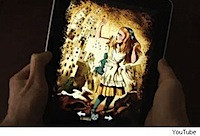
Check out this video of the iPad version of Alice in Wonderland (but be forewarned, it’s a little frenetic. I’d advise against clicking on the link if you’re prone to seizures).

Wow. Seeing that, I finally grasped the iPad’s potential. For one thing, it could revolutionize children’s books (although I’m hard pressed to name a parent who would hand a relatively fragile $500 device over to their child). And for graphic novels, this is a complete game changer. aliceforipad041610b.jpg

On my book tour for THE GATEKEEPER, I assembled a PowerPoint display of real-life settings from the book and other materials to provide a frame of reference for readers. Just imagine if that information could actually be incorporated into the text itself.

It reminded me of reading The Da Vinci Code while vacationing in Costa Rica. I found it maddening that when so much of the plot was focused on specific paintings and statues, there were no images included in the text. With the iPad, a book could include those, plus links to video interviews with the author, related sources- really, the sky is the limit.

I’ll save a discussion of other iPad features for another day, including apps (movies look amazing on it, though, in case you’re curious). But I have to say, I’m a convert. I’ll probably wait for the inevitable price drop. When that comes, (and I suspect we’ll be seeing a huge decline in prices for eReaders across the board soon), Apple could corner the publishing market the same way that they basically appropriated the music industry. And along the way, they might end up changing what constitutes a book.


In the land of zombies

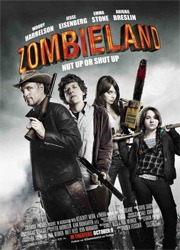
Recently, I watched a movie called ZOMBIELAND staring Woody Harrelson and Abigail Breslin (Little Miss Sunshine). It was a fun movie with lots of laughs and clever moments like the “Zombie kill of the week” involving a grand piano, and a guest appearance by Bill Murray who played himself. Sadly, he was accidently shot and killed. Those things tend to happen in zombie movies. I’m not a zombie fan, but I enjoyed this movie.

zl1 I think it takes a lot of guts to write about zombies or vampires or werewolves. That’s because I consider those topics to be “box” stories. I feel that the moment you write the first word of a zombie story, you have placed yourself in a box. It’s hard to make a zombie more disgusting; everyone on the planet already knows how disgusting they are. Just like it’s a challenge to make a vampire more vile or a werewolf more dangerous. It’s sort of like writing about Jeffery Dahmer’s hearty appetite. You’re making the tough job of writing even tougher. The secret to great zombie stories is not the zombies, it’s the characters that must struggle to survive. Characters make the story. After all, George Lucas could have easily changed Luke Skywalker’s name to Frodo Baggins, set the story in a place called The Shire, changed the name from Star Wars to . . .well, you get the point. It would have been the same basic story because what matters are the characters, not the setting.

We don’t get to pick which one-page submissions we critique, our fearless founder Kathryn Lilley hands them out to each of us. So I may not be the best choice to comment on a zombie story simply because I don’t read them. But I can comment on the writing. And my comments follow today’s one-page anonymous submission called RUE.

They say that a person’s first memory shapes its being.

My first memory was of pain. Incredible, unending pain, beyond any possibility of relief. I tried to scream. There was no breath in my lungs to scream with, and besides, there were…things. In my throat, and in my nose. I couldn’t even think, the pain was so bad.

After a moment, or it might have been an eternity, the pain pulled back some, and I was able to grip the things – tubes, like the ones my grandmother had had in her mouth near the end (grandmother? I couldn’t remember the woman’s face, only that she had died in a hospital) and pull them out. That hurt too.

Once I was sitting upright and reasonably awake, I became aware of the hunger. It was terrible, a deep painful gnawing in my gut. I was starving.

“Hello? Is anyone there?” I called. My voice echoed out into the hospital, but there was no other sound. And there it was, the thing that had been bothering me: it was too quiet. I had been in hospitals before, and they were noisy places, polluted with the sounds of blood pressure machines and the many, many other things humans use to keep death at bay for just a little while longer.

So I got out of the bed. My feet hurt, but no more than anything else, and they would carry me. There was nobody in the hospital – or at least, nobody I could find. I kept thinking I could hear voices, just around the next corner, or the next…

I found the cafeteria, though, and helped myself. Eating with my hands like a savage I emptied three huge serving bowls of lasagne that had seen better days. It didn’t really help much. I was still starving.

I went on. It was about then that the first zombie found me. It had been a doctor once, I think. It wasn’t anymore. It was just a mindless…thing, and it was hungry. My first impression of it was confused. Lab-coat, once white, now a sort of greyish brown. Grey skin. Hair falling out in clumps, and eyes that saw nothing. And over it all a deep black chasm of hunger, laced with hopeless screams. That’s one thing the living were fortunate not to know. The walking dead are still aware. Trapped, helpless in their decaying bodies, the soul of each zombie screams endlessly for some kind of release, bound about by the endless consuming hunger of the undead.

This is a pretty good beginning although I was a bit thrown by the first line indicating this was “My first memory”. I immediately pictured an infant with a phenomenal awareness. But reading on made it clear that it was an adult or young adult. The sex is unknown.

There’s conflict right off the bat with the medical impediments and the unnerving isolation in what should be a busy place. I think it’s over-written and just needs a good, swift kick with a red pen. But overall, I’m going to assume a zombie fan would keep reading to find out if this person makes it out of the hospital. In reality, isn’t that the plot of all zombie stories?

One advantage to writing a zombie story is that the basic conflict is built-in and comes with the territory. We know there’s going to be danger around every corner and the protagonist will probably get few moments to take a breather. So overall, I’ll give this submission a B-. Get out the editing pen, clean it up, delete all the unnecessary words, and the author will have a good start here.

What do you zombie and non-zombie fans think? Would you keep reading?

Download FRESH KILLS, Tales from the Kill Zone to your Kindle or PC today.

Little things that add up to a big difference

Several years ago I did a post over at Killer Hobbies called “Stomping out your story killers,” in which I discussed how the frequent repetition of small errors  can kill your manuscript. As writers we tend to commit our own particular story killers, such as the overuse of certain words and constructions. Some of my most frequent offenders are are the overuse of dashes, and using italics for emphasis in dialogue. During rewrite, I do a global search for my story killers and winnow them down so that they they don’t occur as often.
Which brings me to today’s critique. I enjoyed today’s first page submission, but I do think it contains a couple of potential story killers that the writer may want to watch out for. My comments follow in the bullets. 
MYSTERY OF THE HEART
What could be so urgent as to have his old friend send for him so soon after their recent visit?
Witt entered the palace and a world of opulence greeted him and a smile tugged at the corners of his mouth. A wonderful place to visit, but not his kind of purposeful, long-term living. He much preferred the country.
A young page dressed in the red and gold finery of the Regent’s colors approached, a serious expression clouding his young features.
“Lord Witt.” The page bowed low. “The Regent awaits you. Follow me, please.”
Witt smiled. “Young Thomas, you are far too serious this evening. Why the frown? I enjoy the sound of your laughter much better than the stern look you wear.”
“You will know soon enough and you will understand.”
An edge of uneasiness rippled down his back as he followed the boy. He’d helped his old friend out of difficulties in the past, but those were around issues of war, but those days were past and he enjoyed his quiet life in the country now.
The page knocked on a heavy oak door and bowed out of the way as the door swung open. A dozen men occupied the room. All wore serious expressions.
“Who died?” he joked. But when the circle parted a man, pale and slack, lay across a chaise lounge, his face horribly disfigured.
“Charleton,” said the Regent, stepping from the circle: regal, robust and somber. “Murdered.”
“How?”
“We are not entirely sure…that’s why I sent for you. When word gets out.”
“Tell me what happened.”
Templar came forward. “It appears his face was torn to pieces.”
Comments:

  • I enjoyed this piece, especially the last line, “It appears his face was torn to pieces.” However, I got thrown as I encountered three instances of the word “serious” on the very first page, plus a similar word, “somber.”  Every word on the first page needs to have a purpose for being there. It needs to push the narrative forward in some way. I would suggest that the writer trim down the use of “serious” to one instance. Rather than simply repeating the fact that people seem serious, find another way to heighten the tension on the first page.
  • The description of the palace was too nonspecific to draw me into the setting. I would suggest highlighting one outstanding thing about the palace–something that’s familiar to the narrator, but that underscores its opulence–to bring it to life.

 Your thoughts? And while you’re at it, can you share some of your personal “story killers”?

Taking it on the Chin

by Clare Langley-Hawthorne
Today I return to our first page critiques and tackle an issue that is always a thorny one for writers – how to deal with feedback (or as it is all too often, criticism in disguise!) In my writing group I have witnessed at least one member halt writing her memoir completely – she was simply so overwhelmed by all the conflicting comments and feedback she had received that she couldn’t progress any further with the book. While this may be an extreme example, there’s no doubt that taking in feedback can be a daunting task – and taking criticism can be even harder.

By now I cope with criticism pretty well – my agent and editors have dished it out often enough and almost always their feedback has been spot on. In those instances I am merely thankful for their feedback and the opportunity to fix the manuscript! I do, however, worry about giving negative feedback to a new writer. All too often the issue is one of stylistic taste – and a new writer can so easily be put-off or overwhelmed by the range of comments received. One person loves the prologue – the next person hates it. One person loves the complex imagery – another finds it bogs down the book. The list of issues can be endless. So how is a new writer to respond to criticism? You hear of many established writers disagreeing with their editor or their agent over a manuscript – sometimes even parting the ways over it all…I have never faced that (as yet) thankfully, but still when I read our first page critiques, I am aware of the over-arching issue.

So how should a writer ‘take it on the chin’?? How do you respond to criticism? How do you deal with conflicting feedback (I always think it’s pretty easy when there are consistent issues coming up – then I know I need to address them – but what if no one agrees on what is right or wrong about your piece?!)

Anyway I’d be interested in finding out how people cope with feedback…and now it’s on with today’s first page critique. It’s a piece entitled DOUBT. My comments follow as bullet points.

DOUBT

“We had a deal,” Tom said as he turned his attention back to the blonde across the table. Without waiting for an answer, he lifted the cold bottle of Heineken to his lips. The bitter liquid flowed down his throat, but couldn’t wash away the distaste of doing business with Alessandra LaFave.
Alessandra tapped her long red fingernails, one by one, on the table as she silently stared at him.

Clack…clack…clack.
The impact of acrylic against Formica echoed like deliberate shots of distant gunfire. She took a long drag off the slim cigarette, tilted her head back and blew gray smoke toward the yellow stained ceiling.
“Deals are made to be broken. Aren’t they?” she asked.
“What are you talking about?” He could see the gears turning behind those icy blues. It was now a waiting game. Tom glanced out of the large glass window behind her as he waited for her reply.
The small Italian seaport was busy. Fishing trawlers docked alongside freighters from around the world in Gaeta Harbor. From where he sat, Tom could just make out the NATO base in the distance.
It was getting late and hurried workers anxious to get home for dinner yelled to each other as they offloaded boxes and fish. The salty air merged with the acrid taste of burning tobacco as diners left the small cafe with their arms full of boxes stuffed with a local specialty, Tiella, a combination of a pizza and calzone.
Tom’s dinner sat untouched on his plate.
His gaze went back to Alessandra still sitting silent in front of him. Her black pantsuit cinched at the waist, curving tight around her ample hips as she moved in her chair. A very pampered Yorkshire terrier puppy snored on her lap, its nose tucked under its tiny paws.
Yes, Alessandra portrayed the softness of a woman. But he knew better. Charming one minute; chilly the next. After having done numerous transactions with her over a number of years, he was immune to her machinations.
In return, she no longer bothered with him. It was strictly business.
“Well? Deal? No deal?” asked Tom. “I have a plane to catch.”
“In a hurry are we?” She lifted a fork and pushed the now cold chicken picatta around her plate. “This isn’t cooked properly. It’s such a shame when things don’t work out the way we hope. Isn’t it, Tom?”
“Quit whatever game you’re running. This was a done deal.” He jabbed his finger down on the table hard. “If you don’t want my future business just say so and we can part company now.”

  • There were a number of things I thought worked well in this first page – I liked the way the dialogue interspersed with the description and I thought there was a good balance between dialogue and backstory exposition – although the description of the Italian seaport seemed to lack specificity for me – the NATO base was a teaser but still I was left wanting a little bit more local colour (beyond the menu variety).
  • What I did feel was lacking was sufficient tension. We already know by the opening line that the ‘deal’ whatever it is, is in jeopardy but by the end of this first page the tension really hasn’t mounted all that much. We get a glimpse of Alessandra but while at first she appears cold and calculating the pampered pooch in her lap seems to detract from her initial ‘sang froid’. The threat at the end of the page ‘if you don’t want my future business…” doesn’t really seem the raise the stakes enough for me. I think perhaps the issue is one of repetition – I would perhaps just speed up the first page – delete some of the to-ing and fro-ing over the deal and cut to the chase: what’s going to happen if the deal goes south.
What do you all think?

Death to Prologues?

James Scott Bell


“First thing we do, let’s kill all the prologues.” ––Shakespeare (hack writer Chip Shakespeare of Schenectady, NY)


Last week we discussed one of those “fiction rules” that begins to get trumpeted about until it gets chiseled in a tablet as an unbreakable command. Here’s one that seems to be developing: No prologues!

You hear this occasionally from agents and even readers. So it behooves us to ask if there’s something to this mushrooming new “rule.”

I think there is––and isn’t.

Let me explain.

First, a definition. A prologue is a scene (or sometimes a group of scenes) that precedes in time the main plot. So the question to ask yourself is, if it isn’t part of the main plot, why am I including it? And why should a reader bother with it?

Some reasons you might include a prologue:

• To start the book with intense action that hooks the reader.

• To set up an intriguing mystery that will pay off later in the book.

• To show a significant incident in the Lead’s life that haunts him in the present.

• To demonstrate the evil deeds of the bad guy, setting up the stakes for the Lead.

What a prologue should not be is merely an excuse to give us backstory, the sort of information about the Lead that can wait to be revealed later. Only if the material in the prologue is absolutely essential, riveting and has real impact on the story, should it be used.

Maybe that’s why agents are suspicious. They see too many prologues that don’t need to be there.

Some readers report that they skip prologues. Why would they do that? Perhaps because it seems to them that it’s just setup information and they want to get right on to the story.

So what should you do if you’ve got a great prologue that makes sense? That accomplishes just what it’s suppose to?

Should you give up and bow to the blanket rule that you should never use a prologue? I don’t think so.

Instead, be deceptive.

That’s right. I said deceptive. You’re a fiction writer, after all. That’s what you do.

So here is a simple strategy: never label a prologue as “Prologue.” That’s an invitation for a reader, not to mention an agent or editor, to skip this part or toss aside the manuscript.

Instead, if it’s in the long past, you can start with a date stamp, like this:

November 22, 1963

Or you can simply decide to call it “Chapter One.”

Another option is simply not to put anything at all. I like this move. You just go halfway down the page and start your scene. Then, you can number the next scene as Chapter One. This was the strategy used by Harlan Coben in Tell No One. There is no call out that the book opens with a prologue. It simply gives us a riveting scene about a husband losing his wife and getting knocked out. Then, the next scene is headed:

1

Eight Years Later

But Coben wrote such a great opening scene that you don’t stop and say, “Hey! He fooled me! That was a prologue! I want my money back!”

So here’s my bottom line advice. Don’t start with a prologue unless you have an absolutely clear reason for doing so. Make it short, too, unless you can justify the longer opening––as in, say, Mystic River, where the opening scenes, in the long past, are essential to understanding the plot as it unfolds. Dennis Lehane knew what he was doing.

Make sure you do, too, and then just don’t call it a “Prologue.” Problem solved.

Or is it? Do you tend to be let down if you see the word Prologue at the beginning of the book? Do you care? Is “Kill the Prologues” one “rule” we should nip in the bud?

I’m enjoying this critique thingie…

John Miller


I dropped the Ramsey this week because it seemed pretentious all of the sudden. I may put it back, but I don’t ever use it in my day-to-day life. My friends and neighbors call me Miller, and I prefer it to Mr. Miller, John or John Ramsey Miller. Out of a sense of boredom and thinking I should make some money for a new hen house and bullets, I applied for a job as a census worker. It’s really a funny story and I did a truly shitty job on the written test, and I left the testing center (a small county library branch with none of our books in it) laughing because the guy said I could take the test as many times as I liked. I told him I didn’t like taking his test the first time. Long and short is I’m getting trained Monday, Tuesday, Wednesday, and Thursday at $15.00 an hour. So I won’t be writing or authoring for a few weeks while I bother my sometimes touchy (and anti-whatever you’ve got) neighbors in the quiet evenings and on weekends, and no doubt will be seen as a gov’ment agent. I like honest work, especially gardening, chicken chasing, and cutting trees, etc… I have always seen writing as good hard work, but I like to get in the ditches, move dirt, rip things apart, and put things together.


Anyhow, today’s page gets very little criticism from me. Other than the first line about 1918, I can live with it and I’d keep reading.


Chapter One


Atlantic City, New Jersey


“The 1918 has gone: a year momentous as the termination of the most cruel war in the annals of the human race; a year which marked, the end at least for a time, of man’s destruction of man; unfortunately a year in which developed a most fatal infectious disease causing the death of hundreds of thousands of human beings. Medical science for four and one-half years devoted itself to putting men on the firing line and keeping them there. Now it must turn with its whole might to combating the greatest enemy of all–infectious disease,” (12/28/1918).


American Medical Association final edition of 1918


He wanted it all to be over; the war in Iraq, the terrorism, the death, the killing. But it wasnít going to stop. Not anytime soon.


Explosions rocked a large market in Iraq disrupting a diplomatic visit by two senior House of Representative leaders. The in-country reporter glanced nervously over his shoulder as he searched for something to say. The scene played out on the plasma television above the bar, caught on tape by CNN cameras. Details on the forty-something U.S. soldiers killed that day scrolled along the bottom of the screen. The image changed. Visiting Representatives Jackson and Levey, draped in body armor, were being rushed from the scene by a tight knot of amour-clad soldiers.


Pete Robinson teetered on the bar stool contemplating the grizzly scene. Those political idiots were probably second-guessing their decision to parade around Iraq in support of the President and his claims that things were improving. The more he thought about the war, the more he drank, and the more he drank, the angrier he got. Heíd been perched on the bar stool for the last two hours. He was hammered and pissed-off. Just nuke the bastards.


Starts off like my kind of book. I’m along for the ride. What do you think?

The Smelly Tulip

By John Gilstrap
www.johngilstrap.com

A few hundred years ago, some English guy named Willy said, “If you call a rose a tulip, you’re not gonna change what it smells like.” Something like that, but in British.
Willy’s point was that sometimes labels don’t mean all that much. I tend to agree with him. I’d bet that most people who give it any real thought would agree, at least in principle. But only until egos get involved. Once you start messing with people’s sense of identity, labels can matter a lot.

A couple of weeks ago, I was silent witness to a writers’ board flame war that erupted over the assertion that writers and authors are different species, the definitions split by publication status. A “writer,” said one side of the conflict, may not call himself an “author” until the product of the writer’s efforts have been published. This ultimately led to a full-scale assault on the legitimacy of self-publishing as a form of “real” publishing, and it all got really ugly really fast.

There’s a reason why I don’t engage in flame wars: they’re ultimately damaging to everyone involved. But, oh, they can be fun to watch. (Contributing factor number 10,497 to why I’m running behind on my current manuscript.)

Just for grins, though, I thought I’d do a little research. Okay, a very little research. I turned to my new favorite reference, Dictionary.com, and looked up the offending words. What I found surprised me:

Writer: “a person engaged in writing books, articles, stories, etc., esp. as an occupation or profession; an author or journalist.”

Author: “a person who writes a novel, poem, essay, etc.; the composer of a literary work, as distinguished from a compiler, translator, editor, or copyist.”

It would seem by this definition that both camps of the flame war were wrong from the outset. Dictionary.com says that “author” is the generic term, while “writer” implies payment as a professional. Who knew?

Is it okay if I don’t care?

Let’s be honest: as humans, we all like to differentiate ourselves from our respective packs. Even among published authors of books, there’s a good bit of ring-knocking based on everything from print run size to publication format, but among professionals, those distinctions actually mean something, if only in terms of commercial clout. In a news room, I would imagine that there’s similar significance to differentiating a beat reporter from an investigative reporter from a web reporter.

I guess my point is that I’m not anti-label; I am anti-meaningless label. Am I missing something here? Do any of you get wrapped around the axle on whether you’re a writer or an author?

For our Killzone denizens who are not yet published, when you’re in the company of other like-minded people—say, in a writers’ conference environment—do you hesitate to call yourself a writer or an author?

What am I missing?