The Great Backstory Debate

Last week we looked at the great semi-colon debate, which was a bit tongue-in-cheek (but only a bit!) Today we look at a real writing controversy, a little thing called backstory. Specifically, how much (if any) do you put in your opening pages?
You will find those who argue that there should be no backstory at all in those first chapters. Why not? Because, by definition, backstory is what has happened before your narrative opens, and you want to establish the action first, get the readers locked in on that.
This is, on the surface, sound advice. These days we do not have the leisure time, a la Dickens, to set the stage and do a ton of narrative summary up front. Or, a la Michener, begin with the protozoa of the pre-Cambrian earth and record their evolutionary development into the Texans of today.
I am an advocate of beginning with action (which doesn’t mean, necessarily, car chases or gun fights). The best openings, IMO, show a character in motion. And further, manifesting a “disturbance” to their ordinary world.
I tell writing students, “Act first, explain later.” A big mistake in many manuscripts is that chapter one carries too much exposition. The writer thinks the reader has to know a bunch of character background to understand the action. Mistake. Readers will wait a long time for the explanations when there’s a character in motion, facing a disturbance.
However, I believe in strategic backstory in the opening. I say strategic because you do have a strategy in your opening, one above all—bond your character with the reader.
Without that character bonding, readers are not going to care about the action, at least not as much as they should. Backstory, properly used, helps you get them into the character so there is an emotional connection. Fiction, above all, should create an emotional experience.
I also stress properly used. That means marbled within the action, not standing alone in large blocks over several pages.
The guys who do this really well also happen to be two of the bestselling novelists of our time, King and Koontz. You think that’s a coincidence?
So here’s the simple “rule.” Start with action. Let’s see a character in motion, doing something. Make sure there’s some trouble, even minor, on the page (disturbance) and then you can give us bite-sized bits, or several paragraphs (if you write them well!) of backstory.
An early Koontz (when he was using the pseudonym Leigh Nichols) is Twilight. It opens with a mother and her six-year-old son at a shopping mall (after an opening line that portends trouble, of course). On page one Koontz drops this in:
To Christine, Joey sometimes seemed to be a little old man in a six-year-old boy’s small body. Occasionally he said the most amazingly grown-up things, and he usually had the patience of an adult, and he was often wiser than his years.
But at other times, especially when he asked where his daddy was or why his daddy had gone away––or even when he didn’t ask but just stood there with the question shimmering in his eyes––he looked so innocent, fragile, so heartbreakingly vulnerable that she just had to grab him and hug him.
Koontz bonds us with this Lead through sympathy. We don’t know why the boy’s father isn’t there, but we don’t have to know right away, do we? In this way Koontz also creates a little mystery which makes us want to keep on reading.
Now, a word of warning when writing in first person POV. It’s much easier for the narrator to give us a backstory dump. But the “rule” remains the same: act first, explain later. To see how it’s done, check out the opening chapter of Harlan Coben’s Gone for Good, which begins:
Three days before her death, my mother told me – these weren’t her last words, but they were pretty close – that my brother was still alive.
We then cut to the mother’s funeral, and the narrator, Will Klein, leaving the house to walk through his old neighborhood. He has a specific place he’s going, the place where a terrible murder happened years before. Along the way he describes the setting and drops in some backstory, especially about one night when his big brother explained the “facts of life” to him from a ninth grader’s perspective. It’s a warm, human bit that creates sympathy. But Coben weaves it in with the action, which is about the narrator getting to the murder spot. That happens on the very next page. Very little time is lost to backstory.
Some time ago I interviewed Laura Caldwell, author of the Izzy McNeil series. She told me the following:
“I wish I’d known how to weave in background information instead of dumping it in big chunks. It’s still something I struggle with, although I think I’ve improved a lot. It’s a skill that has to constantly be refined so the background information which gets delivered reads and feels organic right at that point in the story.”
Good point from Laura.
How do you handle backstory in your opening pages? Are you strategic about it?  
Luther. Not Martin.

I had one of those uncomfortable epiphanies a couple of weeks ago: I am getting old enough to have senior moments. On Sunday night, at 9:45 PM, my Blackberry gave a reminder beep and a window popped up that read: “Luther BBC America 10:00 PM.” I had no recollection whatsoever of entering that notation in my calendar. That’s much worse, to my mind, than forgetting the entry until it popped up — I mean, what are reminders for, other than to remind? — and then thinking, “oh yeah, I wanted to see that.” No, this was like one of those Philip K. Dick stories where the Joe from the future sends a note to Joe in the past, like, “Sell short on Simon & Schuster on December 1!” I had no idea what Luther even was. Anyway, I need to thank whichever of my personalities, present or future, wrote the memo because Luther should be required viewing for anyone who loves crime fiction.

Luther is an unrelentingly grim and dark psychological crime drama about a London homicide detective who is, as it happens, unrelentingly grim and dark. The lead role of Luther is played by Idris Elba, who was so riveting in The Wire. Elba plays the role just right, all frowns and sudden, explosive anger at what he sees and what he has become, a cog missing a couple of teeth in a machine that no longer works. The criminals are scary-frightening, but Luther, who is supposed to represent the side of goodness and light, is more so, given his willingness to do whatever it takes to catch the murderer of the week. Last week he conducted an illegal search of a suspected serial killer’s living quarters and found a dead victim, a young mother who had been abducted from her home, in a freezer. Luther left her dead body as he found it so as not to alert the baddie that the law was onto him, in order to entrap him later. AGGHHH!!! Luther is also involved in a love rectangle of sorts. His wife has left him and taken up with someone else; at the same time a very smart, powerful and attractive woman who has more loose screws than Home Depot is trying desperately to seduce Luther, who meanwhile, was last seen having an affair with his own wife. As with the best of film, it chills and heats at once and by turns. The series is created by Neil Cross, who also has written several episodes of MI-5, now in its seventh season. Throw in the haunting theme music by Massive Attack and you’ve got an addictive hour. TiVo The Walking Dead on AMC and watch Luther instead. Cross, incidentally, is a fine crime fiction author in his own right, though way too little of his work is available in the States. Hopefully, that will change, and soon.

***

What I’m reading: BURIAL by, uh, Neil Cross, BOX 21 by Anders Roslund & Borge Hellstrom, and HYPOTHERMIA by Arnaldur Indridason. BURIAL is a nasty little tale of sins coming back to haunt the sinner; BOX 21 is a sordid, one-sit novel which concerns the sex trade in Sweden, among other things; and HYPOTHERMIA is the sixth of the Inspector Erlendur novels to be translated from the Islenka, brooding tale about an obsessive investigation of a suicide.. I’m bouncing back and forth amongst them all to the accompaniment of “Take It Easy On Kathy At Least She Can Dance” by Andrew Graham & Swarming Branch, played over and over. It sounds like a much younger Bob Dylan fronting the Velvet Underground & Nico.

Blame it on the Time Zone

By John Gilstrap
Yeah, yeah, yeah, I know I’m posting late today.  I write this from the departure lounge of McCarran International Airport in Las Vegas, having just finished a grueling week of meetings in service to my Big Boy job.  Parroting the words I spoke so often in my college days, I’m sorry, but I’m unprepared for the assignment.  Sir.  Or ma’am.

If it makes anyone feel better, it’s really friggin’ early here, on the end of a not-very-early night.  If that sounds like an excuse, it is; and it gives me the right to disavow any stupidity contained in this post.  (That semicolon was for you, Joe.)

Within the range of my casual gaze, I see two people reading newspapers, six or seven people thoroughly absorbed in their PDA devices, and one person with an eReader.  I can’t tell the Nook from the Kindle at a distance, but I’m pretty sure it’s one of those.  Of the two people who are reading pBooks, both are reading stories by Stieg Larson.  (They actually have Stieg books open on their laps as they watch the crowd milling around them.  I see that happen a lot with Stieg books.)

I spent the week in the new Aria Hotel on the Vegas strip.  It’s up there on the opulence meter, and it’s enormous.  Unfortunately, according to the Wall Street Journal, it’s losing $126 million this year.  I’m no economist, but I’m guessing losses like that can’t be sustained for very long.  If you want to stay there, perhaps you should plan to travel soon.

I’ve been to Vegas many times over the years, and I still can’t decide whether I like the place or hate it.  There’s a grandness to it that is sort of mesmerizing, but after a few days, the audible and visual noise begins to make me feel kind of twitchy.  Where else, though, can you find PornCon–the convention that represents the puplishers and purveyors of pornography.  (PornCon might not be the actual name, but it’s close.)  According to the ads, for $50, anyone over 21 can spend the entire day touring the aisles, perusing the publications and meeting their favorite stars.  Proctor and Gamble doesn’t make enough anti-bacterial soap to get me to go there, but I bet the security tapes are a little slice of porn unto themselves.

As I wrote that last paragraph, a lady sat across from me carrying a bag marked, “Lube Gard/World’s Finest Lubricants.”  Hey, I’m just reporting what I see.

The Stieg books are both closed, and their owners are both trying to doze. 

Here’s hoping that the movie on the plane doesn’t suck.

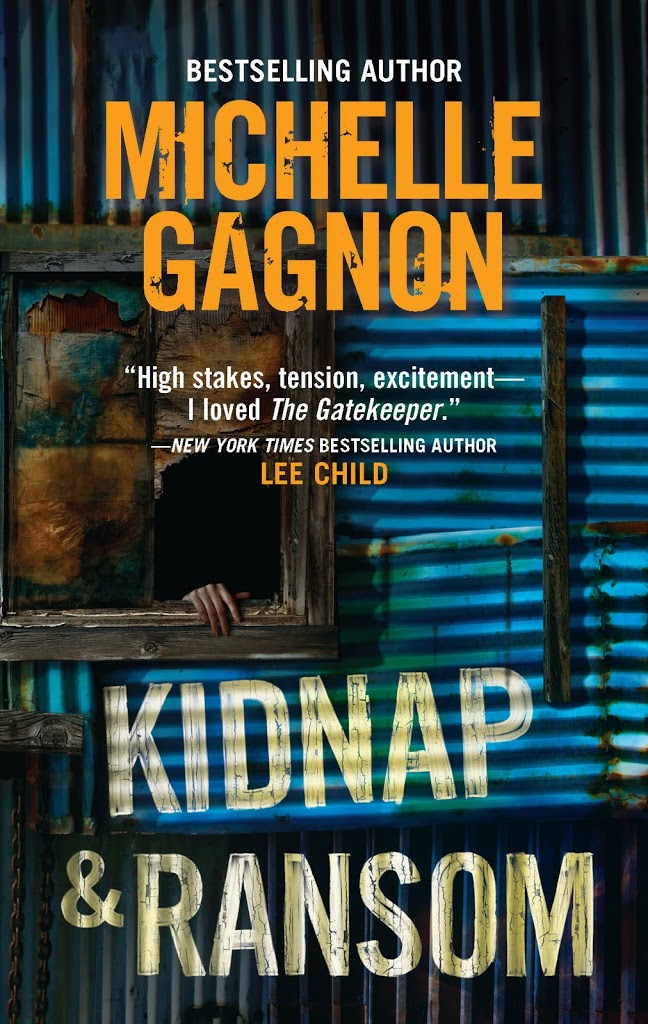
The real-life kidnapping that inspired KIDNAP & RANSOM

by Michelle Gagnon

My fourth book, KIDNAP & RANSOM, was released on November 1st. And unlike my last thriller, this time a real-life kidnapping sparked the initial idea for the story.

While researching border issues for THE GATEKEEPER in December of 2008, I stumbled across an article on the kidnapping of Felix Batista. Batista was a security consultant for ASI Global (if you saw the film PROOF OF LIFE, this was the same job held by Russell Crowe’s character).

Batista personally negotiated the release of more than a hundred hostages over the course of his career. That December he was in Saltillo, Mexico, offering advice on how to handle the uptick in abductions for ransom. While dining with local businessmen one evening, Batista excused himself from the table to take a phone call. On his way out of the restaurant to get better reception, he handed his companions his laptop and a list of phone numbers in case he didn’t return (this was a man who clearly knew you can never be too careful). Moments later, an SUV pulled to the curb and Batista was forced inside. He hasn’t been seen or heard from since.

The irony of the story grabbed me—the hero becoming the victim, an expert suddenly forced into the position he’d saved so many people from. Stranger still, his kidnapping wasn’t proceeding normally—there was no ransom demand, and no one claimed responsibility for seizing him. It was a true mystery. (And over the next two years, kidnappings and cartel violence in Mexico became increasingly rampant, spilling over the border to such an extent that related articles appeared in the U.S. media nearly every day.)

So I set off to find out more about narcocartels south of the border, and about kidnappings in general. I fixed on Los Zetas, mainly because their backstory was fascinating. Los Zetas is a gang comprised mainly of former Mexican Army soldiers. They were part of an elite brigade, comparable to the Army Rangers, trained in special operations techniques by the best in the business at Fort Benning in Georgia. Upon returning to Mexico, they promptly left the Army and went to work for the Gulf Cartel. Eventually, they branched off on their own, wresting control of drug trafficking operations from rival cartels. In recent years Los Zetas have become increasingly involved in kidnappings, murder-for-hire, extortion, money laundering, human smuggling, and oil siphoning. They’re suspected of killing the 72 migrants found in a mass grave in Tamaulipas last August, and of the murder of American David Hartley on Falcon Lake last September. The DEA considers Los Zetas to be the most violent paramilitary enforcement group in Mexico.
So when it came to villains, the choice was easy.

Last May, I attended the wedding of a friend from Mexico City who had helped tremendously with my research. At the reception, I was seated with some of his relatives. When they found out that my latest novel was set in their hometown, they were enthusiastic…until they heard the title.

“Oh, no,” one uncle said. “You cannot write about that. Mexico City is very safe.”

“Really?” I asked (in all sincerity, might I add). “I heard that most locals know at least one person who has been kidnapped.”

“Well, of course,” they all agreed. Every single person at the table knew someone who had been kidnapped. But as they explained, it’s much worse up north by the border with Texas. There, it’s really a problem.

Mexico is rapidly supplanting Iraq and Colombia as the kidnapping capital of the world. In the past decade, drug cartels and terror groups have seized upon kidnappings as a relatively low-risk source of financing. During a recent election in Russia, one political party’s entire campaign was funded covertly by ransom money.

Many kidnapping victims are held for months, or years. Some continue to be held even though their ransom has been paid. Many never make it home again.
I dedicated KIDNAP & RANSOM to them, and to people like Felix Batista who devote their lives to freeing them.

Opinions, Please

By Joe Moore

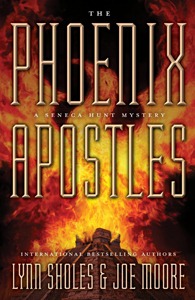
Last week, my publisher sent over the final cover design for my new thriller THE PHOENIX APOSTLES (written with Lynn Sholes) which is scheduled for release in June, 2011. TPA-blogThe title—the first one our publisher accepted with no change—refers to a group of followers of a religions cult that believes the only way to save the world from the predicted end of mankind is to appease the gods using the same technique as the Aztecs: human sacrifice. Or more specific, the ripping out of a human heart while the victim is still alive. Those are the “apostles” referred to in the title. The phoenix portion comes from the name of the group itself: The Phoenix Ministry, of which their logo is the mythical phoenix bird rising from its own ashes.

The cover consists of two main elements: the phoenix bird aflame shooting out of an Aztec pyramid, both of which go along with the plot of the story.

Although the back cover text has not been finalized, here’s the gist of the what it will say.

THE PHOENIX APOSTLES (coming June, 2011)

At a dig site in Mexico City, magazine journalist Seneca Hunt is reporting on the opening of Montezuma’s tomb when it’s discovered that the remains of the Aztec emperor are missing. Before she can investigate further, what appears to be a terrorist attack kills the dig team including her fiancé. Seneca barely escapes the carnage not knowing that a passing glimpse of an out-of-place object in the tomb may have sealed her fate. She soon learns that someone is stealing the burial remains of the most infamous mass murderers in history. Seeing a story in the making, her research uncovers a plot to slaughter millions in the name of an ancient cult. Seneca teams up with a bestselling novelist to prove the threat really exists while staying one step ahead of those who want her dead. As time is running out, she must follow a 2000-year-old trail leading back to the death of Jesus Christ.

Some of my fellow thriller authors were kind and generous enough to take the time to read THE PHOENIX APOSTLES and send me a blurb. Here are four:

"Bold, taut, and masterfully told."
— James Rollins, New York Times bestselling author of THE DOOMSDAY KEY

"A fascinating, compelling page-turner."
— Carla Neggers, New York Times bestselling author of COLD DAWN

"A knockout apocalyptic thriller!"
— Douglas Preston, New York Times bestselling author of IMPACT and THE MONSTER OF FLORENCE

"A rollicking thrill ride!"
— Tess Gerritsen, New York Times bestselling author of ICE COLD

You can read their complete quotes by clicking here.

So now that you’ve seen the cover and know a little bit about the story, would it grab your attention if you saw it in your favorite bookstore? Would it make you want to read the book? Please be honest and share your opinion. Thanks.

A beautiful day in the neighborhood

As neighbors go, I haven’t always been the most sociable–not in the Mr. Rogers, “I always wanted to have a neighbor just like you” kind of way. I don’t volunteer to organize block parties, update email and phone lists, any of the stuff that keeps people connected. I’m more one of those “If nominated, I will very reluctantly serve” kind of people. I don’t even remember the names of many of the people I’ve met at the annual block parties. (The one thing I do manage to do every year is to bring name tags, primarily so that I’m not embarrassed by not recalling the name of someone I’ve seen, at least once a year, for eight years now.)


But ever since I adopted my rescue Lab/Rotti mix, Macintosh, and started walking the streets twice a day, my outlook on neighbors has begun to change. We live in the charming but highly congested seaside village of Hermosa Beach in Southern California, where McMansions are packed cheek to jowl against small, aging beach cottages.


So as I’ve been walking down the street every day, I’ve gotten a much better feel for the neighbors. I know the retired SWAT officer who trains Rottweilers, and the family that never seems to be home because they’re always at their place up in Big Bear. I met another family when I found their gigantic white rabbit hopping around a garden. I gave it some carrots and water and kept it in our bathroom until I found out whose it was. (I loved my husband’s reaction after I called his cell phone to report that we had a large white rabbit locked in our bathroom. I’d just been diagnosed with hydrocephalus, a leaky brain fluid condition. He later confessed that he suspected I was hallucinating the rabbit, which I called Harvey, but whose actual name was Clover.}


For over a year I watched a double-wide McMansion being built on a corner that guaranteed it an ocean peek. (Around here, an ocean “peek” means you have a nice house. For an ocean “view”, we’re talking multiple millions). Finally the house was finished and landscaped. Last week I saw a Master-of-the-Universe type guy standing on the sidewalk outside the house, savoring his peek du mer. Mac was dragging behind me on his leash (he’s more of a supreme dawdler on walks.) Unfortunately when I wasn’t looking, Mac decided to hydrate the UMaster’s newly planted portofino plants. UMaster gave me a look of supreme disdain and said, “Please don’t allow your dog to do that.” Upon which I turned to Mac and said, “Please don’t water the gentleman’s shrubbery.” And on we went.


But most people are nice. I found out how nice they are, on Halloween. Mac and I are major magnets for off-leash dogs. On Sunday, he and I came upon a couple of guys with dogs, one of them a young Boxer off leash. Mac had a hard time in County lockup and doesn’t react well to off leash approaches, so I did my Dog Whisperer thing and put myself between the dogs to block. Turns out the Boxer had been following the men around for some time. We debated what to do. They found a leash from a lady who had leaned out her window to see what all the commotion was about. I decided the Boxer looked familiar–maybe it had escaped from a house near mine. We got the dog on the leash, and then we all trooped over to my neighbor’s house (I didn’t know the guy’s name, only that he has a Boxer.) We arrived at the guy’s house at the same time as Animal Control (which I’d called in a rash moment before instantly regretting it). So here we all descend on this guy’s house on Halloween–three dogs, two men, me, and the cops in a paddy wagon flashing blue lights. One of my guys pounds on my neighbor’s door.


“I hear a dog barking inside,” he says. Uh oh. Our Boxer must not belong to this house, then.


Then a pleasant but confused looking guy answers the door, along with his Boxer. He takes us all in. Meanwhile, I’m having a conversation with Animal Control. If they take him, the dog will go to “County,” which is tantamount to a death sentence. I’m panicking because I’ll face my own death sentence from DH if I bring one more animal home.


My neighbor–whose name is John, I now know–studies us for another moment, then says, “I could keep him for a while. I was thinking about getting a companion for Rocky, anyway.”


“You could name him Apollo, to go with Rocky the Boxer,” I suggested in a grateful tone.


We all left quickly after that. I got John’s contact number, and promised to put him in touch with my rescue group lady.


I was just blown away by the way this neighbor reacted so humanely after this pack of humans, dogs, and cops converged upon him like a Dogtown SWAT team.


Last night, I checked my email and found out that the wandering Boxer’s owners found him at John’s house and picked him up. Apollo’s real name is “Shake,” by the way.


Oh, and John is one neighbor whose name I won’t forget if I see him at the next block party.

Losing the Psychological Battle

by Clare Langley-Hawthorne

I pride myself on being pretty upbeat and resilient most of the time, but now, I fear I am losing the psychological battle as I try to get some major revisions complete on my current WIP. I have a revised chapter outline, so I know where I am headed, and I even have the first 150 pages revised and polished…but now I feel as though I have psyched myself out of being able to finish the manuscript on the timeline I had planned. To be fair we have made a rather major move to a new (or should I say old) country but the transition has had a greater psychological impact than I expected – it’s made me question my ability to juggle my writing with being a mum.
Don’t worry I am not about to embark on a whine-fest or a ‘woe-is-me’ blog post but I am finding that I no longer have the confidence that I can find the time to get the revisions done before school holidays arrive. So what’s the big deal about the holidays, you ask?

Let me explain…The long summer break here in Australia falls over the holidays (duh! That’s when it is summer here) and this means my twin boys finish school on December 7 and do not return until February 2nd next year. Given the total absence of the concept of summer camp in Oz, this means I will be looking after my boys pretty much 24-7 – which mean writing is limited to the ‘after bed-time’ hours. So, as you can imagine, I really, really, really want to get the bulk of my revisions done by December 7th.
Normally I would view this kind of thing as another challenge and I would just tell myself to slather on the bum-glue and get down to it…but this time I suddenly find myself immobilized by the prospect. I’ve convinced myself I cannot get it done and the prospect of the manuscript revisions stretching out into February next year is depressing as hell.

So I could really do with some advice on how regain the upper hand in the psychological battle (with myself!) to get the manuscript finished. Any tips on how to un-psych myself out of this hole?
Otherwise, I fear you may be hearing a two month long scream of frustration all the way from Down Under…

The Great Semi-Colon Debate

by James Scott Bell

And you didn’t think there was one, did you?
Well, there is. At least I’m declaring it so, here and now.
When it comes to fiction, I think of semi-colons the way I think of eggplant: avoid at all costs. As Kurt Vonnegut once said, “Here is a lesson in creative writing. First rule: Do not use semicolons … All they do is show you’ve been to college.”
The semi-colon is a burp, a hiccup. It’s a drunk staggering out of the saloon at 2 a.m., grabbing your lapels on the way and asking you to listen to one more story.
Not that I have an opinion, you understand.
Okay, I’ll modify things a bit. For non-fiction, like essays and scholarly writing, the semi-colon does serve a purpose; I’ve used them myself. In such writings you’re often stringing two thoughts together for a larger point, and the semi-colon allows you to clue the reader in on this move.
But in fiction, you want each sentence to stand on its own, boldly. The semi-colon is an invitation to pause, to think twice, to look around in different directions, to wonder where the heck you’re standing. Do you want that? Or do you want your story to move?
The semi-colon is a stone that causes the reader to stumble.
Not that they’ll notice this on a conscious level. Most won’t think, “Why’d he use a semi-colon here? I’m being taken out of the story!” No, but it will have that very effect, on a subconscious level. It will weaken the reading experience in a small way. Not fatally, but why would you want even a small speed bump in your story?
The semi-colon is especially grating in dialogue:
“We must run to the fire,” Mary said. “It is going to burn the town; that is a disaster!”
What’s that semi-colon doing there? Is it making Mary’s dialogue stronger or weaker? Is it adding to the intensity of the moment or diluting it?
Semi-colons. For academics, yes. For novelists, no.
I’ll leave you with this clip from a poem entitled “On Punctuation” by Elizabeth Austen. You may then offer your own opinion on the great semi-colon debate!
 . . .as for the semi-
colon call it what it is

a period slumming
with the commas

a poser at the bar

feigning liberation with one hand

tightening the leash with the other
 . . .
“On Punctuation” by Elizabeth Austen, from The Girl Who Goes Alone. © Floating Bridge Press, 2010

Steel Teeth and Soft Thumbs

John Ramsey Miller

On Monday I went stupid for a split second and damn near lost my left thumb to the blade on my table saw, which was spinning at 4,000 RPMs. I’ve been using table saws all of my adult life and this is the first time I’ve drawn blood. I kept the thumb, but involved 17 stitches and I will long bear a greatly revised fingerprint and a lack of those nerves that tell a person what their thumb is discovering. At the time, I was working alone out at my place so I had no choice but to wrap a bandanna around the injury and drive myself the 25 miles to the hospital of my choice.

This Tuesday past I was scheduled to speak this week and so I had to wear something other than denim overalls and slip-on boots. Alone at home, I discovered that I had to iron a dress shirt, which is slightly harder with a thumb cocooned within a huge bandage. Then I had to button my shirt, tie my tie, and lace up my dress shoes with one thumb. I haven’t had so much trouble with tying a bow since I was five. After managing to do all of that, I had the pleasure of speaking to a group of fifty or so supporters of the library at a nearby college. I talked about my background and how I fell into my career, and how I do what I do. I ran through the old standards: developing characters, where my plots come from, the differences between mysteries and thrillers and then I went into ebooks and what seems to be the future of publishing. For instance, by 2014 ebooks should account for 25% of publishing income. I basically scared the crap out of the audience.

But the cool thing (and one of the points of this blathering) was I started my talk by holding up my Kindle, explaining how it works, how I can put a library inside it, and then placing it on the lectern and waking it up. After I was finished with the basics of my life and career, I told them what was happening with ebooks and the publishing industry. After my talk there was an hour and a half of questions. And I confessed that the points for the talk I had just given were on the Kindle screen. I emailed them to my kindle, and when I had covered the points on the screen I would just hit the “next page” button. The night before I was trying to decide if I would use note cards or wing it as I usually do, but this thumb thing requires stiff medication and that can fog the sharpest mind. I knew I could email my manuscripts into the creature, and so I went modern and emailed my notes to John’s Kindle, which has its own email address. Worked like a charm. But the entire time I was speaking, and glancing down, I swear the Kindle was breathing raspily and saying, “John, I am your father. Embrace the force. Love the technology.” Well, I guess I’ve gone over completely.

Page One . . . Again

By John Gilstrap
Threat Warning is in the can now (look for it next July), and now it’s time to get on with the next book in the Jonathan Grave series. I’m calling it Untitled Grave 4 for the time being, but I’m reasonably certain that I’ll come up with something more compelling before the pub date rolls around in 2012.

I know the basic bones of the story, and I’ve already mapped out the kick-ass final sequence in my head. Having spent all of July and August in a panicked writing frenzy (the price of procrastination), I harbor a dream of digging right into the story and hammering it out right away, delivering a finished manuscript a few months early, thus buying time to take a more leisurely pace on the book to follow that one. Recognizing that I wrote the last 300 pages of Threat Warning in about seven weeks, I should be able to have this next book finished by April and not even be out of breath.

I should be able to do that. So, why can’t I do that?

I think it’s because I don’t like me very much during the frenzied times. Every waking hour that I’m not dedicating to my Big Boy job is dedicated to the book. I’m not much of a husband or a friend during those times, and when the pressure is finally lifted, the pleasure of not writing—the pleasure of dinner table conversations and occasional nights out—is so overwhelming that I find it difficult to sit down and write again.

Thus far, I figure I’ve written about 200 words of the next opus. Soon enough, I’ll be pulled away to respond to the inevitable editorial letter for Threat Warning, and when that’s done it’ll be the Holidays, and shortly after that, two nights per week will be consumed by American Idol (yes, I’m a rabid fan), and then, come May, if this year mimics previous years, I’ll be about 200 pages behind the power curve, and the race to catch up will begin.

Come July and ThrillerFest and the release of Threat Warning, I’ll become impossibly distracted, and then the panic will begin again. I’m beginning to think that maybe I need the crippling pressure to be motivated. Is it really procrastination if you know it’s going to happen?

As I write this, I really hope that I’ll find a way to pace myself and write consistently and regularly, so that when summer rolls around next year, I’ll be able to enjoy it. In fact, that’s the plan.

I wonder if I’ll be able to make it happen . . .