The Two Things Every Novel Needs


“Trouble is my business.” – Raymond Chandler
So you want to be a writer. You want to sell your novel to a publisher, via an agent, or maybe you’re thinking of going indie like 90% of sentient beings these days. Maybe you think if you do the latter, and do it fast, you’ll rake in a boatload of easy lettuce.
Well, you won’t. Unless your book has the two things every novel needs.
Without these two things, you will have no story. At least, no story most readers will care about. You might have an “experimental novel,” and that’s okay if you understand what experimental novel means. It means a novel that five people buy. (Please note: This may not matter to you, and that’s perfectly fine with me. Experimental artists have given us some good stuff over the years. A lot of bad stuff, too. But if that’s your corner of the artistic world, go for it. This is America, after all).
But if you want to sell your work and have a shot at generating income, you need to master these two elements.
They are Conflict and Suspense.
Conflict
What is the goal of the novel? Is it to entertain? Teach? Preach? Stir up anger? Change the world? Make the author a lot of money?
It can be any of these things, but in the end, none of these objectives will work to their full potential unless they forge, in some way, a satisfying emotional experience for the reader.
And what gets the reader hooked emotionally? Trouble. Readers are gripped by the terrible trials a character goes through. (There are psychological reasons for this that are beyond the scope of this post).
That’s where conflict comes in. While there are writers who say plot comes from character, let me say that’s too simplistic. Character actually comes from plot. Why? Because true character is only revealed in crisis. Put your character into big trouble (plot) and then we’ll see what he or she is made of (character). If you don’t believe me, imagine a 400 page novel about Scarlett O’Hara where she just sits on the porch all day, sipping mint juleps and flirting. Gone With the Wind only takes off when she finds out Ashley is going to marry Melanie (trouble) and then the Civil War breaks out (big trouble!)
Another way to think about it is this: we all wear masks in our lives. A major crisis forces us to take off the mask and reveal who we really are. That’s the role of conflict in fiction: to rip the mask off the character.
Now, this conflict must be of sufficient magnitude to matter to readers. That’s why I teach that “death stakes” must be involved. Your Lead character must be facing death—which can be physical, professional or psychological.
Genre doesn’t matter. In a literary novel like The Catcher in the Rye, it’s psychological death. Holden Caulfield must find meaning in the world or he will “die inside.” Psychological death is also the key to a category romance. If the two lovers do not get together, they will lose their soul mate. They will die inside and forever have diminished lives (that’s the feeling you need to create. Think about it. Why was Titanic such a hit with teen girls? It wasn’t because of the special effects!)
In The Silence of the Lambs,it’s professional death on the line. Clarice Starling must help bring down Buffalo Bill in part by playing mind games with Hannibal Lecter. If she doesn’t prevail, another innocent will die (physical death in the subplot) and Clarice’s career will be over.
And in most thrillers, of course, you have the threat of physical death hanging over the whole thing.
That’s why, novelist friend, trouble is indeed your business. Without sufficient conflict readers aren’t going to care enough to finish the book.
Suspense
The second element is suspense,and I don’t just mean in the suspense novel per se. Suspense means to “delay resolution so as to excite anticipation.” Another way to say this is that it’s the opposite of having a predictable story. If the reader keeps guessing what’s going to happen, and is right, there is no great pleasure in reading the novel.
We’ve all had the wonderful experience of being so caught up in a story that we have to keep turning the pages. This is where writing technique can be studied and learned and applied. For example, there are various ways you can end a chapter so readers are compelled to read on. I call these “Read on Prompts,” and it was one of the first things I personally studied when I started learning to write. I went to a used bookstore and bought a bunch of King, Koontz and Grisham. When I’d get to the end of a chapter I’d write in pencil on the page what they did to get me to read on.
Invaluable. Of all the reader mail I’ve received over the years, the ones that please me most are those that say, “I couldn’t put it down.” Music to a writer’s ears. Suspense will make music for you.
And again, genre doesn’t matter. You have to be able to excite anticipation and avoid predictability in any novel. 
I am so passionate about this that I wrote a whole book on the subject, and Writer’s Digest Books has just released it.
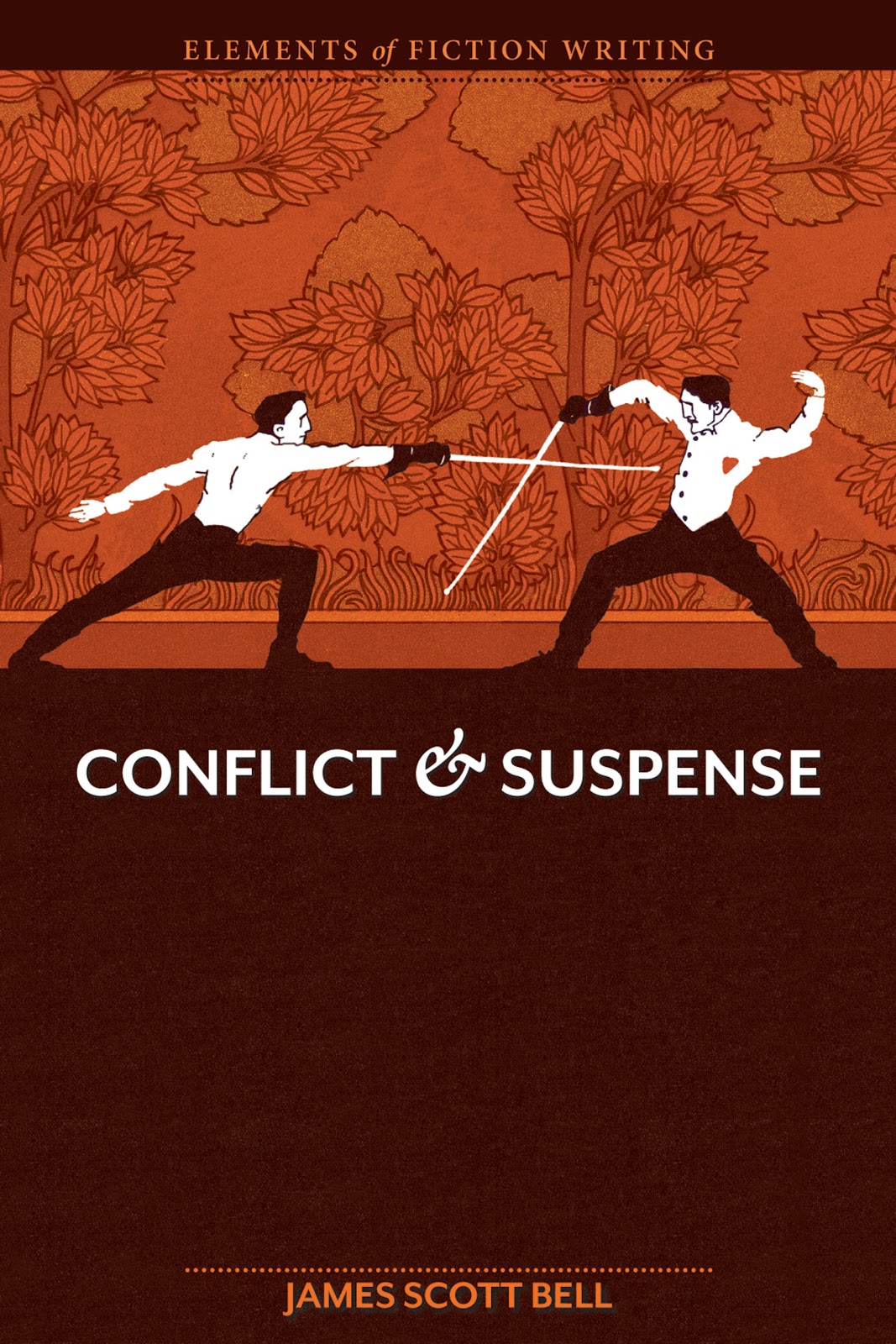
[Insert short commercial here!]
For the PRINT version:
Or E-BOOK:
[End commercial here with woman looking pleased with product]

I could go on and on about this subject, but we don’t want to overstuff one blog post. Suffice to say that if you were to concentrate almost exclusively on these two key elements for the next few months, your books will take a huge step toward that exalted “next level” everyone always talks about. Try it and see.
May your own new year be filled with plenty of conflict and suspense (on the page, I mean!)
***
NOTE: I will be teaching a workshop on conflict and suspense at the annual Writer’s Digest conference in New York, January 20-22. It’s the perfect time to travel to the Big Apple (just bring a coat). And it’s an awesome conference. Use this code: WDCSPEAKER12 when you sign up and you’ll get a $115 discount off the regular price (the home office says this is for new registrations only). Go to the WD Conference page to find out more.
The Roads Less Traveled

When I need to recharge the creative batteries I go to a part of my metropolitan area that I have never been to before and either walk or drive for several blocks, dictating notes about what and who I see. I started doing this several years ago, when my two sons were in short pants. One Christmas break I had pretty much broken the bank while assisting Santa Claus and, as will happen with children between the ages of 5 and 40, they were bored and looking for something to do. I don’t know why or how I thought of it, but I suggested that I would take them down some streets that they had been past frequently, but never been down. I also offered to take them, if possible, into buildings they had seen, but never entered. We had a lot of fun doing it. We went to recording studios and old hotels and down streets that had houses that had been built in the 1870s, where people had lived and died and procreated and slept and waken thousands of times over decades, their lives strange and unfamiliar layers that others would later walk upon. And I started imagining what had happened in each one, to this teenaged girl or that widowed husband or those families for whom the term “living in quiet desperation” had undoubtedly be coined.
My sons are older and have lives of their own but I still take those walks and make those drives when the page is blank and the well seems empty.  A few months ago I noticed a small house set back off a street, between a twelve-unit apartment building and a duplex, like a small child trying to unobtrusively hide behind two much bigger siblings. The house has apparently been there for a while — the auditor’s office lists its date of construction as “old” — and looks to surely be haunted.  It figures prominently in a project I’m working on. There are others buildings and people like that house, full of stories, just waiting to be opened and read. There are storerooms without signs that are barred with new locks during the day and where parking lots fill at odd hours of the night. And there are people who were someone’s son or daughter who sit, reliably as the USNO Master Clock, smoking cigarettes and drinking coffee on benches and in alleys, some of whom know secrets that would curl your hair, if you were but to ask.
Each person, each building, is a book, some humdrum and common, others almost — almost — beyond imagination. Do you look? Do you ask? Have you ever opened a door not your own and been surprised by what you found? Or asked a stranger a question and been shocked by the answer? All of the stories will never be told, but many are there for the asking.

Lots Of Opportunity in 2012

By John Gilstrap
Fair warning: What follows might be categorized as shameless self-promotion.  I prefer to think of it as seeing pretty lights on the horizon.  Either way . . .


If 2012 lives up to its potential, it could be a terrific year for me, career-wise.  It’s the kind of potential that I hesitate to talk about for fear of jinxing things, but among my resolutions for this year is to be less locked-down about things in general.


Let’s start with book news.  Nathan’s Run, my first novel (released in 1996), is now available in all eBook formats, with a paper version to follow sometime in the future.  As an added bonus, the eBook contains a link to my original ending to the story, which should answer the single most-asked question about Nathan’s Run.


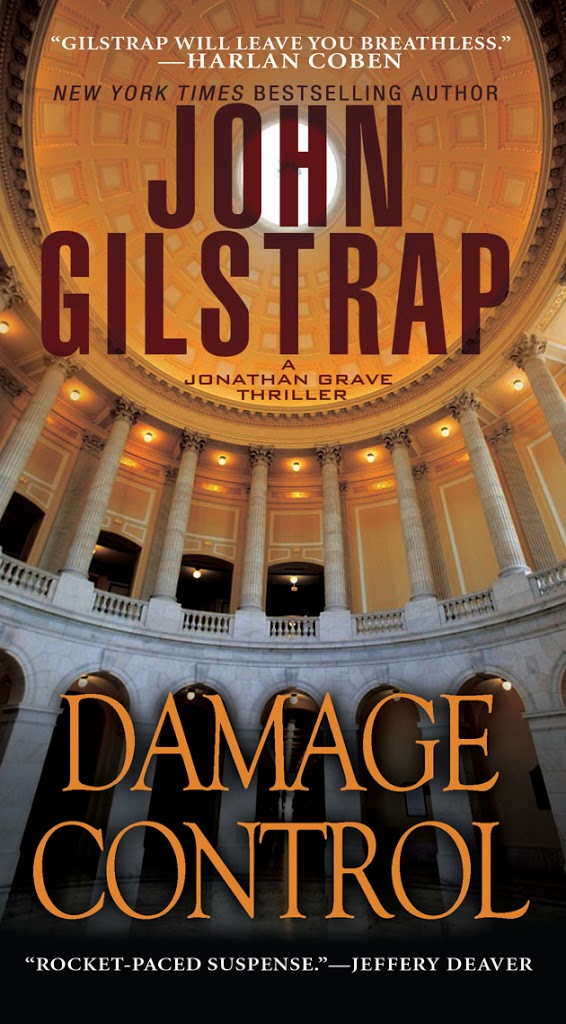
On the Jonathan Grave front, Kensington is yet again stepping up to give the series as big a push as the market can sustain.  Damage Control (June, 2012) is featured in a two-page spread for the catalog, and will be released in a premium mass market format–not quite trade paper, but taller than the standard MMPB, which, if nothing else, allows for a more readable font size.  This is what happens when a professional sales force truly gets 100 percent behind an author and his books.  I couldn’t ask for more.


Hopefully, there’ll be movie news in 2012, as well.  New Year’s resolutions notwithstanding, I have to be a little circumspect here, but we seem to have taken a giant step closer to seeing a version of Six Minutes to Freedom on the big screen.  The rules of the movie game dictate that official announcements come not from me but from the producers.  Suffice to say that meetings are going very well, and that all the players seem to truly get the story.


Then there’s the television series I’m developing.  This, too, seems to have real legs with intense interest from all the right people.  We’ll actually be doing some shooting later in the month.  If it goes well, y’all will be among the first to hear.  If it doesn’t, well, I probably won’t say much because I think it’s a very good, very stealable idea.  (Is stealable a word?)


Finally, I would love to make this my first two-book year.  I’ve had an idea knocking around in my head for years, and if I don’t get it on paper, it’s going to make me crazy.  For that to happen, though, I need to write the next Grave book in six months instead of a year.  If all the other stuff comes to pass, this one might not be doable, but for now, in the first week of a brand new year, anything and everything is possible.


Here’s hoping that everyone’s dreams are realized in 2012!

Mortification, in the First Person

by Michelle Gagnon

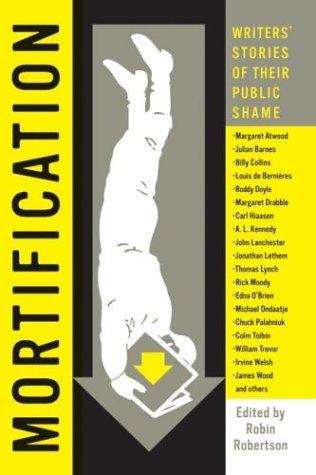
One of my all-time favorite books (and a popular gift for friends who write) is called, MORTIFICATION: WRITERS’ STORIES OF THEIR PUBLIC SHAME.

It includes vignettes from such storied authors as Roddy Doyle, Michael Ondaatje, and Val McDermid on the most embarrassing experiences they’ve ever had during their writing careers. For example, did you know that Margaret Atwood’s first-ever book signing took place in the Men’s Socks and Underwear section of a department store? Or that some of Chuck Palahniuk’s fans started throwing dinner rolls at him during an event in San Francisco? And apparently Stephen King was once forced to sign so many books that his fingers cracked and started to bleed.

Up until last October, my most mortifying moment as an author occurred at a local bookstore, when not a single person showed up for my reading.

And then along came Litquake.

Litquake is San Francisco’s premier literary festival, a week-long celebration of the written word that features hundreds of authors reading at dozens of events. More than 16,000 people attended last year. Being asked to participate is a big deal, particularly for one of the most coveted spots.
And for the 2011 series, I was included in a great one, entitled, “These Mean Streets: Reality and Fiction Collide.”
I was the only woman appearing on a slate with a former mob informant; the terrific writer, working PI, and all around great writer David Corbett; and a slew of other big names. The event was being held at Tosca Cafe, one of my favorite bars in San Francisco.

All in all, it was shaping up to be an exciting evening. Thanks largely to the fact that the event would be happening in a bar, I even managed to convince several friends who don’t ordinarily attend readings to come along.

You can never predict how big the crowd will be at one of these events, but that night, Tosca was packed. Standing room only, easily a couple hundred people in the room.

I was nervous, and hadn’t slept terribly well the night before. Too nervous to eat very much all day, in fact. So I did what any sane person would do–I drank a glass of wine to calm myself down.
I was scheduled to be the third reader of the evening. I sat through the first two, my mouth dry, palms slick with sweat, tapping the pages of my chapter on the table (to the growing irritation of my friends).

And then, it was my turn.

I’ve performed in hundreds of dance performances, and have participated in dozens of author events over the past few years. One thing I know: the minute I get up there, the nervousness dissipates and I’m fine.
So there I was, standing in front of a microphone with a spotlight bearing down on me, facing this hot, crowded room.

Initially, everything was clipping along just fine. I read the first few pages of my chapter, and the crowd seemed appreciative–at least, no one was heckling or throwing things at me.

In the middle of page five, the words started swimming before my eyes. I paused and tried hard to force them back into focus. They refused to cooperate. I realized that for the space of at least a minute, I hadn’t said anything. Panicking, I tried to collect myself. I stood up tall, found my place, and got through another paragraph.

I’ve never fainted before in my life–never even came close. But next thing I know, I’m lying on my back with a total stranger inches from my face, yelling, “Were you locking out your knees?”

Which even in retrospect doesn’t seem to be the first thing you should ask someone who has just passed out cold.

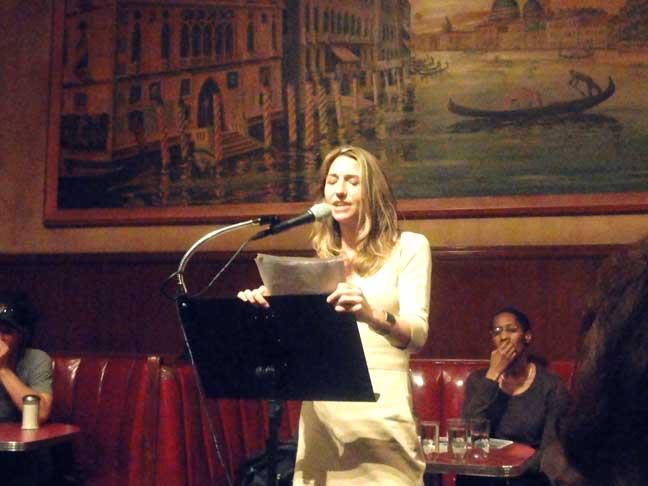
Thankfully, there was an open booth behind me. According to my friends (who delighted in detailing the exact order of events after I’d recovered slightly), I said, “I’m dizzy,” then sat down hard in the booth behind me. After which I proceeded to plummet ungracefully into the lap of the woman occupying the banquette (featured in the photo above, right before we became much better acquainted).
And of course, this was the one and only time that I’d decided to wear a dress for a reading. Meaning that I pretty much flashed the entire audience. Thank God I was wearing tights.

My friends helped me outside and plied me with glasses of water and relatively fresh air (there were a lot of smokers around). Strangers came out to check on me. The rest of the reading proceeded inside; sadly, I missed most of it. As a favor, the event organizers let me get up and finish my story at the very end of the evening.

A week later, during the closing party, Litquake impresario Jack Boulware informed me that they’ve never had an author faint before–apparently it was the talk of the organizing committee. So much so that they’re debating naming an honorary award after me next year. Word is still out on whether it will be bestowed for passing out or remaining conscious.

So now, should the editors of MORTIFICATION ever contact me, I can assuredly put Stephen King’s most embarrassing moment to shame.

I’d love to hear about your most mortifying experience, either during and event or really, at any point in your life. Please. It will make me feel better.

Beating the January Doldrums

As Florida residents, we’re accused of having no change of seasons. This is far from true. In the Spring, we definitely note the rise in humidity as we approach hurricane season. Fall brings some color changes to certain trees although they don’t drop leaves. The morning air gets cooler, and the autumn scent is in the air. Summer is our rainy season with daily showers and high humidity. I love the smell of impending rain and the march of angry clouds across the horizon. But winters are why we live in Florida.
I don’t complain if morning temps start out in the low sixties and rise to eighty by noon. Other transplanted Northerners may whine about the lack of cold, but not me! I grew up in New Jersey, and you can have the ice and snow. Winter here is delightful when it’s mild. In South Florida, you can smell orange blossoms as you stroll past manicured lawns. Brilliantly colored flowers grace the landscaping, and palm fronds wave in the breeze. So why would we experience doldrums under these ideal conditions?
It’s not as though we live up North where the days are short and so are the tempers. Some folks, I understand, love winter. Skiing, sledding, skating—you name it, they love bundling up with the sting of bitter cold in their nostrils. Other people hate the tedium of shoveling snow and sloshing through slush for endless gray days. But the one thing we all face is that the holidays are over and now it’s business as usual.
Yep, we have to get back to work after a hectic month of parties, gift exchanges, and feasts. The long winter stretches ahead. How can we make it through? (And how can we lose the weight we gained?)Here are a few suggestions:

  • Stack up a pile of favorite books to read. Maybe you asked for them on your holiday gift list, or loaded them into your new ebook reader. But each evening, you’ll have something exciting to anticipate.
  • Look for a new author who has written several books in a series you might enjoy. Try one, and get hooked on them all.
  • Cozy up on the couch with some movies you’ve always wanted to watch or a television series that you can view from Season 1.
  • Play with your new technology and learn how it operates. Cell phone? iPad? Nook?
  • Take a class in a new subject.
  • Start an exercise program or buy a new workout DVD. Use a Wii with exercise programs.
  • Determine to eat healthy and try out new recipes, maybe take a cooking class with a friend.
  • Join a book club, sewing circle, or knitting group, or volunteer your services, anything that gets you out of the house and into the company of others beside writers.
  • Plan a vacation or a dinner party. Either way, figuring out the details will keep you busy in a happy way.
  • Share the love. Shower your pet with affection. Call a friend you haven’t contacted in months. Do something special for a loved one.
  • Set your goals for the New Year. Having a purpose will drive you forward.

What advice would you offer for beating the January jitters and the winter blues?

2012 WITH NO END IN SIGHT

By: Kathleen Pickering  http://www.kathleenpickering.com

Now that the holidays are already behind us, let me begin by offering each and every one of us a Merry New Year filled with excitement and possibilities!

http://www.public-domain-image.com (public domain image)

I know the Mayans promised us the end of the world, but I’d like to offer another possibility. How about the end of the world as we know it? Like, no more heart-ache and wars and economic strife. No more anxiety over careers and passions and hopes and dreams. I’d like to submit that the Armageddon we can all personally claim will be the death of all things negative in our lives.

I know the planet is still going to spin, the sun will continue to shine, my granddaughter will surely be born in May and I will have to make good on the pending three book contract I have coming down the pike from Harlequin.

There will be no end of the world for me only a different way to approach my world view.

Like New Year’s resolutions, I think it would be awesome and easy to allow these four simple views to become our new reality:

1. There is enough of everything for everybody. Sharing my wealth, talent and time can do nothing but improve me. There is no need to compete with anyone for my space in the world. Abundance is universal. Not only in my career, but in reaching out to everyone in need.

2. This planet earth which so graciously nurtures us is in as much need of our care as we are in need of hers. Greeting her each day with the affection we show to our loved ones can do nothing but keep her healthy and strong to sustain us.

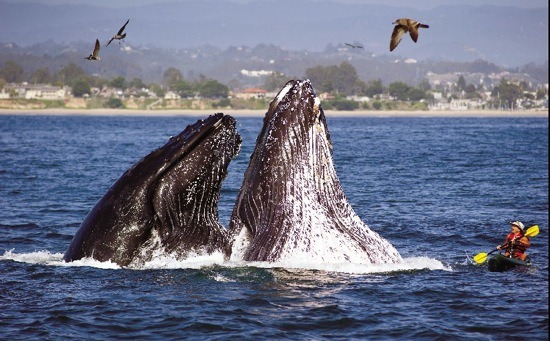
Whales

3. We already have the technology to live “Green” lives. Why don’t each and every one of us take the baby steps to becoming environmentally correct adults? Think of what living cleanly will do to our subconscious self-worth!

4. Each of us was born uniquely, yet our differences do NOT set us apart. Our uniqueness enhances our human experience. We need each other to appreciate life. Who I am is my gift to you and vice-versa. We should honor each other because when you look closely into my eyes, you will see yourself.

5. We are out of time for procrastination. This is 2012. The end of the world as we know it, so they say. I’m going to take that as fact: the end of the world as I know it. There is nothing but this moment, right now. What you and I do with each minute, hour, day will depend on how we shape the world. Me? I’m digging deep within to bring out the golden nuggets I was born to share with you.

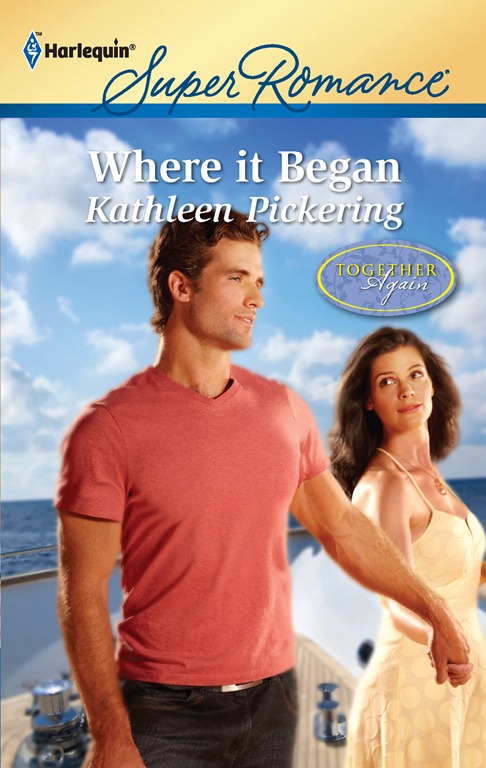
So, I have to end here. My new WIP awaits. Today I’m celebrating the release of my first Harlequin novel, WHERE IT BEGAN.

9780373717545

Click here to view on Amazon:

http://www.amazon.com/Where-Harlequin-Superromance-Kathleen-Pickering/dp/0373717547/ref=sr_1_4?ie=UTF8&qid=1317497566&sr=8-4

It’s a love story about a girl with a past she can’t remember. The mystery is . . . when she does remember, will her new world be seen with love?

I invite us all to view the world with love. Even mystery writers do that. They battle the bad and the bleak to bring about the good. Let’s let the old world die and make 2012 the year humanity remembers for the best.

So, care to share? If you could make one change for the better in your career, or life . . . what would it be? 

Happy New Year from TKZ

by Clare Langley-Hawthorne

As the author of the first TKZ blog post for the new year let me wish everyone a happy, healthy and prosperous 2012, full of wild crazy dreams and completed manuscripts! 


Although, I usually start off the year with a list of (often futile) new year resolutions, this year I’ve decided to work on just three key areas (and I confess I’ve nicked these from my sons’ school) – organization, persistence and resilience. So just like ‘Oscar Organization’, ‘Pete Persistence’ and Rosie Resilience’ I am going to tackle the new writing year full-on with optimism and tenacity (hey, it’s only January 2, I can be enthusiastic!)


Given the current state of the world and the in-flux nature of publishing, these also seem like a good triumvirate to take on board. All three are crucial to being a published author (whether indie or traditional) and are the key ingredients to what I like to call ‘bum glue’ – what all writers need to progress from the dream of a novel to an actual, completed manuscript. As I close in on the finish line for my latest WIP, I know that bum glue, which survived the holiday madness, has been vital.


When it comes to the TKZ, I look back at 2011 and am amazed at the breadth of topics covered – though, inevitably, the question of ‘indie versus traditional publishing’ dominated many a ‘comment debate’. So, as the new year commences, I thought I’d find out what you’d like to see more (and less) of in the future from our blog posts. 

  • Are there any areas you think we haven’t adequately covered? (or topics you feel we’ve done to death?!)
  • Do you have burning questions we haven’t addressed? 
  • Would you like us to have more guest bloggers from the industry (editors, agents or publicists for example) or perhaps change the format some weeks (where we give our points of view on one particular topic or question)?
  • Are there any changes/expansions you’d like to see to our existing ‘first-page’ analysis competition? 
  • And given the impending Mayan apocalypse… any last (writing related) requests for us at TKZ?

This is your chance to weigh in on topics/issues or areas you’d like us to cover this year, so let us know! 


Happy New Year!

Happy Holidays!

[image4.png]It’s Winter break here at the Kill Zone. During our 2-week hiatus, we’ll be spending time with our families and friends, and celebrating all the traditions that make this time of year so wonderful. We sincerely thank you for visiting our blog and commenting on our rants and raves. We wish you a truly blessed Holiday Season and a prosperous 2012. From Clare, Kathryn, Kathleen, Joe M., Nancy, Michelle, Jordan, John G., Joe H., John M., and James to all our friends and visitors, Seasons Greeting from the Kill Zone.
See you back here on Monday, January 2.

Be Thankful That You’re a Writer

James Scott Bell
Twitter.com/jamesscottbell

As we close up shop for a couple of weeks here at TKZ, it’s the perfect time to reflect on the year past and the year to come, and to pause and be thankful for the blessings you enjoy. If there is one thing world religions and secular philosophy largely agree upon, it is that gratitude is the key to happiness. Learning how to be thankful consistently may take some practice and discipline, but it can be done. And it is so worth it.

You can start by being thankful that you’re a writer.

Be thankful because you get to play. You get to make stuff up. You get to spin yarns that have the potential to move people. Do you know how hard that is to do? But when you do it, when you hear from a reader of your work who loved it – even if it’s just your Uncle Harry – there’s something magic in that transaction. And people today have precious little magic in their lives. You do.

So be thankful that you’re a writer.

It’s work, to be sure. It can be frustrating and bewildering and angering and insane. It can keep you up at night and wandering the streets talking to yourself like a mental patient without his meds (though what you are really doing is figuring out what your character might say in that scene you’re working on). There are plenty of obstacles and set-backs that happen in a writing life, but you know what? Those are the very things that make you stronger. If you persevere, if you care, if you feel your calling in your heart and mind and sinews, if you know deep down that you’re a writer, keep after it. If you do, when the dust all settles, you will have found a rich satisfaction in this passion of yours.

Because most folks don’t feel much passion for anything. As Thoreau famously noted, the mass of people “lead lives of quiet desperation.” But you’re a writer, so at least if you ever do feel desperate, it’s not going to be quiet! It’ll shout and beat drums and cry and scream. But that very noise will pull you out of despair and get you back to the page, where your passion lives. Writing will save you from ever being stuck in the Land of Bland sequestered in the Army of the Drab.

In Herb Gardner’s great play, A Thousand Clowns, Murray Burns tries to explain to his bland brother why he dropped out of the “rat race.”

Arnold, five months ago I forgot what day it was. I’m on the subway on my way to work and I didn’t know what day it was and it scared the hell out of me. I was sitting in the express looking out the window, watching the local stops go by in the dark, with an empty head and my arms folded, not feeling great and not feeling rotten, just . . .not feeling. And for a minute I couldn’t remember, I didn’t know, unless I really concentrated, whether it was a Tuesday or a Thursday or . . . for a minute it could have been any day, Arnie. It scared the hell out of me. You got to know what day it is. You have to own your days and name them, each one of them, every one of them, or else the years go right by and none of them belong to you.

You’re a writer, and your days belong to you. You can name them and own them. Be thankful for that.

And don’t fall into the trap of thinking money is the sole measure of success in this game. That’s only a part of it. Even so, the incredible thing is that it’s now more possible than ever for a writer to make something from writing. If you have the goods, you can find the buyers. The buyer might be a traditional publisher, or it might be a reader out there downloading digital. But you are living in a new golden age. Never have we had the choices we do now. Even if you only make a pittance it’s within your power to do so, which means you’re better off than the great majority of writers in the whole history of scribbling. Do you realize how fantastic that is?

Be thankful that you’re a writer!

Don’t be ashamed of it, don’t be afraid to call yourself what you are, don’t let the naysayers and critics (even if they are in your immediate family) keep you from doing what you love.

Here comes 2012. Resolve to write for all you’re worth, which is inestimable. Because, as Brenda Ueland puts it, each one of you is original and talented and has something important to say. A writer is original, Ueland says, “if he tells the truth, if he speaks from himself. But it must be from his true self and not from the self he thinks he should be.”

Be done with the shoulds. Tell your stories and don’t hold back. Give your imagination freedom to run. Study the craft because it’s your friend and helps you express your true self on the page.

And one thing more: keep on writing for the rest of your life. Don’t stop. Ever. Why should you? You’re a writer, after all, and that’s a wonderful thing to be.

Merry Christmas, Happy Holidays, and have a Joyous and Keyboard-Clacking New Year. 

It’s High Time We Abandon The Printed Book Once and For all.

John Ramsey Miller

I’ve been thinking about books. Magazines. Newspapers. Sales Brochures. Mail.

I have stacks of books, magazines. I have a storage room filled with boxes of books. I have a wall-length book shelves packed with hardcovers. I don’t know that I’ll ever again open most of them. I’m not sure I’ve ever opened a lot of them. The pages of the newer hardcovers are yellowing, the older ones were printed on better paper with less acids. A Russian edition of one of my books was printer on what looks like tabloid pulp. I’m slowly turning against paper books. I’ve decided that I might be ready to face the new world where books are delivered through the air like lethal arrows were delivered to massed armies a long time ago. I’m not talking plains Indians firing a few at settlers and cavalry units, but more like Medieval armies where archers would loose thousands of arrows that would rain down like steel-tipped rain. Wow, and ouch.
I have a Kindle. I also have a Google Android “A-4 Panaramadingdong” with a 7″ screen. My wife bought a Kindle Fire that we promptly passed on to our 4-year-old screen-addicted grandson for him and his family. Christmas gift. We are giving our other grandchildren the Google color-screen thingamabobs for reading and gaming for Christmas. They are dang near cheaper than a box of Lincoln Logs. And they are not just gaming devices, but a delivery device for books.
For a moment let’s look beyond the typical “coot-ish” argument of “Owww, I must have the feel of a book, the aroma of paper and ink, the sound of pages turning. I need an actual book in my hands for the experience, blah, blah…” Hopefully the days of physical books are going away, and my suggestion is “Git ov’r it, y’old farts!” Okay, fellow old farts. I’m sure people, all now dead, felt the same way about the demise of clay tablets, cave drawings, scrolls, and smoke signals. Backordering was invented in the days when people wrote books one copy at a time.

I think I have boiled down the major reasons to turn away from the printed book for once and all time. There are just ten listed here but I have two others I’m holding back so I won’t have twelve on the list.
1) Libraries will no longer require huge buildings since the e-versioning of the books in the Library of Congress will fit into a single-wide with enough room left for a few reading TV trays. In these days of lowered city budgets, it’s great when one window unit can cool an entire library. No more cricked-up necks from browsing book spines in the library stacks. Plus librarians will be free to get real jobs or appear as contestants on Jeopardy.
2) The savings in “spine” string would stretch from the lobby of the Peabody Hotel in Memphis to the far edge of the known Universe. This saved string can be used for other things like making hammocks, for filling the insides of more yo-yo’s, and giving towns across the country the ability to create string balls the size of Sperm Whales as a method of drawing tourists.
3) We will save enough trees to build fifty-seven Noah-style animal arks a week for fifty years. Plus we will have 250 million trees left growing which give us oxygen, and give birds more choices of places to perch, and squirrel escape routes from pursuing cats.
4) Fewer paper mills will mean like 55% less air stink in the rural south.
5) Reduced weight on the Earth’s crust will mean a straighter trajectory and less wobbly course around the sun.
6) Fewer deaths of people and pets who are crushed by accidentally or purposefully overturned book shelves. Also an end of tripping over stacks of books in the dark. It is all but impossible to trip on a Kindle (depending on the thickness of the padding of the case). Also fewer hernias when moving boxes of books when changing residences.
7) There will be fewer rodents since there will be no making nests from the pages of books stored in boxes. The death of dust jackets will mean less food roach and centipede food.
8) More shelf space in stores for necessities like shampoos, laxatives, tennis balls, candies, and socks.
9) The cardboard presently being wasted on hardcovers can now be used to make disposable ping-pong paddles, the bills of baseball caps, and those “For Rent” signs that go in windows.
10) No more need for book burnings by fascists or wing-nut churches. Censorship of books can now be accomplished with a few keystrokes from a Government computer. In fact it will be far easier for officials to keep up with what everyone reads without having to look into our windows.
Feel free to tell me what you would have put on my list if it was your list.