Lesson From Gun Camp
Designing a Thriller – Guest Post Virna DePaul
Host – Jordan Dane
I’m thrilled to host my friend, Virna DePaul. Virna is an esteemed member of the International Thriller Writers and recently interviewed me for ITW’s wonderful e-newsletter for my latest release, but Virna and I had met once before at a Romance Writers of America annual conference. We struck up a conversation at a Karen Rose workshop on writing suspense and had lunch after. At the time, Virna hadn’t sold yet, but she left a good impression on me that she was determined to succeed. Boy has she ever. Welcome Virna DePaul, TKZers!
Thank you to the Kill Zone and in particular Jordan Dane for having me as a guest today!
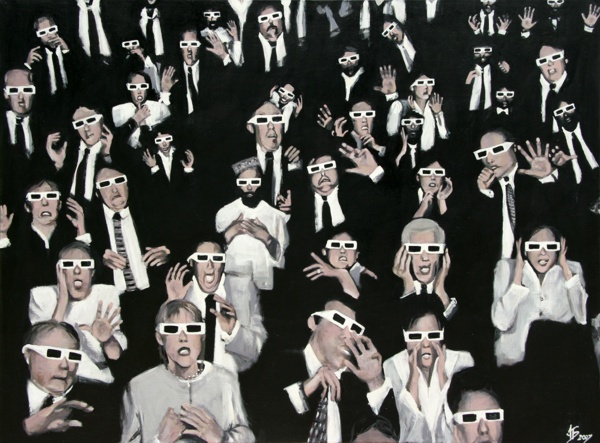
Roller coaster rides. Haunted houses. Horror flicks. And of course, suspense and thriller novels. What do they have in common? They scare us, yet there’s always a certain number of riders, participants, and readers willing to go back for more. Again and again, we seek out experiences that make our hearts race, and alternately tighten our muscles with anticipation and make us dizzy with relief. Why?
Because these experiences affirm our existence even as they wash away its ordinariness. They give us the illusion of being out of control and ultimately triumphant even as we remain both safe and, let’s face it, relative victims to the whims of fate.
We’ll board a roller coaster only because we know the ride will be quick and we can choose to never ride it again. We’ll see a horror movie only because we know we can walk out of the movie theater or cover our eyes at any time. And we’ll read a thriller novel only because we know we can put the book down until we’re ready to dive back in.
Of course, the key to any great thriller experience is that even given these options, we are swept away in spite of ourselves. We forget reality and simply soak in the larger-than-life wonder of the moment. We feel, we agonize, and we rejoice even as some part of our brains know we’re being manipulated by words, images, or mechanical engineering.
I write romance, both contemporary and paranormal, but my novels always have a suspense element in them. Much like a roller coaster architect, I enjoy designing a thrill ride for my audiences. I take into consideration who they are, what their expectations are, and how I can mix things up to bring them something fresh and new. I wield plot to provide suspension, loops, or a straight drop. I use characters to transport a reader to another time and place, keeping her safe even as I provide her maximum thrill and catharsis. I especially like knowing that at the end of my novels, readers will always have a happily-ever-after in the romance plot. And finally, I enjoy the fact that despite being the architect of my novels, I embark on a wondrous journey, too.
In my Para-Ops series, I take my readers from Washington D.C to North Korea to Los Angeles to France. I introduce them to an elite special ops team comprised of a vampire, werebeast, mage, and wraith. In my contemporary novels, I explore the world of undercover cops and state special agents who chase down drug lords and murderers. But always, no matter the genre or the specific plot, I strive to give my readers two things: a thrilling ride that sweeps them away, and enough satisfaction and hope at the end of the story that they can’t help but want to take the ride again.
How about you? Do you seek out thrills just in books or other places, too?
Experience Virna DePaul’s “intriguing world” protected by an elite Para-Ops team with a unique set of skills. In Virna’s latest release, Chosen By Sin (Para-Ops #3), you’ll meet a werebeast hero, a vampire heroine, and a host of other paranormal creatures such as a mage, human psychic, wraith (ghost), demons, and dragons. You can learn more about Virna and her series at www.virnadepaul.com and http://www.chosenbysin.com/.
Virna DePaul is a former criminal prosecutor and now national bestselling author for Berkley (paranormal romantic suspense), HQN (single title romantic suspense; Shades Of Desire (Special Investigations Group Book #1, June 2012)) and HRS (category romantic suspense; It Started That Night (May 2012)). Writers, join Virna’s mailing list to access her archive of monthly writing “cheat sheets.”Blurb from Chosen By Sin:
The longest life isn’t always the happiest one…
Five years after the Second Civil War ends, humans and Otherborn—humanlike creatures with superhuman DNA—still struggle for peace. To ensure the continued rights of both, the FBI forms a Para-Ops team with a unique set of skills.
For now, werebeast Dex Hunt serves on the Para-Ops team, but his true purpose is to kill the werewolf leader he blames for his mother’s death. Biding his time, Dex keeps his emotional distance from his team members and anyone else he might care for, including a mysterious vampire he met in L.A.
Buy the book HERE.
Writing is Rewriting
By Joe Moore
I just finished the first draft of my new thriller, THE BLADE, co-written with Lynn Sholes. This is our sixth novel written together; this one coming in at a crisp 92,500 words. Now that the first pass on the manuscript is finished, the rewrite begins. As E.B. White said in THE ELEMENTS OF STYLE, “The best writing is rewriting.”
Some might ask that if the manuscript is written, why do we need to rewrite it? Remember that the writing process is made up of many layers including outlining, research, first drafts, rewriting, line editing, proofing, more editing and more proofing. One of the functions that sometimes receives the least amount of attention in discussions on writing techniques is rewriting.
There are a number of stages in the rewriting process. Starting with the completion of the first draft, they involve reading and re-reading the entire manuscript many times over and making numerous changes during each pass. It’s in the rewrite that we need to make sure our plot is seamless, our story is on track, our character development is consistent, and we didn’t leave out some major point of importance that could confuse the reader. We have to pay close attention to content. Does the story have a beginning, middle and end? Does it make sense? Is the flow of the story smooth and liquid? Do our scene and chapter transitions work? Is everything resolved at the end?
Next we need to check for clarity. This is where beta readers come in handy. If it’s not clear to them, it won’t be clear to others. We can’t assume that everyone knows what we know or understands what we understand. We have to make it clear what’s going on in our story. Suspense can never be created by confusing the reader.
Once we’ve finished this first pass searching for global plotting problems, it’s time to move on to the nuts and bolts of rewriting. Here we must tighten up our work by deleting all the extra words that don’t add to the reading experience or contribute to the story. Remember that every word counts. If a word doesn’t move the plot forward or contribute to character development, it should be deleted.
Some of the words that can be edited out are superfluous qualifiers such as “very” and “really.” This is always an area where less is more. For instance, we might describe a woman as being beautiful or being very beautiful. But when you think about it, what’s the difference? If she’s already beautiful, a word that is considered a definitive description, how can she exceed beautiful to become very beautiful? She can’t. So we search for and delete instances of “very” or “really”. They add nothing to the writing.
Next, scrutinize any word that ends in “ly”. Chances are, most adverbs can be deleted without changing the meaning of the sentence or our thought. In most cases, cutting them clarifies and makes the writing cleaner.
Next, go hunting for clichés and overused phrases. There’s an old saying that if it comes easy, it’s probably a cliché. Avoiding clichés makes for fresher writing. There’s another saying that the only person allowed to use a cliché is the first one that use it.
Overused phrases are often found at the beginning of a sentence with words like “suddenly,” “so” and “now”. I find myself guilty of doing this, but those words don’t add anything of value to our writing or yours. Delete.
The next type of editing in the rewriting process is called line editing. Line editing covers grammar and punctuation. Watch for incorrect use of the apostrophe, hyphen, dash and semicolon. Did we end all our character’s dialogs with a closed quote? Did we forget to use a question mark at the end of a question?
This also covers making sure we used the right word. Relying on our word processor’s spell checker can be dangerous since it won’t alert us to wrong words when they are spelled correctly. It takes a sharp eye to catch these types of mistakes. Once we’ve gone through the manuscript and performed a line edit, I like to have someone else check it behind us. A fresh set of eyes never hurts.
On-the-fly cut and paste editing while we were working on the first draft can get us into trouble if we weren’t paying attention. Leftover words and phrases from a previous edit or version can still be lurking around, and because all the words might be spelled correctly or the punctuation might be correct, we’ll only catch the mistake by paying close attention during the line edit phase.
The many stages making up the rewrite are vital parts of the writing process. Editing our manuscript should not be rushed or taken for granted. Familiarity breeds mistakes—we’ve read that page or chapter so many times that our eyes skim over it. And yet, there could be a mistake hiding there that we’ve missed every time because we’re bored with the old stuff and anxious to review the new.
Spend the time needed to tighten and clarify the writing until there is not one ounce of fat or bloat. And once we’ve finished the entire editing process, put the manuscript away for a reasonable period of time. Let it rest for a week or even a month if the schedule permits while working on something else. Then bring it back out into the light of day and make one more pass. It’s always surprising at what was missed.
One more piece of advice. Edit on hardcopy, not on a computer monitor. There’s something about dots of ink on the printed page that’s much less forgiving than the glow of pixels. And never be afraid to delete. Remember, less is always more.
How do you go about tackling the rewriting process? Any tips to share?
How do you describe your main character?
Recently in the comments section of one of John G’s posts, a TKZ’er asked, “What is the best way to describe a main character in a story?”.
As tjc and John suggested, there are a few generally recognized rules you should keep in mind when describing your protagonist:
* It’s considered cliche to have your character gaze into a mirror or something similar to deliver physical description.
* Physical descriptions of the main character are best provided from the POV of secondary characters.
* For your protagonist as well as secondary characters, avoid using “description dumps.” Here’s an example of a description dump:
A woman entered the room. She stopped and drilled me with intense blue eyes. She was in her mid-twenties, tall, thin, and blonde.
This type of a straight-on physical description right after a character’s introduction will bring your story to a grinding halt. (Note: Credit for “description dump” goes to Chris Roerden, whose excellent books about the craft of writing, including DON’T MURDER YOUR MYSTERY, deserve to be on any writer’s shelf.)
* If your main character has any specific physical traits which will be used later, make sure to spell those out up front. Otherwise, your reader may form an image of your character that clashes with later scenes. For example, if your character is particularly tall or short, old or young, that’s likely to come up in later scenes in relation to other characters. If your reader has already formed a specific impression that doesn’t agree with your details, it’ll be jarring note.
Even though most writers are aware of these rules, it’s amazing how often they violate them. In book after book, I get irritated by an author who brings his story to a full stop every time a character is introduced. Other books, including best sellers, freely use the mirror cliche to convey physical description. I suppose they do this because it’s hard to convey physical description in a fresh, original way. I’ve tried various approaches to describing the main character in my series. Kate Gallaher is a television reporter, so I’ve used cameras, secondary characters, and her own anxiety about her looks to convey what she looks like. And yet people continue to ask, “What does Kate look like?” Their reactions to her appearance are like a Rorschach test for their own attitudes. Some readers can’t believe that a woman who is 25 pounds overweight can be attractive enough to lure men. Others see her as a modern-day Venus.
What approaches do you use when describing characters in your stories. Do you have any other do’s and don’ts to add to my list?
Resistance is Futile
I had great difficulty rousing myself to write this blog post as we are down at my sister’s beach house on the amazing Great Ocean Road and so I am definitely in holiday mode! This is the Australian summer and we are taking our last opportunity to enjoy surf and sun before the school year starts next week. Anyway, I’ve been thinking a lot about resistance lately – those pesky barriers that seem to get in the way of actually writing. Call it procrastination. Call it fear. Whatever it is, it’s resistance. The brick wall that prevents you from getting the job of writing done.
For me resistance takes the form of a little voice inside that makes me doubt my own abilities. It goads me into avoiding the difficult task of facing an empty page and quite often, it works. To overcome this I remind myself that writing is my profession and, no matter how daunting the task sometimes seems, I just need to roll up my sleeves and get down to it. I succeed in overcoming ‘resistance’ in this way..well, most of the time…
I am just coming down off the high of finishing my WIP and so a new project beckons and with it the dreaded empty page…and so the little voice starts and I have to draw upon all my will power to combat the ‘resistance’. It’s kind of like the anti-force!
At least for the next few days I can be in holiday mode but then the real work starts. So what kind of resistance do you face when writing? Is it a little voice that undermines your confidence or an external force that tries to divert you from the writing course?
How do you overcome resistance?
What is Writing All About?
James Scott Bell
Twitter.com/jamesscottbell
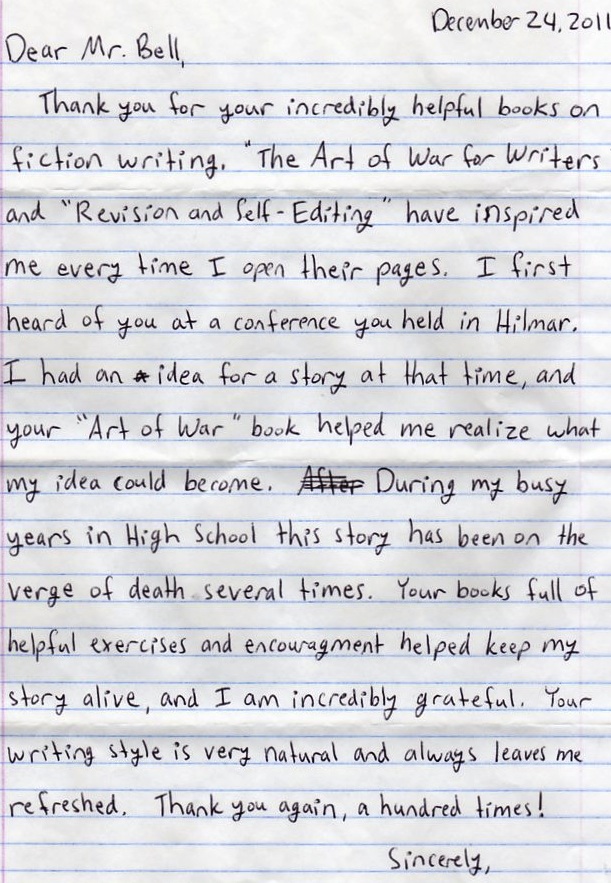
Last month I received a lovely handwritten letter from a high school student (reproduced here with the writer’s permission):
Soothing the Beast
Pure Coolness
By John Gilstrap
I’m writing this blog post on Sunday, January 15 knowing that when you read it, I will be in the middle of a very, very cool day. Actually, a warm day, I hope. In Las Vegas, where I’ll be signing books this morning at the 2012 SHOT Show. According to the show’s website, www.shotshow.org, “The Shooting, Hunting, Outdoor Trade Show (SHOT Show) and Conference is the largest and most comprehensive trade show for all professionals involved with the shooting sports, hunting and law enforcement industries. It is the world’s premier exposition of combined firearms, ammunition, law enforcement, cutlery, outdoor apparel, optics and related products and services.” Last year, over 50,000 people attended.
I was invited to the show months ago by the nice people at 5.11 Tactical, a well-respected manufacturer of tactical apparel–the very kind of geat that Jonathan Grave wears as he charges through my imagination. In fact, in preparation for the show, 5.11 tactical sent me a carton of gear, including shirt, pants, jacket and the best pair of boots I’ve ever worn. I’ll be wearing the attire for the book signings and the press conference.
I’ve never enjoyed this kind of VIP treatment before, so I confess to being a little giddy. Take a look at my official itinerary from yesterday:
6:30am — Firearms instructor will pick you up at the hotel
7:00am — arrive at range, setup/meet with range staff, gear check, etc.
7:00am-7:30am — Orientation, area familiarization, safety briefing, etc.
8:00am-11:00am — Firearms training
11:00am-12:00pm — Knife training
12:00 — depart back to hotel for lunch and classroom training
12:30-1:30 — Prefense Technologies — lecture, PowerPoint presentation, student interactive, etc.
1:30-2:15 — Prep for author panel
2:30-3:30 — Author Panel Press Conference, Venetian Murano Room 3306.
Really, how cool is that? As I write this, I’m hoping that the knife training comes complete with either thick padding or fake knives. You’ll know the answer, I suppose, if you see a post here next week.
Tally ho!
Handling the Crush
I’ll be keeping this short and sweet today, because as you can probably tell by the title of my post, I’m feeling overwhelmed. In fact, I had to drag myself away from the paper bag I was busy hyperventilating in to compose this post.
I finished a book yesterday, only to find out that the deadline for the next one is just a few months away. And I have yet to write the first page of that one (argh!)
Somewhere in there are two week-long school vacations and a slew of long weekends, plus the editing of the book I just turned in (which I suspect-no, know-will require a major overhaul), plus the line edits of a third book.
I realize that this might come across as ungrateful. Believe me when I say that I am incredibly thankful to be under contract at the moment, when so many other people are having a tough time. A year ago, I was worried about selling one more book, and I ended up with two contracts for four. So this is a classic example of be careful what you wish for. Because now, I’m utterly swamped.
On top of everything else, chances are that I’ll be selling my house, finding a new place to live, and moving there in the same four month time period. With a five year-old and a cantankerous cat (and of course, said cat makes finding a pet-friendly place in San Francisco even more of a challenge).
So I’m actively soliciting advice on how to manage all this without losing my proverbial marbles.
My question to you all is…how do you handle it when life comes at you all at once?