Oh, Sweet Irony
I suppose it was inevitable once Amazon started their own publishing wing. A company that was founded on the premise that you need never set foot in a bookstore again (which expanded to never setting foot in any store, for many) has started opening…wait for it…stores. They’re sussing out their first bricks & mortar location in Seattle, where their corporate headquarters is located.
Mind you, this won’t really be a bookstore; apparently the focus will be on pricier items such as tablet computers (and, I’m guessing, their rapidly expanding Kindle line).
It’s an astonishing reversal for the company that insures there’s a UPS driver coming down my street every day, sometimes even multiple times a day.
Mind you, I don’t intend to launch a bout of Amazon bashing here–I’m as guilty as my neighbors when it comes to online ordering. I signed up to have kitty litter, toilet paper, and coconut water shipped to my door every month once I realized that it was cheaper than buying those items in the supermarket. I did the vast majority of my Christmas shopping online this year, a significant chunk of it while getting my hair cut, which is a far cry from past Decembers when I drove from store to store trying to cross everyone off my list. And most importantly for me as a writer, thanks to Amazon I consistently sell backlist copies of books that vanished from store shelves years ago.
So I’m definitely no Amazon hater. And once Barnes & Noble, Books a Million, and other stores issued statements declaring that they would (understandably) refuse to stock titles from Amazon’s new publishing imprint, launching their own physical retail wing made sense.
Still, it is ironic, isn’t it? When companies like Amazon first arrived on the scene in the heady days of the dotcom boom, they loftily promised that within a decade, no one would have to leave their house for anything (fantastic news for agoraphobes; maybe not so great for the rest of us). Websites would sell everything from beds to orange juice to mouthwash and deliver it to your front door, all for less than you’d pay in a store since the overhead of rent, utilities, and payroll would be largely removed from the equation.
And lo and behold, here we are a little more than a decade later, and they were largely right. Except that there no longer are a slew of websites providing the online equivalent of roaming from store to store: instead it’s a one-stop shopping experience. Amazon has become a behemoth, the place where you can buy pretty much anything you desire and have it delivered to your front door, usually within two days. And now, after driving so many mom and pop stores out of existence, they’re backtracking and opening a place where you can get the personal touch; one-on-one interaction with a sales staff.
I have very mixed feelings about all of this. For one thing, the tech boom has spawned a modern day equivalent of the types of monopolies that held the nation at their mercy around the turn of the last century, with Amazon and Microsoft replacing Standard Oil and U.S. Steel. In some regards, aren’t Jeff Bezos and Mark Zuckerberg contemporary robber barons?
And now that so many stores that I loved have shuttered, it seems unseemly that the company that helped drive them out of existence is stepping in and taking over the shelf space they helped destroy. (For the record, I buy all of my physical books in bookstores, and I still buy as many as I did before I got my Kindle. I’ve actually found that having an eReader has increased my weekly book consumption).
But I’m also guilty of getting those deliveries every month, of using them to make my holiday shopping easier; and I’ve received the gains in sales that wouldn’t have been possible if my books were only available in print. And I have many friends whose contracts weren’t renewed, but managed to continue publishing their books independently thanks to Amazon, an outlet that wouldn’t have been available to them otherwise.
So I’m curious; what do you all think about Amazon’s latest move?
Oh, Sweet Irony
I suppose it was inevitable once Amazon started their own publishing wing. A company that was founded on the premise that you need never set foot in a bookstore again (which expanded to never setting foot in any store, for many) has started opening…wait for it…stores. They’re sussing out their first bricks & mortar location in Seattle, where their corporate headquarters is located.
Mind you, this won’t really be a bookstore; apparently the focus will be on pricier items such as tablet computers (and, I’m guessing, their rapidly expanding Kindle line).
It’s an astonishing reversal for the company that insures there’s a UPS driver coming down my street every day, sometimes even multiple times a day.
Mind you, I don’t intend to launch a bout of Amazon bashing here–I’m as guilty as my neighbors when it comes to online ordering. I signed up to have kitty litter, toilet paper, and coconut water shipped to my door every month once I realized that it was cheaper than buying those items in the supermarket. I did the vast majority of my Christmas shopping online this year, a significant chunk of it while getting my hair cut, which is a far cry from past Decembers when I drove from store to store trying to cross everyone off my list. And most importantly for me as a writer, thanks to Amazon I consistently sell backlist copies of books that vanished from store shelves years ago.
So I’m definitely no Amazon hater. And once Barnes & Noble, Books a Million, and other stores issued statements declaring that they would (understandably) refuse to stock titles from Amazon’s new publishing imprint, launching their own physical retail wing made sense.
Still, it is ironic, isn’t it? When companies like Amazon first arrived on the scene in the heady days of the dotcom boom, they loftily promised that within a decade, no one would have to leave their house for anything (fantastic news for agoraphobes; maybe not so great for the rest of us). Websites would sell everything from beds to orange juice to mouthwash and deliver it to your front door, all for less than you’d pay in a store since the overhead of rent, utilities, and payroll would be largely removed from the equation.
And lo and behold, here we are a little more than a decade later, and they were largely right. Except that there no longer are a slew of websites providing the online equivalent of roaming from store to store: instead it’s a one-stop shopping experience. Amazon has become a behemoth, the place where you can buy pretty much anything you desire and have it delivered to your front door, usually within two days. And now, after driving so many mom and pop stores out of existence, they’re backtracking and opening a place where you can get the personal touch; one-on-one interaction with a sales staff.
I have very mixed feelings about all of this. For one thing, the tech boom has spawned a modern day equivalent of the types of monopolies that held the nation at their mercy around the turn of the last century, with Amazon and Microsoft replacing Standard Oil and U.S. Steel. In some regards, aren’t Jeff Bezos and Mark Zuckerberg contemporary robber barons?
And now that so many stores that I loved have shuttered, it seems unseemly that the company that helped drive them out of existence is stepping in and taking over the shelf space they helped destroy. (For the record, I buy all of my physical books in bookstores, and I still buy as many as I did before I got my Kindle. I’ve actually found that having an eReader has increased my weekly book consumption).
But I’m also guilty of getting those deliveries every month, of using them to make my holiday shopping easier; and I’ve received the gains in sales that wouldn’t have been possible if my books were only available in print. And I have many friends whose contracts weren’t renewed, but managed to continue publishing their books independently thanks to Amazon, an outlet that wouldn’t have been available to them otherwise.
So I’m curious; what do you all think about Amazon’s latest move?
Here’s another promotional tool that will drive you crazy. I just learned about Pinterest, where you pin up pictures online that relate to your book, your characters, the locations in your story, your vacation in New Guinea, your restaurant meals, or your life in general. This acts as an online pinboard that other folks can view. If someone spots a photo on my board they like, they can share it. You tell what the picture means and people comment on it. At least, this is my understanding so far.
But who owns the rights to the photos you post? What happens, for example, if I imagine a character looking like Richard Dean Anderson in Stargate: SG1? Can I just copy his photo off the Web? According to one person I asked, yes I can, if Pinterest attributes the source. In some cases, though, I’ve cut out photos from magazines of celebrities or people on society pages and scanned them into my computer because they look like my characters. Can I use these photos? I doubt it, because I don’t have the people’s permission. It seems safer to provide your own pictures.
This promises to be another time consuming promotional activity. I’d have to learn how to use the site, determine a theme for each board, and upload the photos. Do we really need more work to do? Or is this a great promotional opportunity we might be missing if we let it go? There’s always the pressure to jump on the next cart that wheels along. But hop on too many wagons, and you might fall off.
Oh, and you have to request an invitation to join this site. Then you register using your Facebook or Twitter account. This is what the site says:
How Pinterest Works
After you have created an Account (defined below) to become a Member of Pinterest, you may use the Services to create, view and follow visual collections. In order to create a visual collection, you may (i) upload images from your computer by selecting the “Add a Pin” section of the Site, (ii) use the Application to take and upload images, or (iii) install and use our “Pin It” browser toolbar to upload images, by following the instructions provided on the “About” section of the Site. Please note that your visual collections will be publicly viewable by all visitors to the Site and Application. In order to follow the visual collections of other Members, you may search for other visual collections via the Site and Application and select the option to “Follow” such Members. http://pinterest.com
Here are some tips, kindly shared by another author on one of my listserves:
http://www.authormedia.com/2012/02/01/3-ways-authors-can-use-pinterest-guilt-free/
http://www.authormedia.com/2012/02/02/set-up-your-author-pinterest-profile-in-10-easy-steps/
http://www.authorems.com/2012/pinterest/
http://savvybookwriters.wordpress.com/2012/01/29/how-can-pinterest-increase-your-book-sales/
So do any of you already participate in Pinterest? Or would you do it now that you’re aware of this site?
Here’s another promotional tool that will drive you crazy. I just learned about Pinterest, where you pin up pictures online that relate to your book, your characters, the locations in your story, your vacation in New Guinea, your restaurant meals, or your life in general. This acts as an online pinboard that other folks can view. If someone spots a photo on my board they like, they can share it. You tell what the picture means and people comment on it. At least, this is my understanding so far.
But who owns the rights to the photos you post? What happens, for example, if I imagine a character looking like Richard Dean Anderson in Stargate: SG1? Can I just copy his photo off the Web? According to one person I asked, yes I can, if Pinterest attributes the source. In some cases, though, I’ve cut out photos from magazines of celebrities or people on society pages and scanned them into my computer because they look like my characters. Can I use these photos? I doubt it, because I don’t have the people’s permission. It seems safer to provide your own pictures.
This promises to be another time consuming promotional activity. I’d have to learn how to use the site, determine a theme for each board, and upload the photos. Do we really need more work to do? Or is this a great promotional opportunity we might be missing if we let it go? There’s always the pressure to jump on the next cart that wheels along. But hop on too many wagons, and you might fall off.
Oh, and you have to request an invitation to join this site. Then you register using your Facebook or Twitter account. This is what the site says:
How Pinterest Works
After you have created an Account (defined below) to become a Member of Pinterest, you may use the Services to create, view and follow visual collections. In order to create a visual collection, you may (i) upload images from your computer by selecting the “Add a Pin” section of the Site, (ii) use the Application to take and upload images, or (iii) install and use our “Pin It” browser toolbar to upload images, by following the instructions provided on the “About” section of the Site. Please note that your visual collections will be publicly viewable by all visitors to the Site and Application. In order to follow the visual collections of other Members, you may search for other visual collections via the Site and Application and select the option to “Follow” such Members. http://pinterest.com
Here are some tips, kindly shared by another author on one of my listserves:
http://www.authormedia.com/2012/02/01/3-ways-authors-can-use-pinterest-guilt-free/
http://www.authormedia.com/2012/02/02/set-up-your-author-pinterest-profile-in-10-easy-steps/
http://www.authorems.com/2012/pinterest/
http://savvybookwriters.wordpress.com/2012/01/29/how-can-pinterest-increase-your-book-sales/
So do any of you already participate in Pinterest? Or would you do it now that you’re aware of this site?
A Valentine for My Muse: Danger Ahead!
By: Kathleen Pickering http://www.kathleenpickering.com
My muse returns to the spotlight for Valentine’s Day, not because I love writing more than I love my husband (please, let’s not go there) but because when I decided to join my husband in courting danger, I did so for my Muse—and only for my Muse.
It all started with this volcano in the resort village of Pucon in southern Chile. The approximate elevation of Volcan Villarica is 9,750 feet from sea level. Villarica is smoking. She is alive, well and dangerous. As a matter of fact, the photo above of Villarica with smoke billowing from her crater was taken from Pucon by my sister-in-law at the time we were approaching the top.
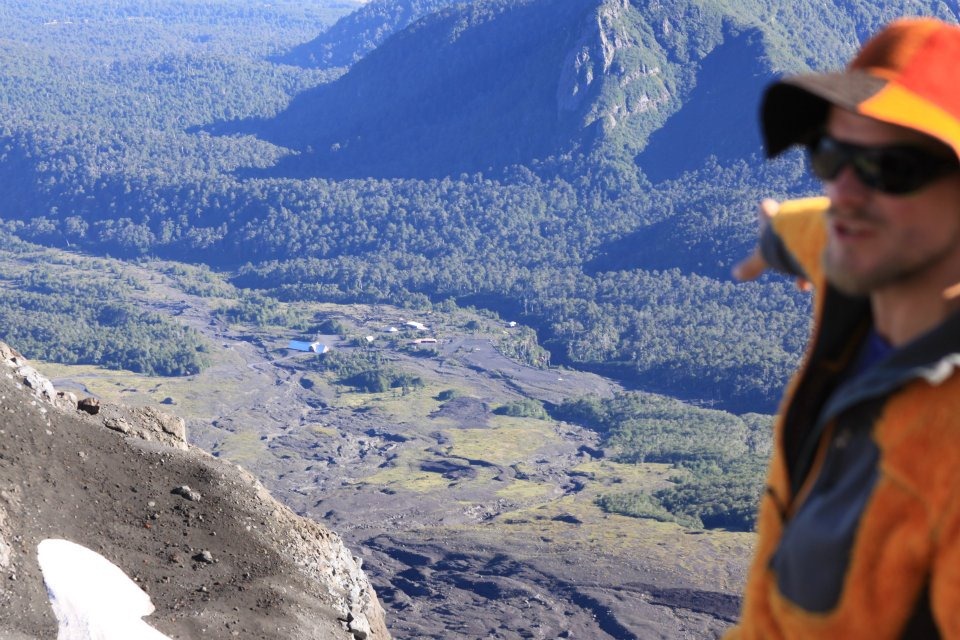
Now, in all fairness, Villarica has been smoking for a very long time. She belches now and again. Last lava flow was 1984. This photo shows its last path:
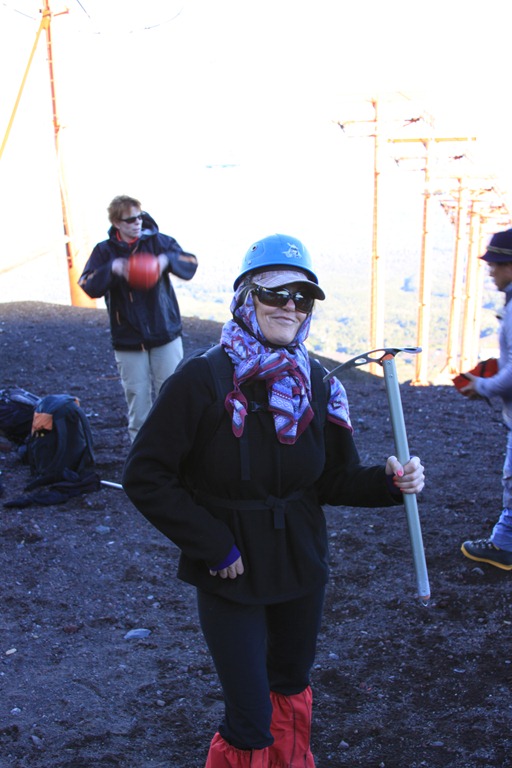
Our guide, David (shown in the picture) promised that there is seismic equipment to detect impending volcanic activity enough in advance that we were free from danger of an eruption. However, when they give you tools like hard hats, ice axes (which he said would be our best friend on the climb—and was right!), crampons for your boots, and cold weather gear for a five hour climb to the top, you sort of figure you’re not going on a picnic.
I tell you what. When my Muse and I rode the first leg up the mountain on a chair lift with no seat belt, I held on for dear life (I’m terrified of heights) while my flighty Muse started jumping around the chair lift, wanting to take off. You see, Sam Wilson in my Mythological Sam series will have a demon battle on a volcano at one point, so I took my girl up there to really test her wings. As I had expected, she started pulling in scenes from the moment I pulled on my first boot.
While I cavalierly mention the danger factor, I have to admit that when I agreed to make this climb, I hadn’t considered danger. I’ve hiked so many less grueling places before that the words volcano, toxic gas, rock slides and fissures in glaciers were terms relegated to National Geographic, not my physical well-being. Reality started to settle in when they gave us instructions on how to use the ice ax to keep from sliding off the glacier should we lose footing and fall. I mean really!
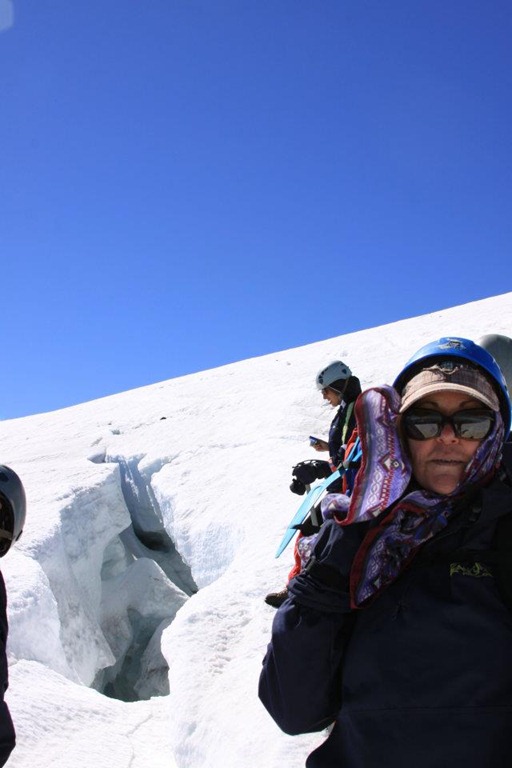
Here is a fissure in the glacier. Not a place to lose one’s footing!
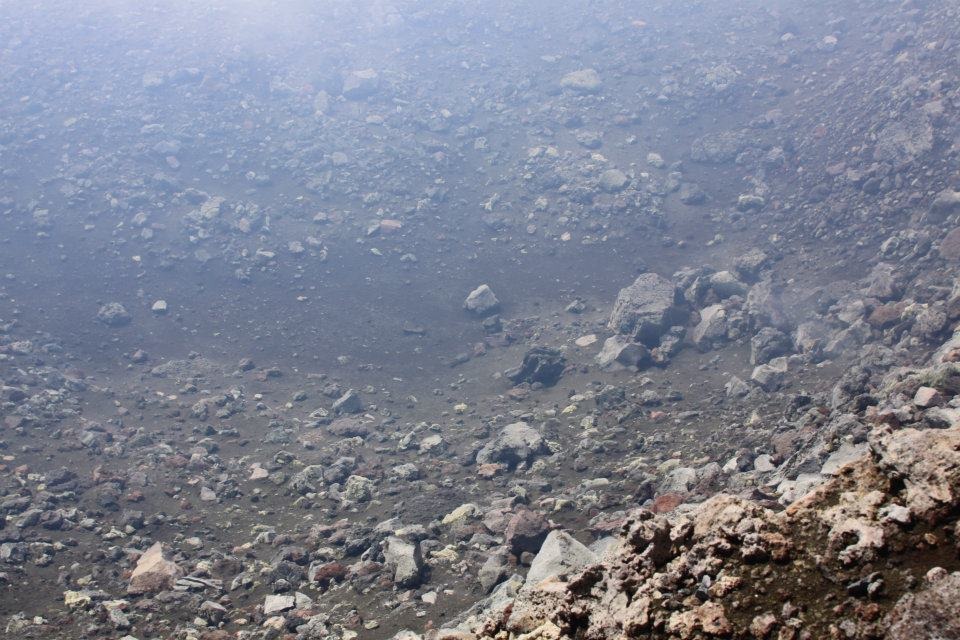
This photo shows Inside the crater with sulfur dioxide gas seeping through the surface.
Friend, Gustavo, is holding his breath on the crater rim here. (Crazy, I know! At least I knew enough to get off the edge.) The gas literally burns the inside of your nose. Can’t imagine the lung damage should one breath in those fumes for too long. The buzz word here is toxic. We were lucky there wasn’t a wind shift.
On the flip side of all this danger, when walking in a slow, steady rhythm in single file across the glaciers or up the rock faces, I found myself one-on-one with nature, once again, renewing my awe in her Presence. The captivating views sent my Muse soaring. In my mind, I was out there flying right beside her.
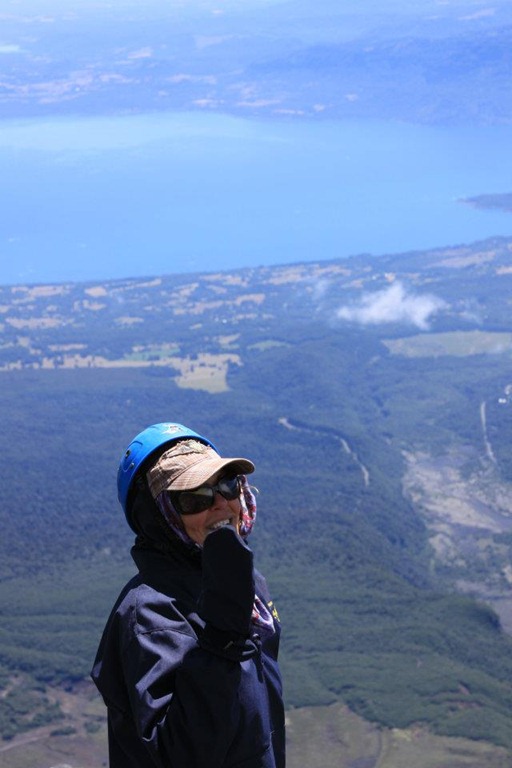
These spectacular vistas changed my point of view from ground level, for sure!
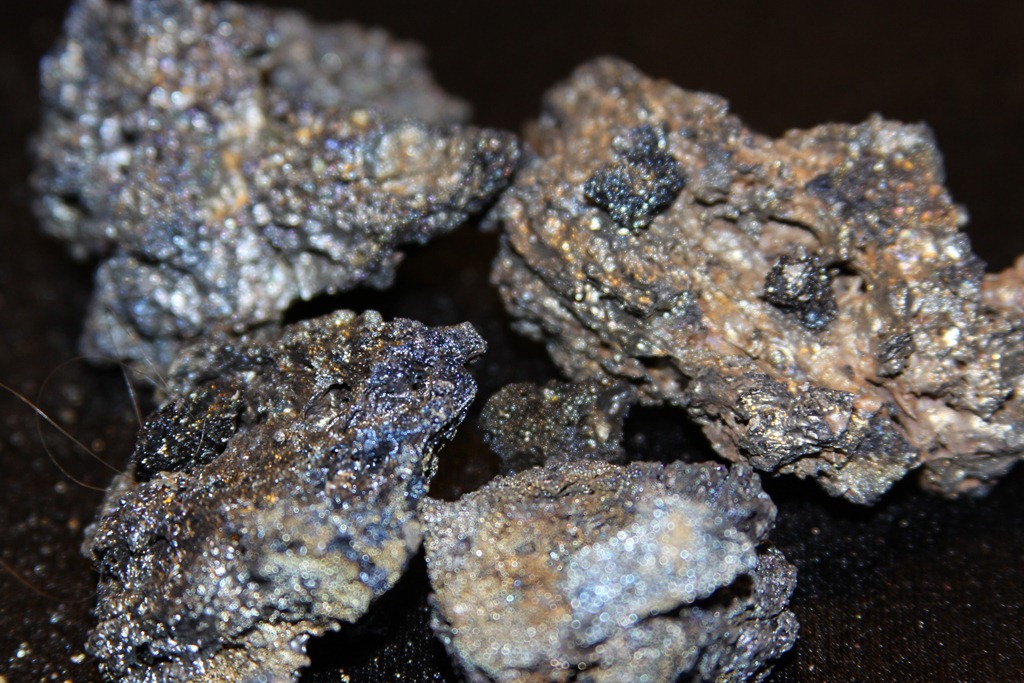
Once we came off the glacier and arrived at the rocky climb to the “false peak” just below the crater, the unexpected (in a good way) happened. The closer we traversed to the top the more colorful the black lava became. The photo below doesn’t do justice to the iridescent colors of the lava rocks littering the peak . . . glittering with blue, orange and gold colors like jewels in the sunlight. I couldn’t resist. I scooped them up by the handful. That mountain with it’s layers of lava flows, glacial formations and different rock types is a geologist’s dream.
So, when my heart finally stopped pounding, I was able to catch my breath. We actually reached the top without incident, except the gas had me scrambling back down to the glacier edge, toot sweet. What we didn’t see? Animals. Not a one. Except for a lone bird at the top—and that’s a story for another time.
For the return, the group was rewarded with a two and a half hour slide down the glacier. No joke. Curving channels like toboggan runs were cut shoulder deep into the glaciers just wide enough to accommodate a person seated on a plastic disk with a handle attached at the waist. I wish I had a photo of one of us descending in those channels. It cut the descent time in half and the laughter made up for all the labor spent on the challenging climb up.
I’m thinking this trip covered all three rules for keeping Muses happy: love, feeding, and letting her fly.
Then why a Valentine’s gift, you may ask? Because I don’t usually put my tail in danger to prove my love for my Muse. This adventure was like a box of bon-bons on steroids, and given my fear of heights (which has lessened now, I must say) I took her higher than she’s ever flown before, at least with both feet still on the earth.
Since we just got home, I’m taking all of today to recover. My Muse is full and happy. Now, I just hope my husband will understand (and laugh out loud) when I hand draw him a Valentine’s Day card and order take-out—delivered. We’re staying in!
If you’d like to see more volcano pictures, please feel free to visit my Facebook album: Climbing Volcan Villarica. (You may have to sign in first for the link to work. Otherwise, visit: www.facebook.com/kathleenpickering.)
Then afterwards, let me know what you are doing today for Valentine’s Day . . . is there any Muse involved?
Happy Valentine’s Day to you, and most importantly, Happy Writing!
A Valentine for My Muse: Danger Ahead!
By: Kathleen Pickering http://www.kathleenpickering.com
My muse returns to the spotlight for Valentine’s Day, not because I love writing more than I love my husband (please, let’s not go there) but because when I decided to join my husband in courting danger, I did so for my Muse—and only for my Muse.
It all started with this volcano in the resort village of Pucon in southern Chile. The approximate elevation of Volcan Villarica is 9,750 feet from sea level. Villarica is smoking. She is alive, well and dangerous. As a matter of fact, the photo above of Villarica with smoke billowing from her crater was taken from Pucon by my sister-in-law at the time we were approaching the top.
Now, in all fairness, Villarica has been smoking for a very long time. She belches now and again. Last lava flow was 1984. This photo shows its last path:
Our guide, David (shown in the picture) promised that there is seismic equipment to detect impending volcanic activity enough in advance that we were free from danger of an eruption. However, when they give you tools like hard hats, ice axes (which he said would be our best friend on the climb—and was right!), crampons for your boots, and cold weather gear for a five hour climb to the top, you sort of figure you’re not going on a picnic.
I tell you what. When my Muse and I rode the first leg up the mountain on a chair lift with no seat belt, I held on for dear life (I’m terrified of heights) while my flighty Muse started jumping around the chair lift, wanting to take off. You see, Sam Wilson in my Mythological Sam series will have a demon battle on a volcano at one point, so I took my girl up there to really test her wings. As I had expected, she started pulling in scenes from the moment I pulled on my first boot.
While I cavalierly mention the danger factor, I have to admit that when I agreed to make this climb, I hadn’t considered danger. I’ve hiked so many less grueling places before that the words volcano, toxic gas, rock slides and fissures in glaciers were terms relegated to National Geographic, not my physical well-being. Reality started to settle in when they gave us instructions on how to use the ice ax to keep from sliding off the glacier should we lose footing and fall. I mean really!
Here is a fissure in the glacier. Not a place to lose one’s footing!
This photo shows Inside the crater with sulfur dioxide gas seeping through the surface.
Friend, Gustavo, is holding his breath on the crater rim here. (Crazy, I know! At least I knew enough to get off the edge.) The gas literally burns the inside of your nose. Can’t imagine the lung damage should one breath in those fumes for too long. The buzz word here is toxic. We were lucky there wasn’t a wind shift.
On the flip side of all this danger, when walking in a slow, steady rhythm in single file across the glaciers or up the rock faces, I found myself one-on-one with nature, once again, renewing my awe in her Presence. The captivating views sent my Muse soaring. In my mind, I was out there flying right beside her.
These spectacular vistas changed my point of view from ground level, for sure!
Once we came off the glacier and arrived at the rocky climb to the “false peak” just below the crater, the unexpected (in a good way) happened. The closer we traversed to the top the more colorful the black lava became. The photo below doesn’t do justice to the iridescent colors of the lava rocks littering the peak . . . glittering with blue, orange and gold colors like jewels in the sunlight. I couldn’t resist. I scooped them up by the handful. That mountain with it’s layers of lava flows, glacial formations and different rock types is a geologist’s dream.
So, when my heart finally stopped pounding, I was able to catch my breath. We actually reached the top without incident, except the gas had me scrambling back down to the glacier edge, toot sweet. What we didn’t see? Animals. Not a one. Except for a lone bird at the top—and that’s a story for another time.
For the return, the group was rewarded with a two and a half hour slide down the glacier. No joke. Curving channels like toboggan runs were cut shoulder deep into the glaciers just wide enough to accommodate a person seated on a plastic disk with a handle attached at the waist. I wish I had a photo of one of us descending in those channels. It cut the descent time in half and the laughter made up for all the labor spent on the challenging climb up.
I’m thinking this trip covered all three rules for keeping Muses happy: love, feeding, and letting her fly.
Then why a Valentine’s gift, you may ask? Because I don’t usually put my tail in danger to prove my love for my Muse. This adventure was like a box of bon-bons on steroids, and given my fear of heights (which has lessened now, I must say) I took her higher than she’s ever flown before, at least with both feet still on the earth.
Since we just got home, I’m taking all of today to recover. My Muse is full and happy. Now, I just hope my husband will understand (and laugh out loud) when I hand draw him a Valentine’s Day card and order take-out—delivered. We’re staying in!
If you’d like to see more volcano pictures, please feel free to visit my Facebook album: Climbing Volcan Villarica. (You may have to sign in first for the link to work. Otherwise, visit: www.facebook.com/kathleenpickering.)
Then afterwards, let me know what you are doing today for Valentine’s Day . . . is there any Muse involved?
Happy Valentine’s Day to you, and most importantly, Happy Writing!
Unpleasant Characters
I’m currently reading The Slap by Christos Tsiolkas, an Australian book that provoked quite a bit of controversy a couple of years ago, not surprisingly, as it centers around someone slapping another person’s child at a backyard BBQ. Although I find the issues it raises about Australian culture and parenting interesting, I have nearly thrown the book in the bin (and seriously, I’m not sure I even want to bother reading the rest of the book) because of the repellent nature of the characters.
What makes this strange, for me at least, is that it is the very unpleasantness of these characters that has made the story less rather than more compelling. This is in complete contrast to the previous two books I have read – The Ghost Road by Pat Barker (about shell shocked WW1 soldiers including the poet Wilfred Owen and a character, Billy Prior, who is unsympathetic for most of the book) and A Game of Thrones by George R.R. Martin – which has a number of pretty unlikeable characters.
So what makes an unsympathetic character nonetheless compelling? Why is it that in some books, you might dislike, even loathe, a character, but still find the book intriguing – while in others, that same visceral reaction makes you want to hurl the book at the nearest wall and be done with it?
Although I am not the sort of writer who subscribes to the notion that you have to have a sympathetic main character, I do believe that there must be some redeeming feature, flaw or level of humour that ensures a reader isn’t alienated by an unlikeable character. In the case of The Slap I’ve found some characters so distasteful that I simply don’t want to spend any more time inside their heads. In the case of the other books (which are as unlike each other as it is possible – one, historical the other total fantasy) the world and the characters that inhabited it were flawed but intriguing. They hadn’t crossed the line to become either dull or intolerable.
But how, when you are writing a novel, do you avoid falling into this trap? None of us want to read books about one-dimensional goodies or baddies, but neither do we want to hang-out with boring or repellent three-dimensional characters either.
This got me thinking about how to write ‘unpleasant’ characters, knowing of course, that there are no rules – only pitfalls to avoid. For me, these include alienating a reader, failing to provide any redeeming feature for a character, or ‘telling’ the reader to such an extent that the reader does not believes the character to be realistic. For me (and I am in the minority as most reviewers loved The Slap) the characters themselves impeded the story. I didn’t want to delve into their minds, not because it was an unpleasant place to be, but because it was unpleasant to the point of being dull. It turned me off what I might otherwise have been interested in reading. I had no sympathy. I had no compelling reason to find out what happened to them.
So how do you think writers should tackle the subject of unpleasant and unsympathetic characters? Who do you think does this successfully and why?
In many ways, tone can be as important as characterization. In Kingsley Amis’ Lucky Jim, the protagonist is likeable because of the humor brought to his predicament as well as the tone of the book. Perhaps in The Slap I simply didn’t like the ‘voice’ brought to bear for the characters – too strident, too boorish, to misogynistic perhaps. That probably says as much about me as it does about the book…but still how do you feel about reading books about characters you find morally (or otherwise) repugnant?
Unpleasant Characters
I’m currently reading The Slap by Christos Tsiolkas, an Australian book that provoked quite a bit of controversy a couple of years ago, not surprisingly, as it centers around someone slapping another person’s child at a backyard BBQ. Although I find the issues it raises about Australian culture and parenting interesting, I have nearly thrown the book in the bin (and seriously, I’m not sure I even want to bother reading the rest of the book) because of the repellent nature of the characters.
What makes this strange, for me at least, is that it is the very unpleasantness of these characters that has made the story less rather than more compelling. This is in complete contrast to the previous two books I have read – The Ghost Road by Pat Barker (about shell shocked WW1 soldiers including the poet Wilfred Owen and a character, Billy Prior, who is unsympathetic for most of the book) and A Game of Thrones by George R.R. Martin – which has a number of pretty unlikeable characters.
So what makes an unsympathetic character nonetheless compelling? Why is it that in some books, you might dislike, even loathe, a character, but still find the book intriguing – while in others, that same visceral reaction makes you want to hurl the book at the nearest wall and be done with it?
Although I am not the sort of writer who subscribes to the notion that you have to have a sympathetic main character, I do believe that there must be some redeeming feature, flaw or level of humour that ensures a reader isn’t alienated by an unlikeable character. In the case of The Slap I’ve found some characters so distasteful that I simply don’t want to spend any more time inside their heads. In the case of the other books (which are as unlike each other as it is possible – one, historical the other total fantasy) the world and the characters that inhabited it were flawed but intriguing. They hadn’t crossed the line to become either dull or intolerable.
But how, when you are writing a novel, do you avoid falling into this trap? None of us want to read books about one-dimensional goodies or baddies, but neither do we want to hang-out with boring or repellent three-dimensional characters either.
This got me thinking about how to write ‘unpleasant’ characters, knowing of course, that there are no rules – only pitfalls to avoid. For me, these include alienating a reader, failing to provide any redeeming feature for a character, or ‘telling’ the reader to such an extent that the reader does not believes the character to be realistic. For me (and I am in the minority as most reviewers loved The Slap) the characters themselves impeded the story. I didn’t want to delve into their minds, not because it was an unpleasant place to be, but because it was unpleasant to the point of being dull. It turned me off what I might otherwise have been interested in reading. I had no sympathy. I had no compelling reason to find out what happened to them.
So how do you think writers should tackle the subject of unpleasant and unsympathetic characters? Who do you think does this successfully and why?
In many ways, tone can be as important as characterization. In Kingsley Amis’ Lucky Jim, the protagonist is likeable because of the humor brought to his predicament as well as the tone of the book. Perhaps in The Slap I simply didn’t like the ‘voice’ brought to bear for the characters – too strident, too boorish, to misogynistic perhaps. That probably says as much about me as it does about the book…but still how do you feel about reading books about characters you find morally (or otherwise) repugnant?
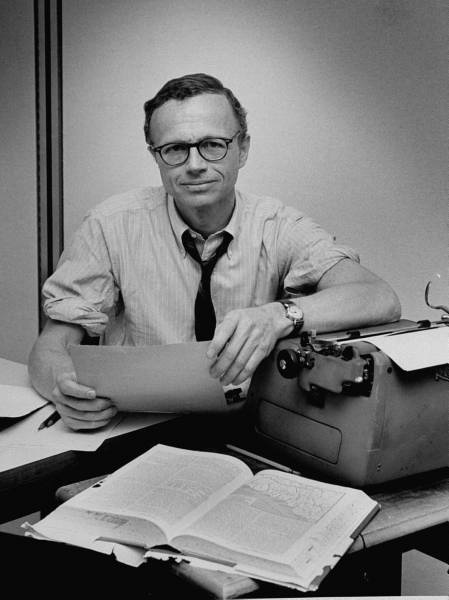
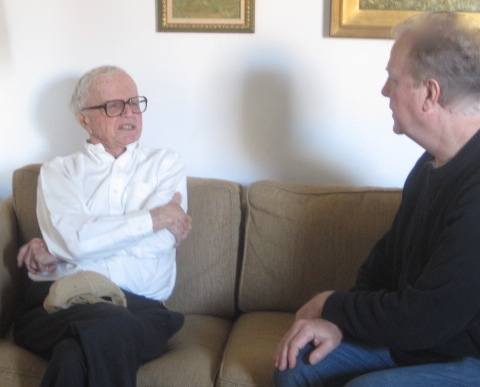
My Meeting With America’s Greatest Living Writer
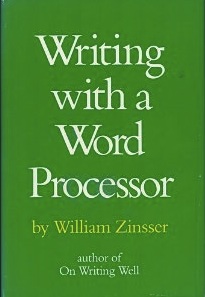
Mr. Zinsser has written eighteen books on a variety of subjects. My absolute favorite is a little gem of cultural history, Writing With a Word Processor.
Published in 1983, it is the account of his transition from typewriter to computer. It still makes me laugh. Even though the technology aspect is dated, the writing remains fresh, clear and hilarious. I’ll sometimes take it off the shelf and read a random chapter to my wife, and we’ll laugh again at how he captured that historical and hysterical slice of life.
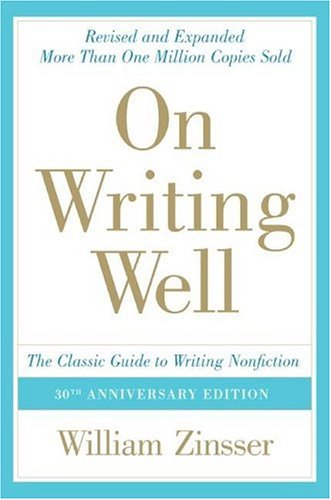
I don’t care if you write fiction or non-fiction, books or blogs. If you write anything that has to connect with a wide readership, and you don’t own a copy of On Writing Well, order it now. It needs to be in every writer’s library.