What’s something you haven’t done yet that you absolutely must do before you kick that bucket? Do you plan to write about it?

By Elaine Viets
“Your next Dead-End Job mystery should be about cats,” my editor said.
I reacted as if she’d handed me a freshly used litter box.
“No,” I said. “Not cats.”
“You love cats,” she said.
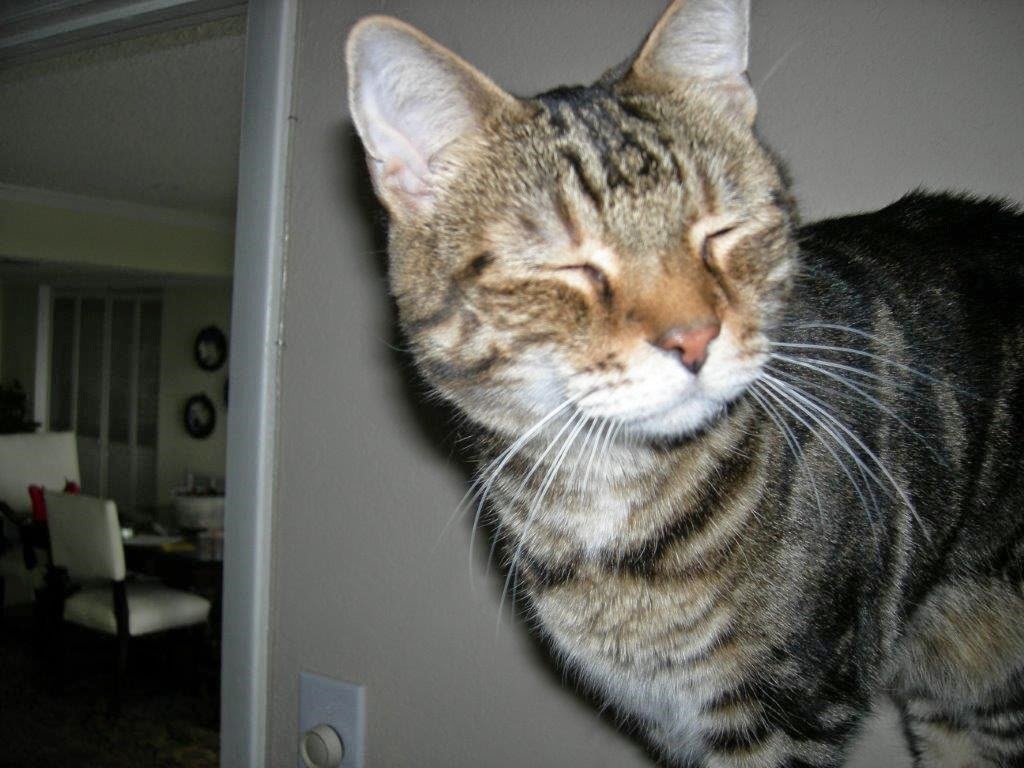
I do. And I like most cat mysteries, too. But some are so cutesy they make my teeth ache. Cats are not sweet. They’re funny, they’re beautiful, they’re elegant. But I never forget that under a cat’s soft fur beats the heart of a killer.
So I persuaded my editor that I should write my 13th Dead-End Job mystery about another subject. I sent her the outline. She was underwhelmed. “You really should write about cats,” she said.
“But they’re so girlie,” I said.
“They don’t have to be,” she said. “Write the Elaine Viets take on cats.”
That’s when it dawned on me. Cats are the new vampires. They’re a subject that’s eminently portable and ever changing. Cats are whatever you want them to be: cuddly, ruthless, aloof, loveable – or all four.
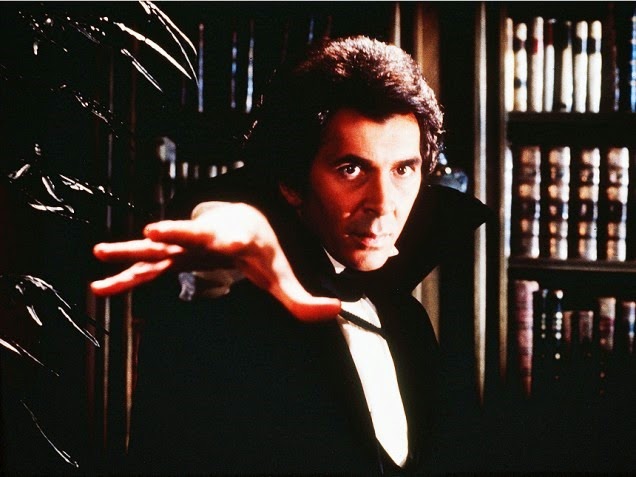
Each generation reworks the vampire myth. The classic Bram Stoker vampire was the rich preying on the poor. The ’70s Frank Langella vampire was sex without responsibility – or pregnancy.
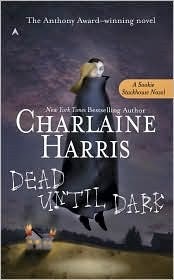
Charlaine Harris brilliantly reworked the vampire myth, and I’m not saying that just because I know her. Charlaine was already a successful New York Times mystery writer with several series when she got the idea for her Sookie Stackhouse Southern Vampire series.
Charlaine added a fresh twist. Her vampires, like gay people, lived unrecognized among us. Then the Japanese blood substitute let the vamps come out and northern Louisiana was overrun with the undead.
When other writers tell me they’re going to write a vampire mystery, I congratulate them. But I wonder if they’ll write a different vampire mystery, or simply another variation on one of the timeworn themes.
I wrote a vampire story called “Vampire Hours,” about a woman who becomes a vampire to escape the trials of middle age – an unfaithful husband, constant dieting, fading beauty. People asked me if I was going to make that story into a novel. No. My idea was different, but not universal.
But cats are universal. So I agreed to do the cat book. I’m owned by a defrocked show cat, Columbleu’s Unsolved Mysterie. She bit a judge at her first show.

I would write my new Dead-End Job mystery about the world of show cats and the people who love and care for them. I’d report on a culture.

And so Catnapped! was born. Helen Hawthorne and Phil Sagemont, my husband and wife PI team, are the in-house lawyers for a Fort Lauderdale attorney. The lawyer’s client, Trish Barrymore, is divorcing her husband, financier Smart Mort, and the only thing the couple can agree on is custody of their show cat, Justine.
When Mort fails to return the cat on time, Helen and Phil are sent to collect the cat. They find Mort dead and Justine kidnapped and held for half a million dollars. Helen goes undercover to work for a show cat breeder.
Judge Tracy Petty, Cat Fanciers’ Association southern region director, helped with the cat show details.
Did you know that long-haired show cats have to be bathed – and they learn to like it? Their fur is so thick they are slathered in Goop, the mechanic’s hand cleaner, and then the cats get two shampoos, a conditioner and more. Their fur is dried with a special blow dryer. There’s more. Much more. But you’ll have to read the book to find it out.
When you pick your next subject, ask yourself: How novel is it? How universal?
Catnapped! is two days old today. Too young to know if I have a were-tiger by the tail, like Charlaine. But my show cat is scratching her way up the charts.
___________________________________
Check out the first chapter and the book trailer for Catnapped! at www.elaineviets.com
Nancy J. Cohen
While researching my mysteries, I often need information that you can’t go around asking writer friends in public. Imagine discussing these topics in a restaurant. What kind of poison can I use that will kill someone right away and is easily obtainable? How can I stage a crime scene by hanging the victim to make it look like a suicide? Does firing a .38 give much of a recoil? What happens when a detective is personally involved in a murder case? What kind of poisonous snake can I have the bad guy put in my hero’s suitcase? Often, I’ll need specific advice to help me set the scene with as much authenticity as possible.

Fortunately, mystery writers have a range of resources available besides your friendly cop on the local force. These are some of the sites where you can get useful information and answers to your research questions. Also listed are well-known mystery conferences. Check out the links. They’ll lead you to informative websites and blogs.
Bright Blue Line: http://scottsilverii.com/
Bouchercon: http://www.bouchercon.info
Crime Scene Writer: http://tech.groups.yahoo.com/group/crimescenewriter/
Florida Chapter of MWA: http://www.mwaflorida.org/
Florida Sisters in Crime: http://floridasistersincrime.com/
Independent Mystery Booksellers Association: http://www.mysterybooksellers.com
In Reference to Murder: http://www.inreferencetomurder.com/
International Thriller Writers: http://thrillerwriters.org/
Killer Nashville: http://www.killernashville.com/
Kiss of Death: http://www.rwamysterysuspense.org
Left Coast Crime: http://www.leftcoastcrime.org
Malice Domestic: http://www.malicedomestic.org
Murder Must Advertise: http://groups.yahoo.com/group/MurderMustAdvertise/
Mystery Writers of America: http://www.mysterywriters.org
Sisters in Crime: http://www.sistersincrime.org
SleuthFest: http://www.mwaflorida.org/sleuthfest.htm
The Graveyard Shift: http://www.leelofland.com/wordpress/
Thrillerfest: http://www.thrillerfest.com/
The Writer’s Forensic Blog: http://writersforensicsblog.wordpress.com/
Write Crime Right: http://writecrimeright.blogspot.com/
Writers Police Academy: http://www.writerspoliceacademy.com/
Note that most of these are listed in my writing guide, Writing the Cozy Mystery.
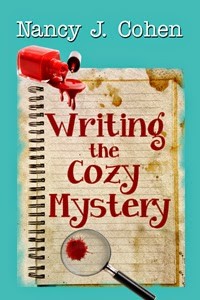
What sites do you find helpful in your crime-related research?
A friend of mine got some pretty good news this week. He won the Edgar for Best Novel.
William Kent Kreuger is his name. The book is Ordinary Grace and there’s nothing ordinary about it. Now I didn’t read all the best novel nominees this year, but I can vouch for this book and for Kent himself. He’s one of the good guys. He’s paid his dues, is generous to other writers, and has kept his Cork series going at a high level for fourteen books now. (Not an easy feat!)
So last Thursday night, I was delighted to see him hugging that ugly little porcelain statue.
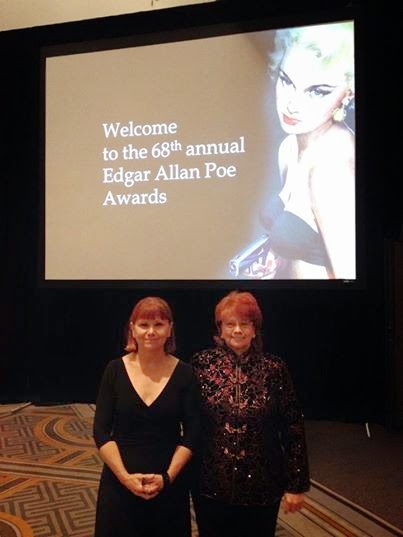
I’ve had a front row seat to the Edgars for seven years now. My sister Kelly and I are the banquet chairs. That’s us in the pic above just before the night got started. We produce the “show” that is sometimes called the Oscars of the crime world. It’s a great gig because Kelly gets to make movies for the night, I get to make the Powerpoint and work with great writers to produce the annual. It’s even fun to help MWA’s Margery Flax set things up. Can I share some backstage snapshots?
Here’s how Eddie arrives at the Grand Hyatt, rather unceremoniously:
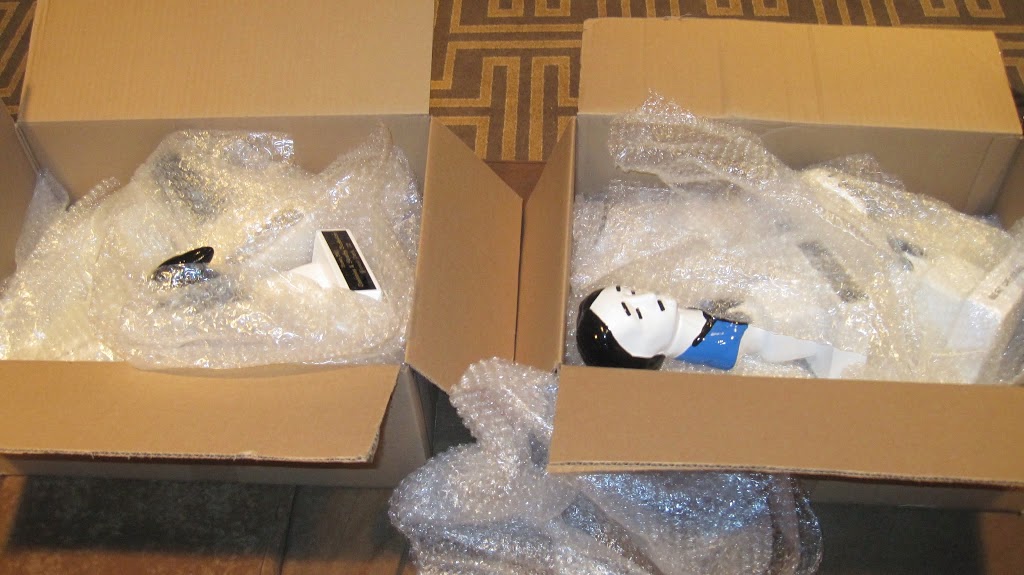
Here’s me doing grunt-work, unboxing the annuals.

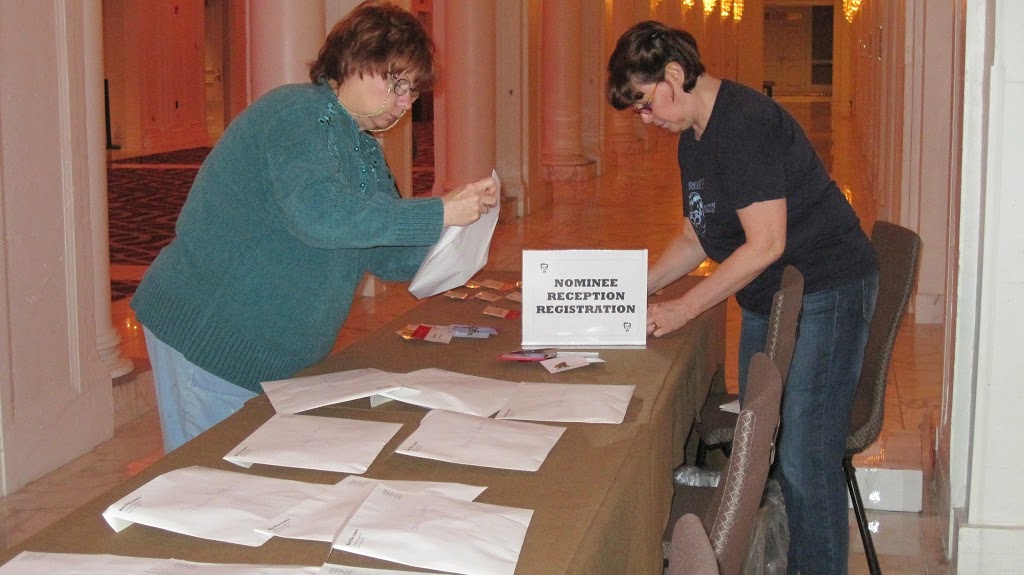
And Kelly helping Margery set up the registration table.
I can hear you sighing. Ugh…awards. Who cares?
True, there are some great and successful writers in our genre who never won an Edgar. Or an ITW Thriller Award, or Shamus or Anthony or Dilys. Many really good books are overlooked every year. Some publishers neglect to even enter their authors’ books. And except for the Mary Higgins Clark Award and the Agatha Award, there is a bias against traditionals and cozies. But after working the Edgars for seven years now, come banquet time it is fun to see folks who slave over their Macs in sweatpants put on tux and gown, put aside their cynicism, and get their moment in the sun.
But can an award change your life?
My sister Kelly and I got an Edgar nomination for our second book Dead of Winter. We were pretty naive — hell, stupid — about the book biz in those days. We didn’t even understand what the Edgar was, to be honest. I do remember exactly what I was doing when I got the news. The Bucs were beating up on the Raiders so everyone at our Super Bowl party was three sheets to the wind, including me. The phone rang and I took it outside so I could hear. When the person delivered the news, I screamed. My husband came running outside.
“What the hell is wrong?” he yelled.
“We’re an Edgar nominee!” I yelled back.
“I thought the cat drowned in the pool. What’s an Edgar?”
Things got better fast. First, the book jumped a couple notches on Amazon. It was probably from 1,4456,957 to 56,789, but hey, you take what you can get. We got some late reviews from folks who had ignored it the first time. (Paperback originals don’t register on most reviewer radar screens).
Then came the Edgar banquet. We bought new dresses and went to New York. At the hotel bar, we sat in a quiet circle: Kelly, her son Robert, my husband Daniel and our agent. We allowed ourselves one drink because if we did win, we didn’t want to make asses of ourselves up there.
Inside the cavernous dining room, we sat at our publisher’s table, ogling and pointing. There goes Harlan. Was that T. Jefferson Parker? Laura Lippman is taller than she looks in her pictures. Look at the red dress Mary Higgins Clark is wearing. Omigod, that’s Edie Falco over there!
Everything was a blur. Then they started announcing the winners. It is excruciating sitting through all the categories knowing your moment is coming. The sound starts rushing in your ears and your vision grows dim. You’re stone cold sober but you feel like you’re going to pass out.
I felt my husband grab my hand.
Then…
We lost.
I applauded the winner then grabbed the wine bottle and poured myself a tall one. The next day, we went home and I went back to chapter 12 of what was to become our fourth book, Thicker Than Water.
I wouldn’t be honest if I didn’t tell you the truth: Losing bites. My good friend Reed Farrel Coleman has been nominated three times in three different categories. He was up this year for Best Short Story. He lost. He says he is now chasing Jeffrey Deaver’s record who has lost seven times.
It is now ten books later for us. There have been dark days when I couldn’t put two decent sentences together and darker nights when I have fretted that the world was finally going to discover that I have no talent and am a complete fraud. Writing is a lonely affair. It’s a cliche but a true cliche. And the egos of most writers I know are swiss-cheesed with doubt. So yes, I think getting an award can change your life. Hell, a nomination can change your life.
Not because it’s some outer confirmation like a bump in sales, or a translation into a better contract or a bigger publisher. It is because it is an inner validation — that something you did, something you created out of the ether of your imagination and the sweat of your faith — is real. And your peers know and honor that.
 by Jodie Renner, editor, author, presenter
As a freelance editor, I receive fiction manuscripts from lots of professionals, and for many of these clients, whose report-writing skills are well-researched, accurate and precise, my editing often focuses on helping them relax their overly correct writing style.
Writing fiction that sizzles is a world away from nonfiction writing, especially scholarly, professional, or technical copy. In fact, people who have had a lot of experience writing academic, professional, legal, or business documents often have the steepest learning curve when it comes to switching to fiction. Professionals typically have the most “bad” (correct but inappropriate for fiction) habits to unlearn when they’re trying to create a believable story world with a casual, even quirky voice; lively, fast-paced writing; and colorful characters from various walks of life.
Here are some concrete tips for relaxing your writing style, trimming the clutter, and finding an authentic, appealing voice for your story, whether you’re a professional or not. Most of this advice also applies to writing engaging, zippy, natural-sounding blog posts.
~ To loosen up, read lots of popular fiction – and blog posts.
An excellent first step to counteract stiff, overly correct, nonfiction-type writing habits is to read a lot of bestselling fiction in the genre you want to write. Even better, try reading the novels aloud, or buy the audio books and listen to them in your car, on walks, or while puttering around the house or garage. You’ll soon get into the rhythm of the writing and start to develop your own natural, compelling fiction voice.
~ Relax and pare down any overly correct, convoluted sentences.
Remember, it’s about communicating images and concepts and carrying your reader along with the story. Don’t muddle your message with a lot of extra words that just clutter up the sentence and hamper the free flow of ideas.
Here are some well-disguised examples from my fiction editing of trimming excess words:
Before:
“Bastards. Why am I always the last to know?” Pivoting, the detective walked in the direction of the station’s front desk with a purposeful, nearly aggressive, gait. He shoved himself bodily through the swinging door and locked eye contact with the uniformed officer on reception duty.
Notice how the ideas flow better in the revised version:
After:
“Bastards. Why am I always the last to know?” Pivoting, the detective marched toward the front desk. He slammed through the swinging door and glared at the officer on reception duty.
Before:
Nathan paused a moment before replying as he slowed the car in preparation for a right-hand turn onto a smaller road, resuming the conversation as the car again picked up speed.
After:
Nathan paused as he slowed the car to turn right onto a smaller road, then continued as the car picked up speed.
~ Don’t drown your readers in details.
Too much unnecessary detail complicates the issue and impedes the flow of ideas.
Leave out those picky little details that just serve to distract the reader, who wonders for an instant why they’re there and if they’re significant:
Before:
He had arrived at the vending machine and was punching the buttons on its front with an outstretched index finger when a voice from behind him broke him away from his thoughts.
After:
He was punching the buttons on the vending machine when a voice behind him broke into his thoughts.
In the first example, we have way too much minute detail. What else would he be punching the buttons with besides his finger? And we don’t need to know which finger or that it’s outstretched. Everybody does it pretty much the same. Avoid having minute details like this that just clutter up your prose.
Before:
The officer was indicating with a hand gesture a door that was behind and off to the right of Wilson. An angular snarl stuck to his face, he swung his head around to look in the direction the officer was pointing.
After:
The officer gestured to a door behind Wilson. Snarling, he turned to look behind him.
Before:
Jason motioned to a particular number in the middle of the spreadsheet that Tom currently had on the computer screen.
After:
Jason motioned to a number in the middle of the spreadsheet on the screen.
Or:
Jason pointed to a number in the middle of the spreadsheet.
Or even better:
Jason pointed to a number on the spreadsheet.
~ Condense long-winded dialogue and make sure it reflects the speaker’s personality and background.
People rarely speak in complete, grammatically correct sentences, especially when they’re in a casual situation, in a hurry, or angry, upset or scared. Overly correct dialogue just doesn’t sound natural. Unless you’ve got two professors or other professionals speaking to each other in the workplace, don’t have your characters speaking in long sentences in lengthy paragraphs.
In tense or rushed action scenes especially, go for incomplete sentences and one or two-word questions and answers. Read your dialogue aloud or even role-play with a friend to hear where you can cut words to make it sound more realistic.
Before:
The homicide detective looked at the CSI, who was on his way out. “Leaving already?”
“This wasn’t the crime scene. Not much for me to find. You would do me a huge favor by making sure that the next time we had a murder I had an actual crime scene to investigate.”
“I’ll keep that in mind.”
After:
The homicide detective looked at the CSI, who was on his way out. “Leaving already?”
“This wasn’t the crime scene. Not much for me to find. Next time can you get me an actual crime scene to investigate?”
“I’ll keep that in mind.”
Before:
“C’mon, I don’t believe that. Lance knew you’d tell the cops about the connection. He just wanted the excuse in place because he knew Perkins might not be leaving.”
After:
“C’mon, I don’t believe that. Lance knew you’d tell the cops about the connection. He just wanted an excuse in case Perkins didn’t leave.”
Before:
Craig flipped a page in his notebook. “Do you keep records in your system that specify which of your inmates have had access to this room?”
After:
Craig flipped a page in his notebook. “Do you keep records of patients who’ve had access to this room?”
So be sure to read or listen to lots of fiction, and read your story out loud to see if it sounds natural, like people in those situations would actually talk and think. And delete all those extra little words that are cluttering up your prose, to create a smooth, natural flow of ideas.
For more on this topic, see my blog post, “Making the switch from Nonfiction to Fiction Writing,” on Joanna Penn’s award-winning blog.
Jodie Renner is a freelance fiction editor and the award-winning author of three craft-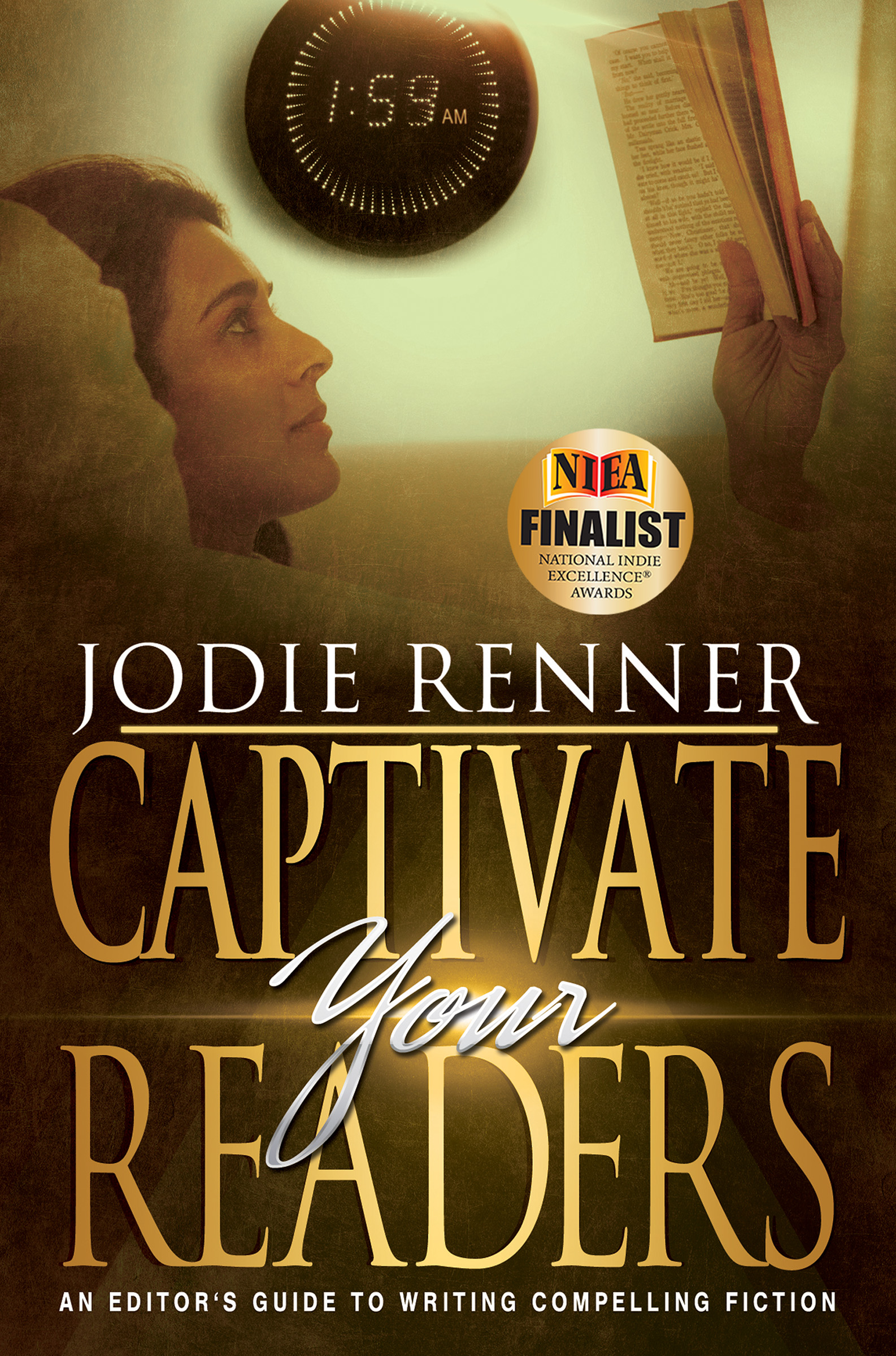 of-writing guides in her series An Editor’s Guide to Writing Compelling Fiction: Captivate Your Readers, Fire up Your Fiction, and Writing a Killer Thriller. She has also published two clickable time-saving e-resources to date: Quick Clicks: Spelling List and Quick Clicks: Word Usage. You can find Jodie at www.JodieRenner.com, www.JodieRennerEditing.com, her blog, http://jodierennerediting.blogspot.com/, and on Facebook, Twitter, and Google+.


This anonymous question was submitted to our blog. I thought I would attempt an answer and would love it if everyone could share their own answer.
“When you were at your lowest point and about to give up writing fiction, what pulled you through?”
I distinctly remember this low point. Ironically it came after a huge high. Go figure. I’d been working full time in the energy industry, doing a demanding job with travel, and had been writing for 3-4 hours every night (much longer on weekends). I did this grueling schedule for 3 years and it felt as if I worked two full time jobs at the same time.
I had joined a writer’s group, attended conferences & craft workshops, entered national writing contests, and submitted proposals to agents and editors with countless rejections. Mind you, I’d been named winner or finalist in half the contests I entered and I’d been receiving “good” rejections. The ones with handwritten notes or encouragement to resubmit from editors and agents, and I had 7 full requests out at the time. This kind of feedback requires risk. A writer has to dare to put their work out there for public scrutiny and rejection in order to learn and open your mind. Here’s an excellent post from TKZ’s James Scott Bell on the importance of Rhino Skin.
With every one of these aspiring author stories, there often comes tantalizing peaks along with devastating emotional valleys. I had entered (for the first time) the Romance Writers of America’s (RWA) Golden Heart contest for aspiring authors and had been named a finalist. This is like the Oscars for RWA. This was the Mt Everest high I’d talked about.
A good friend of mine, who had also been a finalist that year, gave me good advice. She told me to simply focus on my writing (a new project) and not get caught up in all the hoopla of the event, like what formal dress I would wear, or my shoes, or hair. From her experience, she knew it was too easy to get distracted and that if I didn’t sell from this, I would have to find a way to carry on and keep going. As high as I’d been from the contest, I felt my hopes dashed when I didn’t sell by the time the event came around. (Often, expectations are the proverbial albatross.) My friend had been right. I had to focus on what was important.
What got me through the crashing low after such a Rocky Mountain High was one question. I asked something that would change how I looked at my writing from there forward. “Would I still write if I never sold?” When I answered with an enthusiastic “YES,” I knew why I wrote. I wrote for the passion of the process and the love of storytelling, my way. I had tapped into a form of self-expression, creating something from nothing, that I hadn’t experienced any other way. The love of writing and reading had been with me since I was a child. It would always be a part of me.
Writing has elevated my quality of life. It’s changed me forever and in that moment, the burden of expectation (something I had no control over) was lifted. After I’d let go of the Must Sell mentality, it wasn’t long after that I sold big. My first sale story is here at this LINK. Yes, I sacrificed a body part to sell. But after I finished “No One Heard Her Scream,” I knew it would sell. Don’t ask me how I knew. I just did. Who needed pain killers when the euphoria of writing had me walking on clouds?
In that stage of my writing journey–after I’d rediscovered the joy–I focused on the craft of writing and forgot about what was popular or what some publishers were wanting in their detailed submission guidelines. I never was one to worry over or chase trends. I had my day job. I treated my writing as something I did because I loved it. Writing still brings joy to my life and I continue to write the stories I want to read.
I’d love to hear from others in our TKZ family. What gets you through the slumps? What keeps you going?
I teach workshops on a regular basis to mostly beginning writers. A common issue that often shows up in their first drafts deals with point-of-view shifting; specifically what’s called “head hopping”. Most of the time it’s done without the writers even realizing it. They want to make sure enough information is passed on to the reader for the story to make it clear and move forward. I’ve found that even after pointing out the problem, it’s a bit mystifying and confusing to new authors. It takes practice to understand where they’re going wrong. Unfortunately, head hopping comes with some undesirable side effects which I’ll cover below. First, here’s an example of POV head hopping.
Agent Miller watched his partner, Agent Cobb, as they suited up for the assault. Why was Cobb so secretive when he showed up at the staging area? Why had he seemed reluctant to talk about his upcoming promotion? Cobb always confided in him with personal issues. After ten years together, it wasn’t like him.
“You decide to take the gig,” Miller asked as the two suited up for the assault.
“Not sure,” Cobb said and turned away, not wanting his best friend to know that the promotion meant he would soon be Miller’s new boss.
Here we have the inner thoughts of both men. There are two points of view.
It would be easy to conclude that this is omniscient point of view. The omniscient narrator simply knows what both men are thinking. Technically, it is. But there’s a good chance the author didn’t use omniscient POV on purpose. If anything, it was out of inexperience. Omniscient POV is not used much in popular fiction these days. Its heyday came years ago when writers like to play god—all knowing, all seeing. In order to maintain an omniscient POV, the narrator had to know everything about everybody all the time. It’s an oppressive writing style that dilutes the mystery and personal conflict of the plot—one of the side effects I mentioned.
The biggest downside to head hopping is a lack of close, personal connection with the main characters. Readers love to get “inside” the heads of the protagonist and antagonist. They want to see and feel what the characters feel; what makes them tick. With head hopping, it’s more distant and somewhat sterile. Even cold like a documentary where the voice over narrator tells everything in a matter-of-fact fashion. In contemporary fiction, the reader desires to see the story through the character’s eyes, not the narrator’s.
So what’s the solution to head hopping? As an example, let’s rewrite the scene with the two agents. Pick a POV character, usually the protagonist and route everything through his eyes and thoughts. As the writer, put yourself in the character’s head. You’re not a psychic, clairvoyant or mind reader. You can only determine another character’s attitude through their actions, reactions and speech.
Agent Miller watched his partner, Agent Cobb, as they suited up for the assault. Why was Cobb so secretive when he showed up at the staging area? Why had he seemed reluctant to talk about his upcoming promotion? After ten years together, it wasn’t like him.
“You decide to take the gig,” Miller asked. He knew Cobb always confided in him about personal issues.
“Not sure,” Cobb said and turned away.
It was almost as if Cobb was hiding something about the promotion. Something that embarrassed him.
The basic information was revealed in the second version. The difference was that an element of mystery, even conflict emerged. It pushes the story forward and tells the reader something about both characters’ motivation.
So how do you manage multiple POVs?
It’s called the “handoff”. Sort of like when the quarterback hands off the football to the running back. The focus is now on the new character with the ball. In order to shift POV, you must hand off the POV from one character to the other. This can be done with a “drop” or scene change where the first POV character leaves the scene thereby “handing off” the point of view to the remaining character. An even better method is to always stay in a single POV per chapter, shifting only when the new chapter starts.
Shifting POV should be for a specific purpose, not random. Not doing so violates the most important rule of writing: never confuse the reader.
How do you deal with POV shifts? Any additional tips?
——————————-
 Coming soon:THE SHIELD by Sholes & Moore
“THE SHIELD rocks on all cylinders.” – James Rollins, New York Times bestselling author of THE EYE OF GOD.