We’re interrupting this holiday programming to ask our friends for a favor: please nominate The Kill Zone for the annual “Top Ten Blogs For Writers” contest hosted by WriteToDone. Click the link for details.
Happy Thanksgiving From TKZ!
Zoning in TKZ
I’ll be flying most of the day and may not get to respond to your comments. In case I don’t, here’s wishing all my TKZ blogmates and friends a wonder Thanksgiving Holiday.
—————-
Someone once asked: “I’ve heard writers talk of being ‘in the zone’ regarding their writing, which I take to mean being in an altered state of extreme creativity. But how, without drugs or other stimulus, do you get into that state?”
In fact, we hear the term in the zone used often, not only with writers, but athletes, artists, and just about any activity that requires skill, creativity and deep concentration.
So what is “the zone” and how do we enter it? Why is it so hard to remain there for extended periods of time?
Being in the zone can last for a few minutes, a couple of hours or a whole day. For those that never seem to enter the zone, it might be because they try too hard to do so. Sort of like when we stop trying to solve a problem, the solution suddenly comes to us through our subconscious.
Let’s try to define what being in the zone means, especially when it relates to writing. For me, it’s a mental state where time seems to disappear and my productivity greatly exceeds normal output. It might start after I’ve finished lunch and sat down at my PC to work on a new chapter. Without any feeling of the passage of time, I suddenly realize a couple of hours have gone by and I’ve produced 1000 words or more. I don’t remember the passage of time or anything that deals with my surroundings. I only remember “living” or becoming immersed in the story’s moment, having the words flow from a deeper source, and “awakening” from the writing zone as if only a few moments have passed.
I’ve never been hypnotized, but I can assume that being in the zone is somewhat like self-hypnosis. My body remains in the here-and-now, but my creative senses somehow find a hidden room inside my mind, a place normally under lock and key. And I’m able to enter it for a short time to let what’s there emerge into the light of day.
It can also feel like driving down the Interstate on a long trip deep in thought and suddenly realize I can’t remember the past ten miles.
I’ve never been athletic, but I bet it’s a similar scenario: a golfer is able to tune out the surrounding crowd of tournament spectators, the dozens of network cameras, the worldwide audience, the cheers from the distant gallery as his opponents make a great putt, and he’s able to enter a place where only his game stretches out before him. The rest slips by in a blur. Personal mind control.
So what is a good method for getting into the zone? Some writers use the “running start” technique by reading the previous day’s work or chapter. It gets them back into the story and hopefully the new words start to flow.
Others listen to music. This is something I often do. Nothing with lyrics, though. I listen to movie scores or piano and guitar solos. I find that it can help set a mood or become background “white noise” that blocks out other audible distractions. That’s because, for me, the biggest obstacle to zoning is distractions. It’s important to reduce interruptions and distractions by creating an environment where they are minimized. This means shutting my office door, closing the drapes on the windows, unplugging the phone, disconnecting Internet access, and most of all, choosing a time to write when those things can be fully managed. Doing away with distractions is no guarantee that I will enter the zone at will, but it does give me a fighting chance to at least knock on the door to one of those dark, hidden rooms upstairs and let my story flow out.
How about you Zoners? What’s it like for you to write in the zone? And do you have a method to slip easily into the zone?
—————
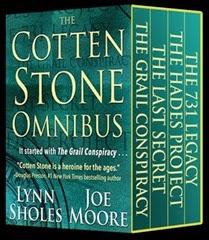
“Cotton Stone is a heroine for the ages.” – Douglas Preston, #1 New York Times bestselling author.
Less than a week to go until the release of THE COTTEN STONE OMNIBUS. The collection includes the complete series: THE GRAIL CONSPIRACY, THE LAST SECRET, THE HADES PROJECT and THE 731 LEGACY. All 4 thrillers for only $7.99. Pre-order now!
Thoughts About Authors Changing Genres?
This is a Reader Friday-type question, but I have a question for y’all: When an author whose work you have previously enjoyed begins writing in a new genre, using a different voice, how have you responded? Do you think it’s a good idea for authors to use a pen name for a new style of writing, or are you willing to accept different voices from the same writer?
The Kindness of Strangers
For any of you who are on Facebook with me, you will know that last week I had a great deal to be thankful for, especially as a result of the kindness of strangers.
The drama occurred last Wednesday when one of my neighbors (1st stranger really, as I don’t know him very well) knocked at my door around 7:30 in the morning to tell me that he had just seen our beloved collie, Hamish (as shown in photo above), being lured up the road by two coyotes. I rushed outside (very glamorous in my PJs and dressing gown) to see the most surreal scene – two coyotes nearly at the end of our street cunningly leading my dog along to what I have no doubt would have been a nasty end. I never truly believed all the stories about coyotes working together to lure large dogs away to be attacked by the pack – but I do now.
In a panic I called out after Hamish, who initially looked back at me with a face that said “are you kidding me, I’m having way too much fun!”. By this time my neighbor was running to his car, ready to help – because we both could see that Hamish was way too far away for me to get to him. It took me four attempts (and a lot of willpower not to scream at my dog) before Hamish turned reluctantly to come back to me. That was when the next stranger came in – running down her driveway to help coax Hamish and grab his collar. I’d never met her before, and although it was a little weird meeting in the circumstances (both in our PJs – saving my dog from coyotes!) I was touched by her concern. She was already on the phone to animal control telling them to send a patrol – having not only seen the amazing sight of two coyotes ‘playing’ with a collie but also making the decision to actively come outside and help rescue him.
So as you can see I have a lot to thank two relative strangers and this got me thinking, especially as this is Thanksgiving week, about the difference strangers can make. In my writing career I have been amazed how people who I’ve often never met, have gone out of their way to help me – be it booksellers, readers, conference organizers, blogger or reviewers. Although I’ve always tried to thank each person individually, I would also like to take this time to acknowledge how much we, as writers, rely on the kindness of strangers. I don’t mean that in a ‘taking pity’ kind of way – I mean those active, ‘go out of your way’ actions that can often make all the difference to a writing career. All too often we have no way to repay these acts of kindness, except (I hope) by following their example and helping other writers in our midst.
So, in the spirit of Thanksgiving, which ‘stranger’ would you thank if you could? Have you ever experienced a moment such as mine, where the kindness of strangers really made all the difference (and there is no doubt in my mind that without them Hamish would have been lost forever)? Well, now is the time, to acknowledge those moments. We should also aspire to be these sort of strangers – the ones who don’t stand idly by – but who rush in to help when help is needed.
Oh, and as a side note, this morning we received a ‘coyote’ calling card in the form of someone’s dead chicken disemboweled on our lawn. I swear I feel like I’m suddenly in some kind of ‘coyote godfather’ movie…thank goodness we have strangers looking out for us!
Using the Novel Journal for Writing Breakthroughs
James Scott Bell
@jamesscottbell
Help! Help!
Reader Friday: Getting Away From It All
Calling For First Pages!
Just a housekeeping note today: We are interested in receiving more of your first page submissions for our monthly first-page critiques.
Here’s how it works: Send us the first page (400 words max) of your manuscript in an email or as a Word attachment, along with the title, to the email killzoneblog at gmail dot com. We’ll take the first 30 submissions we receive, then announce when we’re accepting submissions again. The pages will be divvied up among the Zoners for review.We’ll post the pages on recurrent Thursdays, along with a critique. Readers will be able to comment as well. Note: Critiques are done anonymously–writers’names will not be posted, and reviewers will not know who authored their assigned pages.
In years past we’ve had great fun doing this exercise! We’re looking forward to reading some of your pages!
Note: And actually, we don’t cut off the submissions at 30. It just takes us longer to get to ’em! 😉
Gerunds Be Gone
What’s wrong with this sentence: “Shutting off the ignition, she threw her keys into her purse and emerged into the bright sunshine.”
How can you throw your keys into a purse when you are using them to shut off the ignition?
This type of “ing” phrase is called a gerund. I never knew what it was until a critique partner pointed out that I was using them liberally. And I hate to say it, but this was several years into my published works. Even now, I’m not sure this is the correct grammatical term.
I learned my lesson, and as I’m now going through my backlist mystery titles making updates and tightening sentence structure, I am finding more phrasing like the one above.
Beware these illogical phrases in your own work. Here are some examples:
NO: Flinging the door wide, she stepped inside the darkened interior.
YES: She flung the door wide and stepped inside the darkened interior.
NO: Taking a sip of orange juice, she put her glass down and opened the newspaper.
YES: After taking a sip of orange juice, she put her glass down and opened the newspaper.
NO: Racing down the street, she came to a halt when the light turned red.
YES: She raced down the street, coming to a halt when the light turned red.
NO: Shaking the lady’s hand, she stepped back to admire her cobalt dress.
YES: After exchanging a handshake, she stepped back to admire the other woman’s cobalt dress.
It’s okay to use an “ing” phrase in thoughts. For example, you can say, “Wishing she could change the events of the past few hours, she sped down the road.
What is your grammatical Achilles Heel?