What We Can Learn From Chuck Berry

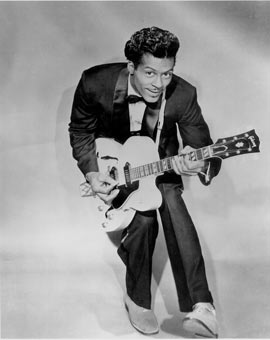
Chuck Berry left us a week ago at the age of 90. He didn’t begin his music career intending to be a rock ‘n’ roll…star? Icon? Immortal? No. Berry wanted to be a blues singer initially, and that genre would sneak onto his albums here and there (including, I understand, Chuck, an album of new material to be released in June). Rock ‘n’ roll, however, was what paid the bills, and that’s what he did, arguably better than anyone else before or since.

Berry’s lyrics were amazing. He could put years and years of story into a three minute song, with three verses, chorus, and guitar solo. Badda bing bang boom. Go to Spotify (or better yet, your own music collection) and listen to what might be his most widely heard song (if not his most famous one), “You Never Can Tell,” which was prominently featured in the film Pulp Fiction. It’s about a teenage girl and boy who get married — probably too early — but with some hard work acquire an apartment with a “coolerator” full of tv dinners and ginger ale (described in a throwaway line that might be the best single pop song lyric ever written), a stereo with all sorts of 45s, and a flash car. They make a go of it against all odds, and Berry tells you everything you need to know about the whole shootin’ match in two minutes and forty-five seconds through a tune driven by Johnnie Johnson’s piano in the background. A somewhat tragic side note to the song is that Berry wrote the song while in prison. Berry also wrote and recorded his autobiography in three songs that you can listen to in just over seven minutes: “Johnny B. Goode,” the lesser known and bittersweet “Bye Bye Johnny” (which tells the story of his acquired stardom and fledgling motion picture career through the eyes of his mother, who drew out all her money from the bank to buy her son a guitar and put him on that Greyhound bus), and “Promised Land,” the mortar between the bricks of the two other songs. I don’t hang around bus stations (…) but I challenge you to go to one in any city and not hear “Promised Land” playing in your head.

What we can learn from this? Keep in mind that Berry’s art had baked-in limitations. For one, songs had to be relatively short if the artist and record label expected to get them played on the radio. For another, the lyrics had to rhyme. A third was that the clock was ticking. You had to keep putting product out back then to keep your place in radio rotation because some young, hungry upstart was breathing down your neck, hoping to take your place. Berry just painted a picture and kept it simple, particularly in songs like “Carol,” where the singer begs the object of his affection not to go off with someone else, and assures her that he’ll learn to dance if he has to practice all night and day. Berry communicates need and desire in two lines. You and I can do this too. If you have an idea for a story or novel, try to write it from beginning to end in one page (single spaced, 12 font size), from beginning to end. Don’t include every character, car crash, or explosion that you conceptualize. Describe each of your main characters in a medium length sentence, set forth what they are chasing, or after, or trying to achieve — the MacGuffin of the work — and what they are going to do to reach their goal. When you wrap up, provide the ending in terms of emotion or result: happy, sad, death, life, win, lose, or draw. There’s your first step, your blueprint, your demo, what they refer to in Nashville as a “guitar/vocal.” You’re not going to be showing this to anyone so if you feel the need to drift off a bit go ahead and have at it but you’ll at least have something down. Think of Chuck Berry while you do it, and remember that all of those great tunes he recorded were the end result of hours and hours or writing, rehearsal and recording, some of it very frustrating. I’m hoping that at some point a boxed set of alternate takes of Berry’s best known songs is released so that we can get a look at some of the entire process. You’re starting in reverse of what Berry did — you’re going to take something short and make it longer — but the principle of keeping it simple is the same for both.

My questions for you: if you have a favorite Chuck Berry song, what is it? Mine is the live version of “Johnny B. Goode” found on The London Chuck Berry Sessions. Berry starts off playing a ferocious version of “Bye Bye Johnny,” savagely spitting the first verse out, but the crowd, either because of their unfamiliarity with the song or confused by its similarity to “Johnny B. Goode,” starts singing the chorus to “Johnny B. Goode” in unison, startling Berry (“Look at ‘em! Look at ‘em! Sing! Sing, children!”) and causing him to switch to the lyrics of “Johnny B. Goode” for the second verse. Listen all the way to the end, when the M.C. pleads with the crowd to vacate the hall because they’re over time and — Oh, The Humanity! — Pink Floyd fans are waiting outside. Meanwhile, the crowd chants “WE WANT CHUCK! WE WANT CHUCK!”

If you don’t have a favorite Chuck Berry song, what is your favorite song otherwise?


Monopoly Tokens For Writers?

As you all have probably heard by now, a popular vote has given the world three new tokens for Hasbro’s game of Monopoly: a T-Rex, a Penguin, and a Rubber Ducky are In. The Thimble, Iron, and Wheelbarrow are Out. (Can’t say we’re sorry to see the Thimble go). The closest unsuccessful candidate was a tortoise. Of course, the announcement of the new designs  was accompanied by an inevitable bit of controversy about how the new tokens undermined the spirit of the original game. But so far, no dark conspiracy theories have emerged about Rubber Ducky fans rigging the system to give the Boot, the boot, thankfully.

It’s too late to vote, but wouldn’t it have been fun to see a writing oriented token in the mix? Perhaps a computer, a paper-filled trash can, or book token?

Are you happy with the winners and losers in the token popular vote? Are you sorry to see any of the old ones go?


Do You Journal?


Look at all the lovely notebooks.

From the top:

Emerald Leuchtturm-Current Bullet Journal, containing calendar events, daily schedule, car maintenance, random notes taken when the appropriate journal wasn’t available.

White Paper-Masako Kubo–Stapled, not bound.  Last summer’s dream journal, reference.

Red HC Moleskine–Long term ideas for novels and stories since 2011

Light Blue Leuchtturm–Mid-End of 2016 Bullet Journal. I didn’t get into Bullet Journaling until late last year. Now using for blog thoughts and ideas

Teal Flexible Moleskine–Current Morning Pages Journal

Bright Orange Moleskine Notebook–Short story development

Buff Flexible Moleskine--Novel (Formerly The Intruder) WIP notes

Orang/Red Moleskine Notebook–Novel (Untitled cozy–Yeah, gonna give that genre a shot)

Bright Pink Leuchtturm1917 Master Slim–This started out as my 2017 Bullet Journal, but it proved too large for toting around. The 5×8 version (top) fits nicely in any purse or bag. I consider this my Journal of As Yet Unrecognized Possibilities.

For somebody who only owned one non-spiral bound notebook six years ago–the Red HC Moleskine–I’ve certainly made up for lost time. What you don’t see are the notebooks for my last three novels, the Bliss House Trilogy, because I’ve archived them.

As a young writer, I wasn’t much of a journaler. I wanted to write, but I was too embarrassed to write down things that might look silly to other people and carried around my ideas in my head. Of course, journals are meant to be private. I have no idea who I thought would want to even peek at my journals. The words were hardly titillating, the ideas tentative and unpolished. It’s not like I kept money or passwords between the pages.

But now that I’m a woman of a certain age, journals have become critical tools. Not only do I have more pressing/interesting  ideas, I also have a memory like a sieve. Journals are my full-body, writerly Spanx. They keep everything tucked in and looking, if not good, at least organized.

I’ve become very attached lately to the notion of ideas floating from writer to writer, looking for the right one to tell the story. It’s an idea I first read of in Elizabeth Gilbert’s Big Magic. She talks about starting to write a novel that had been sort of pestering her–but she struggled, and it just wasn’t happening. So she temporarily shelved it. But then she talked to novelist Ann Pachett, who described her own work-in-progress. And the ideas were nearly identical. But Pachett’s book was going very well, and she later finished it and sold it.

By writing ideas down, I hope to tether them at least for a while. Collect them, live with them, let them nurture themselves with the attention I can give them. I can’t tell you the number of times I’ve gone back to the pages of that Red HC Moleskin when I needed a quick idea fix.

Still, it’s a rather intimidating pile of notebooks. They don’t travel easily, and I’ve only recently gotten used to having the Bullet Journal always with me. For a while I tried an app called Wanderlist, but tapping reminders and notes into my phone makes much less of an impression on me than when I write things down. Then I forget to look at the app often enough.

Tell us how you keep track of your ideas and schedule. Do you journal? Or do you go the electronic route?

.


What Would You Tell Kids About Writing?

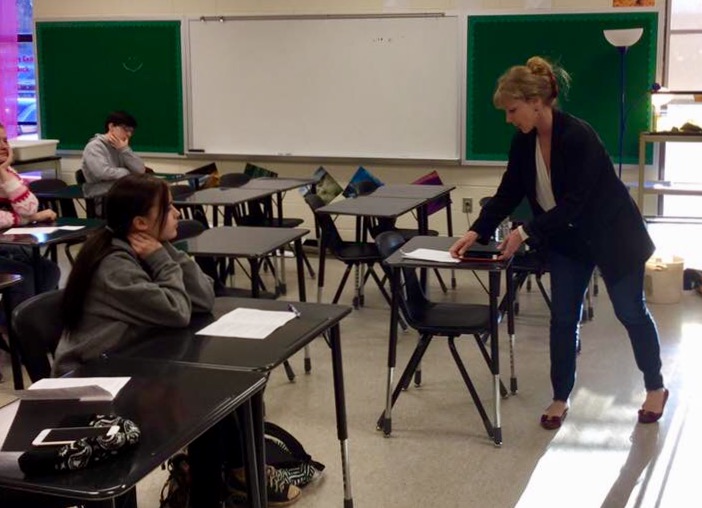
I attended a high school Career Day in South Carolina yesterday, to talk about writing as a possible vocation. I hosted multiple, back-to-back discussions, each one covering different writing-related careers: journalism; fiction writing; and technical writing.

During the sessions about creative writing and being a novelist, I focused on the need to learn the craft of writing, the importance of connecting with the local writers community, and a few other things I wish I’d known when I was in high school. I was impressed by the questions the students asked. We discussed the nature of themes in novels, The use of pen names, and when/how many times to edit a working draft. I think there may have been a future writer or two in that group of bright, inquisitive students.

So, what kinds of things would you like to have known about writing, back when you were in high school?

Who You Are and Who You Ain’t

From Larry Brooks… introducing you to an article by James N. Frey.

Chances are you’ve heard of James N. Frey.  He wrote one of the iconic writing craft books of all time, How to Write a Damn Good Novel (1987), which after three decades remains a consistent seller and presence on the craft shelf of most bookstores and collectors of writing wisdom.

He’s been very generous with me, relative to my own work, blurbing not only my own writing books, but also my fiction. But that’s not the sum total of why I like and respect the guy (which are separate criteria). He tells it like it is – something I’ve tried to emulate –  which in the polite company of the collective writing conversation is both a rare and refreshing clarifier among a plethora of vague and often contradictory and downright confusing advice (“Story Trumps Structure,” anyone?).

So today I’m rerunning an article he contributed to my site, Storyfix.com, some eight years ago, a piece that still comes up at conferences as something writers remember, and credit as a milestone in their own writing journey. I’m the first to line up with that response, because it’s one of the boldest, most cringingly accurate musing on the writing life I’ve ever read.

Who You Are, and Who you Ain’t

By James N. Frey

Did you notice, when you told your mother or father, sister, brother, or friend that you wanted to be a writer, the shocked, hurt, bewildered expression on their faces?  Spouses, upon hearing the news, often get ill or take to the bottle. Some start packing.

There are a lot of great quotes from famous writers on writing that tell of the struggle writers go through.  Supposedly Hemingway said that to be a writer all you have to do is “go into your room, sit in front of your typewriter…and stare at a blank page until blood comes out of your forehead.”

We all know what it feels like to have blood trickling down our forehead.  We all know there are days when the words will not flow from our brain to our fingertips, days when the most used key on the keyboard is the delete key, days when you think your mother was right — you should have taken the Post Office exam.  We all know days when we say, what the hell am I doing bleeding from my forehead when I could be…playing golf…or fishing…or playing frisbee with my dog.

Of course writers don’t play golf or go fishing or play frisbee with the dog.  Few writers even have dogs.  Who the hell has time for dogs?  Writers don’t go out to a lot of movies, or baseball games, or picnics in the park.  Writers don’t do much of anything but write, think about writing, or talk about writing.  We go into our little rooms, turn on our music, and turn on our machines and stare at the screen until blood comes out of our foreheads. That’s the writing life.  Not all that glamorous or glorious, is it?  Taken a day at a time.

And then after countless hours of agony writing, rewriting, workshopping, editing, getting critiques, reading books on craft — some of which are damn good — we try to get published and we find that bleeding from the forehead wasn’t all that bad. Now we’re getting banged on the forehead with rejection slips that hurt more than getting hit with a sledgehammer.

Anybody ever tell you your work was not right for their list?  What the hell that does that mean?  They have too many critically acclaimed bestsellers on their list?

How about they tell you it’s beautifully written…they loved your characters…you obviously have a lot of talent and a great future,  but, gee, it’s just not right for our list…we’re not taking on any new clients at this time.  Then why the hell did they say yes to your query letter?

We try to find out what’s wrong, so we go back to book doctors and writers’ workshops and hear that our work is boring or not right for the market, old-fashioned or too avant-garde, doesn’t fit the genre, or is too derivative, and we go back to our room and bleed some rewrite out of our foreheads.

These book doctors charge like hell — there go the kid’s braces — and so we try agents who charge reading fees to finance their trips to the French Riviera.

And then the big day comes and you finally get an agent who seems to really like your stuff. And after it makes the rounds to a couple dozen houses, you hear that the editor loved it, but the pub board said it wasn’t right for their list, that you write beautifully, they loved your characters, but your book, well, is not quite right for their list….

At least, your writer friends tell you, you aren’t still getting printed rejection slips made out to “Dear Author.”

You have by now disabused yourself of the notion that there is an editor waiting in a book-lined office to shepherd your book through the process of getting you critical acclaim and your rightful place on the New York Times bestseller list.

It may happen some day, but in the meantime you’ve found out the first big truth of the writing game — the publishing industry treats writers like shit on their shoes.

The price you pay for being a writer is high.

Read the remainder/entirety of Frey’s article HERE (the entire piece weighs in at well over 3,000 words, too long for this venue. You’ve just read the first 800 of them… the rest are well worth the time, in my opinion.)

Visit James’ website HERE.

Marketing For Writers Who Hate Marketing

by James Scott Bell
@jamesscottbell

A psychology professor was lecturing his class one day, and asked the following question: “How would you diagnose a man who is standing and screaming at the top of his lungs one moment, then drops into a chair and weeps the next?”

A young man raised his hand and said, “A basketball coach.”

Welcome to March Madness everyone. One of my favorite times of the sporting year. Always a great underdog story or two. And some player stepping up his game to become a national star.

But that’s not the point of my introduction. It’s more about stress and a little something we could call Marketing Madness.

I have a number of friends who came up the “traditional” way. After working to hone their craft and going through the typical rejection cycle, they landed contracts with a publisher. They stayed productive, built up a career.

And then, as they say, stuff happened.

Like the Kindle.

Amazon introduced its industry-changing device in November of 2007. Publishers, at first, rubbed their hands in glee, for they could sell books that didn’t require printing or warehousing, but could be priced the same as a hardcover! (O, what a wake-up was awaiting them!)

No one could have foreseen what this was going to mean for writers. It’s a quaint stroll down memory lane to look at blog posts from those early years of the digital revolution. One of the first indie cheerleaders, Joe Konrath, had this to say:

At this date, May 31 2009, agents and publishers are necessary. Any author who wants to make writing their fulltime job can only support themselves by selling print books, and the agents and publishers are a crucial part of this industry.

But how about in 2012? 2015? 2025?

At this same time, however, the economy was in the tank, the long-term results of which would be fewer contracts offered to writers seeking a place inside the Forbidden City. For so-called “midlist” writers, many felt the big squeeze. Some were not offered another contract. Others saw their advances slashed.

Which meant more writers taking a serious look at self-publishing.

By 2013, your humble scrivener was mostly indie, and began to hear from traditional colleagues wondering if they ought to stick their toe in the self-pub waters. I responded, “Come on in! The water’s fine. And there’s room for everybody!”

So some took a tentative step, some dove, a few did cannonballs. And at first it was a giddy delight. But about a year-and-a-half ago I started to hear rumblings from a few of the newly selfed. Things like:

Marketing is taking up too much of my time!

I wish I could just write!

I don’t know what works to get the word out!

I keep trying things, and I’m frustrated!

I can’t possibly do what [the latest indie superstar marketer] does!

Writing isn’t fun anymore …

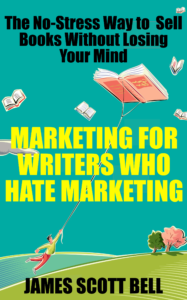
That’s when I decided write about book marketing––what works, what doesn’t, what needs to be done, what can be largely ignored. The result is Marketing For Writers Who Hate Marketing: The No-Stress Way to Sell Books Without Losing Your Mind.

I wasn’t interested in writing yet another tome listing every marketing idea available to mankind. Rather, this book has two primary concerns:

  1. To relieve writers of the worry that they’re not doing enough.
  1. To show writers how to prioritize the few tasks that do the most good, so they can spend the bulk of their time doing what they love most––writing!

Yes, we all have to do some marketing––be ye indie, traditional, or a mix. Publishers want you out there on social media, but how much is enough? Even more to the point, how much is too much? When does a flurry of marketing activity begin to negatively affect the most important thing of all––your writing?

This book is my answer. The chapters are:

  • What, You Worry?
  • The Single Most Important Marketing Tool
  • The First Impression
  • Cover Copy That Sizzles and Sells
  • The Crucial Opening Pages
  • What Price Is Right?
  • Productivity and Links
  • The Care and Feeding of an Email List
  • Your Website and Amazon Author Page
  • Your Book Launch
  • Short Writing as a Marketing Tool
  • Live Networking
  • Things That Suck Time
  • Things That Cost Money
  • Platform Paranoia
  • Social Media Madness
  • If You Want to Go Further

Here is where you can find the ebook:

AMAZON

AMAZON INTERNATIONAL STORES

NOOK

KOBO

iBOOKS

If you prefer print::

PRINT VERSION

 With the time crunch we all feel, it’s more important than ever to assess our available activities via ROI (Return on Investment). Another was to put it is the venerable Pareto Principle (often called the 80/20 Rule), which counsels focusing on the 20% of actions that make a real difference, and avoid expending too much energy (“the law of diminishing returns”) on the 80% that don’t add enough value.

That observation alone should help you sleep better if marketing your books is causing you too much stress. March Madness, good. Marketing Madness, not.

What are your feelings toward marketing? Does it worry you? Frustrate you? Is it something you bear with quiet patience … or with a primal scream?

Ways to Add Humor into Suspense – First Page Critique: WOW

Jordan Dane

@JordanDane

I have another first page critique. An anonymous author has submitted their first 400 words for critique at TKZ. It takes guts, folks. My feedback is below and please comment with your observations.

***

I levered the cork out of a bottle of Chardonnay and a bullet slammed into my back. Below the right shoulder blade. More to the center. That difficult spot where if you’ve got a rash or insect bite it’s impossible to scratch and not look like you’re having a spastic seizure. If I knew this was the night someone was out to kill me I would have brought something up from the cellar that was more unique than a domestic Chardonnay, even though it had a pleasant balance of oak to it. There was that Nieto Senetiner Malbec from Argentina, I was holding for a special occasion, for example.

Anyway, the chard went flying, the bottle hit my hardwood floor, didn’t break, the amber liquid flowed out. As for me, the impact of the slug jolted me forward. I tripped over my feet and did a full body slam on the deck.

There I was, face down, flat on a hard wood floor, my back hurt like hell and I heard heavy footsteps crunch their way over to me. We’re talking serious, heavy duty, outdoorsman leather soles here. All I was grateful for at this point is that I still wore my bullet proof vest from work. No, I’m not a cop, not a private dick sort of guy, no security guard, ex-military or something like that. I worked in a dentist’s officer. Name’s
Wowjewodizic, by the way.

I stayed still, bit the inside of my cheek to distract me from the pain in my back and waited. Waited for the, what’s it called, the ‘coup de – something or other,’ where the bullet enters the back of the skull and you don’t care where it goes next because you’re dead.

Then it occurred to me, this guy, or gal, probably not likely due to the heavy feet, didn’t use a silencer. This was a full on, make-a-lot-of-noise, gunshot. He wasn’t concerned about the blast drawing attention from the neighbors. Then again, my nearest neighbor was three miles away. And it was raining. It does that a lot in Portland, Oregon.

FEEDBACK

OVERVIEW: This story feels like a cozy mystery with liberal use of humor through the first person voice of the protagonist. in this scene, someone is shot and yet I don’t feel any danger. In the first few lines, the reader learns the protagonist is shot and yet there is far more importance placed on the awkwardness of an insect bite.

I levered the cork out of a bottle of Chardonnay and a bullet slammed into my back. Below the right shoulder blade. More to the center. That difficult spot where if you’ve got a rash or insect bite it’s impossible to scratch and not look like you’re having a spastic seizure.

The author voice detracts from any suspense. If the point is the humor, I would think a whole book would make it a challenge to get through, at least for me. I want a plot to follow and characters I care about when they’re in real danger. In suspense/mystery/thrillers, I prefer a more subtle use of humor. At the foundation of every story needs to be a solid plot with escalating stakes and conflict.

STICK WITH THE ACTION – The action of the protagonist getting shot is completely masked by the mental meanderings of the voice, making leaps between wines, insect bites, the gender of the shooter by how weighty the footsteps are, and Portland weather.

In this intro, there’s a seesaw effect of telling a bit of the story, then wading into a distraction of backstory or awkward asides told through the voice of the character. It gave me the feeling of constantly treading water until I’m exhausted, trying to figure out what the story is about. When distractions outweigh the plot, a reader can lose track of the plot and not finish a book.

SETTING – There’s very little setting written into this excerpt and it takes awhile for the reader to piece together where the protag is. A wine cellar is mentioned, but it’s not until the protag mentions “my hardwood floors” that the reader sees he could be at his home. There are subtle ways to add setting without hindering the pace if the descriptions are part of the action. As a reader, I like to get a feeling for setting in books I enjoy.

LINES BEST USED IN DIALOGUE – The line below is an example of how the author could have stuck to the action of the shooting, yet gotten the humor across through dialogue with another character. Witty repartee with a detective, for example, would allow the author to pepper in humor without overdoing it.

If I knew this was the night someone was out to kill me I would have brought something up from the cellar that was more unique than a domestic Chardonnay, even though it had a pleasant balance of oak to it.

FIRST PERSON/GENDER & RAMBLING NARRATIVE – It’s not until this line (toward the end of the 3rd paragraph) that the reader knows the protag is a man–only 3 words. As a practice, I like to get the gender straight at the start whenever I write first person. I love the intimacy of that voice, but there are challenges to it. In the case of this excerpt, I think the author absolutely listened to the protag and wrote down every word they heard in their head, but in first person, you have to direct the action and what you want revealed about your character. It’s too tempting to ramble away from the plot.

No, I’m not a cop, not a private dick sort of guy, no security guard, ex-military or something like that.

RUN ON SENTENCES – I found these sentences hard to follow and the punctuation bothered me. I understand the need to write quicker thoughts in an action scene, but I don’t consider this an action scene with all the asides and random thoughts that detract from the flow. The author might consider breaking these sentences apart. Rather than one long sentence, it could make the writing flow better and improve the natural cadence.

There I was, face down, flat on a hard wood floor, my back hurt like hell and I heard heavy footsteps crunch their way over to me.

REALISM – I found it unbelievable that the protag would lay there and wait for the shooter to finish the job, while he’s trying to figure out ‘coup de – something or other,’ determine what gender has heavier footfalls, whether the shooter used a silencer, and the rainfall in Portland, Oregon.

TYPO – Unless this is an obscure job I’ve never heard of, ‘officer’ should be ‘office.’

I worked in a dentist’s officer.
USE OF HUMOR IN BOOKS

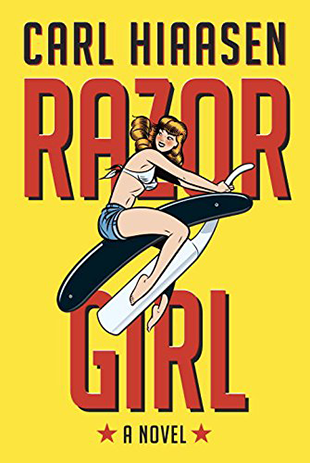
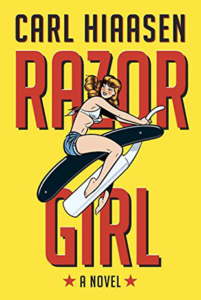
Many authors use humor in their suspense thrillers in various ways: Stephen King, Dean Koontz, Janet Evanovich, Harlen Coben, Lawrence Block, Robert Crais, Elmore Leonard, John Sanford, to name a few. There are countless more who have found ways to add humor to their books. I’ve added an excerpt from one of Carl Hiaasen’s stories below. He and Janet Evanovich tip the scale more toward humor than suspense, but have developed a great balance and a loyal reader following.

Excerpt from Carl Hiaasen’s Razor Girl intro:

On the first day of February, sunny but cold as a frog’s balls, a man named Lane Coolman stepped off a flight at Miami International, rented a mainstream Buick and headed south to meet a man in Key West. He nearly made it.

Twenty-seven miles from Coolman’s destination, an old green Firebird bashed his car from behind. The impact failed to trigger the Buick’s airbags, but Coolman heard the rear bumper dragging. He steered off the highway and dialed 911. In the mirror he saw the Firebird, its grille crimped and steaming, pull onto the shoulder. Ahead stood a sign that said: “Ramrod Key.”

Coolman went to check on the other driver, a woman in her mid-thirties with red hair.

“Super-duper sorry,” she said.

What the hell happened?”

“Just a nick. Barely bleeding.”She held her phone in one hand and a disposable razor in the other.

“Are you out of your mind?” said Coolman.

The driver’s jeans and panties were bunched around her knees. She’d been shaving herself when she smashed Coolman’s rental car.

“I got a date,” she explained.

“You couldn’t take care of that at home?”

“No way! My husband would get so pissed.”

In this example, Hiaasen puts his serious minded characters in outlandish situations using his tongue in cheek humor to allow things to play out. He sticks with the action of a car crash (the disturbance) until the reader finds out what caused the wreck. The dialogue lines are funny, too. The humor is downplayed and yet very present and fluid. It’s how Hiaasen sees his story unfolding. His use of humor is subtle and becomes a thread that holds the story together and creates his author voice. The idea of placing very earnest characters into a complete farce, and yet allow them to confront things in a serious-minded way, it adds an element of the absurd that becomes funny.

WAYS TO ADD HUMOR

1.) Add a funny character, whether it’s the protag or a secondary character.

2.) Have your serious-minded characters confront absurd and escalating situations without seeing the humor themselves. They are facing life or death. Only the reader gets the joke.

3.) Know how to separate or add humor into a suspense/action scene. I recently wrote a scene where I didn’t expect there to be humor. My hero is in a shootout but he gets a cell phone call from a girl. What does he do? I wrote the scene all action, then came back to add in the moments where I thought he might realistically answer that call, without him looking silly or stupid. It gave insight into him and added unanticipated humor to a tense scene. I also underplayed the phone call and made it seem normal, until you see what he’s doing while he’s talking to her.

4.) Throw in the unexpected. Imagine your serious character getting jolted by something he or she never saw coming. How would they handle it?

5.) Develop witty banter between characters in conflict or dare to write characters with different kinds of humor. Pit an educated cynic up against someone with crude bathroom humor in a juxtaposition of character types. You’ll find these characters take on a life of their own in your head and it’s lots of fun to write. Making each voice distinctive in humor is key.

DISCUSSION

What do you think of the anonymous submission, TKZers? Any feedback?


Public Speaking Tips

By John Gilstrap

Before I get to the real business of this post, allow me a moment to update you on the aftermath of a previous post. Back on February 1, I posted an entry here recapping advice I’d received to work more with my Facebook page to post videos and other media that would potentially draw more eyes to my page. Taking y’all’s advice to heart, I have now established my own YouTube Channel, on which I have posted and will continue to post short videos that offer an insider’s look into the publishing business. So far, I’ve talked about the various steps in the editing process, advance reader’s copies and the role of a literary agent. My intent is to post one video per week, with a maximum length of 4-5 minutes. If you’re inclined to subscribe and tell your friends, I’d be most grateful.

Thus endeth the sales pitch. (Endith?)

Public speaking is a major part of a successful writer’s life. Whether sitting on panels or asking questions from the audience, conducting a seminar or delivering a keynote speech, it’s helpful to master the techniques of delivering interesting information in an entertaining way. I know a number of people who have made major improvements in their speech construction and delivery techniques through Toastmasters International. At the very least, Toastmasters helps those who are fearful of public speaking to wrangle their fears. It can be nerve-wracking to speak in front of others if you suffer from anxiety and tend to get stressed when surrounded by others, you can improve your presentation skills here by attending a public speaking course, enabling you to practice your skills and converse with like-minded people who can offer you tips to get better at public speaking.

While there are countless moving parts in constructing and delivering any kind of speech, there are some inherently destructive practices and habits that can distract from or totally destroy an otherwise viable presentation, and yet are relatively easy to prevent.

Let’s talk about microphones.

Yes, you need one. Check out the best usb microphone if you’re unsure which to get. I don’t understand the common refusal to use a mic when one is available and offered. It seems to be a point of pride among some to declare, “people can hear me without a microphone.” Even when that’s true, a microphone makes you more easily heard. Remember, you’re competing with the air handler, the whispers and cellophane crinkles of everyone in the room. Then, there are the physics of it all. If the room is carpeted and the ceilings are high, the sound pressure just gets lost or absorbed. If the floors are wooden and the walls concrete, the echo muddles your words. That’s why they offered you the mic in the first place.

Lavaliere, stand or handheld? If I am the primary speaker, I vastly prefer a lavaliere mic over the other options, simply because I like to move around while I speak. My second choice is a handheld, for the same reason. If the other options are not available, I’ll make due with a stand or lectern microphone. But even with a microphone, there are significant limitations.

  1. Positioning. With a lav, I find the best position to clip the microphone is between the 3rd and 4th buttons of my shirt. That’s where they’re designed to be placed, so you don’t have to look down and speak into it. Just project out to the audience as you would if you had no amplification.
    1. Neatness counts. Okay, this is my personal bugaboo, but I hate the look of the microphone cord trailing from the mic to the battery pack. Tuck that bad boy away so you don’t distract your audience. Here’s a good short video that shows how to do that.
    2. If you’re doing an interview from a stage in front of a live audience and you have lapels to work with, be sure to mount the lav on the lapel that is closest to the other person.
    3. Remember that jewelry, name tags or any other objects that might hit against the microphone need to be secured.
    4. Important safety tip: If you’re miked up with a lav radio mike, be sure it’s turned off until you want it to be turned on. It’s always worth a second check before you go to the bathroom.
  2. With a handheld mic, remember that you have lost one half of your gesticulating ability. If you’re pointing with it, it can’t do its job.
  3. Most podium microphones are aggressively directional. When you look left or right–as you should, to keep everyone’s interest and attention–think of the microphone as the center of a ball and socket joint, always remaining the same distance from your mouth, regardless of the direction you’re looking.
  4. You still have to project and enunciate clearly. Amplified or not, mumbling never works.

About the delivery . . .

Lose the PowerPoint. I see too many presenters of all ilks using PowerPoint more or less as a script. No matter how interesting your topic might be, your audience will stay with you only if your performance is at least as interesting. If I’m ever elected king, an edict shall be passed that limits any PowerPoint slide to a maximum of ten words. But if you must use it, keep a few things in mind:

  1. Make the slides an active part of the presentation. Make them worth reading. For example, when I give my standard How-to-write seminar, immediately after I emphasize the point that there are no rules in writing, I cue the slide that reads, “But there are some very good suggestions.” I let the audience get the joke, and then we move along.
  2. Videos work very well as PowerPoints, but it can be tricky getting them to run.
    1. No matter how many bajillions of times you have done a presentation, always take time to rehearse the slides and the transitions on the actual equipment you will be using.
  3. Talk to the audience, not to the screen. The image is there, I promise. If you need a cue on where you are, use your computer screen as a TelePrompTer of sorts.
  4. Buy your own remote clicker and use it to advance your slides, and practice the transitions so you can keep talking even as the slides move.
  5. Assume catastrophic equipment failure, and have a backup plan to make your presentation without visual aids. It happens more than you’d think, and every time is a character-building experience.

Remember that it’s about the audience. Even if people have not paid to attend your speech or the conference at which your speech is delivered, they are at a minimum paying with their time, and you accordingly owe them a show.

  1. Don’t poison the well before you begin. This is more prominent among writers who speak than other groups I’ve dealt with. It usually begins with something like, “I don’t do a lot of public speaking, so if I screw up . . .” My thought at this point is always, “Then sit the hell down and don’t waste my time.” If you know ahead of time that you’re going to suck, then do us all a favor and don’t start. Cede your time to someone who’s prepared.
    1. If the apology falls better into the category of the humble brag, keep that to yourself, as well. If you kill up there, everyone will know and applaud, and if you die up there, they will likewise know yet still applaud.
  2. Know your subject and be well-rehearsed. Back when I was working my Big Boy Job, I delivered a lot of speeches, most of which were designed to be motivational. Think hundreds of times. And before each one, I always rehearsed the first five minutes and the last five minutes of the speech, usually out loud in the hotel room. Once I got a presentation going, I could maneuver my way through the middle of the speech by feel, but I obsessed about getting the beginning and the end just right.

We writers are communicators, after all. The only difference between writing and speaking is that with the latter, there’s only one draft.

Many of you do more public speaking than I. What have I missed?

Â