Culture Shock

We’re back Down Under for a couple of weeks and due to a bout of food poisoning (thanks Qantas…) and slow internet connection (we’re in rural Victoria) this is going to be a short post – but one that resonates with me as I struggle with culture shock of the strangest kind – my own culture!

Whenever we return home we find things that baffle us – things that after 16 years in America seem perplexing. This time it was the simplest act of turning on a light switch – who knew that Australian light switches are the opposite of American ones? That to turn on a light you flick down the switch, whereas in the US you flick it up. It took me a day of puzzlement and a belief that my mother-in-law’s house must have just been wired weirdly for me to realize that it was merely an example of cultural amnesia…yes, I had actually forgotten how to turn on a light! Add to this the whole time zone confusion – try explaining to your kids that they ‘lost’ a day traveling over the Pacific and it is now yesterday in America – and you have a recipe for family confusion.

So how can going home seem so strange? Like almost all crime fiction writers I enjoy examining the concept of the ‘outsider’ – the stranger who can observe things about a place, a society and a culture that others cannot see…but I never expected that I would feel the outsider in the place I grew up in, or that each time I return home I would find more evidence of cultural confusion. The simple act of turning on a light brought that home to me – and may provide rich fodder (I hope) for future books. But still culture shock in my own country is bizarre. Perhaps, however, I am not alone. Have any of you ever experienced culture shock going home?

A Rose by Any Other Name…

by Clare Langley-Hawthorne

A recent thread on Dorothy L regarding pen names has got me interested – I write under my own name (I mean, you couldn’t make it up!) but have often wondered about the pros and cons of adopting a pen name. It would certainly make some things easier – as it is when someone Googles my name they are likely to get a plethora of information about me, the author, as well as me, the former lawyer, (including my one published law article on tradeable gas emission permits for climate change!) and me, the former health economist, (including my MA on the costs of schizophrenia!). All up I must look pretty loony, so in some ways I wish I had written under a pseudonym. At the same time, though, I like the fact that I do write under my own name – it means people who knew me from school and college can easily find me and my books and, in many ways, it is just easier to be who I am:)

I have been told, however, that if I write a non-mystery novel I will probably have to adopt an alternative pen name so as not to ‘confuse’ anyone…this makes a sense if, for instance, I suddenly start writing erotica, but other than that it seems an enormous pain. With a pen-name I’d have to set up an ‘alternate’ me including a separate website as well as a ‘new’ social networking and marketing identity….and I have enough trouble keeping on top of all of this as it is! I do understand when authors feel that adopting a pseudonym will make it easier to gain acceptance for their work or to appear ‘gender neutral’ – some female authors, for instance, use initials when writing gritty thrillers so the fact that they are female isn’t immediate apparent (sadly this can still be an issue). I can’t say I intend to do this but I do want to write across a number of genres, including YA, and am grappling with the question of whether to use a pen name or not.

So, how many of you use a pen name or have considered adopting one when branching out into a new genre? How do authors with multiple ‘names’ deal with the marketing/web presence issue? Do they established clearly defined and distinct personas on the web or do they roll them all under one ‘umbrella’ site? What do you think are the pros and cons of using a pen name…and importantly, how do you come up with a really cool one?!

Panels from Hell

by Clare Langley-Hawthorne


This weekend I am going down to Carmel (a favorite spot of mine) to do a panel at the Harrison Memorial library with the very talented Hannah Dennison and, since I also just received my panel allocation for Malice Domestic, I am mulling over the whole ‘what makes a successful panel’ issue. Believe me I have seen some stinkers in my time – I dread being on the panel from hell more than just about anything (except perhaps being moderator of the panel from hell…) – but what makes or breaks a panel?

  • First of course, the topic has to be interesting and one that resonates with the panelists. I was once put on a panel about hot sex and had to admit from the get-go that basically there was no hot sex in any of my books! (The panel still was great, despite that:)). However, even with the most exciting of topics there’s still a risk of boring the pants off the audience. I have seen plenty of excellent presentations on some of the most mundane topics (and let’s face it, there’s a limit to how many topics there can be on mystery writing…) and some of the most boring presentations on the hottest of topics…so there must be more to it than merely topic alone.
  • A terrific moderator – a good moderator can ameliorate against some of the worst panel sins (microphone hogging, long-winded answers, blatant and constant self-promotion) – but I’ve been on panels where it is immediately clear that the moderator hasn’t even bothered to read up on the panelists work! In my mind a terrific moderator is prepared, professional, witty and unafraid to step where angels fear to tread in order to prevent the above mentioned sins from ruining a perfectly good panel presentation. What I think turns off many in the audience is a moderator who either sits back and lets the panel degenerate into a rant/lecture/ego-fest, or one who is so intrusive it is as if she (or he) was a panelist rather than a moderator.
  • Well prepared participants. There’s no point being on a panel if you think you can just ‘phone in’ your answers without giving the topic any thought. Some of the worst panels I’ve been on have had an author who clearly spent no time at all thinking about anything except how to promote his (or her) next book at any given opportunity. The best panels I’ve been on have been where the moderator has given everyone a heads-up on possibly questions first, though this is still no guarantee that the panelists will have anything interesting to say about them!
  • Professionalism – as with all the worst panel sins mentioned, the most horrible panels occur when one or more of the participants completely takes over and (disregarding any professional courtesy to others on the panel) hogs the limelight. Equally well, the authors who ramble on for ten minutes answering the question are just as unprofessional in my book. I believe authors should treat the panel as a showcase for themselves as both a writer and a member of the writing community – so no unprofessional behavior please! My motto: Be gracious – dress for the occasion, act for the occasion, and shut-up when necessary.
  • Pass on the Jerry Springer moments. I’ve only witnessed one panel degenerate to this kind of in-fighting – but some authors do allow themselves to get carried away. As far as I’m concerned arrogance and vitriol needs to be left at the door.

So have you had any horrific panel experiences? Any tips from being on a panel or from being in the audience on what makes (or breaks) a panel? What was the best (or the worst!) panel you ever saw or participated in?

Ten Rules for Writing Fiction

by Clare Langley-Hawthorne

Inspired by Elmore Leonard’s list, The UK newspaper The Guardian recently surveyed a number of established writers on their ten rules for writing fiction. The results were inspiring, funny as well as practical and I thought I’d share my ten favorites with you.

  1. The first 12 years are the worst. (Ann Enright)
  2. Put one word after another. Find the right word, put it down. (Neil Gaiman)
  3. Keep a light, hopeful heart. But expect the worst. (Joyce Carol Oates)
  4. Read widely and with discrimination. Bad writing is contagious. (PD James)
  5. Don’t romanticize your “vocation”. You can either write good sentences or you can’t. There is no “writer’s lifestyle”. All that matters is what you leave on the page. (Zadie Smith)
  6. If you have to read, to cheer yourself up read biographies of writers who went insane. (Colm Toibin)
  7. Do not place a photograph of your favorite author on your desk, especially if the author is one of the famous ones who committed suicide. (Roddy Doyle)
  8. Don’t sit down in the middle of the woods. If you’re lost in the plot or blocked, retrace your steps to where you went wrong. Then take the other road. And/or change the person. Change the tense. Change the opening page. (Margaret Atwood)
  9. Try to think of others’ good luck as encouragement to yourself. (Richard Ford)
  10. The two most depressing words in the English language are “literary fiction.” (David Hare)

If you had to write your top ten rules what would be number 1 on your list?

Approaching Agents at Conferences

by Clare Langley-Hawthorne


Writers (and fan) conferences provide unpublished writers with a great opportunity to approach and talk about their work with agents. Recently there have been a few email threads on MWA as well as Sisters in Crime about how writers should go about approaching the whole ‘agents at conferences’ thing, and I thought I’d lay down what I think are some of the basic ground rules.

1. You need to do your homework.

Obvious, I know…but all too often this doesn’t get done. I’ve been at conferences where writers have pitched an idea for a western/science fiction cross-over novel to an agent that only moments before announced that they do not represent either of those genres. It is a waste of everyone’s time and energy to pitch your work to an agent who is clearly not interested in representing the kind of work you do. Almost every agent has a website or an entry in publishers’ marketplace so do yourself a favor – check before you pitch. Don’t rock up at a conference and pitch to every agent you meet – target your approach – check the attendance lists, research which agents represent the kind of writing you do (and the writers you admire) and make sure you know who you should pitch to (and by extension who you should not).

2. Your manuscript must be perfect (and finished).

I remember chatting to a writer at a SinC meeting once, and she told me she had met an agent at a conference who had requested to see her work – only problem was, it wasn’t ready to be sent out. The writer asked me whether I thought it would be okay for her to send the manuscript out now (some 12 months later)…My answer – good luck with that! The agent probably has no idea who you are by now. The moral of this story is obvious – you need to be ready to send the complete manuscript before you pitch your work which also leads to ground rule number three…

3. Send exactly what the agent requests (no more, no less).

If an agent at a conference tells you to send a formal query letter abide by that request, if they ask for the first 5o pages send just the first 50 pages (don’t send them your entire manuscript). Do what they ask you to do. I’m sure it frustrates the heck out of agents to have writers send them material they did not ask to see.

4. Be professional at all times.

A professional pitch at a conference is totally acceptable, shoving you manuscript under a bathroom stall is not. Make sure you appear confident (and sane) which means no stalking the agent…They are (remember) just human beings. Most agents I’ve met are approachable and kind. They will tell you if they are interested and will let you down gently if they are not – so just be yourself and act like a professional (you want to be treated like one, after all).

5. Have your pitch ready. Memorize it. Practice it. Perfect it.

You need to be able to tell an agent with confidence exactly what your manuscript is about in under 3 minutes (no agent is going to listen for half an hour as you outline every chapter in the book!). I’m more than happy to listen to someone’s pitch and give feedback and I’m sure lots of other writers are too – the more feedback and practice you get, the more confident you’ll be when you finally get the chance to speak to the agent of your dreams. As I rough guide I think you should have a high level 1-2 minute concept (the elevator pitch) and then have a more detailed synopsis you can tell, should the agent ask you for more details. I also find a one-page written synopsis is handy – because you can hand this to an agent if they express an interest – just be sure to have your name and email address on this just in case the agent wants to contact you about it (hey, you can dream can’t you!).

Many conferences have specific sessions in which writers get to pitch their work to agents and editors. At the first writers’ conference I ever attended I participated in a ‘speed dating for agents’ session and, although horrific and stressful, it gave me experience pitching my manuscript and interacting with agents about my work. Even when there aren’t such sessions available, however, conferences provide a great opportunity for writers looking for an agent. As these ground rules show all you need to be is prepared.

So what about you all – do you have any other ‘ground rules’ or advice on approaching agents at conferences?

If only…

By Clare Langley-Hawthorne

It’s a miracle this blog post got written at all – I have had a ‘twin-ful’ four days of raging flu in the house (just after my husband issued those fateful words “It’s been such a good winter, the boys have hardly been sick at all – I think we dodged the bullet this time…”) that, in the interests of sanity (and because I may be slightly hallucinatory after getting very little sleep for the last three nights), I offer up a very short blog post on a topic dear to my heart – writing techniques that drive me crazy.

In Australia there used to be a show that had a segment “what cheeses me off” and I was reminded of that when reading a book (which shall remain unnamed) which fell into what I consider one of the most “cheeses-me’ off sins of all – the “if only she had turned back, she would have seen…” sin. Yes, the, let’s totally get out of POV and warn the reader of some ominous event that the character (whose POV is firmly established) could never know or realize.

Now, I’m as guilty as the next writer of including ‘ominous’ descriptions – my own personal failing appears to the weather (which is always indicative of something ill, according to my husband) but I always strive to keep within the POV and voice of the book. To step outside this, I think, is a sign of flabby writing. The ‘If only she/ he/I had known’ technique drives me nuts. In first person POV it is an obvious no-no (how could I know, what I don’t know?) but even with second or third person POV it’s a technique that irritates me. Just think how much tension is lost when you reach a crucial suspenseful moment only to read “if only she had turned round she would have seen the giant squid poised to attack….”

As I hear the dulcet tones of my little ones calling for ‘nurse mummy’, I open the floor to all of you to vent – what is the writing ‘technique’ that most cheeses you off in mysteries and thrillers??

TKZ Short Story Collection ‘Fresh Kills’ Debuts!

by Clare Langley-Hawthorne

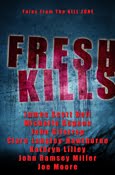
Well, you’ve seen us discuss the e-book revolution, and now we at The Kill Zone have jumped right on in – producing our own e-book anthology of killer stories. All week we’re going to give you a sneak ‘behind the scenes’ insight into each of our stories – but the best thing you can do (of course!) is buy and download the anthology for yourself. Fresh Kills is available on Kindle at Amazon and in a variety of e-book formats at Smashwords.

The stories in Fresh Kills vary in mood and theme (as you can well imagine!) and I am just as intrigued, as you all are, to read my fellow bloggers‘ contributions. My own short story is entitled ‘The Angel in the Garden’ and it is, believe it or not, the first time I have written a story set in Australia. Here’s a brief description (it’s how I like to imagine the dust jacket would read):
When Constable Duff McManus is called out to investigate a body floating in an ornamental pond, he has to confront both the death of a childhood friend long considered a traitor, as well as his own war time memories. It may be a year since the Great War ended but for many in Australia, there are some wounds that will never heal and some secrets that will never be revealed, not even in death.

I was inspired to write this story after reading Juliet Nicholson’s book The Great Silence over the holidays. She deals with the immediate aftermath of the First World War, focusing specifically on the years 1918-1920, and incorporates first hand accounts from people across the social spectrum. The result is incredibly moving (I went through a whole box of tissues), especially when she deals with the decision to introduce a two minute silence to remember the dead (a hush literally fell across England as the 11th hour struck on the 11th day of the 11th month in 1919) and the return of the unknown soldier, who represented all the husbands, fathers, and sons who never made it home.
I don’t think many Americans realize the deep significance of the First World War for Australia. In many ways it was the event that defined and shaped our national identity and altered the way Australians perceived the British Empire forever. When war was declared in 1914 thousands of Australians rushed to enlist – it was considered every Australian’s duty to defend ‘King and Country’. The horrific debacle at Gallipoli and the slaughter of Australians on the Western Front, however, changed all that. The statistics are staggering: From a population of fewer than five million, almost 417,000 Australian men enlisted, and of those over 60,000 were killed and 156,000 wounded, gassed, or taken prisoner. At the end of the war memorials were erected in nearly every town across Australia – you can still see them today – and it is clear from the names of the young men listed that no community or social strata were spared.
In writing ‘The Angel in the Garden’ I wanted to capture a sense of what it must have been like for those soldiers who did return and how they reintegrated (if indeed they ever did) into the shattered remnants of Australian society. In Constable Duff McManus, I hoped to evoke the deep sense of bitterness and anger that permeated post-war Australia. Oh, and I also wanted to kill off someone (always a good idea in a murder mystery!) and I thought who better to target than someone who represented the anti-conscription, trade union movement in Australia. See, even in a short story I cannot help but get caught up in the history books…

I’ve blogged before on the challenges I faced when confronting the medium of the short story and now I face a surprising dilemma – whether to consider writing a longer story about Constable Duff McManus. As a character I find him intriguing. There is no doubt he returned from the war a scarred, wounded man – but what I sensed, from the moment he appeared on the page, was that he had also lost his ‘moral compass’ as a result – and I was fascinated by where that might lead. So now I have a choice to make…do I finally write a novel set in Australia?…

In the meantime, I am content to have a short story out in the e-book world as my fellow bloggers and I dive into the uncharted e-book ocean (hoping to swim of course!). I also can’t wait to read all the stories!

Ghostwriters, Co-authors and The Great Oz

by Clare Langley-Hawthorne

The NYT’s magazine yesterday ran an article on James Patterson’s amazing empire (James Patterson Inc.) and I confess my jaw dropped when I read that he published nine original hardcovers in 2009 and plans at least that many for 2010. Of course, James Patterson doesn’t write all of these on his own – he has a stable of co-authors that work with him. Now, I am probably the only person on earth who has never actually read a James Patterson book (I know, I know…) but the sheer volume of this man’s output is astonishing. The NYT’s article states that one out of every 17 hardcover books bought in the US was written by James Patterson – and this started me wondering – is the Patterson publishing model the way of the future?

We’ve all heard of ghost-writers who help propel celebrity memoirs to bestsellerdom but we often accept this as a necessity, given the fact that the celebrity in question is usually not a writer (or even capable of being one…) – but in this case Patterson recruits other thriller writers to help expand his brand and increase his output. I’m not sure how I feel about the co-author issue – are they really ‘joint’ writers in the traditional co-authorship sense or ‘assistant authors’ helping to churn out books for another, better known, author? As I said, not having read any of Patterson’s books I can’t really comment on the difference between the books he authored alone and those he authored with another writer but I do have to wonder – does the quality of the writing suffer at all? Do readers care if the book that has James Patterson emblazoned on it wasn’t actually written by him?

From what I read in the NYT’s article, the brand and business that is James Patterson requires a team approach. Don’t get me wrong, Patterson is clearly intimately involved with every step in the publishing of his books. He does a detailed outline for each of them and provides editorial oversight and quality control over all the material – but (equally obvious) the business of James Patterson Inc. could be nowhere near as profitable (or prolific) if he had to write each of his books by himself.

Given how centralized publishing is becoming, with marketing resources concentrated almost exclusively on the few top sellers in each publishing house, it will be interesting to see how common the James Patterson model will become. Will it be the model adopted by future bestselling thriller writers? Will those authors become responsible for churning out plots and outlines for others to complete rather than actually writing the books themselves? (Will readers even care?)

So what do you think? For those of you who are Patterson fans, can you tell a difference in quality between the ones he authored alone and those he has co-authored? Has quality diminished over time as a result of his amazing level of output or not? Do you think we will increasingly see this kind of approach where bestselling authors rely on a stable of co-authors to produce a prodigious number of titles each year, thereby centralizing sales even further among the few top sellers? Or will readers eventually tire of this approach – concerned that behind the branding facade lies nothing more than the ‘great Oz’ ?

The Midnight Hour

by Clare Langley-Hawthorne

I admire those writers who get up in the wee hours of the morning to write – I cannot even function before about 6am and even then I need breakfast, The New York Times crossword and a big cup of tea before I can even contemplate writing. Granted every morning I have the boys to get to preschool so inevitably it’s 10am before I even get started writing (and that’s on a good day). When I was writing my first novel, Consequences of Sin, I had the ‘luxury’ of being pregnant so I could spend all day writing (and most of the night since I found it almost impossible to sleep), then the twins were born and I had to try and fit revisions into naps. Suddenly I realized I wasn’t going to be able to write when the mood struck – I was going to have to write in whatever free minute I could find.

Five years later and I am still struggling to find a writing schedule to fit. Never one to be able to write late at night, I now find myself routinely writing until 11 pm (which becomes 2am when I’m trying to meet a deadline). When friends ask me how on earth I find time to write I answer that I just ‘find’ it wherever and whenever I can. I laugh when people tell me about how they prepare themselves with mood music and incense, getting themselves into ‘writing mode’…I haven’t the time to ‘prepare myself’ (for me any form of preparation has to be research) but it’s true that there is always a lead time needed before the writing starts to flow. I still find the time factor difficult to manage. When I was lawyer I billed in 6 minute increments, now I find it hard to feel as if I have achieved anything of substance unless I have had a good 1-2 hour chunk of time. It takes me at least that long to find the rhythm of my writing – but (and here’s the rub) it seems so hard to capture that length of time uninterrupted. I often find that I am just getting into the flow of things when my time (literally) is up.

So what kind of writing schedule do you maintain? How do fit your writing in? Are you someone who gets up early or stays up late? Any advice on how to become a more effective ‘writing time’ manager?

A New Challenge

by Clare Langley-Hawthorne

I was envious when I read John’s post on Saturday about how easy he found writing a short story because I had just the opposite experience – I found it incredibly challenging. My main difficulty? Stopping myself from turning it into chapter one of a new novel.

I view a short story as having a single transformative story arc – one told in the most concise and most powerful terms possible. All fine and dandy in theory but no sooner do I start than I fall prey to an overabundance of backstory and plot complications – and these little buggers have an annoying habit of multiplying, so by the time I reach around 4,000 words I realize what I really have is, you guessed it, chapter one of a new novel. Characters have already started taking control, offering me a range of complexities that I can’t help but want to explore, the setting demands detailed description which I cannot resist providing and the story arc takes on a much grander scale that will inevitably fail as a short story.

With this particular short story (which I’m hoping will pass muster and be published in the Kill Zone collection you’ll be hearing much more about) this dilemma created both opportunities as well as challenges. I had to rise to the challenge of paring everything down so it would succeed as a short story and I realized I had the seeds for a new series set in Australia which was quite exciting (oddly enough I’ve never written anything actually set in the land I grew up in).

My first step to transforming my piece into a ‘proper’ short story was to think about structure. I focused on the four main elements I thought I needed:
  1. Establishment of setting
  2. A trigger for action
  3. A build up of suspense and conflict
  4. A critical choice
  5. Resolution

When I found I basically had all these elements (albeit muddied by too much dialogue, description and backstory!) I knew my main focus had to be on paring everything down to its essential elements. This included character, setting, as well as plot and once I started this process I also found that I could focus on what the story was really all about.

Last Friday I took my short story to my writing group for their critique and they helped me identify areas of improvement and further ‘pruning’ – hopefully I’m now close to the final product and, more importantly, I feel like I’ve grappled with a new challenge that has improved me as a writer.

I can’t say I like the short story as a medium – I am a novelist at heart – but I do appreciate the intensity and power it can bring. I may not have enjoyed the process but as compensation I do have a new (male) protagonist that intrigues me. So who knows, this particular challenge may spur me on to develop a whole new series of books!

My question for you all is what was the last challenge you tackled head-on in terms of your writing (or anything else for that matter). Did it yield any surprising results or have a silver lining? I confess for me, I didn’t love the process but in the end I think it’s made me a better writer (that or just a more delusional one!).